Introductory Chemistry, 5e (Tro)
Chapter 18 Organic Chemistry
18.1 True/False Questions
1) All organic molecules contain carbon but not all carbon compounds are organic compounds.
2) The study of carbon-containing compounds and their reactions is called carbonyl chemistry.
3) It was originally thought that organic compounds had to come from living things.
4) Organic compounds have to come from living things.
5) Carbon must always form four bonds in stable compounds.
6) Hydrocarbons contain carbon, hydrogen and oxygen.
7) Molecules containing carbon always assume a tetrahedral molecular geometry since carbon
forms four bonds.
8) An open -chain (noncyclic) hydrocarbon will always have exactly twice as many hydrogen
atoms as carbon atoms.
9) A noncyclical alkane hydrocarbon containing eight carbon atoms should also contain eighteen
hydrogen atoms.
10) An alkane would be considered a saturated compound.
11) Alkanes contain double and single bonds.
12) The formula of n-octane is: C C C C C C .
13) As the number of carbon atoms increases in n-alkanes, so does their boiling point.
14) Isomerism is very rare in organic compounds.
15) Isomers are compounds with the same structures but different formulas.
16) Isomers have the same molecular formula but have different properties.
17) The compound with the formula CH4 has four possible isomers.
18) An ethyl group can be symbolized as –CH3.
19) Alkynes are compounds with at least one triple bond.
20) Alkenes and alkynes are unsaturated hydrocarbons.
21) The compound CH3CH2CH=CHCH3 is named 3-pentene.
22) 1-hexene and 1-hexyne are isomers.
23) Combustion reactions always produce water and carbon monoxide.
24) Hydrocarbon combustion reactions are highly endothermic – they absorb large amounts of
heat.
25) Alkanes cannot undergo addition reactions because they do not have a multiple bond.
26) When an alkene undergoes an addition reaction to form an alkane, a saturated compound has
been converted to an unsaturated compound.
27) Aromatic compounds contain a benzene ring.
28) Even though the aromatic ring of the compound benzene can be drawn with alternating
single and double bonds, all the carbon to carbon bonds are the same.
29) R— OH is an ether functional group.
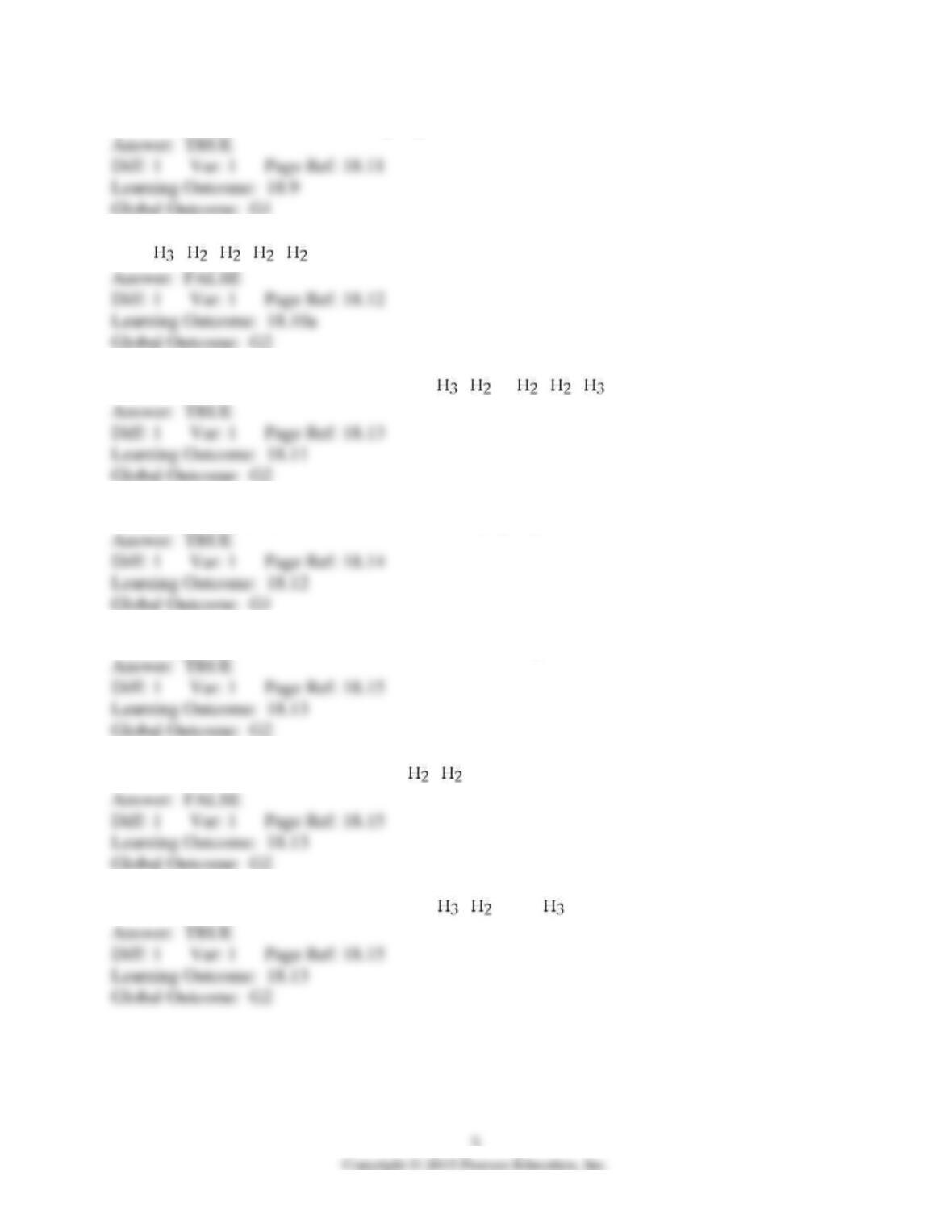
30) R—O—R is an ether functional group.
31) C C C C C OH is named 5-pentanol.
32) The formula for ethyl propyl ether is: C COC C C .
33) Aldehydes and ketones both contain a carbonyl group.
34) The generic condensed structural formula for carboxylic acids is RCOOH.
35) The formula of propanoic acid is: C C COOH.
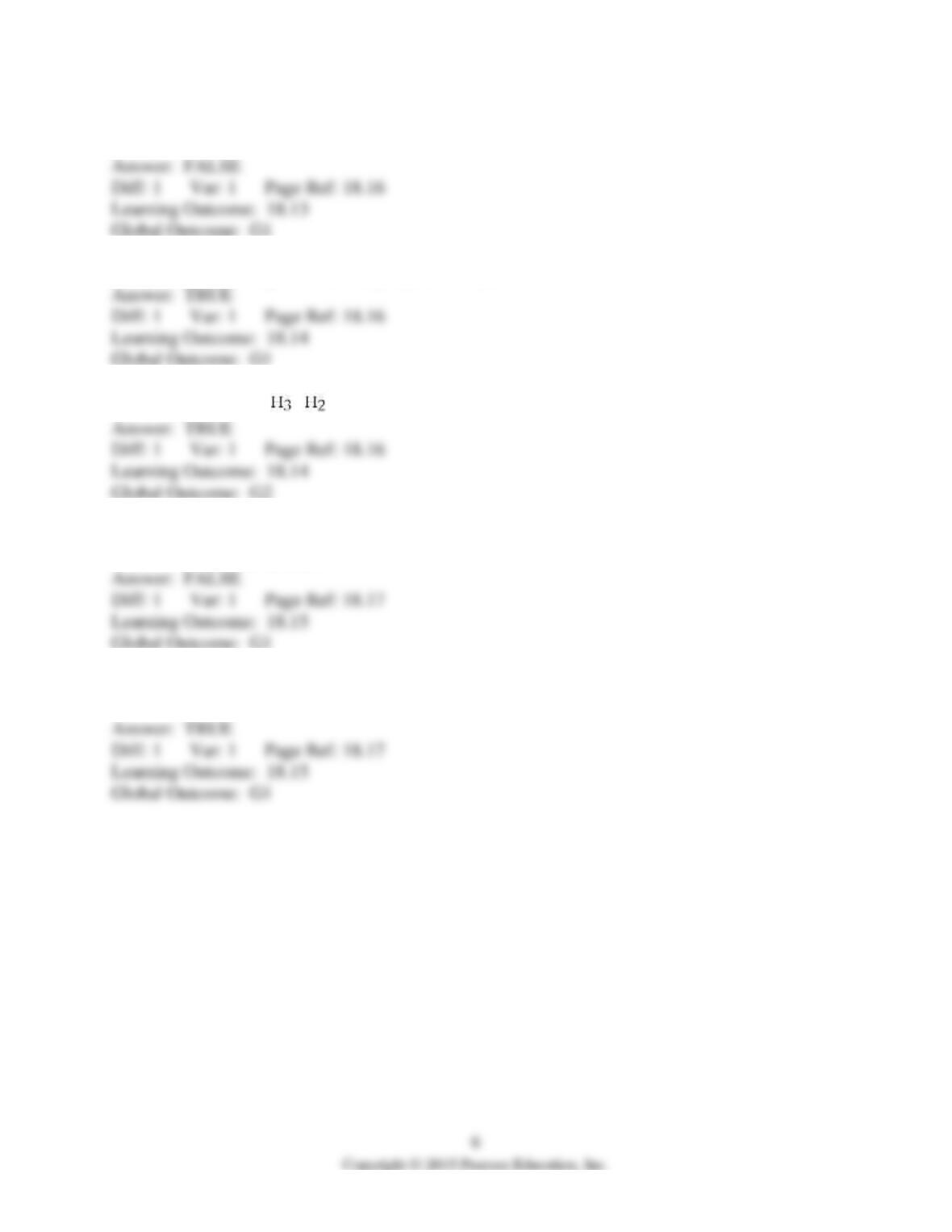
36) The formula of methyl propanoate is: C C COOC .
37) Esters are best known for their awful odors such as that associated with the smell of rotten
fish.
38) Amines are nitrogen- containing organic compounds.
39) The compound C N can be classified as an amine.
40) A polymer is a long chainlike compound containing a random arrangement of organic
molecules called monomers.
41) Production of the synthetic polymer “polyethylene” uses an alkene as a starting monomer
unit.
18.2 Multiple Choice Questions
1) What chemical reaction was used by the German chemist Friedrich Wohler to synthesize urea
for the first time?
A) evaporating urine
B) heating ammonium cyanate
C) heating ammonium cyanide
D) combining the elements carbon, hydrogen, oxygen, and nitrogen
E) none of the above
2) Which of the following statements about carbon is FALSE?
A) Carbon must always have four bonds.
B) Carbon can bond to itself.
C) Carbon can have either a tetrahedral, trigonal planar or linear geometry.
D) Carbon can form into linear, branched and cyclic compounds.
E) none of the above
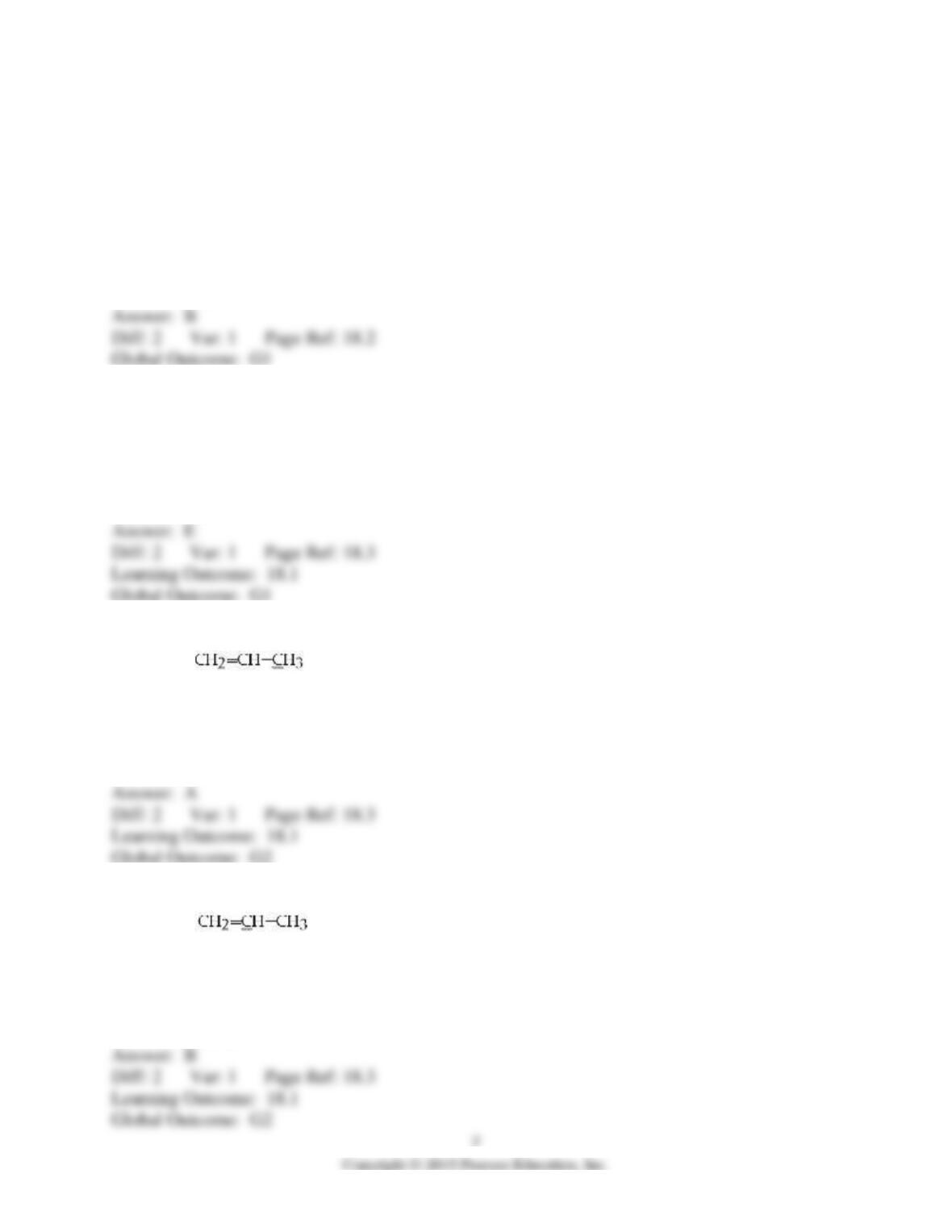
3) What is the molecular geometry of the underlined carbon atom in the following
compound, ?
A) tetrahedral
B) trigonal planar
C) linear
D) bent
E) none of the above
4) What is the molecular geometry of the underlined carbon atom in the following
compound, ?
A) tetrahedral
B) trigonal planar
C) linear
D) bent
E) none of the above
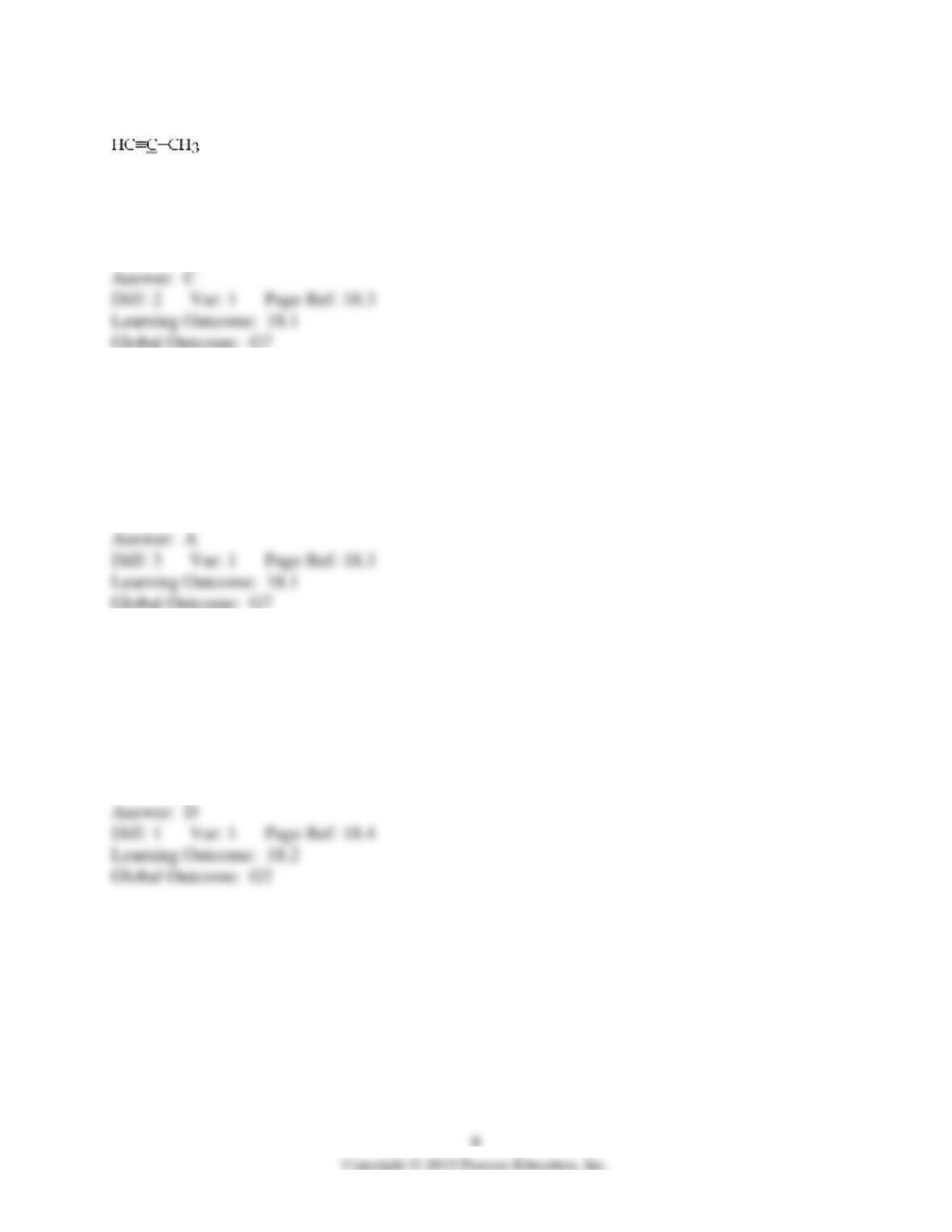
5) What is the molecular geometry of the underlined carbon atom in the following compound,
?
A) tetrahedral
B) trigonal planar
C) linear
D) bent
E) none of the above
6) What will be the molecular geometry of an open-chain noncyclical hydrocarbon with the
generic molecular formula CnH2n-2?
A) linear
B) tetrahedral
C) trigonal planar
D) trigonal pyramidal
E) none of the above
7) Based on the molecular formulas shown below, which compound shown below could be
classified as a cyclical alkane?
A) C4H10
B) C3H8
C) C5H12
D) C12H24
E) C9H20
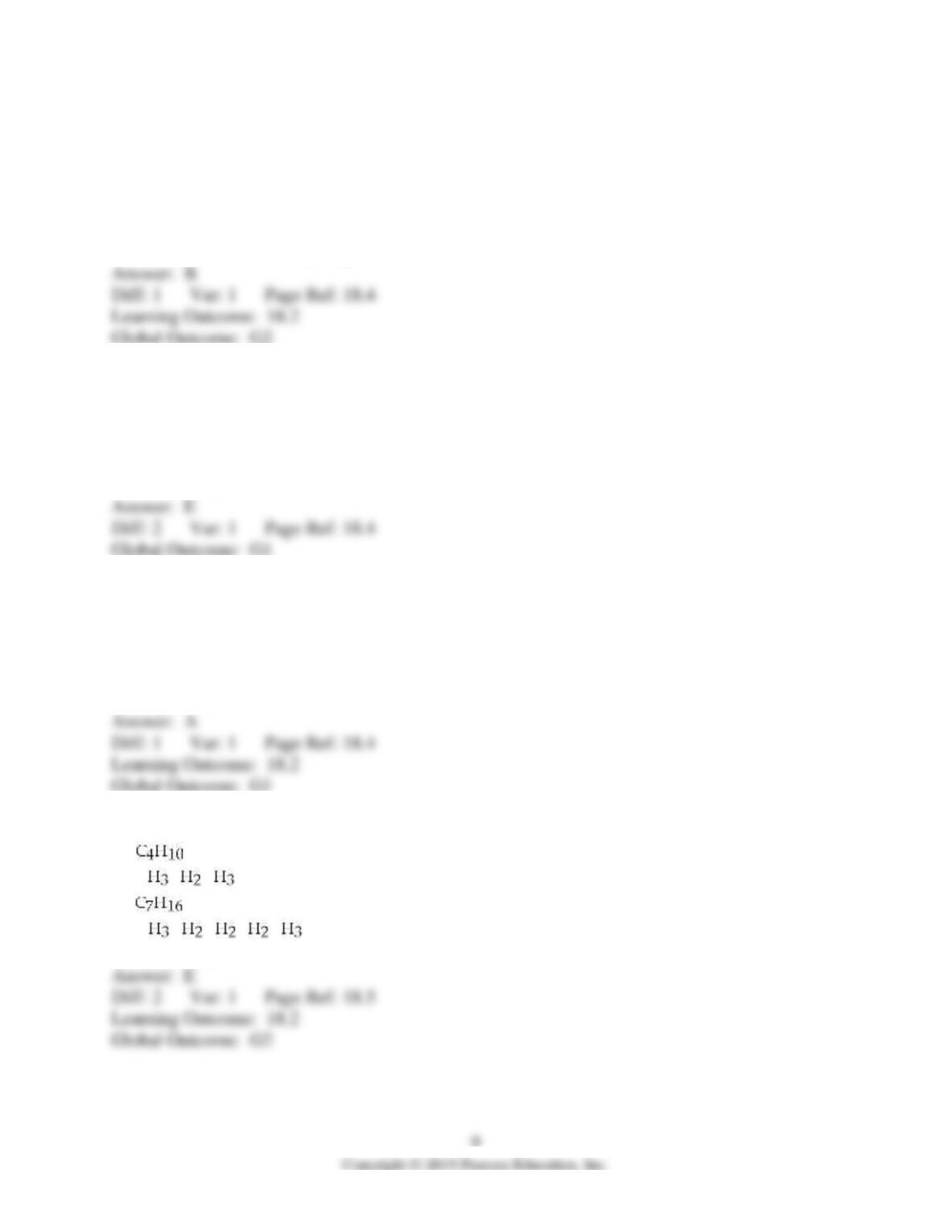
8) Compare a six-carbon open-chain (noncyclic) hydrocarbon alkane, alkene, and alkyne. Which
of these compounds would have the fewest number of hydrogen atoms?
A) the alkane
B) the alkyne
C) the alkene
D) all of these have the same number of hydrogen atoms
E) none of these contain hydrogen atoms
9) Hydrocarbons are commonly used for:
A) fuel.
B) wax.
C) fabrics.
D) plastics.
E) all of the above
10) Which type of hydrocarbon is classified as being saturated?
A) alkanes
B) alkenes
C) alkynes
D) all of these
E) none of the above
11) Which compound below is an alkane?
A)
B) C C C
C)
D) C C C C C
E) all of the above
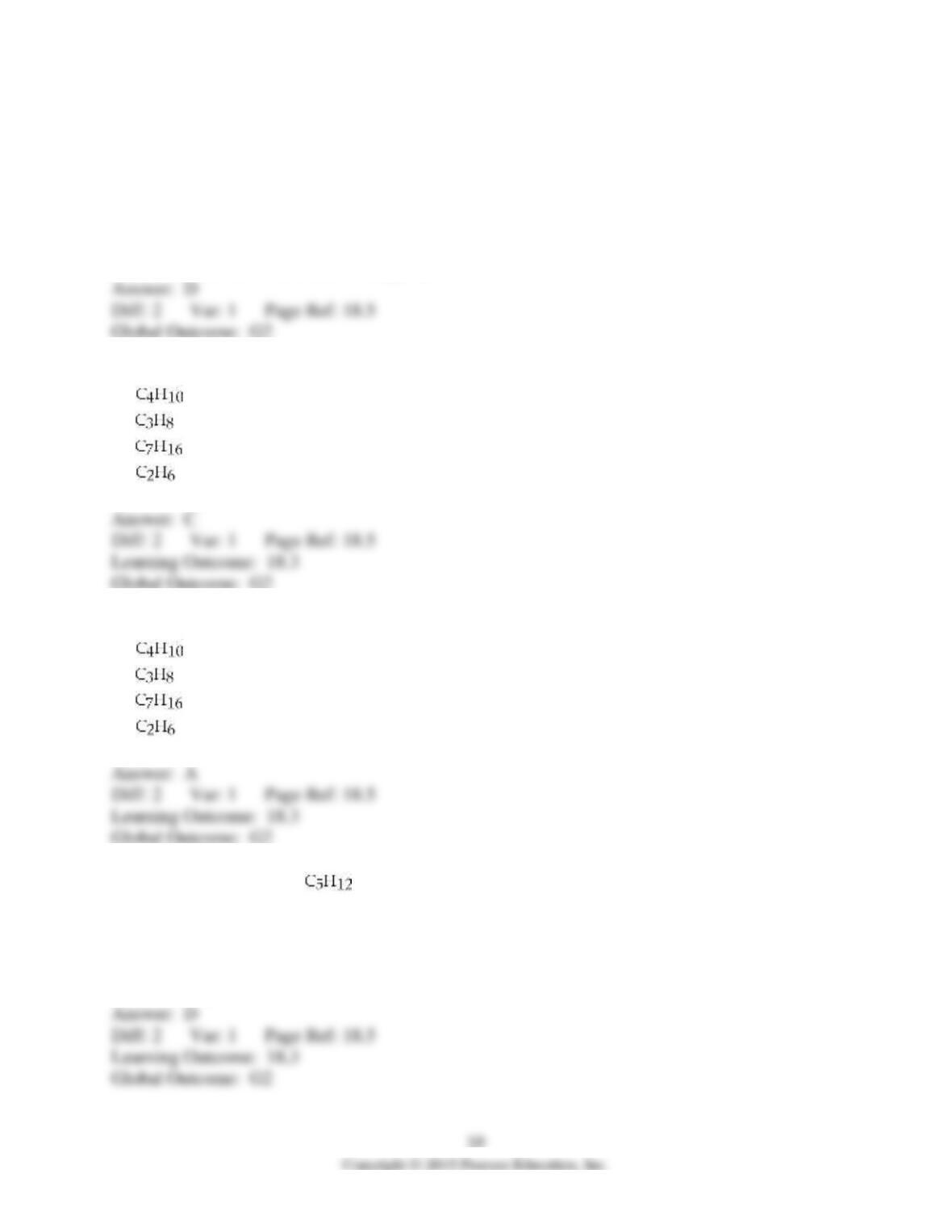
12) Consider the following n-alkanes: CH4, C2H6, C3H8, C4H10
Which of these would you expect to have the highest boiling point?
A) CH4
B) C2H6
C) C3H8
D) C4H10
E) all n-alkanes have the same boiling point
13) Which of the following is the formula for heptane?
A)
B)
C)
D)
E) all of the above
14) Which formula represents butane?
A)
B)
C)
D)
E) all of the above
15) Which is the name of ?
A) n-butane
B) n-hexane
C) n-heptane
D) n-pentane
E) all of the above
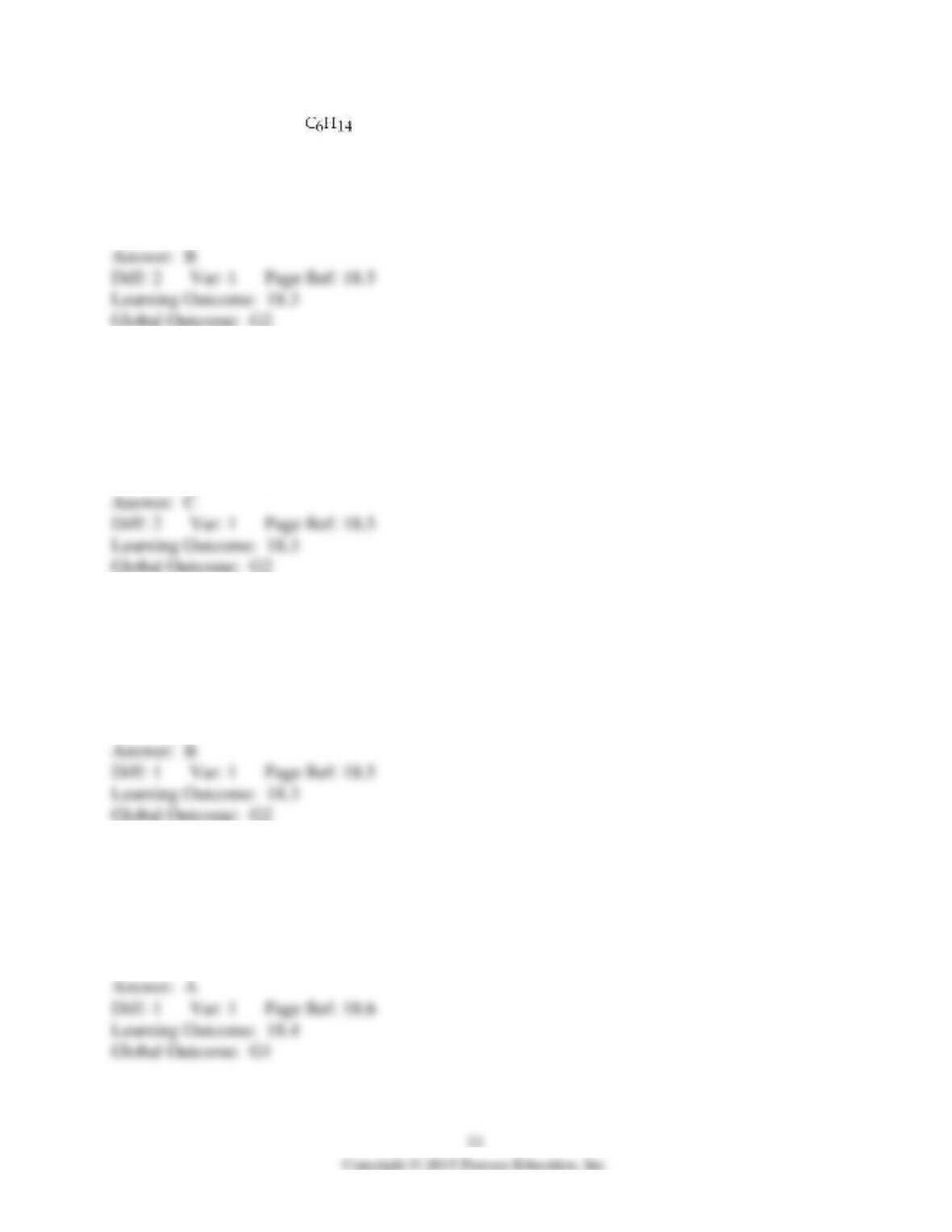
16) Which is the name of ?
A) n-butane
B) n-hexane
C) n-heptane
D) n-pentane
E) all of the above
17) A straight chain saturated hydrocarbon has eight carbon atoms. Its molecular formula is:
A) C8H14.
B) C8H16.
C) C8H18.
D) C8H24.
E) none of the above
18) Which of the following is not a proper condensed structural formula for a normal alkane?
A) CH3CH2CH2CH3
B) CH2CH3CH3
C) CH3CH2CH2CH2CH3
D) CH3CH3
E) none of the above
19) Two compounds are considered as isomers if they have the:
A) same molecular formula AND different structure.
B) same molecular formula AND same structure.
C) different molecular formula AND different structure.
D) different molecular formula AND same structure.
E) same molecular formula OR same structure.
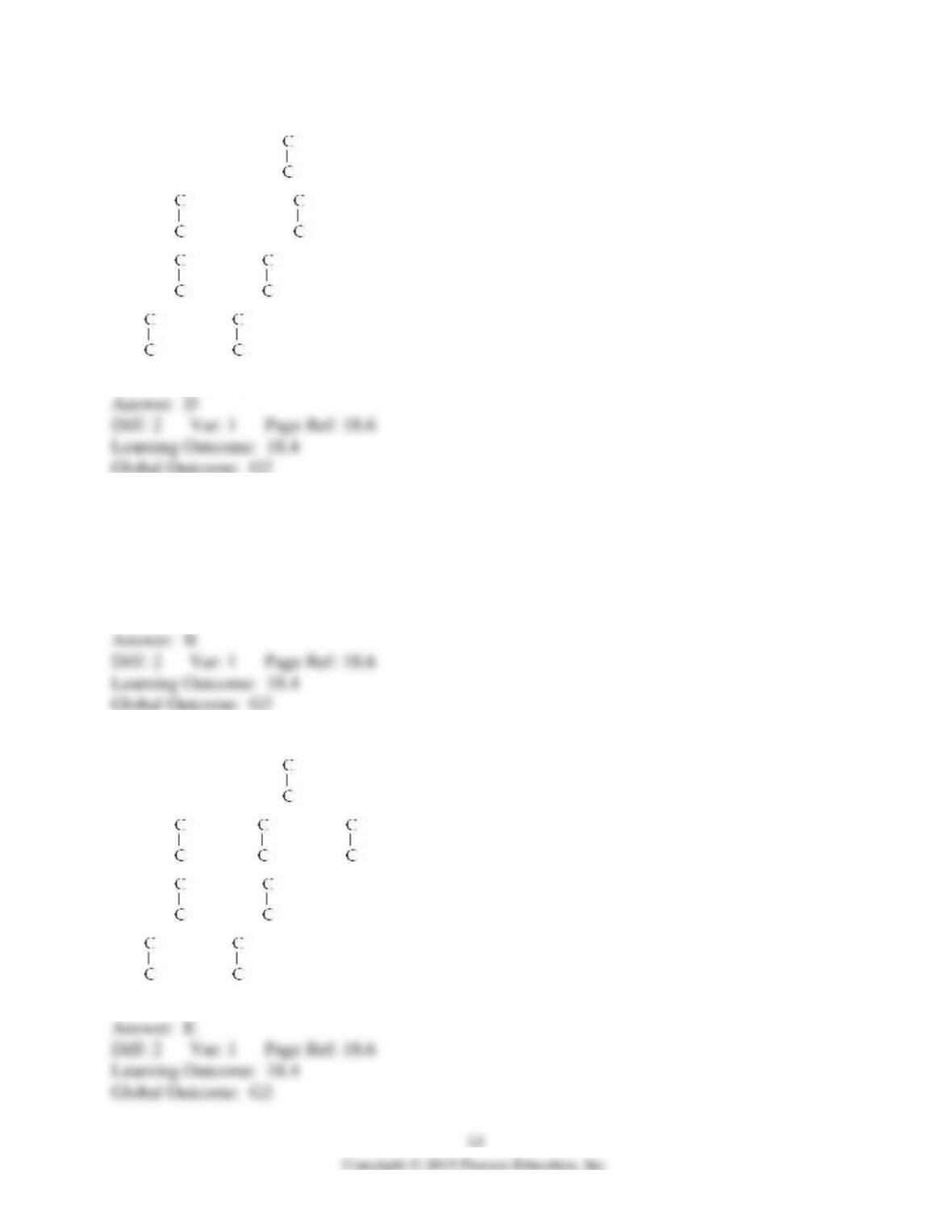
20) Which of the following structural formulas is an isomer to n-hexane?
A) C— C— C— C—— C
B) C—— C— C— — C
C) C—— C— — C
D) — C— — C
E) none of the above
21) How many isomers exist for the alkane whose molecular formula is C4H10?
A) 1
B) 2
C) 3
D) 4
E) none
22) Which of the following structural formulas is an isomer to n-nonane?
A) C— C— C— C— — C
B) C—— C— — C — — C
C) C—— C— — C— C
D) — C— — C— C— C
E) none of the above
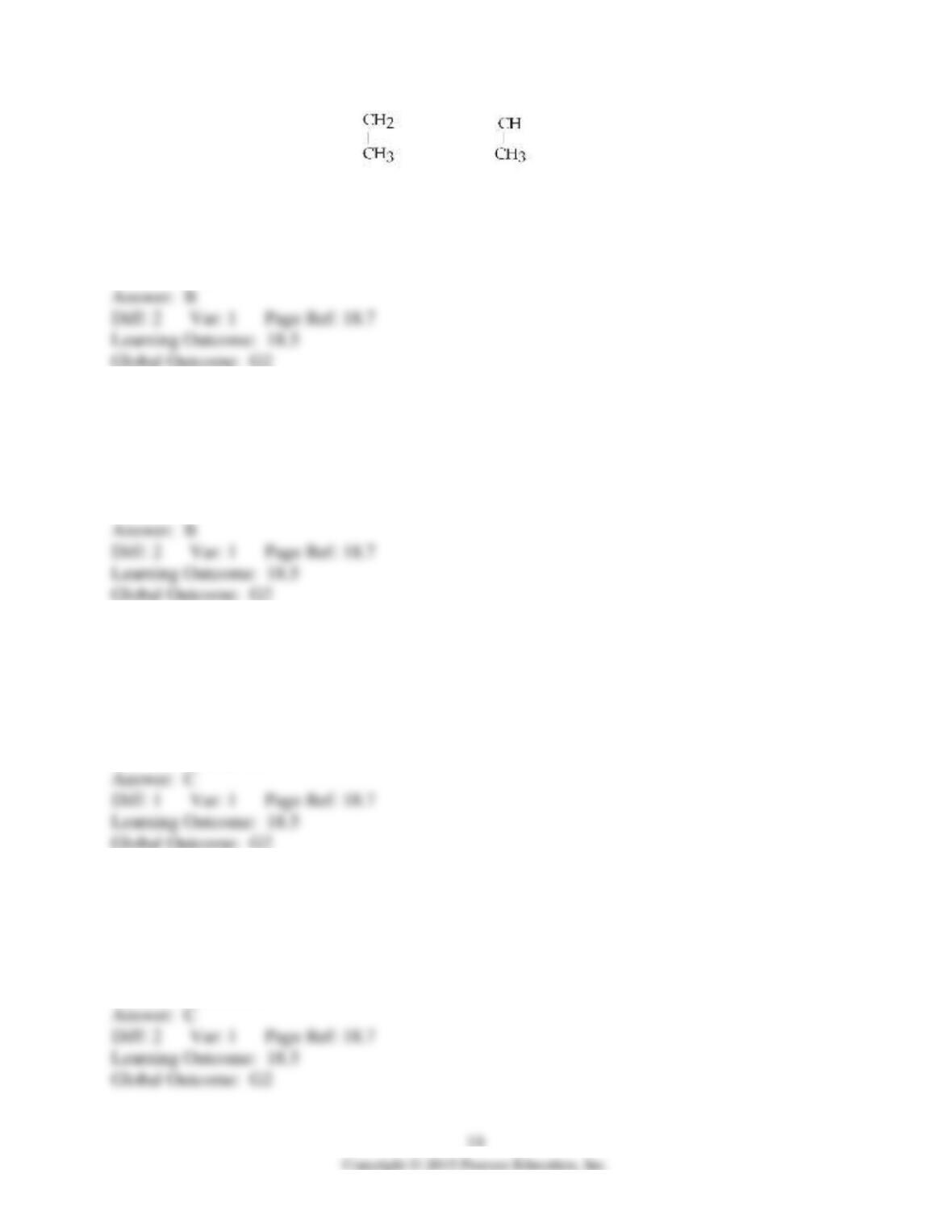
23) Name the following alkane: — CH2 — — CH2 — CH2 — CH3
A) 1,3-dimethylhexane
B) 4-methylheptane
C) 2-propylpentane
D) 1-methyl-1-propylbutane
E) none of the above
24) The prefix “but-” means that the base chain contains how many carbon atoms?
A) 2
B) 4
C) 6
D) 8
E) all of the above
25) Which condensed structural formula is known as the propyl group?
A) –CH2CH2CH2CH3
B) –CH2CH3
C) –CH2CH2CH3
D) –CH3
E) none of the above
26) The compound named 2,3-dimethylpentane would have how many total number of carbons?
A) 3
B) 5
C) 7
D) 8
E) none of the above
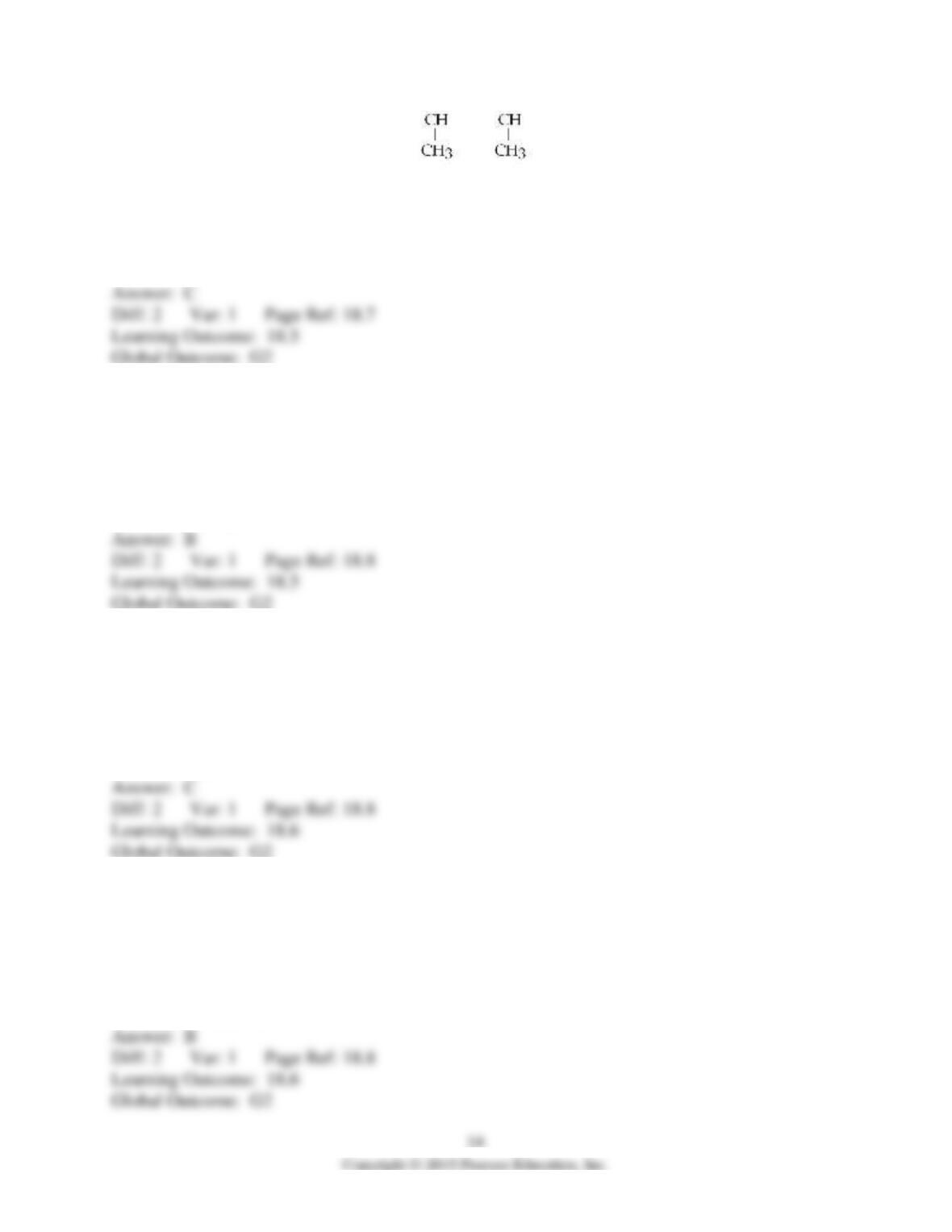
27) Name the following alkane: CH3 —— — CH2 — CH3
A) 3-isopropylbutane
B) 3,4-dimethylpentane
C) 2,3-dimethylpentane
D) 2-isopropylbutane
E) none of the above
28) Which of the following compounds is an alkene?
A) C2H6
B) C3H6
C) C4H6
D) C5H12
E) none of the above
29) Which of the following compounds is an alkyne?
A) C2H6
B) C3H6
C) C2H2
D) C5H12
E) none of the above
30) What is the formula for propene?
A) C3H8
B) C3H6
C) C3H4
D) C3H3
E) none of the above
31) What is the formula for propyne?
A) C3H8
B) C3H6
C) C3H4
D) C3H3
E) none of the above
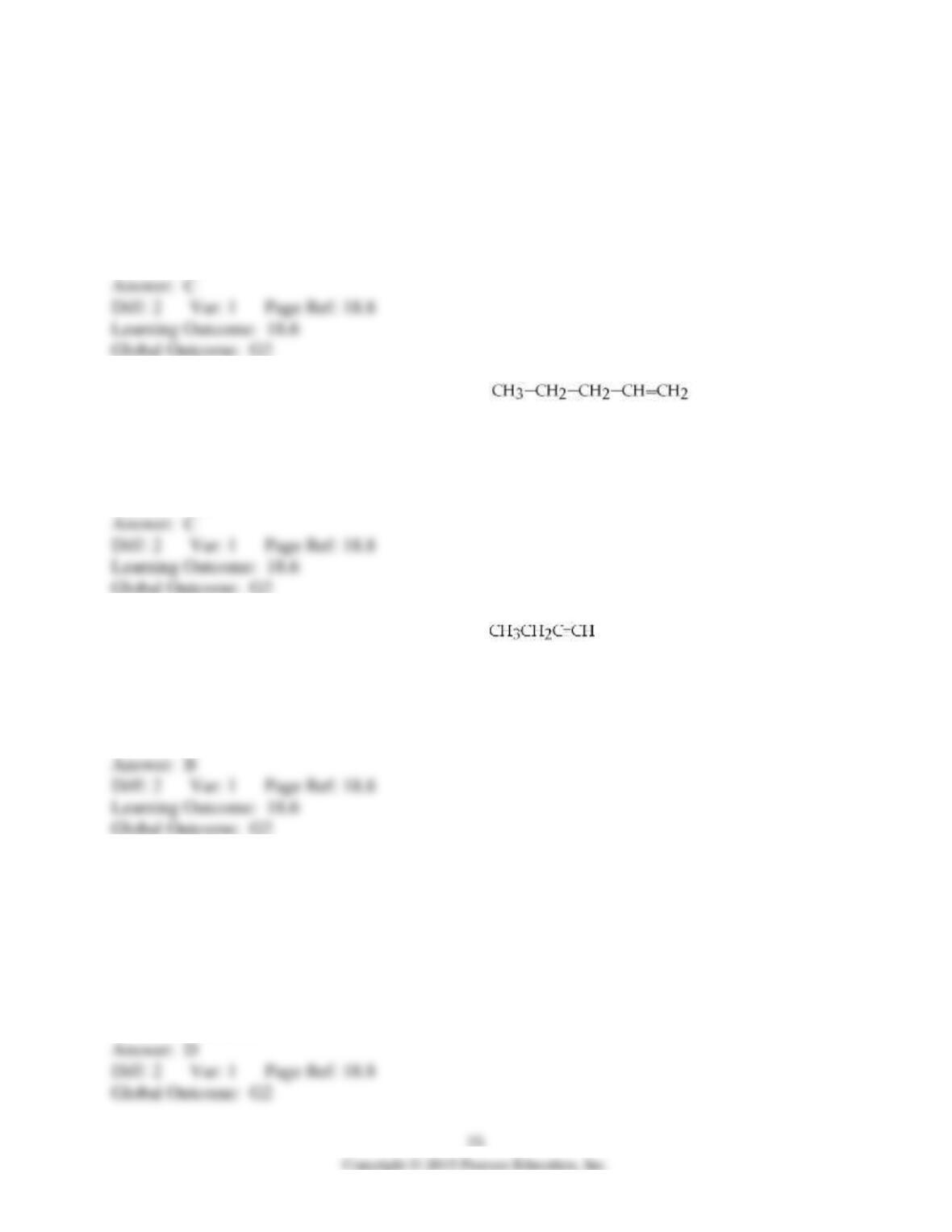
32) What is the name of the following compound: ?
A) 4-pentane
B) 4-ene-pentane
C) 1-pentene
D) 2-pentane
E) none of the above
33) What is the name of the following compound: ?
A) 3-butene
B) 1-butyne
C) 2-butene
D) 1-butene
E) none of the above
34) Name the following alkene: CH3 — CH = C — CH — CH3
| |
CH3 CH3
A) 2-propyl-2-isobutene
B) 1-propyl-2-butene
C) 1,1,3-trimethyl-1-pentene
D) 3,4-dimethyl-2-pentene
E) none of the above