Chapter 18: Acid-Base Equilibria
1. The substance H2SO3 is considered
A) a weak Arrhenius base. D) a neutral compound.
B) a strong Arrhenius acid. E) a weak Arrhenius acid.
C) a strong Arrhenius base.
2. The substance HOBr is considered
A) a weak Arrhenius acid. D) a strong Arrhenius base.
B) a weak Arrhenius base. E) a neutral compound.
C) a strong Arrhenius acid.
3. The substance HCl is considered
A) a weak Arrhenius acid. D) a strong Arrhenius base.
B) a weak Arrhenius base. E) a neutral compound.
C) a strong Arrhenius acid.
4. The substance Ba(OH)2 is considered
A) a weak Arrhenius acid. D) a strong Arrhenius base.
B) a weak Arrhenius base. E) a neutral compound.
C) a strong Arrhenius acid.
5. The substance Ca(OH)2 is considered
A) a weak Arrhenius acid. D) a strong Arrhenius base.
B) a weak Arrhenius base. E) a neutral compound.
C) a strong Arrhenius acid.
6. The substance NaNO3 is considered
A) a weak Arrhenius acid. D) a strong Arrhenius base.
B) a weak Arrhenius base. E) a neutral compound.
C) a strong Arrhenius acid.
7. Which, if any, of the following acids is strong?
A) phosphoric B) carbonic C) acetic D) water E) none of the above
Chapter 18: Acid-Base Equilibria
8. Which one of the following is a strong acid?
A) H2CO3 B) H2SO3 C) H2SO4 D) H3PO4 E) CH3COOH
9. Which one of the following will give a solution with a pH > 7, but is not an Arrhenius
base in the strict sense?
A) CH3NH2 B) NaOH C) CO2 D) Ca(OH)2 E) CH4
10. The substance NH3 is considered
A) a weak acid. D) a strong base.
B) a weak base. E) a neutral compound.
C) a strong acid.
11. The substance (CH3CH2)2NH is considered
A) a weak acid. D) a strong base.
B) a weak base. E) a neutral compound.
C) a strong acid.
12. The substance HClO4 is considered
A) a weak acid. D) a strong base.
B) a weak base. E) a neutral compound.
C) a strong acid.
13. Which of the following is the strongest acid?
A) CH3COOH B) HF C) H3PO4 D) H2SO3 E) HI
14. Select the strongest acid from the following list.
A) HBrO B) HBrO2 C) HClO2 D) HClO3 E) HIO
15. Select the strongest acid from the following list.
A) HBrO4 B) HClO C) HBrO2 D) HBrO E) HIO
16. Which of the following is the strongest acid?
A) CH3COOH B) HF C) H3PO4 D) H2SO3 E) H2SO4
Chapter 18: Acid-Base Equilibria
17. Which of the following is the strongest base?
A) CH3NH2 B) NaNO3 C) B(OH)3 D) Al(OH)3 E) LiOH
18. Which of the following pairs has the stronger acid listed first?
A) HBr, HI D) HNO2, HNO3
B) HClO2, HClO3 E) HF, HCl
C) H2SeO4, H2SeO3
19. Which of the following pairs has the stronger acid listed first?
A) H2AsO3, H2AsO4 D) H2S, HCl
B) HI, HBr E) H2SO3, H2SO4
C) HClO, HClO3
20. Given: H2O(aq) + H2O(l) H3O+(aq) + OH–(aq) H°rxn > 0
When the temperature of a sample of pure water is raised above 25 °C,
A) the hydronium ion concentration will be greater than the hydroxide ion
concentration.
B) the hydronium ion concentration will be less than the hydroxide ion concentration.
C) the value of Kw will increase.
D) the hydronium ion concentration could change to 1.0 × 10⁻¹⁰ M.
E) the hydroxide ion concentration could change to 1.0 × 10⁻¹⁰ M.
21. Which of the following aqueous systems has the highest pH?
A) 0.1 M HA, pKa = 11.89 D) 0.1 M HBO, pKa = 2.43
B) 0.1 M HMO, pKa = 8.23 E) pure water
C) 0.1 M HA, pKa = 4.55
22. Which of the following acids has the lowest pH?
0.1 M HBO, pKa = 2.43
0.1 M HA, pKa = 4.55
0.1 M HMO, pKa = 8.23
0.1 M HST, pKa = 11.89
pure water
A) HA B) HST C) HMO D) HBO E) pure water
Chapter 18: Acid-Base Equilibria
23. Which of the following liquids contains the strongest acid?
A) 0.1 M HA, pH = 6.85 D) 0.1 M HJ, pH = 11.88
B) 0.1 M HD, pH = 7.22 E) pure water
C) 0.1 M HE, pH = 8.34
24. What is the pH of a 0.20 M HCl solution?
A) < 0 B) 0.70 C) 1.61 D) 12.39 E) 13.30
25. What is the pH of a 0.75 M HNO3 solution?
A) 0.12 B) 0.29 C) 0.63 D) 0.82 E) > 1.0
26. What is the pH of a 0.00200 M HClO4 solution?
A) 0.995 B) 1.378 C) 2.699 D) 6.215 E) none of the above
27. What is the pH of a 0.050 M HBr solution?
A) 0.89 B) 1.12 C) 1.30 D) 3.00 E) none of the above
28. What is the pH of a 0.050 M LiOH solution?
A) < 1.0 B) 1.30 C) 3.00 D) 11.00 E) 12.70
29. What is the pH of a 0.0035 M KOH solution?
A) 2.46 B) 5.65 C) 8.35 D) 11.54 E) none of the above
30. What is the pH of a 0.0125 M NaOH solution?
A) 0.972 B) 1.903 C) 12.097 D) 13.028 E) none of the above
31. What is the pOH of a 0.0250 M HI solution?
A) 0.944 B) 1.602 C) 12.398 D) 13.056 E) none of the above
32. What is the pOH of a 0.0085 M KOH solution?
A) 2.07 B) 4.77 C) 9.23 D) 11.93 E) none of the above
Chapter 18: Acid-Base Equilibria
Page 316
33. What is the [OH–] for a solution at 25°C that has [H3O+] = 2.35 × 10⁻³ M?
A) 4.26 × 10⁻⁵ M D) 2.35 × 10⁻¹⁷ M
B) 2.35 × 10⁻¹¹ M E) none of the above
C) 4.26 × 10⁻¹² M
34. What is the [OH–] for a solution at 25°C that has [H3O+] = 8.23 × 10⁻² M?
A) > 10–5 M D) 1.22 × 10⁻¹³ M
B) 1.22 × 10⁻⁶ M E) 8.23 × 10⁻¹⁶ M
C) 8.23 × 10⁻¹² M
35. What is the [OH–] for a solution at 25°C that has pH = 4.29?
A) 1.4 × 10⁻² M D) 7.3 × 10⁻¹³ M
B) 5.l × 10–5 M E) 9.71 M
C) 1.9 × 10⁻¹⁰ M
36. What is the [H3O+] for a solution at 25°C that has pOH = 5.640?
A) 2.34 × 10⁻⁴ M D) 4.27 × 10⁻¹¹ M
B) 2.29 × 10⁻⁶ M E) 8.360 M
C) 4.37 × 10⁻⁹ M
37. Select the correct relationship among the concentrations of species present in a 1.0 M
aqueous solution of the weak acid represented by HA.
A) [H2O] > [A–] ~ [H3O+] > [HA] > [OH–]
B) [H2O] > [HA] > [A–] > [H3O+] > [OH–]
C) [HA] > [H2O] > [A–] > [H3O+] > [OH–]
D) [H2O] > [HA] > [A–] ~ [H3O+] > [OH–]
E) [HA] > [H2O] > [A–] ~ [H3O+] > [OH–]
38. The hydrated Al3+ ion, Al(H2O)63+, is a weak acid in water. What are the products of its
reaction with H2O?
Al(H2O)63+(aq) + H2O(l) → ?
A) Al(H2O)5OH2+(aq) + H3O+(aq) D) Al(H2O)6OH2+(aq) + H3O+( aq)
B) Al(H2O)6H4+(aq) + OH–( aq) E) Al(H2O)62+(aq) + H3O+( aq)
C) Al(H2O)53+(aq) + 2H2O(l)
Chapter 18: Acid-Base Equilibria
39. When 14.7 mL of aqueous HBr (a strong acid) was added to water, 0.482 L of a solution
with a pH of 4.23 was produced. What was the molarity of the original HBr solution?
A) 1.9 × 10⁻³ M
B) 140 M
C) 0.288 M
D) 0.13 M
E) none of the above
40. An aqueous solution is considered to be acidic if
A) the hydroxide ion concentration is 10-6 M.
B) the hydrogen ion concentration is 10-8 M.
C) the hydroxide and hydrogen ion concentrations are equal.
D) the hydroxide ion concentration is greater than the hydrogen ion concentration.
E) the hydroxide ion concentration is 10–10 M.
41. Select the pair of substances in which an acid is listed followed by its conjugate base.
A) H+, HCl D) HCO3–, CO32–
B) NH3, NH4+ E) CH3COOH, CH3COOH2+
C) HPO42–, H2PO4–
42. Select the pair of substances which is not a conjugate acid-base pair.
A) H3O+, H2O D) H2S, S2–
B) HNO2, NO2– E) NH3, NH2–
C) H2SO4, HSO4–
43. Which one of the following pairs is not a conjugate acid-base pair?
A) H2O/OH–
B) H2O2/HO2–
C) OH–/O2–
D) H2PO4–/HPO42–
E) HCl/H+
44. According to Brønsted and Lowry, which one of the following is not a conjugate acid-
base pair?
A) H3O+/OH–
B) CH3OH2+/CH3OH
C) HI/I–
D) HSO4–/SO42–
E) H2/H–
Chapter 18: Acid-Base Equilibria
45. The acid dissociation constant Ka equals 1.26 × 10⁻² for HSO4– and is 5.6 × 10⁻¹⁰ for
NH4+. Which statement about the following equilibrium is correct?
HSO4–(aq) + NH3(aq) SO42–(aq) + NH4+(aq)
A) The reactants will be favored because ammonia is a stronger base than the sulfate
anion.
B) The products will be favored because the hydrogen sulfate ion is a stronger acid
than the ammonium ion.
C) Neither reactants nor products will be favored because all of the species are weak
acids or bases.
D) The initial concentrations of the hydrogen sulfate ion and ammonia must be known
before any prediction can be made.
E) This reaction is impossible to predict, since the strong acid and the weak base
appear on the same side of the equation.
46. A student adds 0.1 mol of oxalic acid and 0.1 mol of sodium dihydrogen phosphate to
enough water to make 1.0 L of solution. The following equilibrium is established with the
concentrations of the products greater than the concentrations of the reactants. Which of the
statements about the equilibrium system is correct?
H2C2O4(aq) + H2PO4–(aq) HC2O4–(aq) + H3PO4(aq)
A) Oxalic acid is a weaker acid than phosphoric acid.
B) The hydrogen oxalate anion, HC2O4–, is a stronger base than the dihydrogen
phosphate anion, H2PO4–.
C) Phosphoric acid is a weaker acid than oxalic acid.
D) The dihydrogen phosphate anion, H2PO4–, is a stronger acid than oxalic acid.
E) Water is a stronger acid than either oxalic or phosphoric acids.
47. Aqueous solutions of phosphoric acid and sodium nitrite are combined, and the following
equilibrium is established.
H3PO4(aq) + NO2–(aq) H2PO4–(aq) + HNO2(aq)
The equilibrium constant Kc for this reaction is greater than one. Based on this information,
which of the following statements is correct?
A) Phosphoric acid is a weaker acid than nitrous acid.
B) Nitrous acid is a weaker acid than water.
C) The nitrite anion is a weaker base than the dihydrogen phosphate anion.
D) The dihydrogen phosphate anion is a stronger acid than nitrous acid.
E) Phosphoric acid is a stronger acid than nitrous acid.
Chapter 18: Acid-Base Equilibria
48. Butyric acid is responsible for the odor in rancid butter. A solution of 0.25 M butyric
acid has a pH of 2.71. What is the Ka for the acid?
A) 0.36
B) 2.4 × 10⁻²
C) 7.8 × 10⁻³
D) 1.5 × 10⁻⁵
E) none of the above
49. A 0.15 M solution of chloroacetic acid has a pH of 1.86. What is the value of Ka for this
acid?
A) 7.2 × 101 B) 0.16 C) 0.099 D) 0.0014 E) 0.00027
50. A 0.050 M solution of the weak acid HA has [H3O+] = 3.77 × 10⁻⁴ M. What is the Ka for
the acid?
A) 7.5 × 10⁻³ M D) 7.0 × 10⁻⁸ M
B) 2.8 × 10⁻⁶ M E) 2.6 × 10⁻¹¹ M
C) 7.0 × 10⁻⁷ M
51. Formic acid, which is a component of insect venom, has a Ka = 1.8 × 10⁻⁴. What is the
[H3O+] in a solution that is initially 0.10 M formic acid, HCOOH?
A) 4.2 × 10⁻³ M D) 1.8 × 10⁻⁵ M
B) 8.4 × 10⁻³ M E) 1.8 × 10⁻⁶ M
C) 1.8 × 10⁻⁴ M
52. Picric acid has been used in the leather industry and in etching copper. However, its
laboratory use has been restricted because it dehydrates on standing and can become shock
sensitive. It has an acid dissociation constant of 0.42. What is the [H3O+] for a 0.20 M solution
of picric acid?
A) 0.022 M B) 0.052 M C) 0.15 M D) 0.29 M E) none of the above
53. Lactic acid has a pKa of 3.08. What is the approximate degree of dissociation of a 0.35 M
solution of lactic acid?
A) 1.1% B) 2.2% C) 4.8% D) 14% E) none of the above
54. A 1.25 M solution of the weak acid HA is 9.2% dissociated. What is the pH of the
solution?
A) 0.64 B) 0.94 C) 1.13 D) 2.16 E) none of the above
Chapter 18: Acid-Base Equilibria
55. Phosphoric acid, H3PO4, is a triprotic acid, for which Ka1 = 7.2 × 10⁻³, Ka2 = 6.3 × 10⁻⁸
and Ka3 = 4.2 × 10⁻¹³. What is the value of Kb for the hydrogen phosphate anion, HPO42–?
A) 6.3 × 10⁻⁸
B) 4.2 × 10⁻¹³
C) 1.4 × 10⁻¹²
D) 1.6 × 10⁻⁷
E) 2.4 × 10⁻²
56. Farmers who raise cotton once used arsenic acid, H3AsO4, as a defoliant at harvest time.
Arsenic acid is a polyprotic acid with K1 = 2.5 × 10⁻⁴, K2 = 5.6 × 10⁻⁸, and K3 = 3 × 10–13. What
is the pH of a 0.500 M solution of arsenic acid?
A) 0.85 B) 1.96 C) 3.90 D) 4.51 E) none of the above
57. Arsenic acid, H3AsO4, is used industrially to manufacture insecticides. Arsenic acid is a
polyprotic acid with K1 = 2.5 × 10⁻⁴, K2 = 5.6 × 10⁻⁸, and K3 = 3 × 10–13. What is the
concentration of the HAsO42– in a solution whose initial arsenic acid concentration was 0.35 M?
A) 9.4 × 10⁻³ M D) 5.6 × 10⁻⁸ M
B) 2.5 × 10⁻⁴ M E) none of the above
C) 8.8 × 10⁻⁵ M
58. What is the pH of a 0.050 M triethylamine, (C2H5)3N, solution?
Kb for triethylamine is 5.3 × 10⁻⁴.
A) 11.69 B) 8.68 C) 5.32 D) 2.31 E) < 2.0
59. Hydroxylamine, HONH2, readily forms salts such as hydroxylamine hydrochloride
which are used as antioxidants in soaps. Hydroxylamine has Kb of 9.1 × 10⁻⁹. What is the pH of
a 0.025 M HONH2 solution?
A) 2.90 B) 4.82 C) 9.18 D) 9.91 E) 11.10
60. What is the value of Kb for the formate anion, HCOO–? Ka(HCOOH) = 2.1 × 10⁻⁴
A) –2.1 × 10⁻⁴
B) 2.1 × 10⁻⁴
C) 6.9 × 10⁻⁶
D) 4.8 × 10⁻¹¹
E) 2.1 × 10⁻¹⁸
61. What is the value of Kb for the cyanide anion, CN–? Ka(HCN) = 6.2 × 10⁻¹⁰
A) 1.6 × 10⁻⁴ B) 1.6 × 10⁻⁵ C) 3.8 × 10⁻⁴ D) 3.8 × 10⁻⁵ E) 6.2 × 10⁴
Chapter 18: Acid-Base Equilibria
62. What is the value of Ka for the methylammonium ion, CH3NH3+? Kb(CH3NH2) = 4.4 ×
10–4
A) 4.4 × 10⁻⁴ B) 4.8 × 10⁻⁶ C) 4.4 × 10⁻¹⁰ D) 2.3 × 10⁻¹¹ E) 4.4 × 10⁻¹⁸
63. What is the pH of a 0.0100 M sodium benzoate solution? Kb (C7H5O2–) = 1.5 × 10⁻¹⁰
A) 0.38 B) 5.91 C) 8.09 D) 9.82 E) 13.62
64. What is the pH of a 0.010 M triethanolammonium chloride, (HOC2H2)3NHCl, solution?
Kb, ((HOC2H2)3N) = 5.9 × 10⁻⁷
A) 2.75 B) 4.89 C) 9.11 D) 11.25 E) none of the above
65. Which of the following aqueous liquids will have the highest pH?
A) 0.1 M CH3COOH, pKa = 4.7 D) 0.1 M ZnCl2, pKa = 9.0
B) 0.1 M CuCl2, pKa = 7.5 E) pure water
C) 0.1 M H3C6H5O7, pKa = 3.1
66. Which of the following aqueous liquids is the most acidic?
A) 0.1 M Al(NO3)3, Ka = 1 × 10⁻⁵ D) 0.1 M Ni(NO3)2, Ka = 1 × 10⁻¹⁰
B) 0.1 M Be(NO3)2, Ka = 4 × 10⁻⁶ E) pure water
C) 0.1 M Pb(NO3)2, Ka = 3 × 10⁻⁸
67. A solution is prepared by adding 0.10 mol of sodium fluoride, NaF, to 1.00 L of water.
Which statement about the solution is correct?
A) The solution is basic.
B) The solution is neutral.
C) The solution is acidic.
D) The concentrations of fluoride ions and sodium ions will be identical.
E) The concentration of fluoride ions will be greater than the concentration of sodium
ions.
68. A solution is prepared by adding 0.10 mol of potassium acetate, KCH3COO, to 1.00 L of
water. Which statement about the solution is correct?
A) The solution is basic.
B) The solution is neutral.
C) The solution is acidic.
D) The concentrations of potassium ions and acetate ions will be identical.
E) The concentration of acetate ions will be greater than the concentration of
potassium ions.
Chapter 18: Acid-Base Equilibria
69. A solution is prepared by adding 0.10 mol of sodium sulfide, Na2S, to 1.00 L of water.
Which statement about the solution is correct?
A) The solution is basic.
B) The solution is neutral.
C) The solution is acidic.
D) The concentration of sodium ions and sulfide ions will be identical.
E) The concentration of sulfide ions will be greater than the concentration of sodium
ions.
70. A solution is prepared by adding 0.10 mol of iron(III) nitrate, Fe(NO3)3, to 1.00 L of
water. Which statement about the solution is correct?
A) The solution is basic.
B) The solution is neutral.
C) The solution is acidic.
D) The value of Ka for the species in solution must be known before a prediction can
be made.
E) The value of Kb for the species in solution must be known before a prediction can
be made.
71. Ammonium chloride is used as an electrolyte in dry cells. Which of the following
statements about a 0.10 M solution of NH4Cl, is correct?
A) The solution is weakly basic.
B) The solution is strongly basic.
C) The solution is neutral.
D) The solution is acidic.
E) The values for Ka and Kb for the species in solution must be known before a
prediction can be made.
72. A solution is prepared by adding 0.10 mol of lithium nitrate, LiNO3, to 1.00 L of water.
Which statement about the solution is correct?
A) The solution is basic.
B) The solution is neutral.
C) The solution is weakly acidic.
D) The solution is strongly acidic.
E) The values for Ka and Kb for the species in solution must be known before a
prediction can be made.
Chapter 18: Acid-Base Equilibria
73. A solution is prepared by adding 0.10 mol of potassium chloride, KCl, to 1.00 L of
water. Which statement about the solution is correct?
A) The solution is basic.
B) The solution is neutral.
C) The solution is acidic.
D) One needs to know the temperature before any of the above predictions can be
made.
E) The values for Ka and Kb for the species in solution must be known before a
prediction can be made.
74. An aqueous solution is prepared by dissolving the salt formed by the neutralization of a
weak acid by a weak base. Which statement about the solution is correct?
A) The solution is strongly basic.
B) The solution is weakly basic.
C) The solution is neutral.
D) The solution is acidic.
E) The values for Ka and Kb for the species in solution must be known before a
prediction can be made.
75. Which one of the following substances will give an aqueous solution of pH < 7?
A) KI B) NH4Br C) Na2CO3 D) CH3COONa E) CH3OH
76. Which one of the following substances will give an aqueous solution of pH closest to 7?
A) KNO3 B) CO2 C) NH4I D) NH3 E) CH3NH2
77. Which of the following is considered a Lewis acid?
A) CH3NH2 B) BCl3 C) F– D) BF4– E) CH4
78. Which of the following is a Lewis base?
A) BCl3 B) Cu2+ C) Cl– D) Mn2+ E) NH4+
79. Iodine trichloride, ICl3, will react with a chloride ion to form ICl4–. Which species, if
any, acts as a Lewis acid this reaction?
A) ICl4–
B) ICl 3
C) Cl–
D) the solvent
E) None of the species acts as a Lewis acid in this reaction.
Chapter 18: Acid-Base Equilibria
80. Calcium oxide, CaO, also known as quick lime, will react with carbon dioxide to form
calcium carbonate, CaCO3. Which species, if any, acts as a Lewis acid in the reaction?
A) Ca2+
B) O2–
C) CO2
D) CaCO3
E) None of the species acts as a Lewis acid in this reaction.
81. Which one of the following is a Lewis acid but not a Brønsted-Lowry acid?
A) Fe3+ B) H3O+ C) HSO4– D) NH3 E) H2O
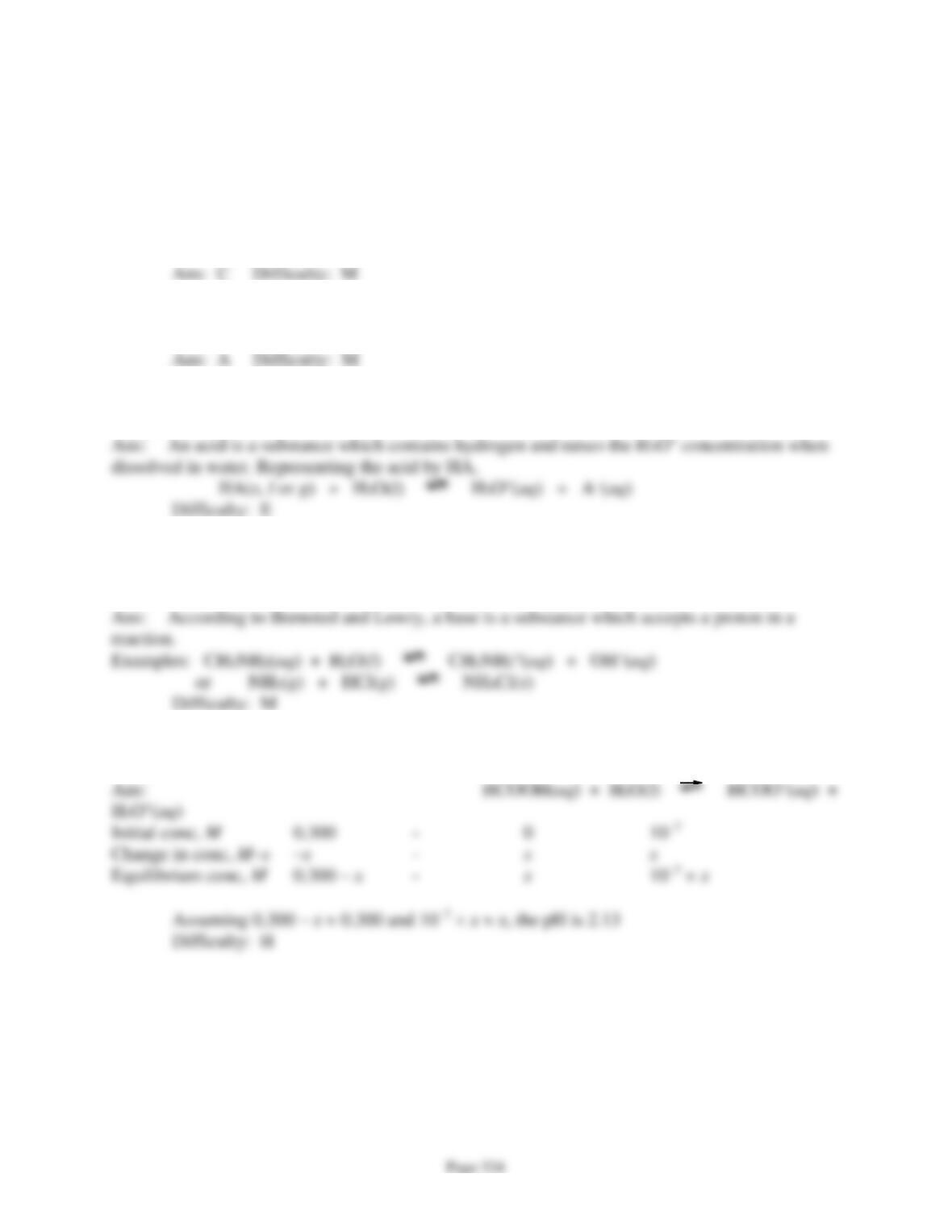
82. Define an acid according to the Arrhenius theory, and write a balanced equation to
support this definition.
83. Define a base according to the Brønsted-Lowry theory. Write a balanced equation in
support of this definition, in which the base is acting as a Brønsted-Lowry base but not as an
Arrhenius base.
84. Formic acid, HCOOH, is a weak acid with a pKa of 3.74. Draw up a reaction table for the
reaction of 0.300 M formic acid with water, and calculate the pH of this solution.
Chapter 18: Acid-Base Equilibria
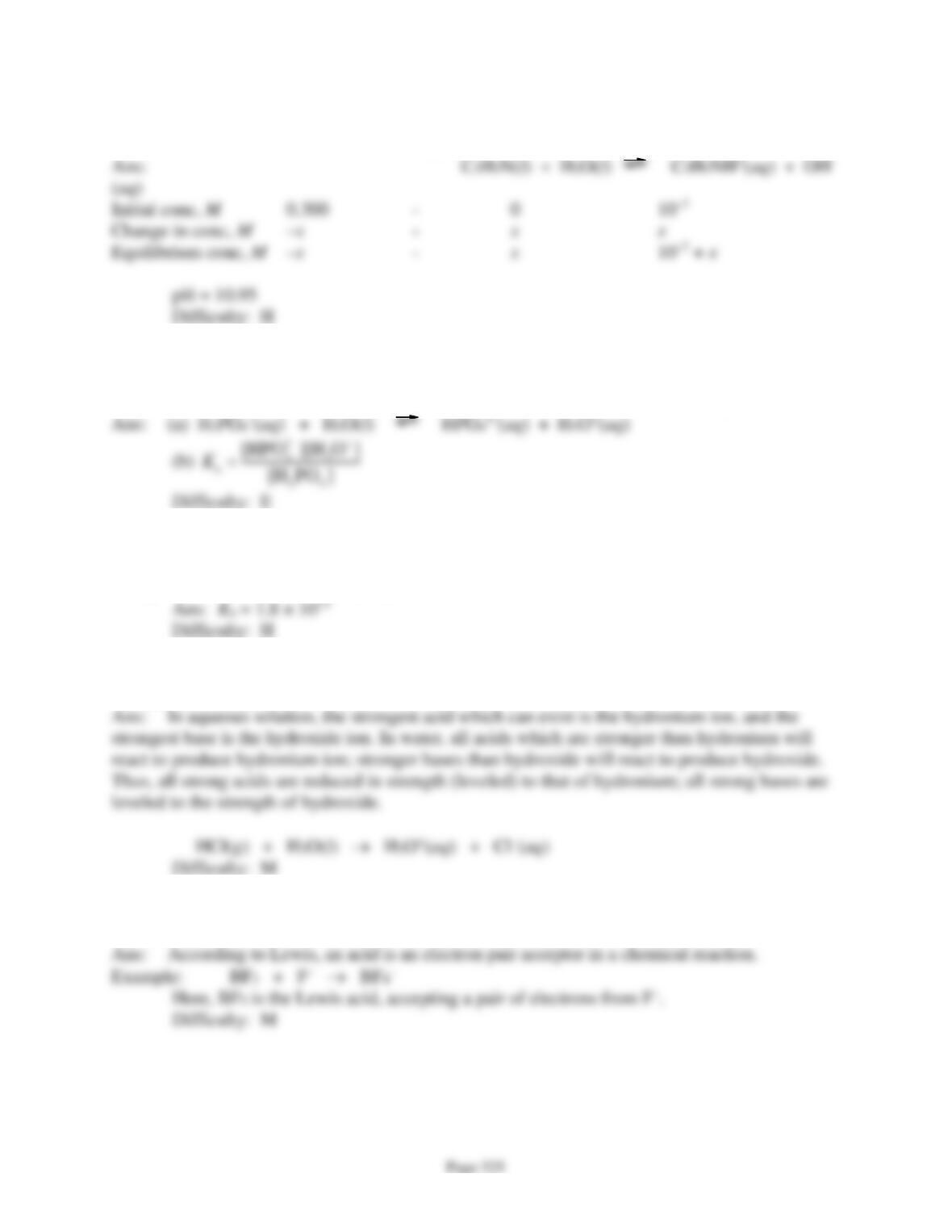
85. The pH of a 0.200 M solution of the weak base pyridine, C5H5N, is 8.59. Draw up a
reaction table for the reaction of 0.200 M pyridine with water, and calculate Kb.
86. (a) Write a balanced equation representing the reaction of the acid, H2PO4– with the base,
water.
(b) Write the expression for Ka of H2PO4– in terms of concentrations of relevant species.
87. The English are fond of soggy French fries (“chips”) wrapped in old newspaper and
generously drenched in vinegar, which is a 0.83 M solution of acetic acid. If the acetic acid in
vinegar is 0.47% dissociated, calculate Ka for this acid.
88. Describe what is meant by the “leveling effect”. Use a real acid as an example, and write
an appropriate equation.
89. Define an acid according to the Lewis theory. Write a balanced equation in support of
this definition, in which the acid is neither an Arrhenius acid nor a Brønsted-Lowry acid.
Chapter 18: Acid-Base Equilibria
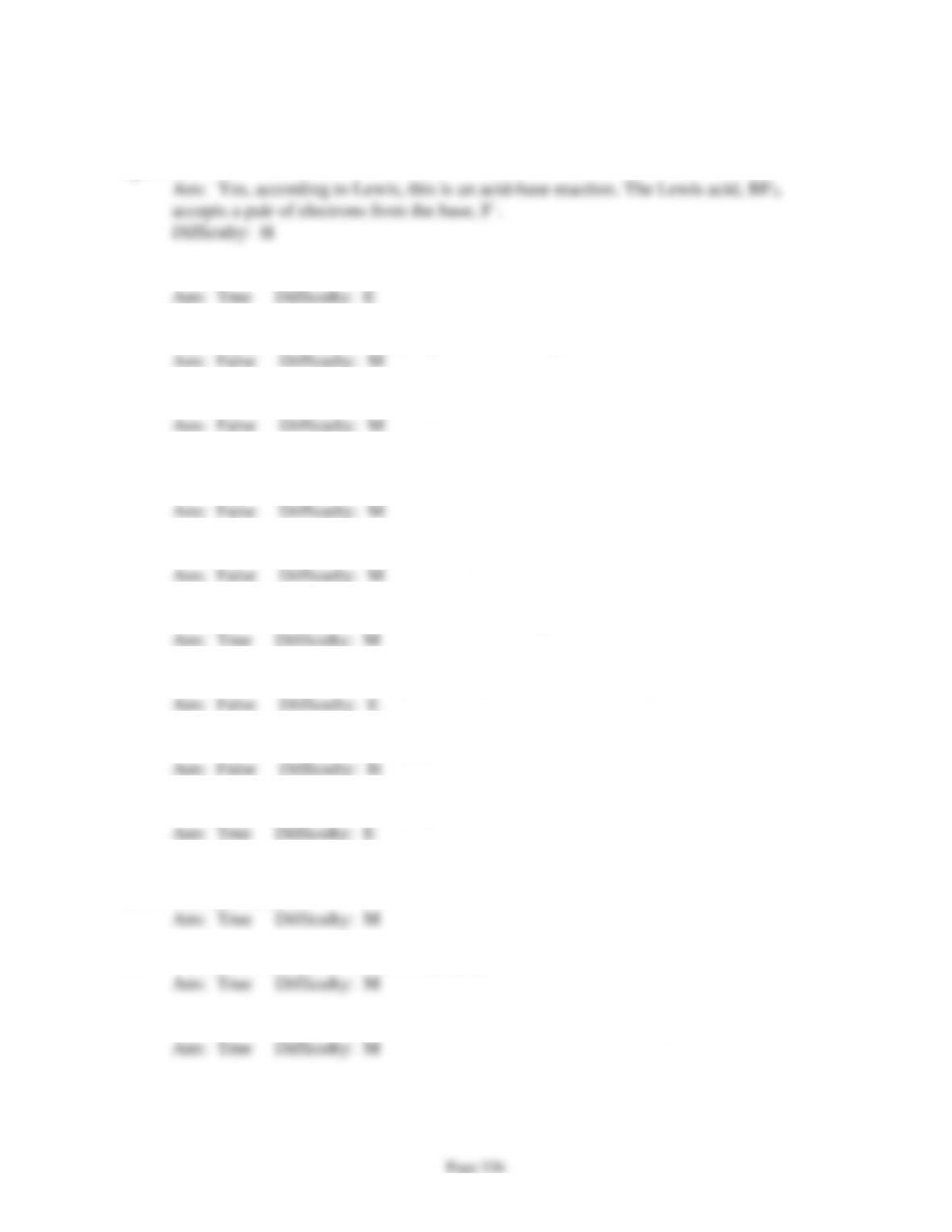
90. Consider the reaction: BF3 + F– → BF4–
Can this ever be considered to be an acid-base reaction? Support your answer with appropriate
arguments.
91. Arrhenius bases raise the hydroxide ion concentration when dissolved in water.
92. It is not possible to have a pH lying outside the range 0 to 14.
93. Kw = 1.0 × 10⁻¹⁴, regardless of temperature.
94. If a strong acid such as HCl is diluted sufficiently with water, the pH will be higher than
7.
95. All Brønsted-Lowry bases contain the hydroxide ion, OH–.
96. All Brønsted-Lowry bases have at least one lone pair of electrons.
97. In order to be a Brønsted-Lowry base, a species must contain a proton.
98. All weak acids have strong conjugate bases.
99. All strong acids have weak conjugate bases.
100. If the compound HX is a strong acid (where H is the acidic proton in this acid), then the
ion X– is a weak base.
101. The ammonium ion, NH4+, is a weak acid.
102. Hydrated metal ions in aqueous solution can act as Brønsted-Lowry acids.
Chapter 18: Acid-Base Equilibria
103. A solution of sodium acetate (CH3COONa) in water is weakly basic.
104. The strongest base which can exist in water is the hydroxide ion.
105. All Lewis acids contain at least one proton.
106. The chloride ion, Cl–, is a typical Lewis acid.