35) For the reaction KMnO4 + Li → LiMnO4 + K, which atom is being reduced?
A) Li
B) Mn
C) O
D) K
E) none of the above
36) What must be done to the following half-reactions before they can be added together?
Mn (s) → Mn 2+(aq) + 2e–
Fe 3+ (aq) + 3 e– → Fe (s)
A) Double the Mn half-reaction.
B) Double the Mn half-reaction and triple the Fe half-reaction.
C) Triple the Mn half-reaction and double the Fe half-reaction.
D) Add H+ ions to the left-side of the Mn reaction.
E) none of the above
37) What is the balanced oxidation half-reaction for the following unbalanced redox reaction:
A) Ca → + 2
B) → Ag +
C) 2 + Ca →
D) + 2 → 2Ag
E) none of the above
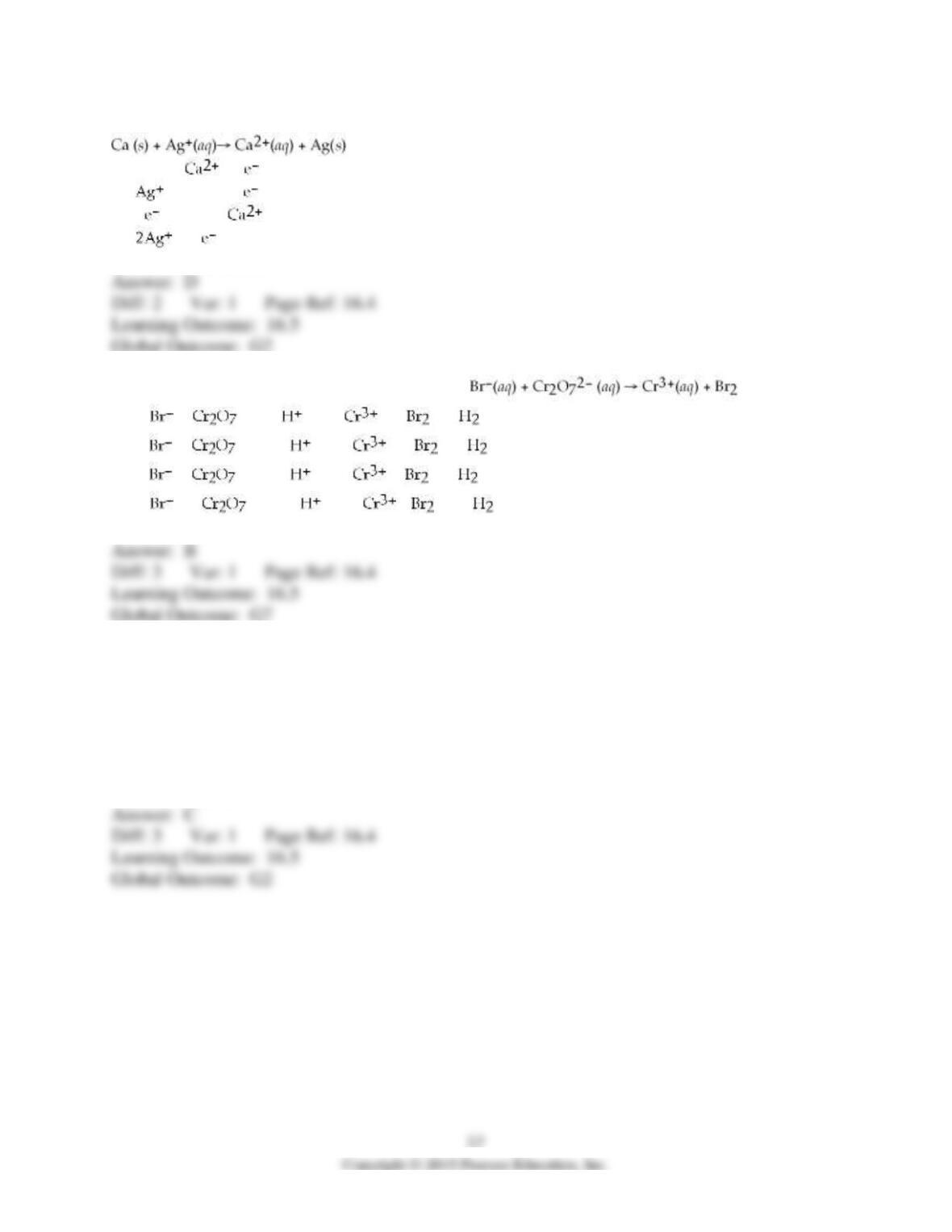
38) What is the balanced reduction half-reaction for the following unbalanced redox reaction:
A) Ca → + 2
B) → Ag + 1
C) 2 + Ca →
D) + 2 → 2Ag
E) none of the above
39) Balance the redox reaction in acid solution: (l)
A) 4 + 2- + 7 → 2 + 2 + 7 O
B) 6 + 2- + 14 → 2 + 3 + 7 O
C) 2 + 2- + 14 → 2 + + 7 O
D) 2 + 2 2- + 14 → 4 + + 14 O
E) none of the above
40) If you properly balance the following half reaction in acid solution, how many electrons
would appear on the product side of the equation? NO (g) → NO31- (aq)
A) 1
B) 2
C) 3
D) 5
E) none of the above
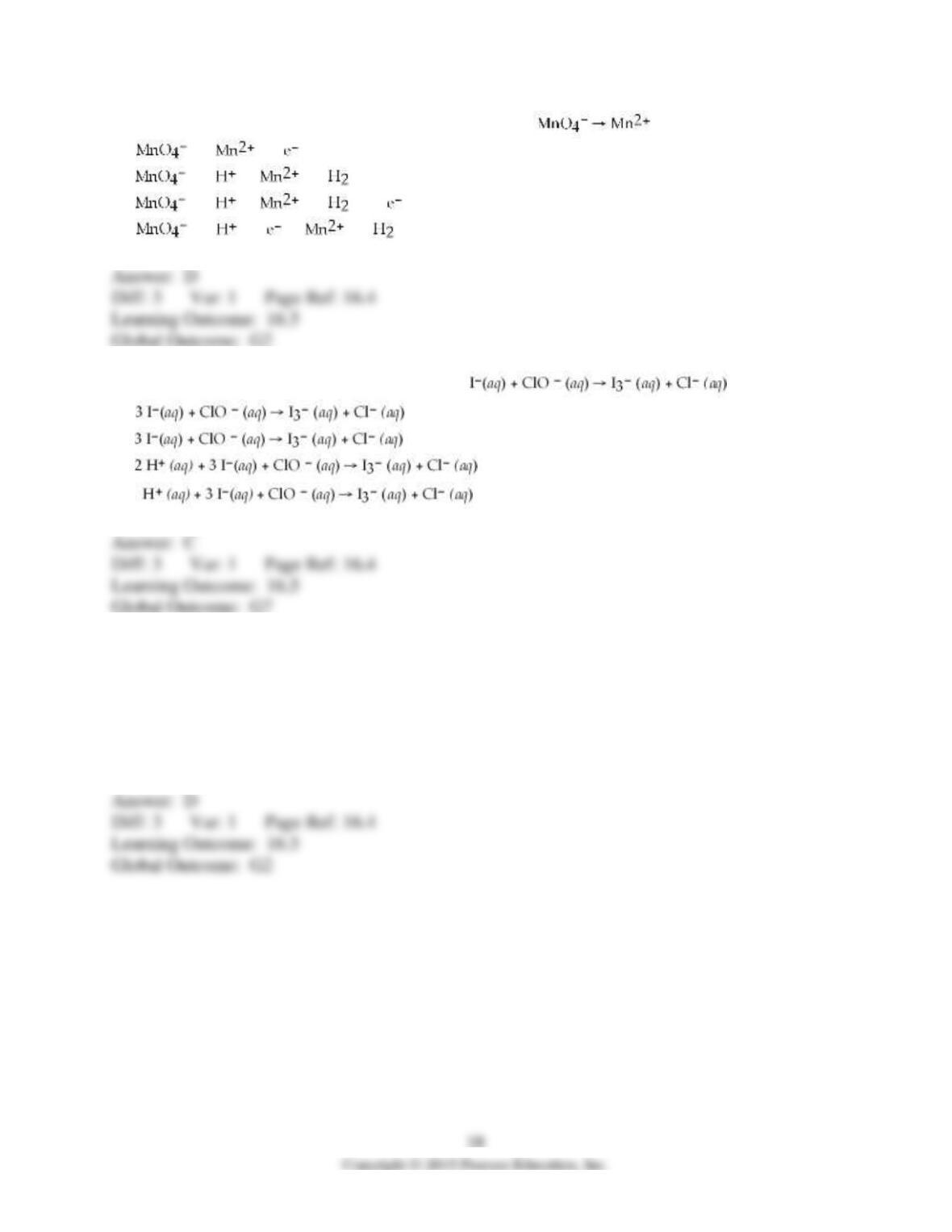
41) Balance the following half reaction in acid solution: (aq)
A) → + 3
B) + 8 → + 4 O
C) + 8 → + 4 O +5
D) + 8 + 5 → + 4 O
E) none of the above
42) Balance the redox reaction in acid solution:
A) + O 2- (aq)
B) + H2O (l)
C) + H2O (l)
D) + OH– (aq)
E) none of the above
43) How many electrons are exchanged when the following reaction is balanced?
Zn (s) + Ni 3+ (aq) → Zn 2+ (aq) + Ni (s)
A) 1
B) 2
C) 3
D) 6
E) none of the above

44) If you properly balance the following half reaction in base solution, how many electrons
would appear on the product side of the equation? Al (s) → Al(OH)41- (aq)
A) 2
B) 3
C) 4
D) 5
E) none of the above
45) Balance the following half reaction in base solution: H20 (l) → H2 (g)
A) 2H2O (l) + 2 e– → H2 (g) + 2 OH– (aq)
B) 2H2O (l) → 2H2 (g) + 2 e– + O2
C) 2H2O (l) → H2 (g) + 2 H+ + 2e–
D) H2O (l) → 2H+ + 2OH–
E) 2H2O (l) → H2 (g) + 2OH– (aq) + 5 e–
46) What is the balanced oxidation half-reaction for the following unbalanced redox
reaction?
A) Ca → + 2
B) → Ag +
C) 2 + Ca →
D) + 2 → 2Ag
E) none of the above
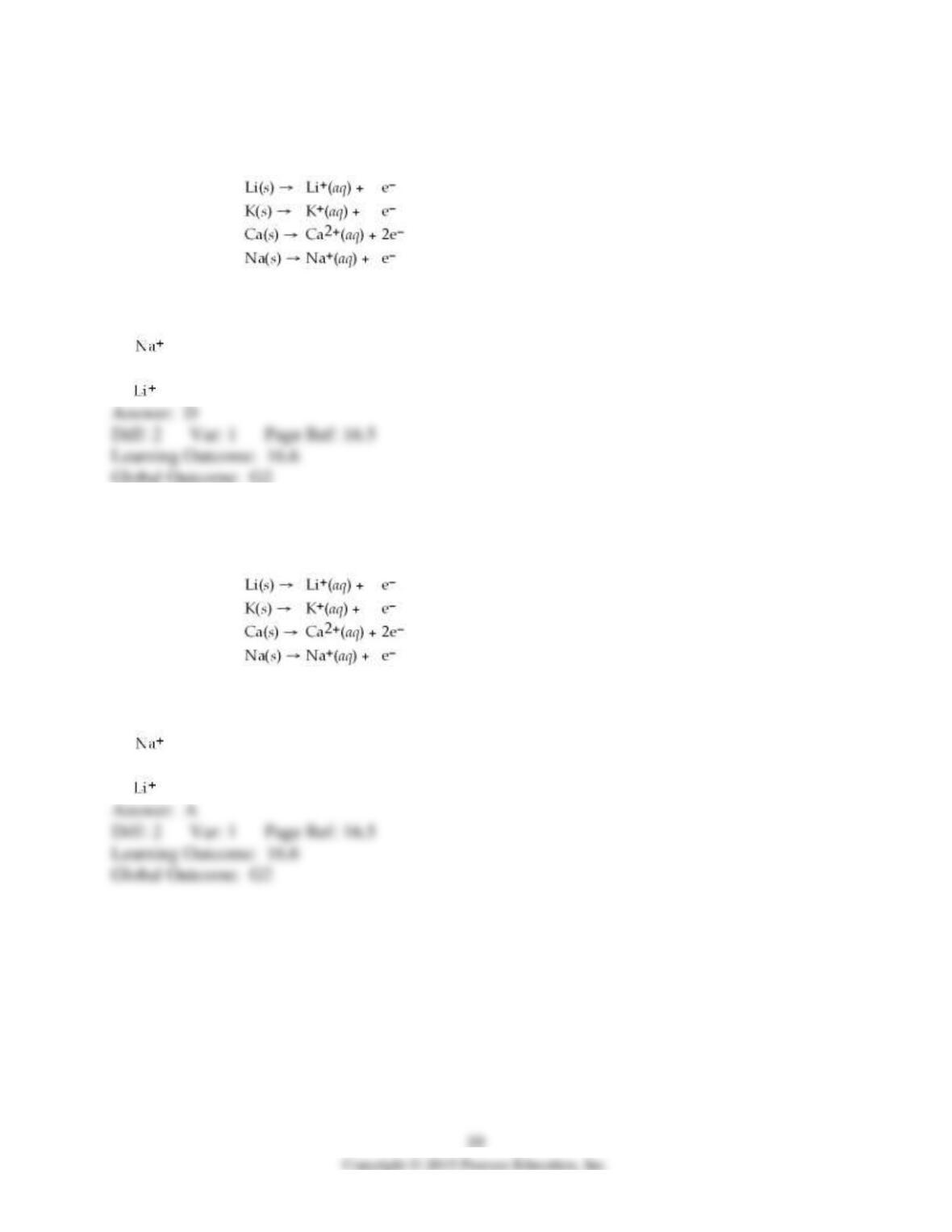
47) From the activity list included in this problem, which element/ion is the most easily
oxidized?
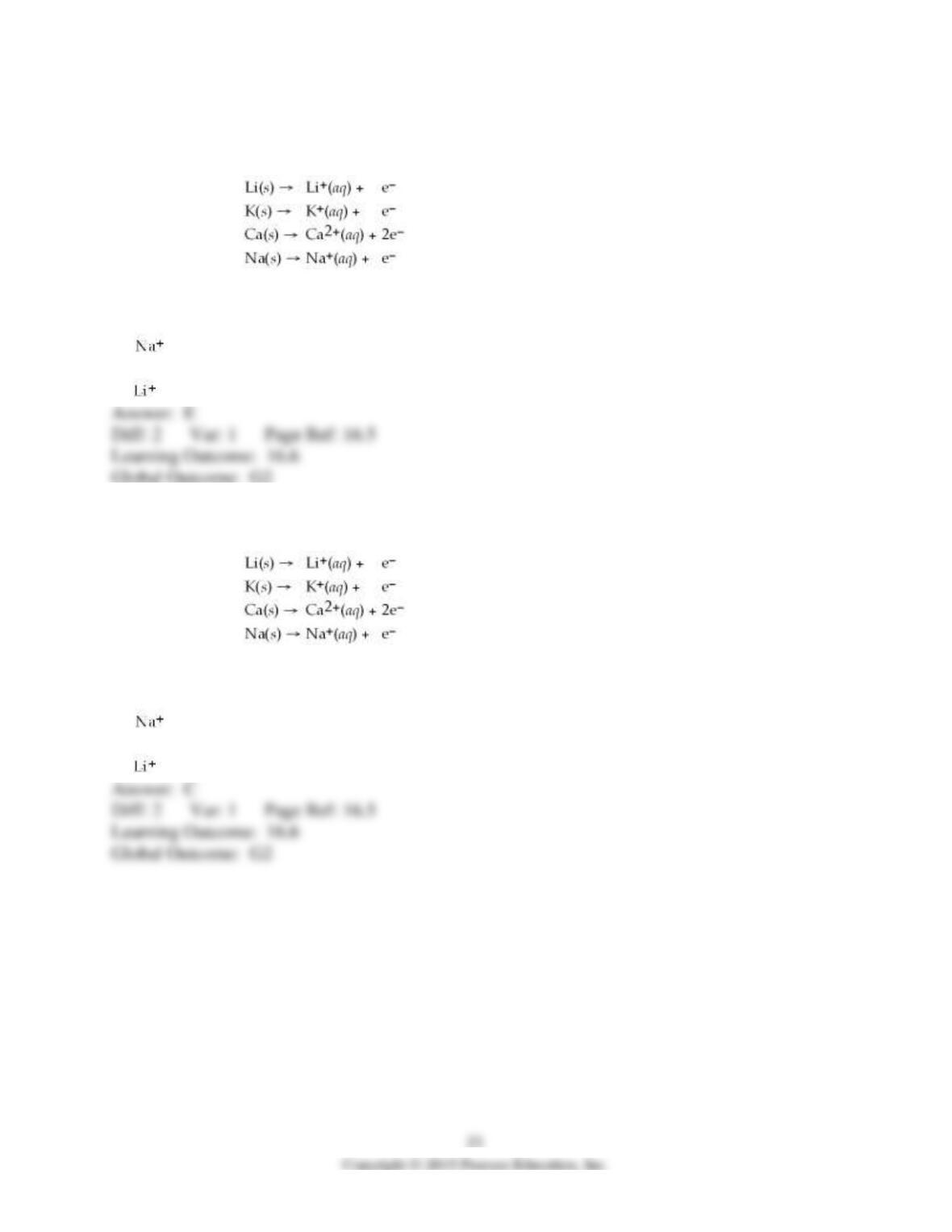
Activity Series =
A) Na
B) Ca
C)
D) Li
E)
48) From the activity list included in this problem, which element/ion is the most difficult to
oxidize?
Activity Series =
A) Na
B) Ca
C)
D) Li
E)
49) From the activity list included in this problem, which element/ion is the most difficult to
reduce?
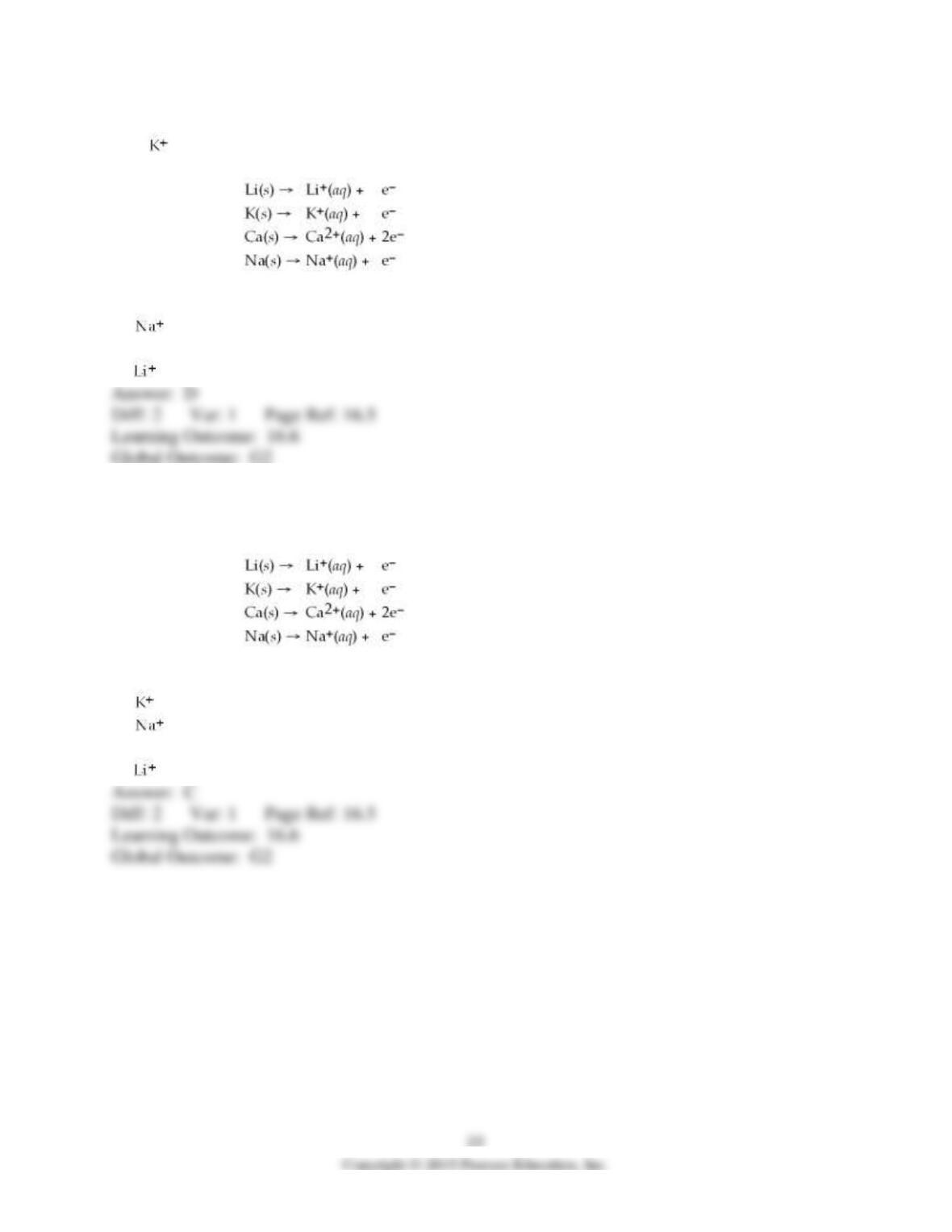
Activity Series =
A) Na
B) Ca
C)
D) Li
E)
50) From the activity list included in this problem, which element/ion is the easiest to reduce?
Activity Series =
A) Na
B) Ca
C)
D) Li
E)
51) From the activity list included in this problem, which element/ion will spontaneously react
with ?
Activity Series =
A) Na
B) Ca
C)
D) Li
E)
52) From the activity list included in this problem, which element/ion will spontaneously react
with Ca?
Activity Series =
A) Na
B)
C)
D) Li
E)
53) From the activity list included in this problem, which element will not dissolve in dilute
hydrochloric acid?
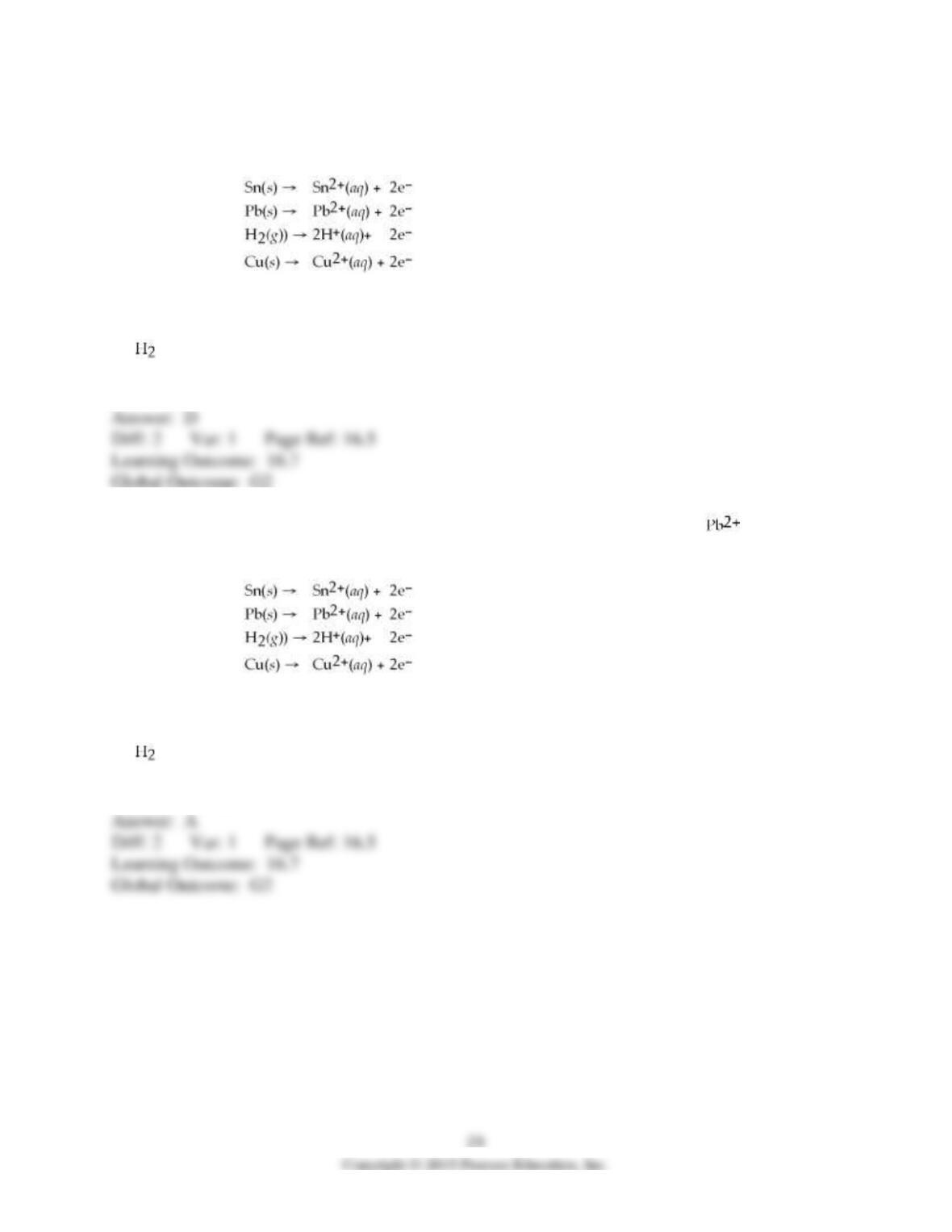
Activity Series =
A) Sn
B) Pb
C)
D) Cu
E) none of the above
54) From the activity list included in this problem, which element will displace ions from
solution?
Activity Series =
A) Sn
B) Pb
C)
D) Cu
E) none of the above
55) From the activity list included in this problem, which element will react with Cu?
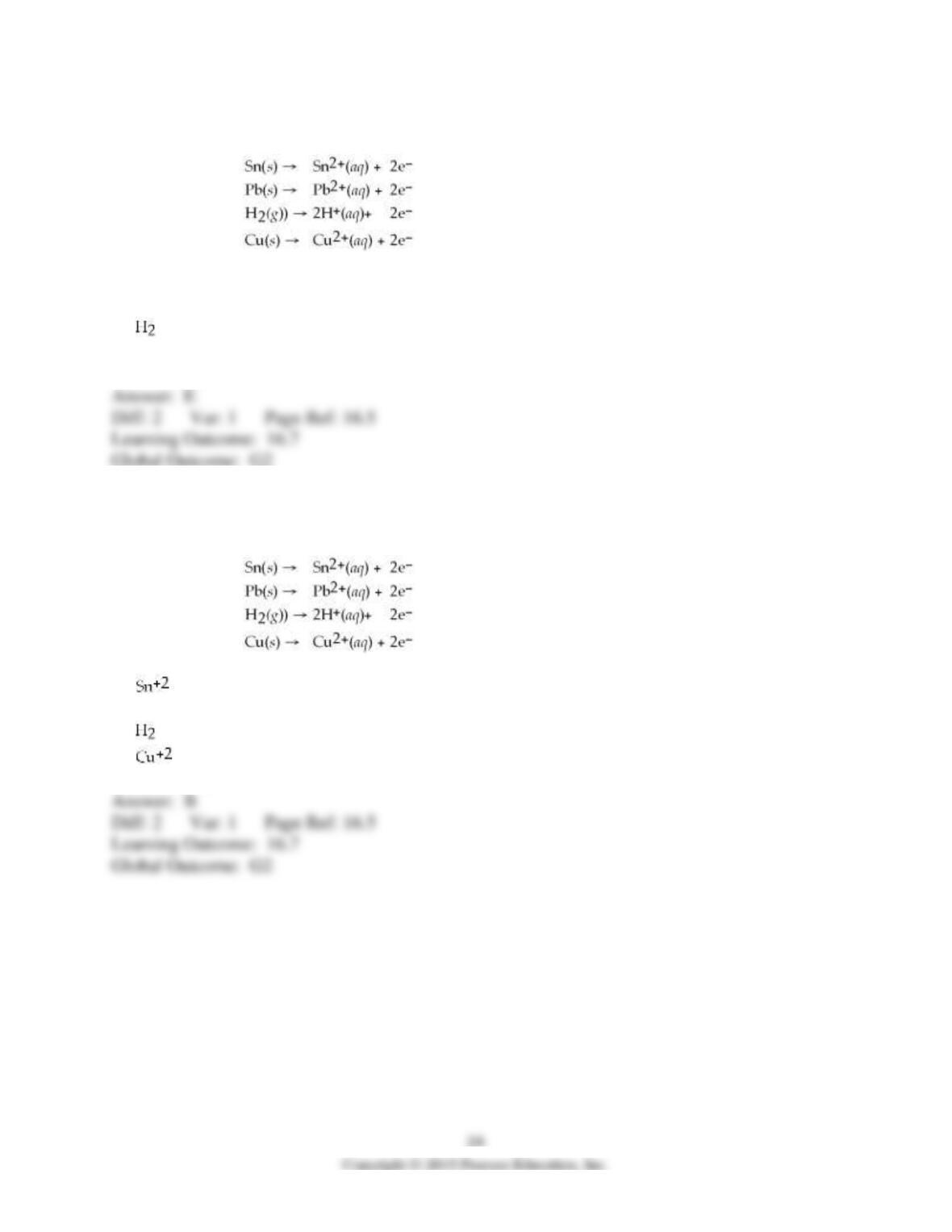
Activity Series =
A) Sn
B) Pb
C)
D) Cu
E) none of the above
56) Using the activity list included in this problem, which element/ion listed below is the most
easily oxidized?
Activity Series =
A)
B) Pb
C)
D)
E) none of the above
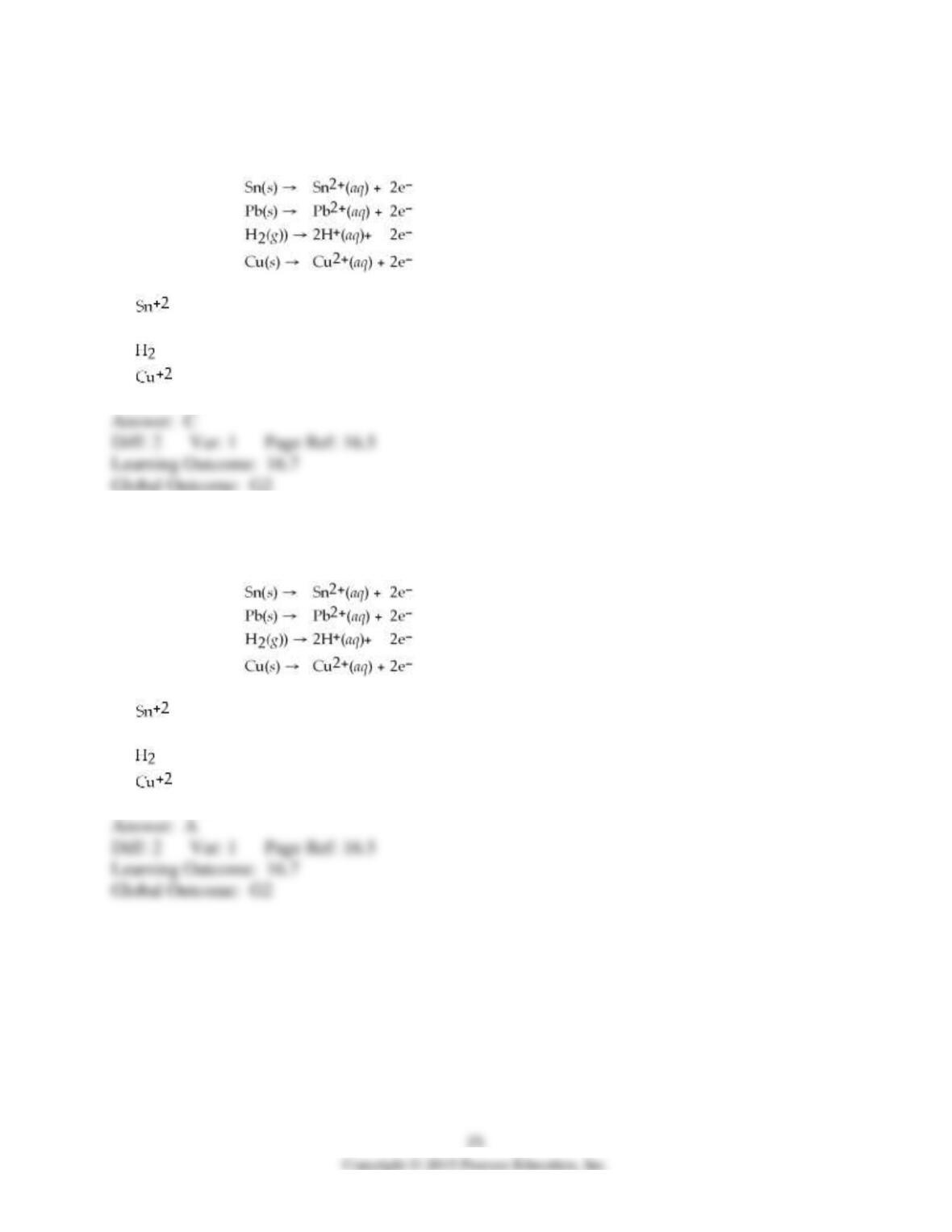
57) Using the activity list included in this problem, which element/ion is the most resistant to
oxidation?
Activity Series =
A)
B) Pb
C)
D)
E) none of the above
58) Using the activity list included in this problem, which element/ion is the most resistant to
reduction?
Activity Series =
A)
B) Pb
C)
D)
E) none of the above
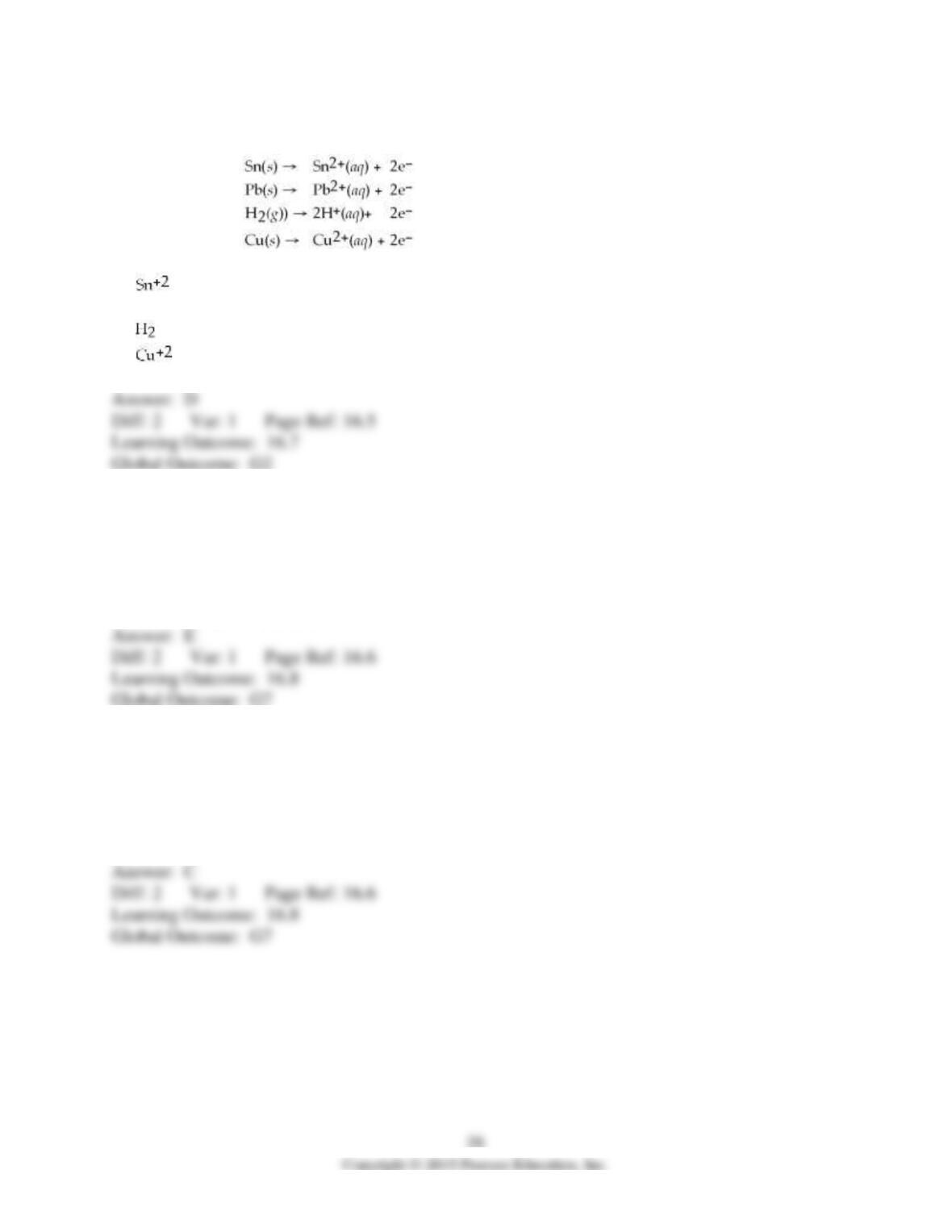
59) From the activity list included in this problem, which element/ion is the easiest to reduce?
Activity Series =
A)
B) Pb
C)
D)
E) none of the above
60) In an electrochemical cell, which of the following statements is FALSE?
A) The anode is the electrode where oxidation occurs.
B) A salt bridge provides electrical contact between the half-cells.
C) The cathode is the electrode where reduction occurs.
D) A spontaneous electrochemical cell is called a galvanic cell.
E) All of the above are true.
61) In an electrochemical cell, which of the following statements is FALSE?
A) Oxidation occurs at the anode.
B) Reduction occurs at the cathode.
C) Electrons flow through the salt bridge to complete the cell.
D) A spontaneous electrochemical cell is called a voltaic cell.
E) All of the above are true.
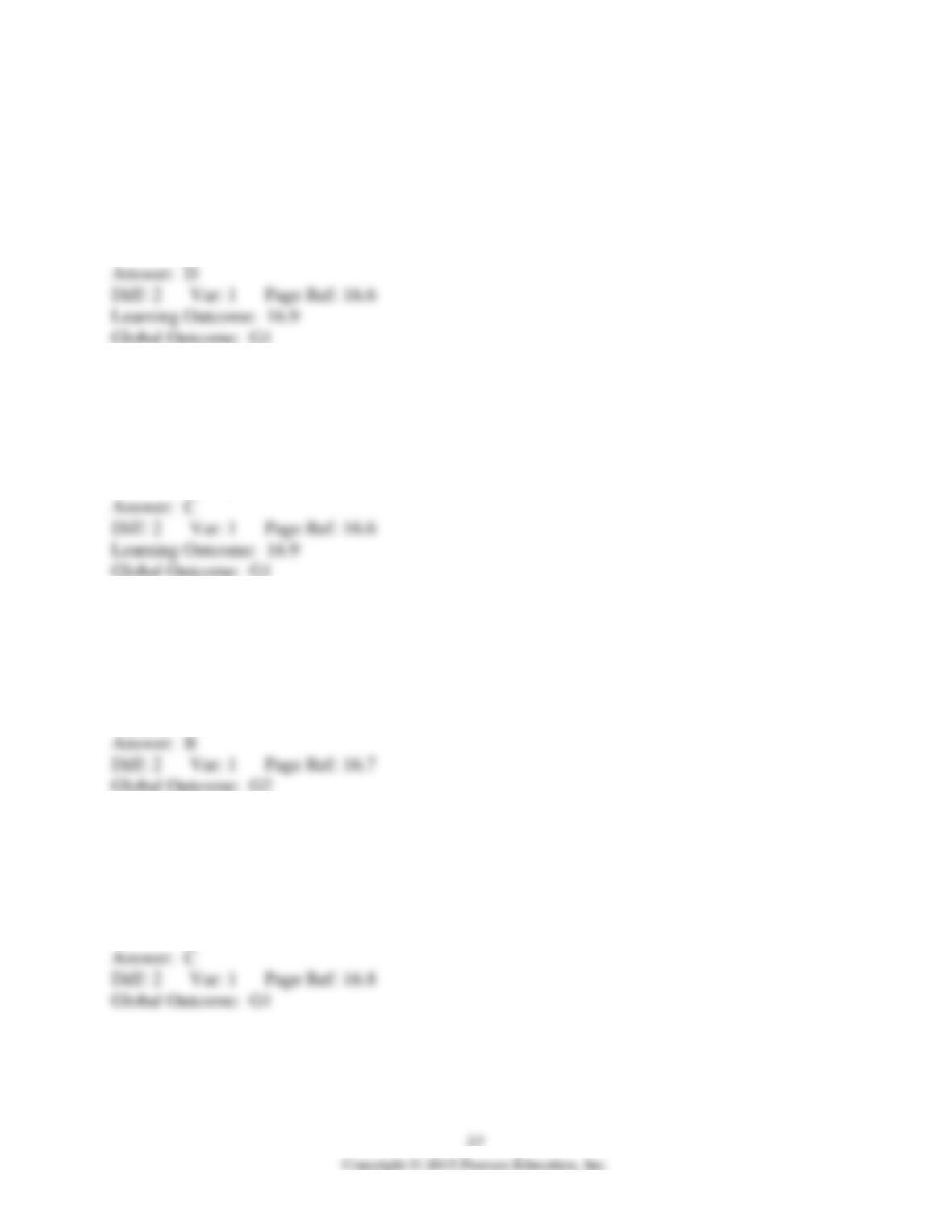
62) Which battery system is based on half reactions involving zinc metal and manganese
dioxide?
A) alkaline batteries
B) fuel cells
C) lead-acid storage batteries
D) dry-cell batteries
E) none of the above
63) Which battery system is completely rechargeable?
A) alkaline batteries
B) fuel cells
C) lead-acid storage batteries
D) dry-cell batteries
E) none of the above
64) In electrolysis:
A) a spontaneous redox reaction produces electricity.
B) a nonspontaneous redox reaction is forced to occur by applying an electric current.
C) only pure, drinkable water is produced.
D) you have a cell which reverses the flow of ions.
E) none of the above
65) Corrosion is the:
A) oxidation of nonmetals.
B) loss of electrons.
C) oxidation of metals.
D) formation of an insoluble hydroxide.
E) none of the above
66) Corrosion can be prevented by all of the following EXCEPT:
A) painting.
B) galvanizing.
C) sacrificial anode.
D) sacrificial cathode.
E) none of the above
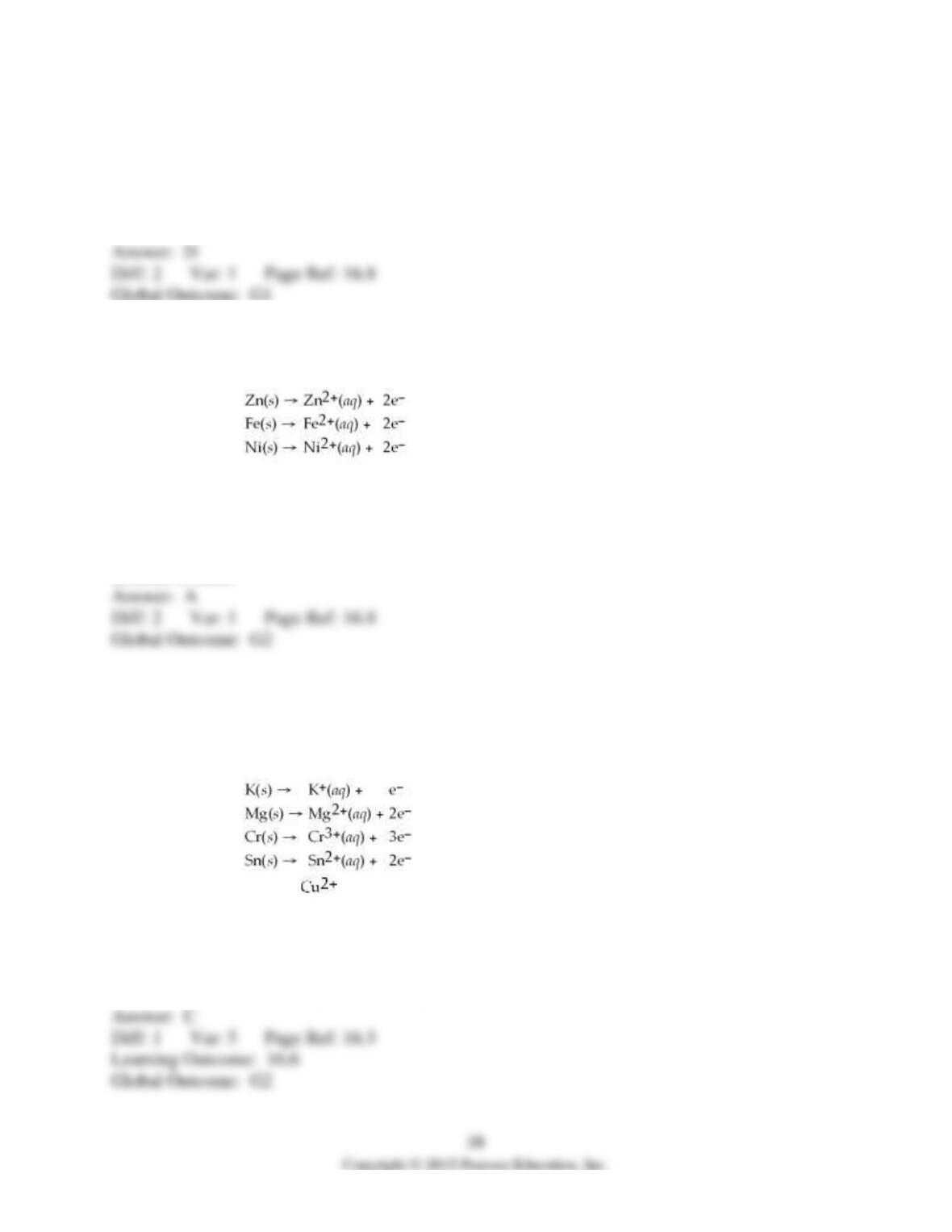
67) From the activity list included in this problem, which element below would serve as a
sacrificial electrode for iron?
Activity Series =
A) Zn
B) Fe
C) Ni
D) all of these
E) none of these
16.3 Algorithmic Questions
1) Examine the activity list given below to answer this question: Which element is most easily
oxidized, Mg , Cu, or K ?
Activity Series =
Cu(s) → (aq) + 2 e–
A) Mg
B) Cu
C) K
D) all of these elements oxidize equally well
E) none of these elements can be oxidized
16.4 Essay Questions
1) Distinguish between a galvanic (voltaic) cell and an electrolytic cell.
2) Suggest two methods to reduce corrosion of a metal such as iron and briefly explain how each
method works.