Introductory Chemistry, 5e (Tro)
Chapter 16 Oxidation and Reduction
16.1 True/False Questions
1) Cars are being developed that run on hydrogen gas and the only emission is water.
2) Fuel cells are based on the tendency of some elements to gain electrons from gasoline.
3) Reactions involving the transfer of electrons are called redox reactions.
4) Oxidation can be defined as the gain of oxygen atoms by another element.
5) Reduction can be defined as the gain of oxygen atoms by another element.
6) Redox reactions must involve the gain or loss of oxygen atoms.
7) Oxidation and reduction cannot both occur in the same chemical reaction.
8) Reduction is the gain of electrons.
9) Oxidation is the loss of electrons.
10) The oxidizing agent is the substance being reduced.
11) The reducing agent is reduced during the reaction.
12) The substance being reduced is the oxidizing agent while the substance being oxidized is the
reducing agent.
13) In the reaction S + O2 → SO2 , the O2 is being oxidized.
14) The sum of the oxidation numbers of all atoms in K2Cr2O7 equals zero.

3
15) The oxidation number of a chlorine atom is -1.
16) The oxidation number of sodium in NaI is +1.
17) The oxidation number of sulfur in S is -6.
18) The oxidation number of manganese in MnO41- is +7.
19) The reaction 2 NO2 → N2O4 would not be considered a redox reaction.
20) The half-reaction 2 Br 1- → Br2 + 2 e– is balanced with respect to mass but it is not balanced
with respect to charge.

21) Given that the Activity Series shown below is accurate, then Li(s) + (aq) → (aq) +
K(s) is a spontaneous reaction.
Activity Series =
22) (aq) + 2Na (s) → Ca (s) + (aq) is a spontaneous reaction.
Activity Series =
23) Most acids dissolve metals by the oxidation of H+ ions to hydrogen gas.
24) Gold metal is found at the bottom of the activity series of metals since it is the most difficult
metal to oxidize.
25) It can be shown that copper metal lies below H2 on the activity series of metals. This means
that copper will dissolve in hydrochloric acid.
26) Electrons flowing through a wire is an example of electrical current.
27) An electrochemical cell is based on the coupling of a spontaneous redox reaction.
28) Oxidation occurs at the cathode.
29) The cathode is the electrode at which reduction occurs.
30) Electrical current can be used to drive a nonspontaneous redox reaction.
31) A galvanic cell is a spontaneous electrochemical cell.
32) The driving force that causes electrons to flow through a wire is called current.
33) Flashlight batteries are called dry cells.
34) Alkaline batteries are used in automobiles.
35) To achieve the largest battery voltage possible, the battery should be assembled from a metal
high on the activity series list with a metal ion low on the activity series list.
36) An electrolytic cell is a spontaneous redox reaction.
37) A spontaneous redox reaction can be used to produce electrical current.
38) Electrolysis is used to recover many metals from their oxide ores.
39) Corrosion can be defined as the reduction of metals.
40) Corrosion of metals may be prevented by keeping them dry at all times.
41) The rusting of iron is an example of the process known as corrosion.
42) Rusting of iron requires the presence of both oxygen and water.
43) A sacrificial electrode works by being reduced which prevents the metal from being
oxidized.
16.2 Multiple Choice Questions
1) Which fact about fuel cells is FALSE?
A) Fuel cell automobiles are powered by water and the only emission is hydrogen.
B) Fuel cells are based on the tendency of some elements to gain electrons from other elements.
C) Fuel cell automobiles are whisper quiet.
D) Fuel cell automobiles are environmentally friendly.
E) all of the above
2) Oxidation typically involves:
A) the loss of electrons.
B) the loss of oxygen.
C) the gain of electrons.
D) the gain of water.
E) none of the above
3) Oxidation involves which of the following?
1. Loss of electron(s).
2. Gain of electron(s).
3. Increase in oxidation state.
A) 1 only
B) 2 only
C) 3 only
D) 1 and 3 only
E) 2 and 3 only
4) Reduction typically involves:
A) the loss of electrons.
B) the gain of oxygen.
C) the gain of electrons.
D) the gain of water.
E) none of the above
5) Reduction involves which of the following?
1. Loss of electron(s).
2. Gain of electron(s).
3. Decrease in oxidation state.
A) 1 only
B) 2 only
C) 3 only
D) 1 and 2 only
E) 2 and 3 only
6) The reducing agent typically:
A) gains electrons.
B) always remains unchanged during a reaction.
C) is the oxidized substance.
D) is itself reduced.
E) none of the above
7) The oxidizing agent typically:
A) loses electrons.
B) gains oxygen.
C) is the reactant that is reduced.
D) is oxidized.
E) none of the above

8) Which of the following are typically TRUE of an oxidizing agent?
1. It causes oxidation.
2. It gains electron(s).
3. It is the reduced substance.
A) 1 and 2 only
B) 1 and 3 only
C) 2 and 3 only
D) All of 1, 2, and 3
E) Neither 1, 2, or 3
9) Which of the following are typically TRUE of a reducing agent?
1. It causes reduction.
2. It gains electron(s).
3. It is the oxidized substance.
A) 1 and 2 only
B) 1 and 3 only
C) 2 and 3 only
D) All of 1, 2, and 3
E) Neither 1, 2 or 3
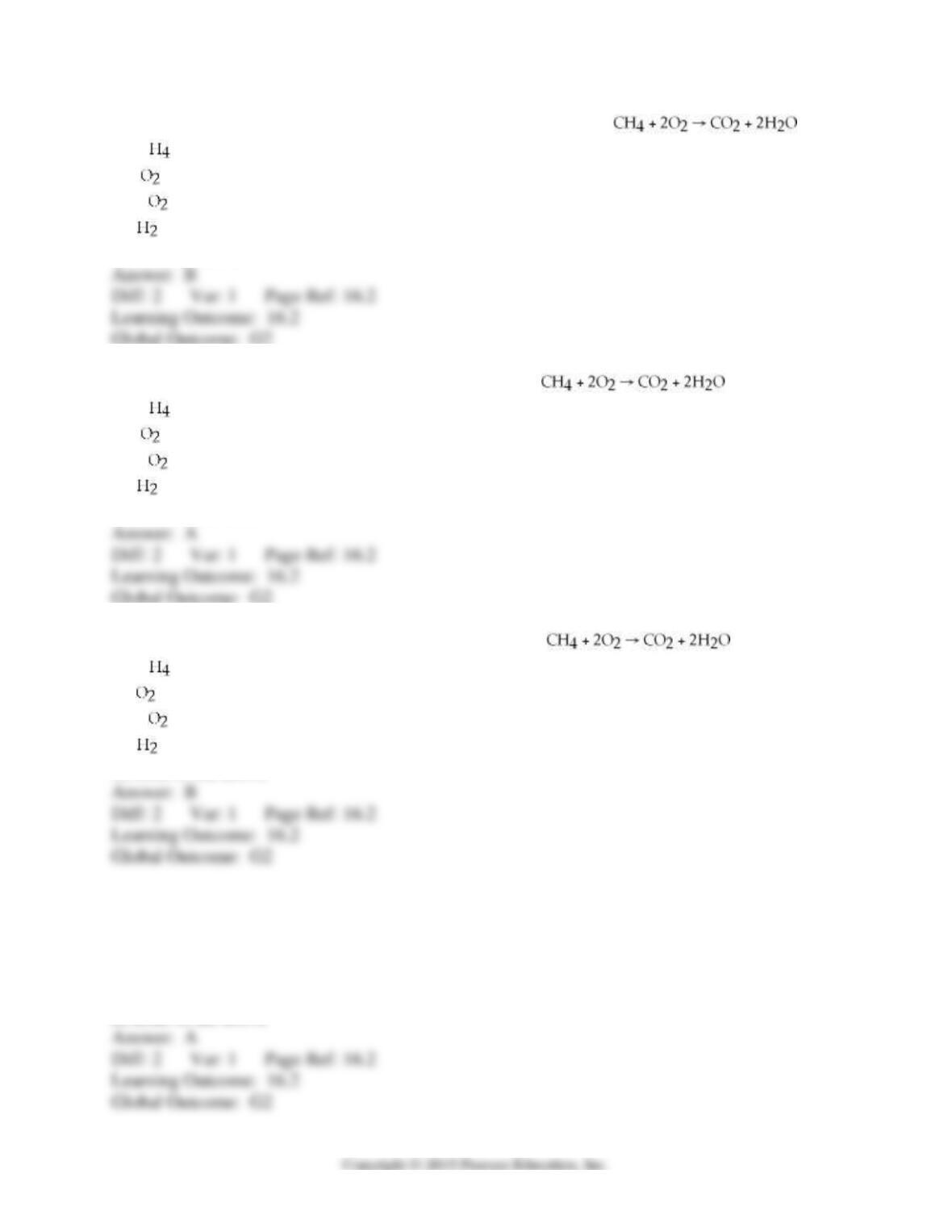
10) Identify the substance being oxidized in the following reaction: .
A) C
B)
C) C
D) O
E) none of the above
10
11) Identify the substance being reduced in the following reaction: .
A) C
B)
C) C
D) O
E) none of the above
12) Identify the reducing agent in the following reaction: .
A) C
B)
C) C
D) O
E) none of the above
13) Identify the oxidizing agent in the following reaction: .
A) C
B)
C) C
D) O
E) none of the above
14) For the reaction Si (s) + O2 (g) → SiO2 (g), the reducing agent is:
A) Si.
B) O2.
C) SiO2.
D) O.
E) none of the above

15) In the following reaction,
Mg (s) + (aq) → (aq) + Cu (s):
A) Mg is the reducing agent and Cu is the oxidizing agent.
B) is the reducing agent and Cu is the oxidizing agent.
C) Cu is the reducing agent and is the oxidizing agent.
D) is the reducing agent and Mg is the oxidizing agent.
E) Mg is the reducing agent and is the oxidizing agent.
16) In the following reaction,
Zn (s) + CuSO4 (aq) → ZnSO4 (aq) + Cu (s):
A) Zn is the reducing agent and CuSO4 is the oxidizing agent.
B) CuSO4 is the reducing agent and Zn is the oxidizing agent.
C) ZnSO4 is the reducing agent and Cu is the oxidizing agent.
D) is the reducing agent and Zn2+ is the oxidizing agent.
E) none of the above
17) The oxidation number of Cr in Cr2O7 2- is:
A) +2.
B) -2.
C) +7.
D) +6.
E) none of the above
18) What is the oxidation state of the underlined atom in the compound: S ?
A) +1
B) +2
C) -2
D) +6
E) +4

19) What is the oxidation state of the underlined atom in the compound: S ?
A) +1
B) +2
C) -2
D) +6
E) +4
20) What is the oxidation state of the underlined atom in the compound: C ?
A) +1
B) +2
C) -2
D) +4
E) +6
21) What is the oxidation state of the underlined atom in the reaction:
A) 0
B) +1
C) -1
D) +2
E) -2
22) What is the oxidation state of the underlined atom in the reaction:
A) 0
B) +1
C) -1
D) +2
E) -2

23) What is the oxidation state of the underlined atom in the reaction:
A) 0
B) +1
C) -1
D) +2
E) -2
24) What is the oxidation state of the underlined atom in the reaction:
A) 0
B) +2
C) -2
D) +4
E) -4
25) What is the oxidation state of nitrogen in N2O3?
A) 0
B) +1
C) +2
D) +3
E) +6
26) What is the oxidation state of sulfur in SO32-?
A) 0
B) -2
C) +3
D) +4
E) +6
27) The oxidation state of Na in Na2SO4 is:
A) +1
B) +2
C) +4
D) -1
E) none of the above
28) The oxidation state of Mn in KMnO4 is:
A) +1
B) -1
C) +5
D) +7
E) none of the above
29) The oxidation number of P in PO4 3- is:
A) -3
B) -5
C) +5
D) +8
E) none of the above
30) In which compound does manganese have the highest oxidation state?
A) Mn
B) Mn2O3
C) KMnO4
D) MnO2
E) none of the above

15
31) Which substance below would contain a nitrogen atom with the highest oxidation number of
all those shown?
A) NH4 1+
B) N2
C) NO2
D) NO3 1-
E) NH3
32) Assign the oxidation state of each atom in potassium chlorate, KClO3.
A) K = +1, Cl = +1, O = -2
B) K = -1, Cl = -1, O = +2
C) K = +1, Cl = +5, O = -2
D) K = +1, Cl = -1, O = 0
E) K = -1, Cl = +1, O = 0
33) Assign the oxidation state of each atom in sodium sulfate, Na2SO4.
A) Na = +1, S = +4, O = -2
B) Na = +1, S = -2, O = +4
C) Na = +2, S = +6, O = -2
D) Na = +1, S = +6, O = -2
E) Na = +2, S = -2, O = 0
34) For the reaction Co + Cl2 → CoCl2 , which statement is TRUE?
A) The cobalt is oxidized because its oxidation state changed from 0 to +2.
B) The cobalt is oxidized because it gained two electrons.
C) The oxidation state of each chlorine atom in Cl2 is -1.
D) Each chlorine atom is oxidized.
E) none of the above