Chapter 16: Kinetics: Rates and Mechanisms of Chemical Reactions
53. Consider the following mechanism for the oxidation of bromide ions by hydrogen
peroxide in aqueous acid solution.
H+ + H2O2 H2O+–OH (rapid equilibrium)
H2O+–OH + Br– → HOBr + H2O (slow)
HOBr + H+ + Br– → Br2 + H2O (fast)
What is the overall reaction equation for this process?
A) 2H2O+–OH + 2Br– → H2O2 + Br2 + 2H2O
B) 2H+ + 2Br– + H2O2 → Br2 + 2H2O
C) 2H+ + H2O2 + Br– + HOBr → H2O+–OH + Br2 + H2O
D) H2O+–OH + Br– + H+ → Br2 + H2O
E) none of the above
54. What is the molecularity of the following elementary reaction?
NH2Cl(aq) + OH–(aq) → NHCl–(aq) + H2O(l)
A) unimolecular
B) bimolecular
C) termolecular
D) tetramolecular
E) Need to know the reaction order before molecularity can be determined.
55. Consider the following mechanism for the oxidation of bromide ions by hydrogen
peroxide in aqueous acid solution.
H+ + H2O2 H2O+–OH (rapid equilibrium)
H2O+–OH + Br– → HOBr + H2O (slow)
HOBr + H+ + Br– → Br2 + H2O (fast)
Which of the following rate laws is consistent with the mechanism?
A) Rate = k[H2O2][H+]2[Br–] D) Rate = k[HOBr][H+][Br–][H2O2]
B) Rate = k [H2O+–OH][Br–] E) Rate = k[Br–]
C) Rate = k[H2O2][H+][Br–]
56. Which of the following affects the activation energy of a reaction?
A) temperature of the reactants D) surface area of reactants
B) concentrations of reactants E) reaction progress
C) presence of a catalyst
Chapter 16: Kinetics: Rates and Mechanisms of Chemical Reactions
57. A catalyst accelerates a reaction because
A) it increases the number of molecules with energy equal to or greater than the
activation energy.
B) it lowers the activation energy for the reaction.
C) it increases the number of collisions between molecules.
D) it increases the temperature of the molecules in the reaction.
E) it supplies energy to reactant molecules.
58. When a catalyst is added to a reaction mixture, it
A) increases the rate of collisions between reactant molecules.
B) provides reactant molecules with more energy.
C) slows down the rate of the back reaction.
D) provides a new pathway (mechanism) for the reaction.
E) does none of the above.
59. The gas-phase reaction CH3NC → CH3CN has been studied in a closed vessel, and the
rate equation was found to be: Rate = –[CH3NC]/t = k[CH3NC]. Which one of the following
actions is least likely to cause a change in the rate of the reaction?
A) lowering the temperature
B) adding a catalyst
C) using a larger initial amount of CH3NC in the same vessel
D) using a bigger vessel, but the same initial amount of CH3NC
E) continuously removing CH3CN as it is formed
Chapter 16: Kinetics: Rates and Mechanisms of Chemical Reactions
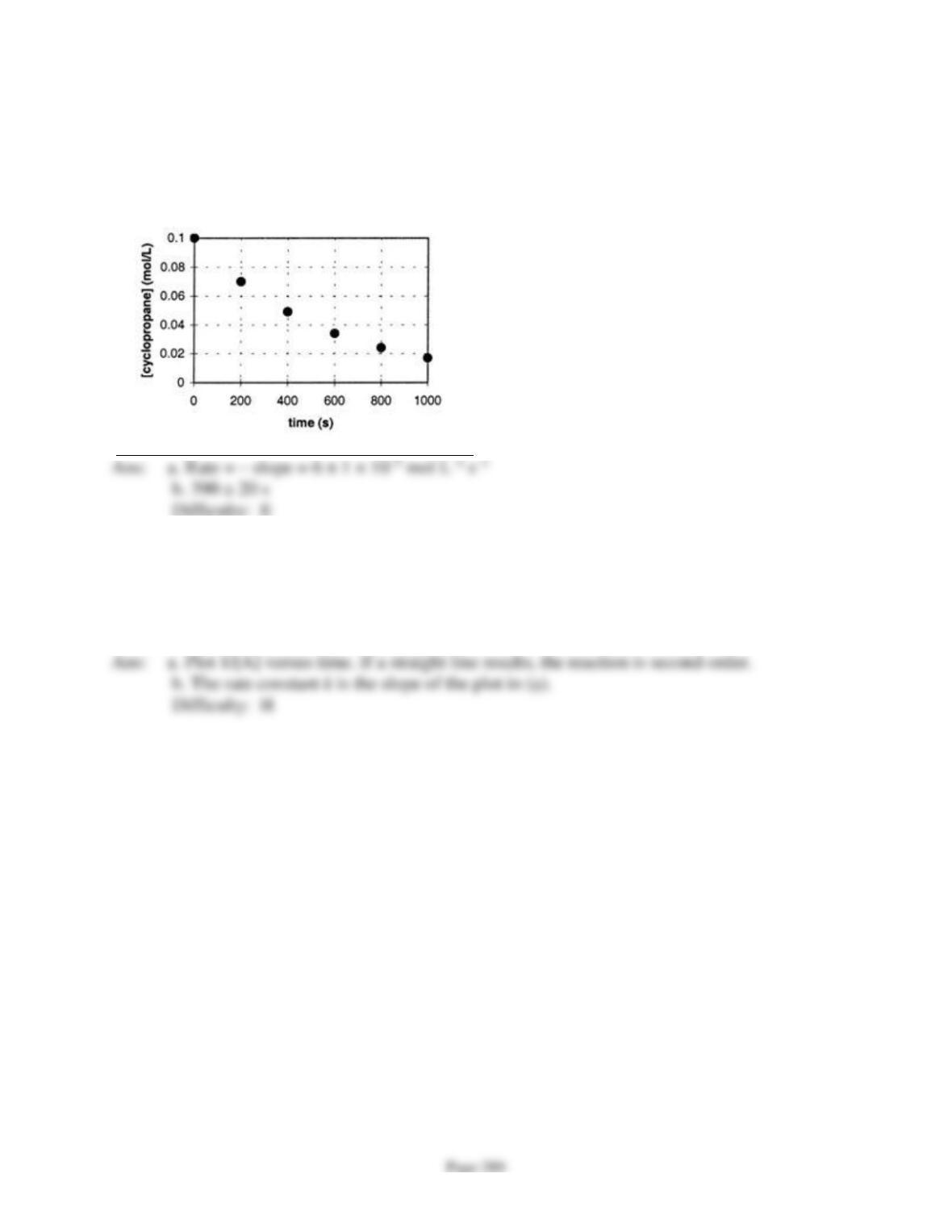
60. In the gas phase at 500.°C, cyclopropane reacts to form propene in a first-order reaction.
The figure below shows the concentration of cyclopropane plotted versus time. Use the graph to
calculate approximate values of
a. the rate of the reaction, 600. seconds after the start.
b. the half-life of the reaction, t1/2.
61. You are studying the rate of the reaction 2A → B and have obtained measurements of the
concentration of A at times t = 100, 200, 300, ……, 1000 seconds from the start of the reaction.
Carefully describe how you would plot a graph and use it to
a. prove that the reaction is second-order with respect to A.
b. determine the second-order rate constant k.
Chapter 16: Kinetics: Rates and Mechanisms of Chemical Reactions
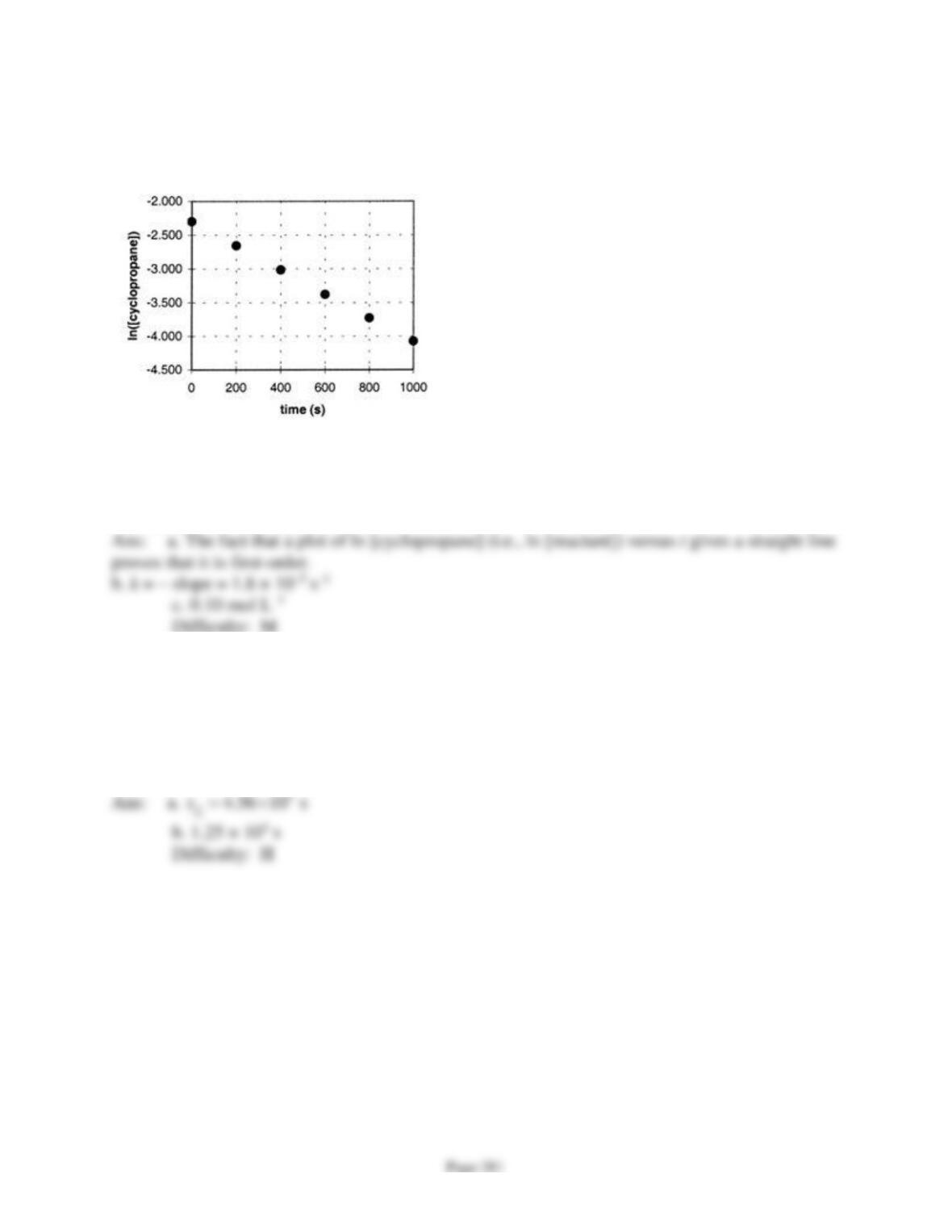
62. In the gas phase at 500.°C, cyclopropane reacts to form propene in a first-order reaction.
The figure shows the natural logarithm of the concentration of cyclopropane (in mol/L) plotted
versus time.
a. Explain how this plot confirms that the reaction is first order.
b. Calculate the first-order rate constant, k.
c. Determine the initial concentration of
cyclopropane in this experiment.
63. A chemical reaction of the general type
A → 2B
is first-order, with a rate constant of 1.52 × 10⁻⁴ s–1.
a. Calculate the half-life of A.
b. Assuming the initial concentration of A is 0.067 mol L–1, calculate the time needed for the
concentration to fall to 0.010 mol L–1.
Chapter 16: Kinetics: Rates and Mechanisms of Chemical Reactions
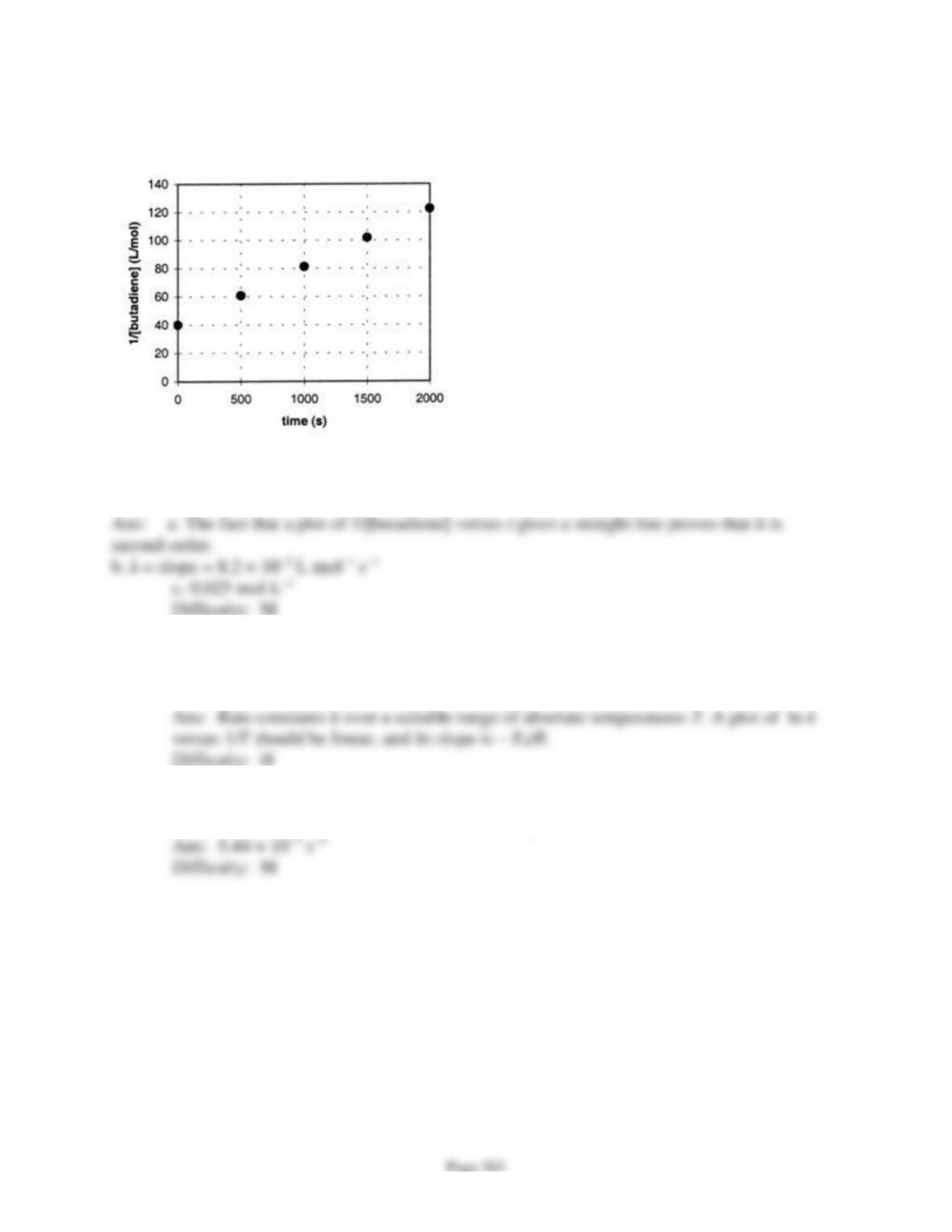
64. The gas-phase conversion of 1,3-butadiene to 1,5-cyclooctadiene, 2C4H6 → C8H12 was
studied, providing data for the plot shown, of 1/[butadiene] versus time.
a. Explain how this plot confirms that the reaction is second order.
b. Calculate the second-order rate constant, k.
c. Determine the initial concentration of 1,3-butadiene in this experiment.
65. You are required to determine the energy of activation (Ea) of a reaction. Briefly
describe the experimental measurements you would make and how you would obtain the
activation energy from a suitable linear plot of the experimental data.
66. At 25.0°C, a rate constant has the value 5.21 × 10⁻⁸ L mol–1 s–1. If the activation energy
is 75.2 kJ/mol, calculate the rate constant when the temperature is 50.0°C.
Chapter 16: Kinetics: Rates and Mechanisms of Chemical Reactions
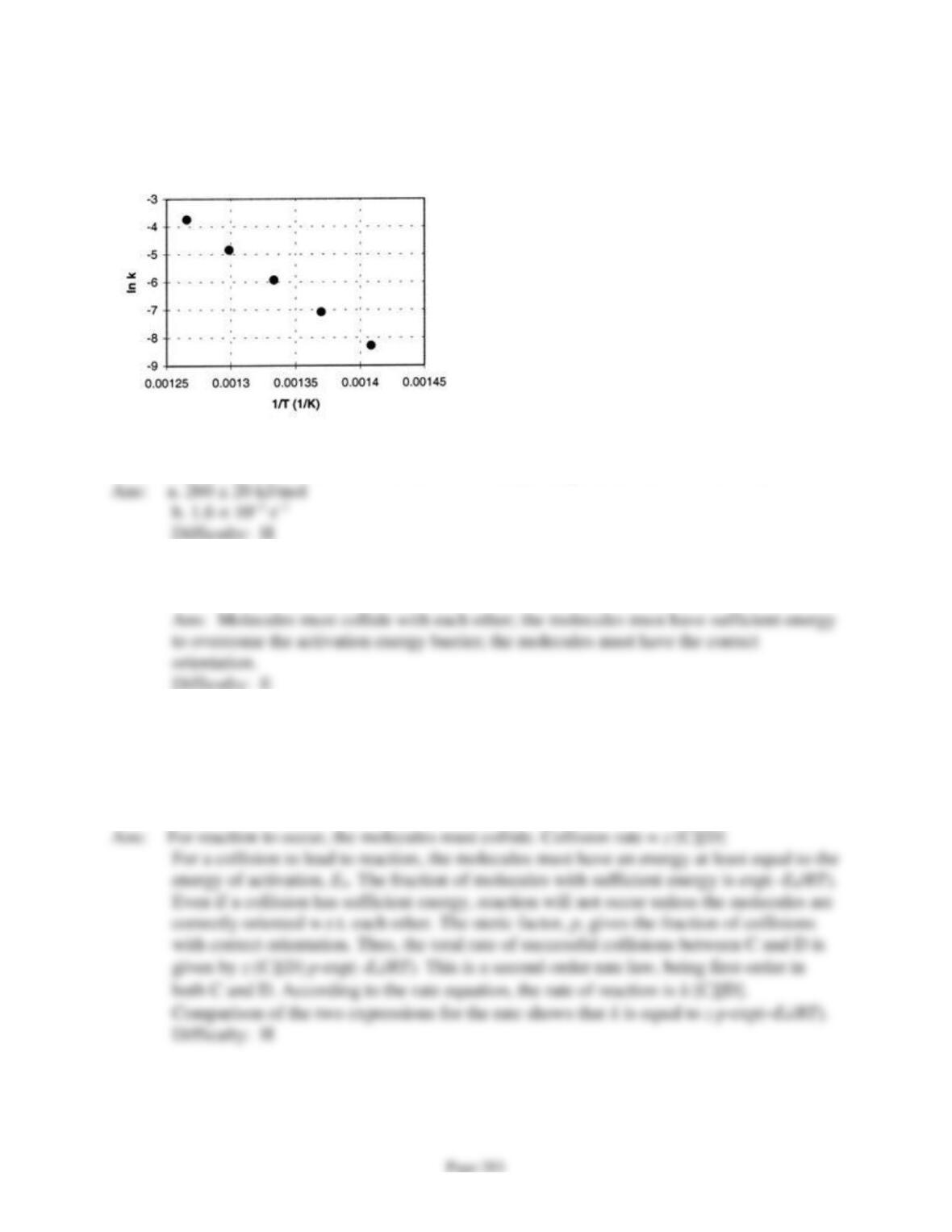
67. Cyclobutane decomposes to ethene in a first-order reaction. From measurements of the
rate constant (k) at various absolute temperatures (T), the accompanying Arrhenius plot was
obtained (ln k versus 1/T).
a. Calculate the energy of activation, Ea.
b. Determine the value of the rate constant at 740. K. (In the plot, the units of k are s–1.)
68. According to the collision theory of reaction rates, what are the three requirements which
must be met before an elementary reaction between two molecules can occur?
69. Briefly outline the key arguments in the collision theory of reaction rates for the
elementary reaction
C + D → products
Show that this theory predicts a second-order rate law, and how it predicts the form of the rate
constant k.
Chapter 16: Kinetics: Rates and Mechanisms of Chemical Reactions
70. In the collision theory of reaction rates, the rate constant for a bimolecular reaction can be
written as
k = zpexp(–Ea/RT)
In one sentence each, clearly explain the physical meaning (interpretation) of the following three
factors which appear in the above expression:
a. z
b. p
c. exp(–Ea/RT)
71. The elementary reaction HBr(g) + Br(g) → H(g) + Br2(g) is endothermic.
a. Would you expect the rate constant for the back reaction to be smaller or larger than that for
the forward reaction? Explain, briefly.
b. Draw a fully-labeled reaction energy diagram for this reaction, showing the locations of the
reactants, products, and transition state.
72. Is a bimolecular reaction necessarily second-order? Is a second-order reaction
necessarily bimolecular? Answer, with explanations and clarifications.
Chapter 16: Kinetics: Rates and Mechanisms of Chemical Reactions
73. For each of the following terms/concepts, give a brief explanation or definition. Where
possible, use examples.
a. order of a reaction
b. elementary reaction
c. reaction intermediate
74. Briefly list the features/properties common to all catalysts and how they work. Draw a
labeled reaction energy diagram as part of your answer.
75. Consider the general gas-phase reaction of a molecular substance, A
1. A → B
At very low pressures many such reactions occur by the following mechanism:
2. A + A → A* + A (slow)
3. A* → B (fast)
(A* represents a molecule with sufficient energy to overcome the activation energy barrier.)
a. Which of the three reactions above is/are elementary?
b. Where appropriate, identify the molecularity of the reactions.
c. Show that the proposed mechanism is consistent with reaction 1, the observed reaction.
d. Given the mechanism above, suggest a likely rate law for reaction (1).
Chapter 16: Kinetics: Rates and Mechanisms of Chemical Reactions
76. The rate law cannot be predicted from the stoichiometry of a reaction.
77. The units of the rate constant depend on the order of the reaction.
78. The units of the rate of reaction depend on the order of the reaction.
79. The half-life of a first-order reaction does not depend on the initial concentration of
reactant.
80. The half-life of a second-order reaction does not depend on the initial concentration of
reactant.
81. The greater the energy of activation, Ea, the faster will be the reaction.
82. An elementary reaction is a simple, one-step process.
83. All second-order reactions are bimolecular reactions.
84. All bimolecular reactions are second-order reactions.
85. The rate of a reaction is determined by the rate of the fastest step in the mechanism.
86. A transition state is a species (or state) corresponding to an energy maximum on a
reaction energy diagram.
87. A reaction intermediate is a species corresponding to a local energy maximum on a
reaction energy diagram.
88. A catalyst lowers the activation energy but does not affect the mechanism of a reaction.

Chapter 16: Kinetics: Rates and Mechanisms of Chemical Reactions
89. In a reversible reaction, a catalyst will speed up the forward reaction but not affect the
reverse reaction.
90. In the lock and key model of enzyme action, the active site on the enzyme provides an
exact fit for the substrate.
91. Chlorine atoms act as heterogeneous catalysts in the destruction of ozone in the
stratosphere.