Introduction to Chemical Principles, 11e (Stoker)
Chapter 15 Chemical Equations: Net Ionic and Oxidation -Reduction
15.1 Multiple Choice
1) For a substance to be considered a strong electrolyte, it must ________.
A) be an ionic compound.
B) dissociate almost completely into its ions in solution.
C) be highly soluble in water.
D) contain both metal and nonmetal atoms.
2) Which of the following is not an electrolyte?
A) HCl
B) KOH
C) Ne
D) NaBr
3) Which of the following would be a weak electrolyte in a solution?
A) KOH
B) HC2H3O2
C) HBr (aq)
D) KCl
4) In which of the following pairs of substances would both species in the pair be written in
molecular form in a net ionic equation?
A) HF and CO2
B) LiOH and H2
C) CO2 and H2SO4
D) NH4Cl and NaCl
2
5) In which of the following pairs of substances would both species in the pair be written in ionic
form in a net ionic equation?
A) CH3COOH and HNO3
B) Na2CO3 and Ba(NO3)2
C) AgCl and CO2
D) KBr and NH3
6) What are the spectator ions in the reaction between KOH and HNO3?
A) K+ and H+
B) H+ and OH–
C) K+ and NO3–
D) H+and NO3–
7) The net ionic equation for the reaction Ca(OH)2 + 2HCl —> 2H2O + CaCl2 is ________.
A) Ca2+ + 2Cl− —>CaCl2
B) Ca(OH)2 + 2H+ —> Ca2+ + H2O
C) OH− + H+ —> H2O
D) 2OH− + 2HCl —> 2H2O
8) The net ionic equation for the reaction CaCO3 + 2HNO3 —> Ca(NO3)2 + CO2 + H2O is
________.
A) CaCO3 + 2NO3− —> Ca(NO3)2 + CO32−
B) Ca2+ + 2NO3− —> Ca(NO3)2
C) CaCO3 + 2H+ —> Ca2+ + CO2 + H2O
D) CO32− + H+ —> CO2
9) In the reaction below, which species will not be written as its constituent ions when the
equation is expanded into the ionic equation?
Mg(OH)2 (s) + 2HCl (aq) —> MgCl2 (aq) + 2H2O (l)
A) HCl
B) MgCl2
C) Mg(OH)2 only
D) H2O and Mg(OH)2
10) Choose the response that lists all of the spectator ions in the chemical equation below.
Pb(NO3)2 (aq) + H2SO4 (aq) —> PbSO4 (s) + 2 HNO3 (aq)
A) Pb2+ and NO3−
B) Pb2+ and H+
C) H+ and SO42−
D) NO3− and H+
11) The reaction between sodium hydroxide and chloric acid produces ________.
A) a molecular compound and a weak electrolyte
B) two weak electrolytes
C) two strong electrolytes
D) a molecular compound and a strong electrolyte
12) Which is the balanced net ionic equation for the reaction between Ni(NO3)2 (aq) and NaOH
(aq)?
A) Na+ (aq) + NO3− (aq) —>NaNO3 (s)
B) Ni2+ (aq) + 2 Na+ (aq) —> NiNa2 (s)
C) Ni2+ (aq) + 2 OH− (aq) —> Ni(OH)2 (s)
D) Ni(NO3)2 (aq) + 2 NaOH (aq) —> Ni(OH)2 (s) + 2 NaNO3( aq)
13) Which of the following statements is not true of a redox reaction?
A) The reducing agent is the substance oxidized.
B) The reducing agent gains electrons.
C) The substance oxidized loses electrons.
D) The oxidizing agent is the substance reduced.
14) In the following reaction H2SO4 is ________.
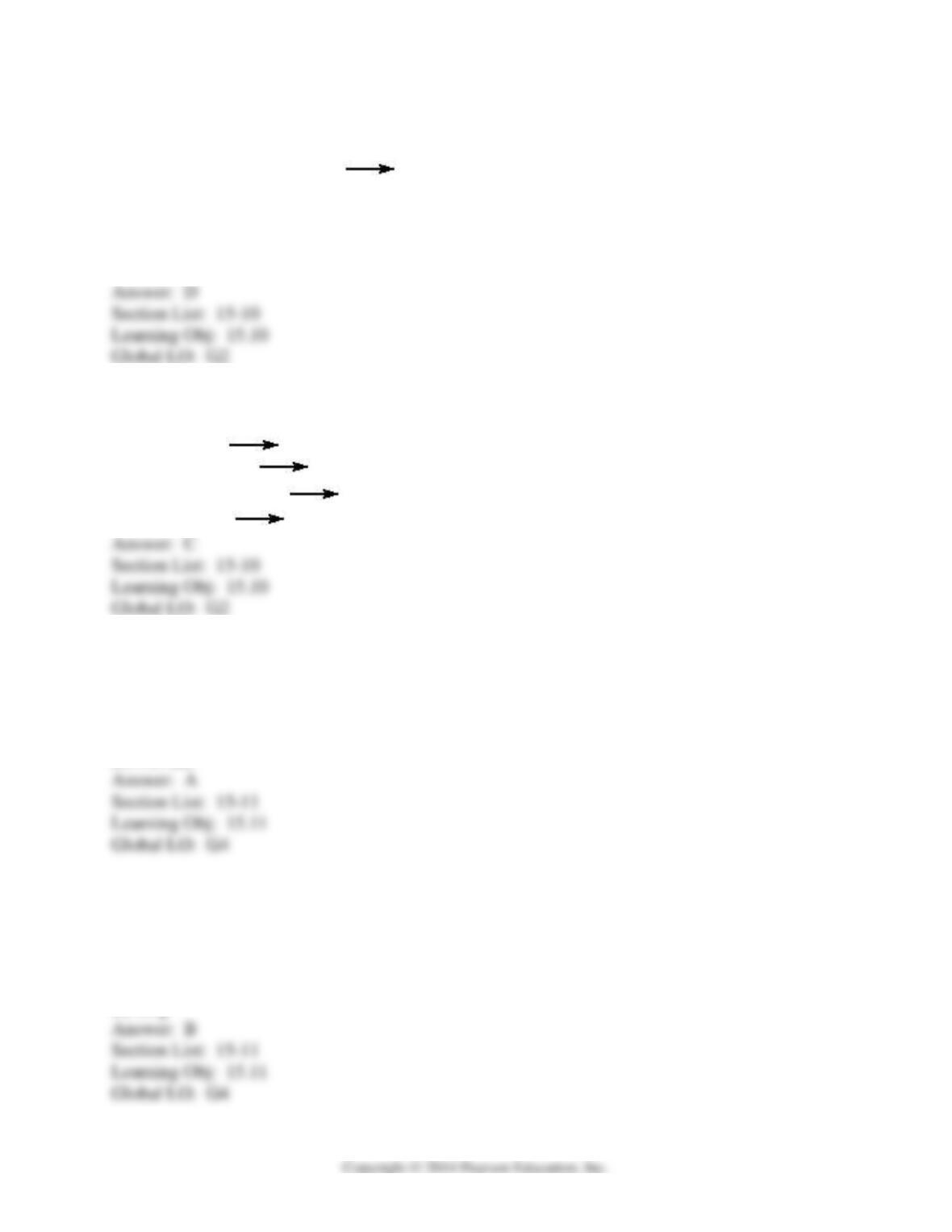
H2SO4 + HI I2 + SO2 + H2O
A) the oxidizing agent and is oxidized
B) the oxidizing agent and is reduced
C) the reducing agent and is oxidized
D) the reducing agent and is reduced
15) Identify the missing words (or phrases) in the following definition: “An oxidation number is
the ________ that an atom ________ when the electrons in each bond it is participating in are
assigned to the ________ electronegative of the two atoms involved in the bond.”
A) number of electrons, definitely has, more
B) number of electrons, appears to have, less
C) charge, appears to have, more
D) charge, definitely has, less
16) The proper assignment of oxidation numbers to the elements in Na2CrO4 would be
________.
A) +1 for Na, +6 for Cr and −2 for O
B) +1 for Na, +4 for Cr and −6 for O
C) +2 for Na, +3 for Cr and −2 for O
D) +2 for Na, +5 for Cr and −6 for O
5
17) +7 is the oxidation number of ________.
A) C in MgC2O4
B) S in H2SO4
C) Mn in KMnO4
D) Br in NaBrO3
18) The oxidation number of C in BaC2O4 is ________.
A) −3
B) −2
C) +2
D) +3
19) The oxidation number of Cr in K2Cr2O7 is ________.
A) +6
B) +5
C) +4
D) +2
20) In which of the following compounds does Cl have an oxidation number of +7?
A) LiClO3
B) Al(ClO4)3
C) Ca(ClO3)2
D) NaClO2
6
21) The oxidation number of iron in the compound FeBr3 is ________.
A) -2
B) +1
C) +2
D) +3
22) In which of the following sequences of sulfur-containing species are the species arranged in
order of decreasing oxidation number for S?
A) SO32−, SO42−, S2−
B) SO42−, S2O32−, S2−
C) S2O32−, SO32−, S2−
D) SO42−, S2−, S2O32−
23) In which of the following compounds is the oxidation number of oxygen not −2?
A) Ba(OH)2
B) Li2O2
C) NaCIO2
D) Na2SO4
24) In which of the following compounds is the oxidation number of hydrogen not +1?
A) NaH
B) H2SO4
C) HClO2
D) NH3
7
25) The pure element zinc has an oxidation number of ________ while in a compound like
ZnSO4 the oxidation number for zinc is ________.
A) 0, 0
B) 0, +1
C) +1, 0
D) 0, +2
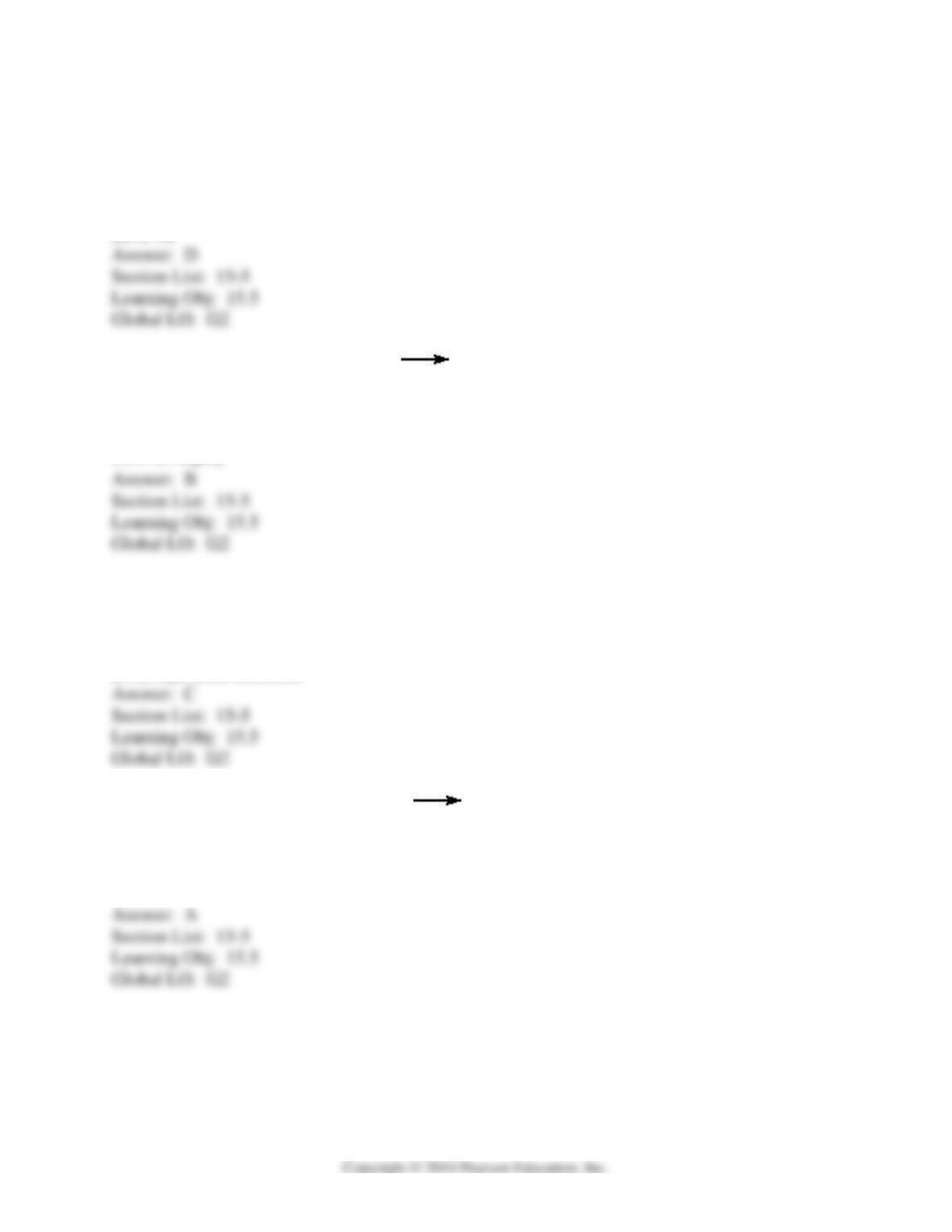
26) In the redox reaction: Al + MnO2 Al2O3 + Mn the oxidizing agent is ________.
A) Al
B) Mn in MnO2
C) O in MnO2
D) O in Al2O3
27) In a redox reaction the substance reduced ________.
A) contains an element which increases in oxidation number
B) is also the reducing agent
C) always gains electrons
D) always loses electrons
28) In the redox reaction: BaSO4 + 4 C BaS + 4 CO the element reduced is ________.
A) S in BaSO4
B) C
C) Ba in BaS
D) O in CO
8
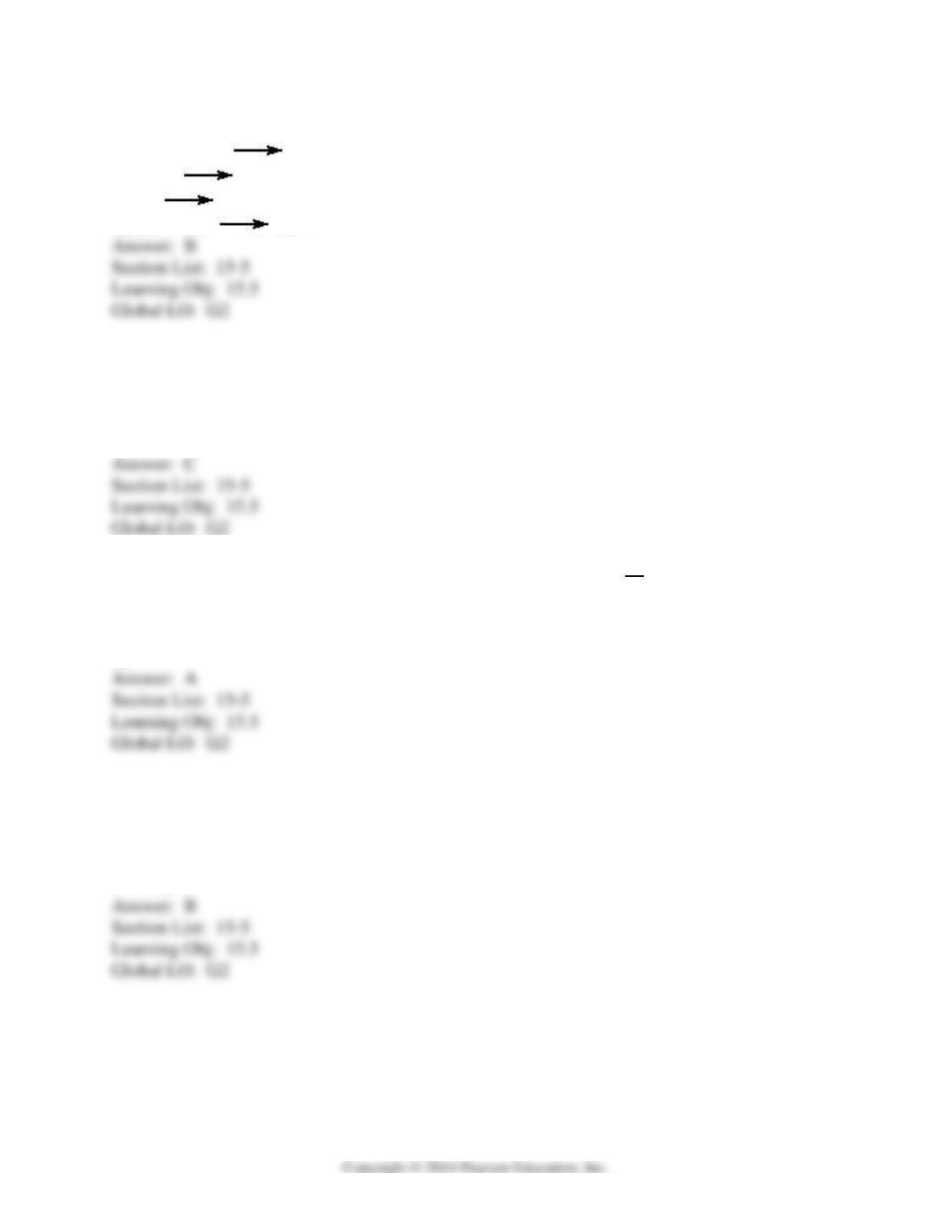
29) Which of the following accurately represents the oxidation of the Co+2 ion?
A) Co+2 + 2 e– Co
B) Co+2 Co+3 + e–
C) Co Co+2 + 2 e–
D) Co+3 + e– Co+2
30) Determine the oxidation number of C in NaHCO3.
A) +6
B) +12
C) +4
D) +5
31) Determine the oxidation number of the underlined element in NaBrO4.
A) +7
B) +4
C) -6
D) -4
32) In which of the following compounds does nitrogen have an oxidation number of +4?
A) HNO3
B) NO2
C) N2O
D) NH4Cl
33) Which reaction below can be classified as a redox/decomposition reaction?
A) 2 CuO 2 Cu + O2
B) 2 NO + O2 2 NO2
C) Sn + Cu(NO3)2 Sn(NO3)2 + Cu
D) Cu(NO3)2 + 2 NaOH Cu(OH)2 + 2 NaNO3
34) Which of the following equations is incorrectly classified as to type of chemical reaction?
Equation Reaction Type
A) CaCO3 CaO + CO2 decomposition/redox
B) H2O + SO2 H2SO3 synthesis/nonredox
C) Cl2 + F22 ClF synthesis/redox
D) AgNO3 + NaCl AgCl + NaNO3 double-displacement/non-redox
35) Which of the following equations is incorrectly classified as to type of chemical reaction?
Equation Reaction Type
A) NaHCO3 + HCl NaCl + H2O + CO2 double-replacement/nonredox
B) 2 Na + H2 2 NaH synthesis/redox
C) PbO + C Pb + CO single-replacement/nonredox
D) 2 Na + 2 HCl 2 NaCl + H2 single-replacement/redox
10
36) The following reactions are classified first as redox or nonredox. They are further classified
as synthesis, decomposition, single replacement, or double displacement reactions. Which of the
following reactions is incorrectly classified as to redox/nonredox or as to synthesis,
decomposition, single-replacement, or double-displacement (precipitation) reactions?
A) HNO3(aq) + LiOH(aq) LiNO3(aq) + H2O(l)
non-redox / double-displacement
B) Pb(NO3)2(aq) + 2 Na(s) Pb(s) + 2 NaNO3(aq)
redox / single-replacement
C) 2 H2O2(s) 2 H2O(l) + O2(g)
non-redox / decomposition
D) AgNO3(aq) + KOH(aq) KNO3(aq) + AgOH(s)
non-redox / precipitation
37) Which of the following reactions is a redox single replacement reaction?
A) Zn + H2SO4 H2 + ZnSO4
B) 2 KClO3 2 KCl + 3 O2
C) 2 NO2 + H2O2 2 HNO3
D) SO3 + H2O H2SO4
38) Which of the following reactions is not a redox reaction?
A) SO3 + H2O H2SO4
B) 2 Na + Mg2+ Mg + 2 Na
C) Cl2 + 2I− 2 CI− + I2
D) Na + AgNO3 NaNO3 + Ag
39) In the redox reaction: 4 Cr + 3 O2 + 12 HBr 4 CrBr3 + 6 H2O the change in
oxidation number for O is from ________.
A) +4 to −4
B) +2 to 0
C) 0 to −2
D) +3 to 0
40) In the redox reaction: 2 HNO2 + 2 HI 2 NO + I2 + 2 H2O
A) HNO2 is the oxidizing agent.
B) HNO2 is the substance oxidized.
C) I undergoes an oxidation number increase of 2 units per atom.
D) N undergoes an oxidation number increase of 2 units per atom.
41) In the following reaction: 2 Mn+2 + Br2 2 Mn+3 + 2 Br– the species that is oxidized
is:
A) Mn2+
B) Br–
C) Mn+3
D) Br2
42) In the following reaction, which species is the reducing agent?
3 Cu (s) + 6 H+ (aq) + 2 HNO3 (aq) 3 Cu+2 (aq) + 2 NO (g) + 4 H2O (l)
A) H+
B) Cu
C) N in NO
D) Cu+2
43) Which substance is serving as the reducing agent in the following reaction?
Fe2S3 + 12 HNO3 2 Fe(NO3)3 + 3 S + 6 NO2 + 6 H2O
A) HNO3
B) S
C) NO2
D) Fe2S3
44) In the following reaction: 2 Al (s) + 3 I2 (s) 2 AlI3 (s) which species is the oxidizing
agent?
A) Al
B) AlI3
C) I2
D) none of the species
45) Which substance is serving as the reducing agent in the following reaction?
14H+ + Cr2O7-2 + 3 Ni 3 Ni2+ + 2 Cr+3 + 7 H2O
A) Ni
B) H+
C) Cr2O7-2
D) H2O
46) Which substance is serving as the oxidizing agent in the following reaction?
14H+ + Cr2O7-2 + 3 Ni 3 Ni2+ + 2 Cr+3 + 7 H2O
A) Ni
B) H+
C) Cr2O7-2
D) H2O
47) How many electrons are lost or gained by each formula unit of CuBr2 in the following
reaction?
Zn + CuBr2 ZnBr2 + Cu
A) gains 2 electrons
B) loses 2 electrons
C) loses 1 electron
D) gains 6 electrons
48) When the redox reaction: NF3 + AlCl3 N2 + Cl2 + AlF3 is balanced, the correct
coefficients for NF3 and Cl2, respectively, are ________.
A) 3 and 4
B) 4 and 2
C) 2 and 3
D) 6 and 3
49) When the redox reaction: Zn + As2O3 AsH3 + Zn2+ (acidic solution) is balanced,
the correct coefficients for H2O, H+ and AsH3 are, respectively, ________.
A) 6, 6 and 3
B) 6, 3 and 12
C) 3, 12 and 2
D) 4, 8 and 3
50) Which of the following is a correctly balanced oxidation half-reaction?
A) H2C2O4 2 CO2 + 2 H+ + 2e−
B) I2 + 2e− 2 I−
C) HOCl + H+ + 2e− Cl− + H2O
D) H2S S + 2 H+ + 4e−
51) The balanced full-equation obtained by adding the following two balanced half-reactions is
________.
2H2O + PH3 H3PO2 + 4H+ + 4e−
I2 + 2e− 2I−
A) 2 H2O + PH3 + I2 H3PO2 + 4 H+ + 2 I− + 2 e−
B) 4 H2O + 2 PH3 + I2 2 H3PO2 + 8 H+ + 2 I−
C) 2 H2O + PH3 + 2 I2 H3PO2 + 8 I− + 8 H+
D) 2 H2O + PH3 + 2 I2 H3PO2 + 4 I− + 4 H+
52) When the half-reaction: MnO4− Mn2+ (acidic solution) is correctly balanced
________.
A) the H+ and H2O are both on the left side of the equation
B) the H+ and H2O are both on the right side of the equation
C) the H+ is on the left side, and the H2O on the right side of the equation
D) the H+ is on the right side, and the H2O on the left side of the equation
53) When the following equation is balanced in an acidic solution, what is the sum of the
coefficients?
HNO2 + Cr2O7-2 Cr+3 + NO3–
A) 17
B) 18
C) 19
D) 20
54) Which is the balanced half reaction (in basic solution) for the reaction below?
Cr(OH)4− CrO42−
A) 3 e− + Cr(OH)4− + 2 OH− CrO4−2 + 2 H2O
B) 4 OH− + Cr(OH)4− CrO42− + 3e− + 4 H2O
C) 2 OH− + Cr(OH)4− CrO42− + 6 e− + 3 H2O
D) Cr(OH)4− CrO42− + 4 H2O + 2 e−
55) Which reaction is the correctly balanced half reaction (in acid solution) for the process
below?
Cr2O72− (aq) Cr3+ (aq)
A) 14 H+ + Cr2O72− + 6 e− 2 Cr3+ + 7 H2O
B) 8 H+ + Cr2O7 + 3 e− 2Cr3+ + 4 H2O
C) 8 H+ + Cr2O7 2 Cr3+ + 4 H2O + 3 e−
D) 12 H+ + Cr2O72− + 3 e− 2 Cr3+ + 6 H2O
56) Which response represents the balanced half reaction for oxidation for the reaction given
below? HCl (aq) + Fe (s) FeCl3 (aq) + H2 (g)
A) 6 e− + 6 H+ 3 H2
B) 2 Fe 2 Fe3+ + 6 e−
C) 3 Fe Fe3+ + 3 e−
D) Fe + 3 e− Fe3+
57) Which response represents the balanced half reaction for reduction for the reaction given
below? Fe (s) + CuSO4 (aq) Fe2(SO4)3(aq) + Cu (s)
A) 2 Cu2+ + 3 e− 2 Cu
B) Fe + 3 e− Fe3+
C) 3 Cu2+ + 6 e− 3 Cu
D) 2 Fe 2 Fe3+ + 6e−
58) Balance the following net ionic equation using the half reaction method (in acidic solution).
What is the coefficient for MnO4−? H+ + Fe2+ + MnO4− Fe3+ + Mn2+ + H2O
A) 8
B) 5
C) 1
D) 14
59) Balance the following net ionic equation using the half reaction method (in acidic solution).
What is the sum of the coefficients for the balanced reaction?
MnO4− + SO32− Mn2+ + SO42−
A) 27
B) 29
C) 21
D) 23
60) Which of the following reactions is a disproportionation reaction?
A) 2 H2O 2 H2 + O2
B) H2SO3 H2O + SO2
C) HNO2 NO + NO3−
D) Mg + H2SO4 MgSO4 + H2
61) In balancing the equation for a disproportionation reaction, using the oxidation number
method, the substance undergoing disproportionation is ________.
A) initially written twice on the reactant side of the equation
B) initially written twice on the product side of the equation
C) initially written on both the reactant and product sides of the equation
D) always assigned an oxidation number of zero
17
62) In the disproportion equation below, what species is undergoing disproportionation?
3 Br2 + 6 OH− BrO3− + 5 Br− + 3 H2O
A) OH−
B) Br−
C) H2O
D) Br2
63) Which of the following formula unit or net ionic equations represents a disproportionation
reaction?
A) Fe + 3 Ag+ Fe3+ + 3 Ag
B) 2 HNO3 + SO2 H2SO4 + 2 NO2
C) ClO− + Cl− + 2 H+ Cl2 + H2O
D) CH4 + 2 O2 CO2 + H2O
64) What volume, in mL, of a 0.400 M Fe(NO3)3 solution is needed to supply 0.850 moles of
nitrate ions?
A) 708 mL
B) 230 mL
C) 0.708 mL
D) 340 mL
65) How many grams of Ba+2 ions are there in an aqueous solution of BaCl2 that contains 6.8 x
1022 Cl-1 ions?
A) 16 g
B) 7.8 g
C) 2.7 x 1048
D) 11 g
15.2 Short Answer
1) Assign an oxidation number to each atom in the following chemical reaction.
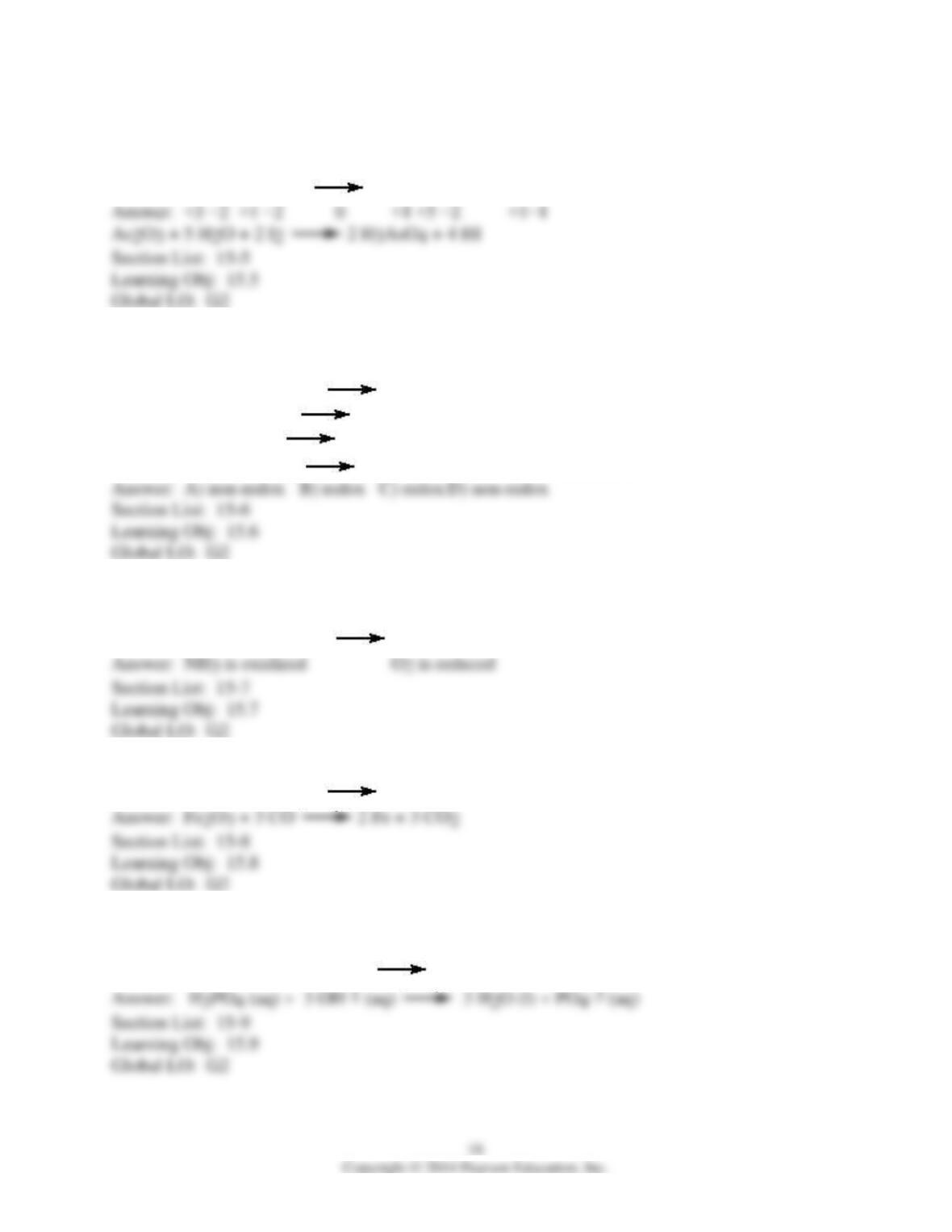
As2O3 + 5 H2O + 2 I2 2 H3AsO4 + 4 HI
2) Indicate whether each of the following formula unit or net ionic equations is or is not a redox
reaction by writing the word redox or non-redox in the blank spaces provided below.
A) NH4+(aq) + CN−(aq) HCN(aq) + NH3(aq) ________
B) 2 Al(s) + 3 FeO(s) 3 Fe(s) + Al2O3(s) ________
C) N2(g) + 3 H2(g) 2 NH3(g) ________
D) Ag+(aq) + Cl−(aq) AgCl(s) ________
3) Identify which substance is oxidized and which substance is reduced in the following
chemical reaction.
4 NH3 + 3 O2 2 N2 + 6 H2O
4) Balance the following equation by the oxidation-number method.
Fe2O3 + CO Fe + CO2
5) Write the balanced net ionic equation for the following acid-base reaction using the simplest
whole number ratio of coefficients.
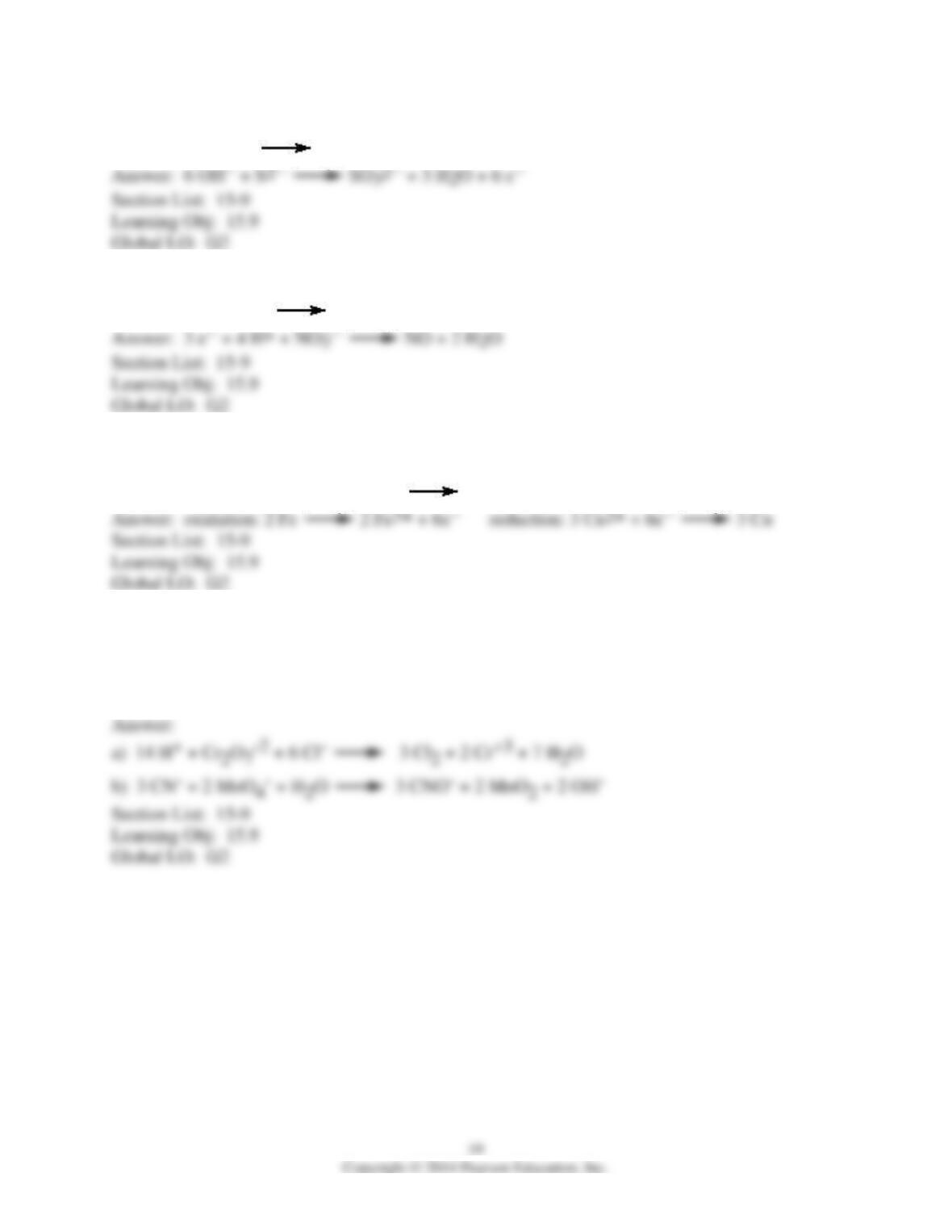
H3PO4 (aq) + 3 LiOH (aq) 3 H2O (l) + Li3PO4 (aq)
6) Balance the following half reaction in basic solution.
S2− SO32−
7) Balance the following half reaction in acidic solution.
NO3− NO
8) Write the balanced half reactions for oxidation and reduction for the following chemical
equation.
Fe (s) + Cu(NO3)2 (aq) Fe(NO3)3 (aq) + Cu (s)
9) Balance the following reactions for the solution type indicted. Be sure to identify which is
oxidized and reduced.
a) Cr2O7-2 (aq) + Cl– (aq) Cr+3 (aq) + Cl2 (g) (acidic)
b) CN– (aq) + MnO4– (aq) CNO– (aq) + MnO2 (s) (basic)