16
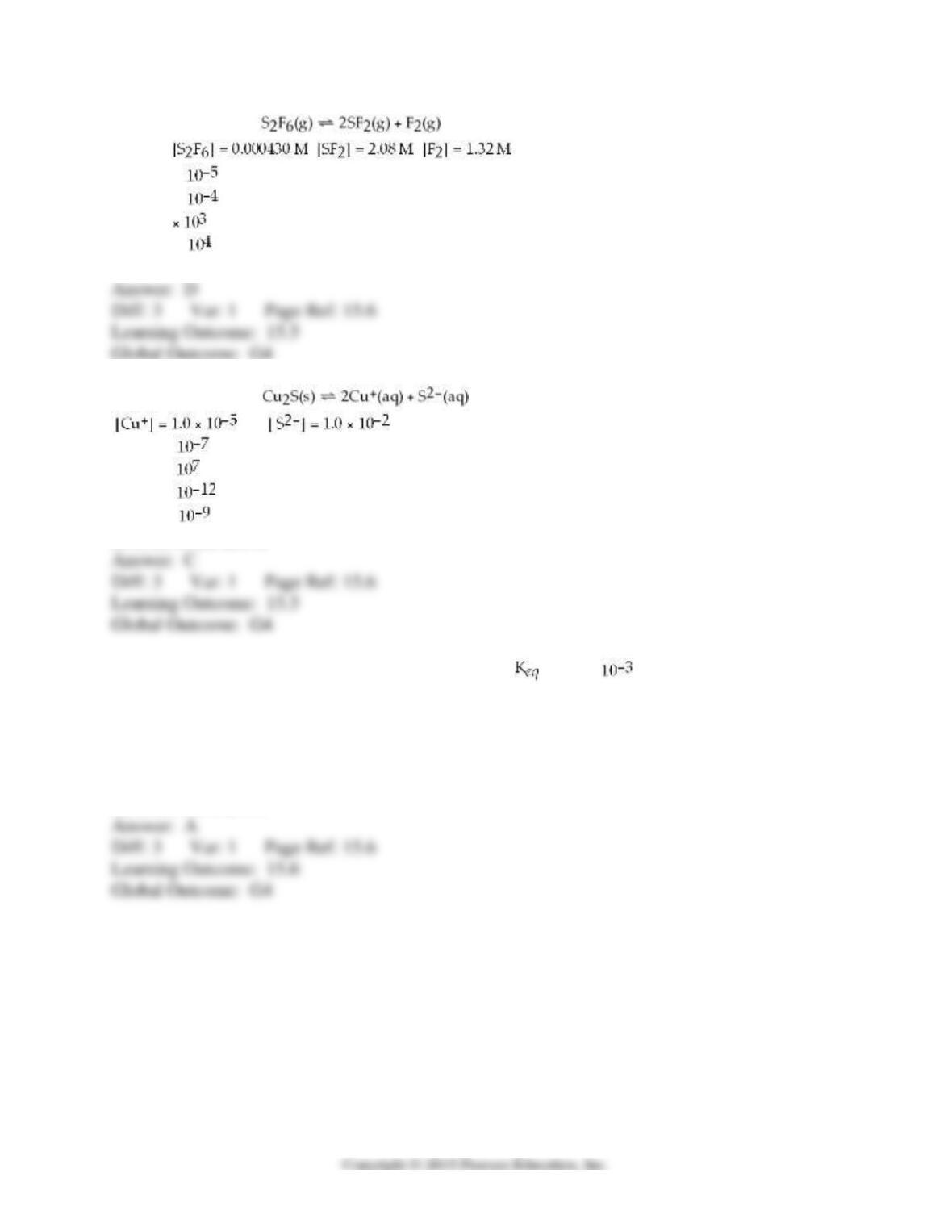
27) For the reaction , the equilibrium concentrations are as
follows: , , . The equilibrium constant is:
A) 7.53 ×
B) 1.19 ×
C) 8.43
D) 1.33 ×
E) none of the above
28) For the reaction , the equilibrium concentrations are as follows:
M, M. The equilibrium constant is:
A) 1.0 × .
B) 1.0 × .
C) 1.0 × .
D) 1.0 × .
E) none of the above
29) For the reaction LiOH (s) ⇌ Li+ (aq) + OH– (aq), = 4.6 × , and the equilibrium
concentration for hydroxide ion is [OH–] = 0.042 M. What is [Li+] at equilibrium?
A) 0.11 M
B) 0.0046 M
C) 0.042 M
D) An answer cannot be determined without [LiOH] value.
E) none of the above
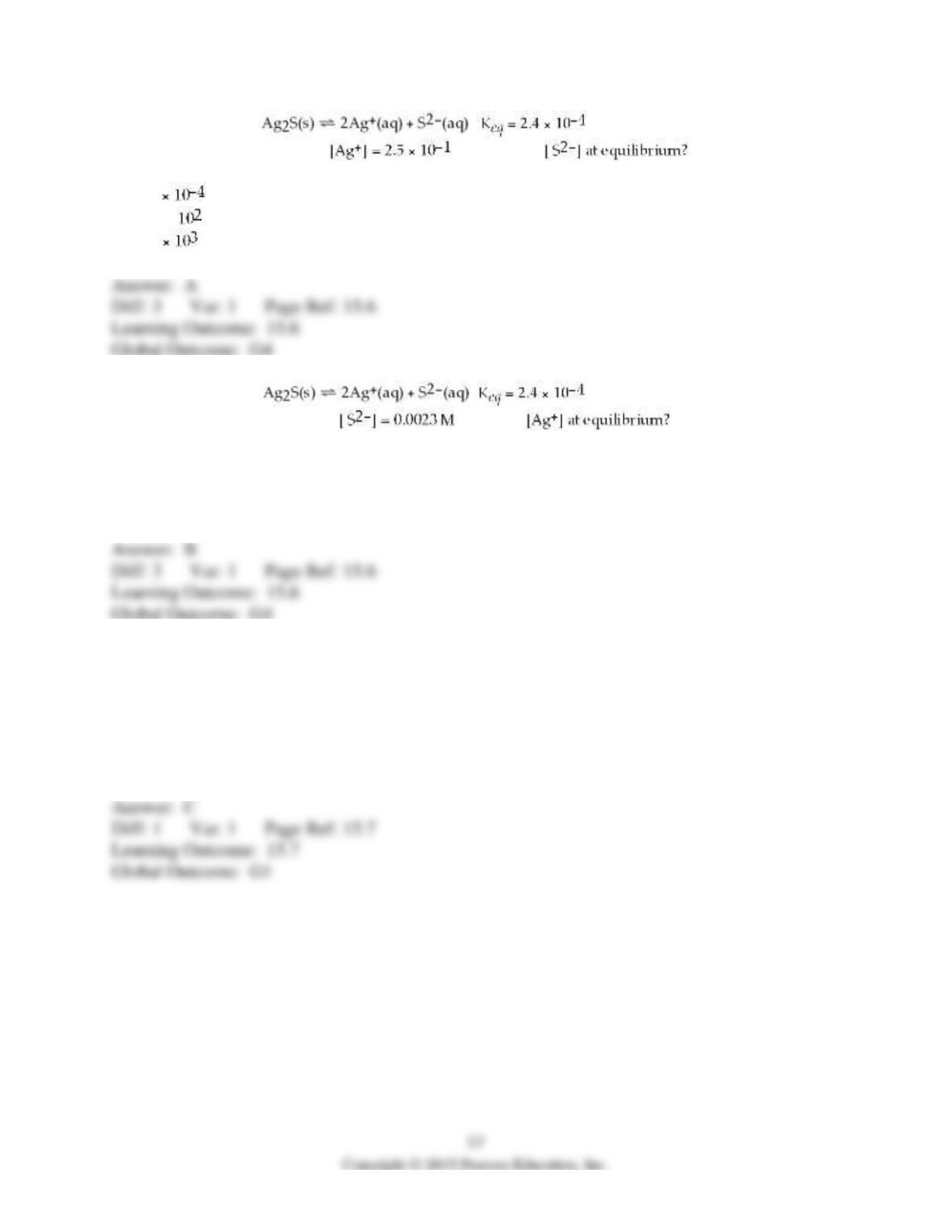
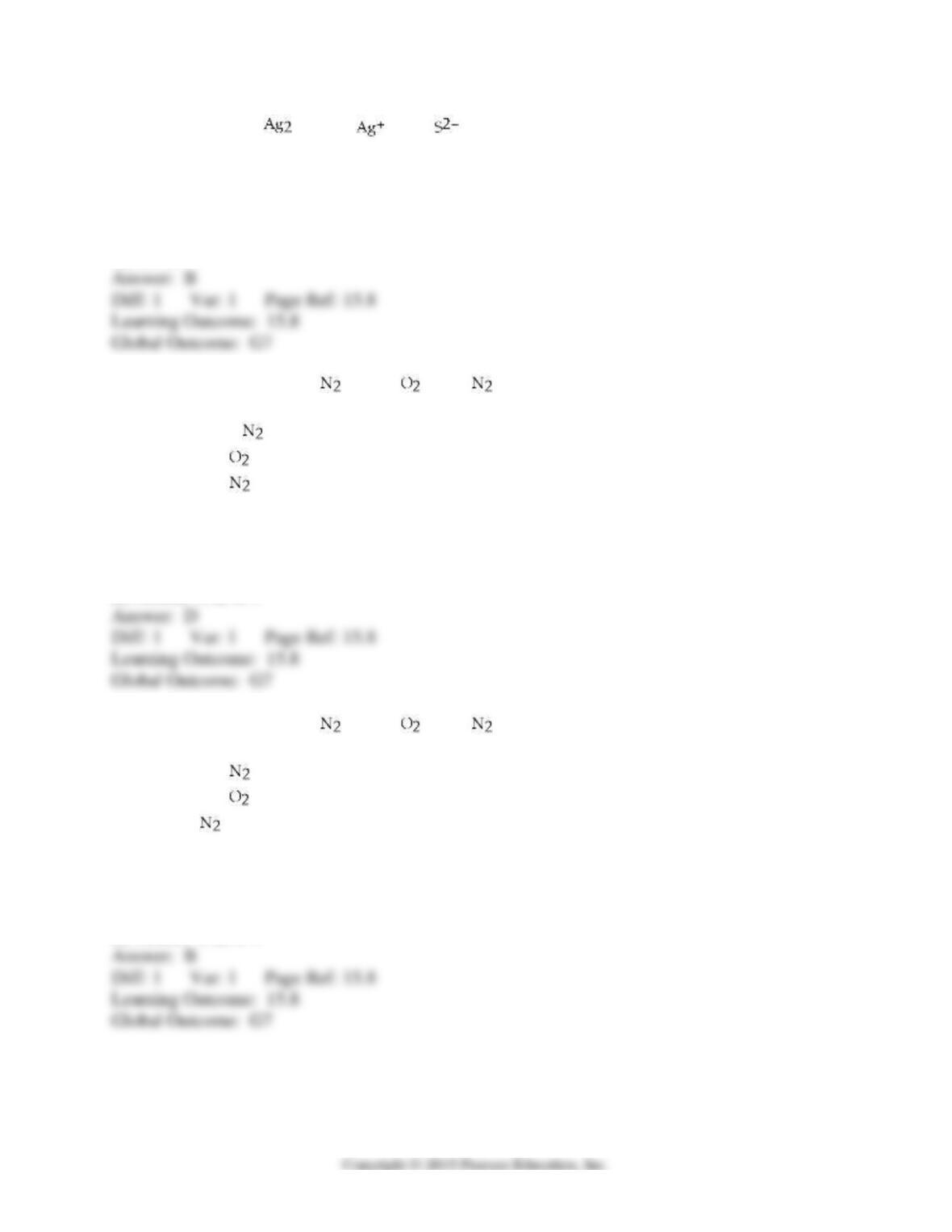
30) For the reaction , and the equilibrium
concentration of silver ion is M. What is
A) 0.0038
B) 9.6
C) 2.6 ×
D) 1.0
E) none of the above
31) For the reaction , , and the equilibrium
concentration of sulfide ion is . What is
A) 0.052 M
B) 0.32 M
C) 0.015 M
D) 0.10 M
E) none of the above
32) Le Chatelier’s Principle states that:
A) a disturbing force must be applied to a system in order for it to reach equilibrium.
B) when a system at equilibrium is disturbed, a new equilibrium constant is established.
C) when a chemical system at equilibrium is disturbed, the system shifts in order to minimize the
effect.
D) when a chemical system is at equilibrium it is no longer possible to alter the system.
E) none of the above

18
33) For the reaction S(s) ⇌ 2 (aq) + (aq), what happens to the equilibrium position if
aqueous ammonium sulfide is added?
A) shifts to the left
B) shifts to the right
C) does nothing
D) doubles
E) halves
34) For the reaction S(s) ⇌ 2 (aq) + (aq), what happens to the equilibrium position if
ammonium sulfate is added?
A) shifts to the left
B) shifts to the right
C) does nothing
D) doubles
E) halves
35) For the reaction S(s) ⇌ 2 (aq) + (aq), what happens to the equilibrium position if
the amount of solid silver sulfide is doubled?
A) shifts to the left
B) shifts to the right
C) does nothing
D) doubles
E) halves
19
36) For the reaction S(s) ⇌ 2 (aq) + (aq), what happens to the equilibrium position if
the amount of silver ion is halved?
A) shifts to the left
B) shifts to the right
C) does nothing
D) doubles
E) halves
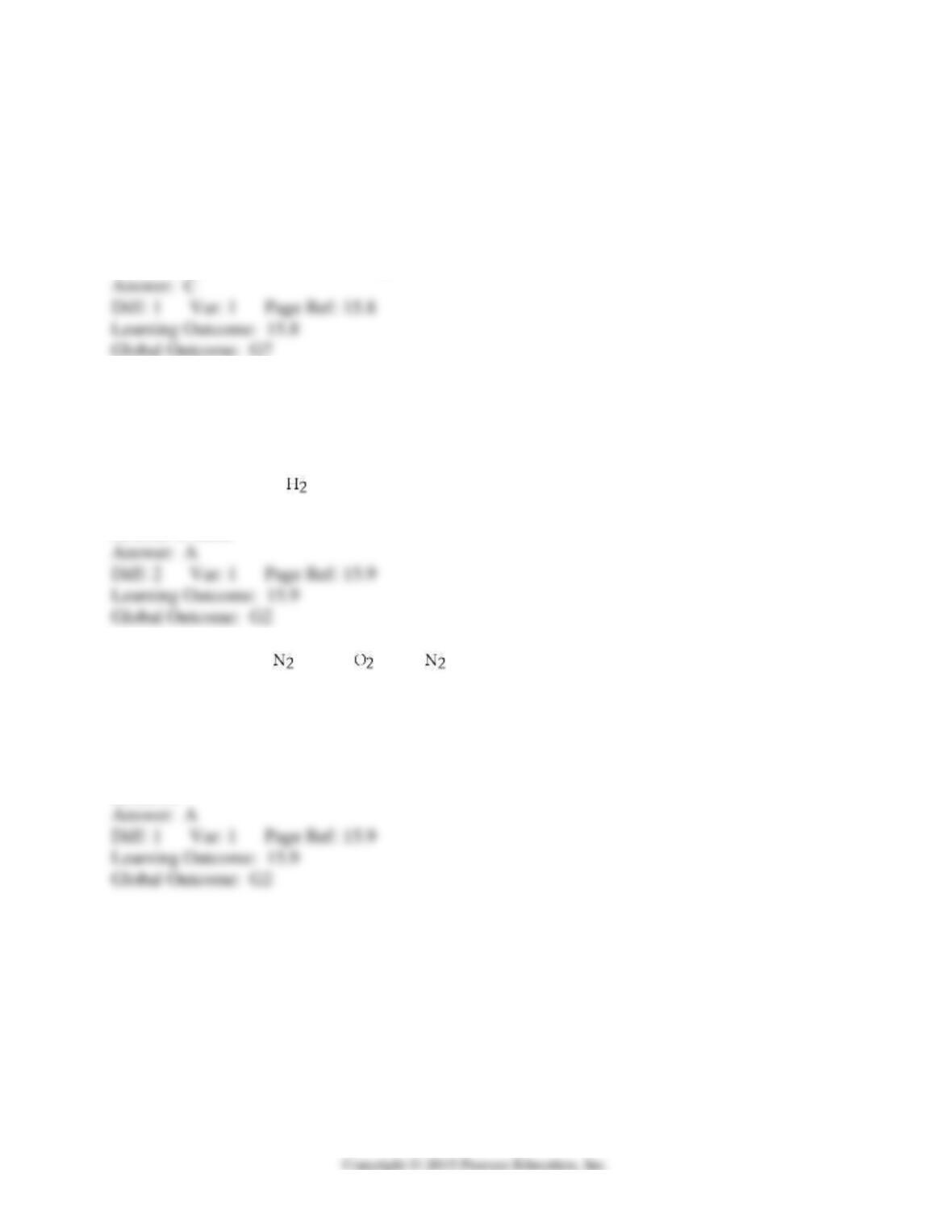
37) Consider the reaction: 2 O(g) ⇌ (g) + 2 (g). Which of the following will cause a shift
in the equilibrium to the right?
1. Add more O
2. Remove
3. Remove
A) 1 and 2 only
B) 1 and 3 only
C) 2 and 3 only
D) All of 1, 2, and 3
E) Neither 1, 2, or 3
38) Consider the reaction: 2 O(g) ⇌ (g) + 2 (g). Which of the following will cause a shift
in the equilibrium to the left?
1. Remove O
2. Remove
3. Add
A) 1 and 2 only
B) 1 and 3 only
C) 2 and 3 only
D) All of 1, 2, and 3
E) Neither 1, 2, or 3
20
39) We have the following reaction at equilibrium in a flask,
CaSO4(s) ⇌ Ca2+(aq) + SO42+(aq)
What will happen to [Ca2+] if additional CaSO4 is added to the flask?
A) It will decrease.
B) It will increase.
C) It will not change.
D) Cannot tell with the information provided.
40) Which of the following equilibrium systems will shift to the right (towards products) when
pressure is increased.
A) 2 PbS (s) + 3O2 (g)⇌ 2PbO (s) + 2 SO2 (g)
B) PCl5 (g) ⇌ PCl3 (g) + Cl2 (g)
C) H2 (g) + CO2 (g)⇌ O (g) + CO (g)
D) all of these
E) none of these
41) For the reaction 2 O(g) ⇌ (g) + 2 (g), what happens to the equilibrium position if the
pressure increases?
A) shifts to the left
B) shifts to the right
C) does nothing
D) doubles
E) halves
21
42) For the reaction H2 (g) + Cl2 (g) ⇌ 2 HCl (g), what happens to the equilibrium position if
the pressure increases?
A) shifts to the right
B) shifts to the left
C) does nothing
D) doubles
E) none of the above
43) For the reaction 2 O(g) ⇌ (g) + 2 (g), what happens to the equilibrium position if the
pressure decreases?
A) shifts to the left
B) shifts to the right
C) does nothing
D) doubles
E) halves
44) For the reaction 2 O(g) ⇌ (g) + 2 (g), what happens to the equilibrium position if the
volume decreases?
A) shifts to the left
B) shifts to the right
C) does nothing
D) doubles
E) halves
45) For the reaction 2 O(g) ⇌ (g) + 2 (g), what happens to the equilibrium position if the
volume increases?
A) shifts to the left
B) shifts to the right
C) does nothing
D) doubles
E) halves
46) What happens to the equilibrium position of an exothermic reaction when you add heat?
A) shifts to the left
B) shifts to the right
C) does nothing
D) doubles
E) halves
47) What happens to the equilibrium position of an exothermic reaction when you remove heat?
A) shifts to the left
B) shifts to the right
C) does nothing
D) doubles
E) halves
48) What happens to the equilibrium position of an endothermic reaction when you add heat?
A) shifts to the left
B) shifts to the right
C) does nothing
D) doubles
E) halves
49) What happens to the equilibrium position of an endothermic reaction when you remove heat?
A) shifts to the left
B) shifts to the right
C) does nothing
D) doubles
E) halves
50) Consider the following endothermic equilibrium reaction:
Fe2O3 (s) + 3H2 (g)⇌ 2Fe (s) + 3 O (g)
Which of the following actions will result in a shift to the left (towards reactants)?
A) increasing the temperature
B) increasing the pressure in the container
C) removing H2O (g)
D) all of these
E) none of these
51) Which compound below is the most soluble in water based on its value?
A) CuS, = 1.27
B) PbS, = 9.04
C) AgCl, = 1.77
D) AgI, = 8.51
E) not enough information
52) Which compound below is the most soluble in water based on its value?
A) CaCO3, = 4.96
B) MgCO3, = 6.82
C) Fe(OH)2, = 4.87
D) AgI, = 8.51
E) FeCO3, = 3.07
53) Given the choice of adding ions of Mg 2+ (aq), Ca 2+ (aq), Sr 2+ (aq) or Ba 2+ (aq) to a
solution of carbonate ions, CO3 2-, which choice would precipitate an insoluble carbonate
compound first?
Use the following data:
MgCO3 = 6.82
CaCO3 = 4.96
SrCO3 = 9.30
BaCO3 = 5.00
A) Mg 2+
B) Ca 2+
C) Sr 2+
D) Ba 2+
E) none of these will give a precipitate
54) What is the molar solubility, (S), of FeS if the for this substance?
A) 1.2 × M
B) 5.9 × M
C) 7.7 × M
D) 3.5 × M
E) none of the above
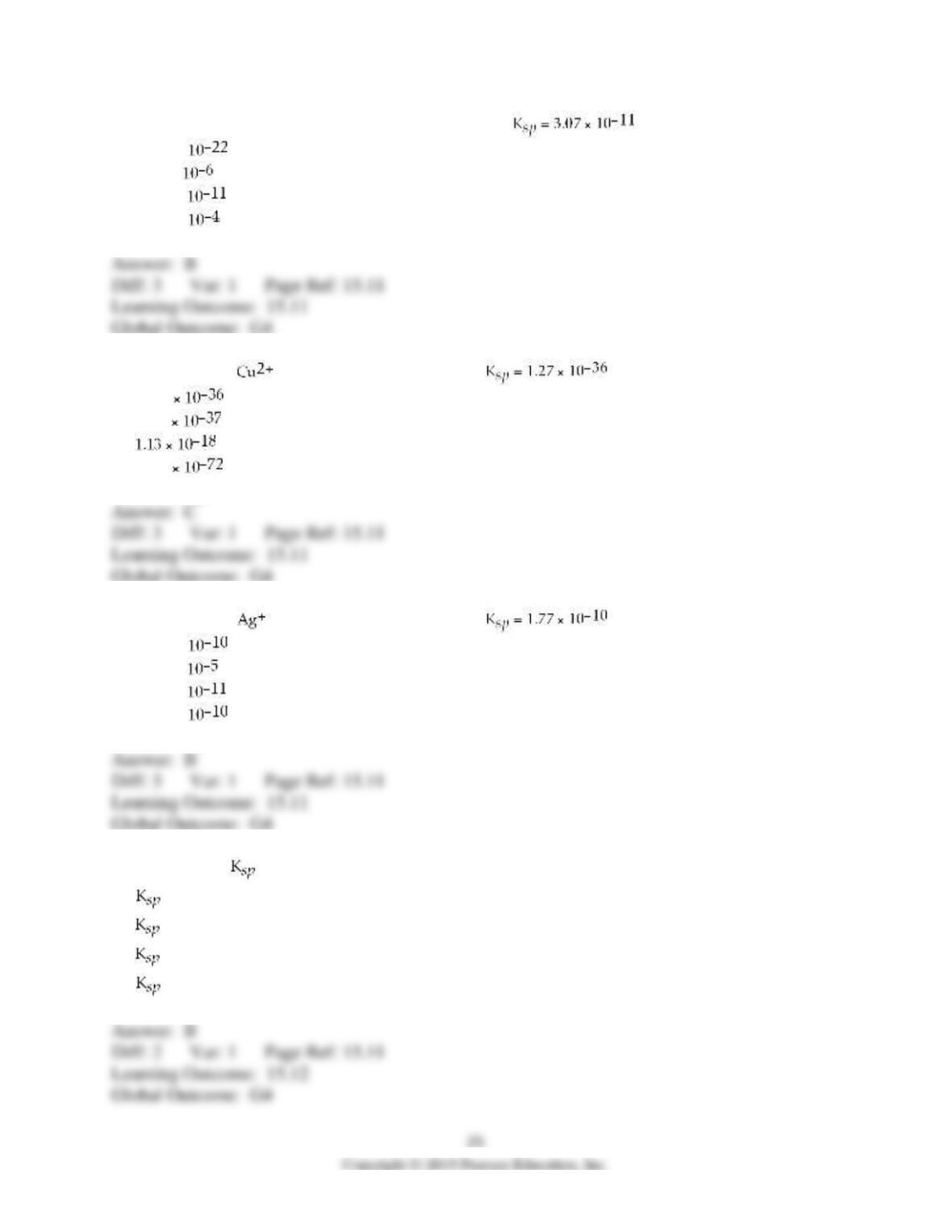
55) What is the molar solubility, (S), of FeCO3 if the for this substance?
A) 9.42 × M
B) 5.54× M
C) 3.07 × M
D) 1.54 × M
E) none of the above
56) What is the [ ] at equilibrium, given CuS, ?
A) 1.27 M
B) 6.35 M
C) M
D) 1.61 M
E) not enough information
57) What is the [ ] at equilibrium, given AgCl, ?
A) 1.77 × M
B) 1.33 × M
C) 8.85 × M
D) 3.54 × M
E) not enough information
58) What is the expression for the ionic compound Li2CO3?
A) = [Li+] [CO32-]
B) = [Li+]2 [CO32-]
C) = 2[Li+] [CO32-]
D) = [Li2CO3]3
E) none of the above
59) What is the expression for the ionic compound barium phosphate, Ba3(PO4)2?
A) = [Ba2+] 2 [PO43-]3
B) = [Ba2+]3 [PO43-]4
C) = [Ba2+]3 [PO43-]2
D) = [Ba2+] [PO43-]
E) none of the above
60) Which statement about activation energy is FALSE?
A) Activation energy is an energy hump that normally exists between reactants and products.
B) The higher the activation energy, the slower the reaction rate.
C) The lower the activation energy, the faster the reaction rate.
D) Increasing the temperature lowers the activation energy.
E) All of the above are true.
61) The effect of a catalyst is to:
A) increase the number of collisions between reactants.
B) increase the temperature of the reactants whereby more products are formed.
C) change the position of the equilibrium.
D) change the stoichiometry of the reaction.
E) lower the activation energy of a reaction whereby making it easier for the reactants to get over
the energy hump.
62) Comparing a reaction with a catalyst to the same reaction without the catalyst, each of the
following statements is true EXCEPT:
A) The rate for the reaction with a catalyst is faster.
B) The products are the same.
C) The catalyzed reaction follows a different pathway.
D) Both reactions would have the same value for the equilibrium constant.
E) The activation energy is the same for both the catalyzed and uncatalyzed reaction.
63) Which statement below is FALSE?
A) The rate of a reaction can be increased by increasing concentrations of reactants.
B) The rate of a reaction can be increased by altering the temperature.
C) The rate of a reaction can be increased by adding a catalyst.
D) A catalyst alters the equilibrium constant.
E) All of the above are true.
64) What happens to the equilibrium constant when a catalyst is added to the reaction mixture?
A) increases
B) decreases
C) does not change
D) varies
E) none of the above
65) Which of the following is FALSE about enzymes?
A) They act as biological catalysts.
B) They lower the activation energy of biological reactions.
C) They increase the temperature of biological reactions to speed them up.
D) They are highly specific in their catalytic activity.
E) none of the above
15.3 Algorithmic Questions
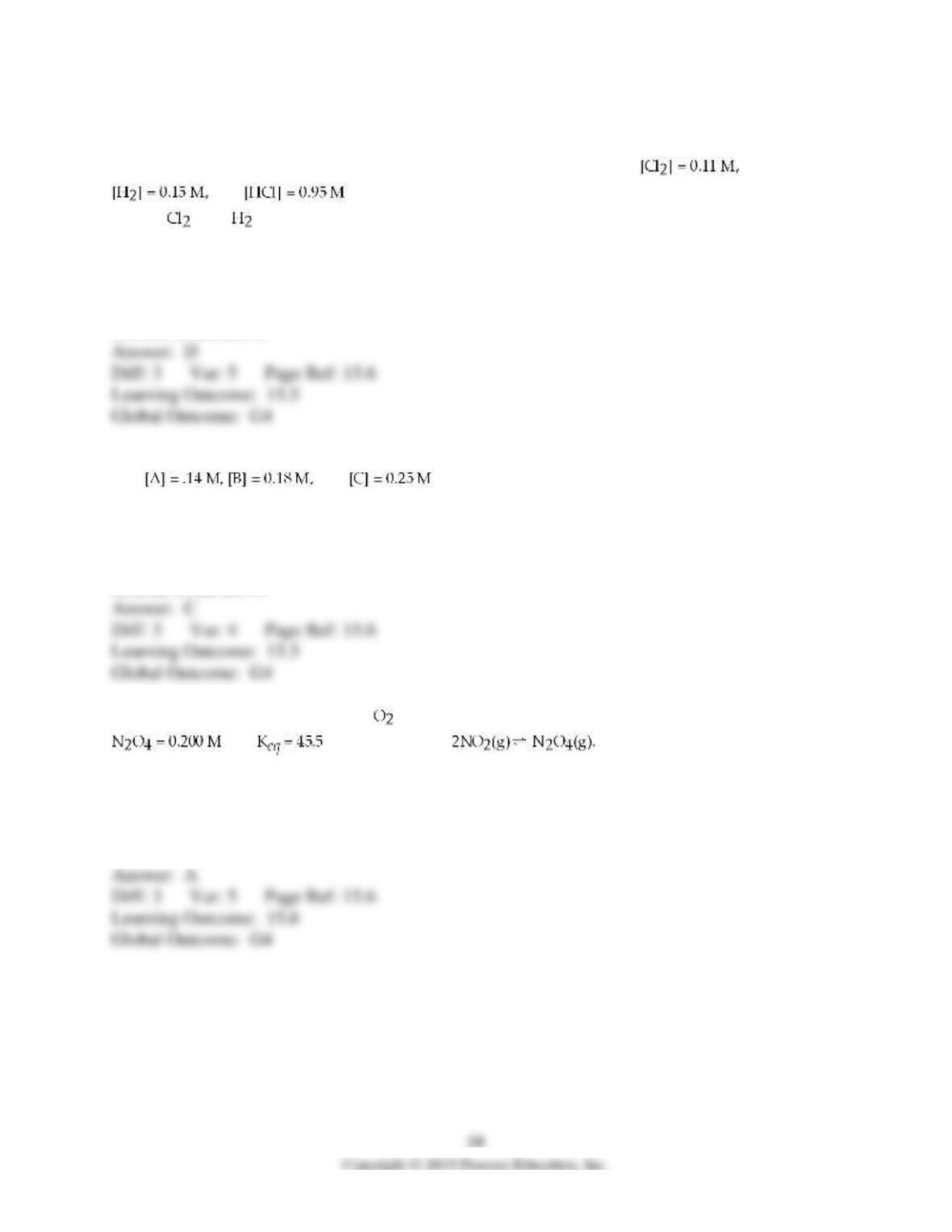
1) Calculate the equilibrium constant for the reaction below given that
and at equilibrium.
Given: (g) + (g) ⇌ 2HCl(g)
A) 0.017
B) 0.018
C) 58
D) 55
E) none of the above
2) Calculate the equilibrium constant (Keq) for the reaction 1A (aq) + 1B (aq) ⇌ 2C (aq) given
that and at equilibrium.
A) 9.9
B) 0.40
C) 2.5
D) 20.
E) none of the above
3) Calculate the concentration of N in an equilibrium mixture given that the concentration of
and for the reaction:
A) 0.0663 M
B) 0.00440 M
C) 227.3 M
D) 15.1 M
E) none of the above
4) Calculate [ ] at equilibrium given that the for the reaction
A) 0.0185 M
B) 0.0 M
C) 0.19 M
D) not enough information given
E) none of the above
5) What is the concentration of the ion in solution when [ ] = 0.25 M given that the
for the following reaction:
A) 5.2 ×
B) 3.7 ×
C) 2.7 ×
D) 19.2
E) none of the above
6) What is the value for the for a compound MX(s) if at equilibrium
A) 0.0020
B) 1.0 ×
C) 1.0 ×
D) not enough information
E) none of the above
7) What is the value for the for a compound MX2(s) if at equilibrium and
?
A) 0.011
B) 1.1 ×
C) 2.3 ×
D) 1.7 ×
E) none of the above