Introductory Chemistry, 5e (Tro)
Chapter 15 Chemical Equilibrium
15.1 True/False Questions
1) Equilibrium involves the ideas of sameness and constancy.
2) Living things are in equilibrium with their surroundings.
3) The rate of a chemical reaction is the amount of reactant that changes to product in a specific
amount of time.
4) Collisions between reactant molecules do not always lead to the formation of product
molecules.
5) Reaction rates generally increase as a reaction proceeds.
6) The rate of a chemical reaction always remains the same from start to finish.
7) The rate of a reaction increases with increasing concentrations of reactants because you have
more collisions occurring in a given time period.
8) The rate of a chemical reaction is inversely proportional to the temperature.
9) A reversible reaction is one that can be stopped and then restarted as needed.
10) Dynamic equilibrium occurs when the rate of the forward reaction equals the rate of the
reverse reaction.
11) Dynamic equilibrium is established when the rate of the forward reaction goes to zero.
12) When dynamic equilibrium is achieved, the concentrations of reactants is equal to the
concentrations of the products.
13) When dynamic equilibrium is achieved, the rates of the forward and backward reactions go
to zero.
14) The Equilibrium Constant, , is a way to quantify the relative concentrations of the
reactants and products of a reaction at equilibrium.
15) It is not necessary to have a balanced equation before writing an equilibrium constant
expression.
16) The larger the equilibrium constant, the greater is the concentration of reactants relative to
products at equilibrium.
17) As long as > 1, all reactants will eventually be consumed and leave us exclusively with
product molecules.
18) Placing a [ ] around the formula of a chemical means that we are referring to the molar
concentration of that chemical.
19) A large equilibrium constant indicates that the forward reaction is largely favored.
20) Since the equilibrium constant ( ) is calculated using the numerical concentrations of
reactants and products, can never be a negative value.
21) If equals about ≈1, then neither direction is favored and significant amounts of both
reactants and products are present at equilibrium.
22) A reaction that has = 2.0 × will have high concentrations of products.
23) A reaction that has = 2.0 × will have high concentrations of products.
24) For a given chemical equation, the coefficients for each substance become the exponents for
each substance in the written equilibrium expression.
25) If = 2 for the reaction X ⇌ Y, then the for Y ⇌ X will be 1/2 (or 0.5).
26) The equilibrium expression for the reaction: .
27) The equilibrium expression for the reaction:
.
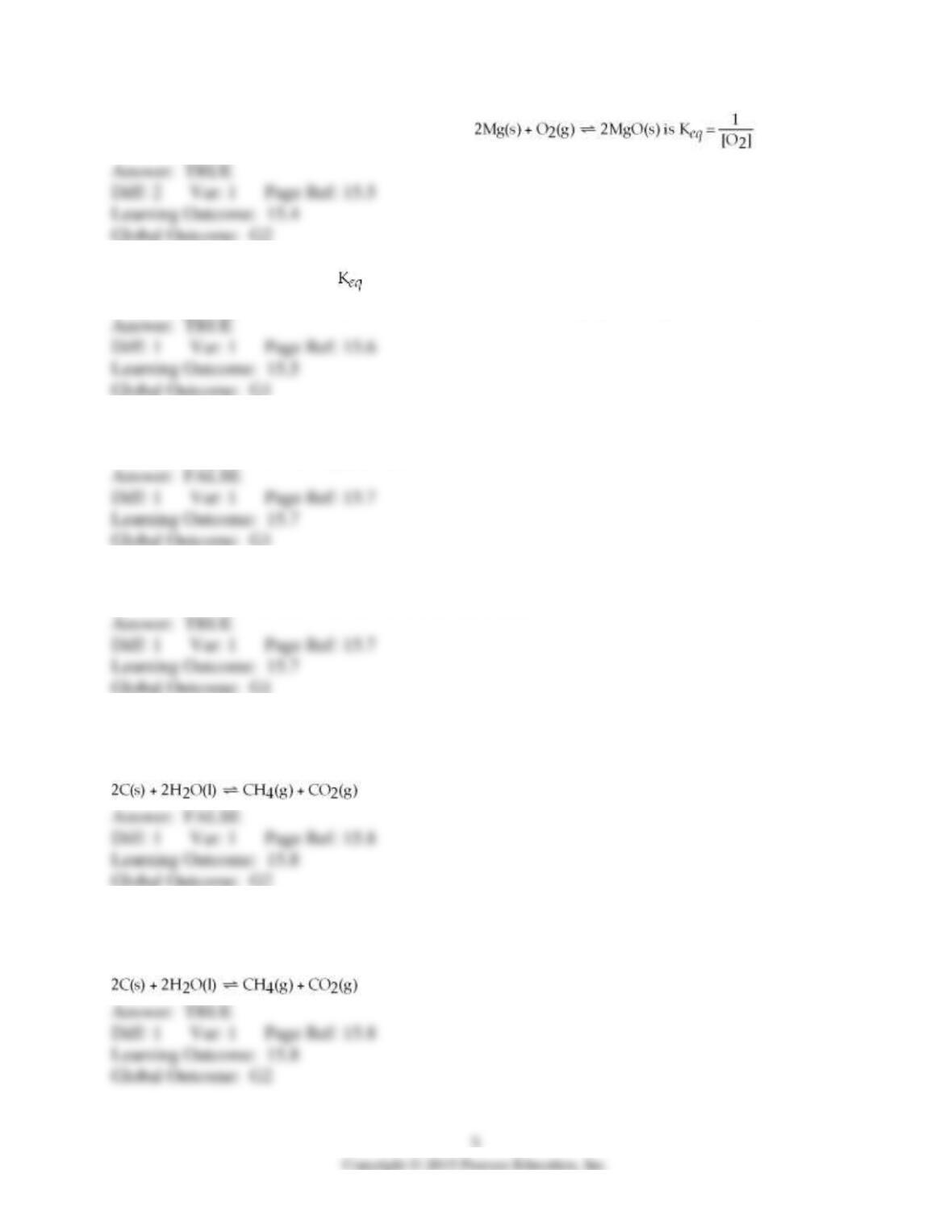
28) The equilibrium expression for the reaction: .
29) The equilibrium constant, , for an equilibrium reaction will always be the same (at a given
temperature) regardless of what the initial concentrations of reactants and products were.
30) Le Chatelier’s principle states that a chemical system must have a shift in direction in order
to force the system to reach equilibrium.
31) Le Chatelier’s principle states that when a chemical system at equilibrium is disturbed, the
system shifts in a direction that minimizes the disturbance.
32) Increasing the amount of carbon in the reaction below will cause the reaction to proceed to
the left so that equilibrium will be restored.
33) Decreasing the amount of carbon dioxide in the reaction below will cause the reaction to
proceed to the right so that equilibrium will be restored.
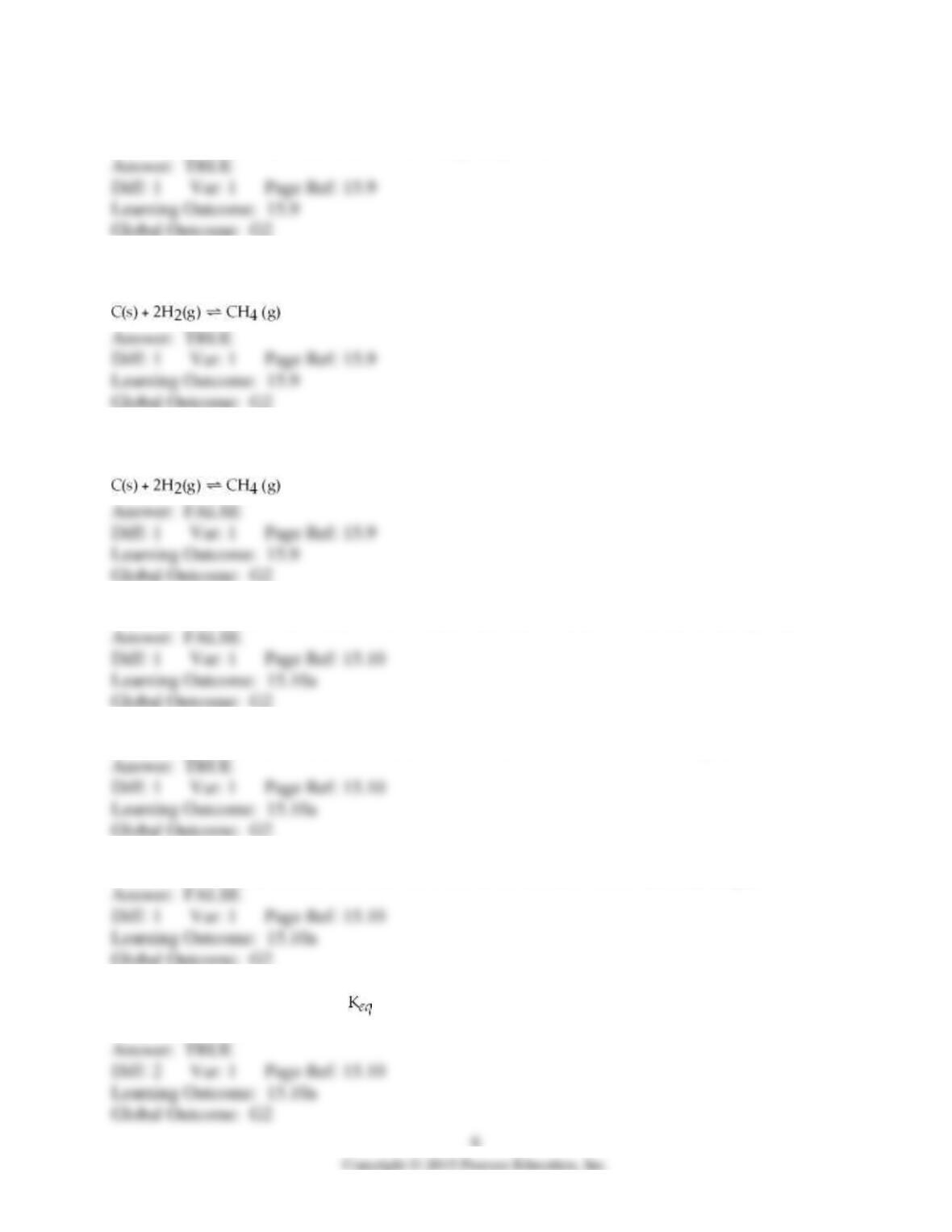
34) If you have a chamber of gases at equilibrium, compressing the gases to half the original
volume would have the same effect as doubling the pressure.
35) Decreasing the volume of the system below causes the reaction to shift towards the right.
36) Increasing the volume of the system below causes the reaction to shift towards the right.
37) In an exothermic reaction, you can consider the emitted heat as a reactant in this system.
38) Adding heat to an endothermic reaction causes the reaction to shift to the right.
39) Adding heat to an exothermic reaction will cause the reaction to remain unchanged.
40) If the equilibrium constant, , for a reaction increases upon heating, the reaction must have
been endothermic.
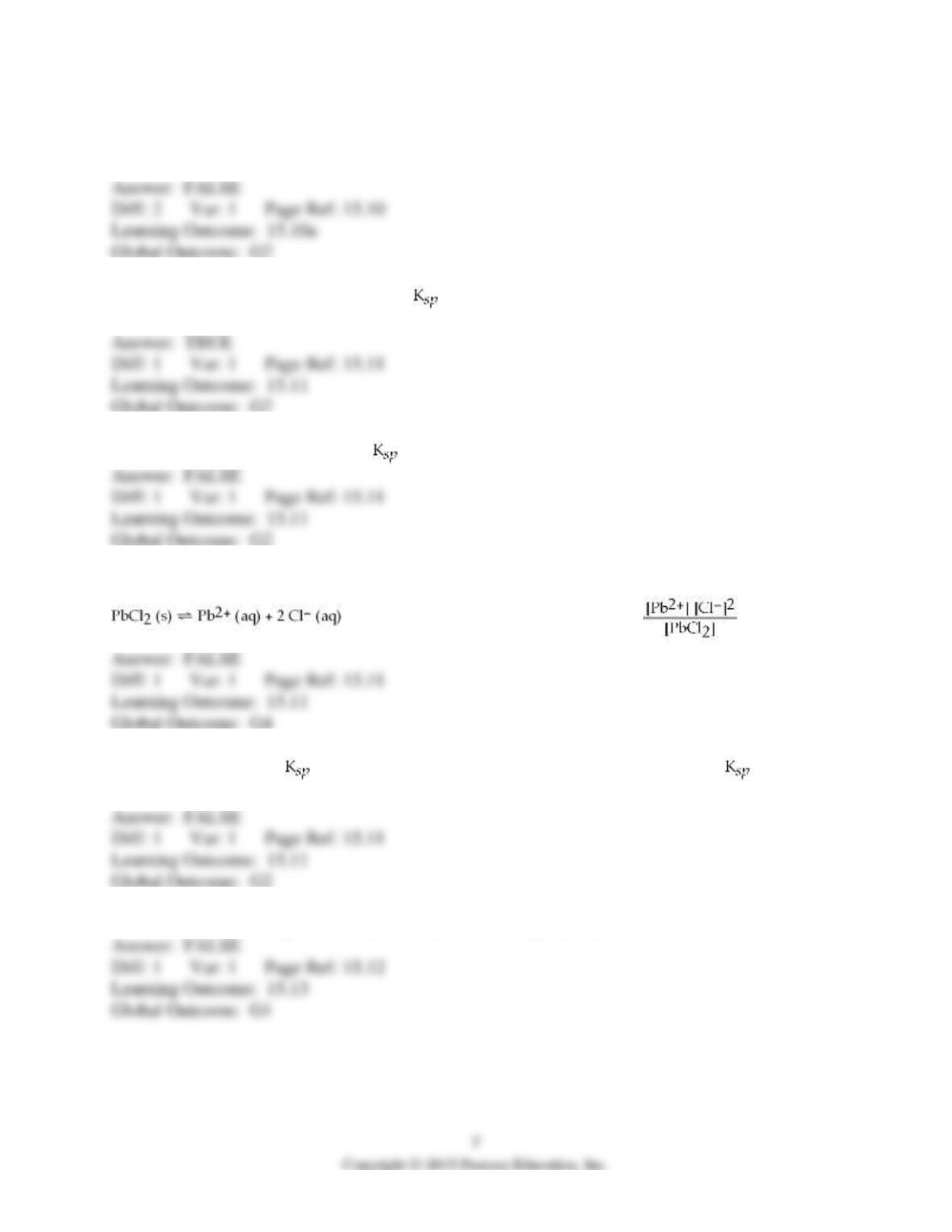
41) If an equilibrium reaction shifts to the right when the system is cooled, this indicates that the
reaction is endothermic.
42) A compound with a relatively small value indicates that the compound is only partially
soluble.
43) A compound with a very large value is generally considered to be only partially soluble.
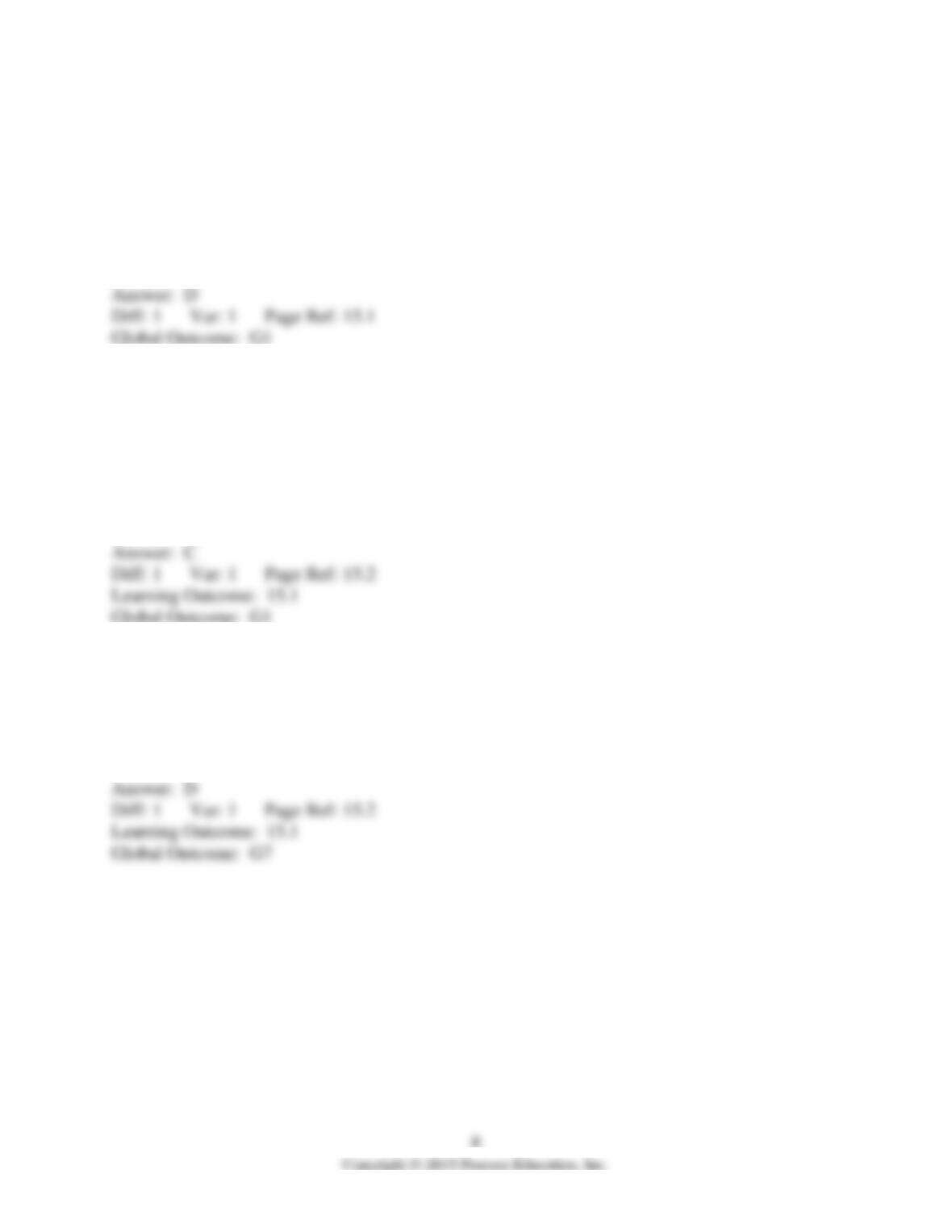
44) Dissolving the compound PbCl2 into water can be represented as
, so the equilibrium expression is Ksp = .
45) Iron(II) carbonate ( = 3.07 × 10⁻¹¹) is more soluble than calcium fluoride ( = 1.46 ×
10-10).
46) A catalyst speeds up a chemical reaction as it is being consumed.
15.2 Multiple Choice Questions
1) A description of life is:
A) Living things maintain and control their sameness.
B) Living things maintain and control their changelessness.
C) Living things maintain and control their equilibrium.
D) Living things maintain and control their disequilibrium.
E) none of the above
2) According to the collision theory of chemical reactions:
A) high energy collisions result in few successful reactions as there isn’t sufficient time for the
products to react.
B) low energy collisions result in many successful reactions as there is sufficient time for the
reactants to form products.
C) high energy collisions lead to the successful formation of products.
D) low energy collisions do not occur in the gas phase.
E) all of the above
3) Which of the following changes will increase the reaction rate?
A) an increase in the concentration of the products
B) a decrease of the reaction temperature
C) allowing more time for the reaction
D) an increase in the concentration of reactants
E) all of the above
4) Which of the following changes will increase reaction rate?
1. An increase in the concentration of reactants
2. An increase in temperature
3. Higher-energy collisions between reacting molecules
A) 1 and 2 only
B) 1 and 3 only
C) 2 and 3 only
D) All of 1, 2, and 3
E) Neither 1, 2, or 3
5) Why does the rate of the reaction decrease over time?
A) Exothermic reactions lose heat which cools the reaction which decreases reaction rate.
B) As the reaction proceeds, the concentration of the products results in fewer collisions.
C) As the reaction proceeds, a decrease in the concentration of reactants results in fewer
successful collisions.
D) Not all molecules will react and some choose to stay in their present form.
E) none of the above
6) Which of the following is TRUE for a system that is in dynamic equilibrium?
A) The forward reaction goes to 100% completion.
B) The reaction rate of the forward reaction approaches zero.
C) The concentration of products is equal to the concentration of the reactants.
D) Both the forward and reverse reactions come to a halt.
E) none of the above
7) Which of the following is TRUE about a chemical system in equilibrium?
A) No reaction takes place.
B) Temperature changes have no effect on reaction rate.
C) Addition of more reactants have no effect on reaction rate.
D) Reaction rate remains stable as long as temperature and pressure are stable.
E) none of the above
8) Suppose a wall divides a playground, and twenty balls lie on the ground on the east side, while
forty balls lie on the west side. If a child on the east side of the wall always tosses a ball over the
wall at the same time a child on the west side tosses a ball over the wall, then:
A) equilibrium has been established.
B) all balls will eventually end up on one side.
C) equilibrium will be established once thirty balls are on each side.
D) this system can never reach equilibrium.
E) none of the above
9) A chemical equilibrium exists when:
A) reactants are completely changed to products.
B) there are equal amounts of reactants and products.
C) the rate at which reactants form products becomes zero.
D) the sum of reactant and product concentrations equals one mole.
E) the rate at which reactants form products is the same as the rate at which products form
reactants.
10) A system is said to be in dynamic equilibrium when:
A) there is no longer any net change in the concentrations of products or reactants.
B) the forward and reverse reactions come to a halt.
C) the sum of the concentrations of the reactants is equal to the sum of the concentrations of the
products.
D) you have let the reaction proceed for approximately 30 minutes and can assume there will be
no more changes.
E) none of the above
11
11) Given N2 (g) + 3 H2 (g) ⇌ 2 NH3 (g), which scenario will allow you to eventually reach an
equilibrium mixture involving these chemicals?
A) Place only N2 into a sealed vessel.
B) Place only H2 into a sealed vessel.
C) Place only NH3 into a sealed vessel.
D) All of the above scenarios.
E) none of the above
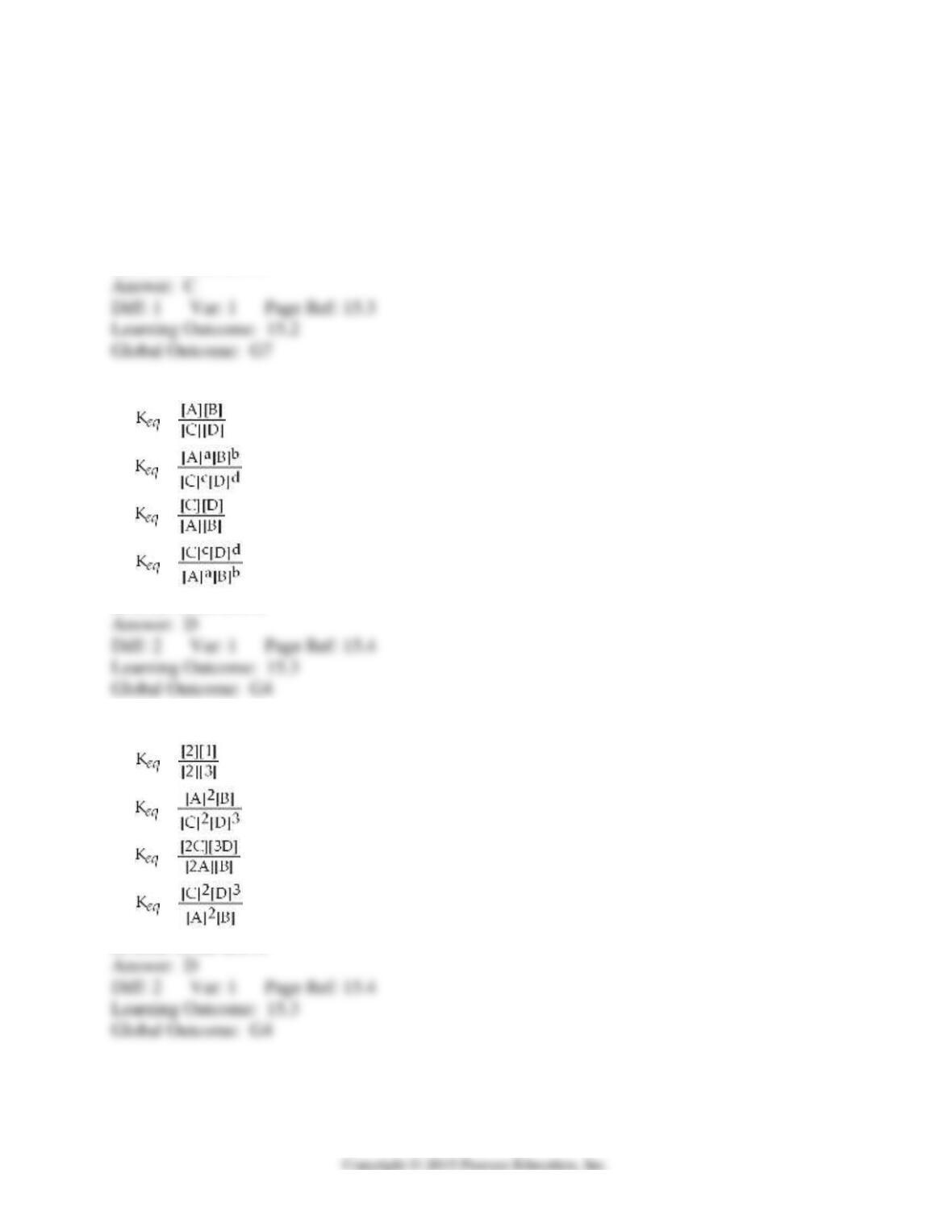
12) For the reaction aA + bB ⇌ cC + dD, the equilibrium expression is:
A) =
B) =
C) =
D) =
E) none of the above
13) For the reaction 2A + B ⇌ 2C + 3D, the equilibrium expression is:
A) =
B) =
C) =
D) =
E) none of the above
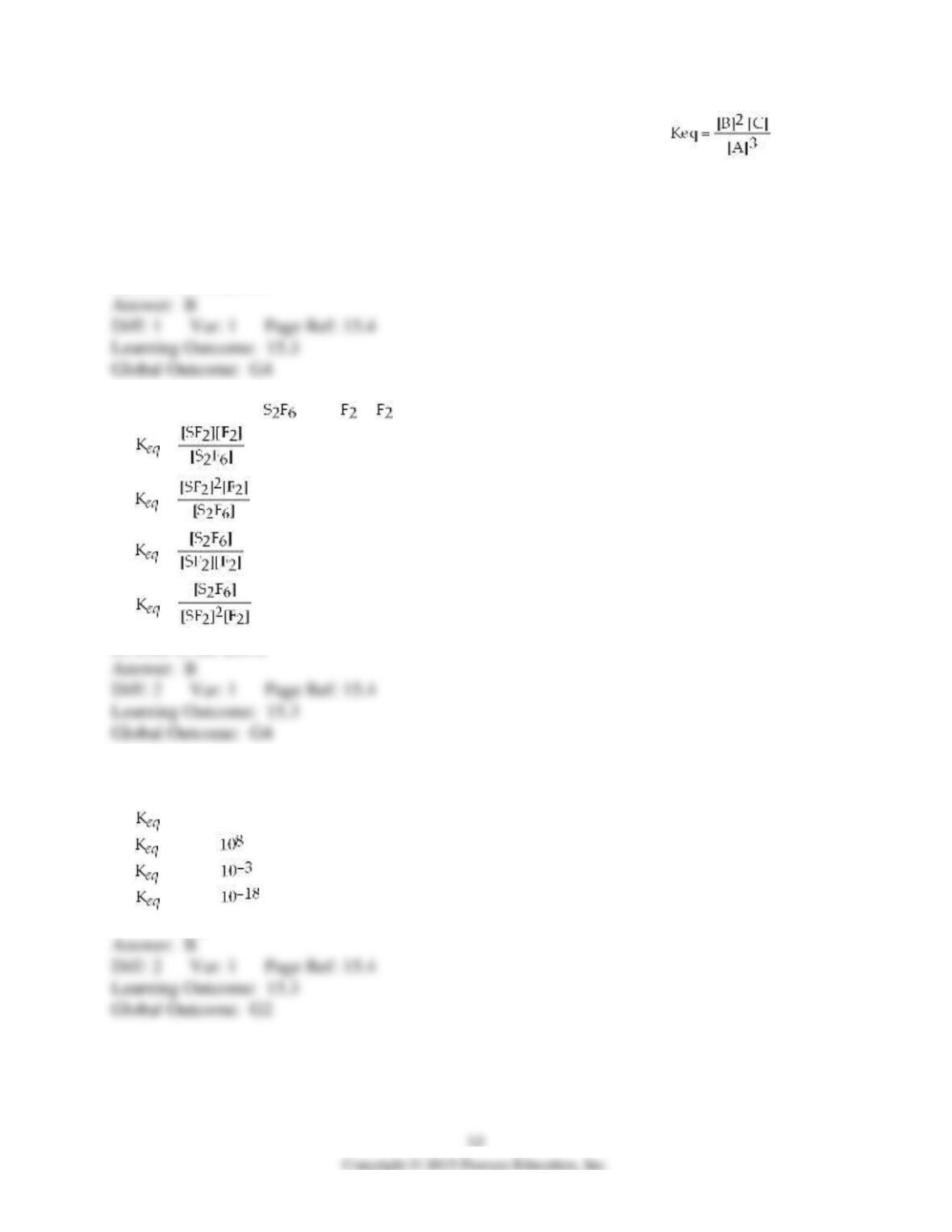
14) The chemical equation that would generate the equilibrium expression is
________. (Assume all substances are gases in this reaction.)
A) C + 2B ⇌ 3A
B) 3A ⇌ 2B + C
C) A ⇌ B + C
D) 1/2 B + C ⇌ 1/3 A
E) none of the above
15) For the reaction ⇌ 2S + , the equilibrium expression is:
A) =
B) =
C) =
D) =
E) none of the above
16) Which equilibrium constant represents a reaction that favors the formation of the products to
the greatest extent?
A) = 100
B) = 1.0 ×
C) = 1.0 ×
D) = 1.0 ×
E) not enough information
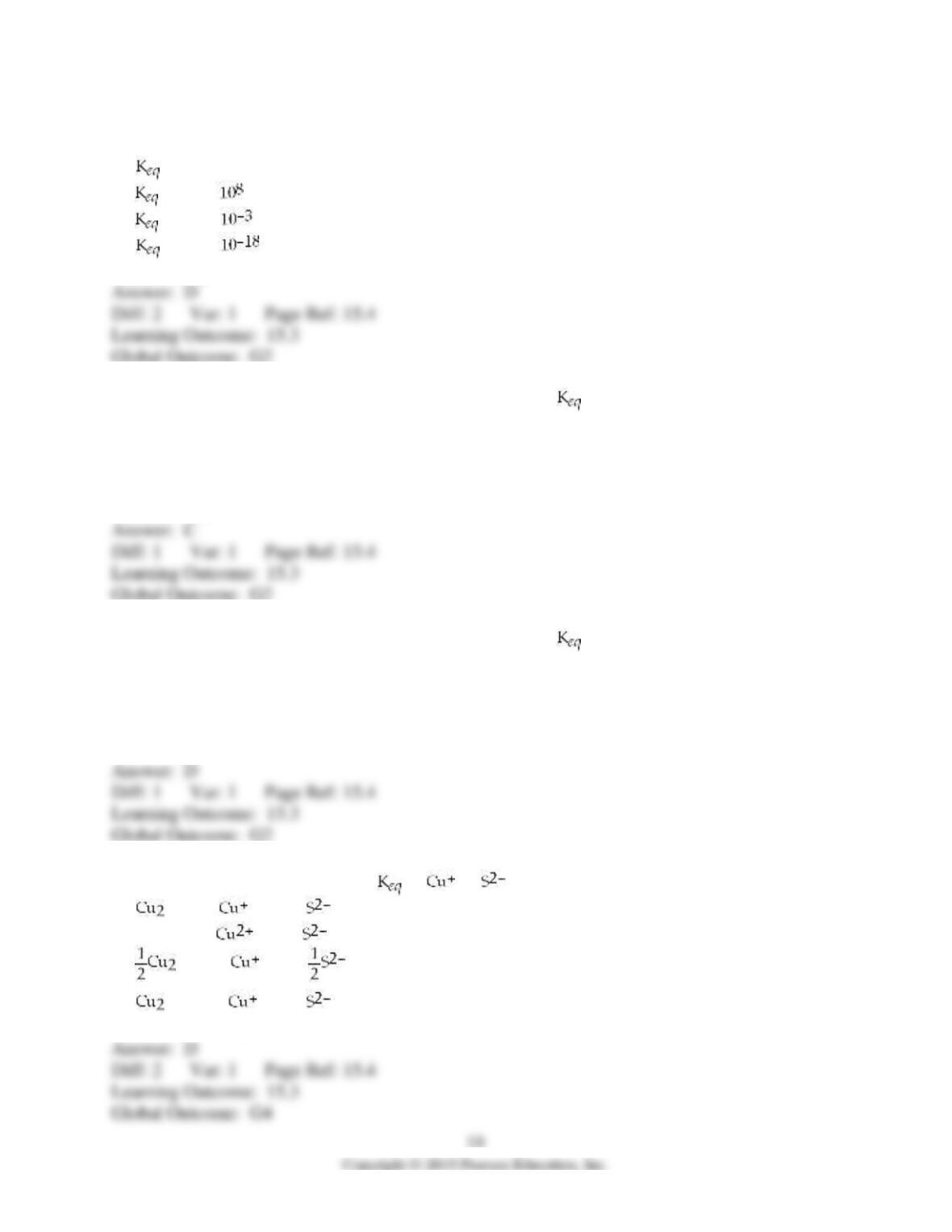
17) Which equilibrium constant represents a reaction that favors the reactants to the greatest
extent?
A) = 100
B) = 1.0 ×
C) = 1.0 ×
D) = 1.0 ×
E) not enough information
18) Which of the following is TRUE of a system for which << 1?
A) It will take a long time to reach equilibrium.
B) It will take a short time to reach equilibrium.
C) The equilibrium favors the reverse reaction.
D) The equilibrium favors the forward reaction.
E) none of the above
19) Which of the following is TRUE of a system for which >> 1?
A) It will take a short time to reach equilibrium.
B) It will take a long time to reach equilibrium.
C) The equilibrium favors the reverse reaction.
D) The equilibrium favors the forward reaction.
E) none of the above
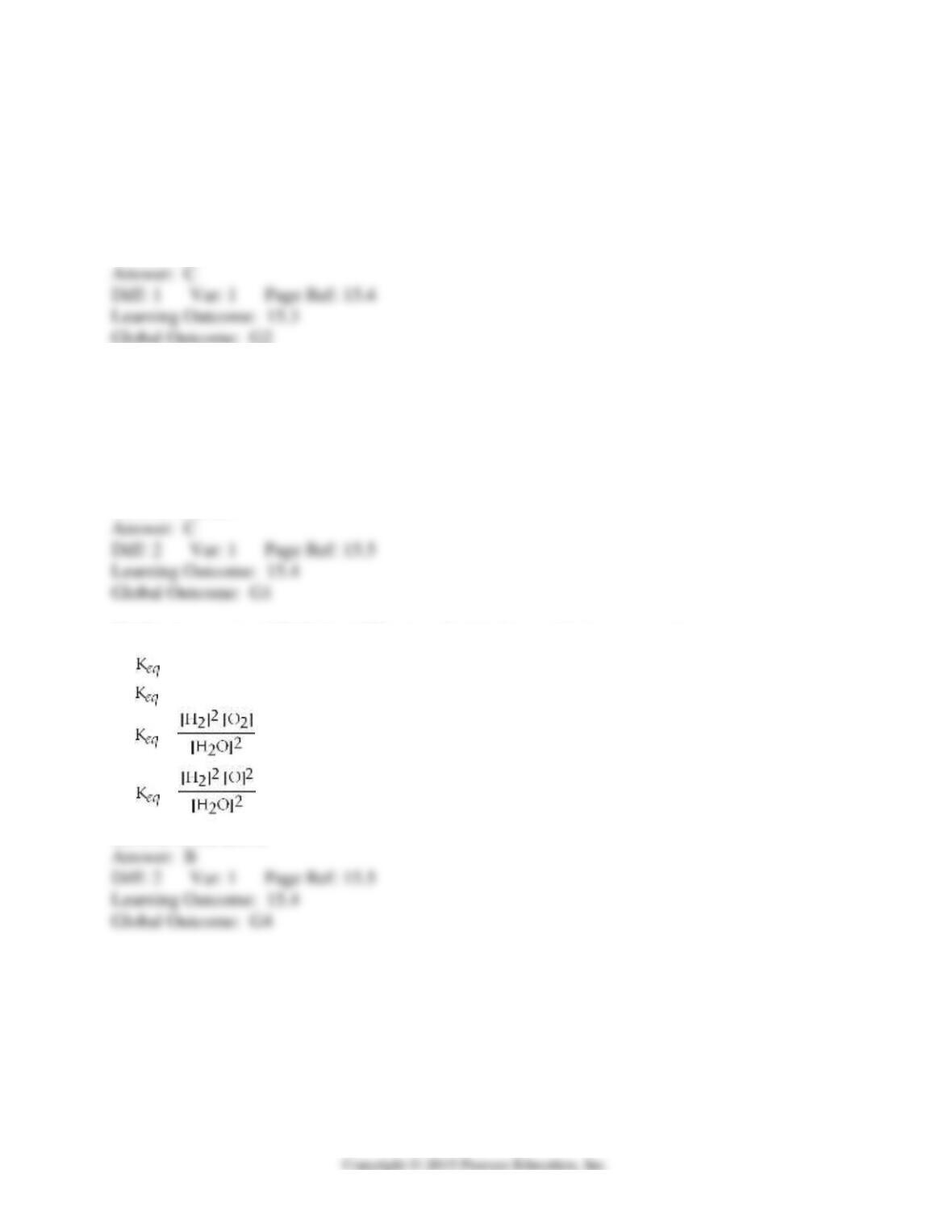
20) Identify the equation for which = [ ]2[ ].
A) S(s) ⇌ (aq) + 2 (aq)
B) CuS(s) ⇌ (aq) + (aq)
C) S(s) ⇌ (aq) + (aq)
D) S(s) ⇌ 2 (aq) + (aq)
E) none of the above
14
21) What must be TRUE for a reaction possessing a large equilibrium constant?
A) The reaction rate is fast.
B) The reaction rate is slow.
C) The forward reaction is favored.
D) The reverse reaction is favored.
E) none of the above
22) When writing the expression for an equilibrium constant, which type of substance IS
included?
A) solids
B) pure liquids
C) gases
D) all of the above
E) none of these
23) For the reaction 2 H2O (l) ⇌ 2H2 (g) + O2 (g), the equilibrium expression is:
A) = [H2O]2
B) = [H2]2 [O2]
C) =
D) =
E) none of the above
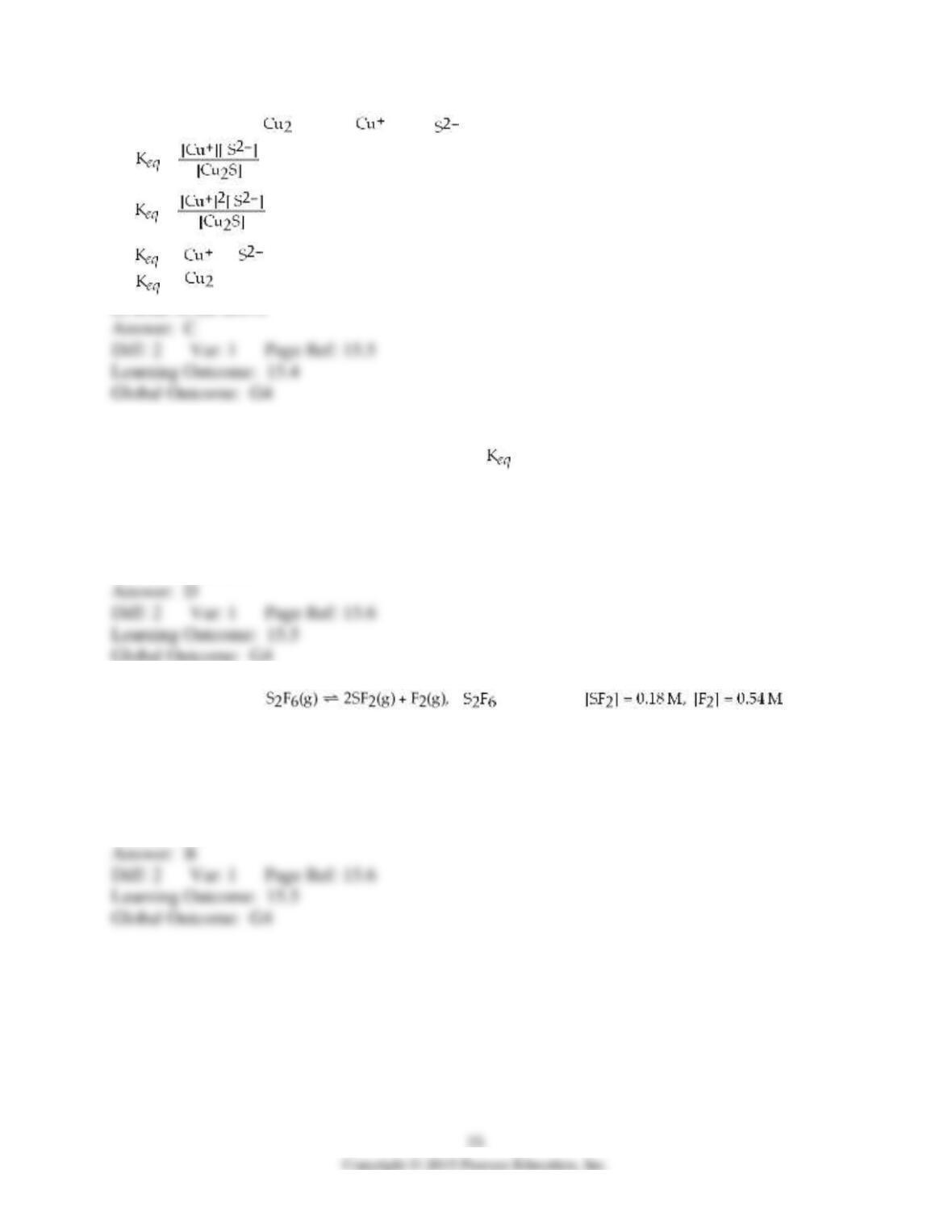
24) For the reaction S(s) ⇌ 2 (aq) + (aq), the equilibrium expression is:
A) =
B) =
C) = [ ]2[ ]
D) = [ S]
E) none of the above
25) For the reaction 2 A ⇌ B, the equilibrium concentrations are as follows: [A] = 0.056 M and
[B] = 0.12 M. Calculate the equilibrium constant ( ) for the reaction.
A) 2.6 × 10⁻²
B) 0.26
C) 2.1
D) 38
E) none of the above
26) For the reaction [ ] = 0.12 M, .The
equilibrium constant is:
A) 0.44
B) 0.15
C) 2.3
D) 6.7
E) none of the above