Chapter 15: Organic Compounds and the Atomic
Properties of Carbon
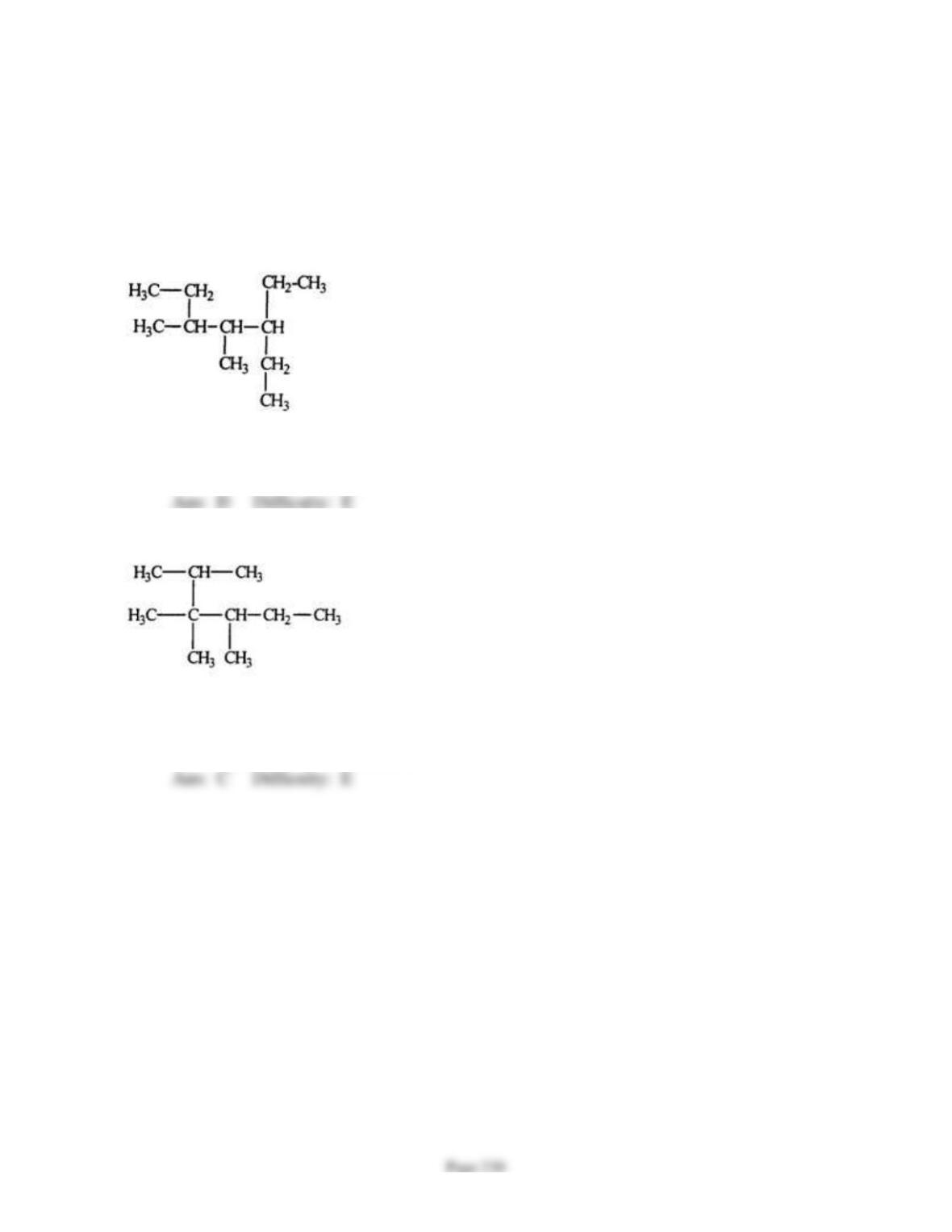
1. Select the correct name for the following compound.
A) 1,1,3-triethyl-2-methylbutane D) 3-ethyl-4,5-dimethylheptane
B) 1,1-diethyl-2,3-dimethylpentane E) none of the above
C) 2,4-diethyl-3-methylhexane
2. Select the correct name for the following compound.
A) 2-isopropyl-2,3,4-trimethylbutane D) 1,1,2,2,3-pentamethylpentane
B) 2-isopropyl-2,3-dimethylpentane E) none of the above
C) 2,3,3,4-tetramethylhexane
Chapter 15: Organic Compounds and the Atomic Properties of Carbon
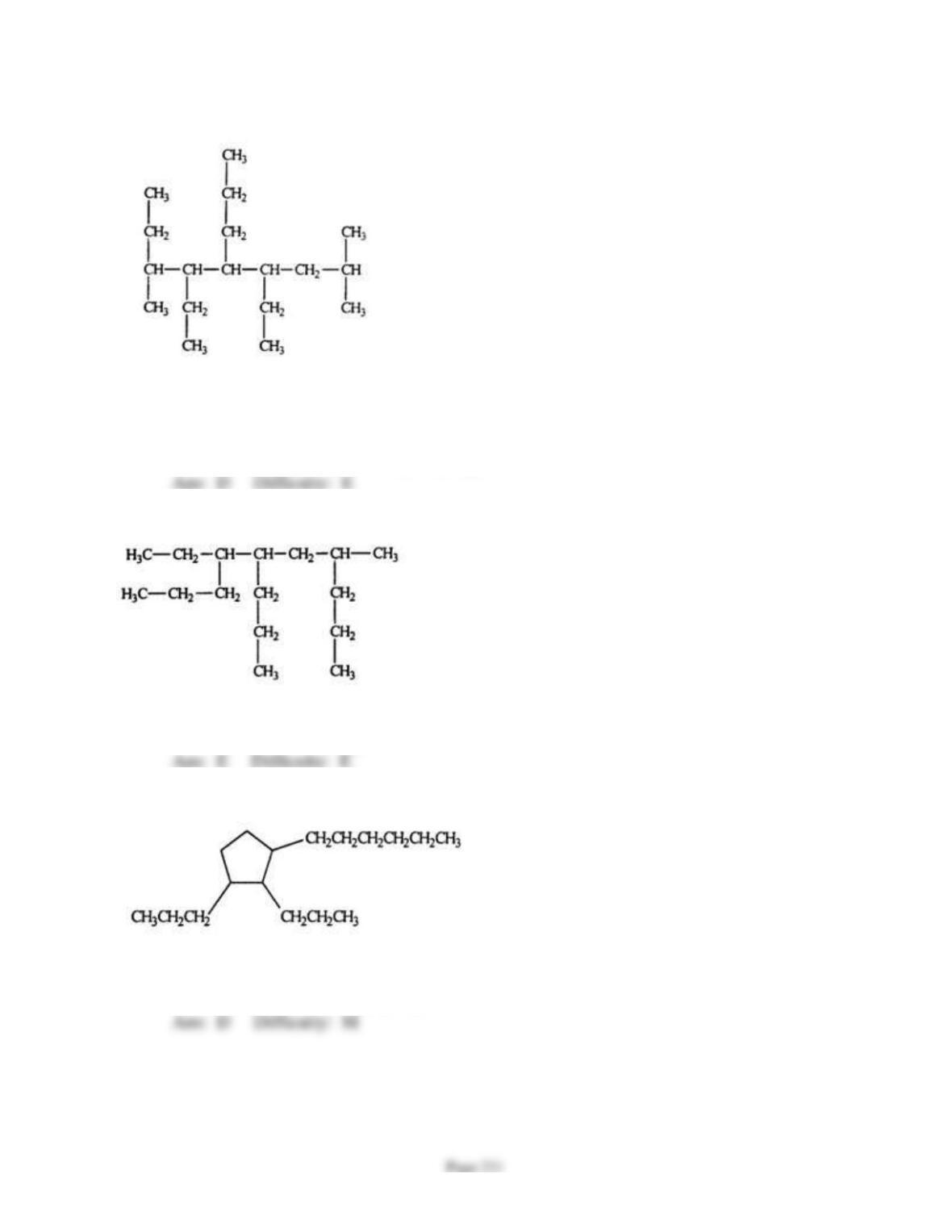
3. Select the correct name for the following compound.
A) 1,2-diethyl-1-methyl-3-propyl-4-isobutylhexane
B) 1,6,6-trimethyl-1,2,4-triethyl-3-propylhexane
C) 1,1,6-trimethyl-3,5,6-triethyl-4-propylhexane
D) 4,6-diethyl-2,7-dimethyl-5-propylnonane
E) 3,5-diethyl-1,1,6-trimethyl-4-propyloctane
4. Select the correct name for the following compound.
A) 2,4,5-tripropylheptane D) 5-ethyl-2,4-dipropyloctane
B) 6-methyl-3,4-dipropylnonane E) 4-ethyl-7-methyl-5-propyldecane
C) 4-ethyl-5,7-dipropyloctane
5. Select the correct name for the following compound.
A) ortho-dipropylcyclopentylhexane D) 1-hexyl-2,3-dipropylcyclopentane
B) 2,3-dipropylcyclopentylhexane E) 1,2-dipropyl-3-hexylcyclopentane
C) 2-hexyl-1,5-dipropylcyclopentane
Chapter 15: Organic Compounds and the Atomic Properties of Carbon
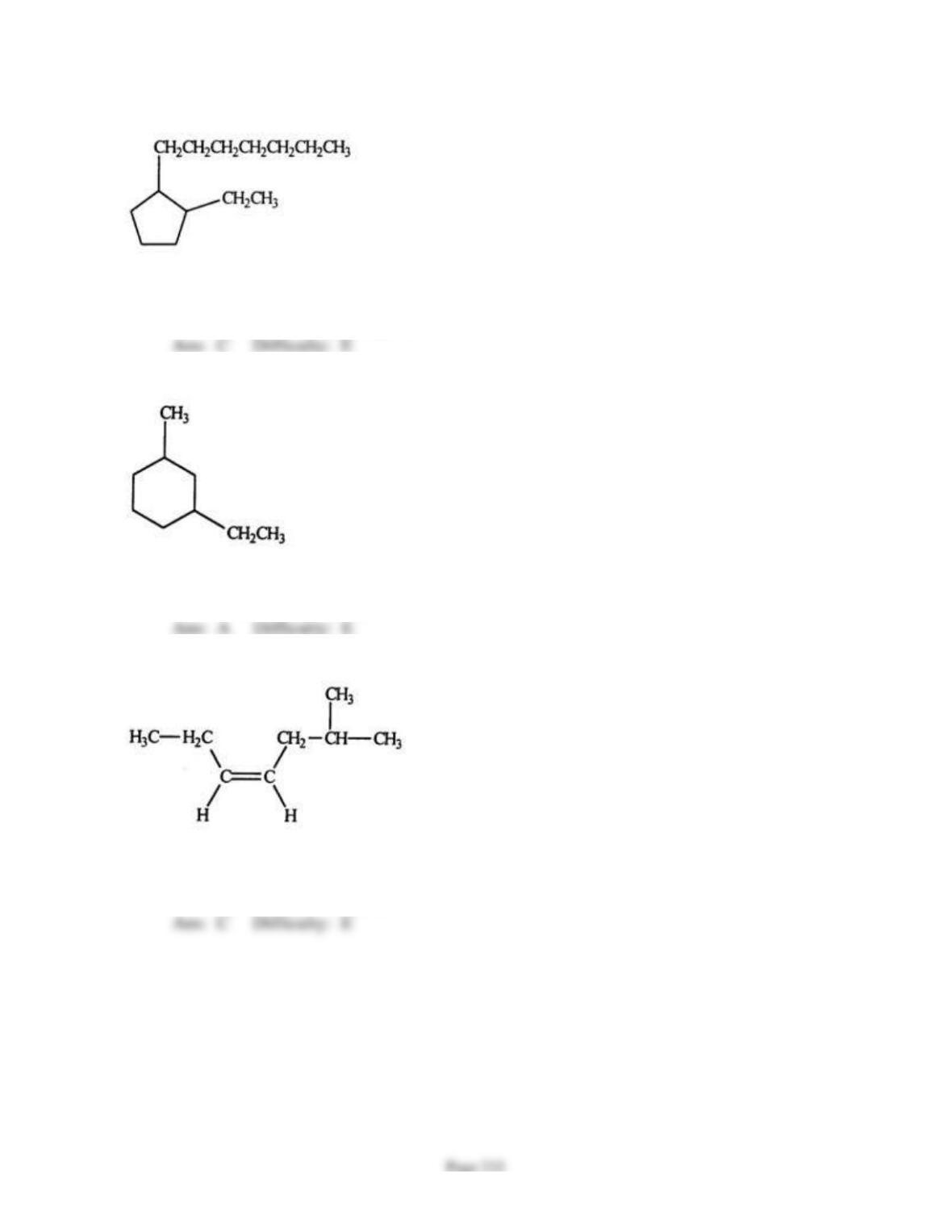
6. Select the correct name for the following compound.
A) ortho-ethylheptylcyclopentane D) ethylcyclopentylheptane
B) meta-ethylheptylcyclopentane E) ortho-ethylheptylbenzene
C) 1-ethyl-2-heptylcyclopentane
7. Select the correct name for the following compound.
A) 1-ethyl-3-methylcyclohexane D) meta-ethylmethylbenzene
B) 1-methyl-5-ethylcyclohexane E) 3-ethyltoluene
C) meta-ethylmethylcyclohexane
8. Select the correct name for the following compound.
A) cis-2-methyl-4-heptene D) trans-6-methyl-3-heptene
B) trans-2-methyl-4-heptene E) cis-2-methyl-3-heptene
C) cis-6-methyl-3-heptene
Chapter 15: Organic Compounds and the Atomic Properties of Carbon
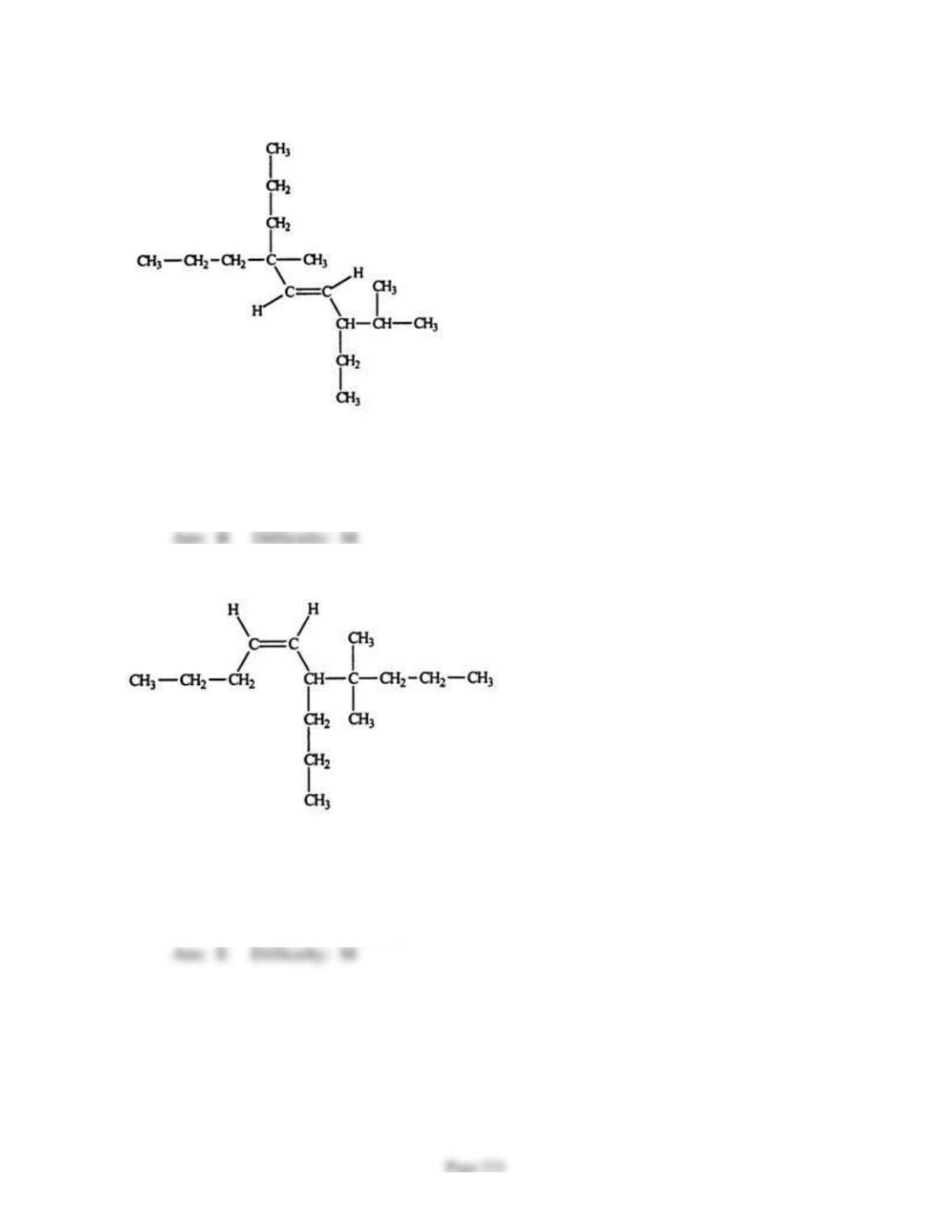
9. Select the correct name for the following compound.
A) cis-3-ethyl-2,6–dimethyl-6-propyl-4-nonene
B) trans-3-ethyl-2,6-dimethyl-6-propyl-4-nonene
C) cis-7-ethyl-4,8-dimethyl-4-propyl-5-nonene
D) trans-7-ethyl-4,8-dimethyl-4-propyl-5-nonene
E) none of the above
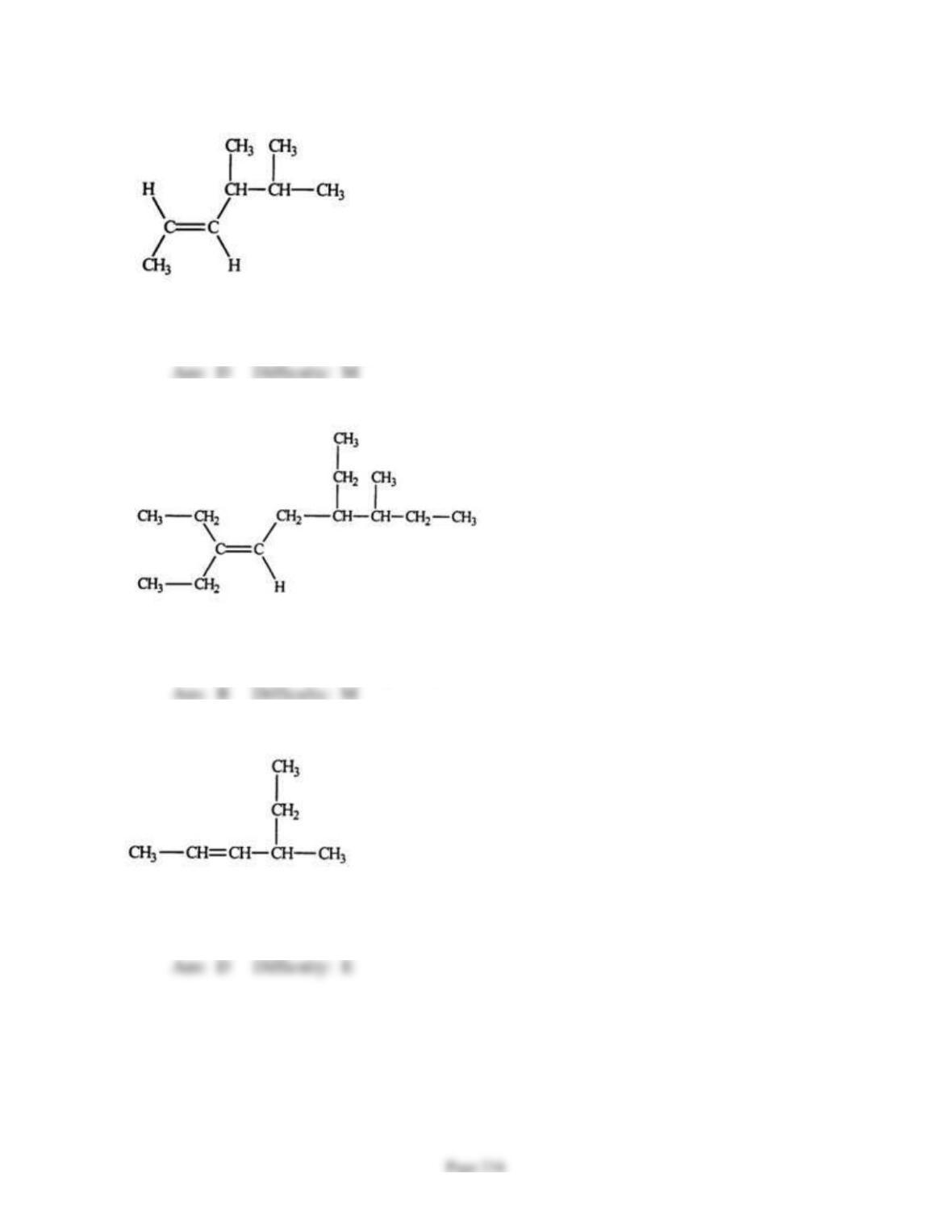
10. Select the correct name for the following compound.
A) cis-2-methyl-2,3-dipropyl-4-octene
B) cis-7-methyl-6,7-dipropyl-4-octene
C) cis-4,4-dimethyl-5-propyl-6-decene
D) trans-7,7-dimethyl-6-propyl-4-decene
E) cis-7,7-dimethyl-6-propyl-4-decene
Chapter 15: Organic Compounds and the Atomic Properties of Carbon
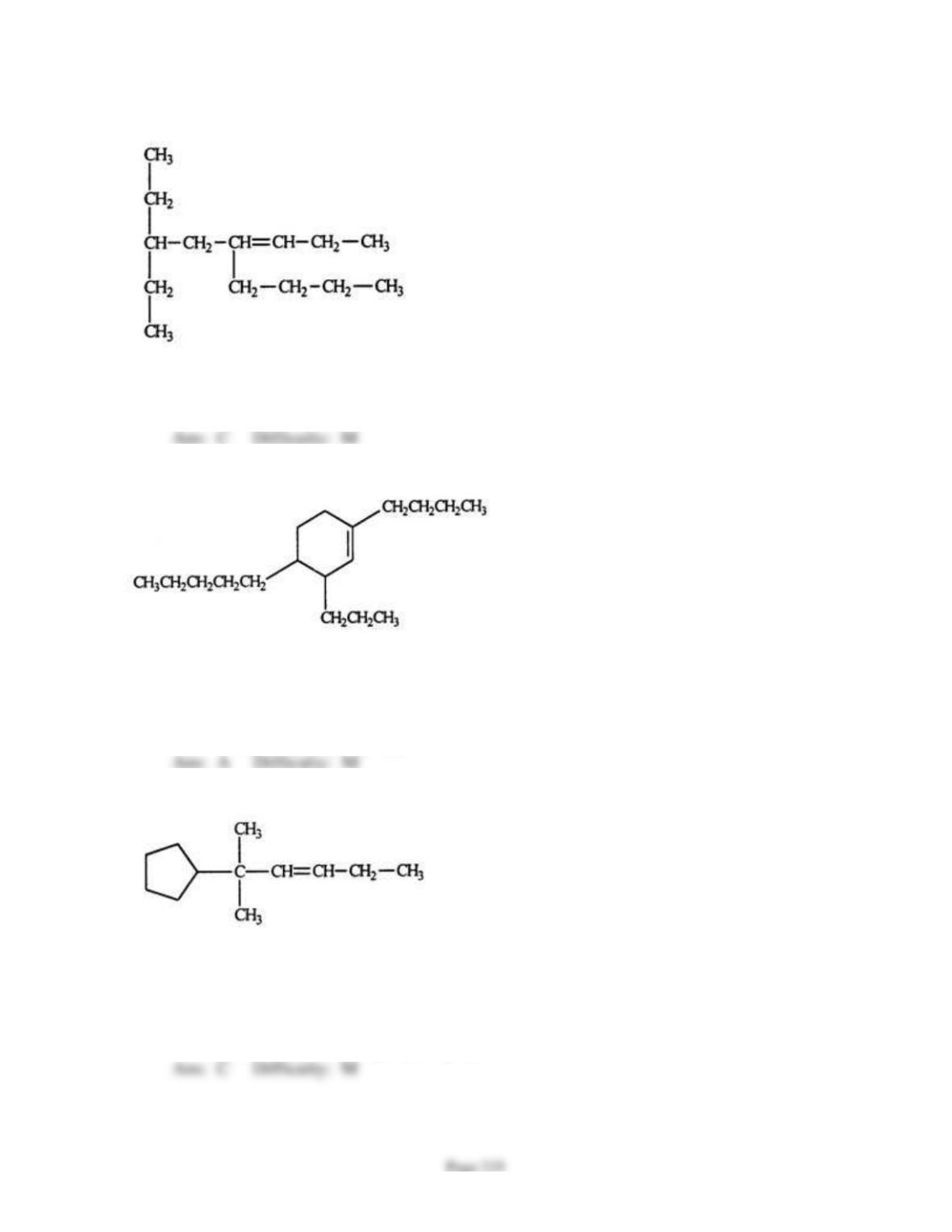
11. Select the correct name for the following compound.
A) cis-2,3-dimethyl-4-hexene D) trans-4,5-dimethyl-2-hexene
B) trans-2,3-dimethyl-4-hexene E) trans-4,5-dimethyl-2-heptene
C) cis-4,5-dimethyl-2-hexene
12. Select the correct name for the following compound.
A) cis-2,5-diethyl-6-methyl-3-nonene D) 4,6-diethyl-3-methyl-6-nonene
B) 2,5-diethyl-6-methyl-3-nonene E) trans-2,5-diethyl-6-methyl-3-nonene
C) cis-4,6-diethyl-3-methyl-6-nonene
13. Select the correct name for the following compound.
A) 2-ethyl-3-pentene D) 4-methyl-2-hexene
B) 4-ethyl-2-pentene E) none of the above
C) 3-methyl-4-hexene
Chapter 15: Organic Compounds and the Atomic Properties of Carbon
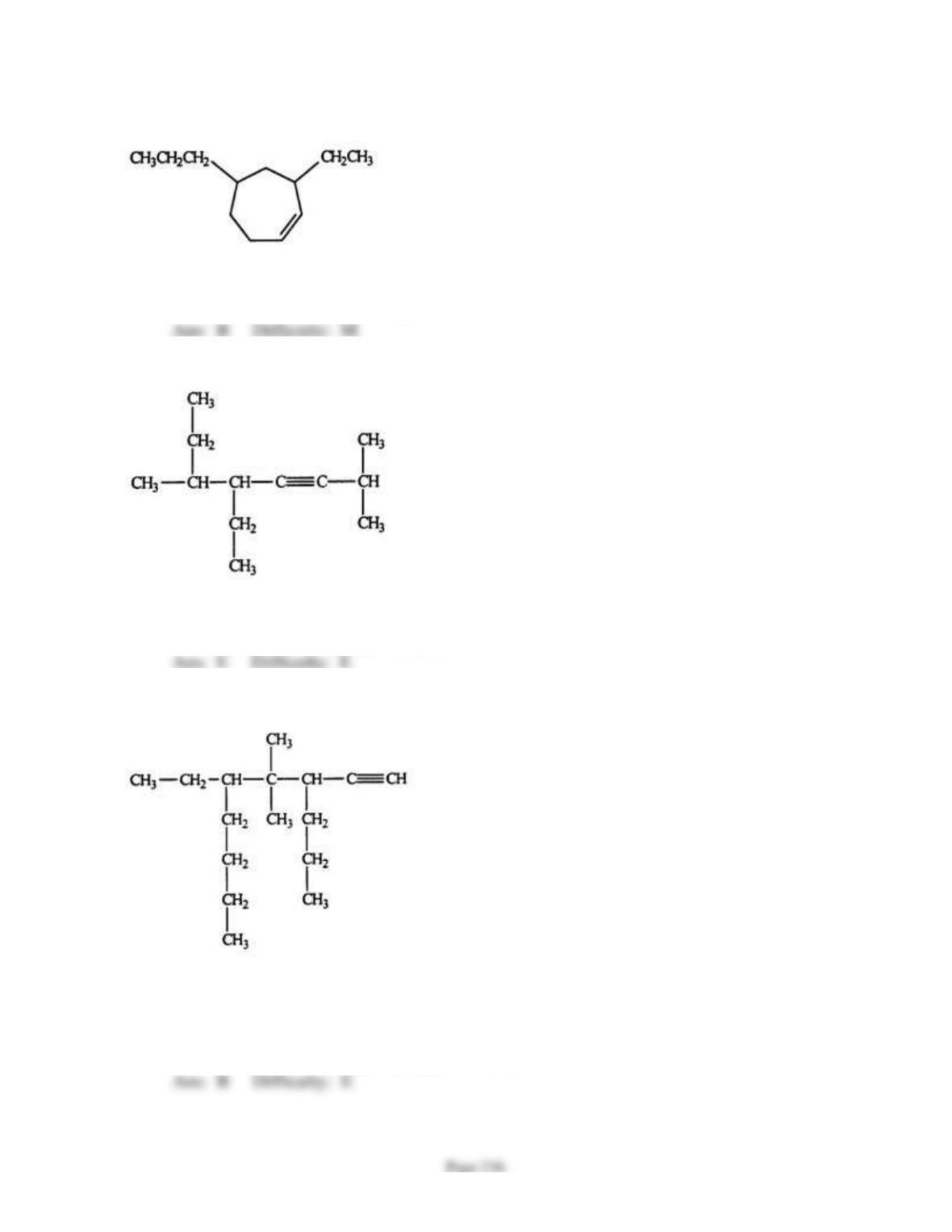
14. Select the correct name for the following compound.
A) 1,1-diethyl-3-butyl-3-hexene D) 3-ethyl-5-propyl-5-nonene
B) 5-butyl-3-ethyl-5-octene E) 4-butyl-6-ethyl-3,4-octene
C) 4-butyl-6-ethyl-3-octene
15. Select the correct name for the following compound.
A) 1-butyl-4-pentyl-3-propylcyclohexene
B) 1-butyl-4-pentyl-5-propylcyclohexene
C) 2-butyl-5-pentyl-6-propylcyclohexene
D) 4-butyl-1-pentyl-2-propylcyclohexene
E) 1-butyl-4-pentyl-3-propylbenzene
16. Select the correct name for the following compound.
A) 1,1-dimethyl-1-cylcopentyl-2-pentane
B) 1,1-dimethyl-2-hexene-cyclopentane
C) 2-cyclopentyl-2-methyl-3-hexene
D) 5,5-dimethyl-5-cyclopentyl-3-pentane
E) 5,5-dimethyl-5-cyclopentyl-3-pentene
Chapter 15: Organic Compounds and the Atomic Properties of Carbon
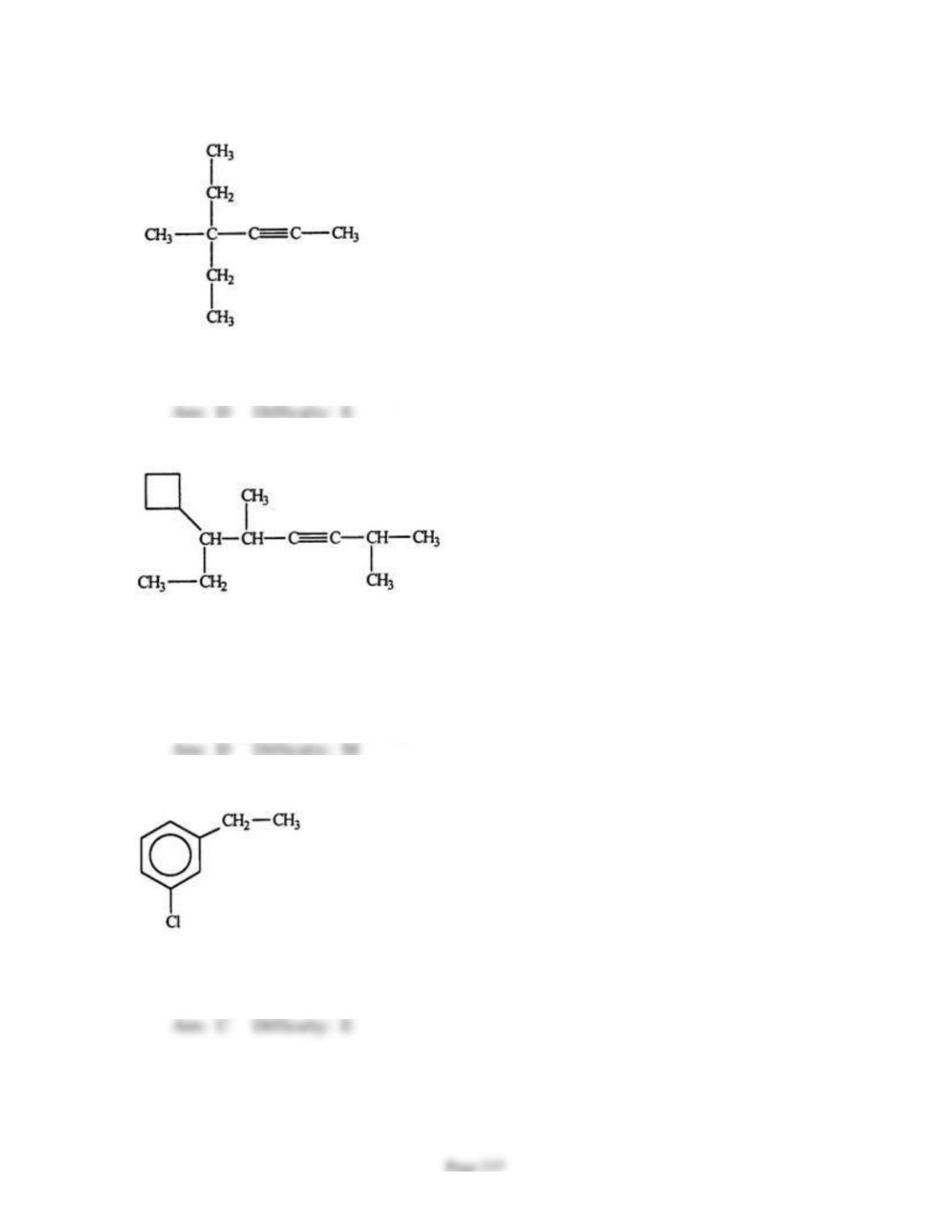
17. Select the correct name for the following compound.
A) 2-ethyl-4-propylcycloheptene D) 7-ethyl-5-propylcycloheptene
B) 3-ethyl-5-propylcycloheptene E) 3-ethyl-5-propylcyclohexene
C) 6-ethyl-4-propylcycloheptene
18. Select the correct name for the following compound.
A) 4-ethyl-1,1,5-trimethyl-2-heptyne D) 3-ethyl-3,7-dimethyl-5-octyne
B) 4,5-diethyl-1,1-dimethyl-2-heptyne E) 5-ethyl-2,6-dimethyl-3-octyne
C) 5-ethyl-2,6-dimethyl-3-octene
19. Select the correct name for the following compound.
A) 5-butyl-4,4-dimethyl-3-propyl-1-heptene
B) 5-ethyl-4-4-dimethyl-3-propyl-1-nonyne
C) 5-ethyl-6-6-dimethyl-7-propyl-8-nonyne
D) 4,6-diethyl-5-5-dimethyl-4-decyne
E) 5-ethyl-4-4-dimethyl-3-propyl-1-nonene
Chapter 15: Organic Compounds and the Atomic Properties of Carbon
20. Select the correct name for the following compound.
A) 4-4-diethyl-2-pentyne D) 4-ethyl-4-methyl-2-hexyne
B) 2,2-diethyl-3-pentyne E) 2-ethyl-2-methyl-4-hexene
C) 2-ethyl-2-methyl-4-hexyne
21. Select the correct name for the following compound.
A) 2,5-dimethyl-3-octyne-6-cyclobutane
B) 4-cyclobutyl-1-isopropyl-3-methyl-1-hexyne
C) 3-cyclobutyl-4,7-dimethyl-5-octyne
D) 6-cyclobutyl-2,5-dimethyl-3-octyne
E) 3-cyclobutyl-4,7-dimethyl-5-octene
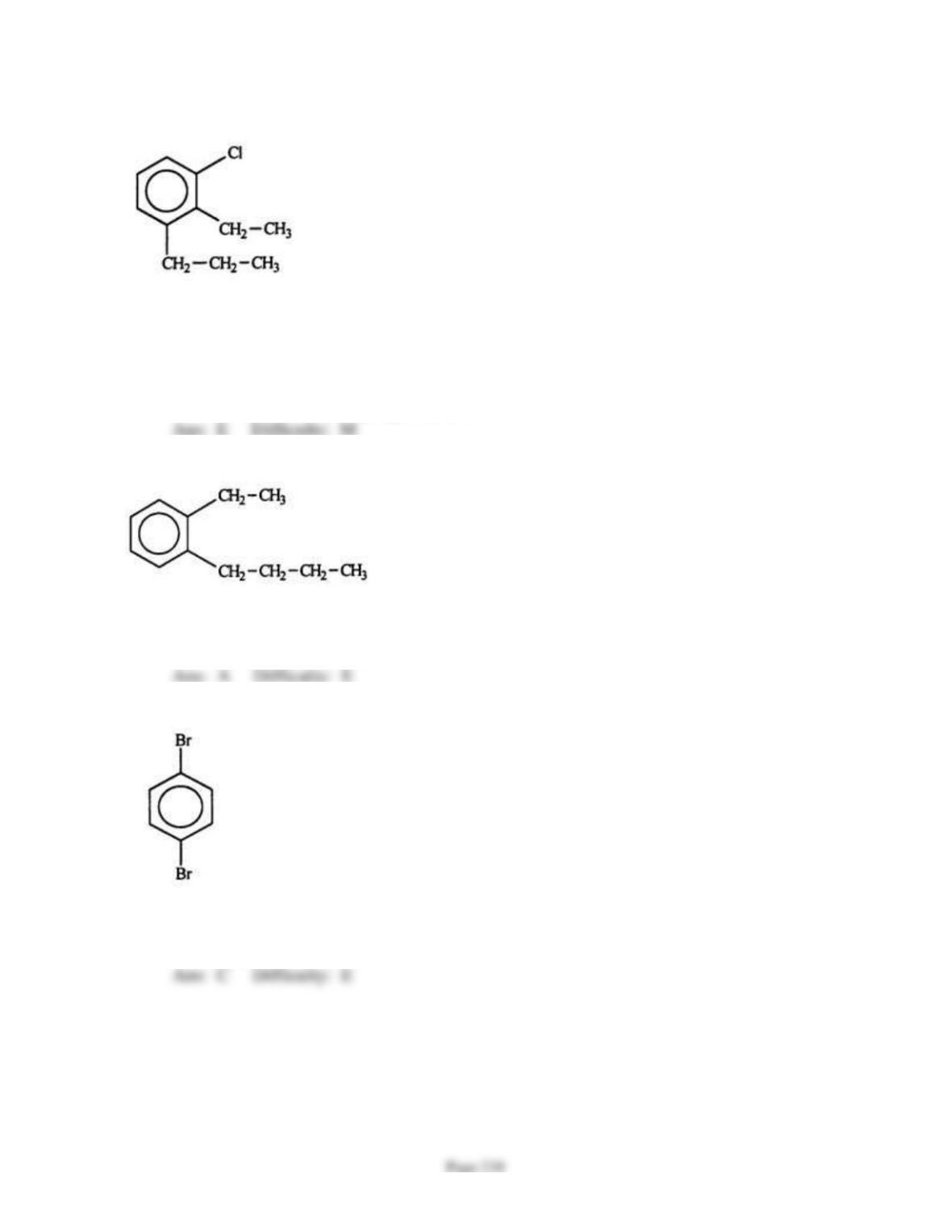
22. Select the correct name for the following compound.
A) meta-chloroethylcyclohexene D) 1-chloro-5-ethylbenzene
B) 1-chloro-5-ethylcyclohexene E) 1-chloro-3-ethylcyclohexane
C) meta-chloroethylbenzene
Chapter 15: Organic Compounds and the Atomic Properties of Carbon
23. Select the correct name for the following compound.
A) 1-chloro-2-ethyl-3-propylcyclohexane
B) 1-chloro-2-ethyl-3-propylcyclohexene
C) 1-chloro-ortho-ethylpropylbenzene
D) 1-chloro-meta-ethylpropylbenzene
E) 1-chloro-2-ethyl-3-propylbenzene
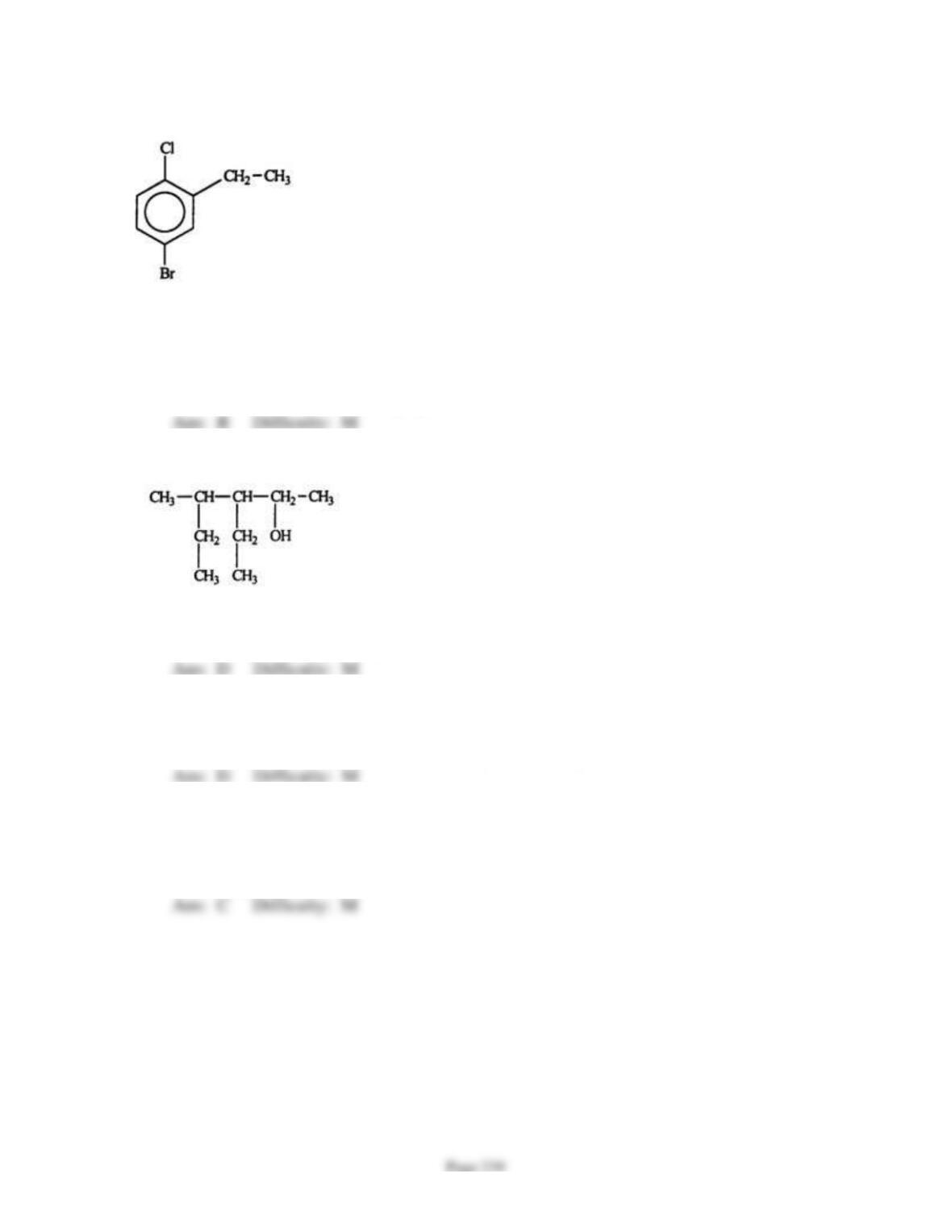
24. Select the correct name for the following compound.
A) ortho-butylethylbenzene D) 1-butyl-2-ethylcyclohexene
B) meta-butylethylbenzene E) 1-butyl-2-ethylcyclohexane
C) para-butylethylbenzene
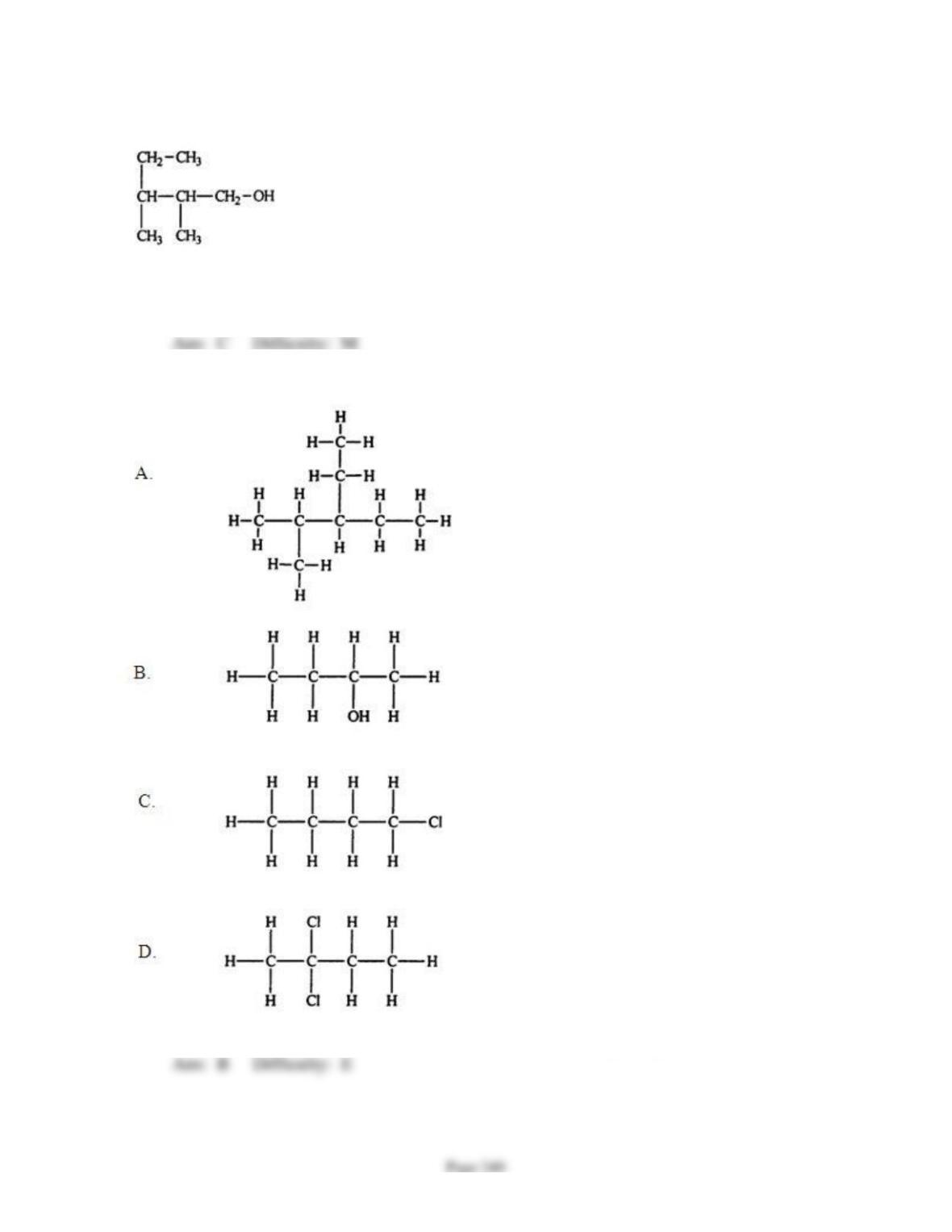
25. Select the correct name for the following compound.
A) ortho-dibromobenzene D) 1,4-dibromocyclohexene
B) meta-dibromobenzene E) 1,4-dibromocyclohexane
C) para-dibromobenzene
Chapter 15: Organic Compounds and the Atomic Properties of Carbon
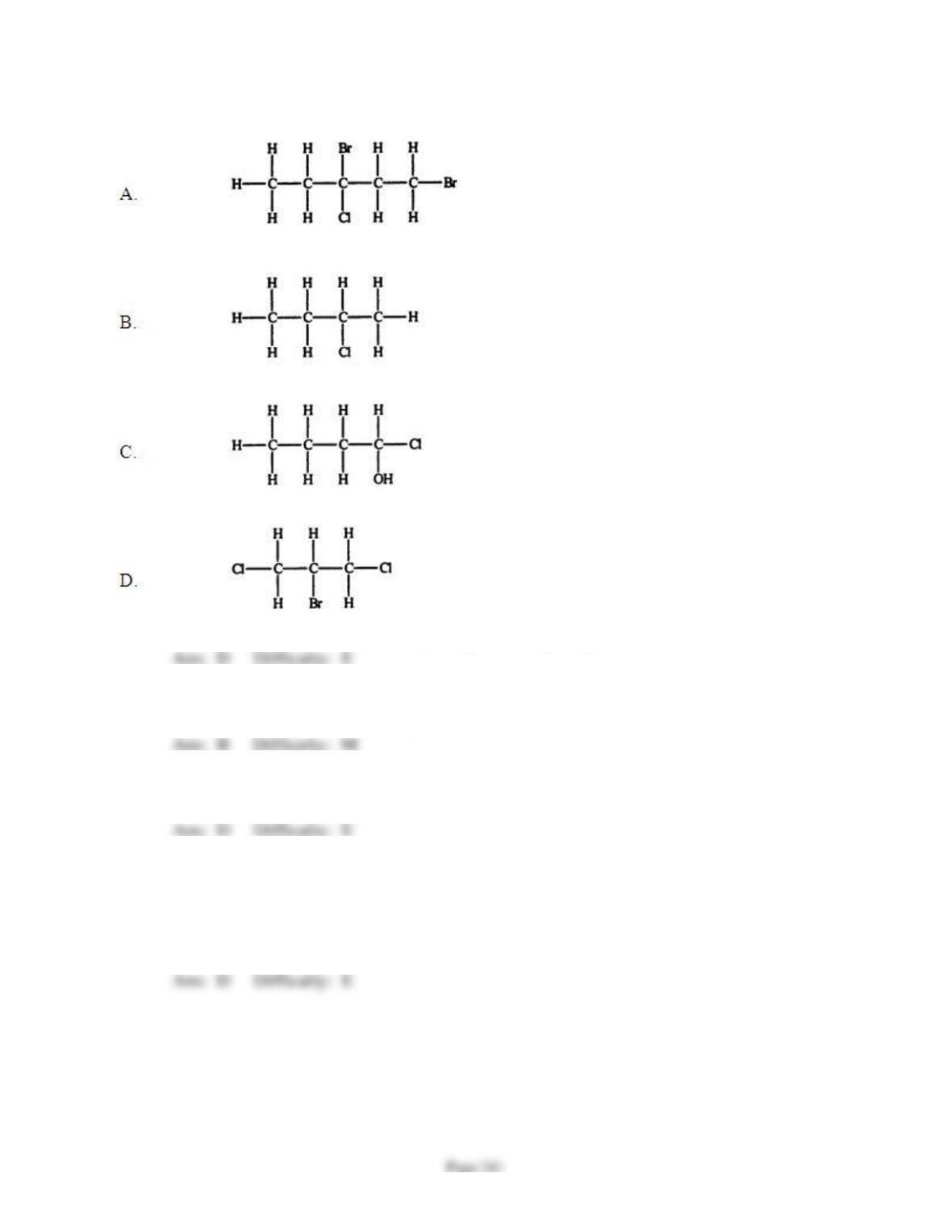
26. Select the correct name for the following compound.
A) para-bromochloro-2-ethylbenzene
B) 4-bromo-1-chloro-2-ethylbenzene
C) 5-bromo-2-chloro-1-ethylbenzene
D) 1-bromo-4-chloro-3-ethylcyclohexene
E) 4-bromo-1-chloro-2-ethylcyclohexane
27. Select the correct name for the following compound.
A) 3,4-diethyl-4-methyl-2-butanol D) 3-ethyl-4-methyl-2-hexanol
B) 2,3-diethyl-4-pentanol E) 3-ethyl-4-methyl-2-hexanal
C) 3,4-diethyl-2-pentanol
28. What is the molecular formula of the compound 2,3-dimethyl-4-cyclopentyl-5-
ethyldecane?
A) C16H34 B) C17H34 C) C18H36 D) C19H38 E) C20H40
29. What is the difference between 1-butyne and 1-butene?
A) 1 carbon atom D) 4 hydrogen atoms
B) 1 carbon atom and 2 hydrogen atoms E) 1 carbon atom and 4 hydrogen atoms
C) 2 hydrogen atoms
Chapter 15: Organic Compounds and the Atomic Properties of Carbon
30. Select the correct name for the following compound.
A) 3-ethyl-2,3-dimethyl-1-propanol D) 3,4-dimethyl-5-pentanol
B) 2,3,4-trimethyl-1-butanol E) 2,3-dimethyl-1-pentanal
C) 2,3-dimethyl-1-pentanol
31. Which compound, if any, will be optically active?
A) A B) B C) C D) D E) None of the above is optically active.
Chapter 15: Organic Compounds and the Atomic Properties of Carbon
32. Which compound, if any, will not be optically active?
A) A B) B C) C D) D E) They are all optically active.
33. Excluding cyclic compounds, how many possible isomers exist for C4H8?
A) 2 B) 4 C) 5 D) 6 E) 7
34. Including cyclic compounds, how many possible isomers exist for C4H8?
A) 2 B) 4 C) 5 D) 6 E) 7
35. Which of the following features do cyclohexene and 3-methyl-1-pentyne have in
common?
A) same physical properties D) same molecular weight
B) same chemical properties E) same number of double bonds
C) same boiling point
Chapter 15: Organic Compounds and the Atomic Properties of Carbon
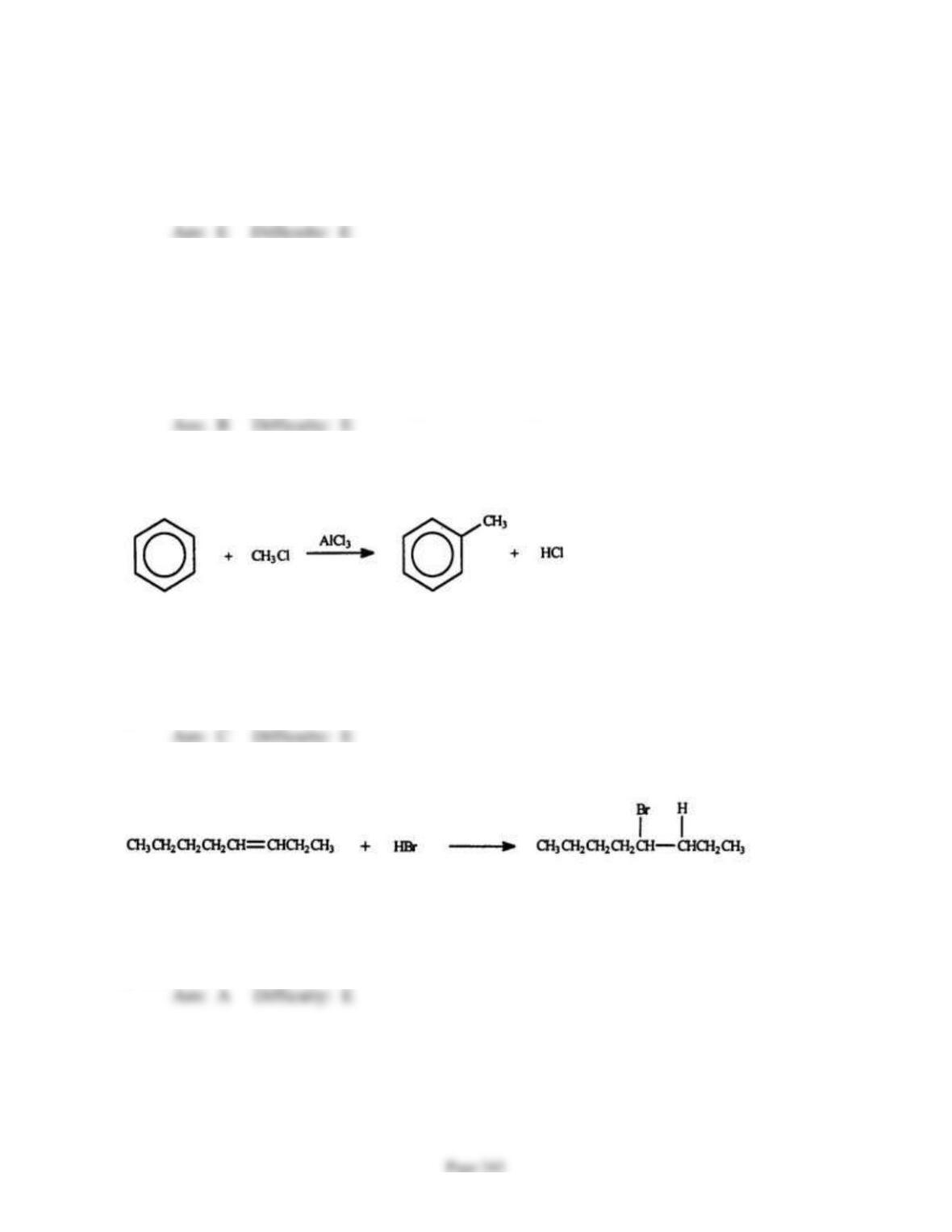
36. Select the correct type for the following reaction.
CH3CH2CH2CH2OH + HBr → CH3CH2CH2CH2Br + H2O
A) dehydration D) elimination
B) dehydroxylation E) substitution
C) addition
37. Alcohols undergo a variety of reactions. Which one of the following reactions is not
undergone by the alcohol functional group?
A) substitution
B) addition
C) dehydration
D) oxidation to form a ketone
E) oxidation to form an aldehyde or a carboxylic acid
38. Benzene will react with chloromethane in the presence of a catalyst to produce toluene
and hydrogen chloride. Select the correct reaction type for the process.
A) addition
B) elimination
C) substitution
D) oxidation
E) reduction
39. Select the correct reaction type for the following process.
A) addition
B) elimination
C) substitution
D) oxidation
E) reduction
Chapter 15: Organic Compounds and the Atomic Properties of Carbon
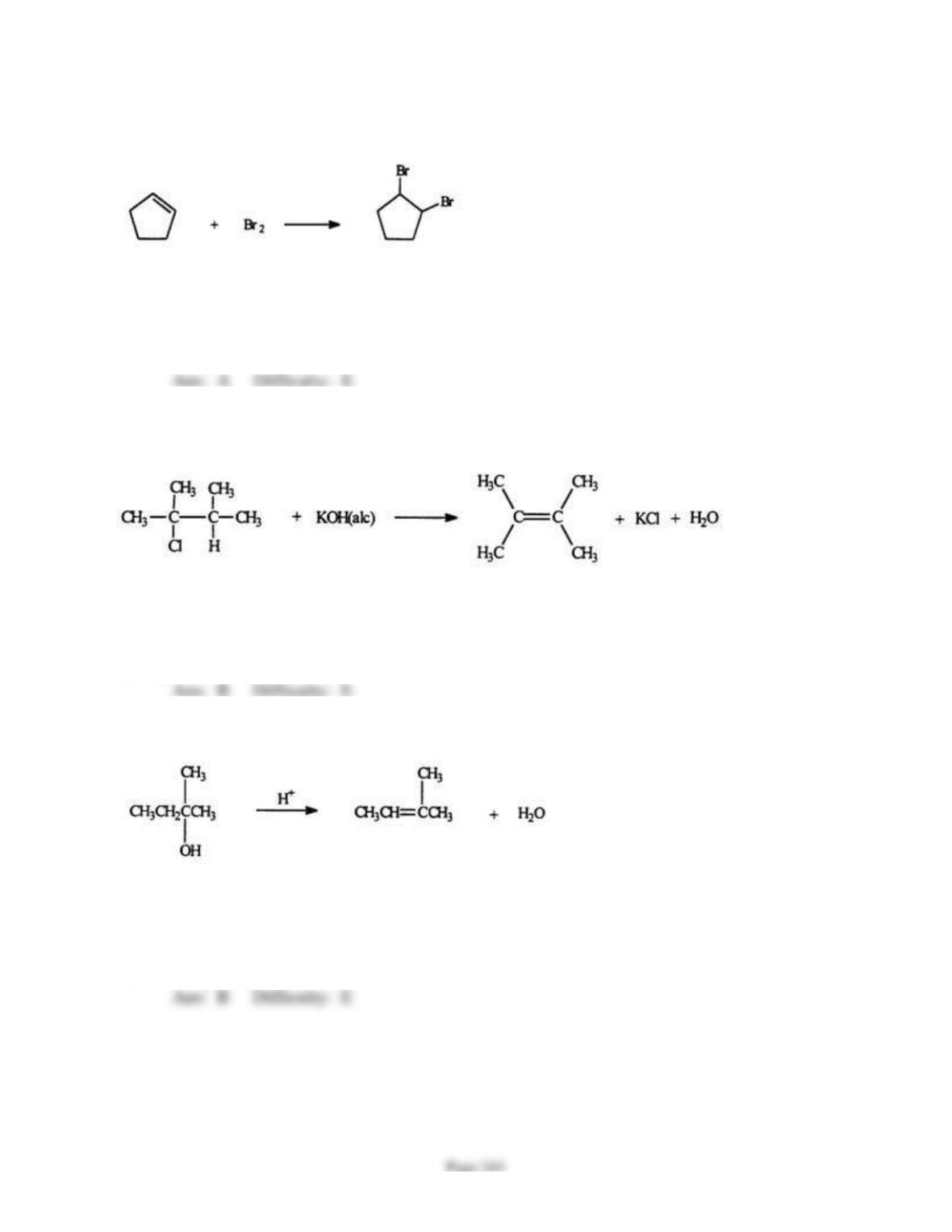
40. The reaction of bromine with an alkene such as cyclopentene is a good laboratory test for
the presence of a double bond in a compound. What type of reaction is it?
A) addition
B) elimination
C) substitution
D) displacement
E) reduction
41. 2-chloro-2,3-dimethylbutane will react with potassium hydroxide dissolved in alcohol to
produce 2,3-dimethyl-2-butene. What type of reaction is this?
A) addition
B) elimination
C) substitution
D) oxidation
E) displacement
42. Select the correct type for the following reaction.
A) addition
B) elimination
C) substitution
D) oxidation
E) dehydrogenation
Chapter 15: Organic Compounds and the Atomic Properties of Carbon
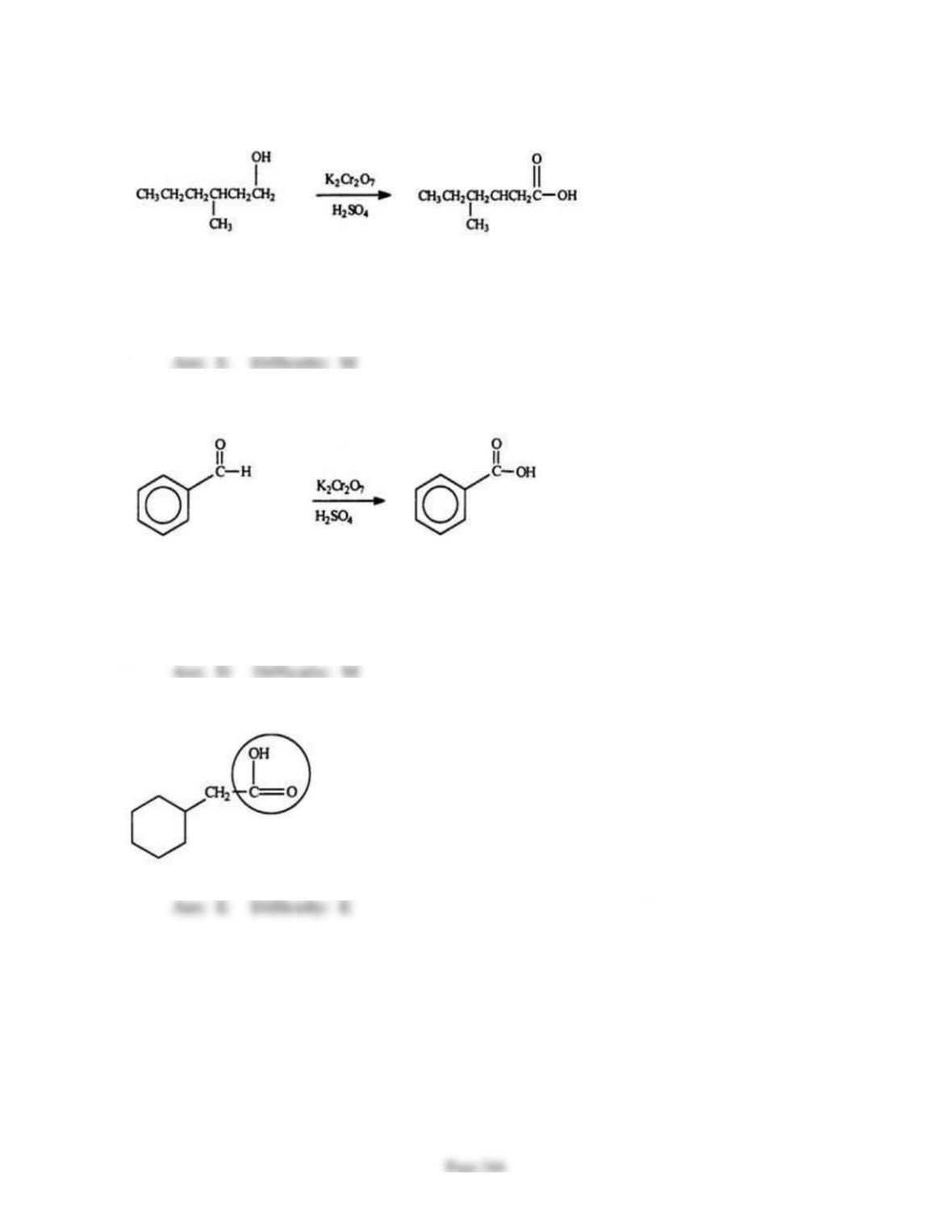
43. Select the correct type for the following reaction.
A) addition
B) elimination
C) carbonylation
D) dehydration
E) oxidation
44. Select the correct type for the following reaction.
A) addition
B) elimination
C) substitution
D) oxidation
E) reduction
45. Identify the functional group circled.
A) aldehyde B) ketone C) alcohol D) ester E) carboxylic acid
Chapter 15: Organic Compounds and the Atomic Properties of Carbon
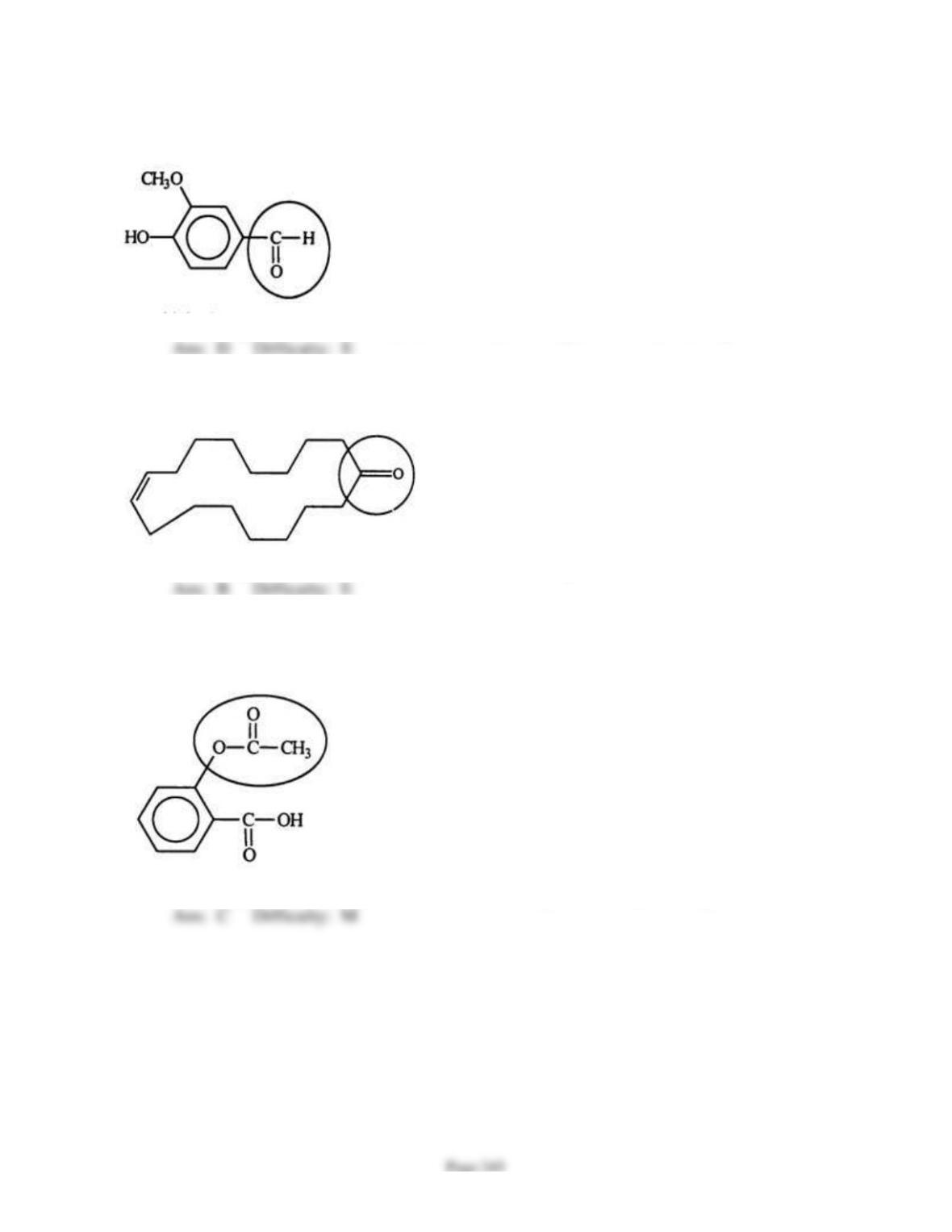
46. Vanillin is a flavoring agent which occurs naturally in the vanilla bean, the seed of an
orchid. Identify the functional group circled.
A) aldehyde B) ketone C) alcohol D) carboxylic acid E) carbonyl
47. One source of a musky odor in perfumes is civetone, a compound extracted from the
scent gland of the civet cat. Identify the functional group circled.
A) aldehyde B) ketone C) alcohol D) carboxylic acid E) oxide
48. Aspirin is an effective and widely used pain reliever. Identify the functional group
circled.
A) aldehyde B) ketone C) ester D) carboxylic acid E) carbonyl
Chapter 15: Organic Compounds and the Atomic Properties of Carbon
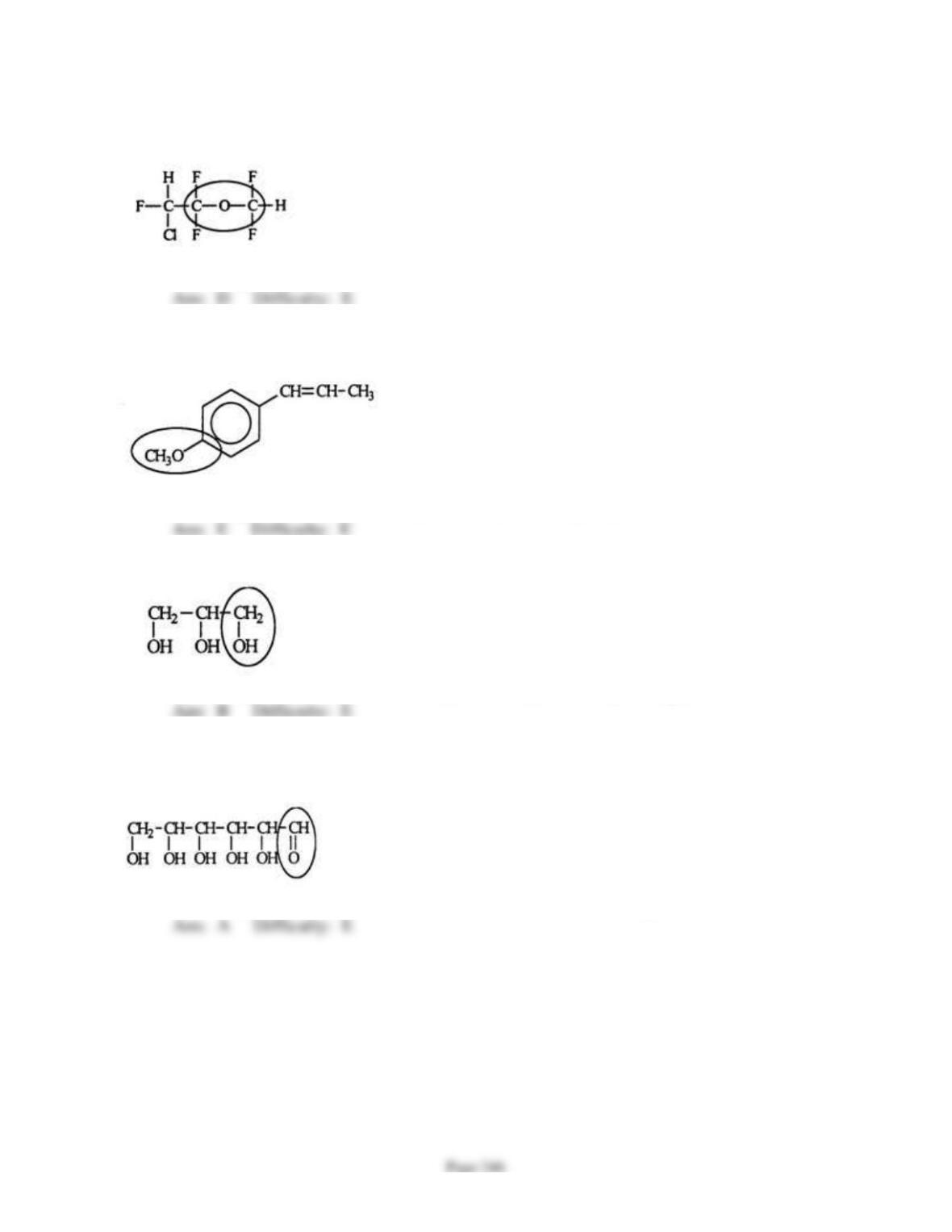
49. Enflurane is an effective gaseous anesthetic with relatively low flammability. Identify the
functional group circled.
A) aldehyde B) ketone C) ester D) ether E) alcohol
50. Anethole, a derivative of anise, is used in flavoring and as perfume in soap and
toothpaste. Identify the functional group circled.
A) aldehyde B) ketone C) alcohol D) ester E) ether
51. Glycerin is used in cosmetics as a moisturizer. Identify the functional group circled.
A) carboxylic acid B) alcohol C) ester D) ether E) aldehyde
52. Glucose is an important sugar in a person’s metabolic cycle. Identify the functional group
circled.
A) aldehyde B) ketone C) alcohol D) ester E) carboxylic acid
Chapter 15: Organic Compounds and the Atomic Properties of Carbon
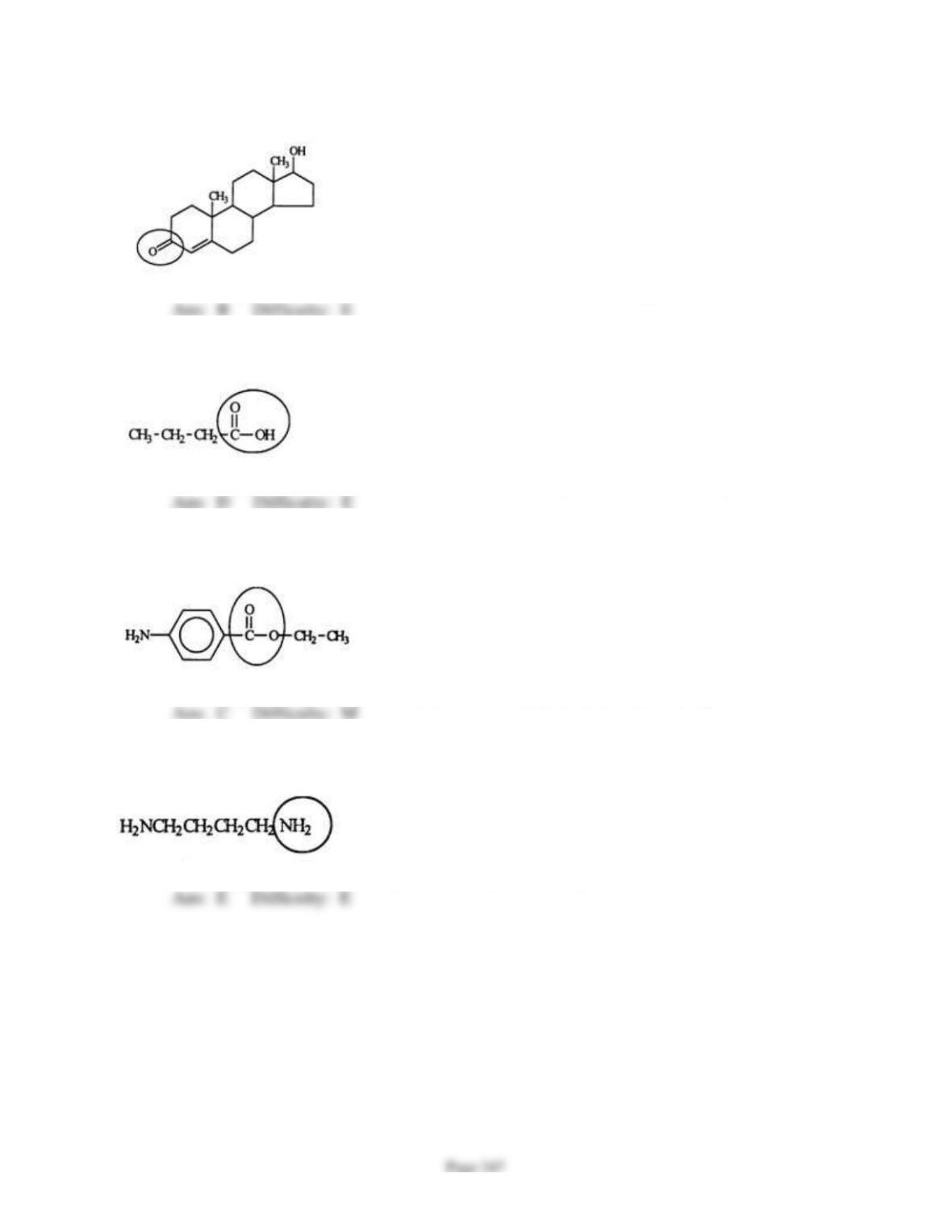
53. Testosterone is a male hormone. Identify the functional group circled.
A) aldehyde B) ketone C) alcohol D) ester E) carboxyl
54. The compound shown below is responsible for the odor in rancid butter. Identify the
functional group circled.
A) aldehyde B) ketone C) alcohol D) carboxylic acid E) carbonyl
55. Benzocaine is from a family of chemicals that are good local anesthetics. Identify the
functional group circled.
A) aldehyde B) ketone C) ester D) carboxylic acid E) carbonyl
56. Putrescine is produced during the decay and protein breakdown of meats and is
responsible for some of the odor found in them. Identify the functional group circled.
A) aldehyde B) ketone C) amide D) nitrile E) amine
Chapter 15: Organic Compounds and the Atomic Properties of Carbon
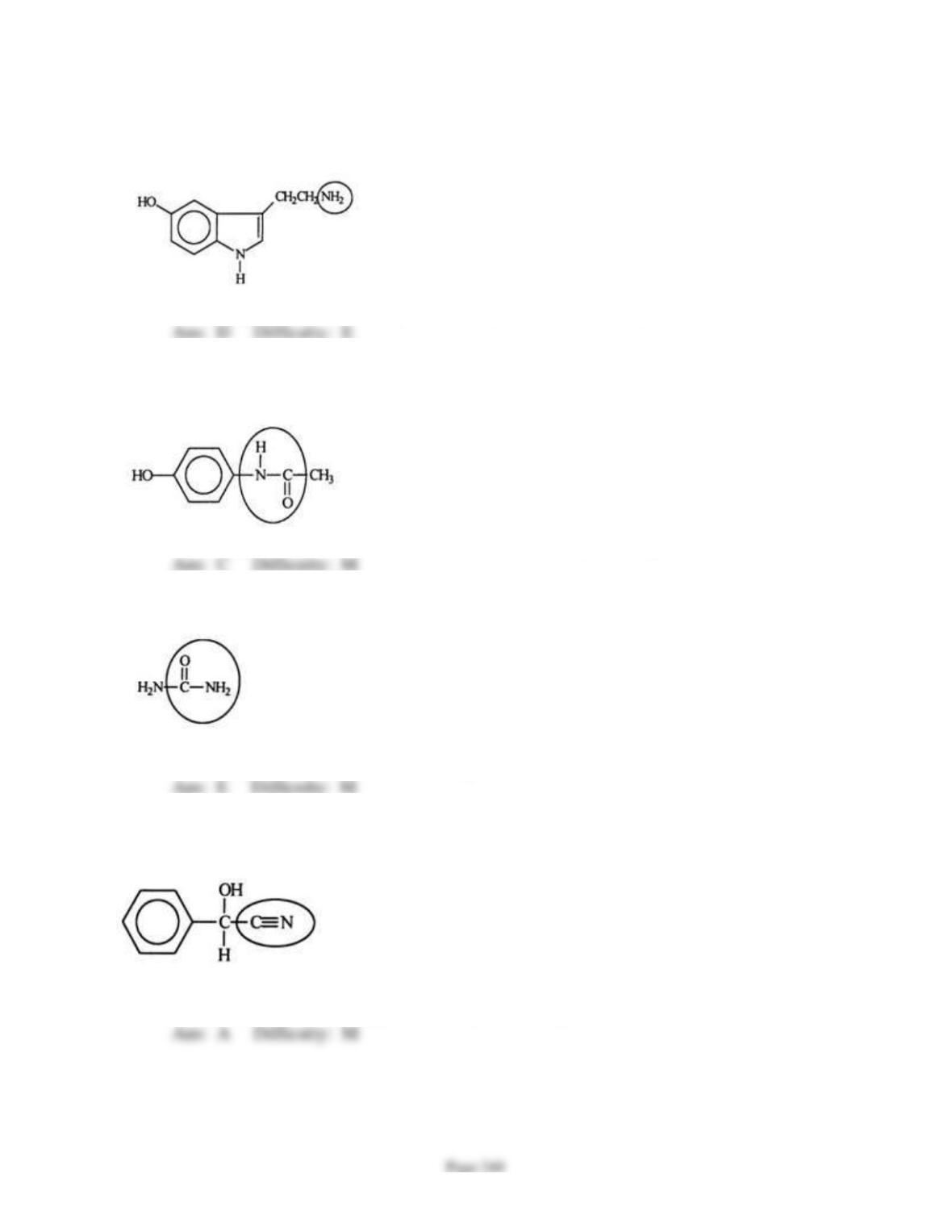
57. Serotonin transmits nerve impulses through the body. Identify the functional group
circled.
A) aldehyde B) alcohol C) amide D) amine E) nitride
58. Acetaminophen is a widely used and an effective pain reliever. Identify the functional
group circled.
A) aldehyde B) alcohol C) amide D) amine E) carbonyl
59. Urea carries waste nitrogen from the body in urine. Identify the functional group circled.
A) aldehyde B) alcohol C) carboxyl D) amine E) amide
60. The millipede ejects the compound shown below to protect itself from its enemies.
Identify the functional group circled.
A) nitrile B) alcohol C) amide D) amine E) nitro