35) Given that you wished to use exactly 0.325 mole of NaCl to prepare a 2.50 M NaCl solution,
how many milliliters of solution must you prepare?
A) 130. mL
B) 0.130 mL
C) 7.69 mL
D) 0.813 mL
E) none of the above
36) How many moles of KOH are contained in 750. mL of 5.00 M KOH solution?
A) 6.67 mol
B) 3.75 × mol
C) 56.1 mol
D) 3.75 mol
E) none of the above
37) What is the molarity of a solution prepared by dissolving of Ca(N into of
water?
A) 0.331 M
B) 0.932 M
C) 0.117 M
D) 1.99 M
E) none of the above
38) How many grams of KCl are needed to make of KCl?
A) 9.13
B) 1.52
C) 91.3
D) 0.123
E) none of the above
39) How many grams of LiF would be present in 575 mL of 0.750 M LiF solution?
A) 11.2
B) 0.0338
C) 1.12 × 10⁴
D) 19.9
E) 33.8
40) What mass (in grams) of fructose (C6H12O6) is contained in 125 mL of a 0.500 M fructose
solution?
A) 11.3
B) 11300
C) 721
D) 0.0625
E) 180.
41) Oftentimes solubility of a compound limits the concentration of the solution that can be
prepared. Use the solubility data given with each compound shown below to determine which
compound would allow the preparation of a 10.0 Molar solution.
A) AgNO3 (solubility = 122 g/100 g H2O)
B) KCl (solubility = 34.0 g/100 g H2O)
C) NaNO3 (solubility = 89.0 g/100 g H2O)
D) NH4Cl (solubility = 41.1 g/100 g H2O)
E) none of the above
42) A 0.15 M solution of BaCl2 contains:
A) 0.15 M Ba2+ ions and 0.15 M Cl– ions.
B) 0.15 M Ba2+ ions and 0.30 M Cl– ions.
C) 0.30 M Ba2+ ions and 0.15 M Cl– ions.
D) 0.30 M Ba2+ ions and 0.30 M Cl– ions.
E) none of the above
43) What are the ion concentrations in a 0.12 M solution of AlCl3?
A) 0.36 M Al3+ ions and 0.12 M Cl– ions
B) 0.12 M Al3+ ions and 0.040 M Cl– ions
C) 0.12 M Al3+ ions and 0.36 M Cl– ions
D) 0.040 M Al3+ ions and 0.040 M Cl– ions
E) none of the above
44) Which one of the following aqueous solutions would have the higher concentration of K+
(aq) ions? (Assume total solubility in water.)
A) 1.0 M KC2H3O2
B) 1.0 M KNO3
C) 1.0 M K2CO3
D) 1.0 M K3PO4
E) All of these solutions have the same concentration of K+ (aq).
45) Which solution below contains the highest total quantity of dissolved sodium ions?
A) 100. mL of 4.0 M NaCl
B) 75.0 mL of 3.0 M Na2SO4
C) 50.0 mL of 8.0 M NaOH
D) 50.0 mL of 2.0 M Na3PO4
E) none of the above
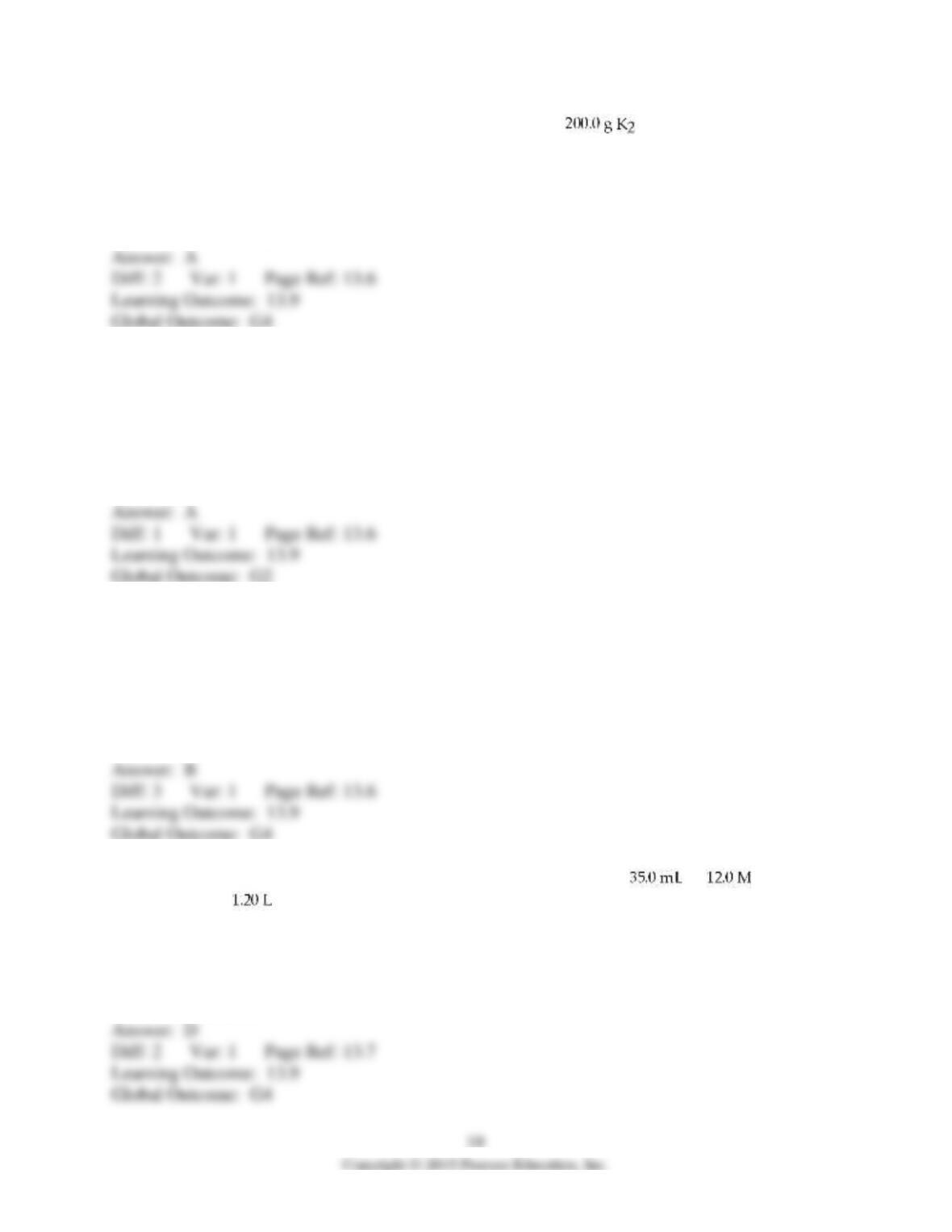
46) How many liters of a 2.18 M solution can be made from S?
A) 0.832
B) 1.81
C) 0.252
D) 1.20
E) none of the above
47) After you have completed the task of diluting a solution, which statement below must be
TRUE?
A) The new solution has more volume but has a lower concentration than before.
B) The new solution has more volume but has a higher concentration than before.
C) The new solution has less volume but has a lower concentration than before.
D) The new solution has less volume but has a higher concentration than before.
E) none of the above
48) A 90.0 g sample of NaOH is dissolved in water and the solution is diluted to give a final
volume of 3.00 liters. The molarity of the final solution is ________.
A) 0.500 M
B) 0.750 M
C) 1.00 M
D) 2.25 M
E) none of the above
49) What is the final concentration of a solution prepared by diluting of HCl to a
final volume of ?
A) 0.504 M
B) 3.50 M
C) 0.420 M
D) 0.350 M
E) none of the above
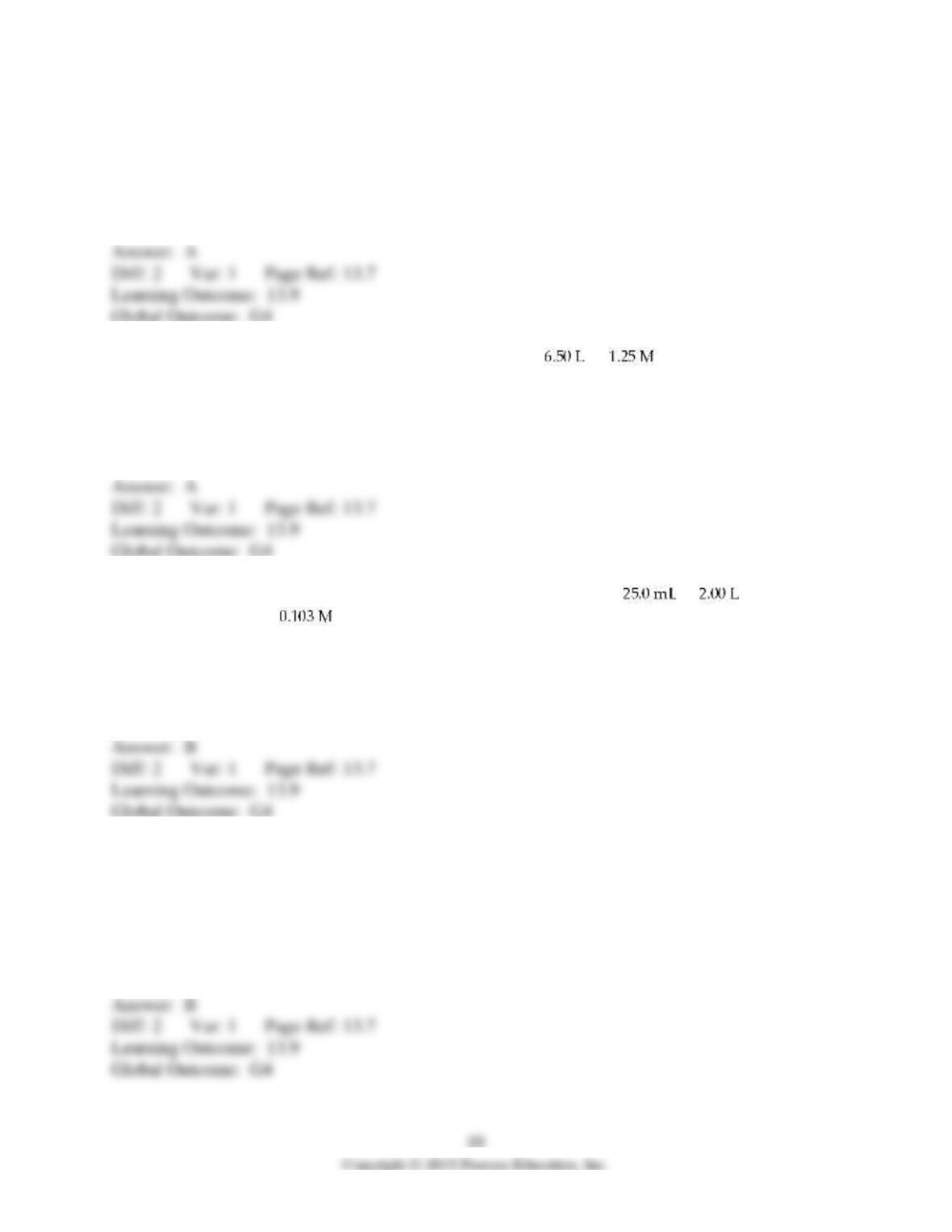
50) What volume of 12.0 M HCl is required to make 75.0 mL of 3.50 M HCl?
A) 21.9 mL
B) 0.560 mL
C) 257 mL
D) 560. mL
E) none of the above
51) What volume of 9.00 M nitric acid is needed to make of solution?
A) 903 mL
B) 1.73 L
C) 1.10 L
D) 748 mL
E) none of the above
52) What molarity should the stock solution be if you want to dilute to and have the
final concentration be ?
A) 0.206 M
B) 8.24 M
C) 4.12 M
D) 0.243 M
E) none of the above
53) If you add 4.00 mL of pure water to 6.00 mL of 0.750 M NaCl solution, what is the
concentration of sodium chloride in the diluted solution?
A) 0.250 M
B) 0.450 M
C) 0.500 M
D) 1.13 M
E) none of the above
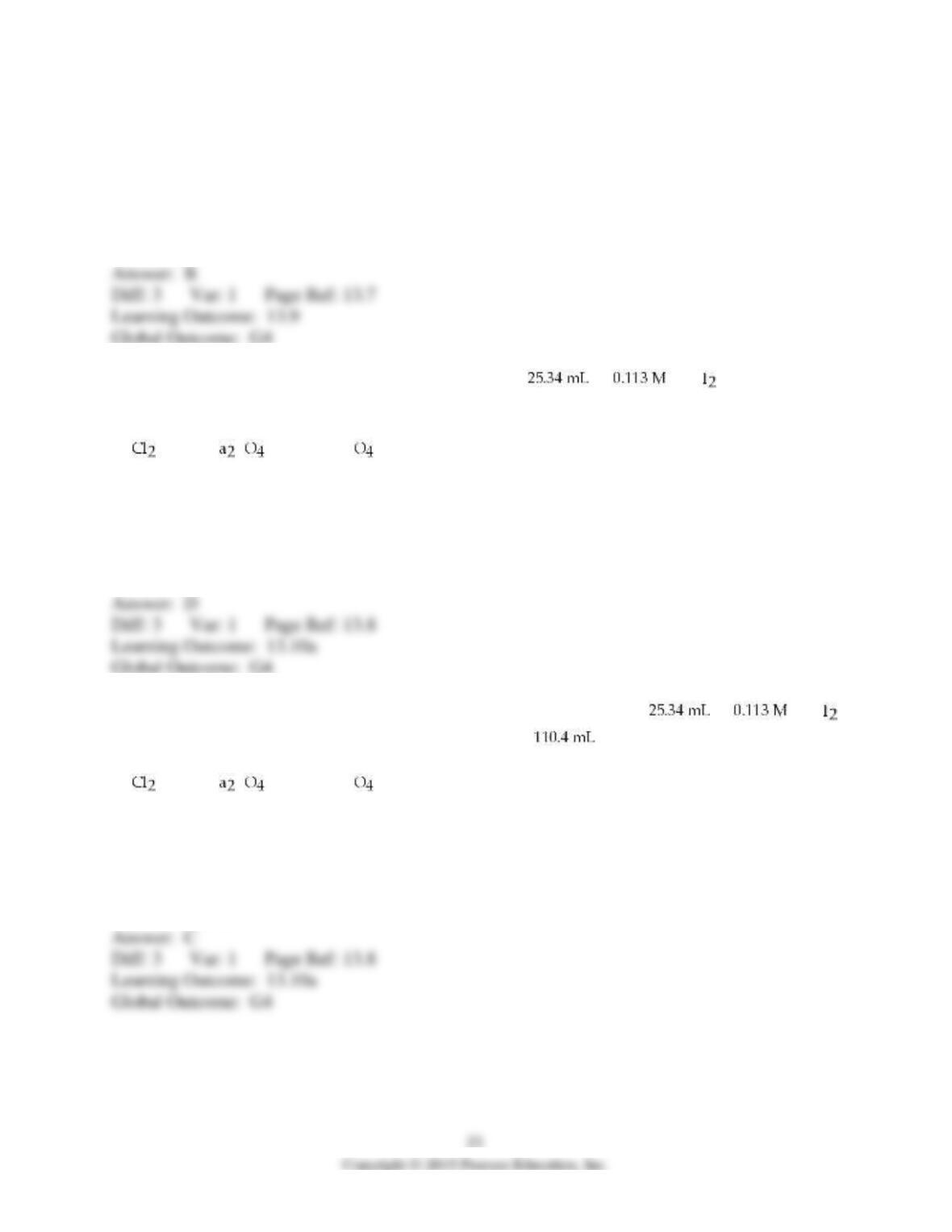
54) How much water would you ADD to 175 mL of 6.00 M hydrochloric acid to prepare a 2.00
M solution of this acid?
A) 525 mL
B) 350 mL
C) 58.3 mL
D) 700. mL
E) none of the above
55) How many grams of barium sulfate are produced if of BaC completely
react given the reaction:
Ba (aq) + N S (aq) → BaS (s) + 2NaCl (aq)
A) 5.90
B) 26.3
C) 1039
D) 0.668
E) none of the above
56) What is the concentration of sodium chloride in the final solution if of BaC
completely reacts and the total volume of the reaction is , given the reaction:
Ba (aq) + N S (aq) → BaS (s) + 2NaCl (aq)
A) 0.226
B) 0.0259
C) 0.0519
D) 0.667
E) none of the above
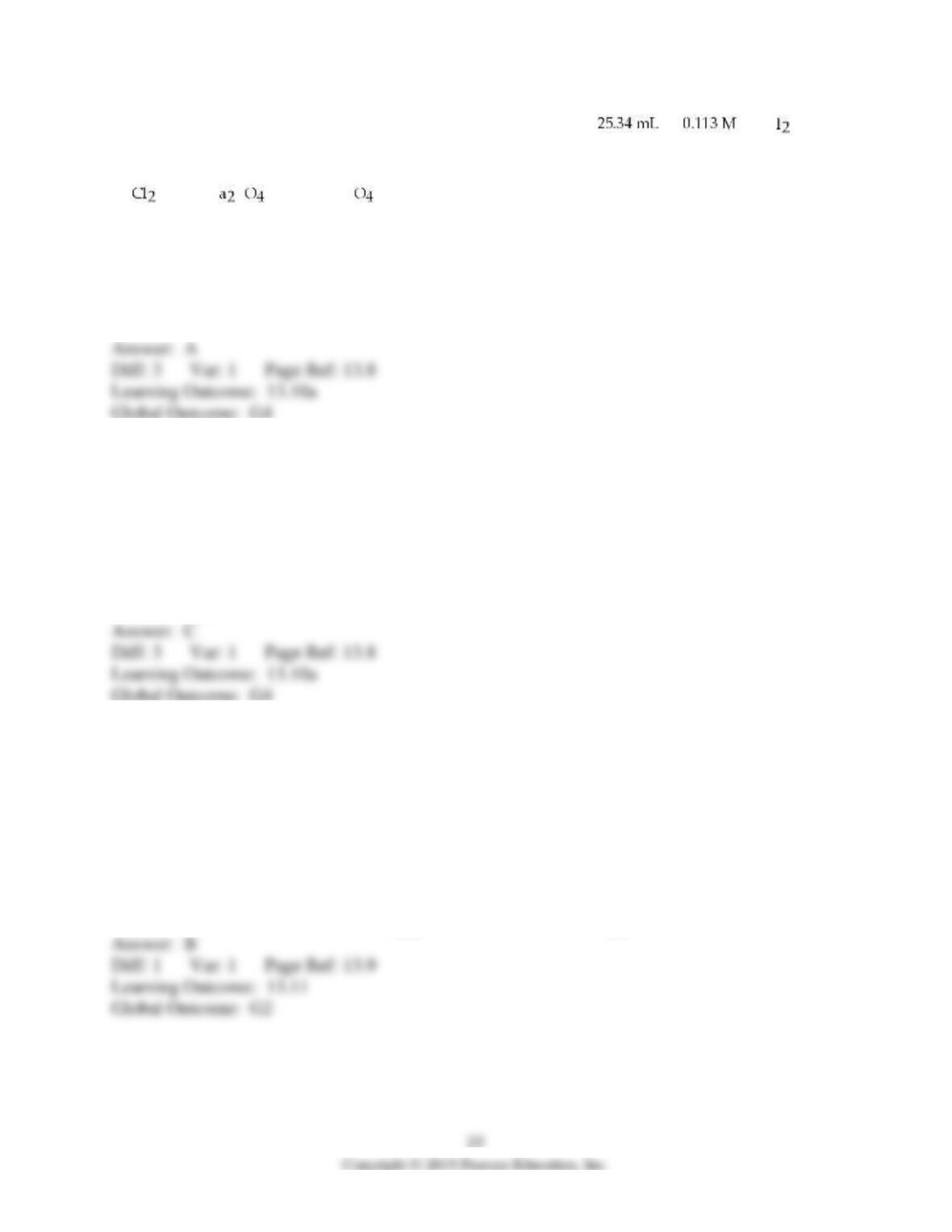
57) How many mL of 0.218 M sodium sulfate react with exactly of BaC given
the reaction:
Ba (aq) + N S (aq) → BaS (s) + 2NaCl (aq)
A) 13.1
B) 5.52
C) 24.6
D) 2.86
E) none of the above
58) How many milliliters of 0.755 M H2SO4 solution is needed to react with 55.0 mL of 2.50 M
KOH solution?
Given: 2 KOH (aq) + H2SO4 (aq) → 2 H2O (l) + K2SO4 (aq)
A) 51.9 mL
B) 182 mL
C) 91.1 mL
D) 17200 mL
E) none of the above
59) In comparing a 0.25 molality aqueous NaCl solution to a 0.25 molality aqueous CaCl2
solution:
A) the NaCl solution has the higher boiling point and the lower freezing point.
B) the CaCl2 solution has the higher boiling point and the lower freezing point.
C) the NaCl solution has the higher boiling point and the CaCl2 solution has the lower freezing
point.
D) the CaCl2 solution has the higher boiling point and the NaCl solution has the lower freezing
point.
E) both solutions have the same boiling point and the same freezing point.
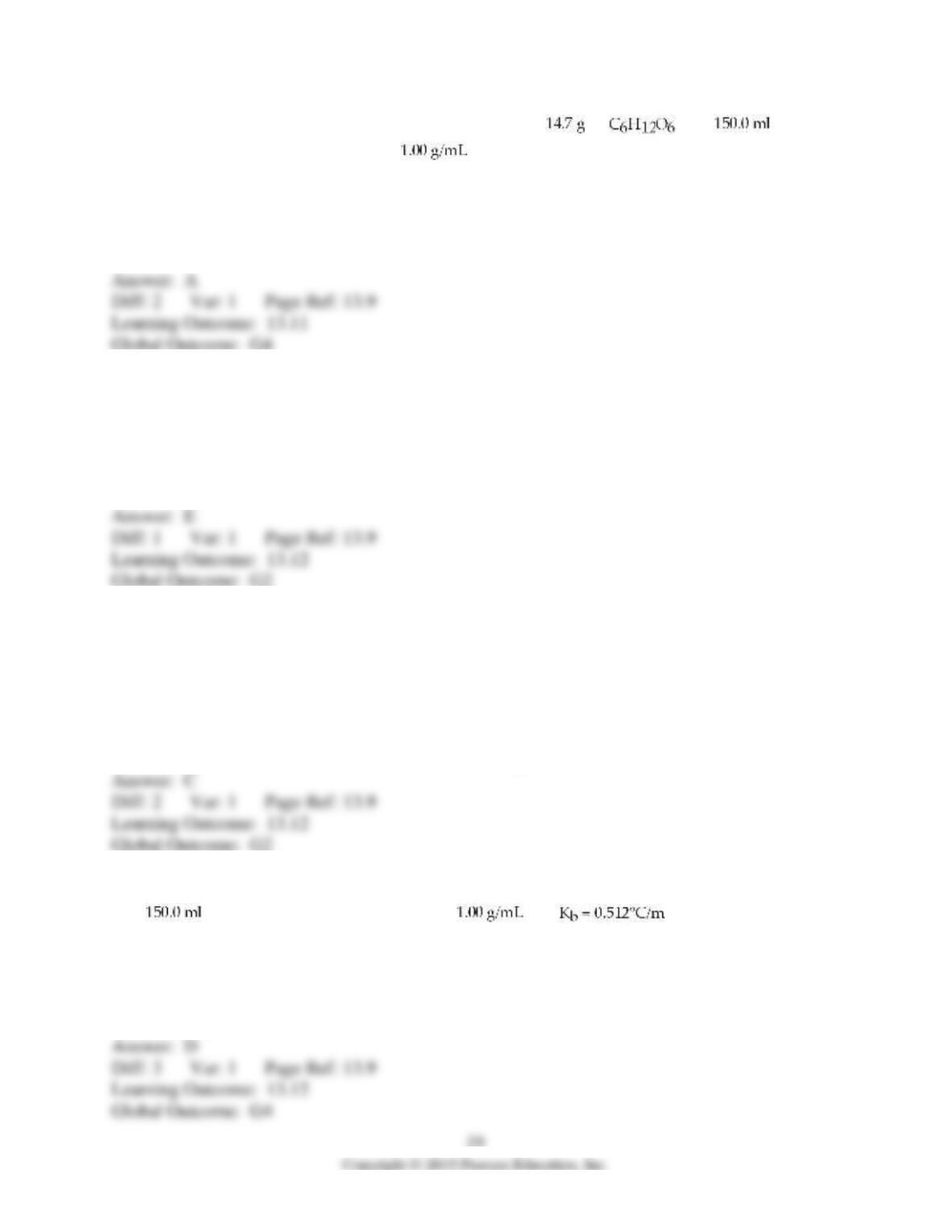
60) What is the molality of a solution made by dissolving of into of
water? Assume the density of water is .
A) 0.544
B) 0.0816
C) 10.2
D) 0.980
E) none of the above
61) Which of the following statements about colligative properties is FALSE?
A) The boiling point of a solution is increased by the addition of salt.
B) The freezing point of a solution is lowered by the addition of salt.
C) The change in temperature is proportional to the molality.
D) The identity of the solute is not a factor.
E) All of the above statements are true.
62) Which of the following aqueous solutions would be expected to freeze at the lowest
temperature?
A) 1 molal KNO3
B) 1 molal NaCl
C) 1 molal CaCl2
D) 1 molal C6H12O6 (fructose)
E) All of these solutions would freeze at the same temperature.
63) What is the change in the boiling point of a solution made by dissolving 14.7 g of C6H12O6
into of water? The density of water is and .
A) 0.502°C
B) 5.22°C
C) 0.0418°C
D) 0.279°C
E) none of the above
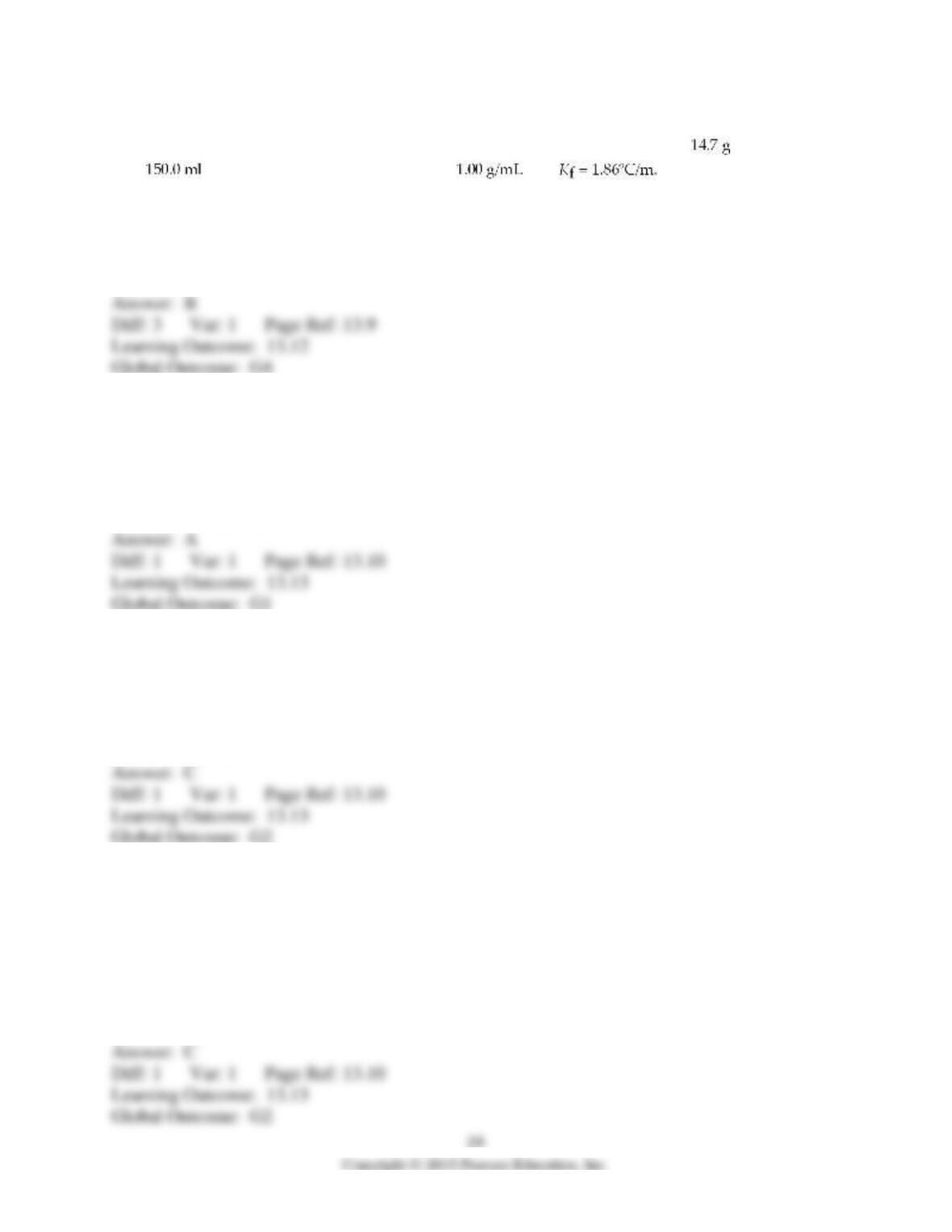
64) What is the change in the freezing point of a solution made by dissolving of C6H12O6
into of water? The density of water is and
A) 0.152°C
B) 1.01°C
C) 18.97°C
D) 1.82°C
E) none of the above
65) Why is it NOT a good idea to drink seawater when people are lost at sea?
A) The high concentration of salt forces water out of the cells lining your stomach and intestine.
B) The osmotic pressure builds up in the cells of your intestine until they potentially rupture.
C) The semipermeable membrane protecting your stomach is ruptured during osmosis.
D) The seawater has fish urine in it and who wants to drink that?
E) none of the above
66) What will happen if a healthy red blood cell is placed into a container of pure water?
A) The cell will totally dissolve in the water.
B) The cell will remain unchanged.
C) The cell will become swollen.
D) The cell will shrink.
E) none of the above
67) Solution A has a concentration of 0.10 M sugar and Solution B has a concentration of 0.20 M
sugar. If the two solutions are separated by a semipermeable membrane, which of the following
occurs during osmosis?
A) Solvent molecules move from B into A.
B) Sugar molecules move from B into A.
C) The molarity of A increases.
D) The molarity of B increases.
E) none of the above
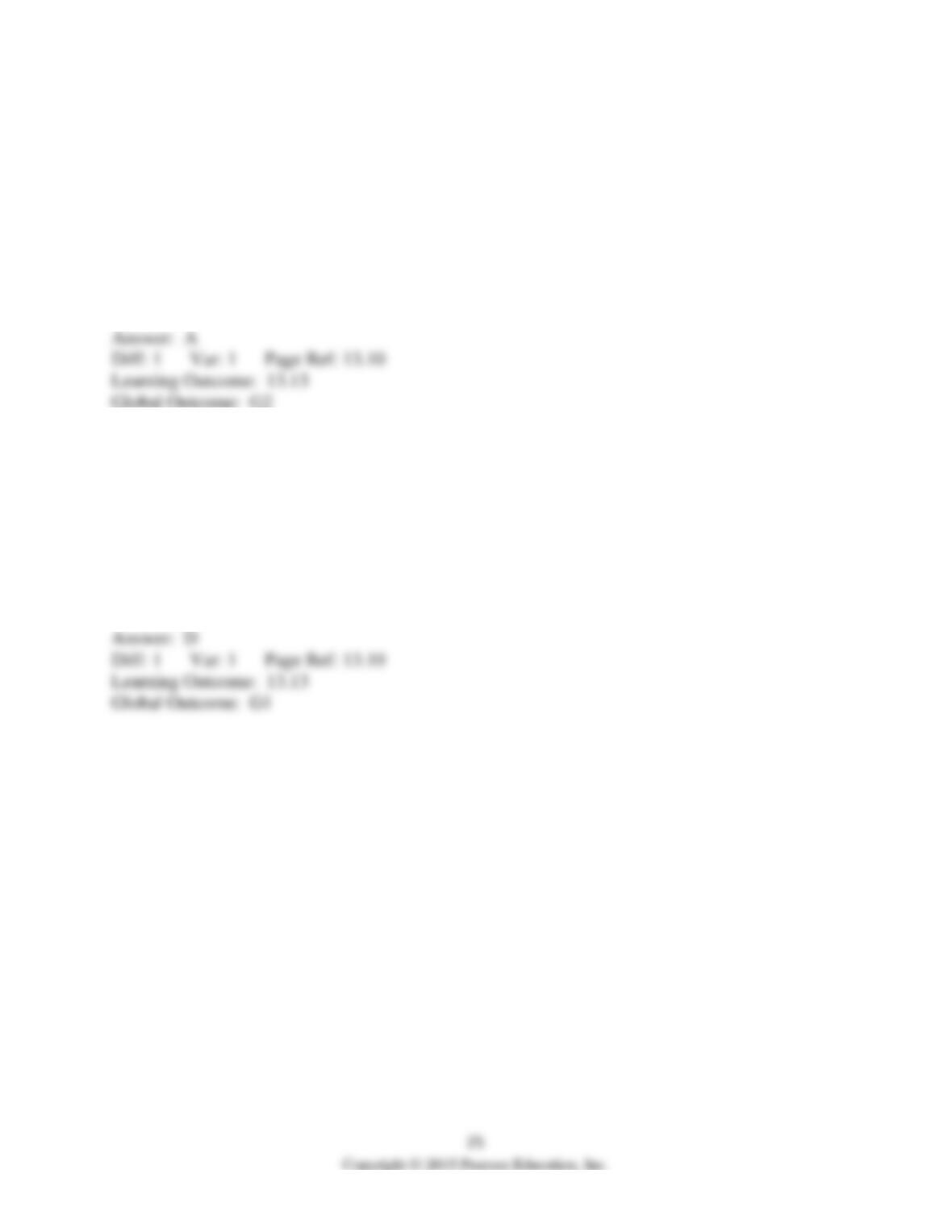
68) An osmosis cell is constructed of a “U” shaped tube with a semipermeable membrane
separating the two arms of the tube. Suppose a concentrated solution is placed in the left arm of
the U-tube, and a dilute concentration of the same substance is poured into the other arm to the
same height. After a period of time has elapsed, you would expect to find that:
A) the level of liquid in the left arm is now higher.
B) the level of the liquid in the right arm is now higher.
C) the levels in both arms stay at the same height.
D) no molecules of any type cross the membrane.
E) none of the above
69) Osmotic pressure is:
A) the pressure required to stop the flow of solvent from a region of high solute concentration to
a region of low solute concentration.
B) the pressure required to stop the rupture of the semipermeable membrane.
C) the pressure required to reverse the flow of solvent through a semipermeable membrane
during osmosis.
D) the pressure required to stop the flow of solvent from a region of low solute concentration
through a semipermeable membrane into a region of high solute concentration.
E) none of the above
13.3 Algorithmic Questions
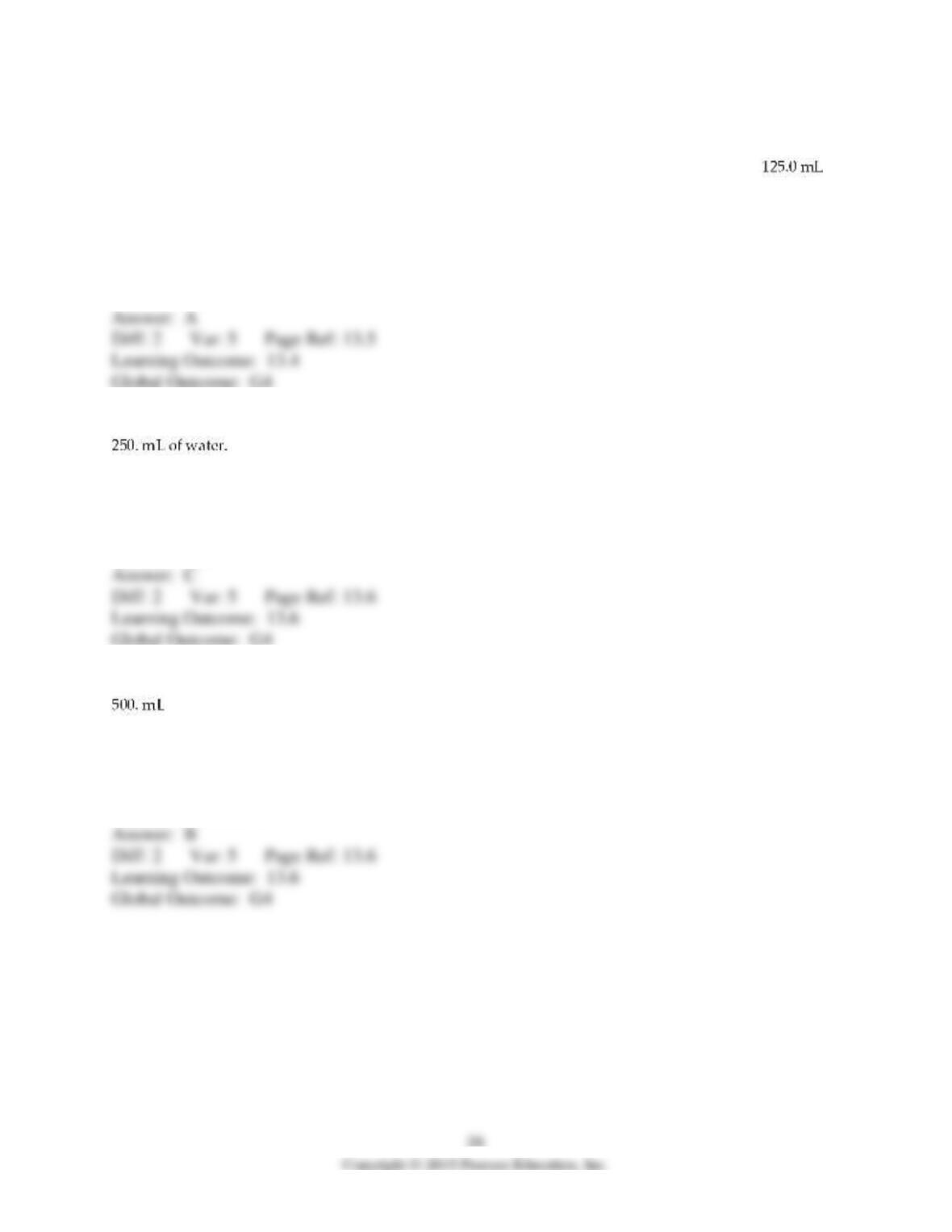
1) Calculate the mass percent of a NaCl solution prepared by mixing 47.0 g NaCl with
of pure water.
A) 27.3
B) 72.3
C) 47.0
D) 37.6
E) none of the above
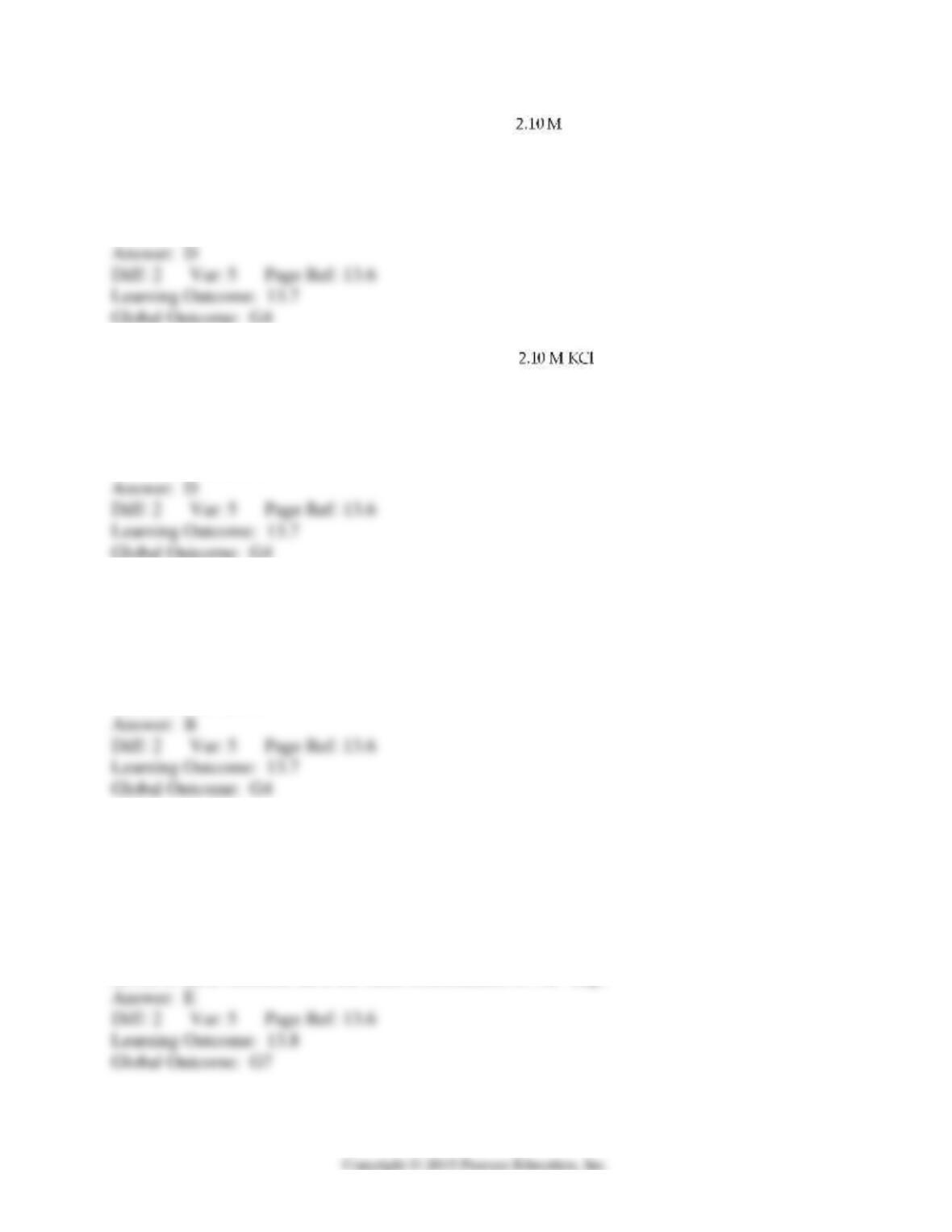
2) Calculate the molarity of a KCl solution prepared by dissolving 0.525 moles of KCl in
A) 0.476
B) 0.00210
C) 2.10
D) 2.02
E) none of the above
3) Calculate the molarity of a KCl solution made by dissolving 24.7 g of KCl in a total volume of
.
A) 0.331
B) 0.663
C) 0.166
D) 6.04
E) none of the above
27
4) How many moles of KCl are present in 95.3 mL of KCl?
A) 0.0500
B) 5.00
C) 20.0
D) 0.200
E) none of the above
5) How many grams of KCl are present in 75.0 mL of ?
A) 5.59
B) 117
C) 2.66
D) 11.7
E) none of the above
6) What volume (L) of 2.00 M KCl solution contains 25.0 g of KCl?
A) 0.335
B) 0.168
C) 0.672
D) 1.49
E) none of the above
7) Which of the following aqueous solutions has the highest molar concentration of Na+ (aq)?
(Assume each compound is fully dissolved in water.)
A) 3.0M NaCl (sodium chloride)
B) 3.0M NaC2H3O2 (sodium acetate)
C) 1.5M Na2SO4 (sodium sulfate)
D) 1.0M Na3PO4 (sodium phosphate)
E) All of these solutions have the same concentration of Na+ (aq).
8) What is the final concentration (M) of a solution prepared by diluting 50.0 mL of a
solution to a volume of
A) 1.67
B) 0.600
C) 0.0167
D) 3.0
E) none of the above
9) How many mL of 0.112 M Pb(N are needed to completely react with of
?
Given: Pb(N )2(aq) + 2KI(aq) → Pb (s) + 2KN (aq)
A) 11.7
B) 23.4
C) 0.147
D) 5.85
E) none of the above
10) Determine the volume (liters) of 0.500M NaOH solution required to neutralize 1.50L of
0.750M H2SO4.
The neutralization reaction is:
H2SO4 (aq) + 2NaOH (aq) → Na2SO4 (aq) + 2 H2O (l)
A) 2.25
B) 1.13
C) 2.00
D) 4.50
E) none of the above
11) Calculate the molality of a solution prepared by dissolving 19.9 g of KCl in of
water.
A) 0.200
B) 0.356
C) 4.99
D) 0.267
E) none of the above
12) Given that the freezing point depression constant for water is 1.86°C kg/mol, calculate the
change in freezing point for a sugar solution.
A) 0.488°C
B) 2.05°C
C) 0.592°C
D) 1.69°C
E) none of the above