26) If we supply additional heat to a solid in equilibrium with its liquid at the melting point, the
thermal energy added is used to:
A) overcome the intermolecular forces that hold the solid together.
B) expand the solid.
C) change the liquid back to solid.
D) change solid to liquid.
E) raise the temperature of the solid above its melting point.
27) When you make ice cubes:
A) it is an endothermic process.
B) it is an exothermic process.
C) the heat of vaporization must be removed.
D) the process is referred to scientifically as sublimation.
E) none of the above
28) Which statement is TRUE in describing what occurs when a solid melts to a liquid?
A) The process is endothermic and the heat of fusion is positive.
B) The process is endothermic and the heat of fusion is negative.
C) The process is exothermic and the heat of fusion is positive.
D) The process is exothermic and the heat of fusion is negative.
E) not enough information
29) Gaseous water vapor can frost the windows of a car on a cold morning. This process of a gas
changing directly into a solid is known as:
A) deposition.
B) melting.
C) condensation.
D) sublimation.
E) none of the above
30) Paradichlorobenzene, a material used in “moth balls,” is known to go directly from a solid
form to a gaseous form. This process is known as:
A) melting
B) evaporation
C) condensation
D) boiling
E) sublimation
31) How much energy does it take to melt a 16.87 g ice cube?
= 6.02 kJ/mol
A) 102 kJ
B) 108 kJ
C) 936 J
D) 5.64 kJ
E) none of the above
32) How many grams of O can be melted by 3 J?
Given =7.27 kJ/mol
A) 14.5
B) 3.64
C) 20.4
D) 74.1
E) none of the above
33) In northern climates, it is common to have a layer of frost form on cars that have been out
overnight in the winter. During the day the frost layer disappears despite the temperature of the
ice remaining below freezing. How?
A) The frost melts due to the sun heating the surface of the car above the melting point.
B) The frost evaporates due to the sun heating the solid.
C) The frost cycles as does the saturation level of moisture in the winter air does from night to
day.
D) The frost sublimes directly from solid ice to water vapor.
E) none of the above
34) Which intermolecular force is present in all molecules and atoms?
A) dispersion forces
B) dipole-dipole forces
C) hydrogen bonding
D) X-forces
E) none of the above
35) Which intermolecular force is due to the formation of an instantaneous dipole?
A) dispersion forces
B) dipole-dipole forces
C) hydrogen bonding
D) X-forces
E) none of the above
36) The ability of sodium chloride to mix with water is most likely due to:
A) dispersion force
B) ion-dipole force
C) dipole-dipole force
D) hydrogen bonding
E) none of the above
37) Which substance below has dipole-dipole forces?
A) CH4
B) CO2
C) F2
D) H2S
E) none of the above
38) Which intermolecular force increases with increasing molar mass?
A) dispersion forces
B) dipole-dipole forces
C) hydrogen bonding
D) X-forces
E) none of the above
39) Which noble gas has the highest boiling point?
A) He
B) Ne
C) Ar
D) Kr
E) Xe
40) Assuming that the molecules carbon monoxide (CO) and nitrogen (N2) have similar electron
clouds, which statement below is TRUE?
A) CO has the higher boiling point because it experiences dipole-dipole forces.
B) N2 has the higher boiling point because it experiences dipole-dipole forces.
C) The N2 has the higher boiling point because it has greater dispersion forces.
D) Both CO and N2 must have the same boiling point.
E) none of the above
41) Which intermolecular force is common to all polar molecules but NOT nonpolar molecules?
A) dispersion forces
B) dipole-dipole forces
C) hydrogen bonding
D) X-forces
E) none of the above
42) Substance A is a molecular compound that dissolves in gasoline but not in water. The
molecules of A are very likely:
A) metallic.
B) nonmetallic.
C) polar.
D) nonpolar.
E) none of the above
43) Which substance is most likely to be miscible with water?
A) CF4
B) Br2
C) CS2
D) CHCl3
E) none of the above
44) Which statement below is FALSE?
A) A hydrogen bond is the strongest of the intermolecular forces.
B) A hydrogen atom must be bonded directly to fluorine, oxygen, or nitrogen to exhibit
hydrogen bonding.
C) The large electronegativity difference between hydrogen and an F, O, or N atom is essential
for the formation of a hydrogen bond.
D) A hydrogen bond is only 2-5% the strength of a typical covalent bond.
E) none of the above
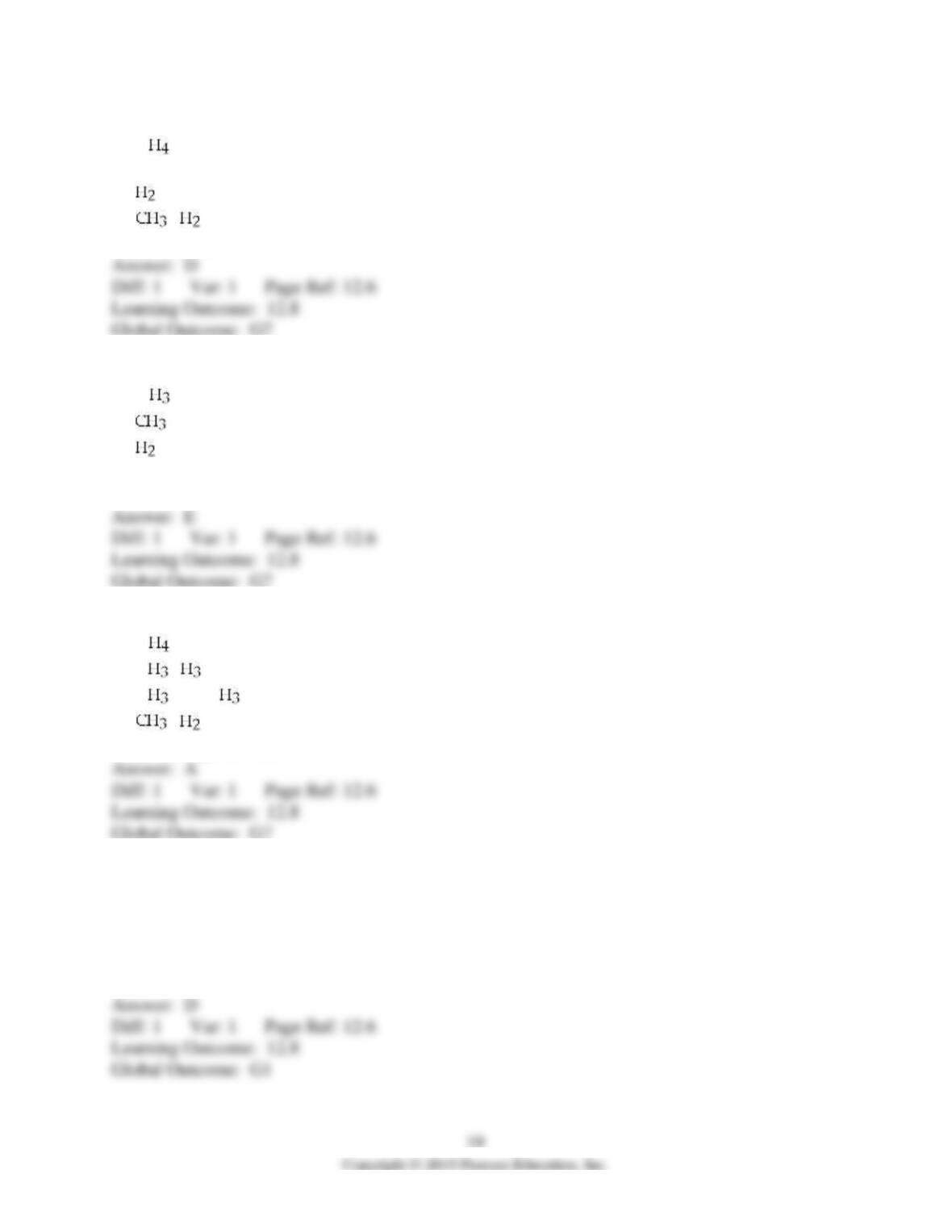
45) Which molecule below has hydrogen bonding?
A) C
B) HCl
C)
D) COH
E) all of the above
46) Which molecule below has hydrogen bonding?
A) N
B) OH
C) O
D) HF
E) all of the above
47) Which compound in liquid form will have the highest vapor pressure?
A) C
B) C C
C) C C(O)C
D) COH
E) not enough information
48) Which intermolecular force is the strongest?
A) dispersion force
B) dipole-dipole force
C) hydrogen bonding
D) ion-dipole force
E) none of the above
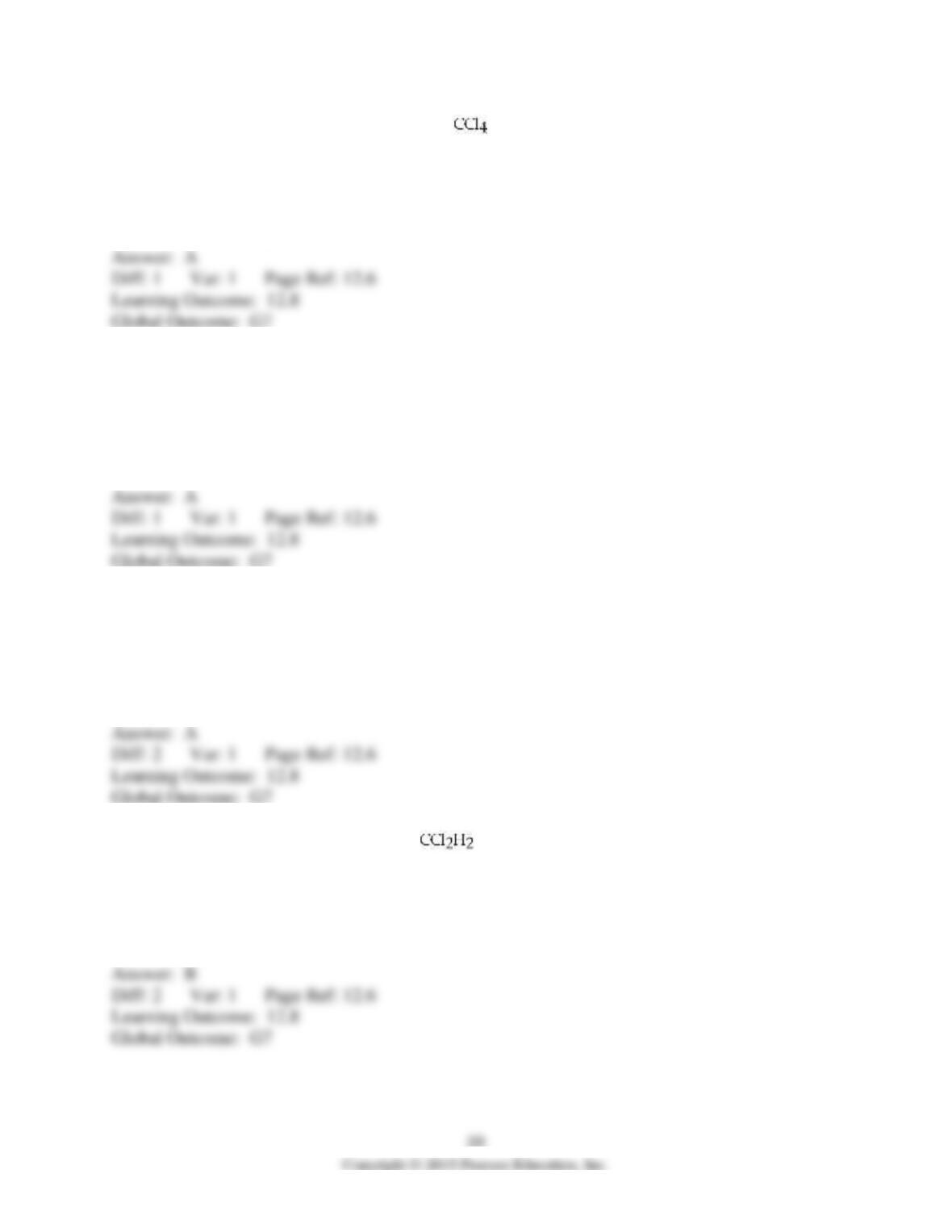
49) Which intermolecular forces are found in ?
A) dispersion forces
B) dipole-dipole forces
C) hydrogen bonding
D) X-forces
E) none of the above
50) Which intermolecular forces are found in CO2?
A) dispersion forces
B) dipole-dipole forces
C) hydrogen bonding
D) dispersion forces and dipole-dipole forces
E) none of the above
51) What types of forces exist between I2 molecules?
A) dispersion forces
B) dipole-dipole forces
C) hydrogen bonding
D) ion-dipole forces
E) none of the above
52) Which intermolecular force found in is the strongest?
A) dispersion forces
B) dipole-dipole forces
C) hydrogen bonding
D) X-forces
E) none of the above
53) Consider the three compounds below, then choose the compound(s) that have hydrogen
bonding.
1) H2
2) CH4
3) HF
A) Only compound 1 has hydrogen bonding.
B) Only compound 2 has hydrogen bonding.
C) Only compound 3 has hydrogen bonding.
D) All three of these compounds have hydrogen bonding.
E) None of these compounds have hydrogen bonding.
54) Which compound will have the highest boiling point?
A) C
B) C C
C) C C(O)C
D) COH
E) not enough information
55) Which substance would be expected to have the highest boiling point?
A) N2
B) O2
C) CO2
D) CO
E) not enough information
56) Rank the compounds NH3, CH4, and PH3 in order of increasing boiling point.
A) NH3 < CH4< PH3
B) CH4< NH3 < PH3
C) NH3 < PH3< CH4
D) CH4 < PH3 < NH3
E) PH3< NH3 < CH4
57) Dry ice (solid C ) is which type of solid?
A) molecular solid
B) ionic solid
C) covalent atomic solid
D) nonbonding atomic solid
E) metallic atomic solid
58) Which substance below is an ionic solid?
A) Cu (s)
B) H2O (s)
C) MgO (s)
D) C6H12O6 (s)
E) none of the above
59) NaCl is which type of solid?
A) molecular solid
B) ionic solid
C) covalent atomic solid
D) nonbonding atomic solid
E) metallic atomic solid
60) Silicon is which type of solid?
A) molecular solid
B) ionic solid
C) covalent atomic solid
D) nonbonding atomic solid
E) metallic atomic solid
61) Copper is which type of solid?
A) molecular solid
B) ionic solid
C) covalent atomic solid
D) nonbonding atomic solid
E) metallic atomic solid
62) Which atomic solid has the highest melting point?
A) Cu
B) Si
C) Xe
D) Fe
E) not enough information
63) What are the principal forces holding ice together?
A) dispersion forces only
B) electrostatic attraction
C) intermolecular forces
D) sea of electrons
E) none of the above
64) Why is water considered an unusual molecule?
A) No molecule of similar size is a liquid at room temperature.
B) No molecule of similar size has as high a boiling point.
C) Water can dissolve many polar and ionic compounds.
D) Water expands upon freezing.
E) all of the above
65) The reason for many of the unique properties of water is:
A) dispersion forces.
B) the ability to form hydrogen bonds.
C) high surface tension and low volatility.
D) moderate viscosity and expanding upon freezing.
E) all of the above
66) Which sequence correctly shows the increasing density of the three phases of water?
A) solid < liquid < gas
B) gas < liquid < solid
C) gas < solid < liquid
D) liquid < gas < solid
E) none of the above
12.3 Algorithmic Questions
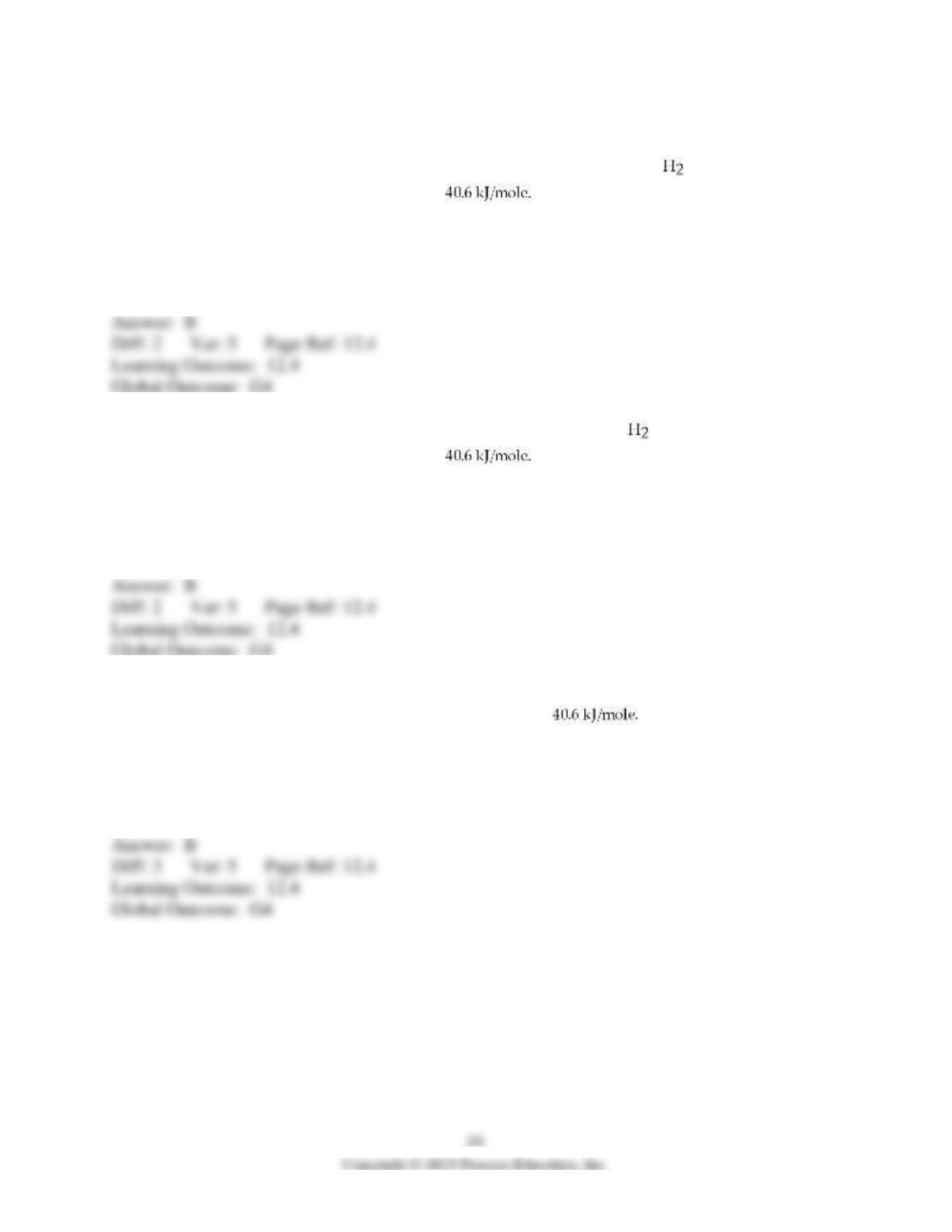
1) How many kJ of heat are needed to completely vaporize 3.30 moles of O? The heat of
vaporization for water at the boiling point is
A) 12.3
B) 134
C) 67.0
D) 2.26
E) none of the above
2) How many kJ of heat are needed to completely vaporize 23.4 g of O? The heat of
vaporization for water at the boiling point is
A) 31.2
B) 52.8
C) 23.4
D) 2.26
E) none of the above
3) A 250 gram sample of water at the boiling point had 45.0 kJ of heat added. How many grams
of water were vaporized? Heat of vaporization for water is
A) 1.11
B) 20.0
C) 0.902
D) 16.2
E) none of the above
4) How many kJ of heat are needed to completely melt 1.70 moles of O, given that the water
is at its melting point? The heat of fusion for water is
A) 30.6
B) 10.2
C) 3.54
D) 63.7
E) none of the above
5) How many kJ of heat are needed to completely melt 17.3 g of O, given that the water is at
its melting point? The heat of fusion for water is
A) 0.961
B) 5.79
C) 1.04
D) 6.26
E) none of the above
6) How many kJ of heat are needed to completely melt 95.3 g of copper metal, given that the
metal is at its melting point? The heat of fusion for this metal is 13.1
A) 19.6
B) 43.0
C) 1250
D) 0.114
E) none of the above