Introduction to Chemical Principles, 11e (Stoker)
Chapter 12 Gas Laws
12.1 Multiple Choice
1) Which of the following statements about gases is correct?
A) high compressibility
B) relatively long distances between molecules
C) formation of homogeneous mixtures regardless of the natures of non-reacting gas components
D) all of the above
2) Identify the missing words in the following statement: “Gas laws describe in mathematical
terms the relationships between the variables pressure, ________ and ________ for a fixed
quantity of gas.”
A) temperature; size
B) temperature; volume
C) volume; chemical identity
D) chemical identity; cost
3) Which of the following is not a unit used in measuring pressure?
A) atmosphere
B) inches Hg
C) kilometer Hg
D) millimeters Hg
4) In terms of size, the mm Hg pressure unit is ________ the torr unit.
A) 100 times larger than
B) numerically equal to
C) 760 times larger than
D) 1000 times larger than
5) What is standard atmospheric pressure in inches mercury (in Hg)? (2.54 cm = 1 in)
A) 1930 in Hg
B) 101 in Hg
C) 76.0 in Hg
D) 29.9 in Hg
6) The barometric pressure in the eye of a hurricane sometimes dips as low as 27.2 inches
mercury. How many millimeters of mercury is this? (2.54 cm = 1 in)
A) 1.07 mmHg
B) 6.91 mmHg
C) 691 mmHg
D) 107 mmHg
7) 8.00 liters of oxygen gas is under a pressure of 280 torr. If the volume of this gas is increased
to 14.00 liters at constant temperature, what will the new pressure be?
A) 66 torr
B) 490 torr
C) 390 torr
D) 160 torr
8) The pressure and volume of a fixed amount of gas are ________ at constant temperature.
A) directly proportional
B) inversely proportional
C) equal
D) none of the above
9) What will the volume of a balloon be at a depth of 50 .0 feet if its volume on the surface of the
water was 2.84 L at constant temperature? Thirty feet of water equals one atmosphere.
A) 1.70 L
B) 4.74 L
C) 1.06 L
D) 3.05 L
10) Identify what the missing words are in the following statement of Boyle’s law: At constant
temperature, the volume of a gas sample is ________ proportional to its ________.
A) directly, gas constant
B) directly, pressure
C) inversely, mass
D) inversely, pressure
11) A 2.50 L sample of helium gas has a pressure of 0.925 atm. Calculate the pressure of the gas
if the volume is reduced to 0.350 L.
A) 0.130 atm
B) 0.946 atm
C) 6.61 atm
D) 0.661 atm
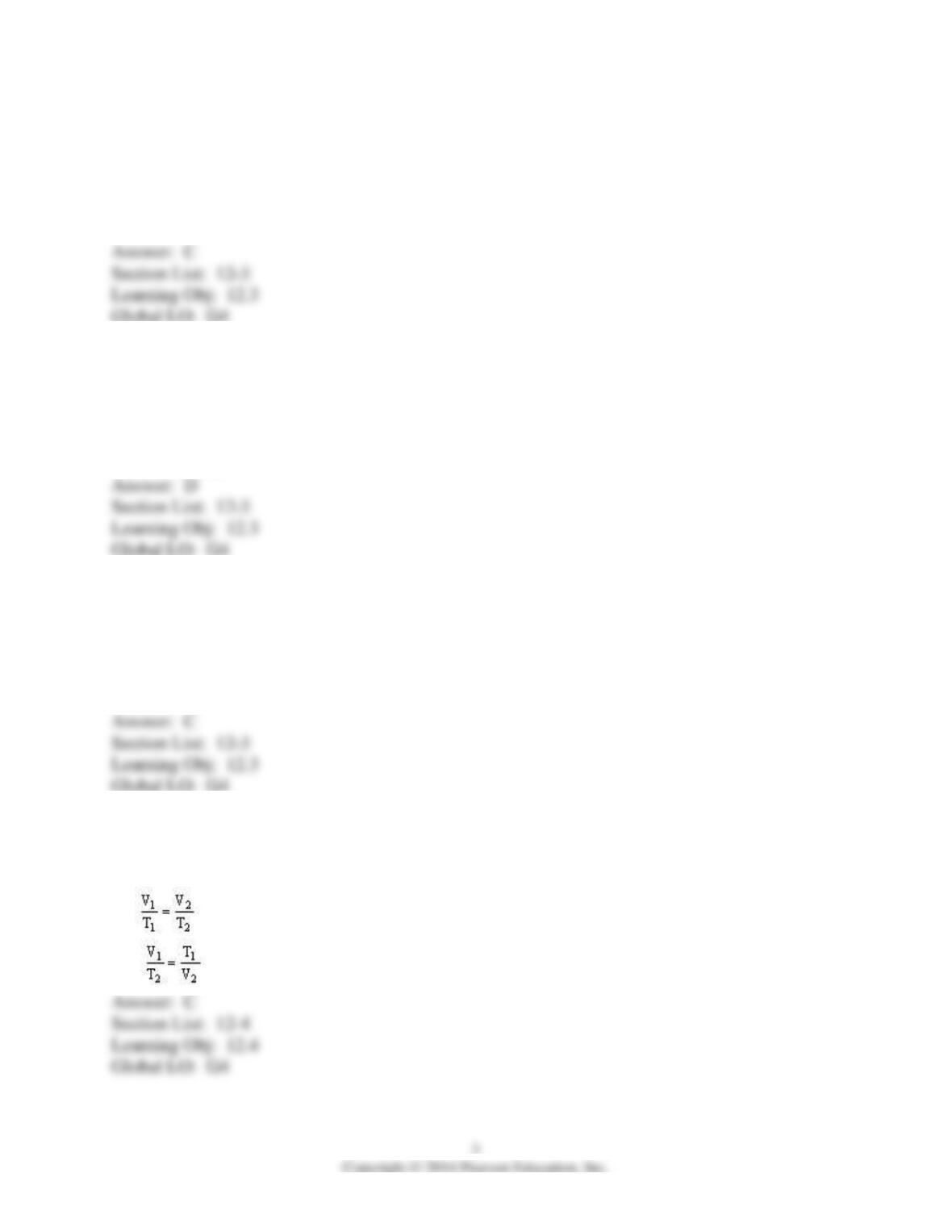
12) A mathematical statement of Charles’ law is ________.
A) V1T1 = V2T2
B) V1 + T1 = V2 + T2
C)
D)
13) Which of the following statements best gives the kinetic molecular theory explanation of the
Boyle’s law observation of increased pressure due to decreased volume?
A) Particles have more kinetic energy.
B) Particles increase in size.
C) Particles strike container walls with more force.
D) Particles strike container walls more frequently.
14) Charles’ law involves which of the following?
A) a varying temperature
B) a constant volume
C) a varying mass of gas
D) an indirect proportion
15) The temperature and volume of a fixed amount of gas are ________ at constant pressure.
A) directly proportional
B) indirectly proportional
C) equal
D) none of the above
16) 10.0 liters of oxygen gas are at a temperature of 23 °C. If the temperature of the gas is raised
to 40 °C at constant pressure the new volume will be ________.
A) 1.82 liters
B) 4.20 liters
C) 14.1 liters
D) 10.6 liters
17) A balloon originally had a volume of 4.39 L at 44 °C and a pressure of 729 torr. To what
temperature (in °C) must the balloon be cooled to reduce its volume to 3.78 L if the pressure is
constant?
A) 38 °C
B) 0 °C
C) 73 °C
D) 273 °C
18) A gas originally at 27 °C and 1.00 atm pressure in a 3.9 liter flask is cooled at constant
pressure until the temperature is 11 °C. What is the new volume of the gas in liters?
A) 3.7 L
B) 0.27 L
C) 3.9 L
D) 4.1 L
19) A 65 mL sample of argon gas has a temperature of 325 °C. What will the temperature be in
°C when the volume of the gas is decreased to 25 mL at constant pressure?
A) 65 °C
B) 125 °C
C) -43 °C
D) 641 °C
20) What is the final Celsius temperature if 6.48 L of H2 gas at 22.0 °C is cooled until the
volume reaches 3.77 L?
A) 24.8 °C
B) 113 °C
C) −205 °C
D) −101 °C
21) If the volume of a sample of chlorine gas is reduced by 1/3 at constant pressure, what
happens to its absolute temperature (K)?
A) It remains constant.
B) It decreases by 1/3.
C) It triples.
D) It increases nine-fold.
22) The Gay-Lussac’s law observation of increased pressure due to increased temperature would
be explained using kinetic molecular theory in the following way: The pressure must increase
because ________.
A) the molecules will strike the container walls less often
B) the molecules will strike the container walls more often
C) the molecules can move slower
D) the molecules can increase in size
23) A mathematical statement of Gay-Lussac’s law is ________.
A) P1 + T2 = P2 + T2
B) P1T1 = P2T2
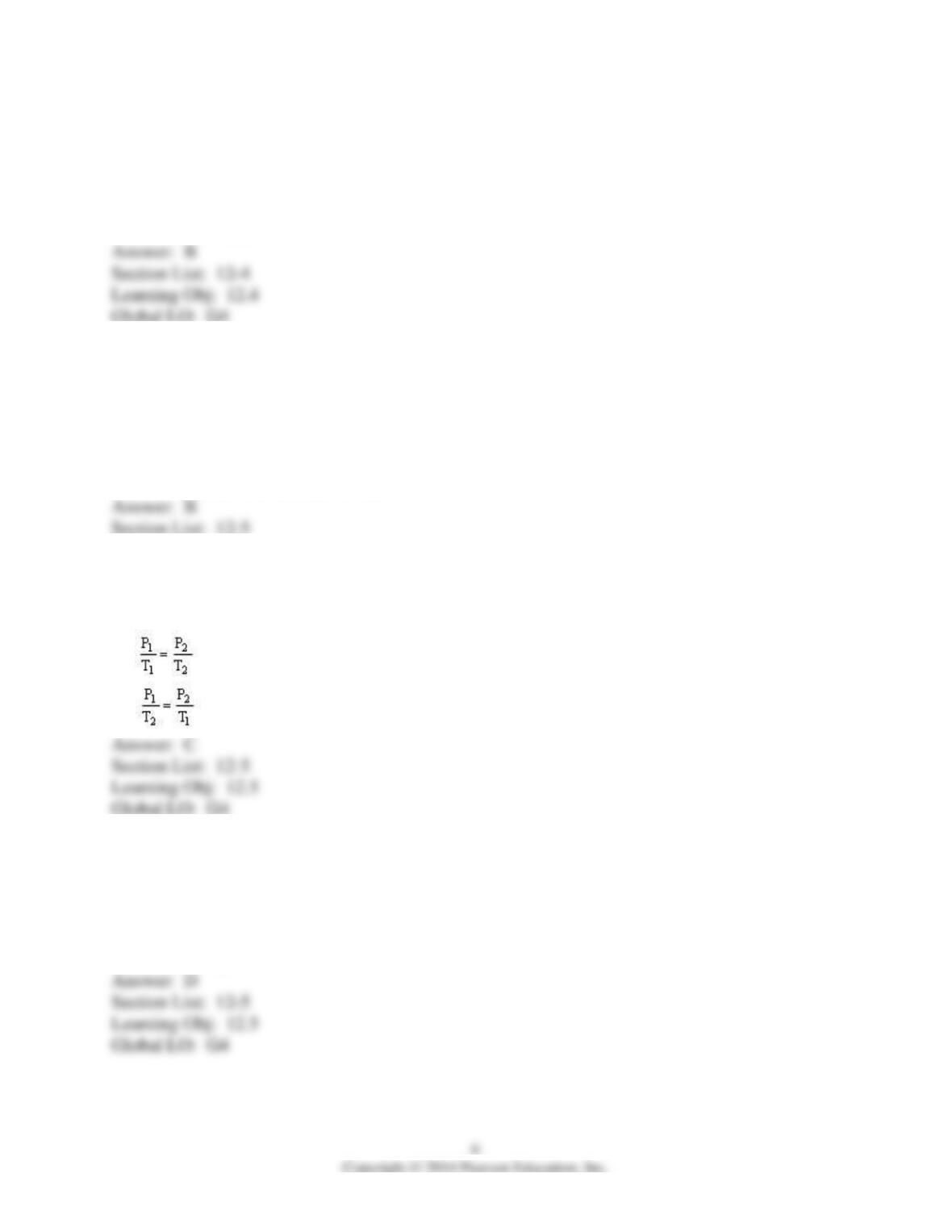
C)
D)
24) According to Gay-Lussac’s law, if the pressure of a gas sample is doubled the gas sample
________.
A) volume decreases by a factor of 2
B) volume is doubled
C) Kelvin temperature decreases by a factor of 2
D) Kelvin temperature is doubled
25) How would the pressure of a sealed container of gas be affected if its Kelvin temperature is
halved while the moles and the volume of the gas remain constant?
A) The pressure would be reduced to one half of the original pressure.
B) The pressure would quadruple.
C) The pressure would not be affected.
D) The pressure would be reduced by a factor of 4.
26) A cylinder of oxygen gas has a pressure of 6.00 atm at 25.0 oC . What is the pressure of the
gas at 0.0 °C?
A) 5.50 atm
B) 6.55 atm
C) 2.40 atm
D) 15.0 atm
27) According to the combined gas law, for a fixed amount of gas ________.
A) volume and pressure are directly proportional
B) volume and temperature are inversely proportional
C) temperature and pressure are directly proportional
D) pressure and temperature have no relationship to each other
28) The combined gas law cannot be written as ________.
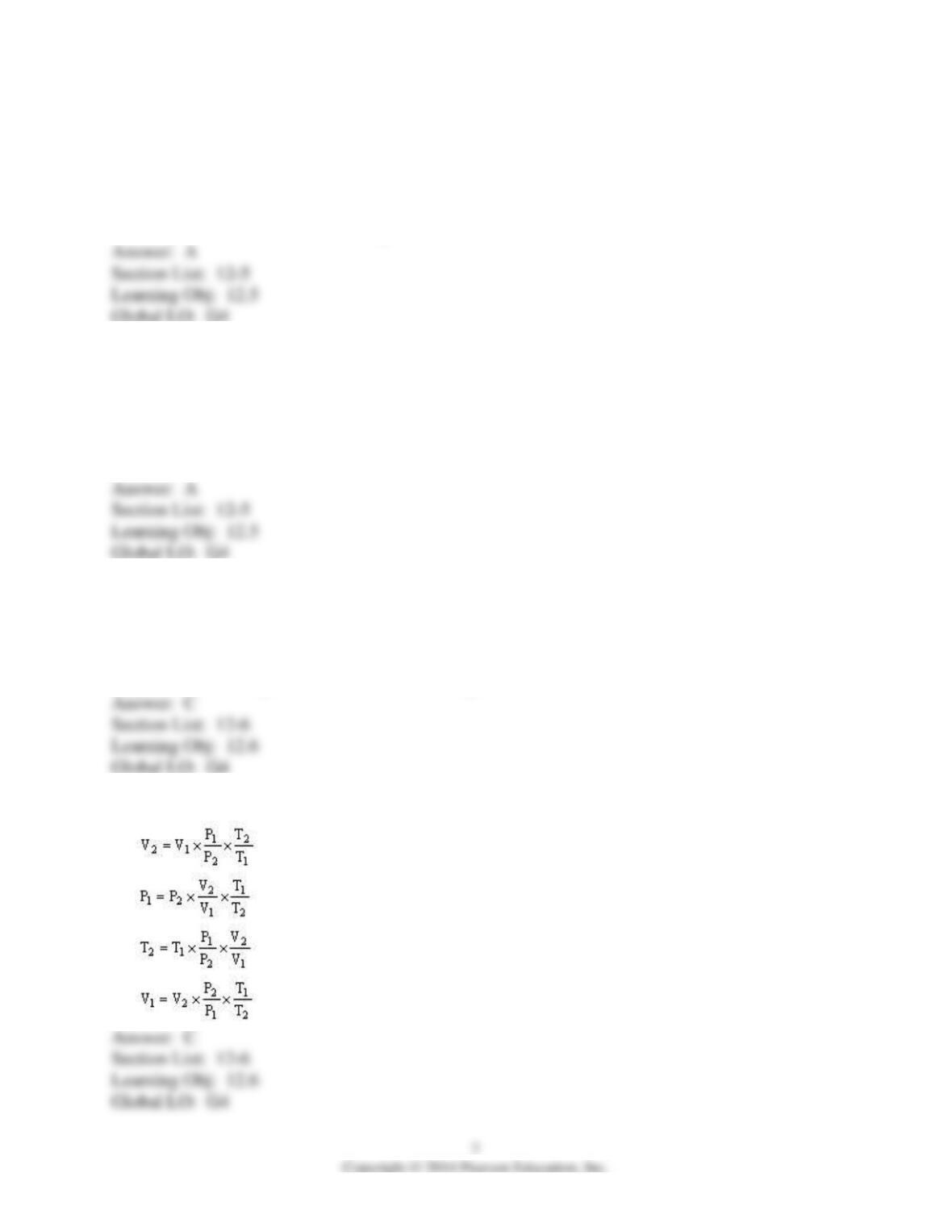
A)
B)
C)
D)
29) If both the pressure and the Kelvin temperature of a gas are halved, the volume will
________.
A) double
B) quadruple
C) be halved
D) remain the same
30) How will the pressure of a fixed sample of gas change if its volume is halved and its Kelvin
temperature is quadrupled (moles of gas remain constant)?
A) The pressure will decrease by a factor of 4.
B) The pressure will increase by a factor of 8
C) The pressure will quadruple.
D) The pressure will decrease by a factor of 8.
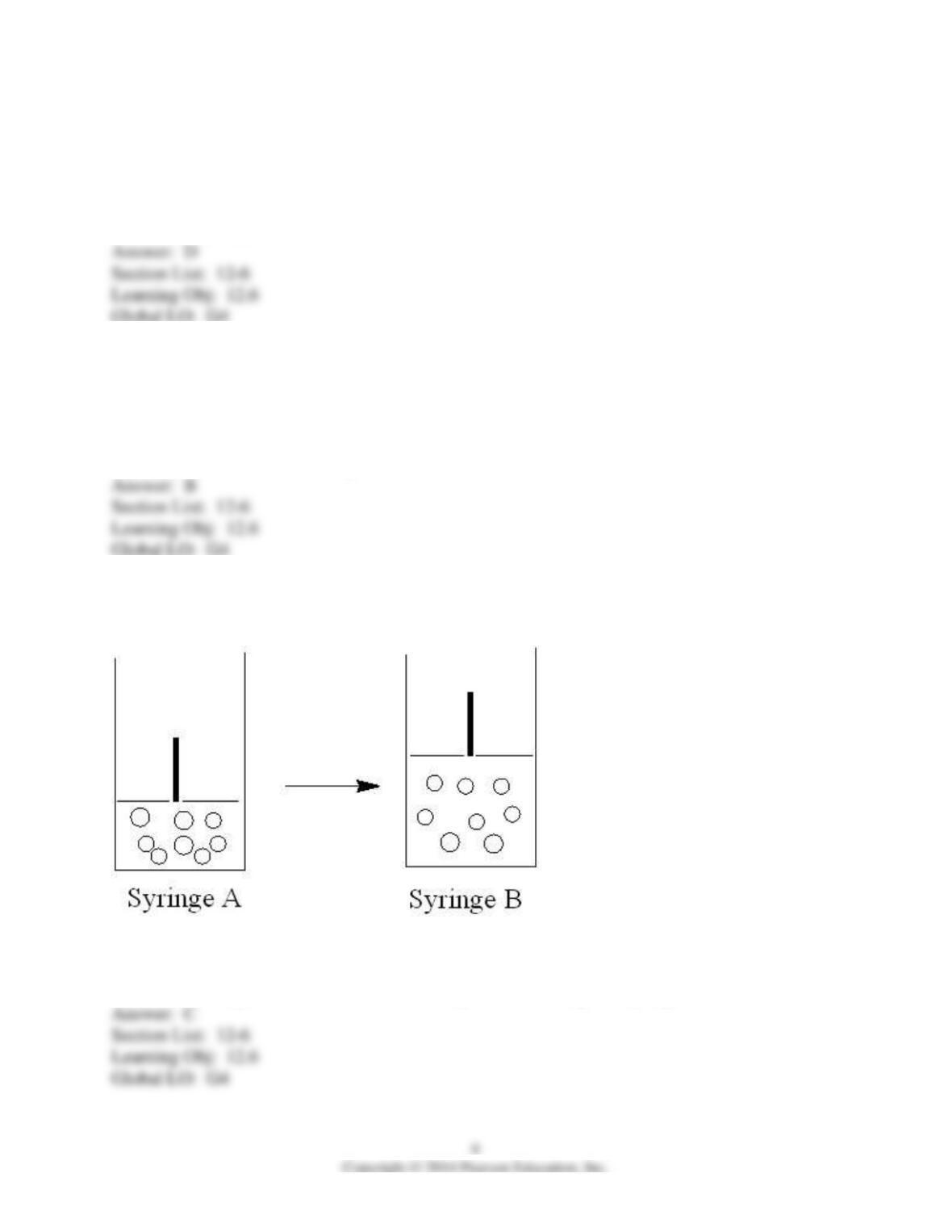
31) Syringe A has a specified volume of a gas at room temperature and atmospheric pressure.
Which response below would not change the volume of gas in syringe A to the volume of gas
shown in syringe B?
A) Decrease the pressure of the gas in syringe A at constant temperature.
B) Increase the temperature of the gas in syringe A at constant pressure.
C) Increase the pressure of the gas in syringe A at constant temperature.
D) Decrease the pressure, and increase the temperature on the gas in syringe A.
32) A sample of nitrogen gas occupies a volume of 8.65 L at a temperature of 295 K and a
pressure of 0.985 atm. What is the pressure of the gas if the volume of the gas is increased to
12.1 L and the temperature is reduced to 284 K?
A) 1.08 atm
B) 0.875 atm
C) 0.678 atm
D) 1.39 atm
33) Avogadro’s law, in its alternate form, is very similar in form to ________.
A) Boyle’s law
B) Boyle’s law and Gay-Lussac’s law
C) Charles’ law and Gay-Lussac’s law
D) Boyle’s law and Charles’ law
34) Which of the following two variables are present in mathematical statements of Avogadro’s
law?
A) n and V
B) n and T
C) n and P
D) n, P, and V
35) An ideal gas differs from a real gas in that the molecules of an ideal gas ________.
A) have no attraction to each other
B) have appreciable volumes
C) have molecular weight equal to zero
D) have no kinetic energy
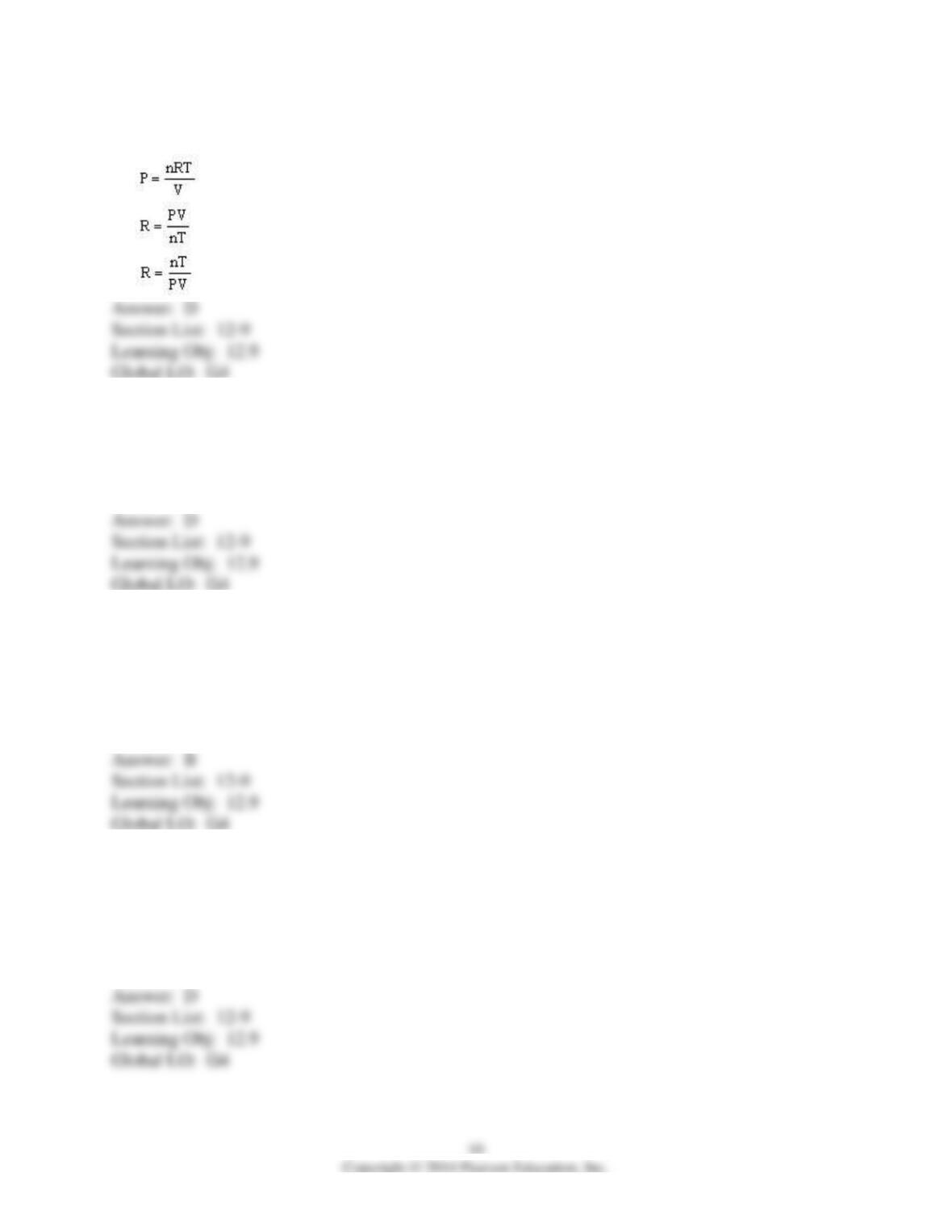
36) The ideal gas equation cannot be written as ________.
A) PV = nRT
B)
C)
D)
37) The value of the ideal gas constant, for the units (torr x mL)/mole x K is ________.
A) 0.0821
B) 1/0.0821
C) 62.4
D) 62,400
38) The temperature, in °C , occupied by 0.643 moles of O2 gas at 0.893 atm pressure and a
volume of 14.7 L is ________.
A) 16 °C
B) −24 °C
C) 48 °C
D) 318 °C
39) At what temperature (in °C) does 0.444 mole of carbon monoxide, CO, occupy 11.8 L at 889
mmHg?
A) 51 °C
B) 14 °C
C) 32 °C
D) 106 °C
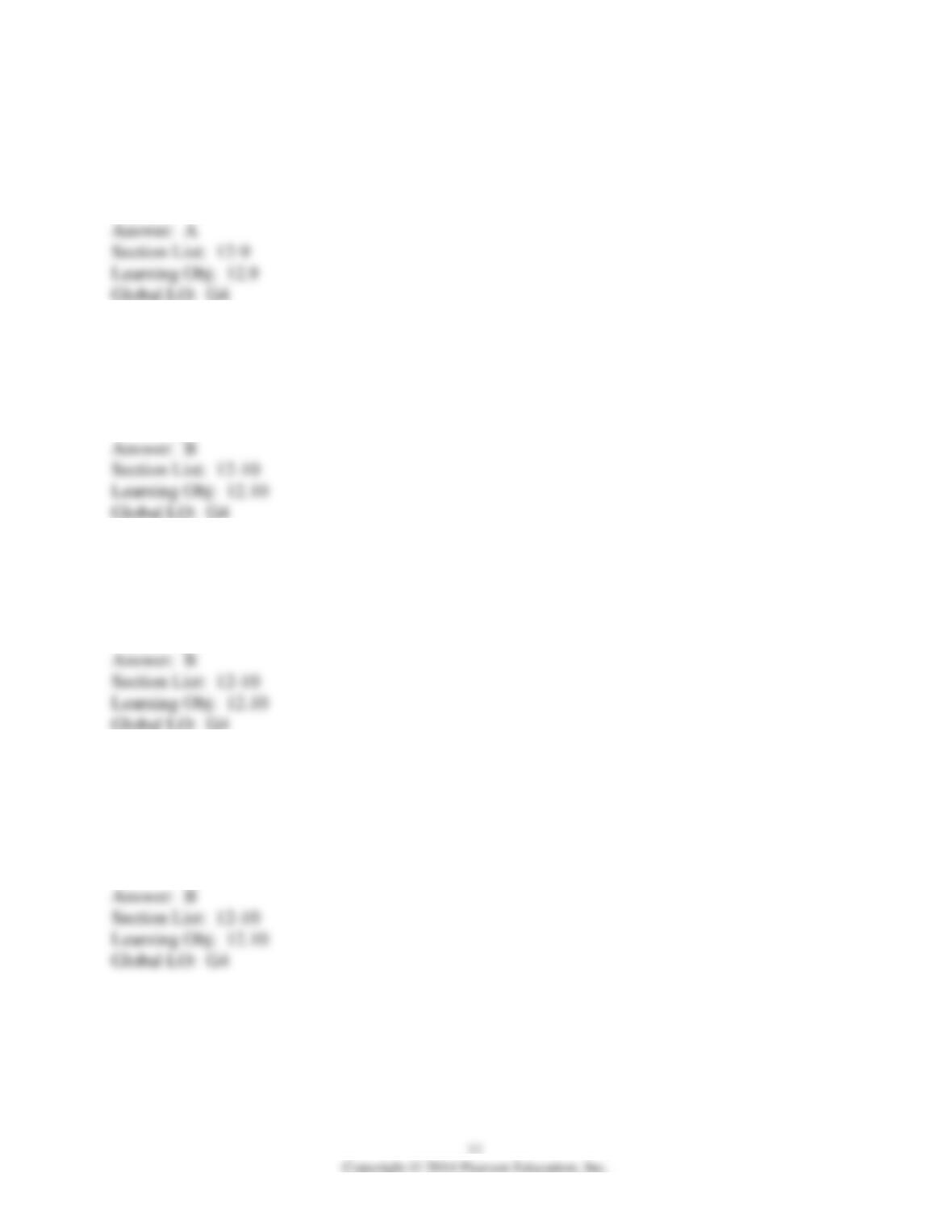
40) Calculate the volume of 12.0 g of helium at 54.5 °C and 1025 mmHg.
A) 59.8 L
B) 13.9 L
C) 24.6 L
D) 77.4 L
41) Calculate the density of butane (C4H10) in grams per liter at STP conditions.
A) 0.822 g/L
B) 2.59 g/L
C) 3.79 g/L
D) 5.48 g/L
42) Calculate the density of ammonia (NH3) gas in a 4.32 L container at 837 torr and 45 °C.
A) 3.86 g/L
B) 0.718 g/L
C) 0.432 g/L
D) 0.194 g/L
43) The density of a gaseous chlorofluorocarbon (CFC) at 23.8 °C and 432 mmHg is 3.23 g/L.
What is its molar mass?
A) 0.182 g/mol
B) 139 g/mol
C) 11.1 g/mol
D) 0.0146 g/mol
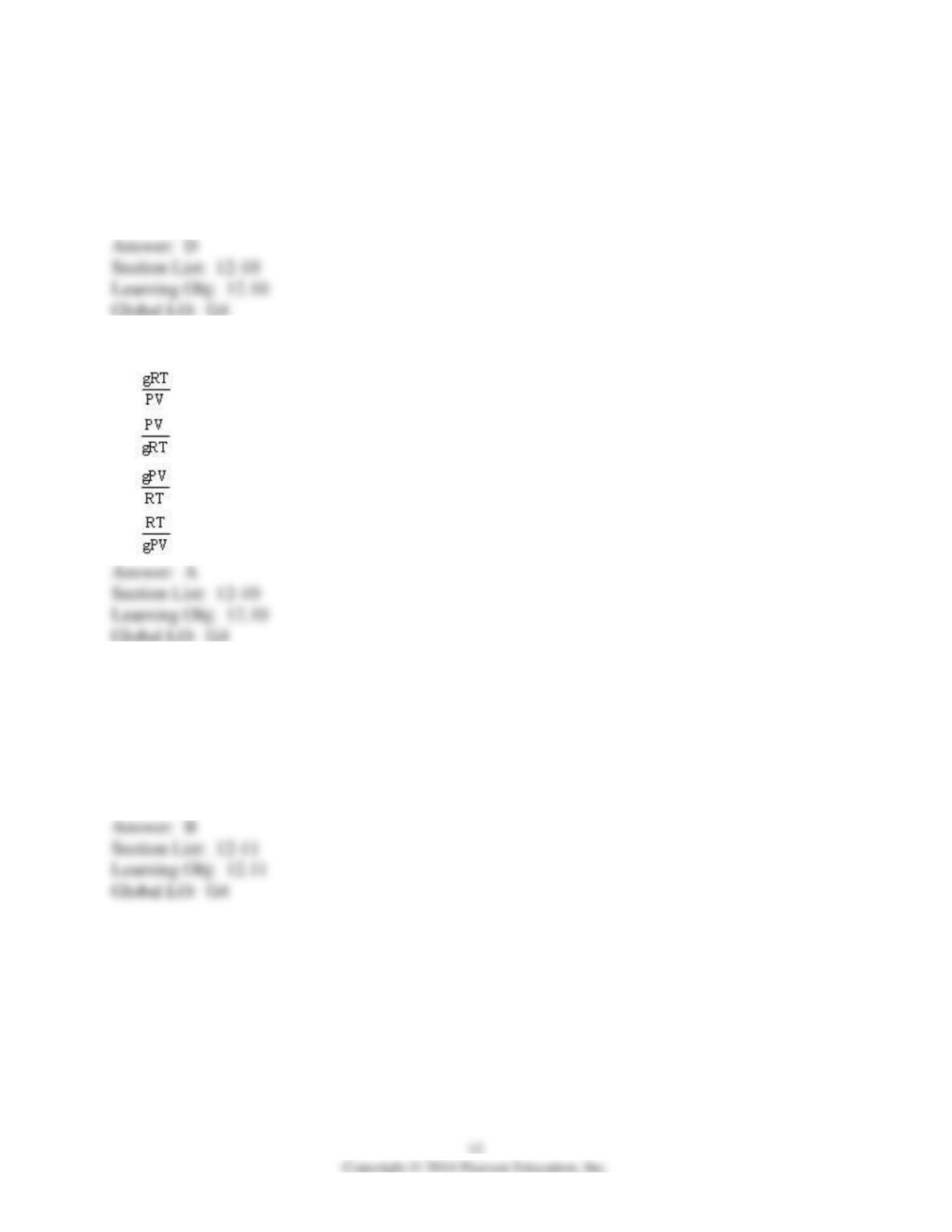
44) 6.80 L of CH4 gas at 0.980 atm and 23 °C ________.
A) contains 0.897 mol CH4
B) has a mass of 3.13 g
C) contains 6.02 x 10²² molecules CH4
D) contains 6.60 x 10²³ H atoms
45) Which of the following is a correct expression for the molecular mass of a gas?
A)
B)
C)
D)
46) Gay-Lussac’s law of combining volumes states that the volumes of gases involved in a
chemical reaction are in the same ratio as the coefficients for these gases in the balanced
equation for the reaction provided that ________.
A) all volumes are measured in liters
B) all volumes are measured at the same temperature and pressure
C) all the gases have molecules that contain the same number of atoms
D) all the gases form diatomic molecules