Chapter 12: Intermolecular Forces: Liquids, Solids, and Phase Changes
51. When identical particles pack in a simple cubic lattice, there is/are ____ particle(s) per
unit cell.
A) 1 B) 2 C) 3 D) 4 E) 8
52. A metal with a body-centered cubic lattice will have ______ atom(s) per unit cell.
A) 1 B) 2 C) 3 D) 4 E) 9
53. A metal such with a face-centered cubic lattice will have ________________ atom(s)
per unit cell.
A) 1 B) 2 C) 3 D) 4 E) 10
54. Polonium crystallizes in the simple cubic lattice. What is the coordination number for
Po?
A) 3 B) 4 C) 6 D) 8 E) 12
55. Iron crystallizes in the body-centered cubic lattice. What is the coordination number for
Fe?
A) 4 B) 6 C) 8 D) 10 E) 12
56. Lead crystallizes in the face-centered cubic lattice. What is the coordination number for
Pb?
A) 4 B) 6 C) 8 D) 10 E) 12
57. Which one of the following statements about unit cells and packing in solids is
incorrect?
A) In any unit cell of a solid crystal, each face of the cell must have an opposite face
which is equal and parallel to it.
B) The faces of a unit cell must all be at angles of 90° to each other.
C) The coordination number of atoms in a close packed metal is 12.
D) The packing efficiency in fcc structures is higher than in bcc structures.
E) The packing efficiency in fcc and hcp structures is the same.
Chapter 12: Intermolecular Forces: Liquids, Solids, and Phase Changes
58. Which of the following statements concerning a face-centered cubic unit cell and the
corresponding lattice, made up of identical atoms, is incorrect?
A) The coordination number of the atoms in the lattice is 8.
B) The packing in this lattice is more efficient than for a body-centered cubic system.
C) If the atoms have radius r, then the length of the cube edge is 8 × r.
D) There are four atoms per unit cell in this type of packing.
E) The packing efficiency in this lattice and hexagonal close packing are the same.
59. Which of the following statements about the packing of monatomic solids with different
unit cells is incorrect?
A) The coordination number of atoms in hcp and fcc structures is 12.
B) The coordination number of atoms in simple cubic structures is 6.
C) The coordination number of atoms in bcc structures is 8.
D) A bcc structure has a higher packing efficiency than a simple cubic structure.
E) A bcc structure has a higher packing efficiency than a fcc structure.
60. A cubic unit cell has an edge length of 400. pm. The length of its body diagonal (internal
diagonal) in pm is therefore
A) 512. B) 566. C) 631. D) 693. E) 724.
61. A certain solid metallic element has a density 7.87 g/cm3 and a molar mass of 55.85
g/mol. It crystallizes with a cubic unit cell, with an edge length of 286.7 pm. Calculate the
number of atoms per unit cell.
A) 1 B) 2 C) 3 D) 4 E) 6
62. Crystal structures may be conveniently measured using
A) X-ray diffraction. D) microwave spectroscopy.
B) infrared spectroscopy. E) magnetic resonance imaging.
C) ultraviolet-visible spectroscopy.
63. Which one of the following substances does not exist in the indicated solid type?
A) graphite – network D) NaCl – ionic
B) Na – metallic E) diamond – network
C) SiO2 – molecular
64. When liquid bromine is cooled to form a solid, which of the following types of solid
would it form?
A) atomic B) metallic C) molecular D) ionic E) covalent network
Chapter 12: Intermolecular Forces: Liquids, Solids, and Phase Changes
65. For the solid forms of the following elements, which one is most likely to be of the
molecular type?
A) Xe B) C C) Pb D) S E) Cr
66. What adjective best describes the solid compound IF7?
A) metallic
B) amorphous
C) covalent network
D) molecular
E) ionic
67. The coordination number of sodium and chloride ions in the NaCl lattice, are,
respectively:
A) 10 and 10 B) 8 and 8 C) 6 and 6 D) 4 and 4 E) none of the above
68. In an ionic solid MX consisting of the monatomic ions, M+ and X–, the coordination
number of M+ is _______________.
A) 1
B) 2
C) 6
D) 8
E) impossible to predict without knowing the crystal structure of MX
69. A temperature increase causes __________________ in the conductivity of a
semiconductor.
A) a decrease
B) an increase
C) a modulation
D) an increase or decrease (depending on the semiconductor)
E) no change
70. A temperature increase causes __________________ in the conductivity of a conductor.
A) a decrease
B) an increase
C) an increase or decrease (depending on the conductor)
D) a modulation
E) no change
Chapter 12: Intermolecular Forces: Liquids, Solids, and Phase Changes
71. The energy gap between the conduction band and the valence band is large for
A) conductors. D) insulators.
B) semiconductors. E) alloys.
C) superconductors.
72. The highest temperature at which superconductivity has been achieved is approximately
A) 4 K. B) 30 K. C) 70 K. D) 100 K. E) 130 K.
73. When silicon is doped with an element from group 3A(13), the device/material produced
is a/an
A) intrinsic semiconductor. D) p-n junction.
B) p-type semiconductor. E) transistor.
C) n-type semiconductor.
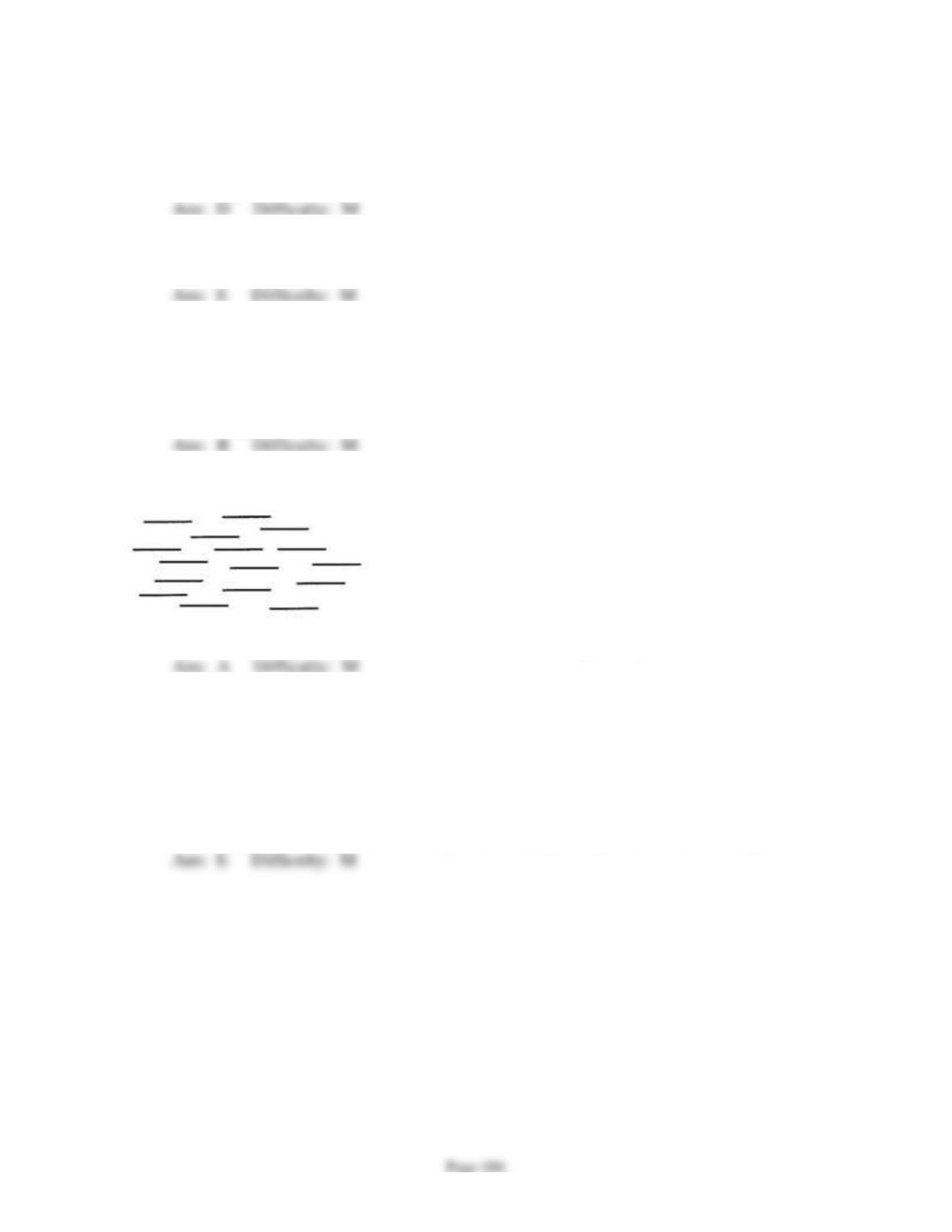
74. What word best describes the type of liquid crystal represented below?
A) nematic B) cholesteric C) smectic D) isotropic E) elastic
75. Which of the following statements about ceramics is incorrect?
A) Silicon carbide has a diamond-like structure.
B) Boron nitride can exist in both diamond-like and graphite-like forms.
C) Silicon carbide can be prepared by direct reaction of silicon and carbon.
D) Superconducting ceramics present manufacturing difficulties owing to their
brittleness.
E) Superconducting ceramic compounds usually incorporate cobalt in a key role.
Chapter 12: Intermolecular Forces: Liquids, Solids, and Phase Changes
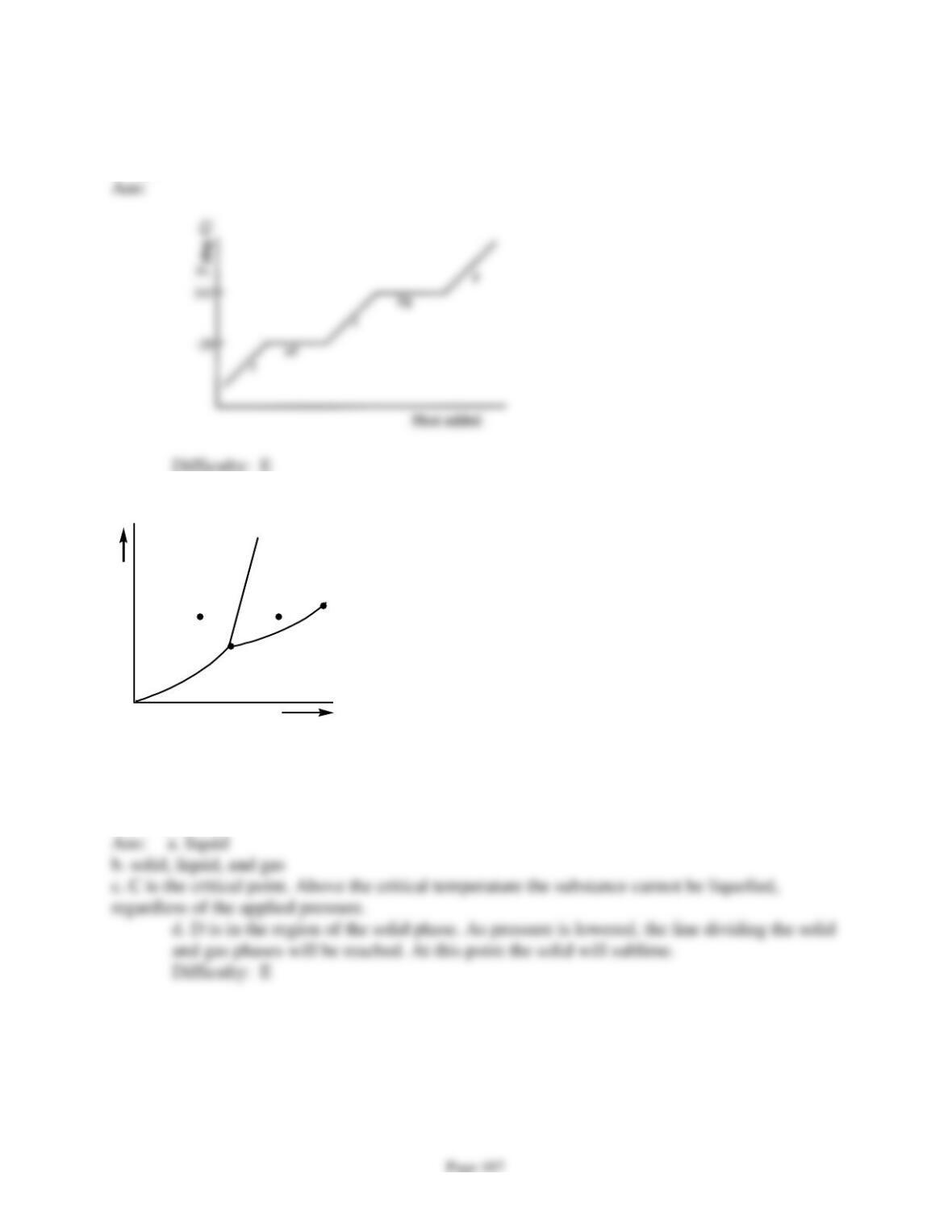
76. Mercury melts at –39°C and boils at 357°C. Draw a diagram of the heating curve of
mercury. Label all lines and axes, and clearly indicate the melting and boiling points on your
diagram.
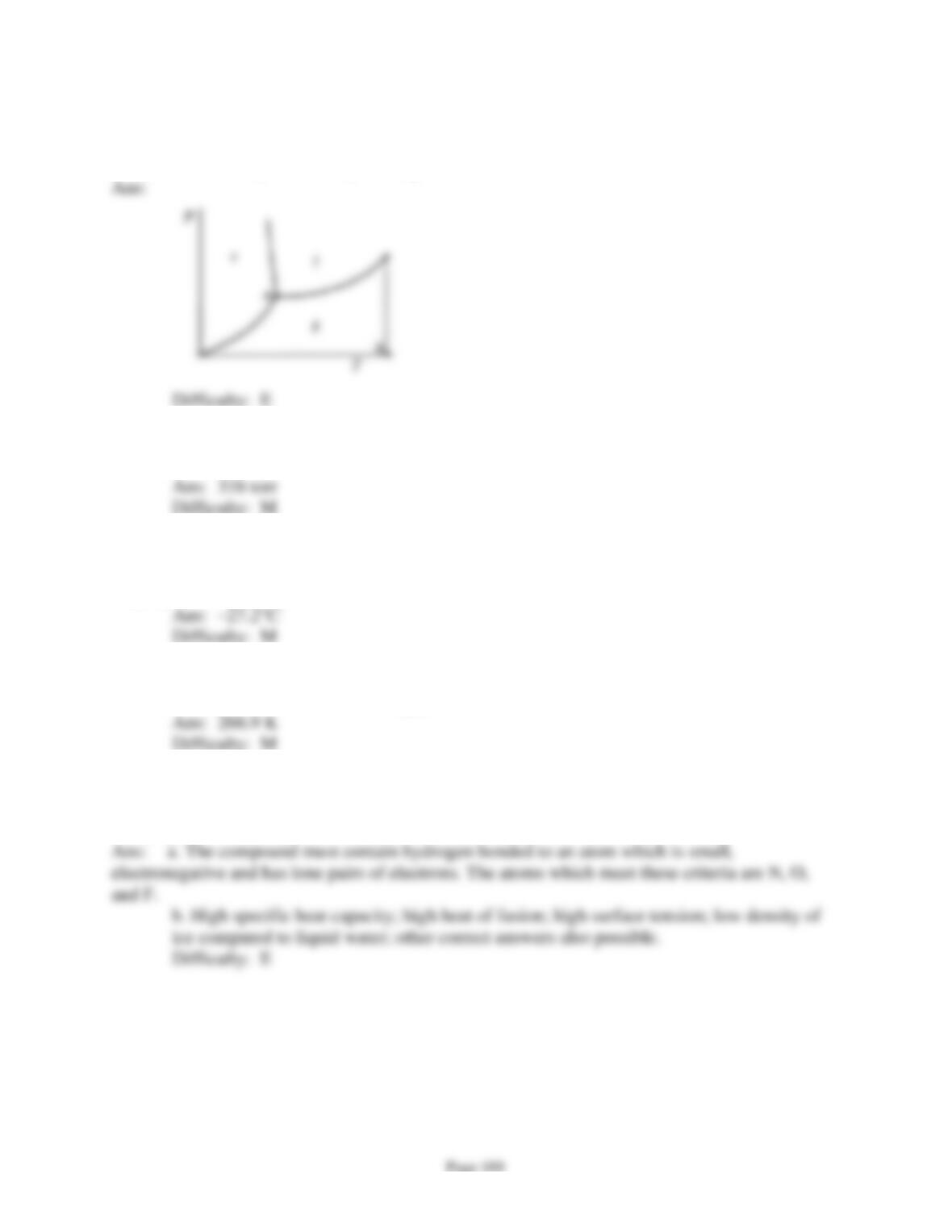
77. Consider the phase diagram shown below.
DA
C
P
T
B
a. What phase(s) is/are present at point A?
b. What phase(s) is/are present at point B?
c. Name point C and explain its significance.
d. Starting at D, if the pressure is lowered while the temperature remains constant, describe what
will happen.
Chapter 12: Intermolecular Forces: Liquids, Solids, and Phase Changes
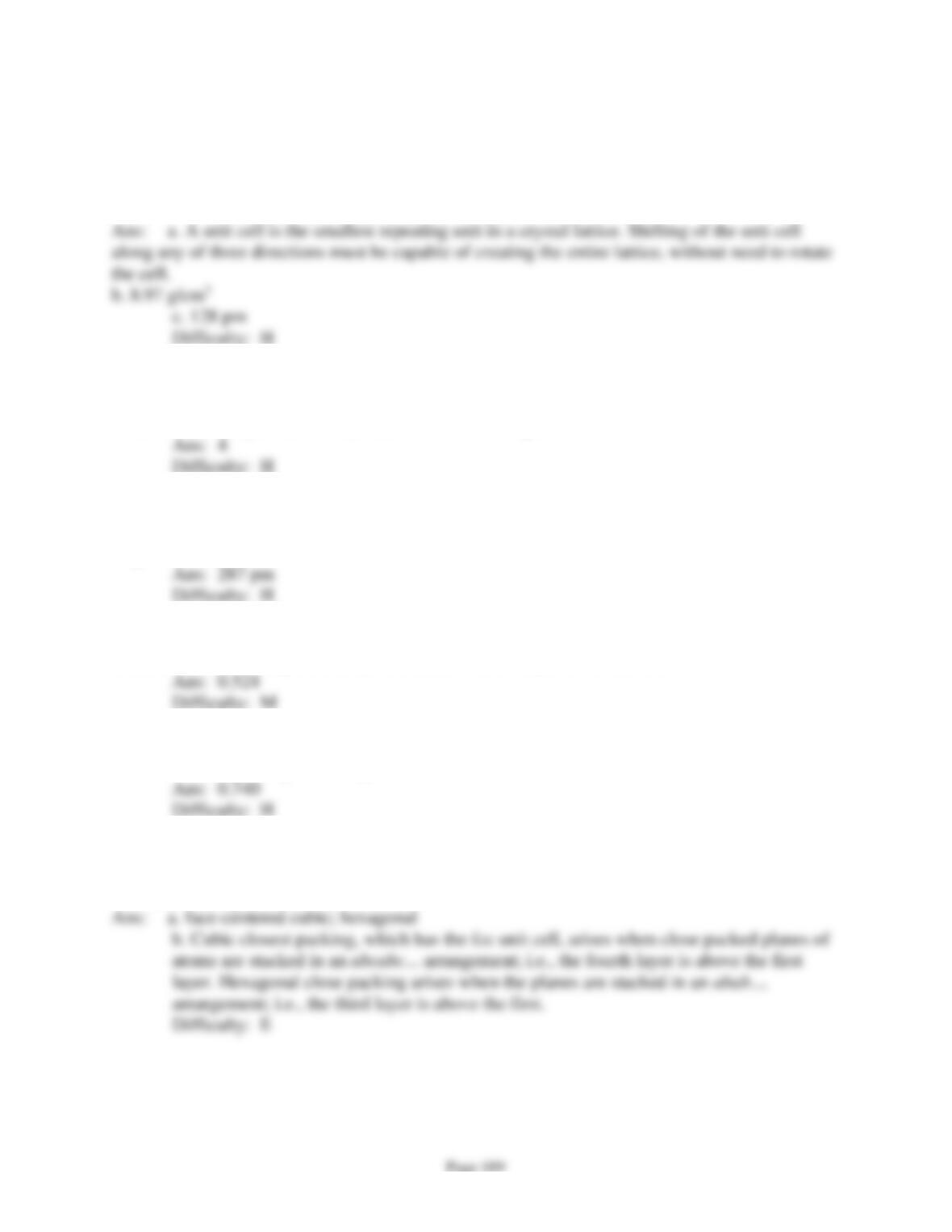
78. Draw a fully labeled phase diagram (P versus T) of a substance whose solid phase can
melt due to applied pressure (i.e., solid is less dense than liquid). Clearly label the triple point
and the critical temperature on your diagram.
79. Liquid ammonia boils at –33.4°C and has a heat of vaporization of 23.5 kJ/mol.
Calculate its vapor pressure at –50.0°C.
80. Chlorine trifluoride is used in processing nuclear reactor fuel. It has a vapor pressure of
29.1 torr at –47.0°C and its heat of vaporization is 30.61 kJ/mol. At what temperature would its
vapor pressure be 107.7 torr?
81. The vapor pressure of 1-butene is 1.268 atm at 273.15 K and its heat of vaporization is
22.9 kJ/mol. What is the normal boiling point of 1-butene?
82. a. State the essential requirements for hydrogen bonding to be important in a compound.
b. List four properties of water which are significantly influenced by the presence of hydrogen
bonding.
Chapter 12: Intermolecular Forces: Liquids, Solids, and Phase Changes
83. a. Explain what is meant by the term “unit cell”.
b. Copper metal has a face-centered cubic unit cell. The edge length of the unit cell is 361 pm,
and the atomic weight of copper is 63.55 amu. Calculate the density of the copper in g/cm3.
(1 amu = 1.661 × 10⁻²⁴ g.)
c. From the data in (b), calculate the radius of a copper atom in pm.
84. Strontium metal crystallizes in a cubic unit cell which has an edge length of 612 pm. If
the mass of an atom of Sr is 87.62 amu, and the density of Sr metal is 2.54 g/cm3, calculate the
number of atoms per unit cell. (1 amu = 1.661 × 10⁻²⁴ g.)
85. Iron has a body-centered cubic unit cell, and a density of 7.87 g/cm3. Calculate the edge
length of the unit cell, in pm. (The atomic mass of iron is 55.85 amu. Also, 1 amu = 1.661 × 10–
24 g.)
86. Assuming that atoms are spherical, calculate the fraction of space which is occupied by
atoms (i.e., the packing efficiency) in a metal with a simple cubic unit cell.
87. Assuming that atoms are spherical, calculate the fraction of space which is occupied by
atoms (i.e., the packing efficiency) in a metal with a face-centered cubic unit cell.
88. a. Name the two unit cells which occur in close packing of identical atoms.
b. Briefly explain how the two types of close-packed lattices of identical atoms differ, in terms
of atomic arrangements.
Chapter 12: Intermolecular Forces: Liquids, Solids, and Phase Changes
89. Of the five major types of crystalline solid, which would you expect each of the
following to form? (e.g., H2O: molecular)
a. Sn
b. Si
c. KCl
d. Xe
e. F2
90. The density of solid sodium chloride, NaCl, is 2.17 g/cm3. Use your knowledge of the
sodium chloride lattice to calculate the spacing between Na+ and Cl– nearest neighbors, in cm.
(Atomic masses (amu) are: Na, 22.99; Cl, 35.45. Also, 1 amu = 1.661 × 10⁻²⁴ g)
91. How do the electrical properties of semiconductors differ from those of metals?
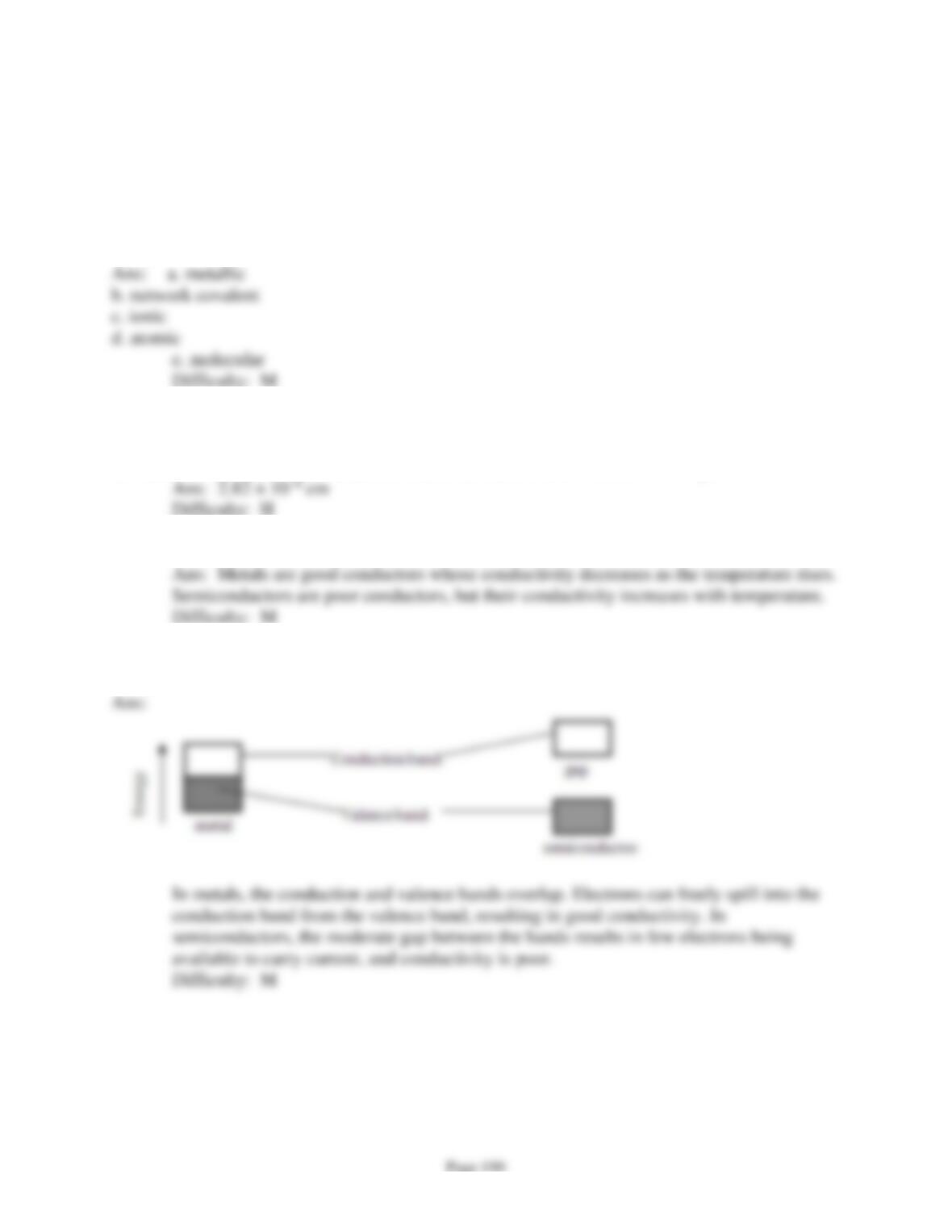
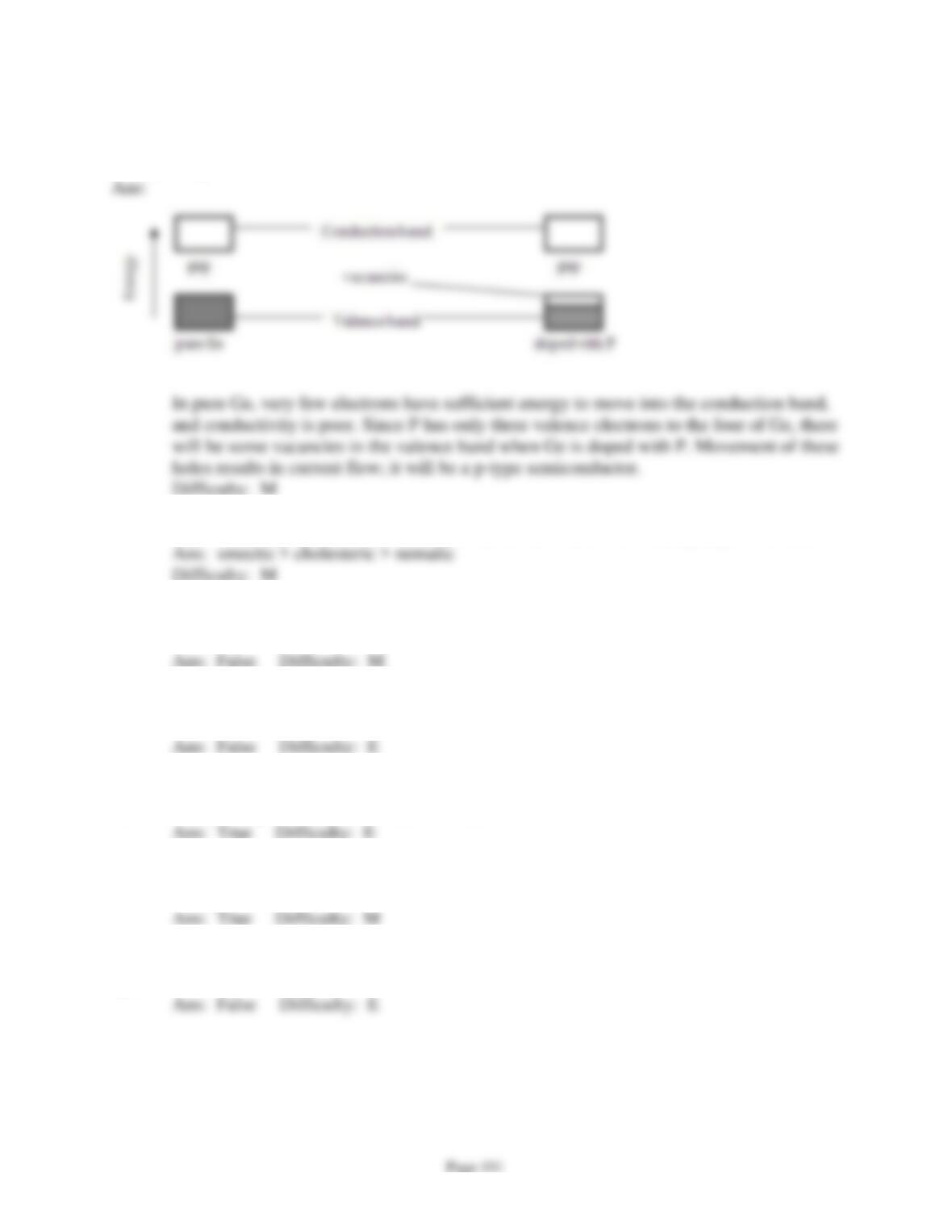
92. Use molecular orbital band diagrams to explain why metals are good conductors but
semiconductors are not.
Chapter 12: Intermolecular Forces: Liquids, Solids, and Phase Changes
93. Germanium is a semiconductor. With the aid of diagrams showing bands of molecular
orbital, explain why it is a poor conductor and how doping it with phosphorus increases its
conductivity.
94. List the three common classes of liquid crystals in order of decreasing degree of order.
95. The maximum number of phases of a single substance which can coexist in equilibrium
is two.
96. The phase diagram of a substance shows the energy changes associated with changes of
state.
97. Some of the information obtained from the heating or cooling curve of a substance can
also be found on a phase diagram of that substance.
98. The phase diagram of a substance can be used to obtain the vapor pressure of that
substance at a given temperature.
99. All gases can be liquefied at room temperature simply by increasing the pressure on the
gas.
Chapter 12: Intermolecular Forces: Liquids, Solids, and Phase Changes
100. If the solid form of a pure substance is denser than its liquid form, an increase in
pressure will cause the melting point to decrease.
101. A liquid may be made to boil at room temperature, simply by lowering the pressure.
102. The energy of a hydrogen bond is greater than that of a typical covalent bond.
103. A single water molecule can participate in at most two hydrogen bonds at any instant.
104. The surface tension of water is lowered when a detergent is present in solution.
105. Only molecules which do not have dipole moments can experience dispersion forces.
106. In the packing of identical atoms with cubic unit cells, the packing efficiency increases
as the coordination number increases.
107. In cubic closest packing, the unit cell is body-centered cubic.
108. Hexagonal close packing of identical atoms occurs when close-packed layers are stacked
in an abcabc…. arrangement.
109. In metals, the conduction bands and valence bands of the molecular orbitals are
separated by a large energy gap.
110. In a transistor, the current through one semiconductor junction controls the current
through a neighboring junction.
111. Liquid crystal displays are most commonly constructed of smectic type liquid crystals.
112. Smectic liquid crystals are more highly ordered than either nematic or cholesteric liquid
crystals.

Chapter 12: Intermolecular Forces: Liquids, Solids, and Phase Changes
113. Ceramic superconductors often contain copper in unusual oxidation states.