Chapter 12: Intermolecular Forces: Liquids, Solids, and
Phase Changes
1. Pentane, C5H12, boils at 35°C. Which of the following is true about kinetic energy, Ek,
and potential energy, Ep, when liquid pentane at 35°C is compared with pentane vapor at 35°C?
A) Ek(g) < Ek(l); Ep(g) Ep(l) D) Ep(g) > Ep(l); Ek(g) Ek(l)
B) Ek(g) > Ek(l); Ep(g) Ep(l) E) Ep(g) Ep(l); Ek(g) Ek(l)
C) Ep(g) < Ep(l); Ek(g) Ek(l)
2. Which of the following is true about kinetic energy, Ek, and potential energy, Ep, when
ethyl alcohol at 40°C is compared with ethyl alcohol at 20°C?
A) Ek(40°C) < Ek(20°C); Ep(40°C) Ep(20°C)
B) Ek(40°C) > Ek(20°C); Ep(40°C) Ep(20°C)
C) Ep(40°C) < Ep(20°C); Ek(40°C) Ek(20°C)
D) Ep(40°C) > Ep(20°C); Ek(40°C) Ek(20°C)
E) Ep(40°C) > Ep(20°C); Ek(40°C) > Ek(20°C)
3. A sample of octane in equilibrium with its vapor in a closed 1.0-L container has a vapor
pressure of 50.0 torr at 45°C. The container’s volume is increased to 2.0 L at constant
temperature and the liquid/vapor equilibrium is reestablished. What is the vapor pressure?
A) > 50.0 torr
B) 50.0 torr
C) 25.0 torr
D) The mass of the octane vapor is needed to calculate the vapor pressure.
E) The external pressure is needed to calculate the vapor pressure.
4. Which one of the following quantities is generally not obtainable from a single heating
or cooling curve of a substance, measured at atmospheric pressure?
A) melting point D) heat of fusion
B) boiling point E) heat of vaporization
C) triple point
Chapter 12: Intermolecular Forces: Liquids, Solids, and Phase Changes
5. The phase diagram for xenon has a solid-liquid curve with a positive slope. Which of the
following is true?
A) Solid xenon has a higher density than liquid xenon.
B) Solid xenon has the same density as liquid xenon.
C) The phase diagram cannot be used to predict which phase of xenon is denser.
D) Freezing xenon is an endothermic process.
E) None of the above statements is true.
6. Liquid ammonia (boiling point = –33.4°C) can be used as a refrigerant and heat transfer
fluid. How much energy is needed to heat 25.0 g of NH3(l) from –65.0°C to –12.0°C?
Specific heat capacity, NH3(l): 4.7 J/(gK)
Specific heat capacity, NH3(g): 2.2 J/(gK)
Heat of vaporization: 23.5 kJ/mol
Molar mass, : 17.0 g/mol
A) 5.5 kJ B) 6.3 kJ C) 39 kJ D) 340 kJ E) 590 kJ
7. Diethyl ether, used as a solvent for extraction of organic compounds from aqueous
solutions, has a high vapor pressure which makes it a potential fire hazard in laboratories in
which it is used. How much energy is released when 100.0 g is cooled from 53.0°C to 10.0°C?
Boiling point: 34.5°C
Heat of vaporization: 351 J/g
Specific heat capacity, (CH3)2O(l): 3.74 J/(gK)
Specific heat capacity, (CH3)2O(g): 2.35 J/(gK)
A) 10.1 kJ B) 13.1 kJ C) 16.1 kJ D) 45.2 kJ E) 48.6 kJ
8. A 5.00 g sample of water vapor, initially at 155°C is cooled at atmospheric pressure,
producing ice at –55°C. Calculate the amount of heat energy lost by the water sample in this
process, in kJ. Use the following data: specific heat capacity of ice is 2.09 J/gK; specific heat
capacity of liquid water is 4.18 J/gK; specific heat capacity of water vapor is 1.84 J/gK; heat of
fusion of ice is 336 J/g; heat of vaporization of water is 2260 J/g.
A) 15.6 kJ B) 10.2 kJ C) 5.4 kJ D) 3.2 kJ E) 1.6 kJ
9. Octane has a vapor pressure of 40. torr at 45.1°C and 400. torr at 104.0°C. What is its
heat of vaporization?
A) 39.0 kJ/mol D) 710 kJ/mol
B) 46.0 kJ/mol E) none of the above
C) 590 kJ/mol
Chapter 12: Intermolecular Forces: Liquids, Solids, and Phase Changes
10. Liquid sodium can be used as a heat transfer fluid. Its vapor pressure is 40.0 torr at
633°C and 400.0 torr at 823°C. Calculate its heat of vaporization.
A) 43.4 kJ/mol D) 1.00 × 10² kJ/mol
B) 52.5 kJ/mol E) none of the above
C) 70.6 kJ/mol
11. The Clausius-Clapeyron equation is used in calculations of
A) melting and freezing points.
B) vapor pressures of liquids.
C) osmotic pressures of solutions.
D) heats of vaporization at different temperatures.
E) crystal structure.
12. The normal boiling point of ether is 307.8 K. Calculate the temperature at which its
vapor pressure is exactly half of that at its normal boiling point. The heat of vaporization for
ether is 26.69 kJ/mol.
A) 305 K B) 302 K C) 295 K D) 289 K E) 281 K
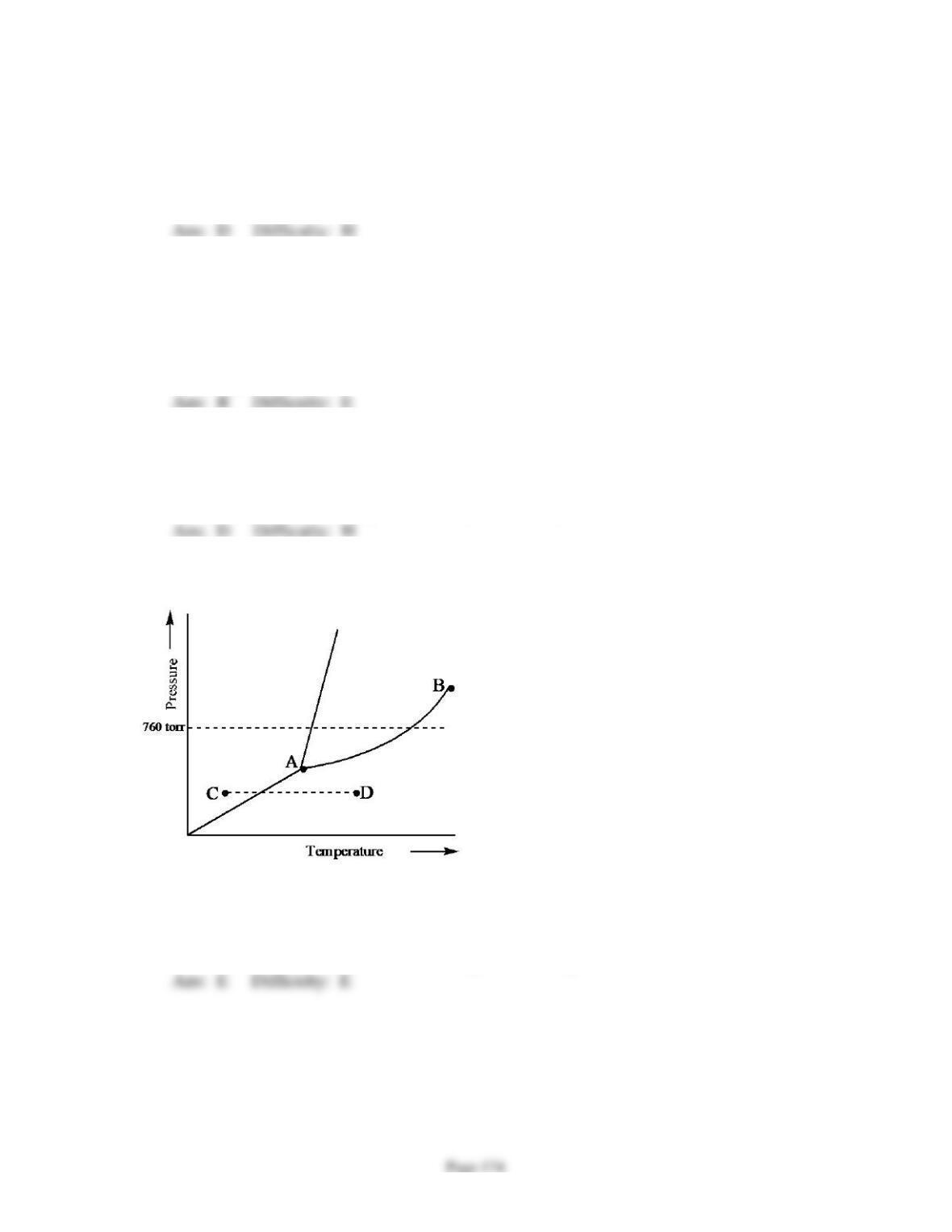
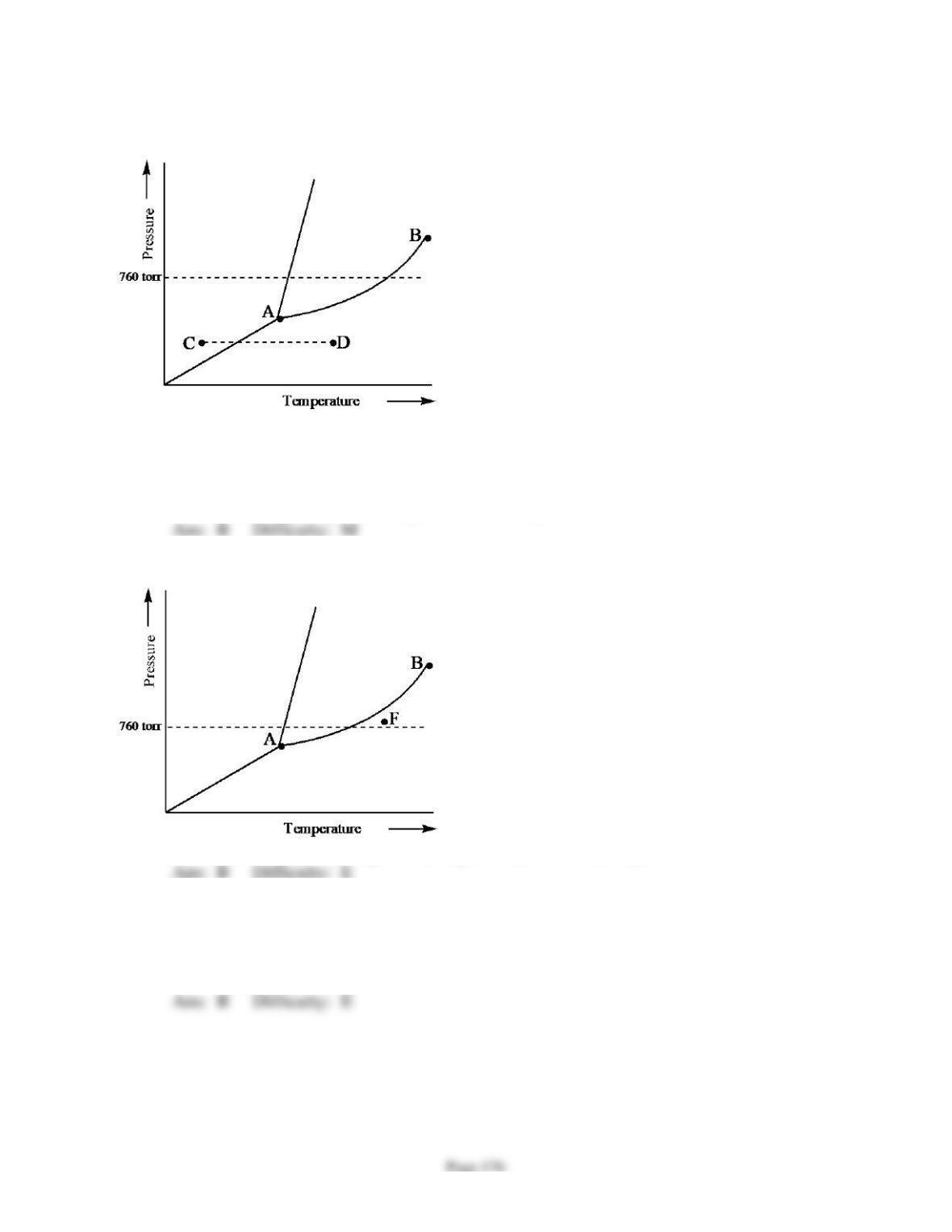
13. Examine the phase diagram for the substance Bogusium (Bo) and select the correct
statement.
A) Bo(s) has a lower density than Bo(l).
B) The triple point for Bo is at a higher temperature than the melting point for Bo.
C) Bo changes from a solid to a liquid as one follows the line from C to D.
D) Bo changes from a liquid to a gas as one follows the line from C to D.
E) Point B represents the critical temperature and pressure for Bo.
Chapter 12: Intermolecular Forces: Liquids, Solids, and Phase Changes
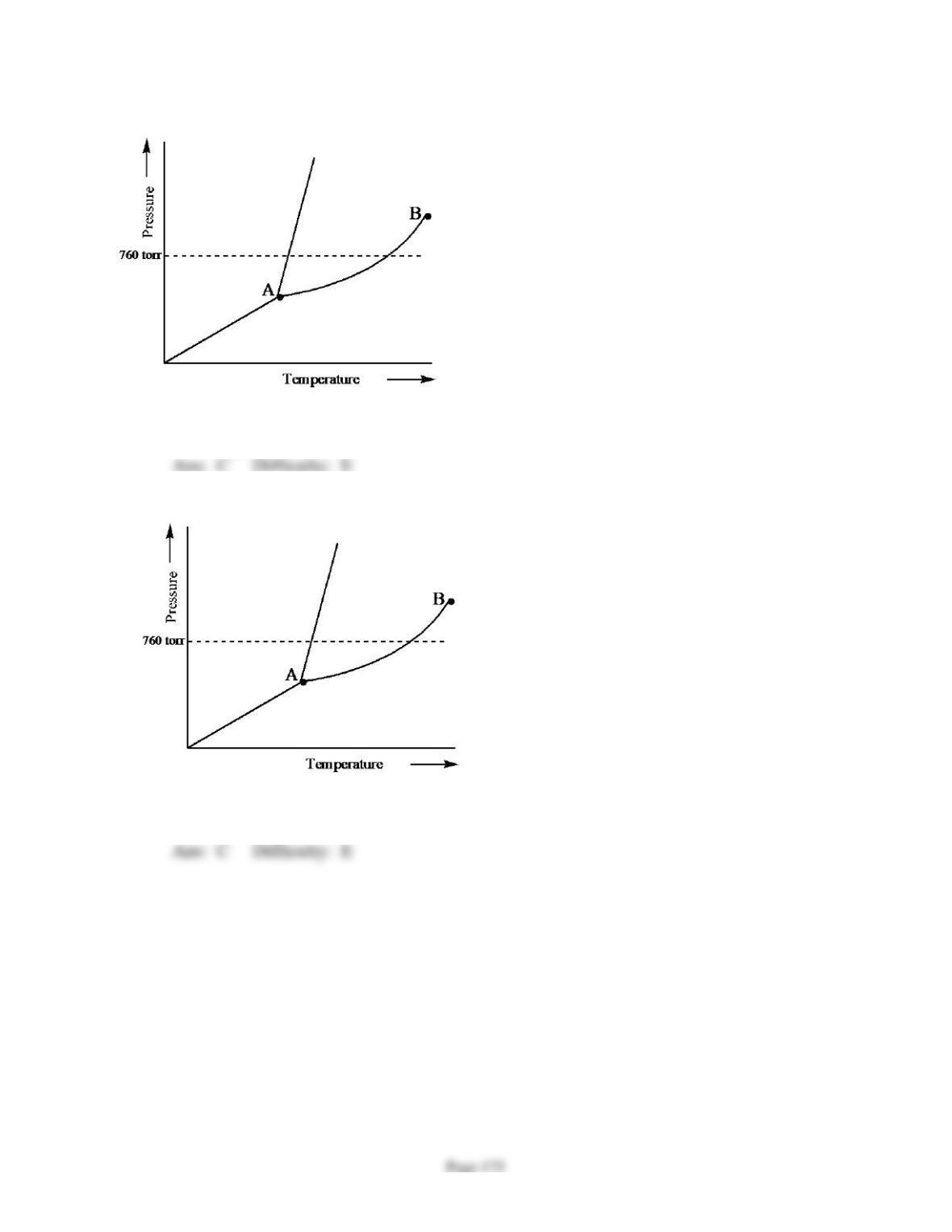
14. Examine the following phase diagram and identify the feature represented by point A.
A) melting point D) sublimation point
B) critical point E) boiling point
C) triple point
15. Examine the following phase diagram and identify the feature represented by point B.
A) melting point D) sublimation point
B) triple point E) boiling point
C) critical point
Chapter 12: Intermolecular Forces: Liquids, Solids, and Phase Changes
16. Consider the following phase diagram and identify the process occurring as one goes
from point C to point D.
A) increasing temperature with a phase change from solid to liquid
B) increasing temperature with a phase change from solid to vapor
C) increasing temperature with a phase change from liquid to vapor
D) increasing temperature with no phase change
E) increasing temperature beyond the critical point
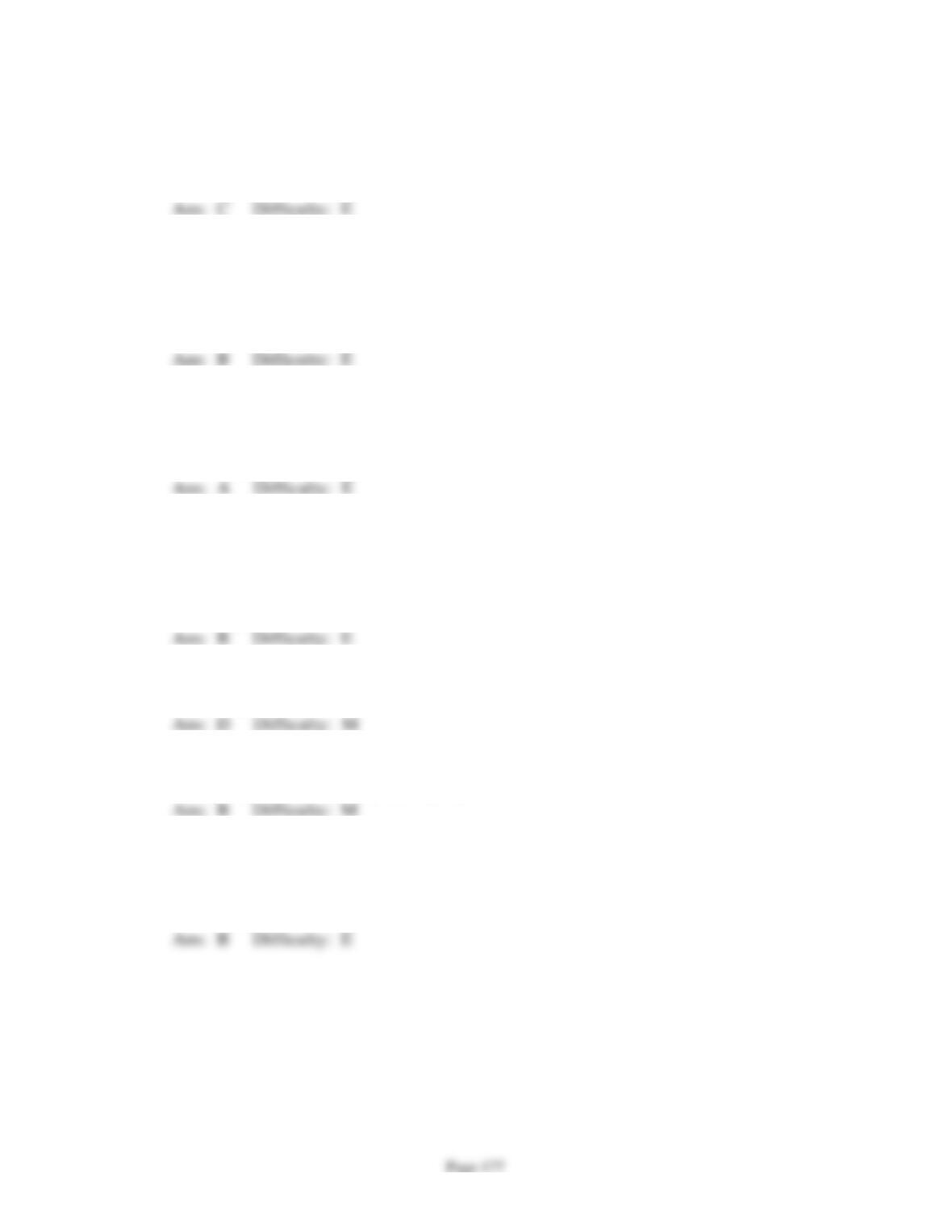
17. Examine the following phase diagram and determine what phase exists at point F.
A) vapor + liquid B) vapor C) liquid D) solid E) supercritical fluid
18. Neon atoms are attracted to each other by
A) dipole-dipole forces. D) covalent bonding.
B) London dispersion forces. E) intramolecular forces.
C) hydrogen bonding.
Chapter 12: Intermolecular Forces: Liquids, Solids, and Phase Changes
19. Ammonia’s unusually high melting point is the result of
A) dipole-dipole forces. D) covalent bonding.
B) London dispersion forces. E) ionic bonding.
C) hydrogen bonding.
20. Octane is a component of fuel used in internal combustion engines. The dominant
intermolecular forces in octane are
A) dipole-dipole forces. D) covalent bonds.
B) London dispersion forces. E) carbon-hydrogen bonds.
C) hydrogen bonding.
21. In hydrogen iodide __________________ are the most important intermolecular forces.
A) dipole-dipole forces D) covalent bonds
B) London dispersion forces E) polar covalent bonds
C) hydrogen bonding
22. When the electron cloud of a molecule is easily distorted, the molecule has a high
_____________.
A) polarity D) van der Waals radius
B) polarizability E) compressibility
C) dipole moment
23. Which of the following atoms should have the greatest polarizability?
A) F B) Br C) Po D) Pb E) He
24. Which of the following atoms should have the smallest polarizability?
A) Si B) S C) Te D) Bi E) Br
25. The strongest intermolecular interactions between pentane (C5H12) molecules arise from
A) dipole-dipole forces. D) ion-dipole interactions.
B) London dispersion forces. E) carbon-carbon bonds.
C) hydrogen bonding.
Chapter 12: Intermolecular Forces: Liquids, Solids, and Phase Changes
26. What types of forces exist between molecules of CO2?
A) hydrogen bonding only.
B) hydrogen bonding and dispersion forces.
C) dipole-dipole forces only.
D) dipole-dipole and dispersion forces.
E) dispersion forces only.
27. The strongest intermolecular interactions between ethyl alcohol (CH3CH2OH) molecules
arise from
A) dipole-dipole forces. D) ion-dipole interactions.
B) London dispersion forces. E) carbon-oxygen bonds.
C) hydrogen bonding.
28. The strongest intermolecular interactions between hydrogen sulfide (H2S) molecules
arise from
A) dipole-dipole forces. D) ion-dipole interactions.
B) London dispersion forces. E) disulfide linkages.
C) hydrogen bonding.
29. The strongest intermolecular interactions between hydrogen fluoride (HF) molecules
arise from
A) dipole-dipole forces. D) ion-dipole interactions.
B) London dispersion forces. E) ionic bonds.
C) hydrogen bonding.
30. Which one of the following substances will have hydrogen bonds between molecules?
A) (CH3)3N B) CH3–O–CH3 C) CH3CH2–OH D) CH3CH2–F E) HI

Chapter 12: Intermolecular Forces: Liquids, Solids, and Phase Changes
31. In which of the following compounds will the molecules not form hydrogen bonds with
each other?
A)
H3C CH2C
O
OH
B)
H F
C)
H3C CH2C CH3
O
D)
H3C CH2N
H
CH3
E)
H3C CH2O H
32. Which of the following pairs of molecules can form hydrogen bonds between them?
A) HCl and HI D) SO2 and CH2O
B) CH3OH and NH3 E) H2 and O2
C) CH4 and H2O
33. Which of the following pairs is arranged with the particle of higher polarizability listed
first?
A) Se2–, S2– B) I, I– C) Mg2+, Mg D) Br, I E) none of the above
34. Which of the following pairs is arranged with the particle of higher polarizability listed
first?
A) CCl4, CI4 D) NH3, NF3
B) H2O, H2Se E) none of the above
C) C6H14, C4H10
35. Which of the following should have the highest boiling point?
A) CF4 B) CCl4 C) CBr4 D) CI4 E) CH4
36. Which of the following should have the lowest boiling point?
A) C5H12 B) C6H14 C) C8H18 D) C10H22 E) C12H26
37. Which of the following has a boiling point which does not fit the general trend?
A) NH3 B) PH3 C) AsH3 D) SbH3 E) BiH3

Chapter 12: Intermolecular Forces: Liquids, Solids, and Phase Changes
38. Select the pair of substances in which the one with the higher vapor pressure at a given
temperature is listed first.
A) C7H16, C5H12 D) CH3CH2OH, CH3–O–CH3
B) CCl4, CBr4 E) Xe, Kr
C) H2O, H2S
39. Select the pair of substances in which the one with the lower vapor pressure at a given
temperature is listed first.
A)
CH3C OH
O
,
CH3CH2CH2OH
B)
PH3
,
NH3
C)
CF4
,
CBr4
D)
C3H8
,
C4H10
E)
F2
,
Cl2
40. Comparing the energies of the following intermolecular forces on a kJ/mol basis, which
would normally have the highest energy (i.e., be the strongest force)?
A) ion-induced dipole D) dipole-dipole
B) dipole-induced dipole E) dispersion
C) ion-dipole
41. Which of the following should have the highest surface tension at a given temperature?
A) CH4 B) CF4 C) CCl4 D) CBr4 E) CI4

Chapter 12: Intermolecular Forces: Liquids, Solids, and Phase Changes
42. Which of the following should have the highest surface tension at a given temperature?
A)
H3C CH2CH2OH
B)
H3C CH2O CH3
C)
H3C CH2C
O
H
D)
H3C CH2C
O
OH
E)
H3C CH2CH3
43. Which of the following properties measures the energy needed to increase the surface
area of a liquid?
A) capillary action D) cohesion
B) surface tension E) specific elasticity
C) viscosity
44. When the adhesive forces between a liquid and the walls of a capillary tube are greater
than the cohesive forces within the liquid
A) the liquid level in a capillary tube will rise above the surrounding liquid and the
surface in the capillary tube will have a convex meniscus.
B) the liquid level in a capillary tube will rise above the surrounding liquid and the
surface in the capillary tube will have a concave meniscus.
C) the liquid level in a capillary tube will drop below the surrounding liquid and the
surface in the capillary tube will have a convex meniscus.
D) the liquid level in a capillary tube will drop below the surrounding liquid and the
surface in the capillary tube will have a concave meniscus.
E) None of the above will occur.
45. The meniscus of mercury in a glass capillary tube is convex because of
A) the very high density of mercury as compared with water.
B) the low surface tension of mercury.
C) the greater attraction of mercury atoms to the glass than to each other.
D) the weaker attraction of mercury atoms to the glass than to each other.
E) electrostatic repulsion between the glass and the mercury.
Chapter 12: Intermolecular Forces: Liquids, Solids, and Phase Changes
46. Which of the following terms refers to the resistance of a liquid to flow?
A) surface tension
B) capillary action
C) viscosity
D) adhesion
E) cohesion
47. Which of the following factors contributes to a low viscosity for a liquid?
A) low temperature D) high molecular weight
B) spherical molecular shape E) high boiling point
C) hydrogen bonding
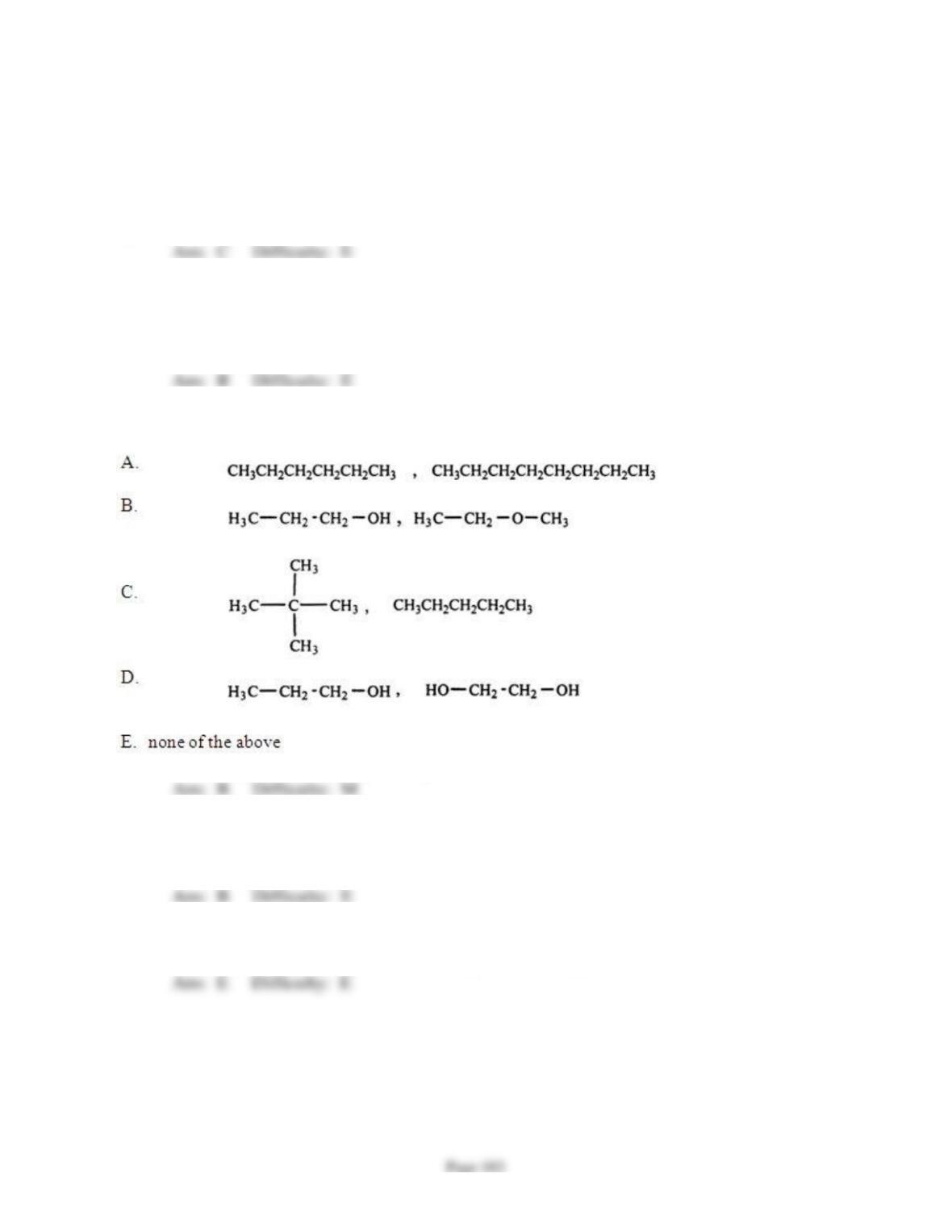
48. Which of the following pairs of substances is arranged so that the one with higher
viscosity is listed first?
A) A B) B C) C D) D E) E
49. Which of the following liquid substances would you expect to have the lowest surface
tension?
A) Pb B) CH3OCH3 C) HOCH2CH2OH D) H2O E) CH3CH2OH
50. Which of the following liquids is likely to have the highest surface tension?
A) Br2 B) C8H18 C) CH3OCH3 D) CH3OH E) Pb