Introduction to Chemical Principles, 11e (Stoker)
Chapter 11 States of Matter
11.1 Multiple Choice
1) Which of the following statements concerning the physical states of the elements at room
temperature (25 °C) and pressure is incorrect?
A) Only two elements, bromine and mercury, are liquids.
B) The vast majority of the elements are solids.
C) The gaseous state is more common than the liquid state.
D) Over half of all the elements are liquids.
2) Which of the following is a property of both liquids and gases?
A) indefinite volume
B) definite shape
C) definite volume
D) indefinite shape
3) Which best describes the size and shape of a sample of liquid?
A) definite volume and definite shape
B) volume and shape both determined by the container
C) definite volume, but shape is determined by the container
D) volume determined by container, but definite shape
4) Gasses and liquids both exhibit the property of ________.
A) compressibility
B) definite shape
C) constant composition
D) indefinite volume
5) In which of the following groupings of terms are the three terms closely related?
A) kinetic energy, energy of motion, cohesive forces
B) potential energy, energy of attraction, disruptive forces
C) kinetic energy, electrostatic interactions, disruptive forces
D) potential energy, electrostatic interactions, cohesive forces
6) Which of the following is not a postulate of kinetic molecular theory?
A) Matter is composed of particles that are in constant motion.
B) Particle velocity increases as the temperature increases.
C) The energy of a given particle cannot change.
D) Particles transfer energy to each other through elastic collisions.
7) Which of the following pairs is incorrectly matched?
A) airplane in flight; kinetic energy
B) charged battery; potential energy
C) burning candle; potential energy
D) water flowing over a fall; kinetic energy
8) In the solid state disruptive forces are ________.
A) roughly of the same magnitude as cohesive forces
B) very weak compared to cohesive forces
C) dominant over cohesive forces
D) a consequence of excessive potential energy
9) Solids are characterized as having ________ volume which means they are ________.
A) definite, compressible
B) indefinite, compressible
C) definite, incompressible
D) indefinite, incompressible
10) Which of the following is not a correct characterization of the liquid state?
A) The particles move relatively long distances before colliding with adjacent particles.
B) The particles are randomly packed in relatively close proximity to each other.
C) The particles “slide” freely over each other.
D) The particles do not have sufficient energy to separate from each other.
11) Which is not a characteristic of liquids?
A) Collisions between particles occur often.
B) Particles are essentially independent of one another.
C) Under normal pressures, the particles are relatively close together.
D) The particles are not very compressible when pressure is applied.
12) Liquids are characterized as having ________ volume which means they are ________.
A) definite, compressible
B) indefinite, incompressible
C) definite, incompressible
D) indefinite, compressible
13) Which of the following is not a factor in determining the magnitude of the vapor pressure of
a liquid?
A) the type of forces between molecules within the liquid
B) the size of the container for the liquid
C) the strength of the attractive forces between molecules of the liquid
D) the temperature of the liquid
14) According to kinetic molecular theory, the molecules of a gas ________.
A) are constantly moving in a regular pattern
B) are constantly moving in a random manner
C) cannot move because of lack of space
D) move only at high temperatures (above 1000 °C)
15) Gases are highly compressible because the particles ________.
A) strongly repel each other
B) have no potential energy
C) are very far apart
D) vibrate
16) The phrases “particles close together and held in fixed positions” and “completely fills the
container” apply, respectively, to ________.
A) liquids and gases
B) gases and liquids
C) solids and gases
D) liquids and solids
17) When liquids and gases are compared, liquids have ________ compressibility compared to
gases and a ________ density.
A) greater, smaller
B) smaller, greater
C) smaller, smaller
D) greater, greater
18) Snow forms in the clouds when water vapor freezes without ever passing through the liquid
phase. This process is known as ________.
A) sublimation
B) condensation
C) freezing
D) deposition
19) Which of the following terms does not involve the solid state?
A) evaporation
B) melting
C) freezing
D) sublimation
20) Which of the following is not an endothermic process?
A) ice melting
B) water evaporating
C) boiling soup
D) condensation of water vapor
21) In which of the following pairs of physical changes are both changes exothermic?
A) sublimation, evaporation
B) freezing, sublimation
C) freezing, condensation
D) melting, condensation
22) Which of the following quantities is needed in calculating the amount of heat energy released
as water turns to ice at 0 °C?
A) heat of solidification for water and the mass
B) heat of fusion for water and the mass
C) heat of vaporization for water and the mass
D) heat of condensation for water and the mass
23) How many joules of heat must be removed to lower the temperature of a 36.5 g Al bar from
84.1 °C to 56.8 °C? The specific heat of Al is 0.908 J/g °C.
A) 581 J
B) 1090 J
C) 905 J
D) 240 J
24) The specific heat of substance A is one fourth that of substance B. The temperature of both a
24.0 g sample of substance A and a 12.0 g sample of substance B were raised 20 °C. The heat
absorbed by substance A was ________ the heat absorbed by substance B.
A) equal to
B) one-half
C) twice
D) four times
25) How much heat energy in Joules is required to heat 16.0 g of copper from 23.0 °C to 66.1
°C? Specific heat of Cu = 0.382 J/(g °C)
A) 263 J
B) 812 J
C) 450 J
D) 109 J
26) A sample of aluminum absorbed 9.86 J of heat and the temperature increased from 23.2 °C
to 30.5 °C. What is the mass of the aluminum? The specific heat of aluminum is 0.90 J/g °C.
A) 72 g
B) 1.5 g
C) 65 g
D) 8.1 g
27) What is the final temperature after 336 J of heat energy is removed from 25.0 g of water at
19.6 °C? Specific heat of water = 4.184 J/(g °C)
A) 32.1 °C
B) 27.6 °C
C) 16.4 °C
D) 24.7 °C
28) What is the heat capacity of 84.0 g of water? Specific heat of water = 4.184 J/g °C
A) 351 J/°C
B) 96.8 J/°C
C) 506 J/°C
D) 492 J/°C
29) How many grams of Ag can be heated from 23 °C to 36 °C when 22 g of Au cools from 95.5
°C to 26.4 °C?
Specific heat of Ag = 0.240 J/(g °C) Specific heat of Au = 0.130 J/(g °C)
A) 47 g
B) 28 g
C) 63 g
D) 1.0 x 10² g
30) Calculate the mass of gold (specific heat = 0.130 J/g °C) that requires 468 J to heat the
sample from 21.6 °C to 33.2 °C?
A) 56.9 g
B) 622 g
C) 538 g
D) 310 g
31) A T-bone steak provides 6.90 x 10² food Calories (Cal). A food Calorie is equivalent to
4180 J of heat energy. The heat energy provided by the steak would be sufficient to heat 59.1 kg
of water by how many Celsius degrees. The specific heat of water is 4.18 J/g °C.
A) 6.58 °C
B) 11.7 °C
C) 9.20 °C
D) 23.6 °C
32) The combustion of one mole of a gas produces 212 calories of energy. Express the energy
released in this reaction in kilojoules.
A) 239 kJ
B) 887 kJ
C) 0.887 kJ
D) 0.239 kJ
33) Which of the following statements concerning temperature change as a substance is heated is
incorrect?
A) As a solid is heated, its temperature rises until its melting point is reached.
B) During the time a solid melts to a liquid the temperature remains constant.
C) As a liquid is heated, its temperature rises until its boiling point is reached.
D) During the time a liquid is changing to the gaseous state the temperature gradually increases
while all the liquid is changed.
34) Which of the following would be correct units for a heat of condensation value?
A) J/°C
B) Cal/°C
C) g/°C
D) Cal/g
35) Which of the following would have the same numerical magnitude?
A) heats of fusion and deposition
B) heats of sublimation and condensation
C) heats of sublimation and deposition
D) heats of solidification and condensation
36) Which of the following quantities is necessary in calculating the amount of heat energy
required to change liquid water at 75 °C to steam at 110 °C?
A) specific heat of water, specific heat of steam, and heat of vaporization for water
B) specific heat of steam and heat of fusion for water
C) heat of fusion for water and heat of condensation for water
D) specific heat of ice and specific heat of water
37) How much energy is required to change 12.9 g of solid Cu to molten Cu at 1083 °C (melting
point)?
Heat of fusion for Cu = 205 J/g
A) 1390 J
B) 3150 J
C) 2640 J
D) 1990 J
38) How much heat must be absorbed to evaporate 14 g of NH3 at −33 °C (condensation point)?
Heat of condensation for NH3 = 1380 J/g
A) 19,000 J
B) 91,000 J
C) 46,000 J
D) 62,000 J
39) What is the heat of vaporization in J/g of an unknown liquid if 6823 J of heat are required to
vaporize 58.0 g of the unknown at its boiling point?
A) 516 J/g
B) 118 J/g
C) 981 J/g
D) 28,100 J/g
40) Calculate the heat energy that must be removed from 17.6 grams of ammonia gas to
condense it to liquid ammonia at its boiling point, −33 °C. The heat of vaporization for ammonia
is 1380 J/g.
A) 24,300 J
B) 78.4 J
C) 0.0128 J
D) 9,680 J
41) How much heat energy is needed to convert 10.0 g of ice at −10 °C to liquid water at 10 °C?
Specific heat of ice = 2.09 J/(g °C) Heat of fusion of ice = 334 J/g Specific heat of water
= 4.18 J/g °C
A) 5270 J
B) 1,070 J
C) 6,210 J
D) 3970 J
42) The calculation set-up below is used to determine how much heat is needed to convert 50 g
of ice at −20 °C to steam at 300 °C. Which constant does C represent?
(A)(50 g)(20 °C) + (heat of fusion)(50 g) + (B)(50 g)(100 °C) + (heat of vap.)(50 g) + (C)(50
g)(200 °C) = total heat
A) specific heat of ice
B) specific heat of water
C) specific heat of steam
D) heat capacity of water
43) The calculation set-up below is used to determine how much heat is needed to convert 50 g
of ice at −20 °C to steam at 300 °C. Which constant does A represent?
(A)(50 g)(20 °C) + (heat of fusion)(50 g) + (4.18 J/g °C)(50 g)(100 °C) + (B)(50 g) + (C)(50 g
)(200 °C) = total heat
A) heat of condensation
B) specific heat of ice
C) specific heat of water
D) heat of vaporization of water
44) Which of the following statements concerning evaporation is correct?
A) Molecules with energies considerably above average escape from the liquid.
B) Decreasing the surface area of the liquid increases the rate of evaporation.
C) During evaporation, the temperature of the liquid changes.
D) Increasing the surface area of the liquid decreases the rate of evaporation.
45) A nonvolatile liquid would ________.
A) have weak attractive forces between molecules
B) have a high vapor pressure at room temperature
C) be a very “explosive” substance
D) have strong attractive forces between molecules
46) The vapor pressure of SnCl4 reaches 400 mm Hg at 92 °C, the vapor pressure of SnI4
reaches 400 mm Hg at 315 °C, the vapor pressure of PBr3 reaches 400 mm Hg at 150 °C, and
the vapor pressure of PCl3 reaches 400 mm Hg at 57 °C. At 175 °C, which substance would
have the lowest vapor pressure?
A) PBr3
B) SnI4
C) SnCl4
D) PCl3
47) What effect will decreasing the temperature of a liquid by 15 °C at constant pressure have on
the magnitude of its vapor pressure?
A) increase
B) decrease
C) no change
D) insufficient information given
48) The boiling point of a liquid is ________.
A) the temperature at which the rate of sublimation and evaporation are equal
B) always 100 °C or greater
C) the temperature at which the vapor pressure of the liquid equals the pressure over the liquid
D) the temperature at which sublimation occurs
49) Which statement about the boiling point of water is incorrect?
A) The boiling point is greater than 100 °C in a pressure cooker.
B) The boiling point is less than 100 °C for locations at low elevations.
C) At sea level and at a pressure of 760 mm Hg, the boiling point is 100 °C.
D) In a pressure cooker, shorter cooking times are required due to the change in boiling point.
50) The normal boiling point of a substance is determined by its molecular mass and its
intermolecular forces. Considering these two factors, predict the order of increasing boiling
points for the following substances: CH4, CS2, KBr, NH3.
A) CS2 < CH4 < KBr < NH3
B) CH4 < CS2 < NH3 < KBr
C) NH3 < KBr < CS2 < CH4
D) CH4 < KBr < NH3 < CS2
51) Which of the following compounds would have the lowest boiling point?
A) CH4
B) NO2
C) HF
D) LiCl
52) Based on your understanding of bonding in liquids and solids, arrange the following
substances from the highest to lowest melting points: NaCl, Na, Cl2, SiO2
A) Cl2, Na, NaCl, SiO2
B) Na, NaCl, Cl2, SiO2
C) SiO2, NaCl, Na, Cl2
D) NaCl, SiO2, Na, Cl2
53) Which of the following statements about intermolecular forces is incorrect?
A) They must be overcome in order for molecules to escape from the liquid state into the vapor
state.
B) They are much weaker than intramolecular forces.
C) They are electrostatic in origin.
D) They occur within molecules rather than between molecules.
54) The strength of London dispersion forces depends on what two factors?
A) molecular mass and polarizability
B) vapor pressure and size
C) molecular mass and volatility
D) volatility and shape
55) Which of the following statements is correct?
A) Dipole-dipole interactions occur only between polar molecules.
B) A hydrogen bond is an extremely weak dipole-dipole interaction.
C) London forces are strong interactions.
D) Hydrogen bonding occurs between any two hydrogen-containing molecules.
56) In which of the following liquids would dipole-dipole interactions be the predominant
intermolecular force?
A) CO2
B) HCl
C) PF3
D) both B and C
57) Which of the following kinds of intermolecular forces is found in all molecules?
A) hydrogen bonding
B) dipole-dipole interactions
C) London forces
D) ion-ion interactions
58) The predominant intermolecular force in (CH3)2NH is:
A) London-dispersion forces.
B) ionic bonding.
C) dipole-dipole attractions.
D) hydrogen bonding.
59) Which of the following substances cannot form hydrogen bonds?
A) HF
B) CH3NH2
C) HCl
D) NH3
60) The boiling points of the halogens increase going from fluorine to iodine. What type of
intermolecular force(s) is (are) responsible for this trend?
A) London dispersion forces
B) hydrogen bonding
C) ion-dipole attraction
D) dipole-dipole interactions
16
61) In a liquid sample of NCl3, what is the dominant intermolecular force present?
A) London forces
B) hydrogen bonding
C) instantaneous bonding
D) dipole-dipole interactions
62) Which of the following substances would be expected to have the highest boiling point?
A) a nonpolar liquid
B) a polar liquid with hydrogen bonding
C) a polar liquid with weak dipole-dipole interactions
D) a nonvolatile liquid
63) Which one of the following decreases as the strength of the attractive intermolecular force
increases?
A) the viscosity
B) the normal boiling temperature
C) the melting point
D) the vapor pressure of a liquid
64) When NaCl dissolves in water, the force of attraction that exists between Na+ and H2O is
called:
A) dipole-dipole.
B) ion-ion.
C) hydrogen bonding.
D) ion-dipole.
65) Which of the following compounds is incorrectly matched with the predominant
intermolecular force associated with that compound in the liquid state?
Compound Intermolecular force
A) Cl2O dipole-dipole interactions
B) HBr London forces
C) CH3OH hydrogen bonding
D) HF hydrogen bonding
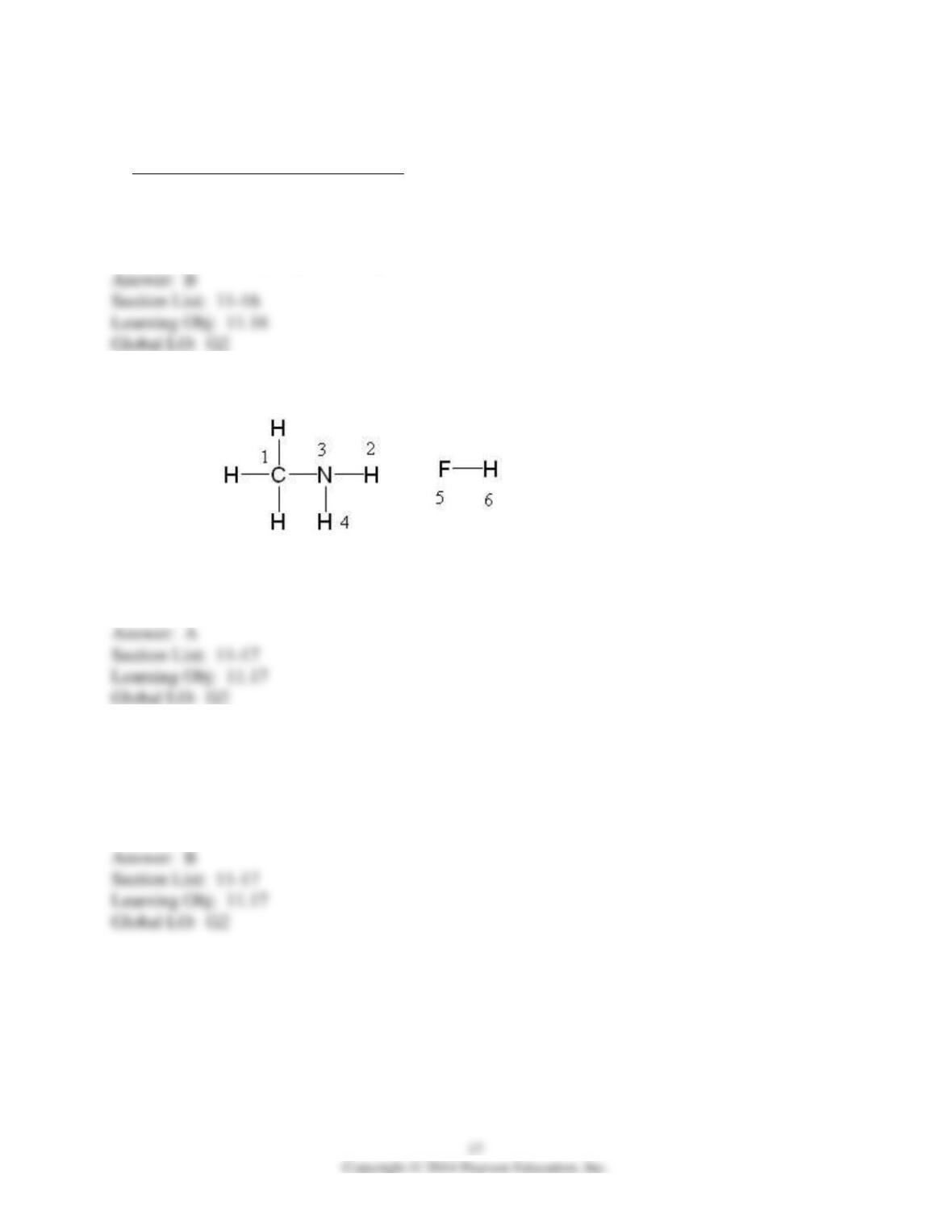
66) If liquid methyl amine and hydrofluoric acid were mixed, between which two atoms in these
molecules would a hydrogen bond form?
A) between 4 and 5, between 2 and 5 or between 3 and 6
B) between 2 and 5 only
C) between 3 and 6 only
D) between 4 and 5 or 2 and 5
67) Which of the following would have the highest boiling point?
A) CO2
B) H2O
C) CH4
D) Kr
68) The high boiling point of water is due to ________.
A) London forces
B) its low heat of vaporization
C) hydrogen bonding
D) ice being less dense than liquid water
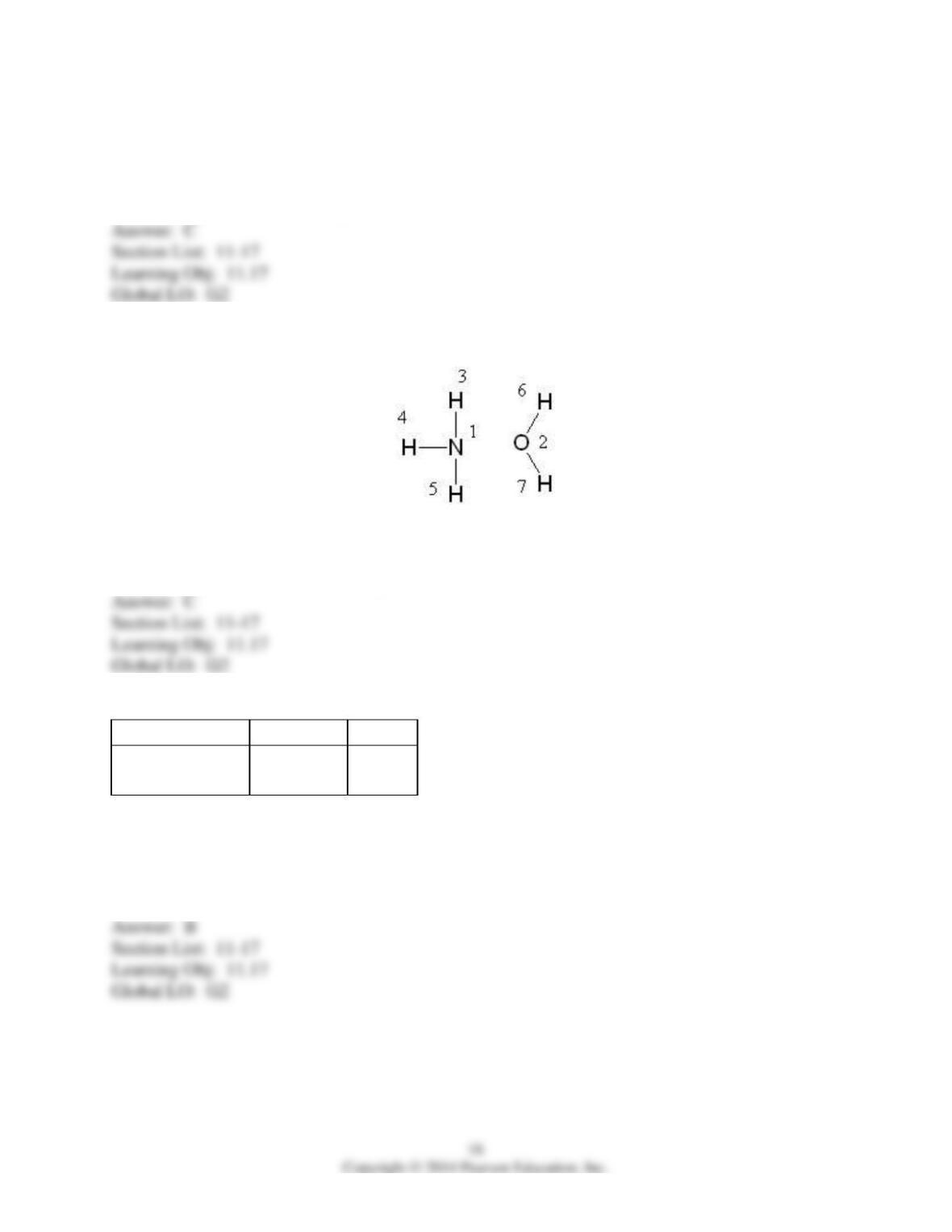
69) If liquid ammonia and water were mixed, between which two atoms in these molecules
would a hydrogen bond form?
A) between 1 and 3
B) between 2 and 6
C) between 3 and 2, 4 and 2, 5 and 2, 1 and 6, and 1 and 7
D) hydrogen bond formation is not possible between these two molecules
70) Which of the following molecules are capable of hydrogen bonding with water?
H2S
NH3
H2
HBr CH4
CH4
HF
A) NH3, HBr, and H2
B) NH3 and HF
C) H2S and CH4
D) H2S, HBr, and H2
11.2 Short Answer
1) What would be the temperature change, in °C, if 555 J of heat energy is added to 35.0 g of a
metal with a specific heat of 0.418 J/g °C?
2) A chocolate caramel pecan candy contains 115 food Calories (Cal). A food Calorie is
equivalent to 1000 calories of heat energy. If the heat energy contained in the piece of candy
were transferred to 53.5 kg of water at 25.0 °C, what would be the final temperature of the
water? The specific heat of water is 4.18 J/g °C.
3) The specific heat of lead is 0.13 J/g-°C. How many joules of heat would be required to raise
the temperature of 25.0 g of lead from 21oC to 39°C?
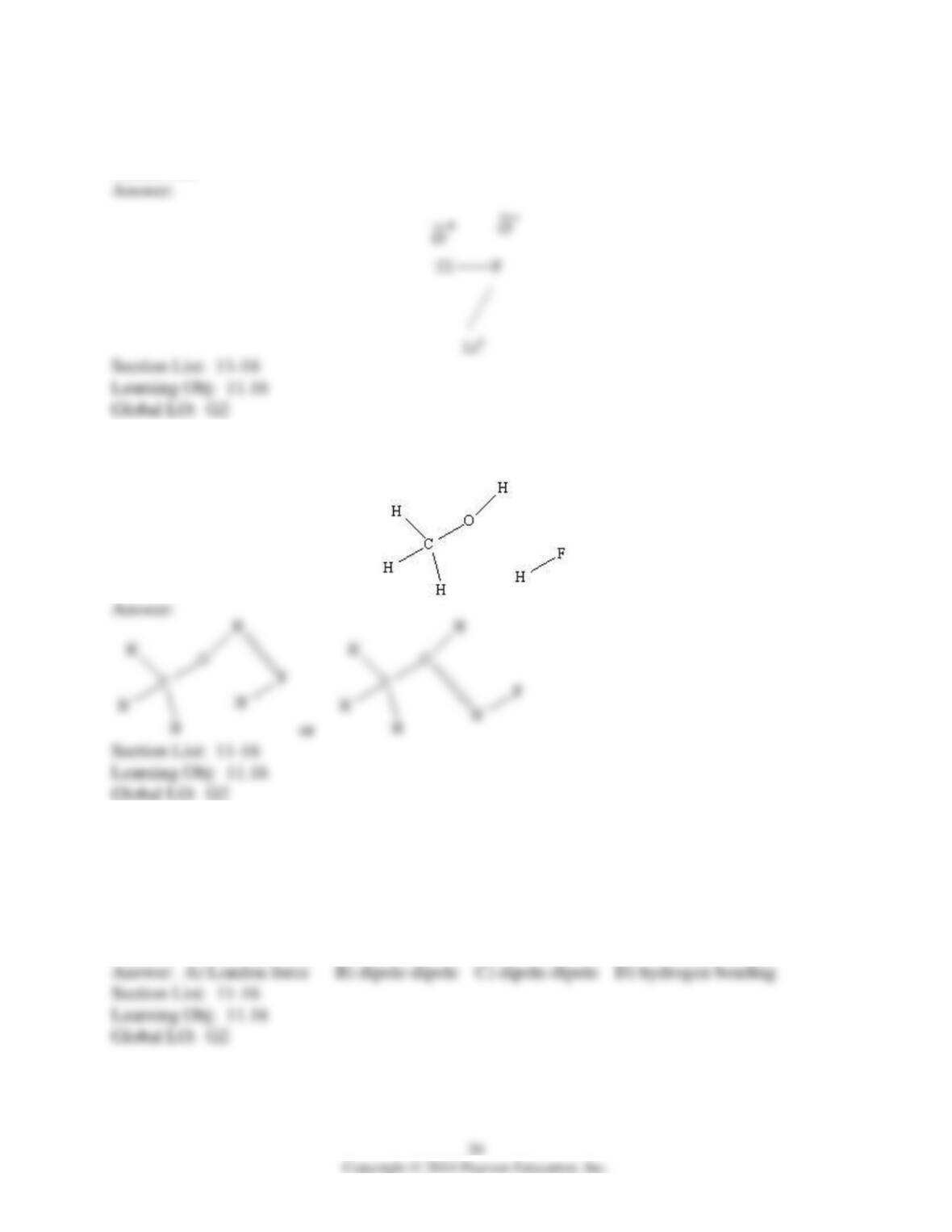
4) The ClF molecule is polar. Use + and − signs to indicate the direction of polarity in the Cl-F
bond. Using a dashed line, illustrate an ion-dipole interaction between a ClF molecule and a
lithium ion.
5) Use a dashed line to illustrate hydrogen bonding between a methanol molecule and a
hydrogen fluoride molecule.
6) Predict the predominate intermolecular force (London force, dipole-dipole, or hydrogen
bonding) that would be associated with each of the following compounds.
A) BeF2 ________
B) OF2 ________
C) HCl ________
D) HCOOH ________