Introductory Chemistry, 5e (Tro)
Chapter 11 Gases
11.1 True/False Questions
1) Straws work because sucking creates a pressure difference.
2) Gases are a collection of particles in constant, unpredictable motion.
3) Gas particles act independently of each other.
4) Gas particles lose energy every time they collide with each other or the container wall.
5) There is a large distance between gas particles as compared to their relative size.
6) As you increase temperature, you increase the average energy of the gas particles.
7) Gases and liquids are compressible, but solids are not.
8) Gases fill the entire volume of their container.
9) The expected order of density for matter is gases < liquids < solids.
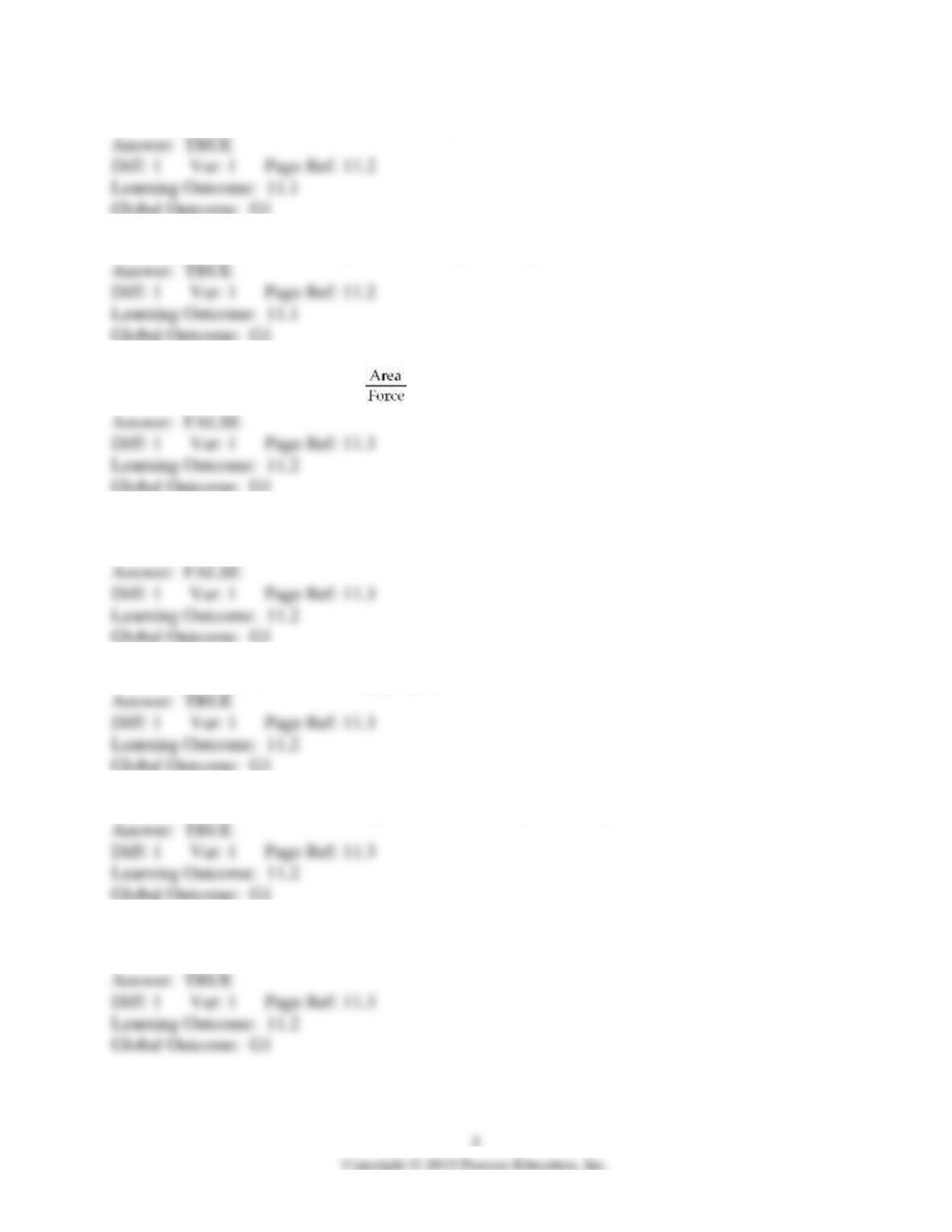
10) Pressure is calculated by: P = .
11) The unit of pressure known as the atmosphere (atm) is defined as the average pressure found
at the top of Mount Everest.
12) Pressure depends on how many gas particles are in a container.
13) As we climb a mountain to a higher altitude, we experience a pressure decrease.
14) If the column of mercury in a barometer drops to a lower reading, this means the measured
pressure has decreased.
15) A pedometer is a device created by Torricelli to measure pressure.
16) The conversion factor for pressure is 1 mm Hg = 1 atm.
17) One atmosphere of pressure is equivalent to 760 psi.
18) Boyle’s law states that as the volume of a gas increases so does the pressure.
19) A sealed bag of potato chips will expand when taken to a higher altitude. This is an example
of Boyle’s law.
20) The volume of a gas is independent of the temperature.
21) For all gas law calculations, the temperature must be in kelvins.
22) Charles’s Law provides an explanation of why hot air balloons float.
23) Absolute zero refers to 0°C.
24) If the kelvin temperature of a gas is doubled, the volume is doubled provided that the
pressure and the number of particles remains constant.
25) The volume of a gas and the number of particles is inversely proportional.
26) One mole of F2 gas at STP would take up twice the volume of one mole of Ar gas at STP.
27) If the number of gas particles is halved, the volume of the gas will be halved given that the
temperature and pressure do not change.
28) If the number of gas particles is tripled, the volume will be 1/3 of the original given that
temperature and pressure do not change.
29) If a slow leak in an inner tube has reduced the volume of the tube to one-third its original
inflated volume, this means that one-third of the moles of gas have escaped the tube. (Assume
constant temperature and pressure.)
30) If you had a five liter balloon of argon gas and a five liter balloon of xenon gas, and you
removed 10 grams of gas from each balloon, the balloons would both shrink down to the same
size.
31) Aerosol spray cans contain gas trapped in a fixed volume and cans of this type can explode if
heated to high temperature. This illustrates that pressure and temperature are directly
proportional.
32) A gas may not behave ideally under conditions of low pressure or high temperature.
33) “Molar Mass” can be calculated using the formula: Molar mass = .
34) The main component of the air we breathe is oxygen gas.
35) Using pure oxygen in scuba diving tanks is a good method of preventing the nitrogen bends.
36) Dalton’s law of partial pressure is: P = .
37) If some argon gas at 400 mm Hg pressure is forced into a gas cylinder that already contained
only neon gas at 400 mm Hg pressure, the total pressure in the cylinder would now be 800 mm
Hg.
38) Vapor pressure of water increases with increasing temperature because the higher
temperature causes more water molecules to evaporate.
39) The vapor pressure of water is independent of temperature.
40) The molar volume of any gas at conditions of standard temperature and pressure is 22.4
liters.
41) A 22.4 liter sample of gas at standard temperature and pressure conditions contains 1 mole of
gas particles.
42) STP conditions are 273 K and 760 mm Hg.
43) The volume of 9.00 grams of water vapor at STP is 11.2 L.
11.2 Multiple Choice Questions
1) Which of the following statements about pressure is FALSE?
A) Pressure is caused by gas molecules colliding with surfaces.
B) The atmosphere has a pressure as the components of air collide with surfaces.
C) After creating a pressure difference, the atmospheric pressure can push liquid up a straw.
D) A deep well dug in the ground must have the pump located at the bottom of well in order to
have the water come to the surface.
E) All of the above statements are true.
2) Which of the following is NOT part of the Kinetic Molecular Theory?
A) Gas particles do not repel each other.
B) There is a large distance between gas particles as compared to their relative size.
C) The size of the actual gas particles is small compared to the volume of the whole gas.
D) The average energy of the particles is dependent on the molecular mass of the particle.
E) All of the above statements are part of the Kinetic Molecular Theory.
3) Which of following statements are consistent with the Kinetic Molecular Theory?
A) Gases are compressible because the volume taken up by the gas is almost entirely open space.
B) Gases assume the shape and volume of their container because they are in constant, straight-
line motion.
C) Gases have a low density because there is so much empty space between the particles.
D) Gas particles collide with each other and surfaces without losing any energy.
E) All of the above statements are consistent with the Kinetic Molecular Theory.
4) All of the following statements are consistent with the kinetic molecular theory of gases
EXCEPT:
A) The size of the gas molecules is negligible compared to the total volume of the gas.
B) The average kinetic energy of the molecules of a gas is proportional to the temperature of the
gas in kelvins.
C) The gas molecules collide with each other and with the surfaces around them.
D) Strong attractive forces hold the gas molecules together.
E) none of the above
5) 1 atm is equal to:
A) 760 mm Hg.
B) 760 torr.
C) 101,325 Pa.
D) 14.7 psi.
E) all of the above
6) 1 torr is equal to:
A) 760 mm Hg.
B) 1 mm Hg.
C) 1 Pa.
D) 14.7 psi.
E) all of the above
7) A barometer uses mercury because:
A) it is a convenient, safe, lightweight material.
B) the density of mercury is very large which allows the barometer to be short.
C) it is the traditional substance used, water could be as easily used.
D) it is the only liquid metal at room temperature.
E) All of the above are true.
8) What is the equivalent pressure of 0.905 atm in units of mm Hg?
A) 688
B) 840
C) 0.905
D) 13.3
E) none of the above
9) What is the equivalent pressure of 1520 torr in units of atm?
A) 203,000
B) 380.
C) 2.00
D) 1520
E) none of the above
10) What is the equivalent pressure of 760 torr in units of mm Hg?
A) 760
B) 1
C) 14.7
D) 29.92
E) none of the above
11) What is the equivalent pressure of 968 mm Hg in units of atm?
A) 1.27 atm
B) 0.785 atm
C) 968 atm
D) 1.30 atm
E) none of the above
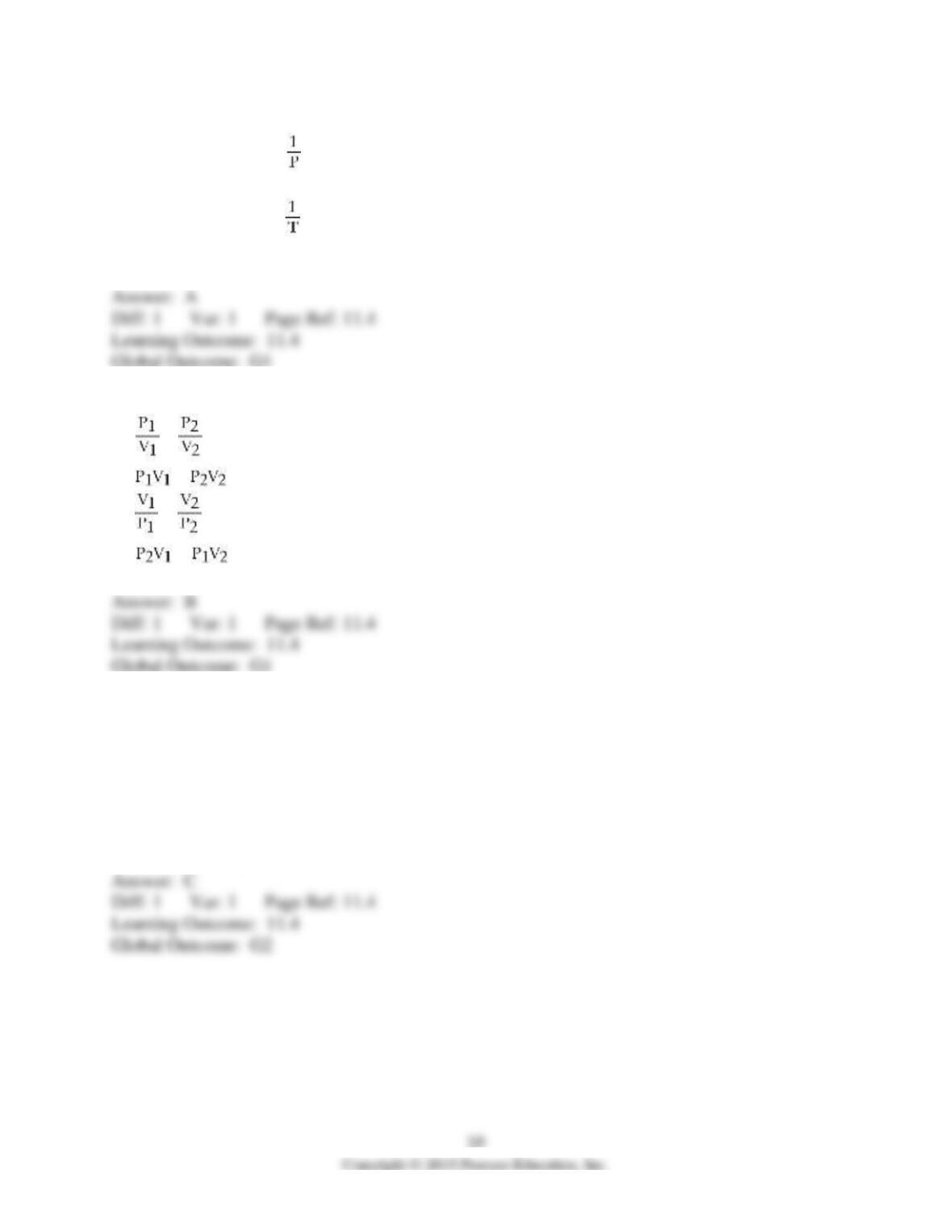
12) Boyle’s Law is expressed as:
A) V is proportional to
B) P is proportional to V
C) V is proportional to
D) V is proportional to T
E) none of the above
13) To solve problems using Boyle’s Law, which mathematical equation should be used?
A) =
B) =
C) =
D) =
E) none of the above
14) One liter of a gas is in a sealed chamber containing a moveable piston. If the piston is moved
so that the volume of the gas is compressed to a volume of one-half liter, what will happen to the
pressure on the gas? (Assume the temperature is constant and no gas particles are lost.)
A) The pressure will remain the same.
B) The pressure will be half of the original value.
C) The pressure will be twice the original value.
D) It would be impossible to move the piston since gases are not compressible.
E) none of the above
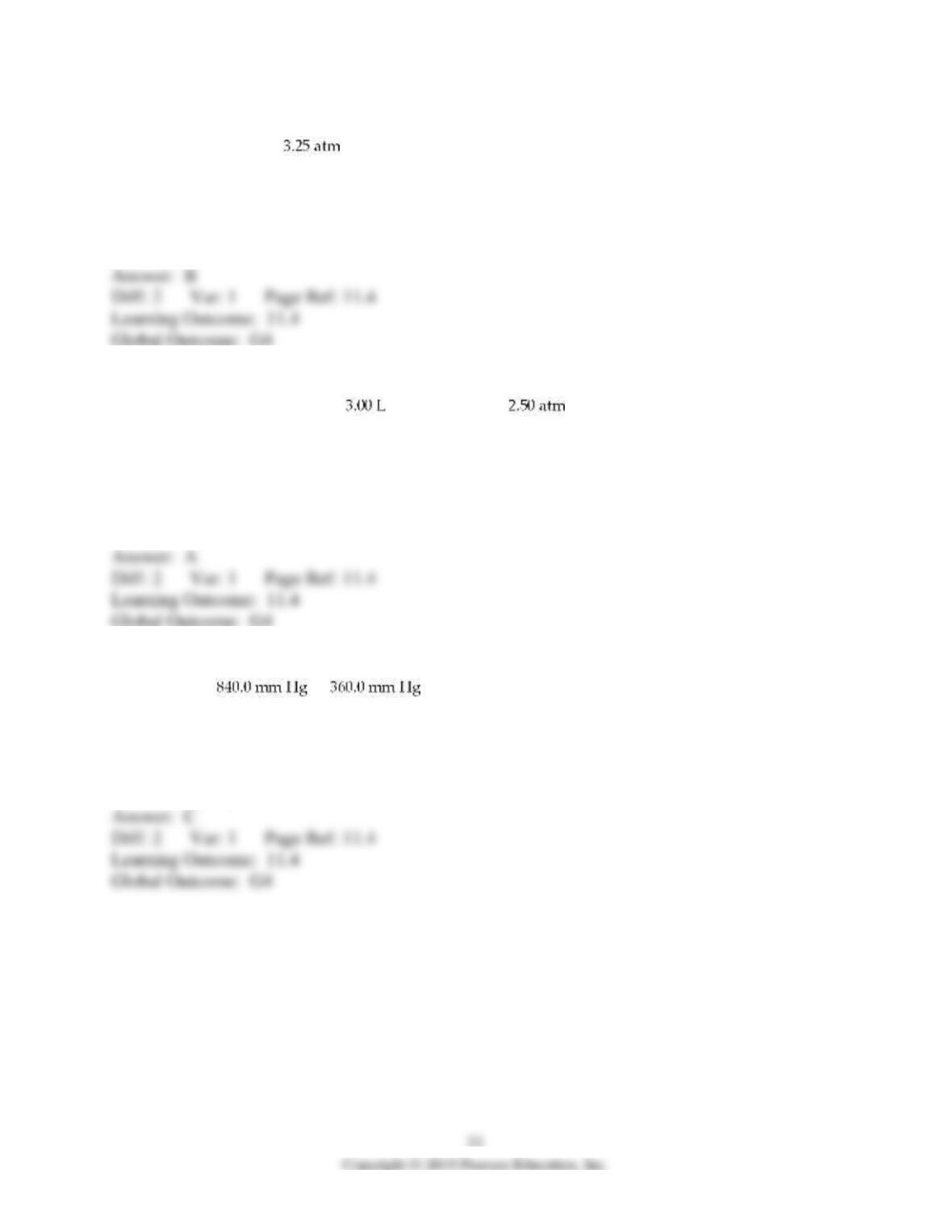
15) A balloon filled with 0.500 L of air at sea level is submerged in the water to a depth that
produces a pressure of . What is the volume of the balloon at this depth?
A) 1.63 L
B) 0.154 L
C) 6.50 L
D) 0.615 L
E) none of the above
16) Divers often inflate heavy duty balloons attached to salvage items on the sea floor. If a
balloon is filled to a volume of at a pressure of , what is the volume of the balloon
when it reaches the surface?
A) 7.50 L
B) 1.20 L
C) 0.833 L
D) 5.50 L
E) none of the above
17) The initial volume of a gas cylinder is 750.0 mL. If the pressure of a gas inside the cylinder
changes from to , what is the final volume the gas occupies?
A) 3.151 L
B) 630.0 mL
C) 1.750 L
D) 321.4 mL
E) none of the above
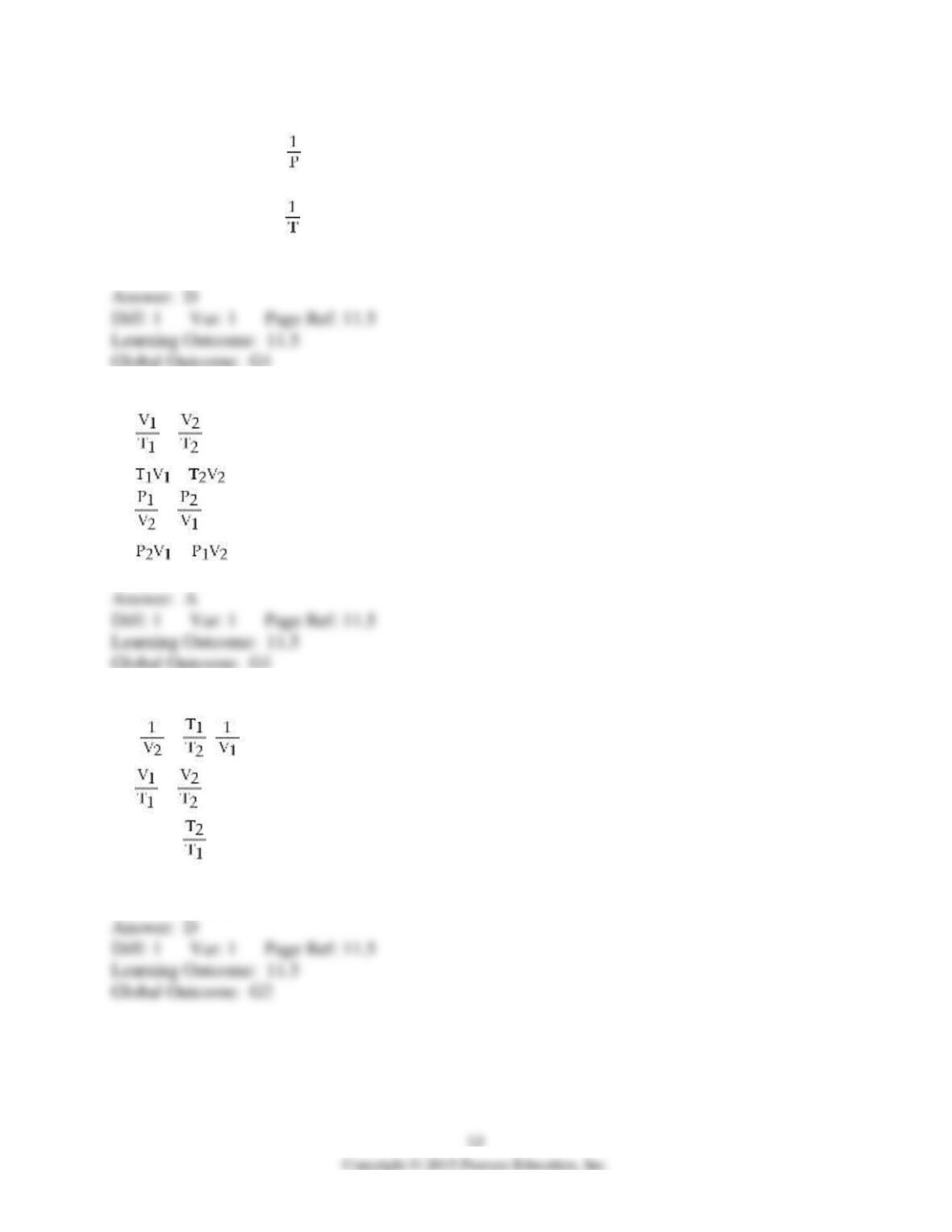
18) Charles’s Law is expressed as:
A) V is proportional to
B) P is proportional to V
C) V is proportional to
D) V is proportional to T
E) none of the above
19) To solve problems using Charles’s Law, which mathematical equation should be used?
A) =
B) =
C) =
D) =
E) none of the above
20) Which one of the following is impossible for an ideal gas?
A) = ( )
B) =
C) V2 = ( ) V1
D) V1T1 = V2T2
E) none of the above
21) When must temperature values in gas law calculations be expressed in kelvin units?
A) only for Charles’s law
B) only for the Ideal Gas law
C) only for the Combined Gas law
D) never
E) always
22) A 5.00 liter balloon of gas at 25°C is cooled to 0°C. What is the new volume (liters) of the
balloon?
A) 0 liters
B) 22.4 liters
C) 5.46 liters
D) 4.58 liters
E) none of the above
23) A gas sample occupies 3.50 liters of volume at 20.°C. What volume will this gas occupy at
100°C (reported to three significant figures)?
A) 0.224 L
B) 2.75 L
C) 4.46 L
D) 17.5 L
E) none of the above
24) What is the final volume of a balloon that was initially 500.0 mL at 25°C and was then
heated to 50°C?
A) 461 mL
B) 193 mL
C) 1.00 L
D) 542 mL
E) none of the above
25) If the volume of a gas container at 32.0°C changes from 1.55 L to 755 mL, what will the
final temperature be?
A) 149°C
B) 353°C
C) 273°C
D) -124°C
E) none of the above
26) What is the initial temperature of a gas if the volume changed from 1.00 L to 1.10 L and the
final temperature was determined to be 255.0°C?
A) 480°C
B) -41°C
C) 232°C
D) 207°C
E) none of the above
27) A balloon originally had a volume of 0.439 L at 44°C and a pressure of 729 torr. To what
temperature must the balloon be cooled to reduce its volume to 378 mL if the pressure remained
constant?
A) 0°C
B) 38°C
C) 95°C
D) 273°C
E) none of the above
28) Gas density can be calculated by dividing the mass of gas by its volume. If you took a
balloon of gas and then warmed the balloon in a sunny window, what can now be said about the
density of the gas in the balloon?
A) The gas density will remain the same.
B) The gas density will increase.
C) The gas density will decrease.
D) The density of gases is independent of temperature.
E) none of the above
29) Which of the following statements is TRUE for gases?
1. The temperature of a gas is inversely proportional to its pressure.
2. The volume of a gas is directly proportional to the pressure in torr.
3. The pressure of a gas is due to collisions of the gas molecules.
A) 1 only
B) 2 only
C) 3 only
D) 1 and 2 only
E) 1 and 3 only
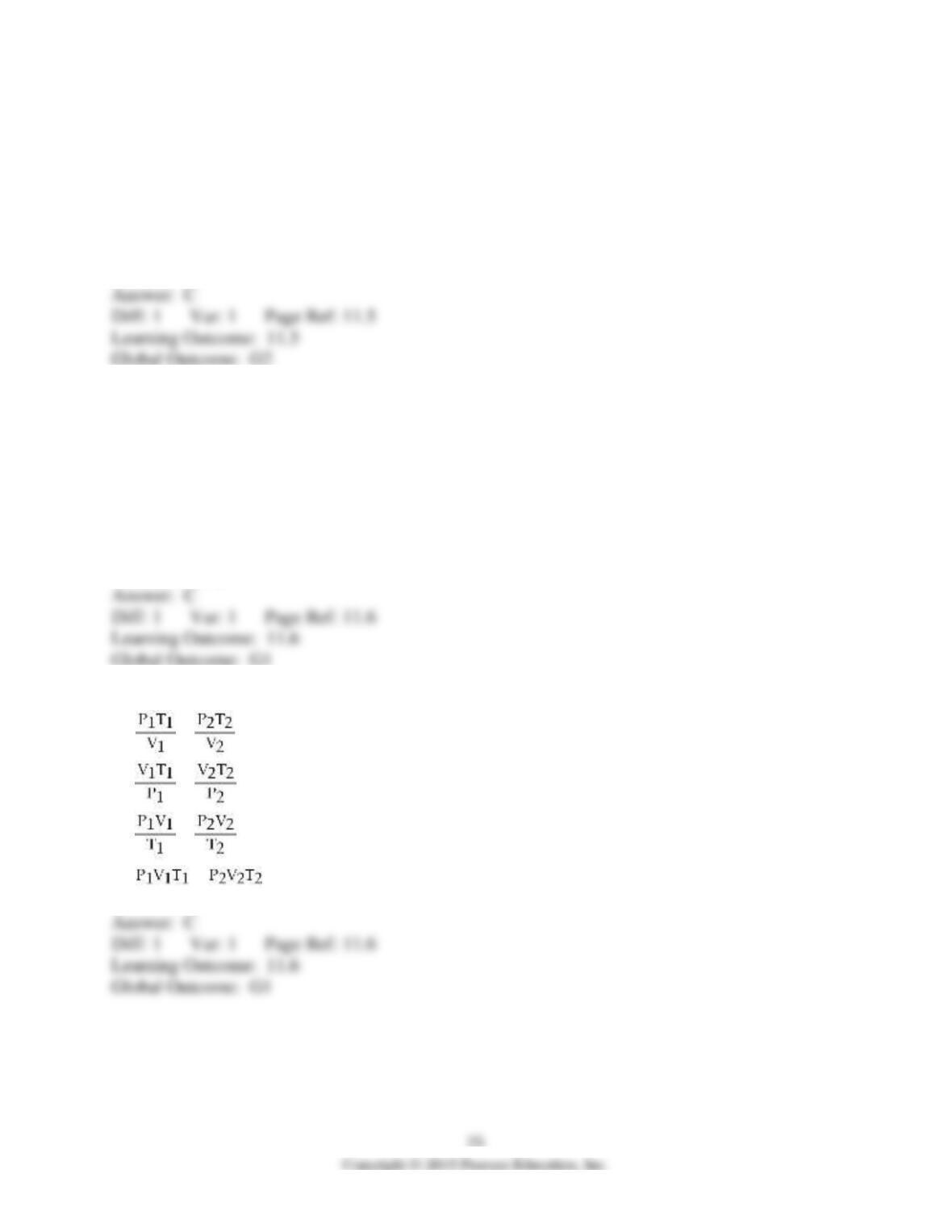
30) What is the proper form of the combined gas law?
A) =
B) =
C) =
D) =
E) none of the above