31) A certain volume of gas was confined in a rigid container. If the pressure of the gas sample
in the container was doubled, what happened to the temperature?
A) The Kelvin temperature decreased by one-half.
B) The Kelvin temperature doubled.
C) The Kelvin temperature increased four times.
D) The Kelvin temperature decreased one-third.
E) not enough information
32) Suppose a balloon was released from the ground and rose to such a height that both the
atmospheric pressure and atmospheric temperature decreased. Which statement is TRUE?
A) Both the temperature and pressure changes act to increase the balloon’s volume.
B) Both the temperature and pressure changes act to decrease the balloon’s volume.
C) The temperature change acts to increase the balloon’s volume.
D) The pressure change acts to decrease the balloon’s volume.
E) none of the above
33) If the initial pressure of a system was 1.00 atm and the volume was halved and the kelvin
temperature was tripled, what is the final pressure?
A) 2.00 atm
B) 0.667 atm
C) 1.50 atm
D) 6.00 atm
E) not enough information
34) A 325 mL sample of gas is initially at a pressure of 721 torr and a temperature of 32°C. If
this gas is compressed to a volume of 286 mL and the pressure increases to 901 torr, what will be
the new temperature of the gas (reported to three significant figures in °C)?
A) 35.2°C
B) 335°C
C) 62.4°C
D) 215°C
E) none of the above
35) A sample of helium gas initially at 37.0°C, 785 torr and was heated to 58.0°C while the
volume expanded to . What is the final pressure in atm?
A) 517
B) 0.681
C) 1.79
D) 3.21
E) none of the above
36) What is the final volume of a 500.0 mL gas container that increased in temperature from
to while the pressure increased from to ?
A) 0.691 L
B) 2.77 L
C) 0.362 L
D) 1.45 L
E) none of the above
37) What is the initial temperature (°C) of a system that has the pressure decreased by 10 times
while the volume increased by 5 times with a final temperature of ?
A) 27
B) 75
C) -198
D) 300
E) none of the above
38) Avogadro’s Law is expressed as:
A) V is proportional to
B) P is proportional to n
C) n is proportional to
D) V is proportional to n
E) none of the above
39) To solve problems using Avogadro’s Law, which mathematical equation should be used?
A) =
B) =
C) =
D) =
E) none of the above
40) What happens to the volume of a gas when you double the number of moles of gas while
keeping the temperature and pressure constant?
A) The volume is halved.
B) The volume doubles.
C) The volume decreases, but more information is needed.
D) The volume increases, but more information is needed.
E) none of the above
41) How many moles of gas were added to a balloon that started with 2.3 moles of gas and a
volume of given that the final volume was ?
A) 9.5
B) 4.4
C) 12
D) 0.085
E) none of the above
42) If each of the following gas samples have the same temperature and pressure, which sample
has the greatest volume?
A) 1 gram of O2
B) 1 gram of Ar
C) 1 gram of H2
D) all have the same volume
E) not enough information
43) Which of the following gas law relationships is true?
A) V α 1/P
B) V α T
C) V α n
D) all of the above are true
E) none of the above are true
44) For an ideal gas, which of the following pairs of variables are inversely proportional to each
other (if all other factors remain constant)?
A) P, V
B) P, T
C) V, T
D) n, P
E) none of the above
45) The ideal gas law is:
A) PV = nRT
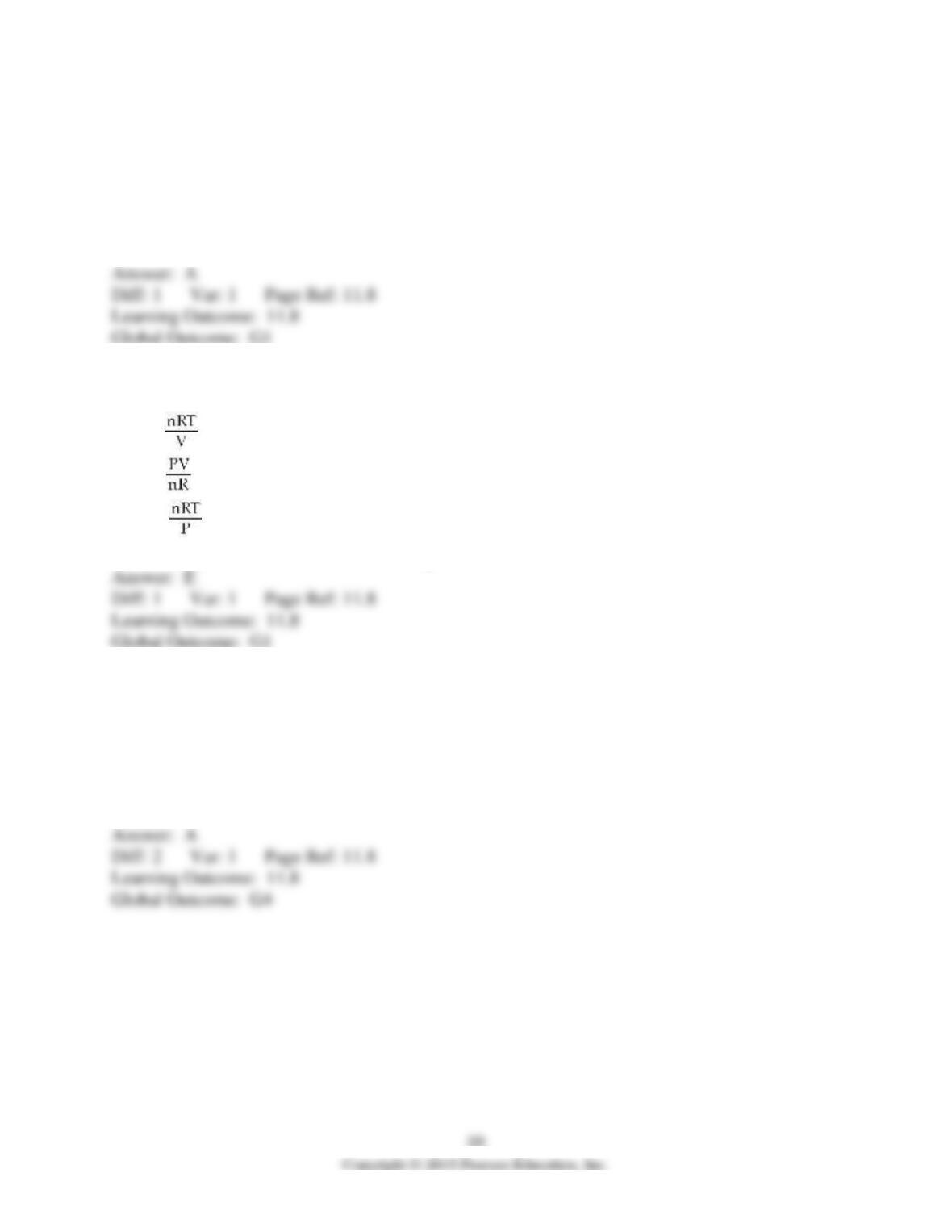
B) P =
C) T =
D) V =
E) All of the above are forms of the ideal gas law.
46) A sample of 0.255 mole of gas has a volume of 748 mL at 28°C. Calculate the pressure of
this gas. (R= 0.0821 L ∙ atm / mol ∙ K)
A) 8.42 atm
B) 0.784 atm
C) 0.00842 atm
D) 7.84 × 10⁻⁴ atm
E) none of the above
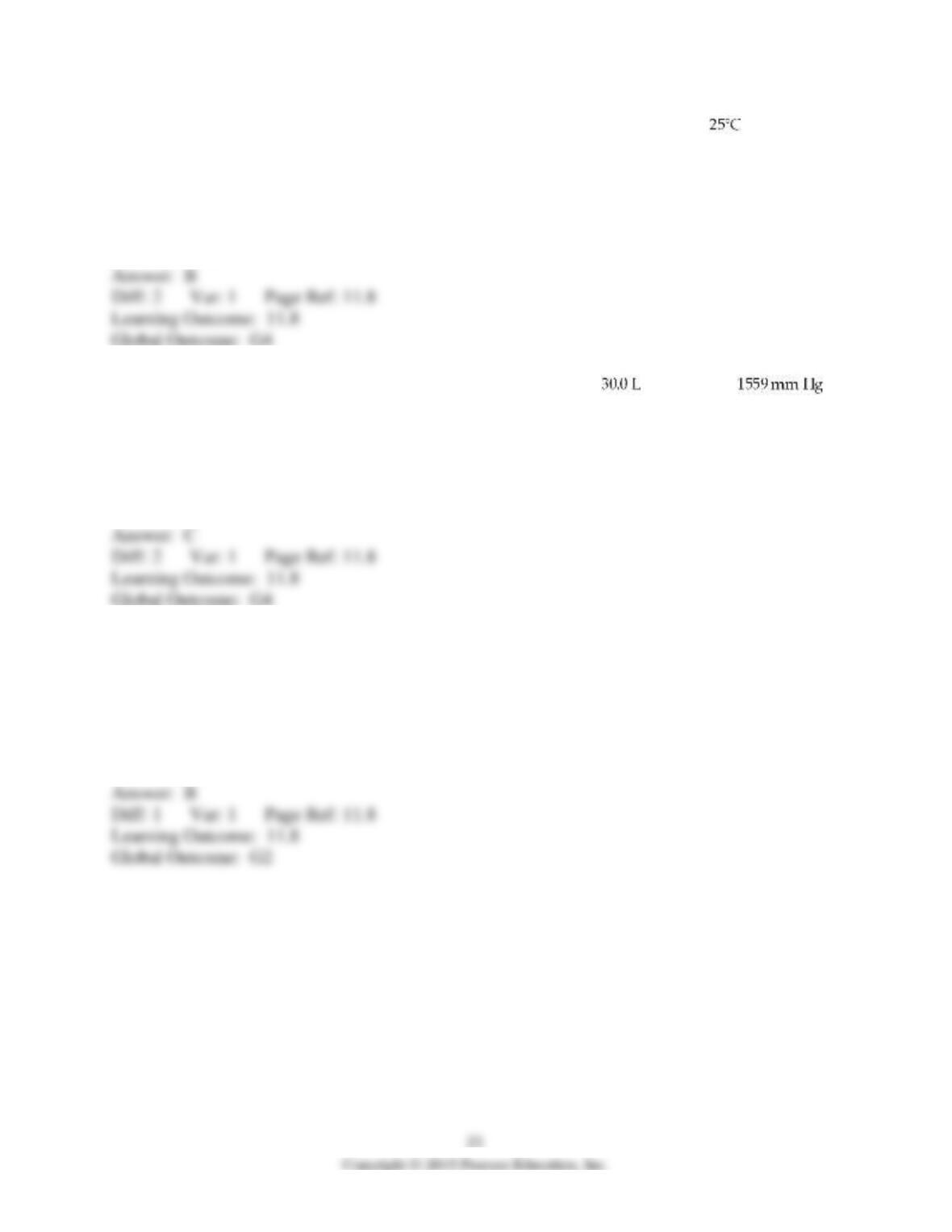
47) What is the pressure of a 3.00 L gas vessel that has 18.0 grams of helium at ?
(R= 0.0821 L atm/ mol K)
A) 147 atm
B) 36.7 atm
C) 32.6 atm
D) 1.81 atm
E) none of the above
48) What is the temperature (°C) of 2.48 moles of gas stored in a container at ?
(R= 0.0821 L atm/ mol K)
A) 302
B) 189
C) 29
D) -84
E) none of the above
49) Which conditions can cause nonideal gas behavior by 1) decreasing the space between gas
particles or 2) by slowing gas particles so that interactions are significant?
A) 1) high pressure; 2) high temperature
B) 1) high pressure; 2) low temperature
C) 1) low pressure; 2) high temperature
D) 1) low pressure; 2) low temperature
E) none of the above
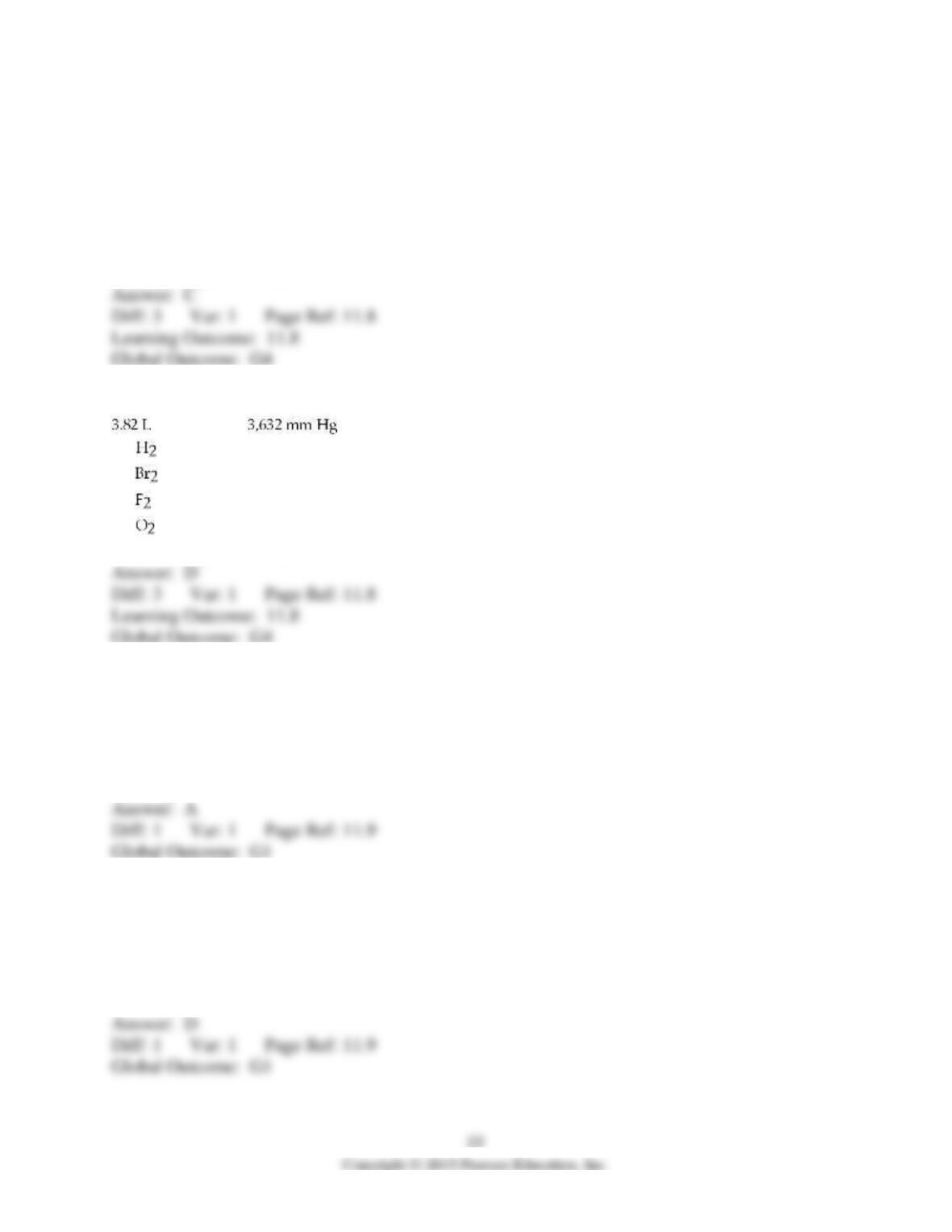
50) A 3.76 g sample of a noble gas is stored in a 2.00 L vessel at 874 torr and 25°C. What is the
noble gas?
(R= 0.0821 L atm/ mol K)
A) He
B) Ne
C) Ar
D) Kr
E) not enough information
51) Which of the following diatomic elements would have a mass of 19.08 grams stored in a
container at and 100°C? (R= 0.0821 L atm/ mol K)
A)
B)
C)
D)
E) not enough information.
52) What is the major component of the air we breathe?
A) nitrogen
B) oxygen
C) argon
D) carbon dioxide
E) smog
53) What is the third most abundant component of dry air?
A) carbon dioxide
B) oxygen
C) nitrogen
D) argon
E) smog
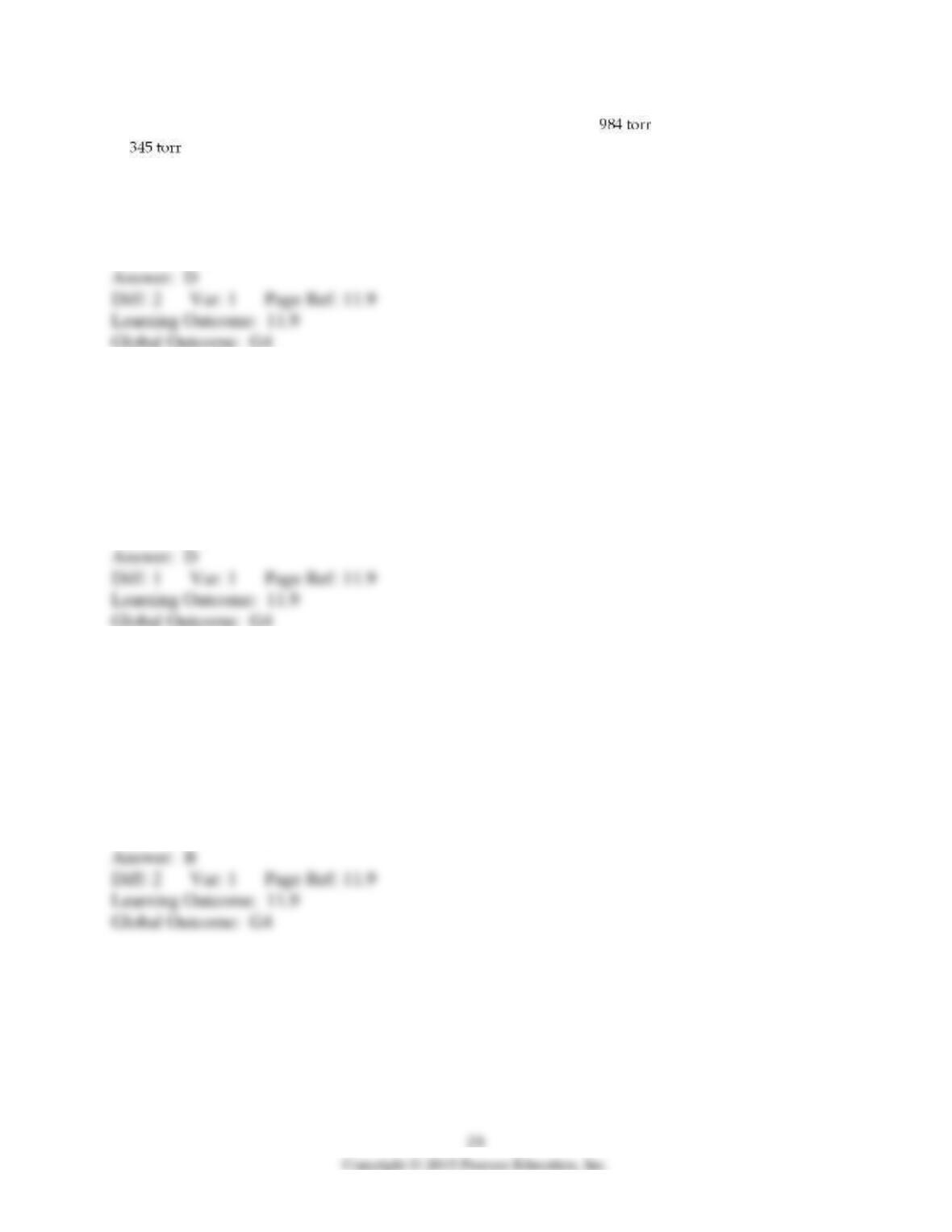
54) If a mixture of gases contained 78% nitrogen at a pressure of and 22% carbon dioxide
at , what is the total pressure of the system?
A) 1,329 atm
B) 17.5 cm Hg
C) 639 torr
D) 1.75 atm
E) none of the above
55) A gas cylinder contains only the gases radon, nitrogen, and helium. The radon has a pressure
of 222 torr while the nitrogen has a pressure of 446 torr. If the total pressure inside the cylinder is
771 torr, what is the pressure that is due to the helium?
A) 771 torr
B) 668 torr
C) 549 torr
D) 103 torr
E) none of the above
56) A “shielding gas” mixture of argon and carbon dioxide is sometimes used in welding to
improve the strength of the weld. If a gas cylinder of this two-part mixture was at 4.0 atm
pressure and this mixture was 90.% argon, what would be the pressure due to the carbon dioxide
gas component?
A) 3.6 atm
B) 0.40 atm
C) 10. atm
D) 4.0 atm
E) none of the above
57) What problem could happen if deep sea divers used pure oxygen in their tanks?
A) hypoxia
B) oxygen toxicity
C) nitrogen narcosis
D) rapture of oxygen
E) none of the above
58) Human lungs have evolved to breathe oxygen at a pressure as that in the atmosphere, 0.21
atm. If a particular heliox mixture to be carried by a scuba diver is at a pressure of 7.00 atm,
what should be the partial pressure due to helium in order to maintain the pressure due to oxygen
at 0.21 atm?
A) 0.21 atm
B) 7.00 atm
C) 6.79 atm
D) 7.21 atm
E) none of the above
59) The vapor pressure of water at 20.0°C is . If the pressure of a gas collected over
water was measured to be . What is the pressure of the pure gas?
A) 0.0230 atm
B) 0.619 atm
C) 0.573 atm
D) 0.596 atm
E) none of the above
60) Hydrogen gas produced in the laboratory by the reaction of zinc and hydrochloric acid was
collected over water at 25°C. The barometric pressure at the time was 742.5 mm Hg. What is the
pressure of dry hydrogen gas if the vapor pressure of water at 25°C is 23.8 mm Hg?
A) 742.5 mm Hg
B) 718.7 mm Hg
C) 766.3 mm Hg
D) 760.0 mm Hg
E) none of the above
61) Suppose a chemical reaction generated a 50% nitrogen/50% oxygen (by volume) mixture of
gas that had a total volume of 22.4 liters at STP. This gas sample is composed of:
A) 1 mole of nitrogen and 1 mole of oxygen.
B) 0.5 mole of nitrogen and 0.5 mole of oxygen.
C) 50 mole of nitrogen and 50 mole of oxygen.
D) 28 mole of nitrogen and 32 mole of oxygen.
E) none of the above
62) Which set of conditions reflect STP?
A) 298 K, 1 atm
B) 25°C, 14.7 psi
C) 373 K, 760 torr
D) 273 K, 1 Pa
E) 273 K, 760 mm Hg
63) At STP, 12.69 g of a noble gas occupies 14.09 L. What is the identity of the noble gas?
(R= 0.0821 L atm/ mol K)
A) He
B) Ne
C) Ar
D) Kr
E) not enough information
64) Suppose you had a balloon containing 1 mole of helium at STP and a balloon containing 1
mole of oxygen at STP. Which statement is TRUE?
A) The balloons will have the same volume.
B) The balloons will have the same mass.
C) Both A) and B) are true.
D) Neither A) nor B) are true.
E) not enough information
65) Ammonia gas decomposes according to the equation:
2NH3(g) → N2(g) + 3H2(g)
If 15.0 L of nitrogen is formed at STP, how many liters of hydrogen will be produced (also
measured at STP)?
A) 15.0 L
B) 30.0 L
C) 45.0 L
D) 90.0 L
E) not enough information
66) Water can be formed according to the equation:
2H2 (g) + O2 (g) → 2H2O (g)
If 8.0 L of hydrogen is reacted at STP, exactly how many liters of oxygen at STP would be
needed to allow complete reaction?
A) 4.0 L
B) 2.0 L
C) 1.0 L
D) 8.0 L
E) none of the above
67) How many liters of O2 (g) are needed to react completely with 56.0 L of CH4 (g) at STP to
produce CO2 (g) and H2O (g)?
Given: CH4 (g) + 2O2 (g) → CO2 (g) + H2O (g)
A) 28.0 L
B) 56.0 L
C) 84.0 L
D) 112. L
E) none of the above
11.3 Algorithmic Questions
1) What is the pressure of 760 mm Hg when expressed in units of in Hg?
A) 29.92 in Hg
B) 101,325 in Hg
C) 760 in Hg
D) 1 in Hg
E) none of the above
2) What is the final pressure of a system (atm) that has the volume increased from to
with an initial pressure of
A) 1.1
B) 0.85
C) 1.8
D) 1.2
E) none of the above
3) What is the final volume (L) of a 10.0 L system that has the pressure quartered?
A) 0.250
B) 17.1
C) 2.50
D) 40.0
E) none of the above
4) What is the final volume of a gas that initially occupies 2.50 L at and is subsequently
heated to
A) 2.69 L
B) 2.96 L
C) 2.23 L
D) 2.32 L
E) none of the above
5) What is the change in temperature of a 2.50 L system when its volume is reduced to if
the initial temperature was
A) 209 K
B) 290 K
C) -89 K
D) -98 K
E) none of the above
6) What is the final volume (L) of a 1.00 L system at 315 K and 1.10 atm if STP conditions are
established?
A) 1.05
B) 0.935
C) 1.50
D) 0.953
E) none of the above
7) What is the final pressure (expressed in atm) of a 3.05 L system initially at and
that is compressed to a final volume of at
A) 1.06
B) 1.60
C) 806
D) 860
E) none of the above
8) A rigid cylinder contains 2.00 liters of gas at a temperature of 25°C. If the pressure of this gas
is changed from 0.500 atmospheres to 1.50 atmospheres, what will be the new temperature (in
Kelvin, reported to three significant figures) of the gas? (The volume is constant.)
A) 99.3 K
B) 75.0 K
C) 8.33 K
D) 894 K
E) none of the above
9) If the number of moles of a gas initially contained in a 2.10 L vessel is doubled, what is the
final volume of the gas in liters? (Assume the pressure and temperature remain constant.)
A) 6.30
B) 1.05
C) 4.20
D) 8.40
E) none of the above
10) What is the volume (in liters) of 1.00 mole of krypton gas that has a pressure of 1140 mm Hg
and a temperature of 25.0°C? (R= 0.0821 L atm/ mol K)
A) 1.37
B) 16.3
C) 0.0215
D) 0.00180
E) none of the above
11) What is the molecular weight of a gas if a 21.0 g sample has a pressure of at
in a flask? (R= 0.0821 L atm/ mol K)
A) 243 amu
B) 1.89 amu
C) 234 amu
D) 11.1 amu
E) none of the above
12) What is the pressure of a 1.0 L flask containing of He at 25°C? (R= 0.0821 L atm/ mol
K)
A) 98 atm
B) 3.7 atm
C) 7.3 atm
D) 15 atm
E) none of the above
13) What is the volume of 28.0 g of nitrogen gas at STP?
A) 33.6 L
B) 11.2 L
C) 22.4 L
D) 44.8 L
E) none of the above