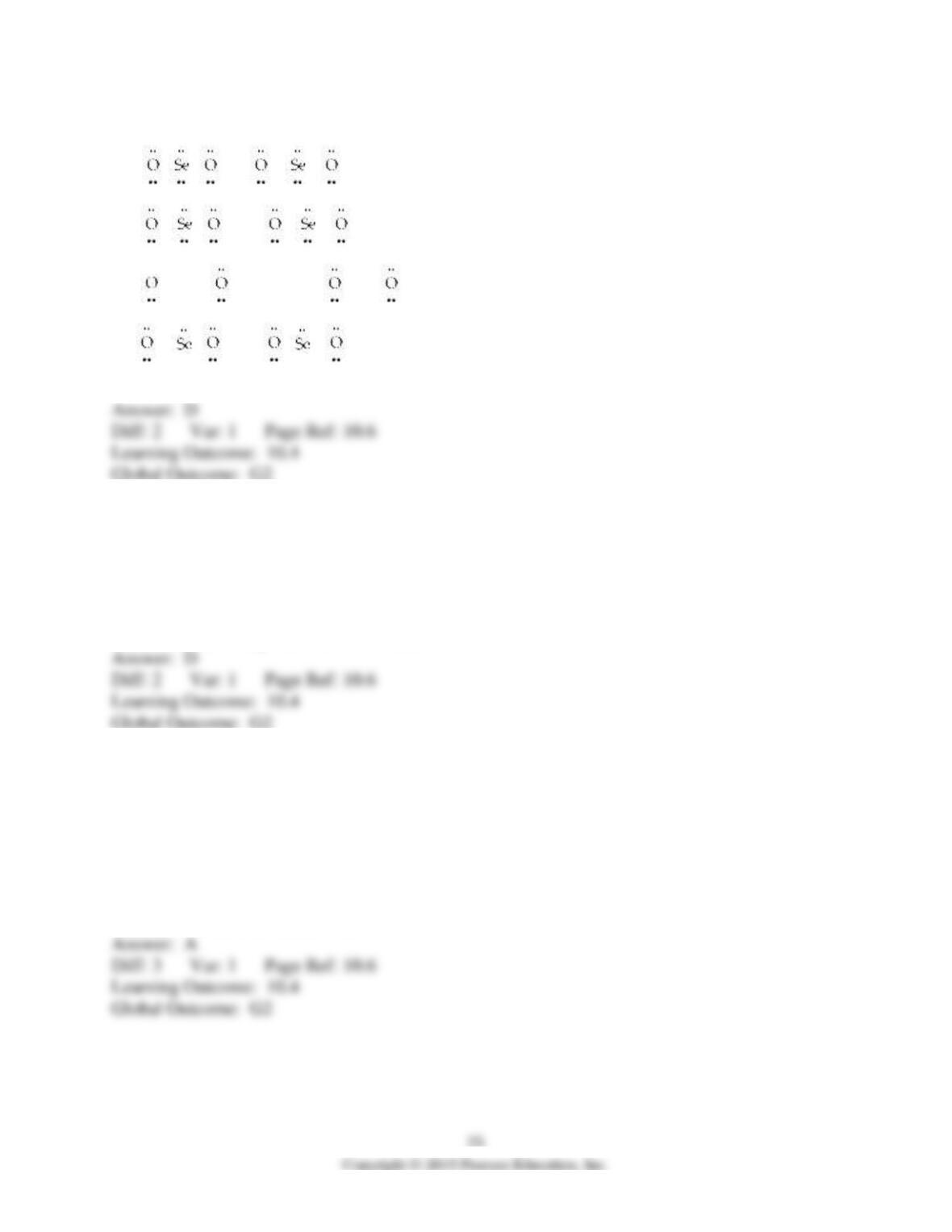
27) Which set shows the correct resonance structures for SeO2?
A) :– – : ↔ = =
B) := – : ↔ : – = :
C) := Se = ↔ : O ≡ Se–:↔ :–Se ≡ O :
D) = – : ↔ :– =
E) SeO2 does not have a resonance structure.
28) Which of the following compounds have resonance structures?
A) CH4
B) H2O
C) NH3
D) O3
E) None of the compounds have resonance structures.
29) Consider the Lewis structures for the compound SO3 and the polyatomic ions SO32- and
SO42-. Which of these must exist as a set of resonance structures?
A) SO3 only
B) SO32- only
C) SO42- only
D) all of these show resonance
E) none of these show resonance
30) Which one of the following molecules is NOT capable of having resonance structures?
A) SeO2
B) H2O
C) SO2
D) O3
E) none of the above
31) What is the angle between electron groups in the linear electron geometry?
A) 90°
B) 109.5°
C) 120°
D) 180°
E) not enough information
32) What is the angle between electron groups in the trigonal planar electron geometry?
A) 90°
B) 109.5°
C) 120°
D) 180°
E) not enough information
33) What is the angle between electron groups in the tetrahedral geometry?
A) 90°
B) 109.5°
C) 120°
D) 180°
E) not enough information
34) Which of the following is considered a single electron group?
A) a lone pair of electrons
B) a single bond
C) a double bond
D) a triple bond
E) all of the above
35) What is the electron geometry if you have 4 electron groups around the center atom?
A) linear
B) trigonal planar
C) tetrahedral
D) trigonal bipyramidal
E) not enough information
36) What is the electron geometry if you have 2 electron groups around the center atom?
A) linear
B) trigonal planar
C) tetrahedral
D) trigonal bipyramidal
E) not enough information
37) What is the electron geometry if you have 3 electron groups around the center atom?
A) linear
B) trigonal planar
C) tetrahedral
D) trigonal bipyramidal
E) not enough information
38) What is the molecular geometry if you have 3 single bonds and 1 lone pair around the central
atom?
A) bent
B) linear
C) tetrahedral
D) trigonal pyramidal
E) not enough information
39) What is the molecular geometry if you have 4 single bonds around the central atom?
A) bent
B) linear
C) tetrahedral
D) trigonal pyramidal
E) not enough information
40) What is the molecular geometry if you have a double bond, a single bond and 1 lone pair
around the central atom?
A) bent
B) linear
C) tetrahedral
D) trigonal pyramidal
E) not enough information
41) What is the molecular geometry of ozone, O3?
A) bent
B) linear
C) tetrahedral
D) trigonal pyramidal
E) not enough information
42) Which of the following compounds would have a linear molecular geometry?
1. N2
2. H2S
3. CO2
A) 1 and 2 only
B) 1 and 3 only
C) 2 and 3 only
D) 1,2 and 3
E) neither 1, 2,or 3
43) What is the molecular geometry of carbon dioxide, ?
A) bent
B) linear
C) tetrahedral
D) trigonal pyramidal
E) not enough information
44) What is the molecular geometry of PH3?
A) bent
B) linear
C) tetrahedral
D) trigonal pyramidal
E) not enough information
45) What is the molecular geometry of SiH4?
A) bent
B) linear
C) tetrahedral
D) trigonal pyramidal
E) not enough information
46) What is the molecular geometry of CCl4?
A) bent
B) linear
C) tetrahedral
D) trigonal pyramidal
E) not enough information
47) What is the molecular geometry of SCl2?
A) bent
B) linear
C) tetrahedral
D) trigonal pyramidal
E) not enough information
48) What is the molecular geometry of NH4+?
A) bent
B) linear
C) tetrahedral
D) trigonal pyramidal
E) not enough information
49) The electron geometry and the molecular geometry of ammonia (NH3) are, respectively:
A) trigonal planar, bent.
B) tetrahedral, tetrahedral.
C) tetrahedral, trigonal pyramidal.
D) tetrahedral, bent.
E) none of the above
50) The electron geometry and the molecular geometry of water are, respectively:
A) trigonal planar, bent.
B) tetrahedral, tetrahedral.
C) tetrahedral, trigonal pyramidal.
D) tetrahedral, bent.
E) none of the above
51) Which of the following has a tetrahedral electron geometry and a trigonal pyramidal
molecular geometry?
A) Br2O
B) GeH4
C) SO2
D) PF3
E) none of the above
52) Which term matches the definition: A separation of charge within a bond?
A) coulombic attraction
B) dipole moment
C) pure covalent
D) nonpolar covalent
E) electronegativity
53) The elements with the highest electronegativity values tend to be found in the:
A) upper right-side of the periodic table.
B) lower right-side of the periodic table.
C) upper left-side of the periodic table.
D) lower left-side of the periodic table.
E) center of the periodic table.
54) Which term matches the definition: The ability of an element to attract electrons within a
covalent bond?
A) coulombic attraction
B) dipole moment
C) polar covalent
D) nonpolar covalent
E) electronegativity
55) Which molecule listed below has a nonpolar covalent bond?
A) NaCl
B) H2O
C) H2
D) all of the compounds
E) none of the compounds
56) Which molecule listed below has a polar covalent bond?
A) NaCl
B) H2O
C) H2
D) all of the compounds
E) none of the compounds
57) Which molecule listed below is a polar molecule?
A) NH3
B) H2O
C) HCN
D) all of the compounds
E) none of the compounds
58) Which substance listed below is a polar molecule?
A) NH4+
B) Cl2O
C) SiCl4
D) all of the compounds
E) none of the compounds
59) Which molecule listed below is a nonpolar molecule?
A) CCl4
B) CO2
C) BH3
D) all of the compounds
E) none of the compounds
60) Which compound listed below will dissolve in water?
A) CCl4
B) SiO2
C) NH3
D) all of the compounds
E) none of the compounds
61) Which compound listed below will dissolve in NH3?
A) H2S
B) CO2
C) O2
D) all of the compounds
E) none of the compounds
62) Which compound listed below will dissolve in carbon tetrachloride, CCl4?
A) NaCl
B) CS2
C) NH3
D) all of the compounds
E) none of the compounds
63) Which of the following statements is TRUE for the covalent molecule HCl?
A) Chlorine is more electronegative and the shared electron pair is likely to be found on the
hydrogen atom.
B) Chlorine is more electronegative and the shared electron pair is likely to be found on the
chlorine atom.
C) Hydrogen is more electronegative and the shared electron pair is likely to be found on the
hydrogen atom.
D) Hydrogen is more electronegative and the shared electron pair is likely to be found on the
chlorine atom.
E) none of the above
64) Which of the following statements about the water molecule is TRUE?
A) A water molecule has two dipole moments and they cancel each other.
B) A water molecule is symmetrical and therefore is nonpolar.
C) A water molecule is asymmetric and therefore is polar.
D) The electronegativities of hydrogen and oxygen are equal and therefore a water molecule is
nonpolar.
E) none of the above
65) Which of the following statements are TRUE about the BF3 molecule?
A) BF3 has a trigonal planar molecular geometry.
B) BF3 violates the octet rule for the central atom.
C) BF3 is nonpolar.
D) All of the above statements are true.
E) None of the above are true.
66) The electronegativity value for N is 3.0 and that for O is 3.5. Based on these values, which of
the following statements is TRUE about the compound NO?
A) NO is an ionic compound.
B) NO is a pure covalent compound.
C) NO is a polar covalent compound.
D) There is not enough enough information to determine the nature of NO.
E) None of the above statements is true.
67) The electronegativity value for Mg is 1.2 and the value for O is 3.5. Based on these values,
what type of bond is expected for a compound formed between Mg and O?
A) ionic
B) pure covalent
C) polar covalent
D) not enough information
E) none of the above
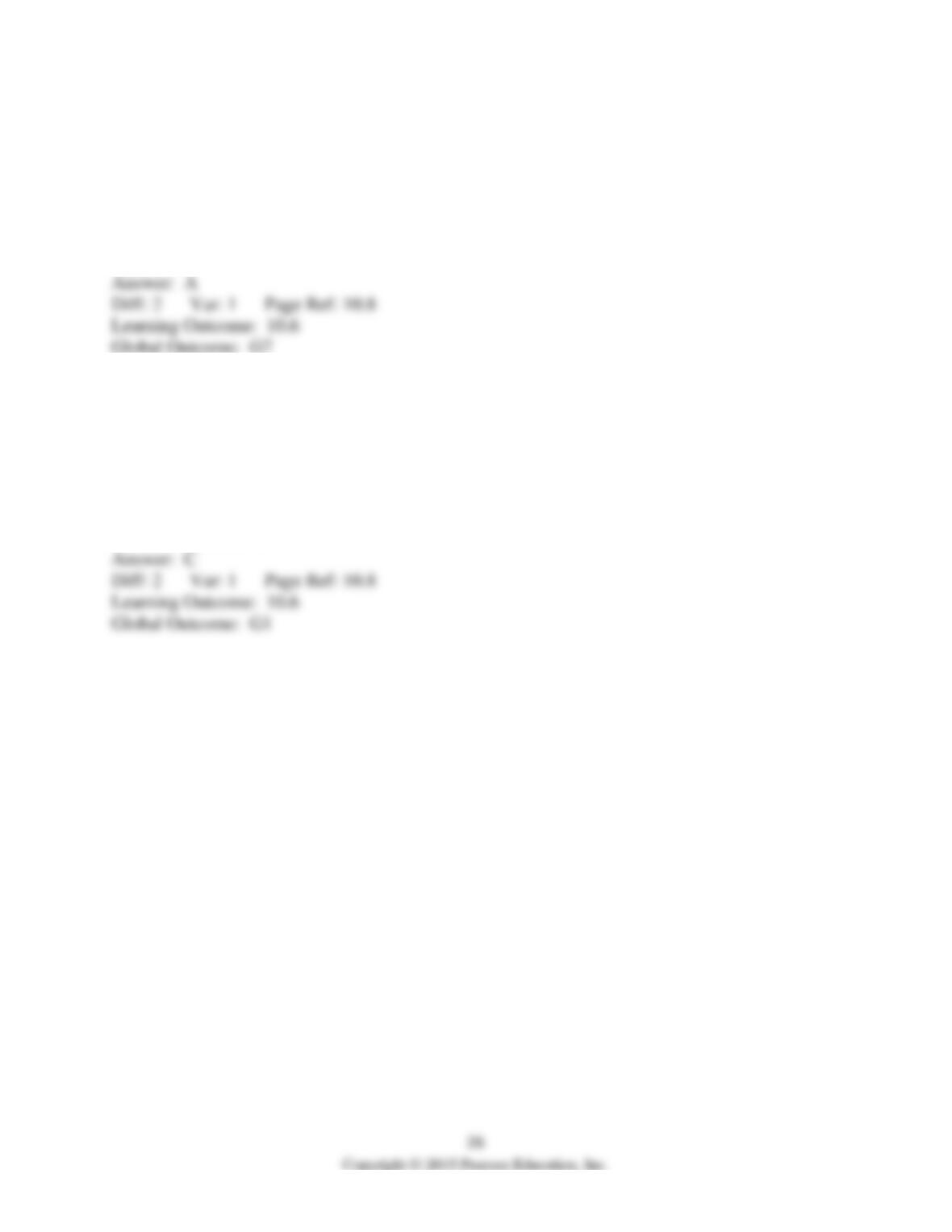
68) Consider the following electronegativity values:
Which molecule below would you expect to have the more polar bond?
A) H2
B) Cl2
C) F2
D) HCl
E) HF
69) Which compound below is a polar molecule AND has a linear molecular geometry?
A) CO
B) CO2
C) CH4
D) H2O
E) none of the above
70) How does soap work?
A) Soap works by breaking grease molecules into smaller molecules that dissolve in water.
B) Soap works by making water into a nonpolar liquid which grease can dissolve in.
C) Soap works by having a polar end and a nonpolar end which allows the water and oil to
interact indirectly.
D) Soap works by having a polar end which attaches to the grease molecule and polarizes it and
turns the grease molecule into another soap molecule. This is a chain reaction.
E) none of the above
10.3 Algorithmic Questions
1) How many lone electron pairs does the ClO (-1 charged) polyatomic anion have?
A) one
B) three
C) six
D) two
E) none of the above
2) When a molecule has four electron groups with none of them lone pairs, the molecular
geometry will be:
A) linear
B) bent
C) trigonal pyramidal
D) tetrahedral
E) none of the above