Introduction to Chemical Principles, 11e (Stoker)
Chapter 10 Chemical Calculations Involving Chemical Equations
10.1 Multiple Choice
1) Identify the missing words in the following statement: “For an ordinary chemical reaction the
mass of the products is ________ the mass of the reactants.”
A) always less than
B) usually more than
C) always equal to
D) usually less than
2) Which of the following elements is represented by a diatomic molecule in a chemical
equation?
A) krypton
B) beryllium
C) chlorine
D) boron
3) Which of the following is represented by a monatomic atom in a chemical equation?
A) chlorine
B) hydrogen
C) neon
D) iodine
4) In a valid chemical equation ________.
A) the number of products must equal the number of reactants
B) the reactants always appear on the right-hand side of the equation
C) only reactants and products that are solids or liquids are listed
D) the total number of atoms on each side of the equation must be equal
5) How many oxygen atoms are there in 5 molecules of Al2(SO4)3?
A) 12
B) 60
C) 5
D) 18
6) How many phosphorous atoms are there in 4 molecules of Mg3(PO4)2?
A) 2
B) 4
C) 8
D) 12
7) Which of the following equations is not balanced?
A) 2Mg + O2 2MgO
B) CaCO3 CaO + CO2
C) 2NO + O2 2NO2
D) 2NaHCO3 + H2SO4 Na2SO4 + 2H2O + CO2
8) Which of the following reactions is correctly balanced?
A) Zn + 2 HCl H2 + ZnCl2
B) 2 H2O + C CO + 2 H2
C) N2 + H2 2 NH3
D) CO + O2 CO2
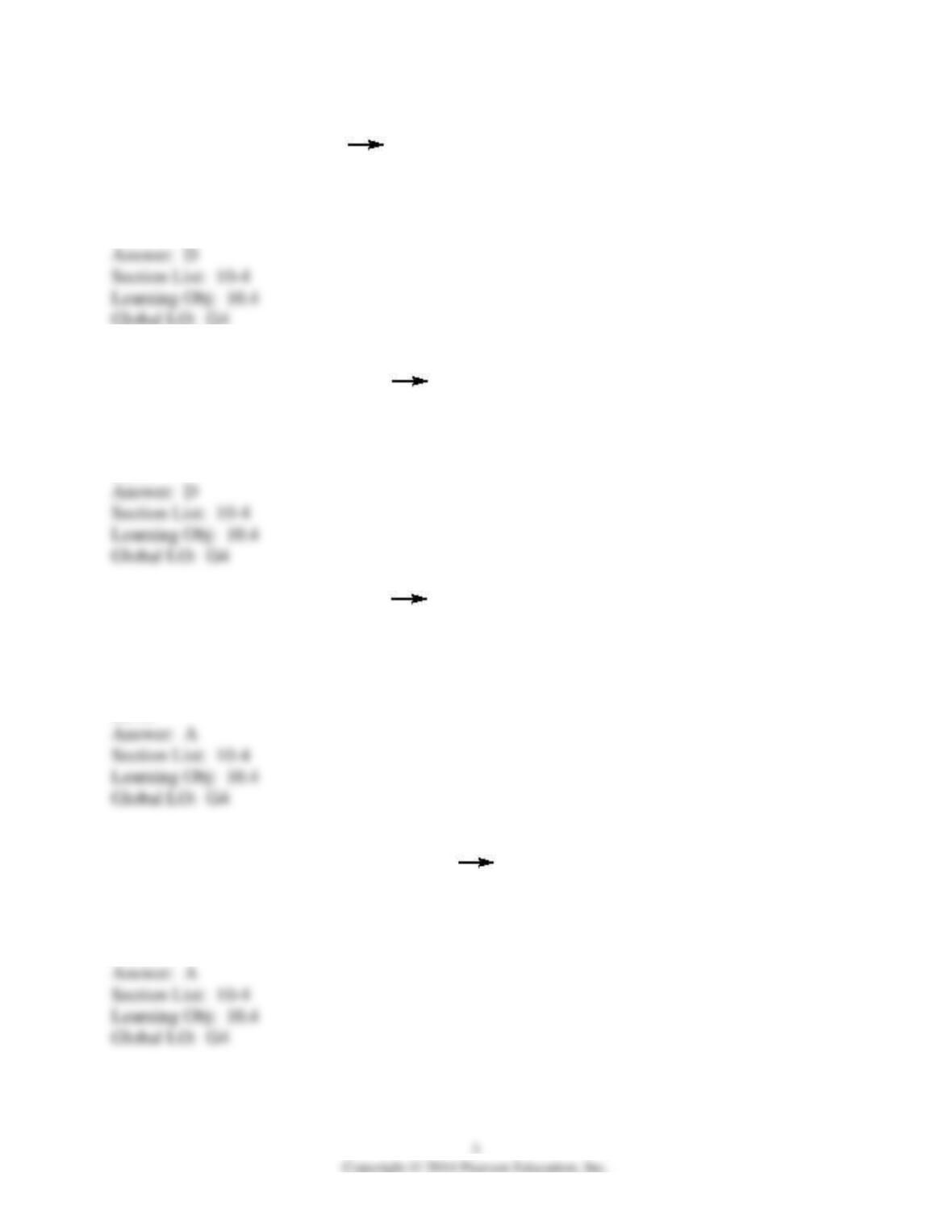
9) Indicate which set of coefficients balances the following equation.
________NH3 + ________O2 ________NO + ________H2O
A) 3, 2, 1, 3
B) 6, 5, 4, 4
C) 2, 6, 3, 3
D) 4, 5, 4, 6
10) Balance the following equation. What is the sum of the coefficients?
________P4 +________S8 ________P4S10
A) 12
B) 19
C) 14
D) 13
11) When the equation C8H18 + O2 CO2 + H2O is correctly balanced, the coefficient in
front of O2 is ________.
A) 25
B) 12
C) 16
D) 18
12) When the following reaction is balanced the coefficient in front of carbon dioxide is:
________ C5H12 + ________ O2 ________ CO2 + ________ H2O
A) 5
B) 6
C) 7
D) 10
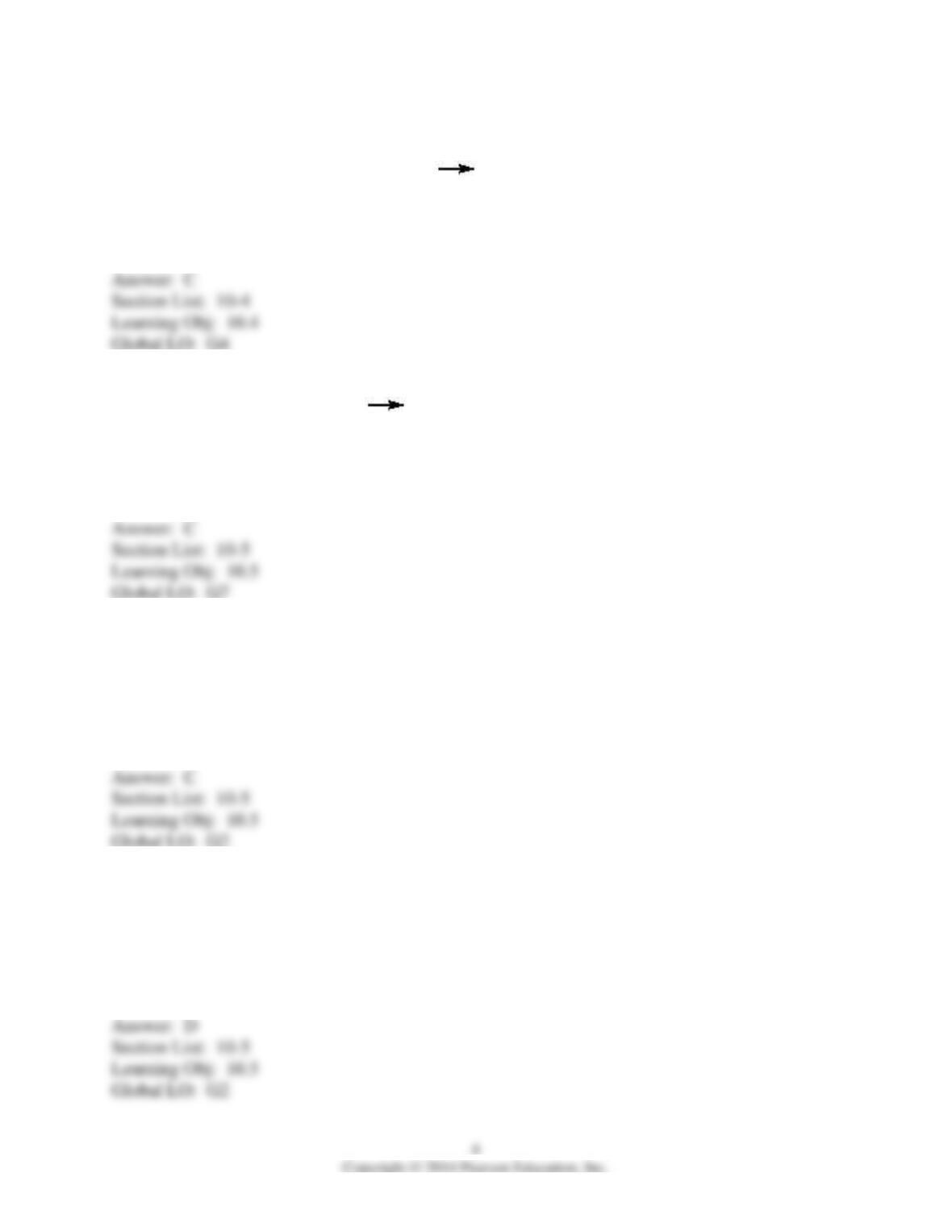
13) What is the coefficient for O2 when the equation for the combustion of methanol is
balanced?
________ CH3OH + ________ O2 ________ CO2 + ________ H2O
A) 1.5
B) 4
C) 3
D) 6
14) In the reaction below, which species is present in the solid state?
CaCO3 (s) + 2HNO3 (aq) Ca(NO3)2 (aq) + H2O (l) + CO2 (g)
A) H2O
B) CO2
C) CaCO3
D) HNO3
15) In the following reaction, which species is present in the liquid state?
NaHCO3 (s) + HCl (aq) —> NaCl (aq) + CO2 (g) + H2O (l)
A) NaHCO3
B) CO2
C) H2O
D) NaCl
16) In the following reaction, which species is present in the gaseous state?
NaHCO3 (s) + HCl (aq) —> NaCl (aq) + CO2 (g) + H2O (l)
A) NaHCO3
B) HCl
C) H2O
D) CO2
17) Which of the following reactions is a synthesis reaction?
A) SO3 + H2O H2SO4
B) C3H8 + 5 O2 3CO2 + 4H2O
C) 3CuSO4 + Al Al2(SO4)3 + 3Cu
D) 2NaHCO3 Na2CO3 + CO2 + H2O
18) Which of the following reactions is incorrectly classified?
A) 2 NO2 + H2O2 2 HNO3 (synthesis)
B) Fe + CuSO4 Cu + FeSO4 (single-replacement)
C) F2 + 2 NaCl Cl2 + 2 NaF (single-replacement)
D) BaCl2 + H2SO4 BaSO4 + 2 HCl (single-replacement)
19) Which of the following reactions below is a decomposition reaction?
A) C7H8O2 (l) + 8 O2 (g) 7 CO2 (g) + 4 H2O (l)
B) 2 KClO3 (s) 2 KCl (s) + 3 O2 (g)
C) 2 Cr (s) + 3 Cl2 (g) 2 CrCl3 (s)
D) 6 Li (s) + N2 (g) 2 Li3N (s)
20) Which of the following reactions is incorrectly classified?
A) Mg (s) + 2 HCl (aq) MgCl2 (aq) + H2 (g) (single-replacement)
B) Pb(NO3)2 (aq) + 2 LiCl (aq) 2 LiNO3 (aq) + PbCl2 (s) (double-replacement)
C) CaO (s) + H2O (l) Ca(OH)2 (aq) (synthesis)
D) PbO (s) + C (s) Pb (s) + CO (g) (double-replacement)
21) Which of the following reactions is incorrectly classified?
A) Zn + H2SO4 ZnSO4 + H2 (single-replacement)
B) 2 KClO32 KCl + 3 O2 (decomposition)
C) CH4 + 2 O2 CO2 + 2 H2O (single-replacement)
D) AgNO3 + KCl KNO3 + AgCl (double-replacement)
22) Which of the following is a double-replacement reaction?
A) CuO + H2 Cu + H2O
B) HBr + KOH H2O + KBr
C) SO2 + H2O H2SO3
D) 2 HI H2 + I2
23) Which one of the following conversion factors is not consistent with the equation?
4 NH3 + 5 O2 4 NO + 6 H2O
A)
B)
C)
D)
24) Given: 2 N2 + 5 O2 2 N2O5
Which of the following is not a valid equality?
A) 5 mol O2 = 2 mol N2
B) 2 mol N2O5 = 2 mol N2
C) 2 mol N2 = 2 mol O2
D) 5 mol O2 = 2 mol N2O5
25) How many moles of Al are needed to react exactly with 10.0 moles of Fe2O3 according to
the following equation?
Fe2O3 + 2 Al Al2O3 + 2Fe
A) 15.0 moles
B) 20.0 moles
C) 30.0 moles
D) 60.0 moles
26) Given the following equation, 2 N2 + 5 O2 2 N2O5, 1.25 moles of nitrogen requires
________ moles of oxygen.
A) 0.500
B) 1.75
C) 3.13
D) 1.56
27) How many moles of CO2 will be produced from the complete combustion of 0.956 moles of
C7H16 in the reaction below?
C7H16 + 11 O2 7 CO2 + 8 H2O
A) 0.667 mole
B) 3.50 moles
C) 1.85 moles
D) 6.69 moles
28) Given: 2 Na + O2 Na2O2 Calculate the moles of sodium peroxide (Na2O2)
produced if 32.5 g of sodium reacts with excess oxygen.
A) 27.6 mol
B) 55.1 mol
C) 0.354 mol
D) 0.707 mol
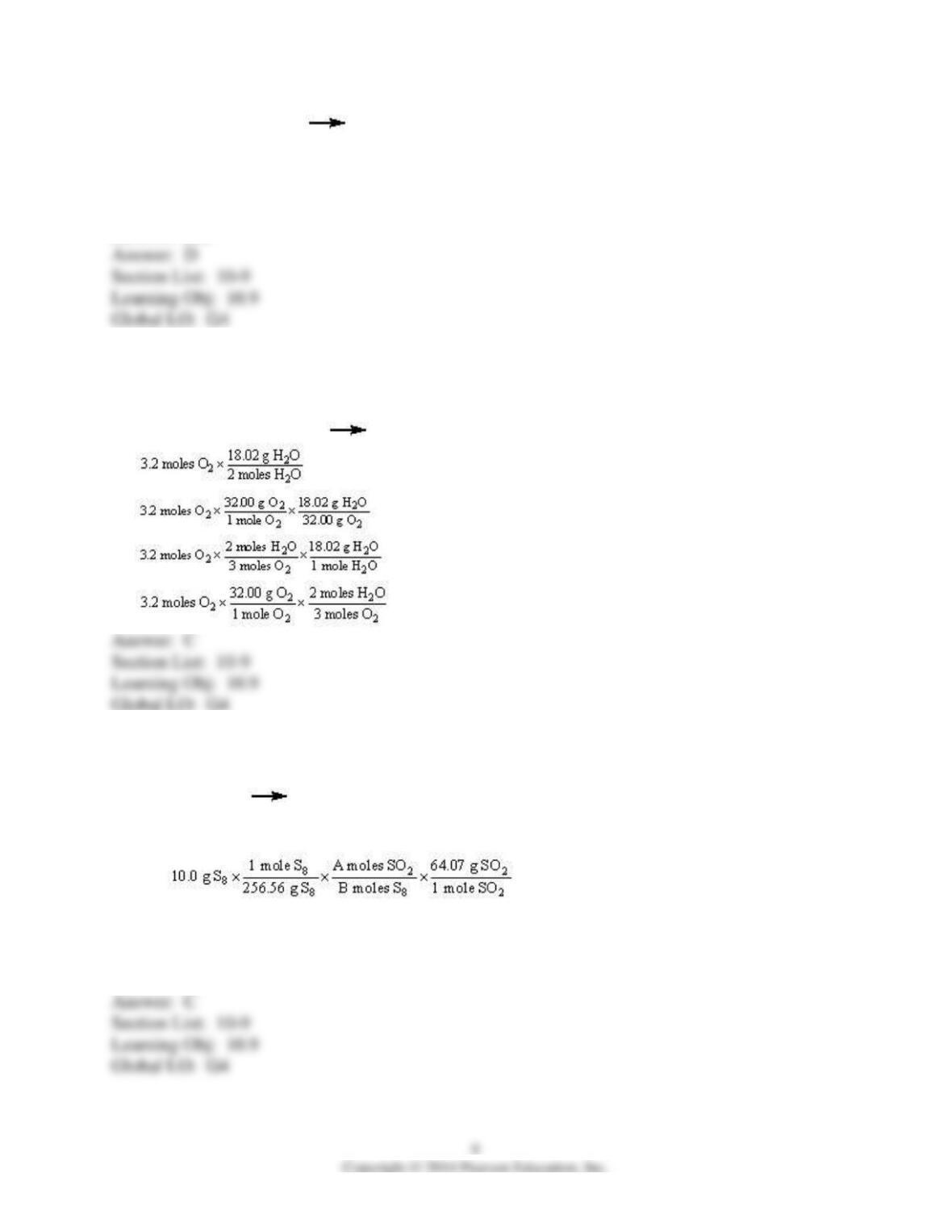
29) Which of the following is the correct “set-up” for the problem “How many grams of H2O
will be produced from 3.2 moles of O2 and an excess of H2S” according to the following
reaction:
2H2S + 3 O2 2H2O + 2SO2
A)
B)
C)
D)
30) The “set-up” which follows for the problem “How many grams of SO2 will be produced
from 10.0 g of S8 and an excess of O2” according to the reaction
S8 + 8 O2 8 SO2
is correct except the letters A and B have replaced the numbers in one of the conversion factors.
What are the numerical values of A and B, respectively?
A) 8 and 8
B) 1 and 8
C) 8 and 1
D) 1 and 1
31) In the following reaction, how many grams of H2O are produced if 3.65 g of N2H4 react?
N2H4 + 3 O2 2NO2 + 2H2O
A) 4.10 g
B) 11.2 g
C) 10.5 g
D) 1.47 g
32) For the reaction: 2 P + 3 Cl2 2 PCl3 , if 32.5 g of Cl2 reacts completely with excess P,
how many grams of PCl3 will be produced?
A) 42.0 g
B) 62.9 g
C) 83.9 g
D) 94.4 g
33) In the reaction: 4HPO3 + 12C 2H2 + 12CO + P4, how many molecules of CO are
produced when 5.00 moles of HPO3 react?
A) 4.11 x 10²³ molecules
B) 1.64 x 1024 molecules
C) 9.03 x 1024 molecules
D) 1.97 x 1025 molecules
34) How many moles of H2O will be produced if 6.80 x 1024 formula units of NH4NO3 are
decomposed in the reaction given below?
NH4NO3 N2O + 2H2O
A) 0.876 mole
B) 3.30 moles
C) 5.40 moles
D) 22.6 moles
35) Aspirin (C9H8O4) can be made in the laboratory by reacting salicylic acid (C7H6O3) with
acetyl chloride (C2H3ClO).
C7H6O3 + C2H3ClO C9H8O4 + HCl
What mass of HCl is produced by the complete reaction of 36.0 g of acetyl chloride?
A) 108 g
B) 16.7 g
C) 58.1 g
D) 8.69 g
36) Propane (C3H8) burns in oxygen to form CO2 and H2O according to the following equation.
How many grams of O2 are required to burn 3.01 x 10²³ propane molecules?
C3H8 + 5 O2 3 CO2 + 4 H2O
A) 80.0 g
B) 40.0 g
C) 160 g
D) 64.0 g
37) If a mixture containing 0.50 moles of N2 and 1.8 moles of H2 is allowed to react according
to the equation
N2 + 3H2 2NH3
A) 34.0 grams of NH3 can be produced.
B) N2 is the limiting reactant.
C) H2 is the limiting reactant.
D) Both A and B are correct.
38) If 5.0 grams of CO and 5.0 grams of O2 are combined according to the following equation:
2 CO + O2 2 CO2, which is the limiting reagent?
A) CO2
B) CO
C) O2
D) neither CO or O2
39) If a mixture containing an unlimited amount of A, 3.00 moles of B and 5.00 moles of C is
allowed to react according to the equation
2A + 2B + 4C 4D + 3E
A) A will be the limiting reactant.
B) B will be the limiting reactant.
C) C will be the limiting reactant.
D) both A and C are the limiting reactants.
40) How many moles of NO2 can be produced from 14.0 g of NO and 4.00 g of O2 according to
the equation:
2 NO + O2 2NO2
A) 0.250 mole
B) 0.125 mole
C) 0.467 mole
D) 2.41 moles