41) 15.0 g of Cu are combined with 46.0 g of HNO3 (molar mass = 63.02), according to the
reaction
3 Cu + 8 HNO3 3 Cu(NO3)2 + 2 NO + 4 H2O
Which reactant is limiting, and how many grams of H2O are produced?
A) Cu, 3.79 g
B) Cu, 5.67 g
C) HNO3, 0.737 g
D) HNO3, 6.13 g
42) The brown color of smog is due to the presence of nitrogen dioxide, NO2. Nitrogen
monoxide, a by-product of combustion of fossil fuels, reacts with oxygen to produce NO2 in the
atmosphere:
2 NO + O2 2 NO2
If 0.65 mole of NO is reacted with 0.75 mole of O2 to produce NO2, the limiting reactant is
________.
A) both NO and O2
B) O2
C) NO
D) Insufficient information given to determine which species is the limiting reactant.
43) If a mixture containing 0.80 mole of A, 2.1 moles of B, and 1.6 moles of C is allowed to
react according to the equation
2 A + 4 B + 3 C 4 D + 2 E
A) A will be the limiting reactant.
B) B will be the limiting reactant.
C) both A and B are the limiting reactants.
D) C will be the limiting reactant.
44) If 30 slices of bread, 26 slices of cheese, and 38 slices of ham are available to make ham-
cheese sandwiches according to the parameters given below,
1 slice of ham + 2 slices of cheese + 2 slices of bread 1 ham-cheese sandwich
How many ham-cheese sandwiches can be prepared?
A) 15
B) 16
C) 30
D) 13
45) Carbon monoxide is reacted with oxygen and converted to carbon dioxide by the catalytic
converter on automobiles: 2 CO(g) + O2(g) 2 CO2(g)
Depicted below is a representation of a mixture of CO and O2 in a catalytic converter (at the
molecular level). The gray spheres represent oxygen atoms and the black spheres represent
carbon atoms. For the mixture shown below, which species is the limiting reactant?
A) CO2
B) CO
C) O2
D) Insufficient information given to determine.
14
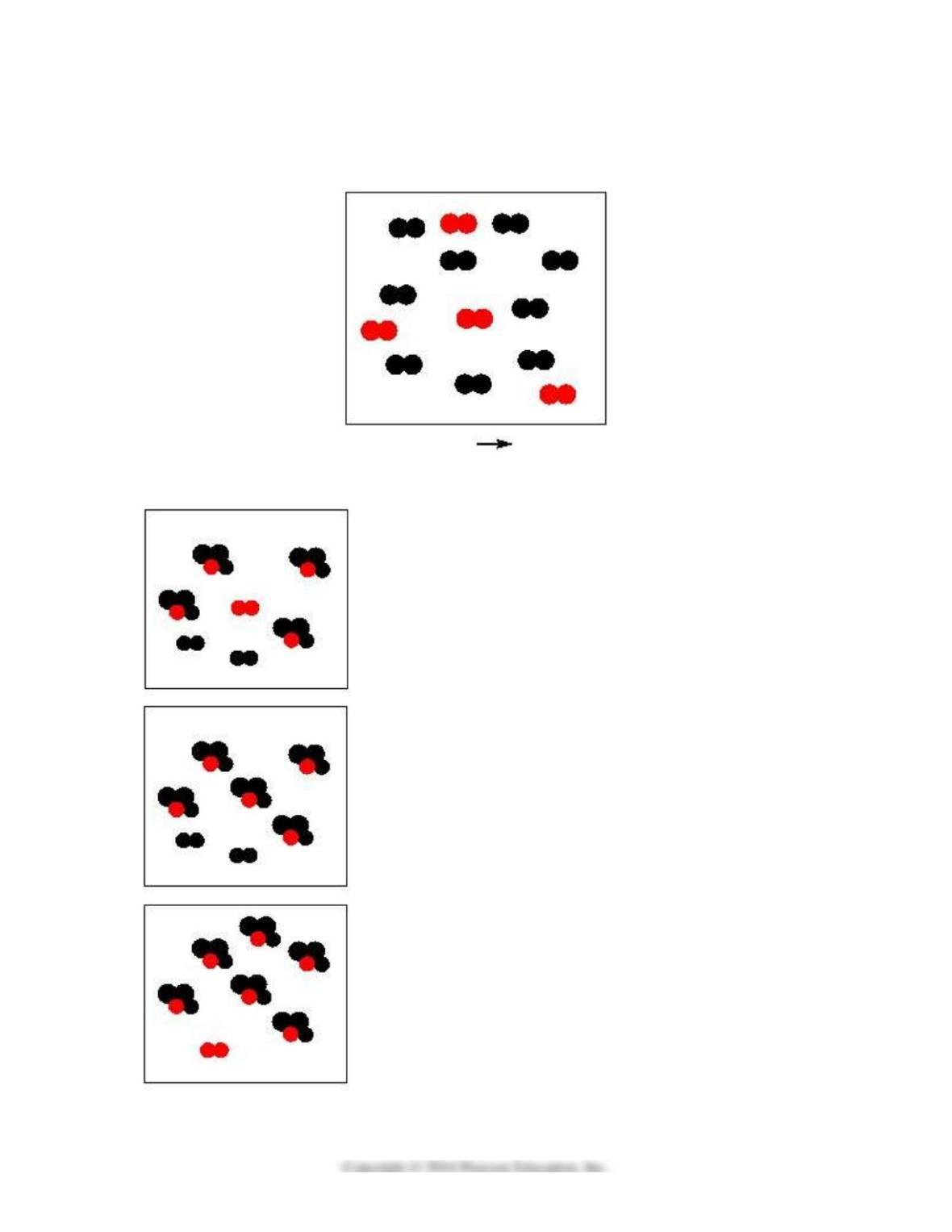
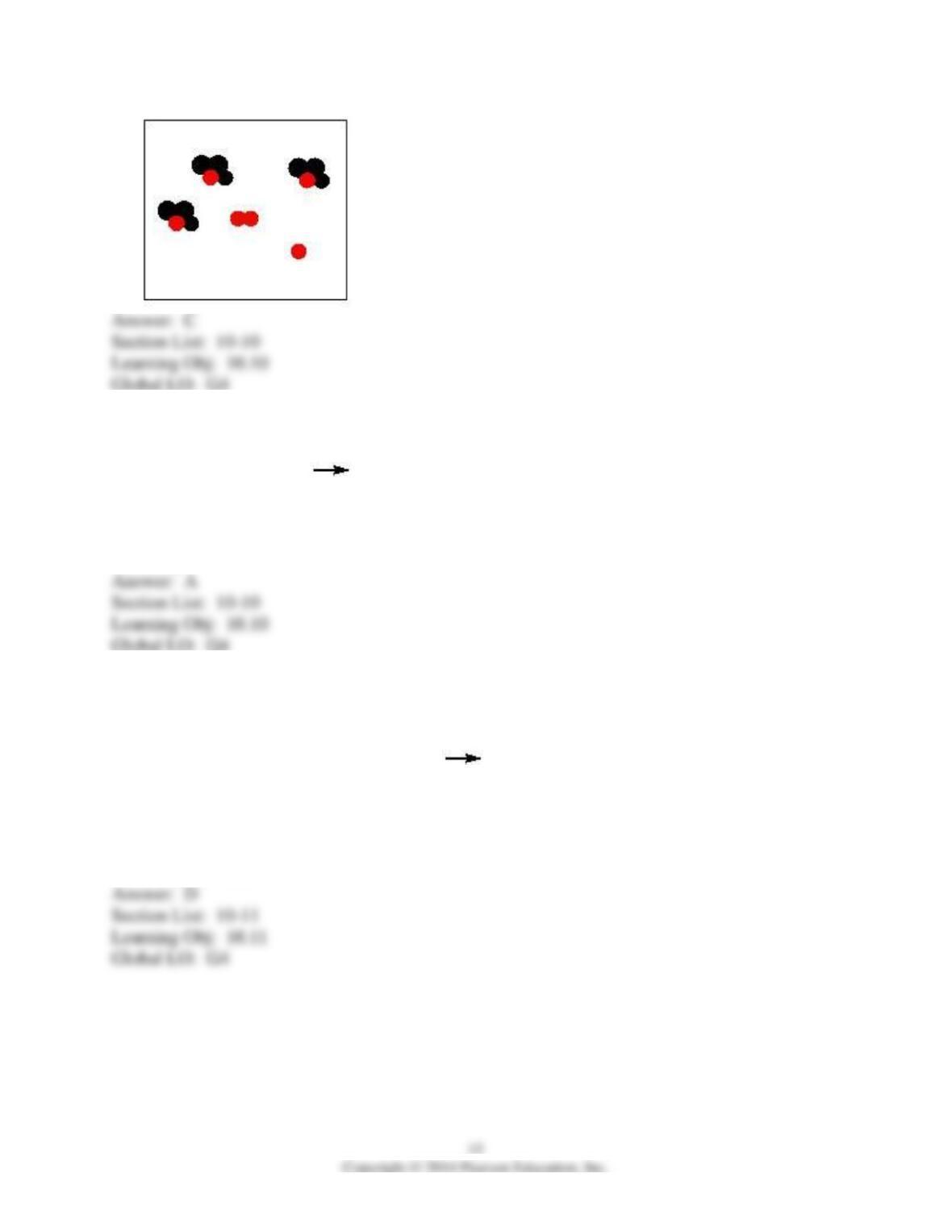
46) Depicted below is a cylinder containing a mixture of N2 and H2 gas. The solid spheres
represent hydrogen atoms and the lighter-shaded spheres represent nitrogen atoms. Nitrogen and
hydrogen react to form ammonia, NH3, according to the reaction below.
N2 (g) + 3 H2 (g) 2 NH3 (g)
Choose the response that represents the contents in the cylinder if the reaction mixture is
permitted to go to completion.
A)
B)
C)
D)
47) Tin metal is reacted with hydrochloric acid according to the following equation. If 0.240
moles of Sn is reacted with 0.320 mol of HCl, calculate the mass of hydrogen gas liberated.
Sn + 2 HCl H2 + SnCl2
A) 0.323 g
B) 2.79 g
C) 0.485 g
D) 1.31 g
48) In a certain experiment 24.9 g of NH4NO3 (molar mass = 80.06) was produced from 27.2 g
of Fe(NO3)3 (molar mass = 241.88) reacting with an excess of NH3 and H2O according to the
equation
Fe(NO3)3 + 3 NH3 + 3 H2O Fe(OH)3 + 3 NH4NO3
What is, respectively, the theoretical yield and percent yield of NH4NO3?
A) 5.53 g and 42.1%
B) 13.5 g and 83.7%
C) 16.6 g and 31.7%
D) 27.0 g and 92.2%
49) In a certain experiment using Ca and an excess of F, 10.6 g of CaF2 is obtained. This
represents a 76.4 percent yield. What is the theoretical yield of CaF2 for this experiment?
A) 13.9 g
B) 12.6 g
C) 14.1 g
D) 15.7 g
50) Which statement concerning yields is correct?
A) Percent yield is the ratio of the actual yield to the theoretical yield times 100%.
B) Theoretical yield is the difference between the calculated yield and the actual yield.
C) Actual yield is the calculated amount of product that can be obtained from a given reaction.
D) In most chemical reactions, the amount of product isolated is larger than the theoretically
possible amount.
51) In the atmosphere, the air pollutant nitrogen dioxide (NO2) reacts with water to produce
nitric acid (HNO3), a component of acid rain. The reaction for the formation of nitric acid is:
3 NO2 (g) + H2O (l) 2 HNO3 (aq) + NO (g)
If 8.50 moles of nitrogen dioxide reacts with excess water, what is the actual yield (in grams) of
NO if the percent yield is 89.4%?
A) 57.8 g
B) 136 g
C) 85.0 g
D) 76.0 g
52) Aluminum is produced commercially by high-temperature electrolysis of aluminum oxide.
When 1.500 x 10³ g of Al2O3 is reacted with excess C, 601 g of Al is produced. Calculate the
percent yield for the production of Al.
Al2O3(s) + 3 C(s) 2 Al(s) + 3 CO(g)
A) 94.7%
B) 75.7%
C) 54.3%
D) 82.1%
53) A mixture contains 0.75 moles of BaCO3 and 0.55 moles of Li2CO3. When this mixture is
strongly heated both carbonates completely decompose to oxides and carbon dioxide as shown
by the following equations
BaCO3 BaO + CO2
Li2CO3 Li2O + CO2
How many moles of CO2 are produced from the decomposition?
A) 1.30 moles
B) 1.60 moles
C) 0.75 mole
D) 0.65 mole
54) The following two-step process can be used to produce NO2:
N2 + O2 2NO
O3 + NO O2 + NO2
If 25.0 moles of NO2 were produced, how many moles of N2 were used to initiate the sequence
of reactions?
A) 25.0 moles
B) 8.00 moles
C) 12.5 moles
D) 16.0 moles
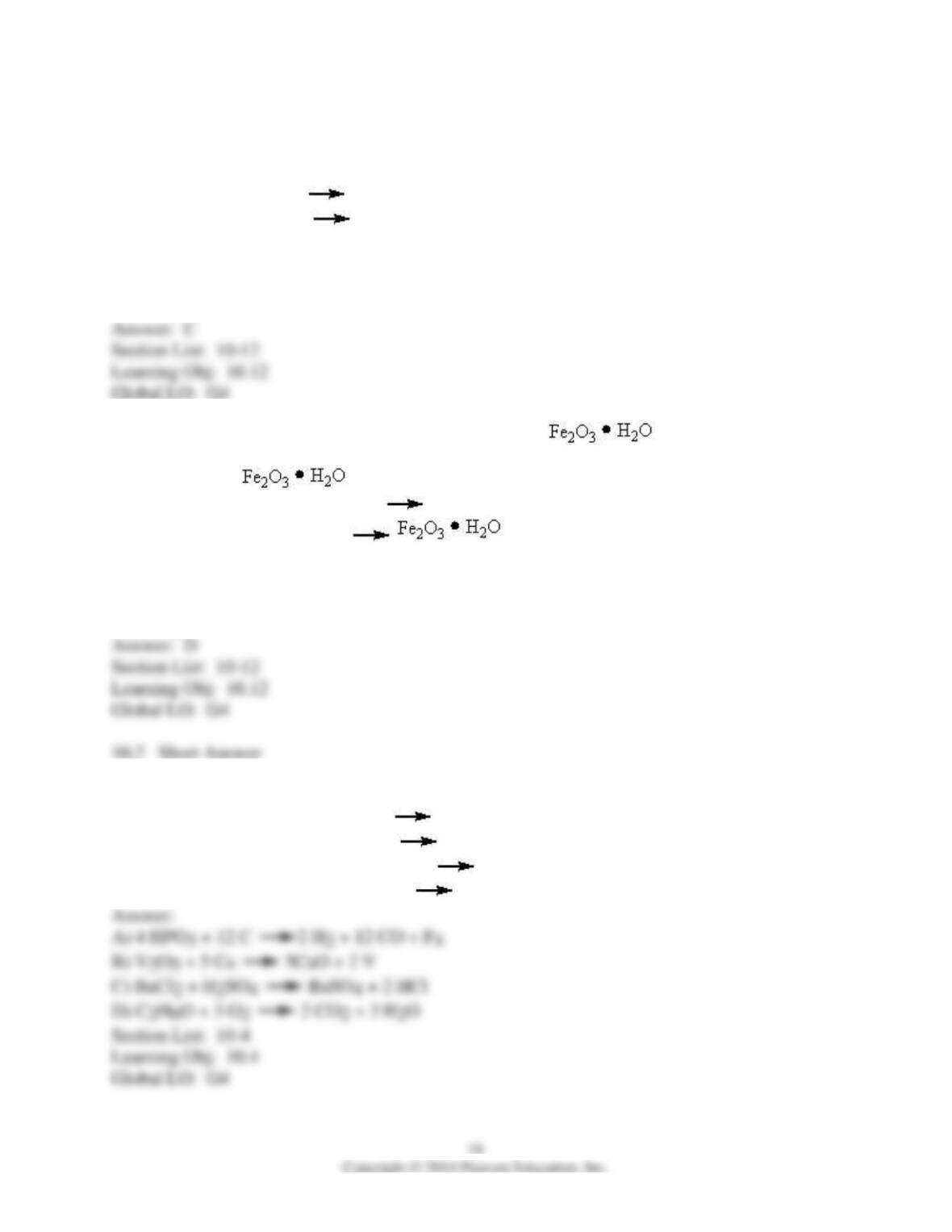
55) A mixture contained 96.4 g of CaCO3 (molar mass of 100.09) and 68.3 g of MgCO3 (molar
mass of 84.32). How many grams of CO2 (molar mass of 44.01) will be produced when the
mixture is heated?
CaCO3(g) CaO(s) + CO2(g)
MgCO3(g) MgO(s) + CO2(g)
A) 32.1 g
B) 96.3 g
C) 78.0 g
D) 46.0 g
56) The process for a piece of iron corroding to form rust, , is given in the two
reactions below. How much rust will be formed if 25.0 g of Fe (molar mass = 55.85) completely
corrodes to form (molar mass = 177.72)?
4 Fe + 12 H+ + 3 O2 4 Fe3+ + 6 H2O
2 Fe3+ + 4 H2O + 6 H+
A) 9.94 g
B) 15.9 g
C) 19.9 g
D) 39.8 g
1) Balance the following equations:
A) ________HPO3 + ________C ________H2 + ________CO + ________P4
B) ________V2O5 + ________Ca ________CaO + ________V
C) ________BaCl2 + ________H2SO4 ________BaSO4 + ________HCl
D) ________C2H6O + ________O2 ________CO2 + ________H2O
2) Balance the following chemical equation using the simplest whole number ratio of
coefficients.
________ I4O9 ________ I2O5 + ________ I2 + ________ O2
3) Balance the following chemical equation using the simplest whole number ratio of
coefficients.
________ C6H14 + ________ O2 ________ H2O + ________ CO2
4) Identify the products of and then write a balanced chemical equation for the following
reaction.
K2SO4(aq) + BaCl2(aq) ? + ? (double-replacement reaction)
5) Verify the Law of Conservation of Mass using the molar masses of the compounds in the
balanced equation given below.
Na2CO3 + 2 HCl CO2 + H2O + 2 NaCl
6) How many grams of N2H4 are needed to produce 6.94 g of H2O using the reaction
N2H4 + 2 H2O2 N2 + 4 H2O
7) Consider the following reaction:
3 O2 (g) + 2 CH4 (g) + 2 NH3 (g) 2 HCN (g) + 6 H2O (l)
How many grams of HCN will be formed upon the complete reaction of 55.8 g O2 with excess
methane and ammonia?
8) How many grams of O2 (molar mass = 32.00) are produced at the same time that 2.68 moles
of KCl are produced using the reaction: 2 KClO3 2 KCl + 3 O2
9) Consider the reaction:
K2Cr2O7 + 6 KI + 7 H2SO4 Cr2(SO4)3 + 4 K2SO4 + 3 I2 + 7 H2O
How many grams of KI will be needed to produce 75.0 grams of water?
10) How many grams of H2O (molar mass = 18.02) can be produced from 20.0 g of H2S (molar
mass = 34.09) and 40.0 g of O2 (formula mass = 32.00) using the reaction
2 H2S + 3 O2 2 SO2 + 2H2O
11) The alcohol in “gasohol” burns according to the following equation:
C2H5OH (l) + 3 O2 (g) 2 CO2 (g) + 3 H2O (l)
a) What is the theoretical yield of carbon dioxide when 12.5 g of ethanol, C2H5OH, reacts with
35.0 g of oxygen?
b) What is the percentage yield for this reaction if the actual yield is 20.5 g of CO2?
12) In a certain experiment 25.0 g of NaCN (molar mass = 49.01) was produced from 40.0 g of
N2 and an excess of other reactants using the reaction
Na2CO3 + 4 C + N2 2 NaCN + 3 CO
What is the percent yield of NaCN?
13) Acrylonitrile (C3H3N) is the starting material in the production of synthetic fibers (acrylics).
Acrylonitrile can be produced from the reaction between propylene (C3H6) and nitric oxide
(NO).
4 C3H6 + 6 NO 4 C3H3N + 6 H2O + N2
If 17.66 g of C3H3N are experimentally obtained from the reaction of 50.0 g of C3H6 and an
excess of NO, calculate the theoretical yield and the percent yield for this reaction.
14) Burning of coal to produce electricity leads to the production of sulfuric acid (H2SO4), a
component of acid rain, in the atmosphere in a three step process shown below.
S + O2 SO2
2 SO2 + O2 2 SO3
SO3 + H2O H2SO4
If 5.00 x 10⁴ kg of sulfur reacts completely with excess oxygen and water, what mass of sulfuric
acid (in grams) is produced in the atmosphere?