Chapter 10: The Shapes of Molecules
41. How many faces and how many vertexes (corners), respectively, are there in a trigonal
bipyramid?
A) 4 and 4 B) 5 and 5 C) 5 and 6 D) 6 and 5 E) 6 and 8
42. According to VSEPR theory, a molecule with the general formula AX6 will have a
______ molecular shape.
A) tetrahedral D) hexagonal
B) trigonal planar E) octahedral
C) trigonal bipyramidal
43. According to VSEPR theory, a molecule with the general formula AX2E will have a
______ molecular shape.
A) bent
B) see-saw
C) trigonal planar
D) T-shaped
E) trigonal pyramidal
44. According to VSEPR theory, a molecule with the general formula AX2E2 will have a
_____ molecular shape.
A) linear B) bent C) trigonal planar D) tetrahedral E) see-saw
45. According to VSEPR theory, a molecule with the general formula AX2E3 will have a
_____ molecular shape.
A) bent
B) linear
C) trigonal planar
D) T-shaped
E) trigonal pyramidal
46. According to VSEPR theory, a molecule with the general formula AX3E will have a
_____ molecular shape.
A) bent
B) trigonal planar
C) trigonal pyramidal
D) tetrahedral
E) triangular
Chapter 10: The Shapes of Molecules
47. According to VSEPR theory, a molecule with the general formula AX3E2 will have a
_____ molecular shape.
A) trigonal pyramidal D) T-shaped
B) trigonal bipyramidal E) see–saw
C) trigonal planar
48. According to VSEPR theory, a molecule with the general formula AX4E will have a
_____ molecular shape.
A) bent B) see-saw C) trigonal planar D) T-shaped E) square planar
49. According to VSEPR theory, a molecule with the general formula AX4E2 will have a
_____ molecular shape.
A) tetrahedral D) octahedral
B) square pyramidal E) see–saw
C) square planar
50. According to VSEPR theory, a molecule with the general formula AX5E will have a
______ molecular shape.
A) tetrahedral D) octahedral
B) trigonal bipyramidal E) see–saw
C) square pyramidal
51. What is the molecular shape of N2O as predicted by the VSEPR theory?
N
NO
A) trigonal pyramidal
B) trigonal planar
C) angular
D) bent
E) linear
52. What is the molecular shape of the thiocyanate anion, SCN–, as predicted by the VSEPR
theory? (Carbon is the central atom.)
A) linear B) bent C) angular D) trigonal E) none of the above
53. What is the molecular shape of ClCN as predicted by the VSEPR theory? (Carbon is the
central atom.)
A) linear B) bent C) angular D) trigonal E) none of the above
Chapter 10: The Shapes of Molecules
54. What is the molecular shape of BeH2 as predicted by the VSEPR theory?
A) linear B) bent C) angular D) trigonal E) none of the above
55. What is the molecular shape of NOCl as predicted by the VSEPR theory?
O N Cl
A) linear
B) trigonal planar
C) bent
D) tetrahedral
E) trigonal pyramidal
56. What is the molecular shape of BCl3 as predicted by the VSEPR theory?
A) linear
B) trigonal planar
C) bent
D) tetrahedral
E) trigonal pyramidal
57. What is the molecular shape of NO2– as predicted by the VSEPR theory?
A) linear B) trigonal planar C) bent D) tetrahedral E) resonant
58. What is the molecular symmetry around the carbons in CCl2CH2 as predicted by the
VSEPR theory?
A) linear D) tetrahedral
B) trigonal planar E) trigonal pyramidal
C) V-shaped
59. What is the molecular shape of ClO3F as predicted by the VSEPR theory?
Cl
O
O
O F
A) trigonal pyramidal D) tetrahedral
B) square planar E) octahedral
C) square pyramidal
Chapter 10: The Shapes of Molecules
60. What is the molecular shape of HOF as predicted by the VSEPR theory?
A) trigonal pyramidal B) trigonal C) tetrahedral D) linear E) bent
61. What is the molecular shape of NH2Cl as predicted by the VSEPR theory?
A) trigonal pyramidal D) see–saw
B) tetrahedral E) trigonal planar
C) T-shaped
62. What is the molecular shape of XeO2F2 as predicted by the VSEPR theory?
Xe
F
O
F O
A) square planar D) see–saw
B) tetrahedral E) octahedral
C) square pyramidal
63. What is the molecular shape of ClF2– as predicted by the VSEPR theory?
A) linear B) bent C) see-saw D) T-shaped E) L-shaped
64. What is the molecular shape of SCl3F as predicted by the VSEPR theory?
A) linear B) bent C) see-saw D) T-shaped E) trigonal pyramidal
65. What is the molecular shape of SiF62– as predicted by the VSEPR theory?
Si
F
F
F
FF
F
2-
A) trigonal bipyramidal D) see–saw
B) hexagonal E) octahedral
C) tetrahedral
66. What is the molecular shape of ClF4– as predicted by the VSEPR theory?
A) square pyramidal D) octahedral
B) square planar E) tetrahedral
C) see–saw
Chapter 10: The Shapes of Molecules
67. Which one of the following molecules and ions will have a planar geometry?
A) PCl3 B) BF4– C) XeF4 D) BrF5 E) H3O+
68. Use VSEPR theory to decide which one of the following ions and molecules is likely to
be planar. (The central atom is always first in the formula.)
A) BrF3 B) H3O+ C) PCl3 D) SO42– E) SF4
69. Use VSEPR theory to decide which one of the following molecules and ions will have a
trigonal pyramidal geometry. (The central atom is always first in the formula.)
A) PCl3 B) BF3 C) SO3 D) BrF3 E) CO32–
70. Use VSEPR theory to predict the electron group arrangement around iodine, the central
atom in the ion IF2–.
A) octahedral D) trigonal planar
B) trigonal bipyramidal E) bent
C) tetrahedral
71. Use VSEPR theory to decide which one of the following molecules and ions will
definitely have at least one 90° bond angle in it. (In each case except water, the central atom is
the first one in the formula.)
A) AlCl4– B) NH3 C) PCl5 D) CO2 E) H2O
72. Predict the ideal bond angles in GeCl4 using the molecular shape given by the VSEPR
theory.
A) 90° B) 109° C) 120° D) 180° E) < 90°
73. Predict the ideal bond angles in AsCl3 using the molecular shape given by the VSEPR
theory.
A) 90° B) 109° C) 120° D) 180° E) between 110 and 120°
74. Predict the ideal bond angles in FNO using the molecular shape given by the VSEPR
theory.
A) 90° B) 109° C) 120° D) 180° E) between 120 and 180°
Chapter 10: The Shapes of Molecules
75. Predict the ideal bond angles around nitrogen in N2F2 using the molecular shape given by
the VSEPR theory. (The two N atoms are the central atoms.)
A) 90° B) 109° C) 120° D) 180° E) between 120 and 180°
76. Predict the ideal bond angles around carbon in C2I2 using the molecular shape given by
the VSEPR theory.
A) 90° B) 109° C) 120° D) 180° E) none of the above
77. Predict the ideal bond angles in IF2– using the molecular shape given by the VSEPR
theory.
A) 60° B) 90° C) 109° D) 120° E) 180°
78. Predict the actual bond angle in SeCl2 using the VSEPR theory.
A) more than 120° D) exactly 90°
B) between 109° and 120° E) less than 90°
C) between 90° and 109°
79. Predict the smallest actual bond angle in BrF3 using the VSEPR theory.
A) more than 120° D) between 90° and 109°
B) exactly 120° E) less than 90°
C) between 109° and 120°
80. Predict the actual bond angles in SF3+ using the VSEPR theory.
A) more than 120° D) between 90° and 109°
B) exactly 120° E) less than 90°
C) between 109° and 120°
81. List all possible molecular geometries (shapes) for a nonpolar molecule with the formula
AX4.
A) tetrahedral D) either tetrahedral or square planar
B) seesaw E) any of the above shapes
C) square planar
82. Which of the following molecules has a net dipole moment?
A) BeCl2 B) SF2 C) KrF2 D) CO2 E) CCl4
Chapter 10: The Shapes of Molecules
83. Which of the following has no net dipole moment?
A) N2O B) NF3 C) H2Se D) TeO3 E) CH3Cl
84. Which one of the following molecules has a zero dipole moment?
A) SO2 B) HCl C) CS2 D) CO E) Cl2O
85. Which one of the following molecules does not have a dipole moment?
A) CS2 B) H2S C) CH2Cl2 D) PH3 E) CH2O
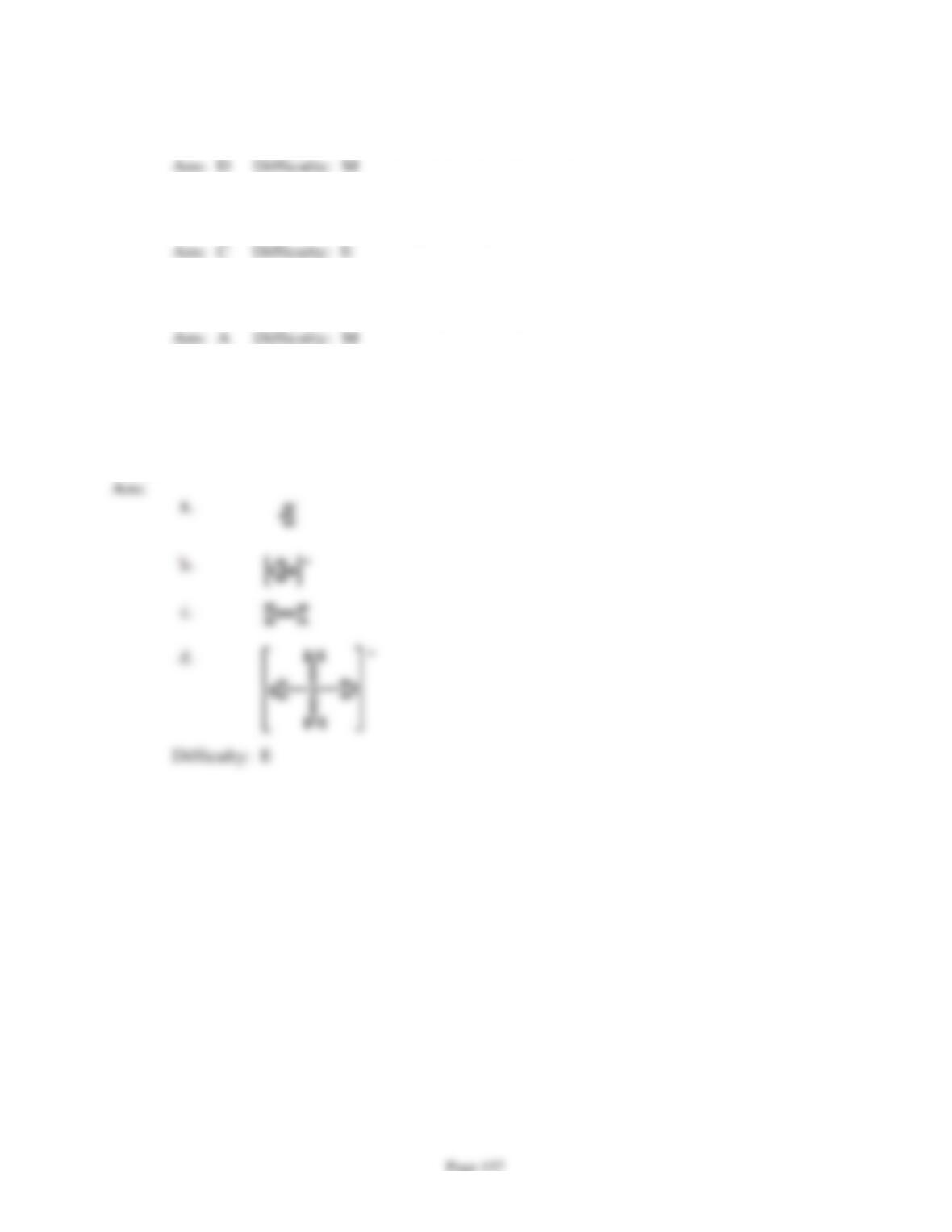
86. Draw Lewis structures, showing all valence electrons, for:
a. N
b. Br–
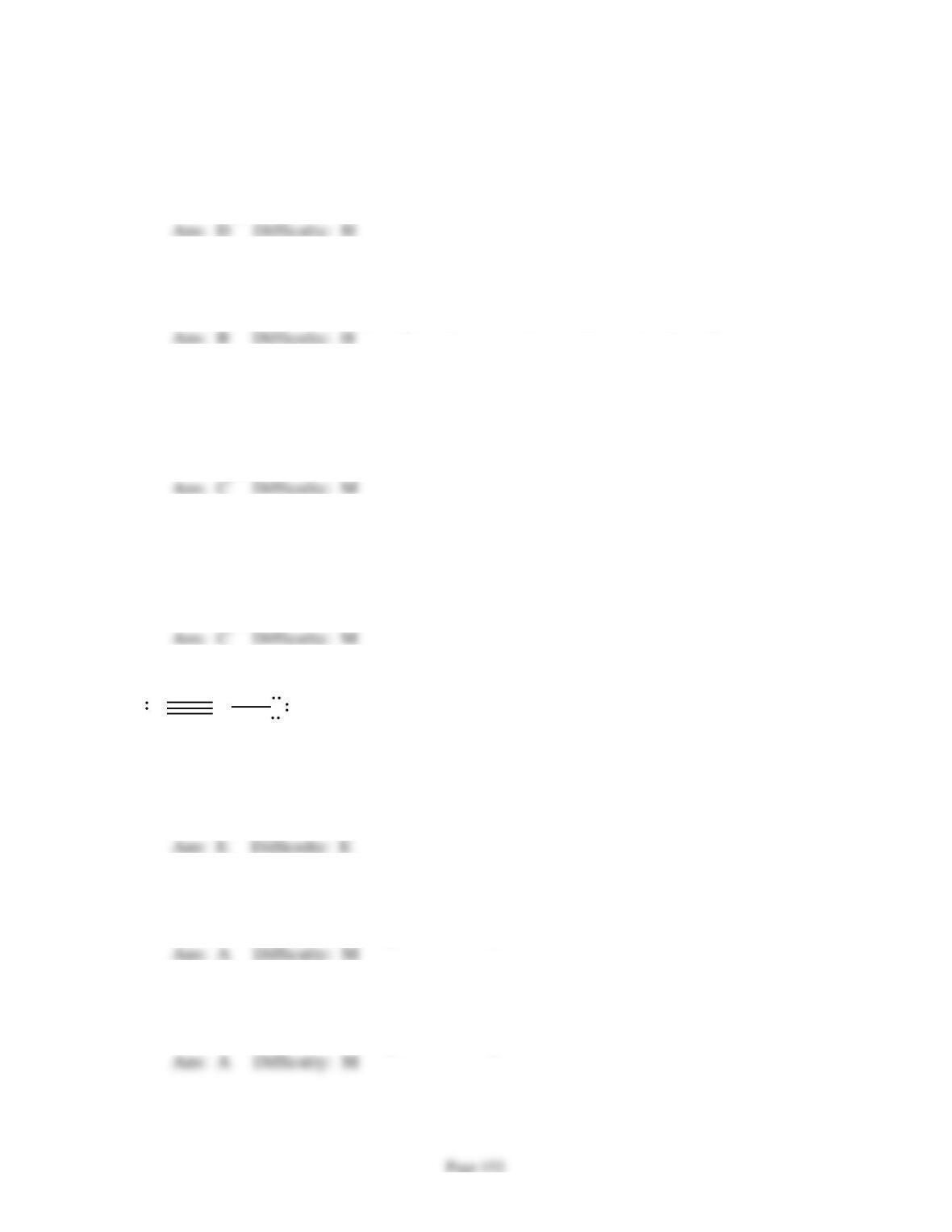
c. O2
d. SO42–
Chapter 10: The Shapes of Molecules
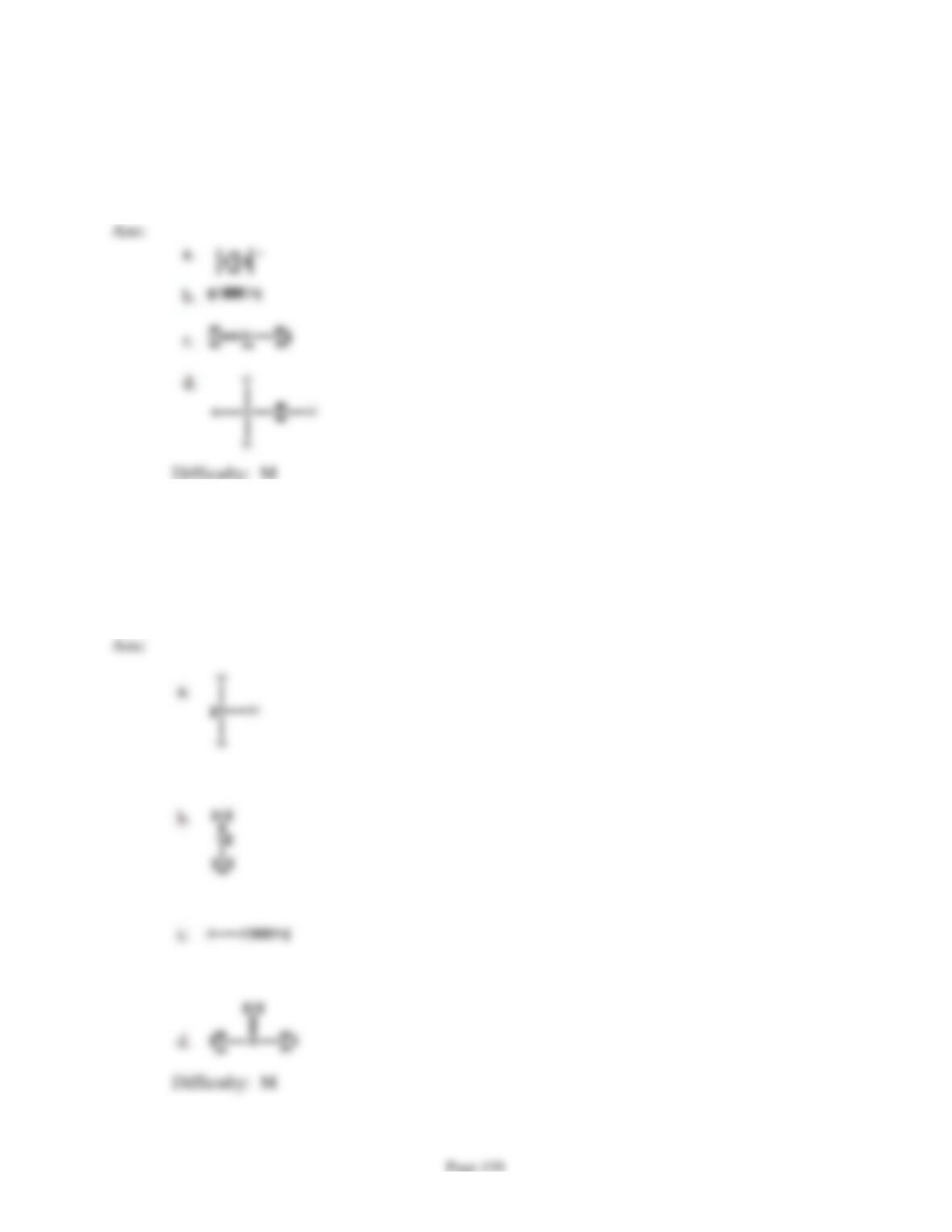
87. Draw Lewis structures, showing all valence electrons, for the following species:
a. S2–
b. CO
c. SO2
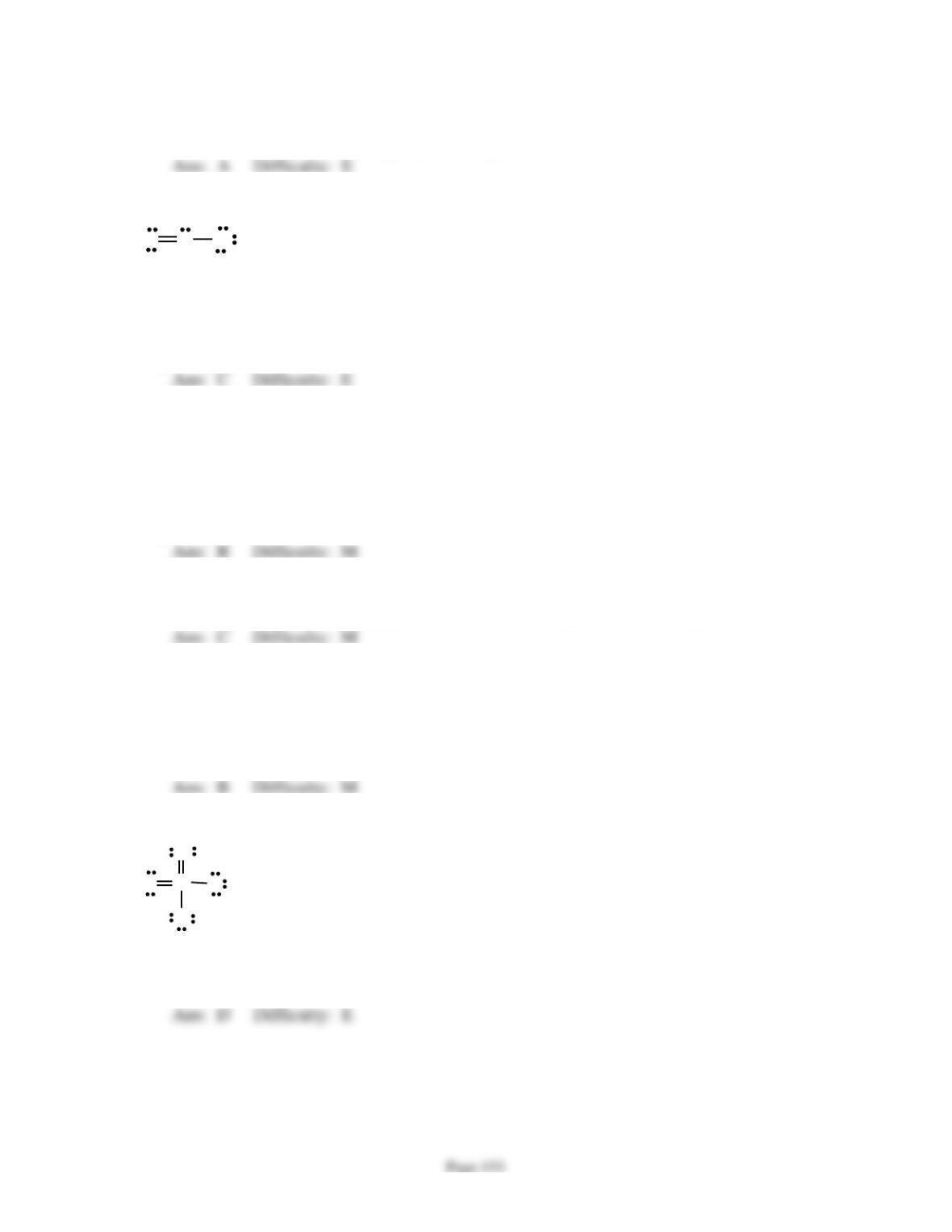
d. CH3OH
88. Draw Lewis structures which obey the octet rule, for the following atoms, molecules, and
ions, showing all valence electrons. Central atoms are shown in bold.
a. NH3
b. O3 (Hint: O3 is not cyclic)
c. HCN
d. SO3
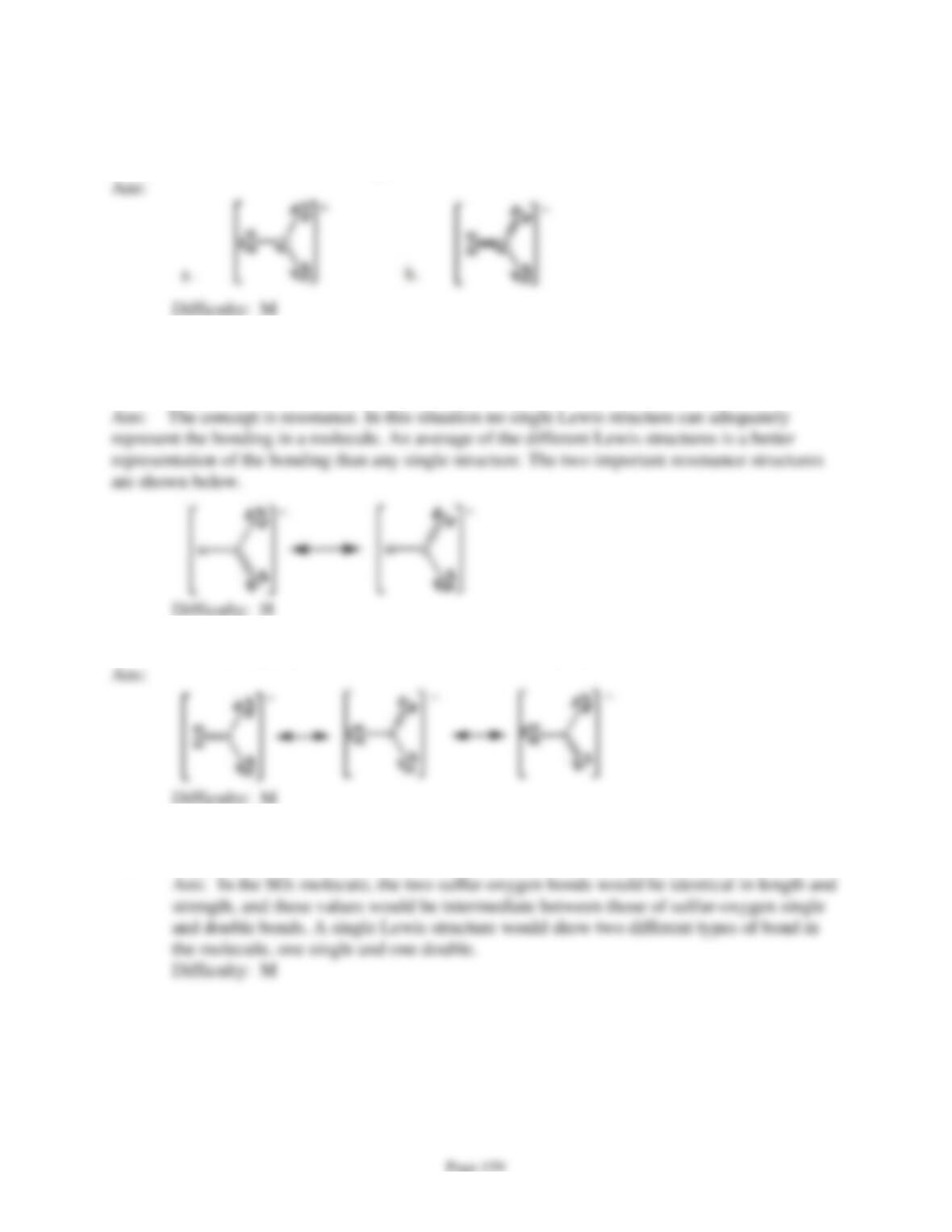
Chapter 10: The Shapes of Molecules
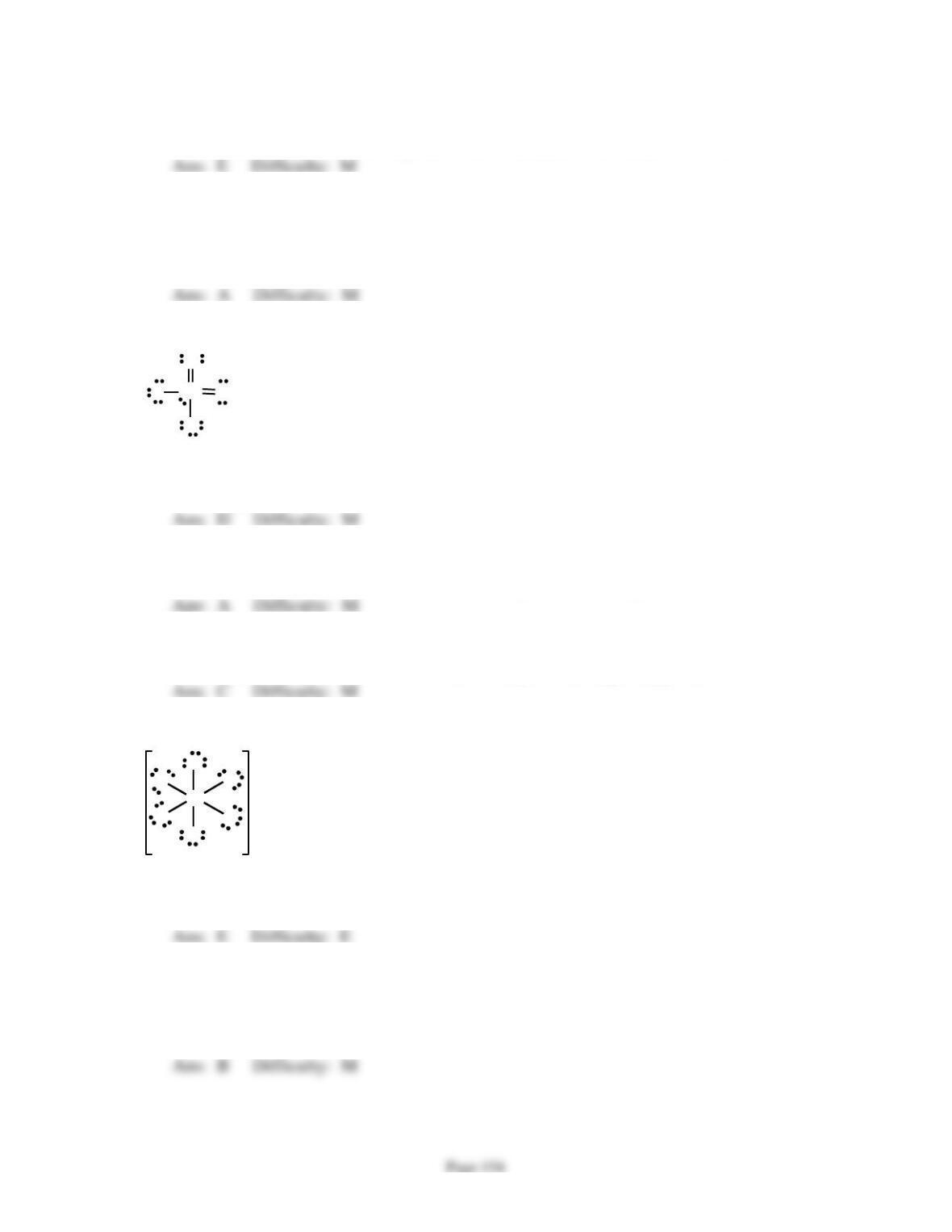
89. For the chlorate ion, ClO3–, draw two different valid Lewis structures, as follows:
a. a structure in which the octet rule is obeyed
b. a structure in which formal charges are minimized
90. Name and outline the concept which is introduced when more than one valid Lewis
structure can be drawn for a given molecule or ion. Use appropriate diagrams of the formate ion
(HCO2–, carbon is the central atom) to illustrate.
91. Draw all important resonance structures of the nitrate ion, NO3–
92. Using SO2 as an example, describe the sort of experimental data which might suggest
that no single Lewis structure is an accurate representation of its bonding.
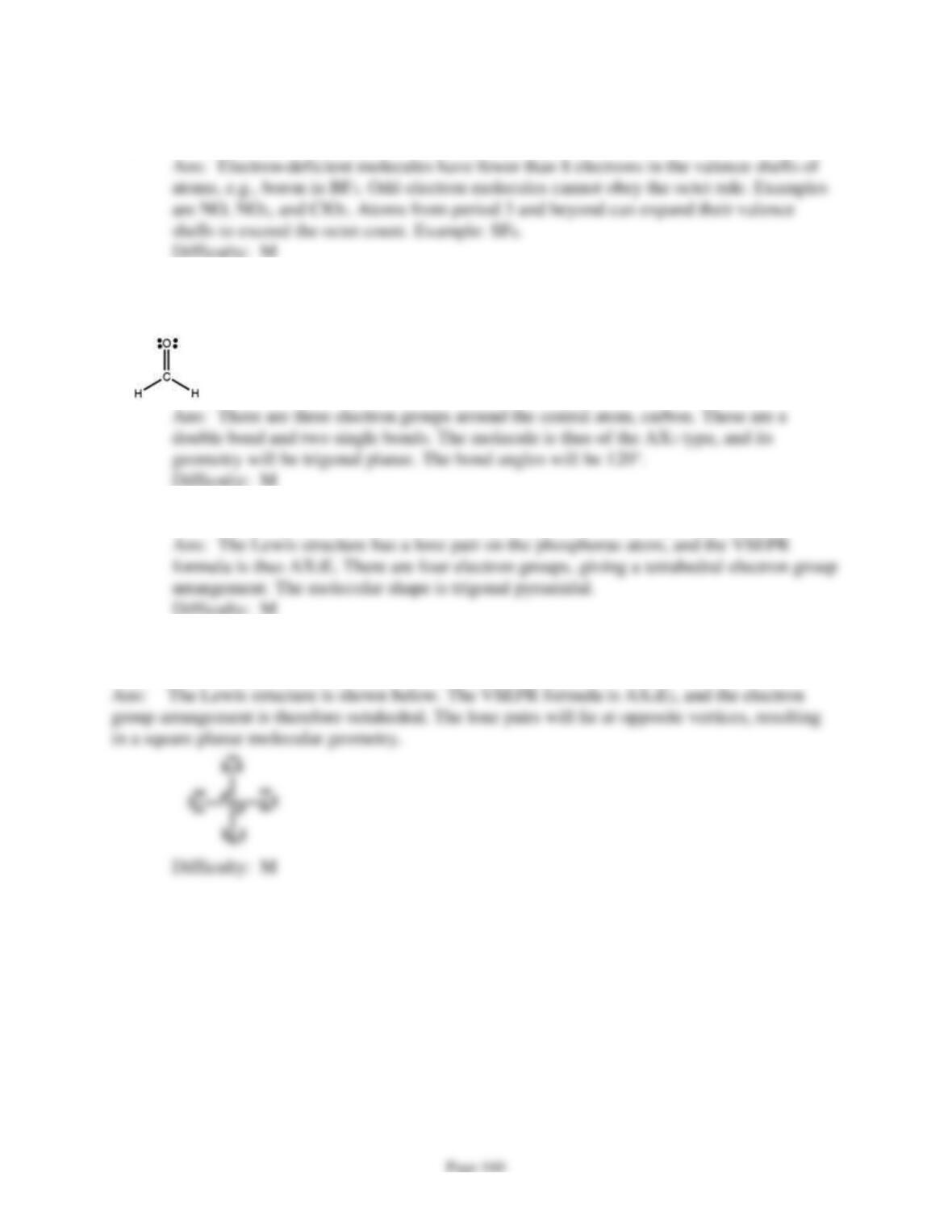
Chapter 10: The Shapes of Molecules
93. List the three important ways in which molecules can violate the octet rule, and in each
case draw one Lewis structure of your choice as an example.
94. The Lewis structure of formaldehyde, CH2O, is shown. Use VSEPR theory to predict the
molecular geometry and the H–C–H bond angle. Outline your reasoning.
95. What is the shape of the PF3 molecule? Explain your answer, using VSEPR theory.
96. Draw the Lewis structure of XeF4. Use this structure, in conjunction with VSEPR theory,
to predict the shape of this molecule. Outline your reasoning.
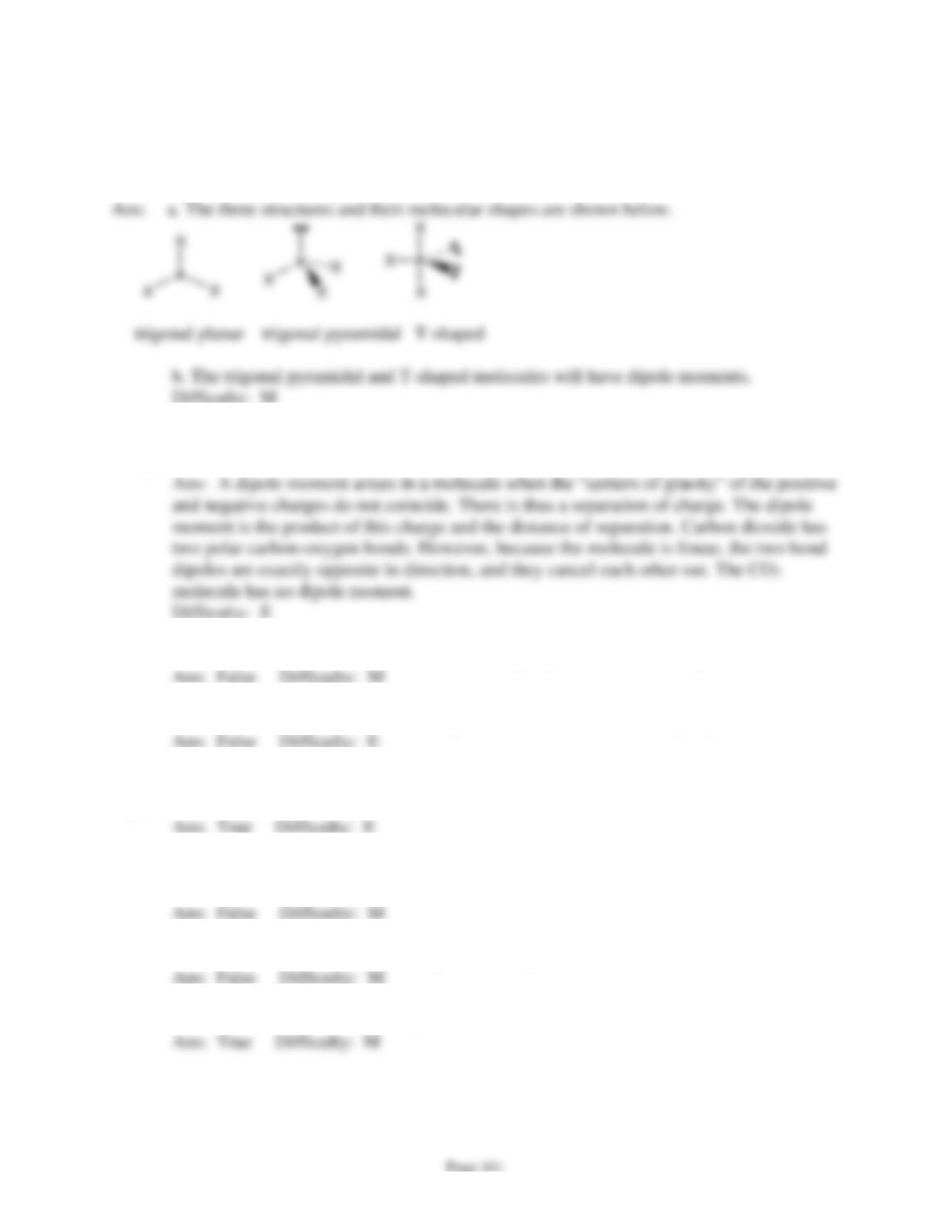
Chapter 10: The Shapes of Molecules
97. a. Draw and name three molecular shapes for molecules having the VSEPR formulas
AX3, AX3E, and AX3E2, respectively.
b. If the three X groups in the above formulas are identical, which of the three shapes would
result in a molecule with a dipole moment?
98. Explain what is meant by “dipole moment”, and give an example of a molecule which
has polar bonds but which does not itself have a dipole moment.
99. All possible resonance structures contribute equally to the resonance hybrid.
100. When resonance occurs, the bond lengths in a molecule fluctuate rapidly.
101. In a Lewis structure for a molecule or ion, the sum of the formal charges on the atoms is
equal to the charge on the molecule or ion.
102. In formaldehyde, CH2O, both the formal charge and the oxidation number of carbon are
zero.
103. Boron never achieves an octet in any of its compounds.
104. The Lewis structure of NO2 violates the octet rule.
Chapter 10: The Shapes of Molecules
105. Bond angles of 180° only occur around atoms which display linear molecular geometry.
106. In order for a non-cyclic triatomic molecule to be bent, VSEPR theory requires that there
must be two lone pairs on the central atom.
107. According to VSEPR theory, a molecule with the general formula AX3E2 (where E
represents a lone pair on A) will be trigonal planar.
108. The molecule AX2, where A and X are different elements, will have a dipole moment if
the molecule is bent.
109. A molecule which contains polar bonds will always have a dipole moment.