
Introduction to Chemical Principles, 11e (Stoker)
Chapter 1 The Science of Chemistry
1.1 Multiple Choice
1) Chemistry is a scientific discipline which ________.
A) is a biological science
B) has only two subdisciplines
C) is devoted to the study of matter and energy
D) has a rigid boundary between itself and other disciplines
2) The subdiscipline of chemistry that studies fundamental laws and concepts of chemistry is
________.
A) inorganic chemistry
B) organic chemistry
C) physical chemistry
D) general chemistry
3) Which of the following subdisciplines of science is not a physical science?
A) chemistry
B) zoology
C) physics
D) astronomy
4) Chemistry, physics, and geology are considered physical sciences because they involve the
study of ________.
A) changes in matter
B) living organisms
C) changes in energy
D) changes in both matter and energy

5) Which of the following is a biological science?
A) chemistry
B) physics
C) zoology
D) geology
6) Which of the following is an example of a scientific discipline that involves the study of living
organisms?
A) geology
B) physics
C) botany
D) astronomy
7) The physical application of scientific knowledge towards the production of goods to improve
Human survival, comfort and quality of life is known as ________.
A) technology
B) scientific discipline
C) natural law
D) theory
8) Teflon is produced when 1,1,2,2-tetrafluoroethene (F2C=CF2) is polymerized. Scientists soon
observed that many materials would not adhere to surfaces coated with Teflon. Today, Teflon is
used to coat cookware to produce non-stick surfaces. This represents an application of ________.
A) a theory becoming a natural law
B) technology
C) an experiment proving a scientific law
D) an experiment verifying a fact

9) Chemists discovered that a class of compounds called esters could be produced by reacting
carboxylic acids with alcohols. Esters are very fragrant and are incorporated into perfumes, and
they are used as flavorings in foods. The use of esters in perfumes and foods is an example of
________.
A) technology manipulating nature for advantage
B) a natural law being exploited by chemical experimentation
C) an experiment proving a scientific law
D) an experiment verifying a fact
10) A formal course in chemistry is essential and fascinating because it helps us ________.
A) understand ourselves
B) understand our surroundings
C) understand the world we live in
D) Answers A, B, and C are all correct
11) A tentative model or picture that offers an explanation for a scientific law is called a
________.
A) theory
B) hypothesis
C) fact
D) observation
12) A statement that is obvious to anyone and based on direct experience is called a ________:
A) hypothesis
B) theory
C) fact
D) thesis

13) A generalization that summarizes in a concise manner facts about natural phenomena is
called a ________.
A) theory
B) hypothesis
C) scientific law
D) fact
14) A theory is ________.
A) a law that is yet to be tested and validated
B) a law that has been “approved” by at least 3 international scientific organizations
C) a hypothesis that has been tested and validated over a long period of time
D) a hypothesis which is yet to be tested and validated
15) Which of the following pairings of terms is incorrect?
A) theory – unvalidated hypothesis
B) fact – observation
C) hypothesis – tentative explanation
D) scientific law – concise summary of facts about natural phenomena
16) Which procedural step comes first in the scientific method?
A) Identifying the problem and planning procedures to obtain information.
B) Testing proposed explanations through experimentation.
C) Collecting data through observation and experimentation.
D) Analyzing and organizing collected data in terms of generalized statements.

17) Which of the following is the most important to chemical discovery?
A) laws
B) hypotheses
C) experiments
D) theories
18) A researcher studies the behavior of a fixed amount of gas under constant pressure
conditions in a balloon with the following results.
Experiment 1: At a temperature of 75 K, the gas occupied a volume of 5.0 liters.
Experiment 2: At a temperature of 150 K, the gas occupied a volume of 10.0 liters.
From this data one can generalize that as the temperature of the gas increases,
A) the volume of the gas decreases proportionally.
B) the volume of the gas decreases exponentially.
C) the volume of the gas increases proportionally.
D) the volume of the gas increases exponentially.
19) A set of procedures used to acquire knowledge and explain phenomena is ________.
A) collectively known as the field of science
B) referred to as technology
C) known as the scientific method
D) required to establish scientific law
20) A valid observation about some natural phenomenon is called ________.
A) a hypothesis
B) a fact
C) an experiment
D) a scientific law

21) When the scientific method is applied to a problem, a set of procedures is followed to acquire
knowledge and explain phenomena. The procedural steps associated with the scientific method
normally occur in the order ________.
A) experiment, fact, scientific law, hypothesis, theory
B) hypothesis, theory, experiment, fact, scientific law
C) theory, hypothesis, fact, experiment, scientific law
D) scientific law, theory, hypothesis, experiment, fact
22) Which of the following statements is false?
A) Facts that have been verified by repeated experiments will never be changed.
B) Theories that are invented to explain certain facts are not subject to change.
C) A theory is a hypothesis that is tested and validated over a period of time.
D) An experiment is a well-defined, controlled procedure for obtaining facts.
23) Which of the following statements is incorrectly classified as a fact, a scientific law, or a
hypothesis?
Statement Classification
A) Women live longer than men because they deal better with stress. hypothesis
B) Sulfur is a yellow solid. fact
C) Gasoline is insoluble in water. scientific law
D) All samples of gaseous substances expand when heated. scientific law
24) A researcher studied the relationship between the wavelength and the frequency of light.
Experiment 1: If the wavelength of light was 0.50 meters, the frequency was 6 x 10⁸ hertz.
Experiment 2: If the wavelength of light was 1.0 meter, the frequency was 3 x 10⁸ hertz. From
this data one can generalize that as the wavelength of light decreases
A) the frequency decreases by a proportional amount.
B) the frequency increases exponentially.
C) the frequency decreases exponentially.
D) the frequency increases by a proportional amount.

25) Suppose you were handed two drinking glasses, each containing a clear, colorless liquid.
Four alternative hypotheses were postulated concerning the liquids contained in the glasses.
1. Both glasses contain water only.
2. One glass contains sugar dissolved in water, and the other glass contains water only.
3. One glass contains salt dissolved in water, and the other glass contains sugar dissolved in
water.
4. Both glasses contain salt dissolved in water.
Which of the hypotheses could be rejected by tasting the liquid in one of the glasses and
determining that it tasted sweet?
A) 3 and 4
B) 1 and 4
C) 2
D) 1 and 3
26) Einstein first stated the relationship between energy and mass, E = mc2, which states that
energy (E) equals mass (m) times the speed of light (c) squared. This is an example of a
________.
A) technology
B) scientific discipline
C) scientific law
D) theory
27) When a doctor makes a diagnosis based on laboratory tests, this is:
A) a fact.
B) a hypothesis based on facts.
C) a proof of a hypothesis.
D) must be true.
1.2 Short Answer
1) The vastness of the volume of chemical information about our world requires that chemistry
be divided into subdisciplines. Match Area of study to its Subdiscipline of chemistry by placing
the appropriate letter in each blank space provided.
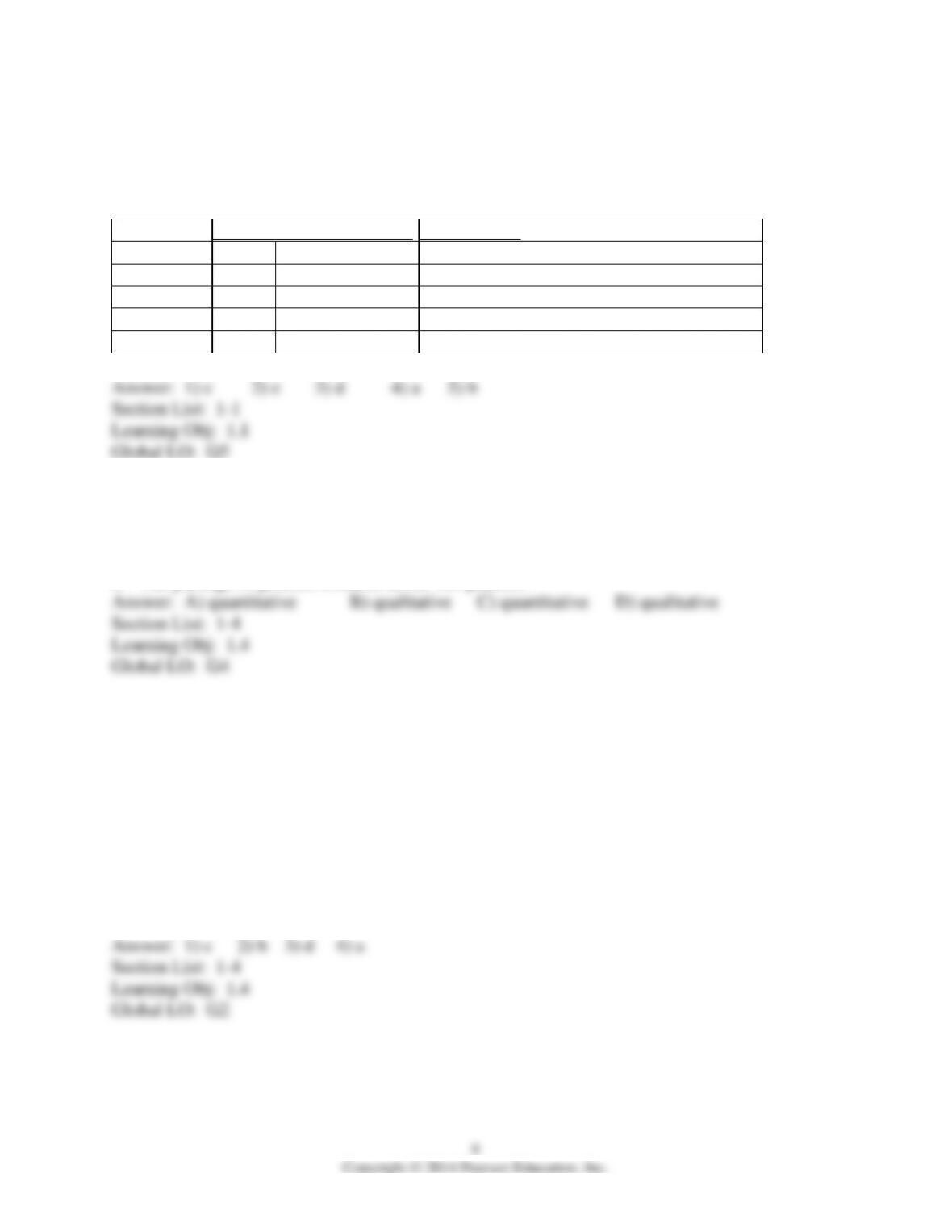
Subdiscipline of chemistry
Area of study
1)
____
analytical
a) energy changes
2)
____
general
b) noncarbon-containing compounds
3)
____
organic
c) analysis
4)
____
physical
d) carbon-containing compounds
5)
____
inorganic
e) fundamental laws and concept
2) Classify the following as representing quantitative or qualitative data.
a. The plank of wood is 55.4 cm long.
b. The vial contains a brown liquid.
c. The temperature outside is 37 °C.
d. The package of peanuts contains about 100 peanuts.
3) Match the terms below with the definitions at the bottom.
1) ________ Tentative model or picture that offers an explanation for the behavior of a system
2) ________ Generalization that summarizes in a concise way information about natural
phenomena
3) ________ Tentative model that has been tested and validated over long periods of time
4) ________ A valid observation about some phenomenon
a) fact
b) scientific law
c) hypothesis
d) theory
4) Indicate whether each of the following statements is true or false.
1) ________ A hypothesis is a statement of fact concerning a natural law.
2) ________ A theory is subject to modification in light of new experimental observations
3) ________ It is much easier to “prove” a hypothesis than it is to “disprove” it.
4) ________ A scientific law is a generalization that summarizes information about natural
phenomena.
5) ________ A theory is an explanation for which no experimental basis has yet been found.
6)________ The validity of a hypothesis is dependent upon it randomly predicting the outcome
of yet untried experiments.
5) Indicate whether each of the following statements represents quantitative data or qualitative
data.
A) A beaker containing calcium carbonate weighs 96.543 grams. ________
B) The gas in the container was reddish-brown in color. ________
C) The volume of a container of gas decreases as the pressure in the container increases.
________
D) A strip of magnesium ribbon is 1.24 centimeters in length. ________
6) Indicate whether each of the following statements represents a fact, a scientific law, or a
hypothesis.
A) The volume of a sample of gas increased as its temperature increased. ________
B) The reddish-brown gas occupied a volume of 25.9 liters. ________
C) Giraffes grew long necks over time to reach food sources in the trees during dry weather.
________
D) The wavelength of any source of light is inversely proportional to its frequency.
________
7) A researcher observed numerous chemical reactions in which he reacted differing masses of
reactants (starting materials) to determine the mass of product(s) formed.
10 grams of A are reacted with 5 grams of B, 15 grams of AB are produced.
2.4 grams of C are reacted with 4.0 grams of D, 6.4 grams of CD are produced.
500 grams of E are reacted with 100 grams of F, 300 grams of G and 300 grams of H are
produced.
What generalization (scientific law) concerning the relationship between the masses of reactants
and the mass(es) of product(s) formed can be derived from these observations?
8) Indicate whether each statement is a fact, hypothesis or theory.
A) Smoking cigarettes is detrimental to your health.
B) The ocean water in Miami, FL contains more salt than water in Galveston, TX.
C) A micrometer (μm) is larger than a nanometer (nm).
9) Fill in the Blank:
A) A shrewd but tentative initial explanation for a relatively small set of observations is best
described as a ________.
B) A ________ is based on further experimental results that have either proven or disproven a set
of initial observations.
10) Explain the difference between science and technology.
11) Identify whether each of the following statements is a theory, hypothesis, observation or law.
a) My watch is no longer keeping correct time so my watch battery must be dead.
b) A candle burns more brightly in pure oxygen than in regular air.
c) A pure substance has a fixed, definite composition.
d) My brother wears green a lot.
12) Explain the difference between:
a) A hypothesis and a theory
b) A theory and a law