Chapter 1: Keys to the Study of Chemistry
1. Which one of the following is a “substance” in the sense of the word as used in your
textbook?
A) air B) tap water C) sea water D) water E) toothpaste
2. Select the best statement.
A) Physical changes may be reversed by changing the temperature.
B) Physical changes alter the composition of the substances involved.
C) Physical properties are not valid characteristics for identifying a substance.
D) Physical properties are mostly extensive in nature.
E) Physical changes are usually accompanied by chemical changes.
3. Select the best statement.
A) Chemical changes provide the only valid basis for identification of a substance.
B) Chemical changes are easily reversed by altering the temperature of the system.
C) Chemical changes always produce substances different from the starting materials.
D) Chemical changes are associated primarily with extensive properties.
E) Chemical changes are accompanied by changes in the total mass of the substances
involved.
4. Which of the following is a chemical change?
A) boiling of water D) condensing water vapor into rainfall
B) melting wax E) carving a piece of wood
C) broiling a steak on a grill
5. Water vapor is less dense than ice because
A) molecules in the gas phase are in constant motion.
B) molecules in the gas phase have more potential energy than in solids.
C) molecules in the gas phase have more kinetic energy than in solids.
D) gaseous molecules have less mass.
E) molecules in the gas phase have more space between them than in solids.

Chapter 1: Keys to the Study of Chemistry
6. During the swing of a frictionless pendulum, what energy form(s) remain constant?
A) kinetic energy only
B) potential energy only
C) both kinetic energy and potential energy
D) kinetic plus potential energy
E) None of the above forms remains constant.
7. The most significant contribution to modern science made by alchemists was
A) their fundamental work in the transmutation of the elements.
B) their widespread acceptance of observation and experimentation.
C) their systematic method of naming substances.
D) their understanding of the nature of chemical reactions.
E) their discovery of phlogiston.
8. Select the best statement about chemistry before 1800.
A) Alchemy focused on objective experimentation rather than mystical explanations
of processes.
B) The phlogiston theory laid a valuable theoretical basis for modern chemistry.
C) Lavoisier’s quantitative work on the role of oxygen in combustion was the
beginning of modern chemistry.
D) The interpretation of data by alchemists was not biased by their overall view of
life.
E) Alchemists failed because they did not develop any practical chemical methods.
9. Which of the following activities is not a part of good science?
A) proposing a theory D) designing experiments
B) developing a hypothesis E) indulging in speculation
C) making quantitative observations
10. A scientist made careful measurements of the pressure and temperature of many
different gases. Based on these measurements, he concluded that “the pressure of a fixed amount
of gas, measured at constant volume, is directly proportional to its absolute temperature.” This
statement is best described as a
A) theory. B) hypothesis. C) law. D) experiment. E) definition.
11. A dictionary has the following definition for a word: “A tentative explanation that
accounts for a set of facts.” Which of the following words best fits that definition?
A) theory B) hypothesis C) law D) experiment E) definition

Chapter 1: Keys to the Study of Chemistry
12. A detailed explanation of natural phenomena that is generally accepted and has been
extensively tested is called a
A) theory. B) hypothesis. C) law. D) fact. E) postulate.
13. The distance between carbon atoms in ethylene is 134 picometers. Which of the
following expresses that distance in meters?
A) 1.34 × 10⁻¹³ m D) 1.34 × 10⁻⁷ m
B) 1.34 × 10⁻¹² m E) 1.34 × 10⁻⁶ m
C) 1.34 × 10⁻¹⁰ m
14. The average distance from Earth to the Sun is 150 megameters. What is that distance in
meters?
A) 1.5 × 10⁸ m D) 1.5 × 10³ m
B) 1.5 × 10⁶ m E) 1.5 × 10⁻⁶ m
C) 1.5 × 10⁵ m
15. The mass of a sample is 550 milligrams. Which of the following expresses that mass in
kilograms?
A) 5.5 × 10⁸ kg D) 5.5 × 10⁻⁶ kg
B) 5.5 × 10⁵ kg E) 5.5 × 10⁻¹ kg
C) 5.5 × 10⁻⁴ kg
16. A dose of medication was prescribed to be 35 microliters. Which of the following
expresses that volume in centiliters?
A) 3.5 × 10⁵ cL D) 3.5 × 10⁻⁴ cL
B) 3.5 × 10⁴ cL E) 3.5 × 10⁻³ cL
C) 3.5 cL
17. Which of the following represents the largest volume?
A) 10,000 L B) 1000 pL C) 100 mL D) 10 nL E) 10 cm3
18. You prepare 1000. mL of tea and transfer it to a 1.00 quart pitcher for storage. Which of
the following statements is true?
A) The pitcher will be filled to 100% of its capacity with no tea spilled.
B) The pitcher will be filled to about 95% of its capacity.
C) The pitcher will be filled to about 50% of its capacity.
D) The pitcher will be completely filled and a small amount of tea will overflow.
E) The pitcher will be completely filled and most of the tea will overflow.
Chapter 1: Keys to the Study of Chemistry
19. In an average year, the American chemical industry produces more than 9.5 million
metric tons of sodium carbonate. Over half of this is used in the manufacture of glass while
another third is used in the production of detergents and other chemicals. How many pounds of
sodium carbonate are produced annually?
A) 2.1 × 10¹⁰ lb D) 2.2 × 10⁶ lb
B) 4.3 × 10⁹ lb E) 2.1 × 10⁴ lb
C) 1.1 × 10⁷ lb
20. A large pizza has a diameter of 15 inches. Express this diameter in centimeters.
A) 38 cm B) 24 cm C) 18 cm D) 9.3 cm E) 5.9 cm
21. The average distance between the Earth and the Moon is 240,000 miles. Express this
distance in kilometers.
A) 6.1 × 10⁵ km D) 1.5 × 10⁵ km
B) 5.3 × 10⁵ km E) 9.4 × 10⁴ km
C) 3.9 × 10⁵ km
22. The area of a 15-inch pizza is 176.7 in2. Express this area in square centimeters.
A) 1140. cm2 B) 448.8 cm2 C) 96.8 cm2 D) 69.57 cm2 E) 27.39 cm2
23. The speed needed to escape the pull of Earth‘s gravity is 11.3 km/s. What is this speed in
mi/h? A) 65,500 mi/h D) 1,090 mi/h
B) 25,300 mi/h E) 5.02 × 10⁻³ mi/h
C) 18,200 mi/h
24. The density of mercury, the only metal to exist as a liquid at room temperature, is 13.6
g/cm3. What is that density in pounds per cubic inch?
A) 849 lb/in3 D) 0.491 lb/in3
B) 491 lb/in3 E) 1.83 × 10⁻³ lb/in3
C) 376 lb/in3
25. Given that 1 inch = 2.54 cm, 1 cm3 is equal to
A) 16.4 in3. B) 6.45 in3. C) 0.394 in3. D) 0.155 in3. E) 0.0610 in3.
Chapter 1: Keys to the Study of Chemistry
26. At a pressure of one billionth (10–9) of atmospheric pressure, there are about 2.7 × 10¹⁰
molecules in one cubic centimeter of a gas. How many molecules is this per cubic meter?
A) 2.7 × 10¹⁶ B) 2.7 × 10¹⁴ C) 2.7 × 10¹² D) 2.7 × 10⁸ E) 2.7 × 10⁴
27. If the price of gold at the morning fixing in London was $5310 per lb, what would a
kilogram of gold have cost in £ (pounds)? (Assume an exchange rate of $1.00 = £0.545)
A) £1310 B) £3510 C) £6370 D) £10400 E) £17100
28. Which of the following is not an SI base unit?
A) meter B) ampere C) second D) gram E) kelvin
29. The symbol for the SI base unit of mass is
A) mg. B) g. C) kg. D) metric ton. E) lb.
30. Which of the following abbreviations of the given SI base unit is incorrect?
A) second: s
B) kilogram: kg
C) kelvin: K
D) mole: m
E) ampere: A
31. Which of the following abbreviations of the given SI base unit is incorrect?
A) second: s
B) kilogram: kg
C) meter: m
D) mole: mol
E) kelvin: k
32. The SI prefix mega- (M) means
A) 10–6. B) 10–3. C) 103. D) 106. E) 109.
33. The SI unit of speed (velocity) is
A) km/h. B) km/s. C) m/h. D) m/s. E) none of the above.
Chapter 1: Keys to the Study of Chemistry
34. The joule is the SI unit of energy and is equal to 1 kg m2 s–2. The erg is another energy
unit, equal to 1 g cm2 s–2. Use unit conversion methods to work out how many ergs are in 1
joule.
A) 10–1 ergs B) 10 ergs C) 102 ergs D) 105 ergs E) 107 ergs
35. Which of the following correctly shows how to convert a density of 20.1 g cm–3 to units
of kg m–3?
A)
3
33
20.1 g 1000 kg 1 cm
××
1 cm 1 g 0.01 m
D)
3
33
20.1 g 1 kg (0.01 cm)
××
1 cm 1000 g (1 m)
B)
3
33
20.1 g 1 kg 1 cm
××
1 cm 1000 g 0.01 m
E)
3
33
20.1 g 1 kg (1 cm)
××
1 cm 1000 g (0.01 m)
C)
3
33
20.1 g 1 kg 0.01 cm
××
1 cm 1000 g 1 m
36. If the density of a certain spherical atomic nucleus is 1.0 × 10¹⁴ g cm–3 and its mass is
2.0 × 10⁻²³ g, what is its radius in cm?
A) 3.6 × 10⁻¹³ cm D) 2.2 × 10⁻¹⁹ cm
B) 2.0 × 10–37 cm E) none of the above
C) 4.8 × 10–38 cm
37. Which of the following is an extensive property of oxygen?
A) boiling point D) density
B) temperature E) mass
C) average kinetic energy of molecules
38. A flask has a mass of 78.23 g when empty and 593.63 g when filled with water. When
the same flask is filled with concentrated sulfuric acid, H2SO4, its mass is 1026.57 g. What is the
density of concentrated sulfuric acid? (Assume water has a density of 1.00 g/cm3 at the
temperature of the measurement.)
A) 1.992 g/cm3 D) 1.598 g/cm3
B) 1.840 g/cm3 E) 0.543 g/cm3
C) 1.729 g/cm3
Chapter 1: Keys to the Study of Chemistry
39. Talc is a mineral that has low conductivity for heat and electricity and that is not
attacked by acid. It is used as talcum powder and face powder. A sample of talc weighs 35.97 g
in air and 13.65 g in mineral oil (d = 1.75 g/cm3). What is the density of talc?
A) 4.61 g/cm3
B) 2.82 g/cm3
C) 2.63 g/cm3
D) 2.44 g/cm3
E) 1.61 g/cm3
40. Acetone, which is used as a solvent and as a reactant in the manufacture of Plexiglas®,
boils at 56.1°C. What is the boiling point in degrees Fahrenheit?
A) 159°F B) 133°F C) 101°F D) 69.0°F E) 43.4°F
41. Isopropyl alcohol, commonly known as rubbing alcohol, boils at 82.4°C. What is the
boiling point in kelvins?
A) 387.6 K B) 355.6 K C) 323.6 K D) 190.8 K E) –190.8 K
42. Acetic acid boils at 244.2°F. What is its boiling point in degrees Celsius?
A) 382.0°C B) 167.7°C C) 153.4°C D) 117.9°C E) 103.7°C
43. Which one of the following numbers contains a digit or digits which is/are not
significant?
A) 970.0 B) 502 C) .300 D) .0043 E) 20.01
44. Select the answer that expresses the result of this calculation with the correct number of
significant figures.
13.602 1.90 3.06
4.2 1.4097
=
A) 13.3568 B) 13.357 C) 13.36 D) 13.4 E) 13
45. Select the answer that expresses the result of this calculation with the correct number of
significant figures and with correct units.
16.18 cm × 9.6114 g ÷ 1.4783 cm2 =
A) 105.2 g/cm3 D) 72.13 g/cm2
B) 105.2 g/cm2 E) 72.13 g/cm
C) 105.2 g/cm
Chapter 1: Keys to the Study of Chemistry
46. Which measurement is expressed to 4 significant figures?
A) 0.423 kg B) 24.049 cm C) 1300 K D) 82,306 m E) 62.40 g
47. Express 96,342 m using 2 significant figures.
A) 9.60 × 10⁴ m D) 9.6 × 10⁻⁴ m
B) 9.6 × 10⁴ m E) 96000. m
C) 9.60 × 10⁻⁴ m
48. Select the answer with the correct number of decimal places for the following sum:
13.914 cm + 243.1 cm + 12.00460 cm =
A) 269.01860 cm D) 269.02 cm
B) 269.0186 cm E) 269.0 cm
C) 269.019 cm
49. The appropriate number of significant figures in the result of 15.234 × 15.208 is
A) 2. B) 3. C) 4. D) 5. E) 6.
50. The appropriate number of significant figures in the result of 15.234 – 15.208 is
A) 1. B) 2. C) 3. D) 4. E) 5.
51. The result of (3.8621 × 1.5630) – 5.98 is properly written as
A) 0.06. B) 0.056. C) 0.0565. D) 0.05646. E) 0.056462.
52. As chief chemist at Superior Analytical Products (SAP) you must design an experiment
to determine the density of an unknown liquid to three (3) significant figures. The density is of
the order of 1 g/cm3. You have approximately 7 mL of the liquid and only graduated cylinders
and balances are available for your use. Which of the following combinations of equipment will
allow you to meet but not exceed your goal?
A) graduated cylinder with ±0.1 mL uncertainty; balance with ±0.1 g uncertainty
B) graduated cylinder with ±0.01 mL uncertainty; balance with ±0.1 g uncertainty
C) graduated cylinder with ±0.01 mL uncertainty; balance with ±0.01 g uncertainty
D) graduated cylinder with ±0.001 mL uncertainty; balance with ±0.001 g uncertainty
E) graduated cylinder with ±0.1 mL uncertainty; balance with ±0.001 g uncertainty

Chapter 1: Keys to the Study of Chemistry
53. A student makes several measurements of the density of an unknown mineral sample.
She then reports the average value of these measurements. The number of significant figures she
uses in her result should be a measure of its
A) accuracy. D) determinate error.
B) precision. E) human error.
C) systematic error.
54. The difference between a student’s experimental measurement of the density of sodium
chloride and the known density of this compound reflects the ___________ of the student’s
result. A) accuracy D) systematic error
B) precision E) indeterminate error
C) random error
55. Bud N. Chemist must determine the density of a mineral sample. His four trials yield
densities of 4.77 g/cm3, 4.67 g/cm3, 4.69 g/cm3, and 4.81 g/cm3. Independent studies found the
correct density to be 4.75 g/cm3. Which of the following statements represents the best analysis
of the data?
A) Bud’s results have much greater accuracy than precision.
B) Bud’s results have much greater precision than accuracy.
C) Bud’s results have high accuracy and high precision.
D) Bud’s results have low accuracy and low precision.
E) Bud’s equipment is faulty.
56. As part of an experiment to determine the density of a new plastic developed in her
laboratory, Sara Ann Dippity measures the volume of a solid sample. Her four trials yield
volumes of 12.37 cm3, 12.41 cm3, 12.39 cm3, and 12.38 cm3. Measurements of other scientists
in the lab give an average volume of 12.49 cm3. Which of the following statements represents
the best analysis of the data?
A) Sara’s results have low precision and high accuracy.
B) Sara’s results have high precision and high accuracy.
C) Sara’s results have greater precision than accuracy.
D) Sara’s results have greater accuracy than precision.
E) Sara has been using a faulty instrument to measure the volume.
57. Which of the following correctly expresses 52,030.2 m in scientific notation?
A) 5.20302 × 10⁴ m D) 5.20 × 10⁴ m
B) 5.20302 × 10⁵ m E) 5.2 × 10⁴ m
C) 5.203 × 10⁴ m
Chapter 1: Keys to the Study of Chemistry
58. Which of the following correctly expresses 0.000007913 g in scientific notation?
A) 7.913 × 10⁶ g D) 7.913 × 10⁻⁶ g
B) 7.913 × 10⁵ g E) 7.913 × 10⁻⁹ g
C) 7.913 × 10⁻⁵ g
59. Give an example of a physical property and a chemical property of each of the following:
a. oxygen gas
b. octane
c. copper
60. Briefly explain the relationship between hypothesis and experiment in the scientific
method.
61. Calculate (to three significant figures) the numerical part of the conversion factors needed
to carry out the following unit conversions:
a. density in g/cm3 to kg/m3
b. speed in mi/h to ft/s
c. area in km2 to mi2
d. area in km2 to cm2
e. mass/area of aluminum foil in mg/cm2 to g/m2
f. number of gas molecules per unit volume from /m3 to /ft3
g. number of bacteria per unit area on a microscope slide from /mm2 to /in2
Chapter 1: Keys to the Study of Chemistry
62. The SI unit of energy is the joule, J. 1 J = 1 kgm2/s2. Another energy unit, the erg, was
once in widespread use. 1 erg = 1 gcm2/s2. Calculate the number of ergs in 1 J, showing all your
work. Ans: 1 J = 107 erg
Difficulty: M
63. Classify the following properties of hydrogen gas as either intensive or extensive.
a. the mass of the gas sample
b. the average speed of a molecule in the sample
c. temperature
d. density
e. number of molecules present
64. An evacuated 276 mL glass bulb weighs 129.6375 g. Filled with an unknown gas, the
bulb weighs 130.0318 g. Calculate the gas density in g/L, and express it with an appropriate
number of significant figures.
65. Use the relationship between temperatures in Celsius and Fahrenheit to calculate the
temperature at which
a. the numerical value is the same on both scales.
b. the Fahrenheit number is exactly twice the Celsius number.
Chapter 1: Keys to the Study of Chemistry
66. Write the following numbers and results in scientific notation, with appropriate
significant figures.
a. 654
b. 1234560
c. 0.000000673
d. 0.002590
e. 200.4
f. 260.0
g. r2, where r = 8.7 cm
h. 23.24 + 18.6 – 5
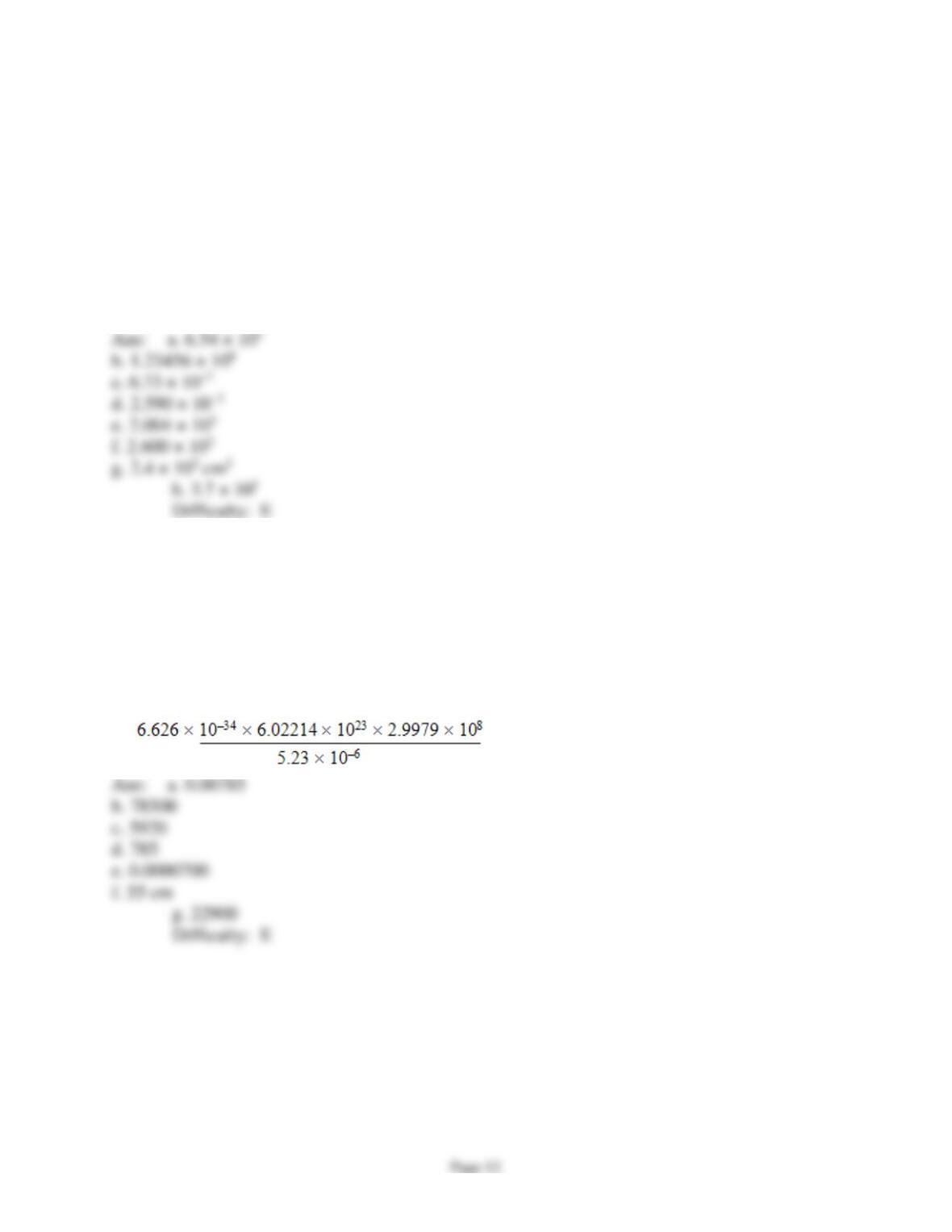
67. Write the following numbers and results in standard notation, with appropriate significant
figures.
a. 7.85 × 10⁻³
b. 7.85 × 10⁴
c. 5.920 × 10³
d. 7.85 × 10¹² ÷ 1010
e. 7.00 × 10⁻⁵
f. circumference of a circle, 2r, where r = 8.7 cm
g.
Chapter 1: Keys to the Study of Chemistry
68. In each of the sets below, choose the one quantity or number which is exact.
a. i. the human population
ii. the distance in light years from the sun to Alpha Centauri, a nearby star
iii. the winning time for the 100 m dash in the Olympic Games
b. i. the weight of a particular one cent coin in g
ii. the boiling point of lead, in °C
iii. the number of cm in 1 yd
c. i. the measured value of the speed of light (2.998… × 108 m/s)
ii. (3.141…)
iii. the volume of milk in a 1-gallon jug
69. The ripening of fruit, once picked, is an example of physical change.
70. An important aim in much chemical work is to use macroscopic measurements in order
to gain an understanding of the microscopic world.
71. The potential energy of a car moving on a level road does not depend on its speed.
72. When a wooden match burns in air, chemical potential energy is converted to kinetic
energy.
73. When applying the scientific method, it is important to avoid any form of hypothesis.
74. When applying the scientific method, a model or theory should be based on experimental
data.
75. The numerical value of any temperature expressed in Celsius is always different from the
numerical value of the same temperature in Fahrenheit.
76. The numerical value of any temperature expressed in Celsius is always different from the
numerical value of the same temperature in kelvin.

Chapter 1: Keys to the Study of Chemistry
77. The number 6.0448, rounded to 3 decimal places, becomes 6.045.
78. The number 6.0448, rounded to 2 decimal places, becomes 6.05.
79. The weight of a coin measured as 1.96235 g on one balance is definitely more accurate
than a weight measurement of 1.95 g on another balance.