
1) Bromine is much more apt to exist as an anion than is potassium. This is because
________.
A) Bromine has a greater electron affinity than potassium does
B) Bromine is bigger than potassium
C) Bromine has a greater ionization energy than potassium does
D) Bromine is a liquid and potassium is a solid
E) Bromine is more metallic than potassium
2) Which of the following is true?
A) If we know that a reaction is an elementary reaction, then we know its rate law.
B) The rate-determining step of a reaction is the rate of the fastest elementary step of its
mechanism.
C) Since intermediate compounds can be formed, the chemical equations for the
elementary reactions in a multistep mechanism do not always have to add to give the
chemical equation of the overall process.
D) In a reaction mechanism, an intermediate is identical to an activated complex.
E) All of the above statements are true.
3) How many moles of magnesium oxide are produced by the reaction of 3.82 g of
magnesium nitride with 7.73 g of water?
Mg3N2 + 3H2O → 2NH3 + 3MgO
A) 0.114
B) 0.0378
C) 0.429
D) 0.0756
E) 4.57
4) Calculate the concentration (M) of sodium ions in a solution made by diluting 50.0
mL of a 0.874 M solution of sodium sulfide to a total volume of 250.0 mL.
A) 0.175
B) 4.37
C) 0.525
D) 0.350
E) 0.874
5) What is the coefficient of M when the following equation is completed and balanced
if M is an alkali metal?
M (s) + H2O (l) →
A) 1
B) 2
C) 3
D) 4
E) 0
6) The concentration of lithium chlorate solution is 12.0% by mass. In a ________ g
sample of this solution, there are 238.5 g of dissolved lithium chlorate.
A) 1990
B) 28.6
C) 0.199
D) 5.03
E) 0.0503
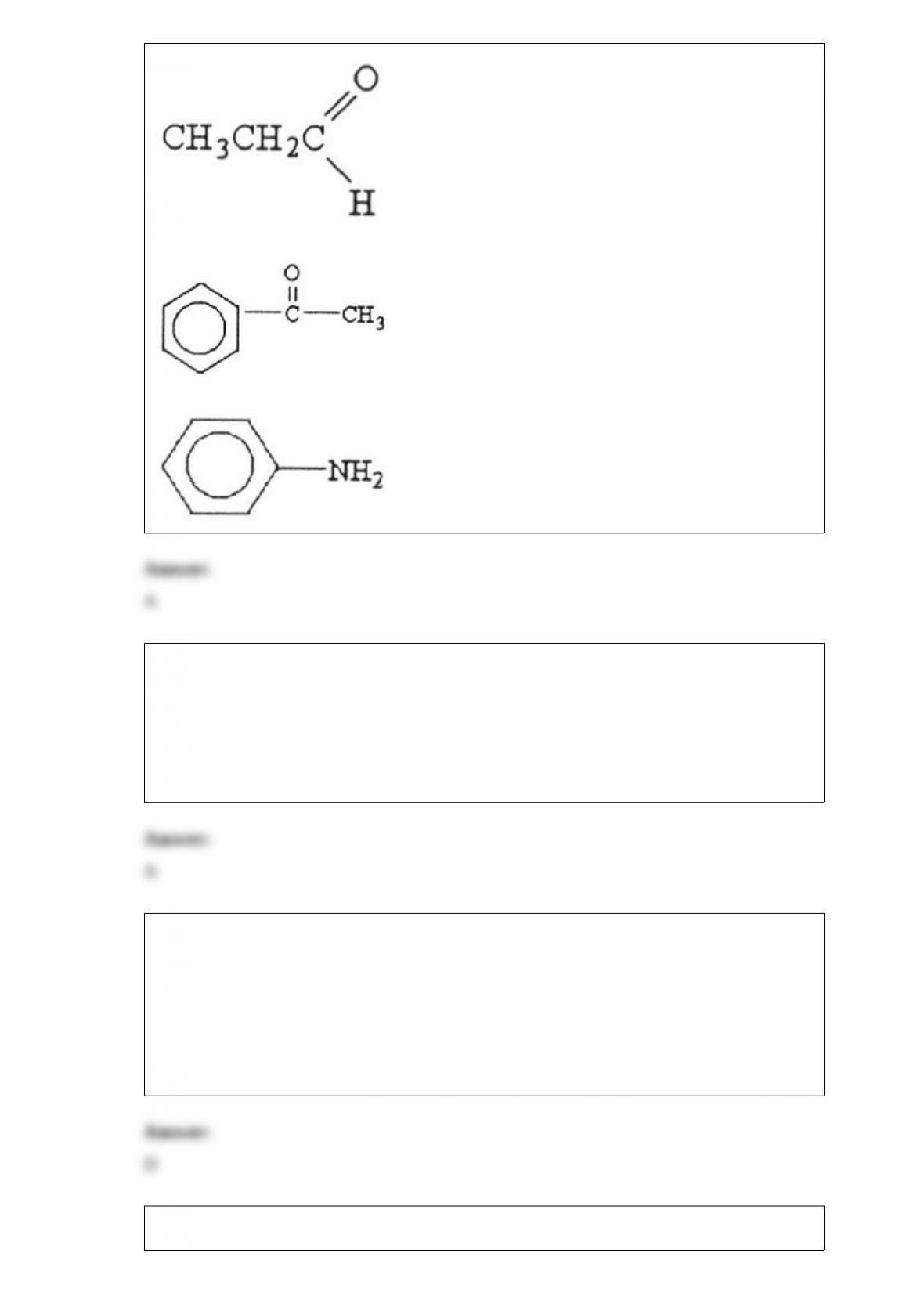
7) Which structure below represents an ether?
A)
B)
C)
D)
E)
8) A spectrum containing only specific wavelengths is called a(n) ________ spectrum.
A) line
B) continuous
C) visible
D) Rydberg
E) invariant
9) The electron-domain geometry and molecular geometry of the nitrite ion are
________ and ________, respectively.
A) trigonal bipyramidal, trigonal planar
B) tetrahedral, trigonal pyramidal
C) trigonal bipyramidal,T-shaped
D) trigonal planar, bent
E) T-shaped, trigonal planar
10) What color of visible light has the highest energy?

A) violet
B) blue
C) red
D) green
E) yellow
11) The formula of a salt is XCl2. The X-ion in this salt has 24 electrons. The metal X is
________.
A) Ni
B) Fe
C) Zn
D) V
E) Pd
12) The value of ΔH° for the reaction below is -336 kJ. Calculate the heat (kJ) released
to the surroundings when 23.0 g of HCl is formed.
CH4 (g) + 3Cl2 (g) → CHCl3 (l) + 3HCl (g)
A) 177 kJ
B) 2.57 x 10³ kJ
C) 70.7 kJ
D) 211 kJ
E) -336 kJ
13) Consider the following properties of an element:
(i)It is solid at room temperature.
(ii)It easily forms an oxide when exposed to air.
(iii)When it reacts with water, hydrogen gas evolves.
(iv)It must be stored submerged in oil.
Which element fits the above description the best?
A) sulfur
B) copper
C) mercury
D) sodium

E) magnesium
14) In which of the following atoms is the 3s orbital closest to the nucleus?
A) S
B) Po
C) Te
D) Se
E) P