You discover that the complex decomposes in water. You dissolve 0.1000 g of the
complex in H2O and add excess NaHg(SCN)4, which precipitates Co(II) as
CoHg(SCN)4(s). After the precipitate is washed and dried, its mass is 0.1102 g. How
many grams of cobalt are contained in 0.1000 g of the complex?
A) 0.1102
B) 0.0396
C) 0.0132
D) 0.437
E) 0.0548
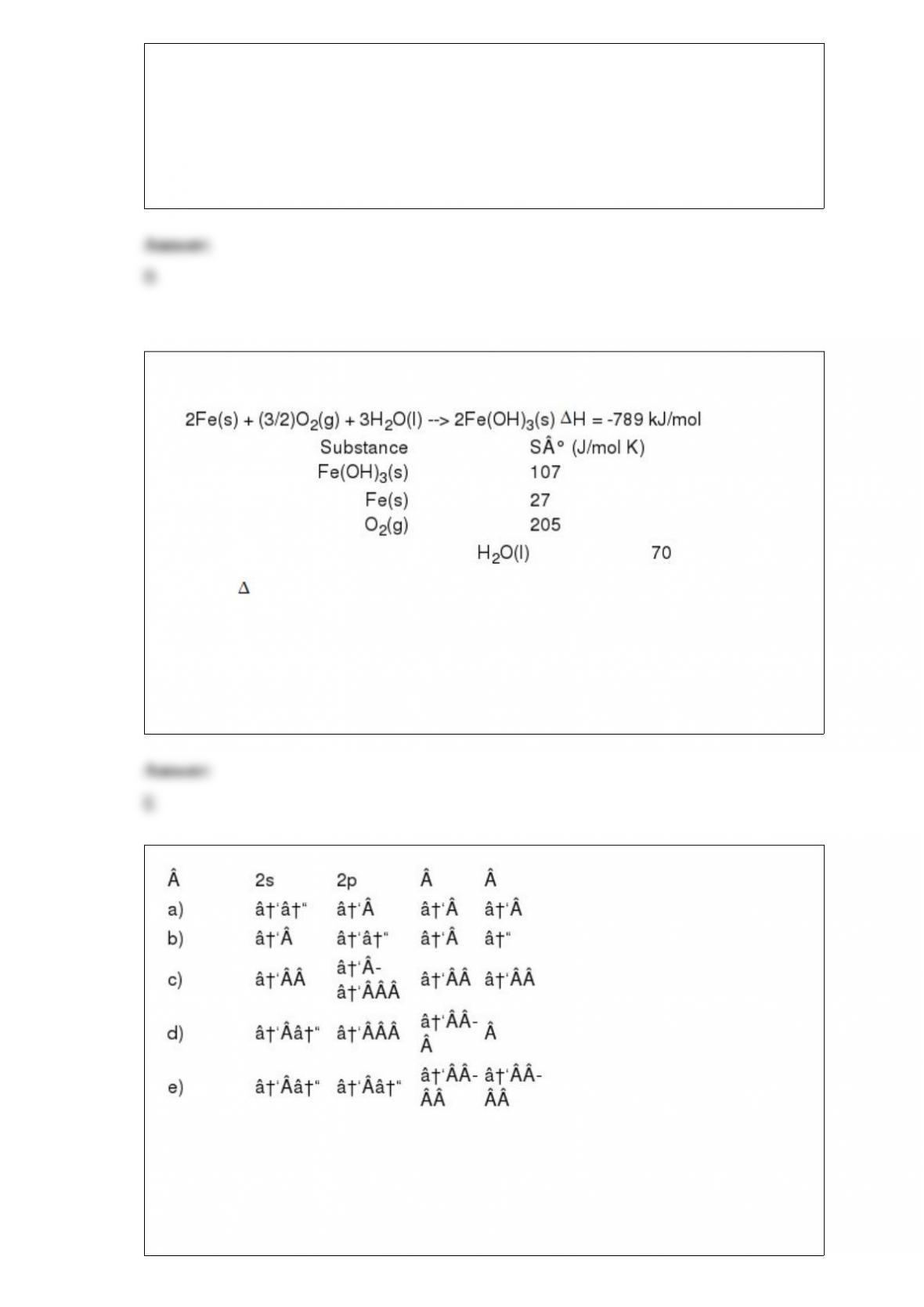
Which of the following is the strongest oxidizing agent?
A) MnO4–
B) I2
C) Zn2+
D) Zn
E) MnO2
Which of the following statements is true?
A) At equilibrium BOTH the rate of the forward reaction equals that of the reverse
reaction AND the rate constant for the forward reaction equals that of the reverse.
B) The equilibrium state is dynamic even though there is no change in concentrations.
C) The equilibrium constant for a particular reaction is constant under all conditions.
D) Starting with different initial concentrations will yield different individual
equilibrium concentrations and a different relationship of equilibrium concentrations.
E) None of these is true.
Consider the following reaction (assume an ideal gas mixture): 2NOBr(g) 2NO(g)
+ Br2(g) A 1.0-liter vessel was initially filled with pure NOBr, at a pressure of 4.0 atm,
at 300 K.
After equilibrium was established, the partial pressure of NOBr was 3.1atm. What is
Kpfor the reaction?
A) 0.26
B) 0.038
C) 0.13
D) 0.45
E) none of these
The following questions refer to the following reaction at constant 25°C and 1 atm.
Determine Ssurrfor the reaction (in kJ/mol K)
A) 3.14
B) 0.937
C) 0.378
D) 1.31
E) 2.65
Which represents the ground state for the N– ion?
A)option a
B)option b
C)option c
D)option d
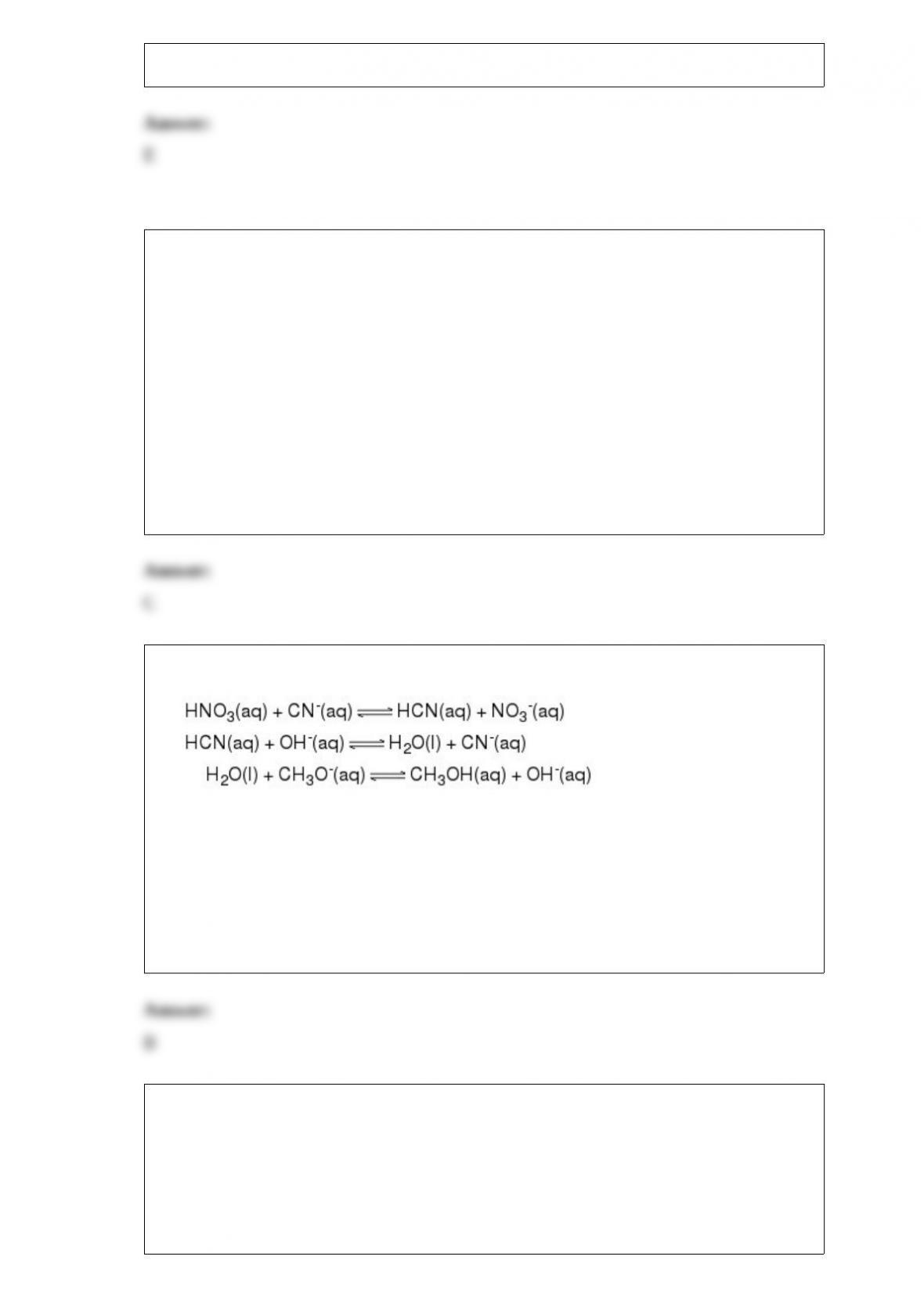
E)option e
Which of the following statements is/are true?
I. Because ionic forces are so much stronger than hydrogen bonds, no ionic compound
will be soluble in ethanol (CH3CH2OH)
II. Making of any solution in which a solid is dissolved in a liquid will always have a
positive entropy.
III. the heats of hydration of ions increase (become more exothermic) as ionic charge
increases
A)I and II only
B)I and III only
C) II and III only
D)all three are true
E)none are true
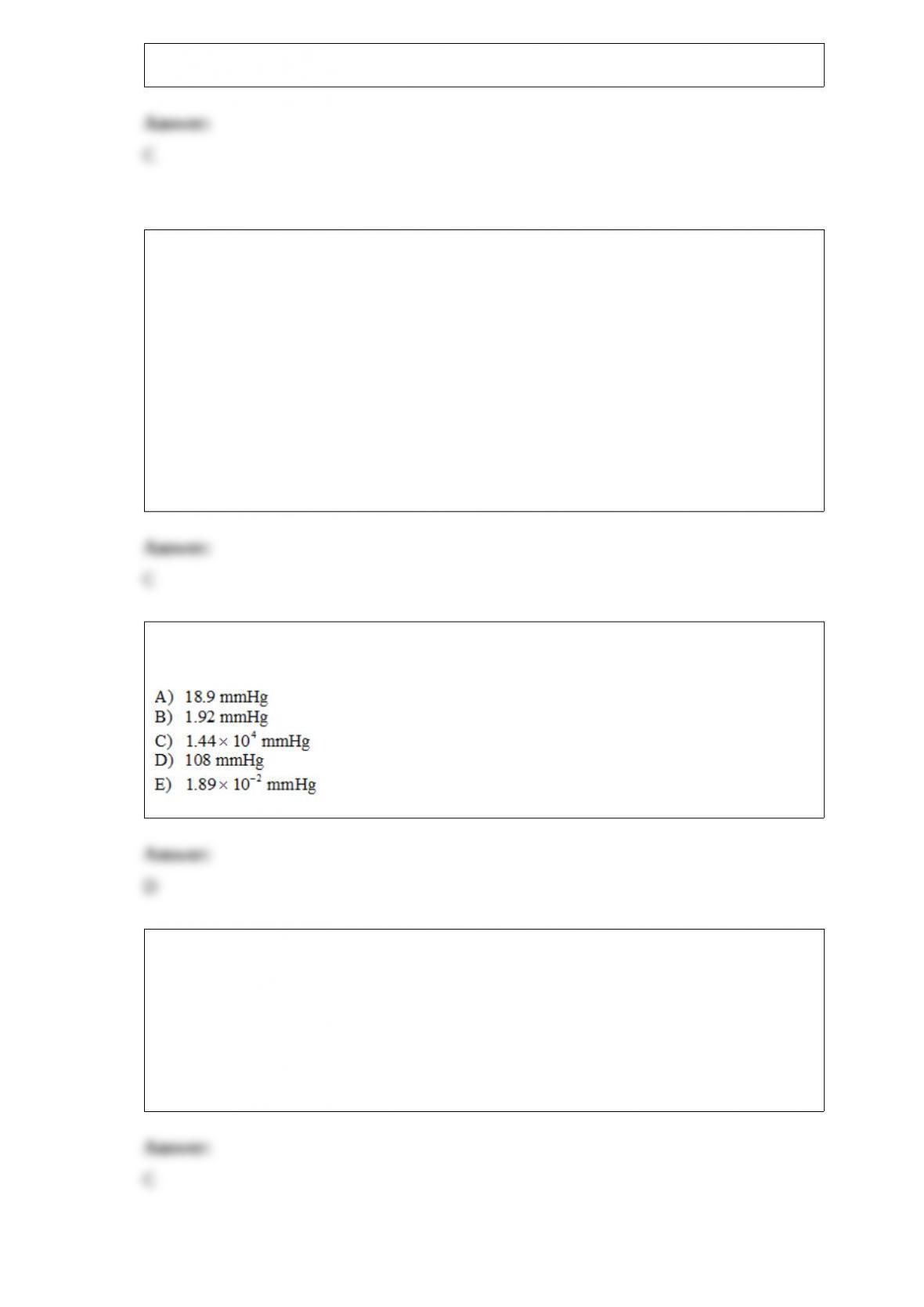
The following three equations represent equilibria that lie far to the right.
Identify the strongest acid.
A) HCN
B) HNO3
C) H2O
D) OH–
E) CH3OH
Select the correct molecular structure for the given species from the choices below:
IF4¯
A)pyramidal
B)tetrahedral
C)square planar
D)octahedral
E)none of these
Select the lattice energy for rubidium chloride from the following data [in kJ/mol]
Rb(s) => Rb(g)DH = 85.8
IE1(Rb)DH = 397.5
BE(Cl2)DH = 226
DHf(RbCl) = -431
EA Cl = -332
A)-53.7
B)+53.7
C)-695
D)-808
E)+808
A physics experiment is conducted at a pressure of 14.4 kPa. What is this pressure in
mmHg?
Calculate the molarity of an aqueous solution that is 12.8% by mass NaCl, given that
the density of the solution is 1.08 g/mL.
A)2.03 M
B)2.19 M
C)2.36 M
D)2.71 M
E)13.8 M
Which of the following statements is false?
A)The density of a gas is directly proportional to the external pressure.
B)The density of helium gas is double that of hydrogen gas.
C)The density of a gas is indirectly proportional to the temperature in Kelvin.
D)All gases have the same density at STP.
E)The density of a gas is independent of the volume.
What is the molar mass of tetraphosphorus decaoxide?
A)140 g/mol
B)410 g/mol
C)253 g/mol
D)204 g/mol
E)284 g/mol
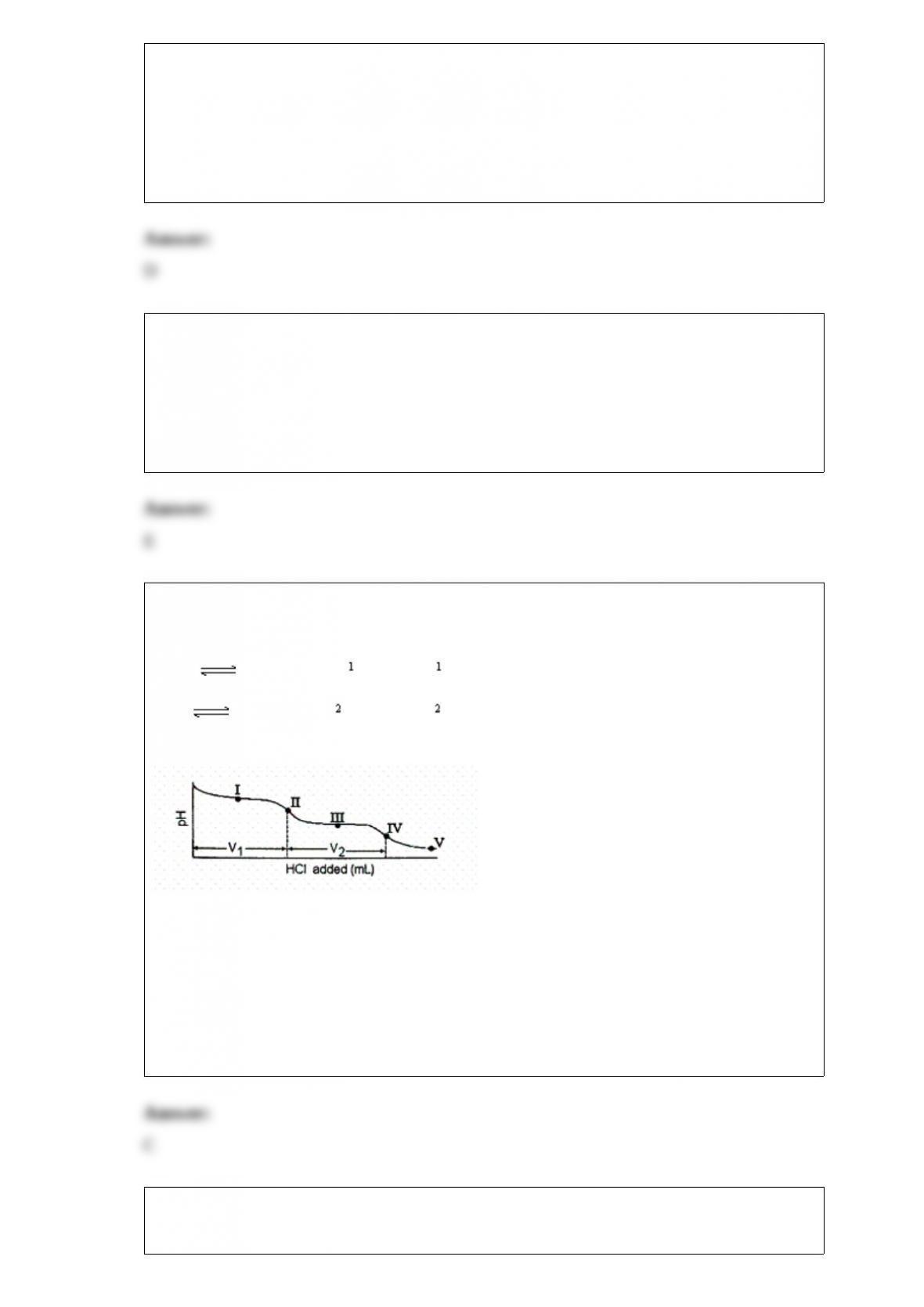
Consider the following information about the diprotic acid, ascorbic acid. (H2As for
short, molar mass 176.1)
H2As HAs–+ H+pKa= 4.10 (Ka= 7.9×10⁻⁵)
HAs– As2-+ H+pKa= 11.79 (Ka= 1.6×10⁻¹²)
The titration curve for disodium ascorbate, Na2As, with standard HCl is shown below:
What major species is (are) present at point III?
A) As2-and HAs–
B) HAs–only
C) HAs–and H2As
D) H2As only
E) H2As and H+
The measure of resistance to flow of a liquid is
A)van der Waals forces

B)vapor pressure
C)London forces
D)surface tension
E)viscosity
How many places on the ligand ethylene diamine can simultaneously bind to a single
metal atom?
A) 1
B) 2
C) 3
D) 4
E) 6