
Which statement is not true?
A. In forming a solution, the solute dissolves other substances that are called solvents.
B. Water is the solvent in an aqueous solution.
C. Pure water does not conduct electricity.
D. Electrolytes dissolved in water produce a solution that can conduct electricity.
Which reaction most accurately represents the dissociation of nitrous acid (HNO2) in
water?
A. HNO2 + H2O → H3O+ + NO2
B. HNO2 + H2O → H3O2+ + NO
C. HNO2 + H2O → HN + HO+ + HO2
D. HNO2 + H2O → H3O+ + N + O2
Weapons-grade uranium is approximately
A. 30% U-235
B. 60% U-235
C. 90% U-235
D. 90% U-239
Which would contribute most to your annual radiation dose?
A. living at an elevation 1,000 m above sea level
B. having a dental X-ray
C. living within 50 miles of a nuclear reactor
D. smoking a pack and a half of cigarettes per day
During petroleum refining, catalysts play an extremely important role during the
A. cracking and reforming processes.
B. environmental cleanup of oil wells.
C. extraction of the oil from the earth.
D. physical separation of the various components of the petroleum.

A 120-pound person uses 3 Calories per minute walking at a 20 min/mile pace.
Approximately, how many miles would a person have to walk to burn off a scoop of ice
cream (175 Calories)?
A. 1.5 miles
B. 2.0 miles
C. 2.5 miles
D. 3.0 miles
Which form of water disinfection continues to provide antibacterial protection after the
water leaves the purification plant?
A. chlorination
B. ozonation
C. UV radiation
D. filtration

How is heat energy used to generate electricity in a modern power plant?
A. Heat warms wires causing electrons to move through them more rapidly.
B. Heat boils water to make steam, which drives a turbine.
C. Heat warms the fins on a turbine, causing them to spin.
D. Heat generates strong magnetic fields through which the wires of a turbine move.
Which of the following countries is the largest consumer of coal (by total mass)?
A. China
B. United States
C. India
D. Indonesia
Why is water a liquid a room temperature instead of a gas?
A. It is a gas a room temperature.
B. Water has hydrogen bonds between the molecules.

C. Water is very acidic.
D. Water is a good solvent.
What is the concentration of hydroxide ions in an aqueous solution containing [H+] = 1
x 10-5 M?
A. 1 x 10⁻⁵ M
B. 1 x 10⁻⁷ M
C. 1 x 10⁻⁹ M
D. 1 x 10-14 M
Which covalent bond is the most polar?
A. H H
B. H O
C. H N
D. H S

In general, hydrogen bonds are
A. about ten times stronger than typical covalent bonds.
B. about 1/10 as strong as typical covalent bonds.
C. found in every molecule containing more than one hydrogen atom.
D. found only between H atoms in molecules like H2.
X-ray diffraction is a method for
A. determining the position of atoms in a crystal.
B. sequencing the primary structure of polymers.
C. inserting modified DNA into a cell.
D. dividing the DNA molecule into pieces for analysis.
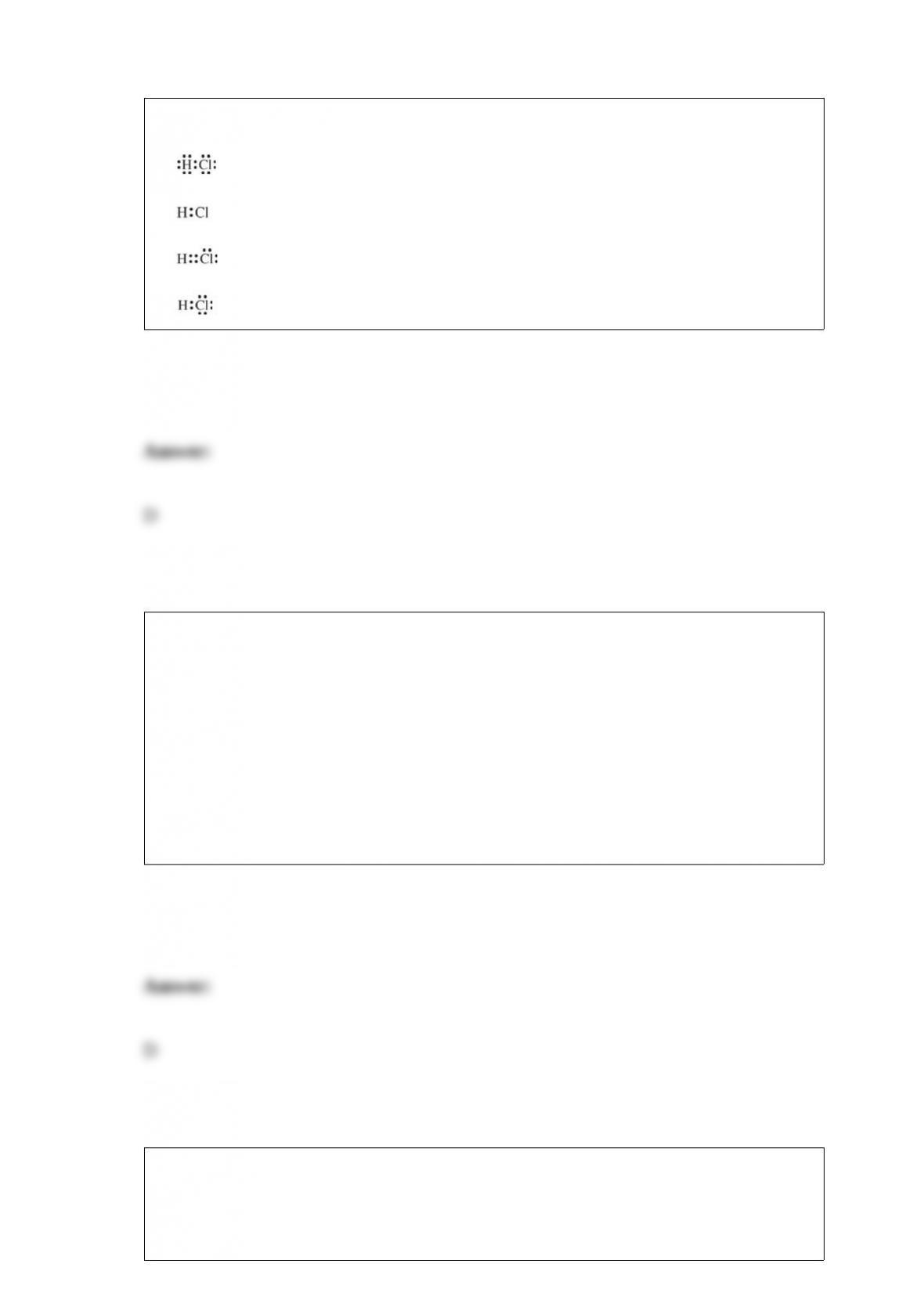
The correct Lewis structure for HCl is:
A.
B.
C.
D.
What is meant by malnutrition?
A. More calories than are necessary are consumed on a daily basis.
B. Daily caloric consumption is insufficient to meet metabolic needs.
C. Sufficient carbohydrate, fats, and proteins are consumed, but diet lacks
micronutrients.
D. The diet islacking in proper nutrients, even though caloric intake may be sufficient.
The octet rule is applied to bonding in carbon containing compounds. In accordance
with the octet rule,
A. each bonded carbon atom forms eight bonds.

B. all carbon containing compounds contain at least eight bonds.
C. each bonded carbon atom shares electrons so that it has exactly eight outer valence
electrons.
D. the number of atoms in any carbon containing compound is a multiple of eight.
Which substances are regulated by the Kyoto Protocol?
I. argon
II. carbon dioxide
III. nitrogen
IV. nitrous oxide
V. sulfur hexafluoride
A. I, II, and III only
B. I and III only
C. II, IV, and V only
D. II and V only

Semiconductors, such as the element silicon, may be used in cells that convert solar
radiation to electricity. One of the major difficulties encountered in using silicon is that
it
A. is one of the rarest of all elements and therefore difficult to find on earth.
B. is expensive to produce large quantities of extremely pure silicon.
C. quickly evaporates when isolated in a pure state.
D. is the most active of all the elements, so it cannot be prepared in a pure state.
The acid neutralizing capacity of a lake or stream most often derives from the presence
of _______ in the surrounding soil or rock.
A. CaCO3
B. HNO3
C. NaCl
D. Sr(OH)2
Which statement is correct?
A. UV-A is the most energetic of the three forms of UV light.

B. UV-B is the most energetic of the three forms of UV light.
C. UV-C is the most energetic of the three forms of UV light.
D. UV-A, UV-B, and UV-C are equally energetic.
Which of these statements are correct for both addition and condensation
polymerization?
I. Monomer units chemically bond together.
II. Product contains all the atoms of the starting material.
III. A second product, like water, is also formed during the polymerization process.
A. I only
B. I and II
C. II only
D. II and III
The drawing shows a simple way of purifying salt water. What is this process called?
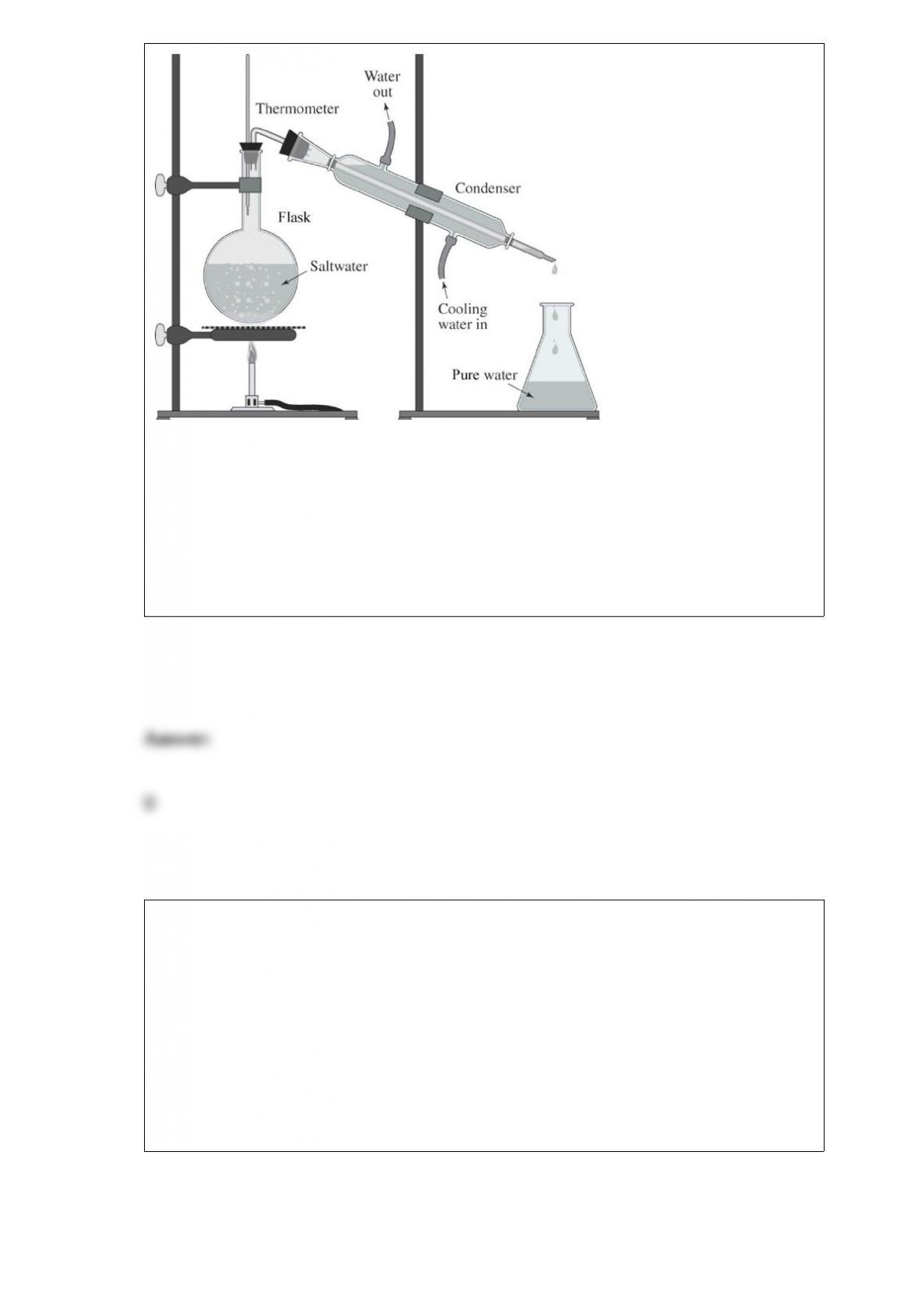
A. filtration
B. distillation
C. ozonation
D. chlorination
If you have 200.0 g of radioisotope with a half-life of 5 days, how much isotope would
remain after 15 days?
A. 12.5 g
B. 13.3 g
C. 25.0 g
D. 40.0 g

Which type of battery is widely used to store the excess energy generated by windmill
farms and solar panels?
A. alkaline
B. lithium ion
C. lead acid
D. nickel-metal hydride
Mixing which of the following will produce a precipitation reaction (give an insoluble
product)?
A. HNO3 (aq) and Sr(OH)2(aq)
B. LiNO3 and NaI
C. Na2SO4(aq) and Ba(OH)2(aq)
D. NaOH and KBr

Which of the following is/are true about Maximum Contaminant Level Goals
(MCLGs)?
I. The MCLG for any contaminant that is regulated as a carcinogen is set to zero.
II. An average person weighing 70 kg (154 lb) could drink two liters (about two quarts)
of water containing a contaminant at the MCGL level every day for 70 years without
suffering any ill effects.
III. The Maximum Contaminant Level (MCL) set by the EPA may be higher than the
MCLG to account for the financial and technical barriers that may make achieving
these goals difficult.
IV. The MCLG for a contaminant is always set to zero because this is the best way to
protect human health.
A. II only
B. I and II only
C. I, II, and III only
D. I, II, III, and IV
A NiCd battery uses nickel and cadmium to produce a potential difference. Using these
equations, answer the following questions.
I. 2NiO(OH) (s) + 2H2O (l) + 2 e– → 2Ni(OH)2(s) + 2 OH (aq)
II. Cd (s) + 2OH (aq) → Cd(OH)2 (s) + 2e
III. Cd (s) + 2NiO(OH) (s) + 2 H2O (l) → 2 Ni(OH)2(s) + Cd(OH)2(s)
Which equation represents what takes place at the anode?
A. I
B. II
C. III
D. I and II
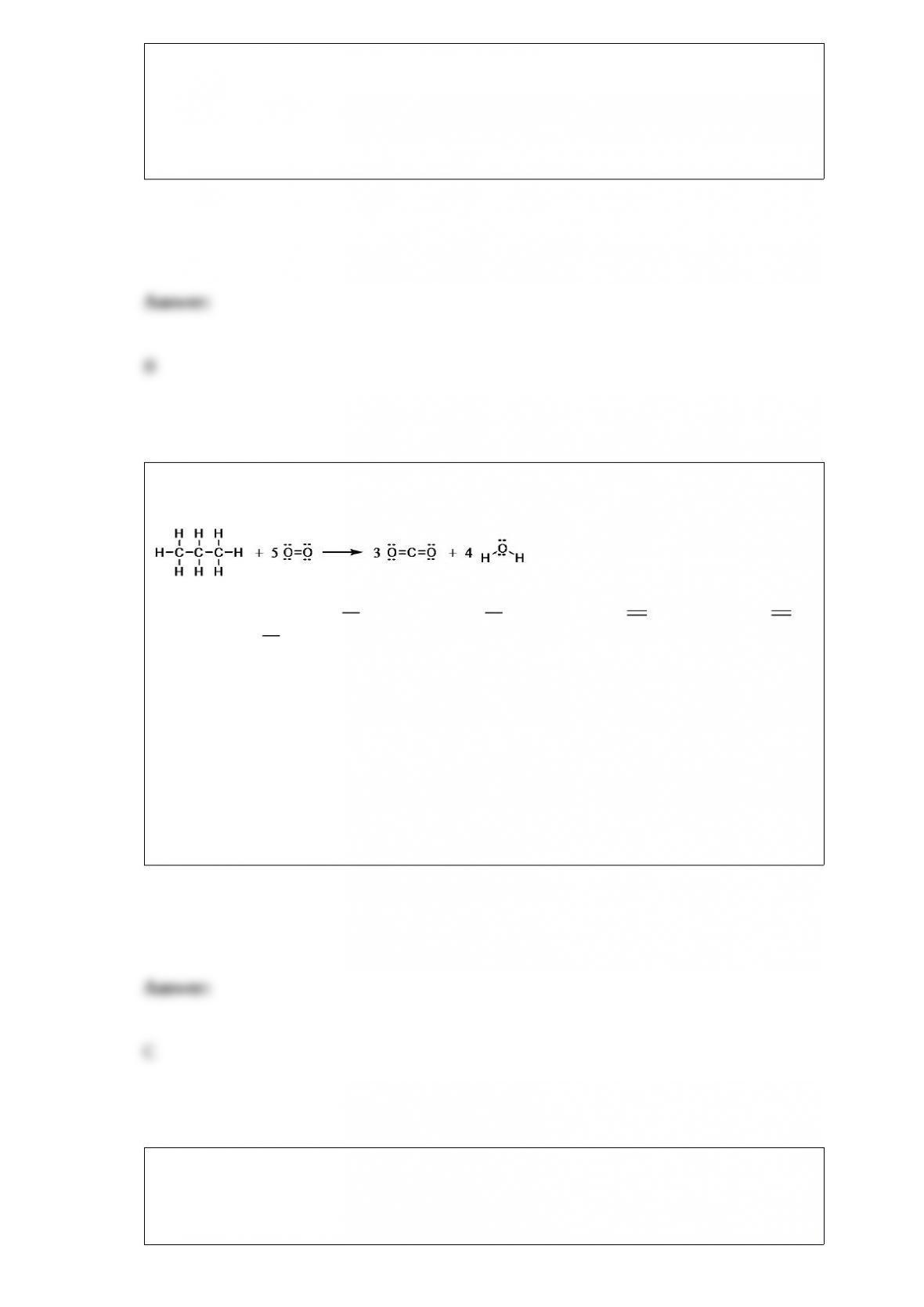
Consider the following equation that describes the complete combustion of propane,
C3H8.
The bond energies are: C H 416 kJ/mol; C C 356 kJ/mol; O O 498 kJ/mol; C O
803 kJ/mol; H O 467 kJ/mol. Which is the total amount of energy required to break
all of the bonds in propane?
A. 712 kJ/mol
B. 3328 kJ/mol
C. 4040 kJ/mol
D. 4396 kJ/mol
Although coal is a complex mixture of substances, its elemental composition can be
approximated by the formula C135H96O9NS. Using this chemical formula, calculate the
percentage, by mass, of carbon (C) in coal.

A. 85%
B. 67%
C. 56%
D. 20%
The rad (radiation absorbed dose) is defined as the absorption of 0.01 J of radiant
energy per kilogram (0.01 J/kg) of body weight. What is the radiation dose for a 50 kg
woman exposed to 0.85 J of energy?
A. 0.085 rad
B. 0.017 rad
C. 1.70 rad
D. It depends on the radiation source.
If 1.8 1014 J is releasedin a nuclear reaction, how much matter was lost?
A. 2.0 103 kg
B. 7.2 102 kg

C. 6.0 105 kg
D. 1.6 1031 kg