
1) An ideal gas differs from a real gas in that the molecules of an ideal gas ________.
A) have no attraction for one another
B) have appreciable molecular volumes
C) have a molecular weight of zero
D) have no kinetic energy
E) have an average molecular mass
2) A certain liquid has a density of 2.67 g/cm3. 1340 g of this liquid would occupy a
volume of
________ L.
A) 1.99 X 10⁻³
B) 50.2
C) 3.58
D) 35.8
E) 0.502
3) Which one of the following is most likely to gain electrons when forming an ion?
A) Mn
B) Zn
C) F
D) Li
E) Al
4) When the following equation is balanced, the coefficient of H2O is ________.
Ca (s) + H2O (l) → Ca(OH)2 (aq) + H2 (g)
A) 1
B) 2
C) 3
D) 5
E) 4
5) The careful, thermal decomposition of solid ammonium nitrate will yield ________.
A) N2O
B) NO
C) NO2
D) N2O3
E) N2O5
6) Which one of the following is an exothermic process?
A) ice melting
B) water evaporating
C) boiling soup
D) condensation of water vapor
E) Ammonium thiocyanate and barium hydroxide are mixed at 25 °C: the temperature
drops.
7) What are the respective concentrations (M) of Na+ and SO4
2- afforded by dissolving
0.500 mol Na2SO4 in water and diluting to 1.33 L?
A) 0.665 and 0.665
B) 0.665 and 1.33
C) 1.33 and 0.665
D) 0.376 and 0.752
E) 0.752 and 0.376
8) The formula weight of LiClO4 is ________ amu.
A) 212.3
B) 101.0
C) 52.0
D) 106.3
E) 58.3
9) The correct name for HClO is ________.
A) hydrochloric acid
B) perchloric acid
C) chloric acid
D) chlorous acid
E) hypochlorous acid
10) A second-order reaction has a half-life of 12 s when the initial concentration of
reactant is 0.98 M. The rate constant for this reaction is ________ M-1s-1.
A) 12
B) 2.0 x 10⁻²
C) 8.5 x 10⁻²
D) 4.3 x 10⁻²
E) 4.3
11) The energy of a photon that has a frequency of 8.21 X 10¹⁵ s-1 is ________ J.
A) 8.08 X 10-50
B) 1.99 X 10⁻²⁵
C) 5.44 X 10⁻¹⁸
D) 1.24 X 1049
E) 1.26 X 10⁻¹⁹
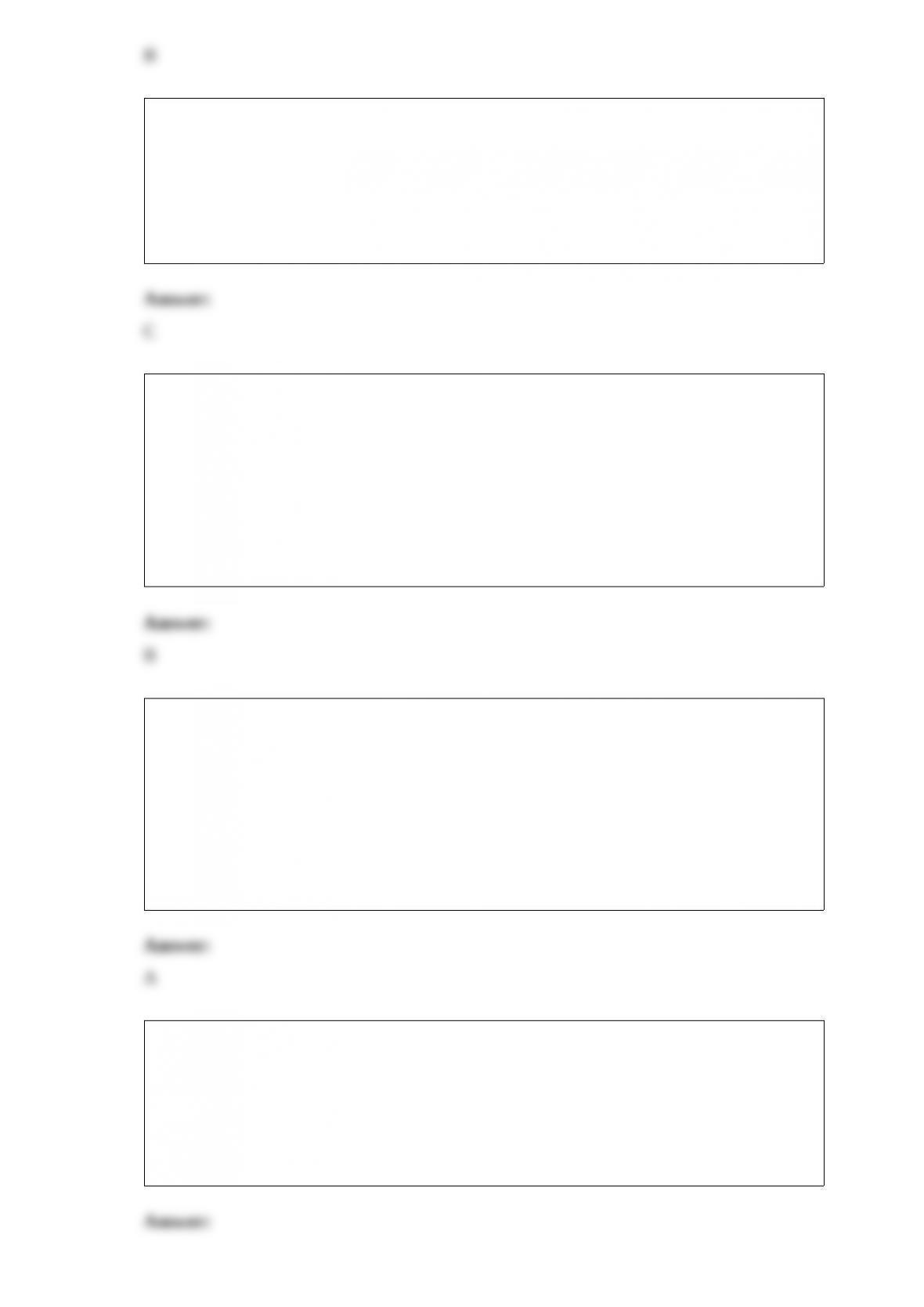
12) Of the following, only ________ is impossible for an ideal gas.
A) =
B) =
C) =
D) =
E) = = 0
13) The F-B-F bond angle in the BF3 molecule is ________.
A) 90°
B) 109.5°
C) 120°
D) 180°
E) 60°
14) The disilicate ion is ________.
A) Si2O8
8-
B) Si2O7
6-
C) Si2O8
4-
D) Si2O8
6-
E) Si2O7
2-
15) Element M reacts with chlorine to form a compound with the formula MCl2.
Element M is more reactive than magnesium and has a smaller radius than barium. This
element is ________.
A) Sr
B) K
C) Na
D) Ra
E) Be
16) What is the coordination number of iron in CaNa[Fe(CN)6]?
A) 2
B) 8
C) 4
D) 6
E) 12

17) Which of the following substances is more likely to dissolve in water?
A) HOCH2CH2OH
B) CHCl3
C) O
CH3(CH2)9CH
D) CH3(CH2)8CH2OH
E) CCl4
18) The concentration of a solution of lithium chlorite dissolved in water is 12.5% by
mass. In a
________ g sample of this solution, there are 52.5 g of water.
A) 60.0
B) 45.9
C) 0.00600
D) 23.8
E) 1.67
19) The combustion of ammonia in the presence of excess oxygen yields NO2 and H2O:
4 NH3 (g) + 7 O2 (g) → 4 NO2 (g) + 6 H2O (g)
The combustion of 43.9 g of ammonia produces ________ g of NO2.
A) 2.58
B) 178
C) 119
D) 0.954
E) 43.9