20) Examples of comparative advantage often begin with two countries that each produce the
same two goods. Each country is then shown to have a comparative advantage in producing the
good it can produce at a lower opportunity cost, and specializes in the production of the good for
which it has a comparative advantage. How do these examples prove that both nations are made
better off as a result of trade than they would be without trade?
21) What are terms of trade?
22) Suppose in Vietnam a worker can produce either 16 units of cloth or 2 bicycles while in
China a worker can produce either 20 units of cloth or 5 bicycles.
a. Which country has an absolute advantage in cloth production? In bicycle production?
b. What is the opportunity cost of 1 unit of cloth in Vietnam? In China?
c. What is the opportunity cost of 1 bicycle in Vietnam? In China?
d. Which country has a comparative advantage in cloth production? In bicycle production?
e. Suppose each country has 1,000 workers. Currently, each country devotes 40 percent of its
labor force to cloth production and 60 percent to bicycle production. What is the output of cloth
and bicycles for each country and what is the total output of cloth and bicycles between the two
countries?
f. Suppose each country specializes in the production of the good in which it has a comparative
advantage. What is the total output of cloth and bicycles in the two countries?
g. Provide a numerical example to show how Vietnam and China can both gain from trade.
Assume that the terms of trade are established at 6 units of cloth for 1 bicycle.
23) How does the U.S. federal government assist workers who have lost their jobs due to
international trade?
9.4 Government Policies That Restrict International Trade
1) Free trade refers to trade between countries
A) that is without shipping costs.
B) that is licensed by both governments.
C) that is without restrictions.
D) of products which are free to low-income consumers.
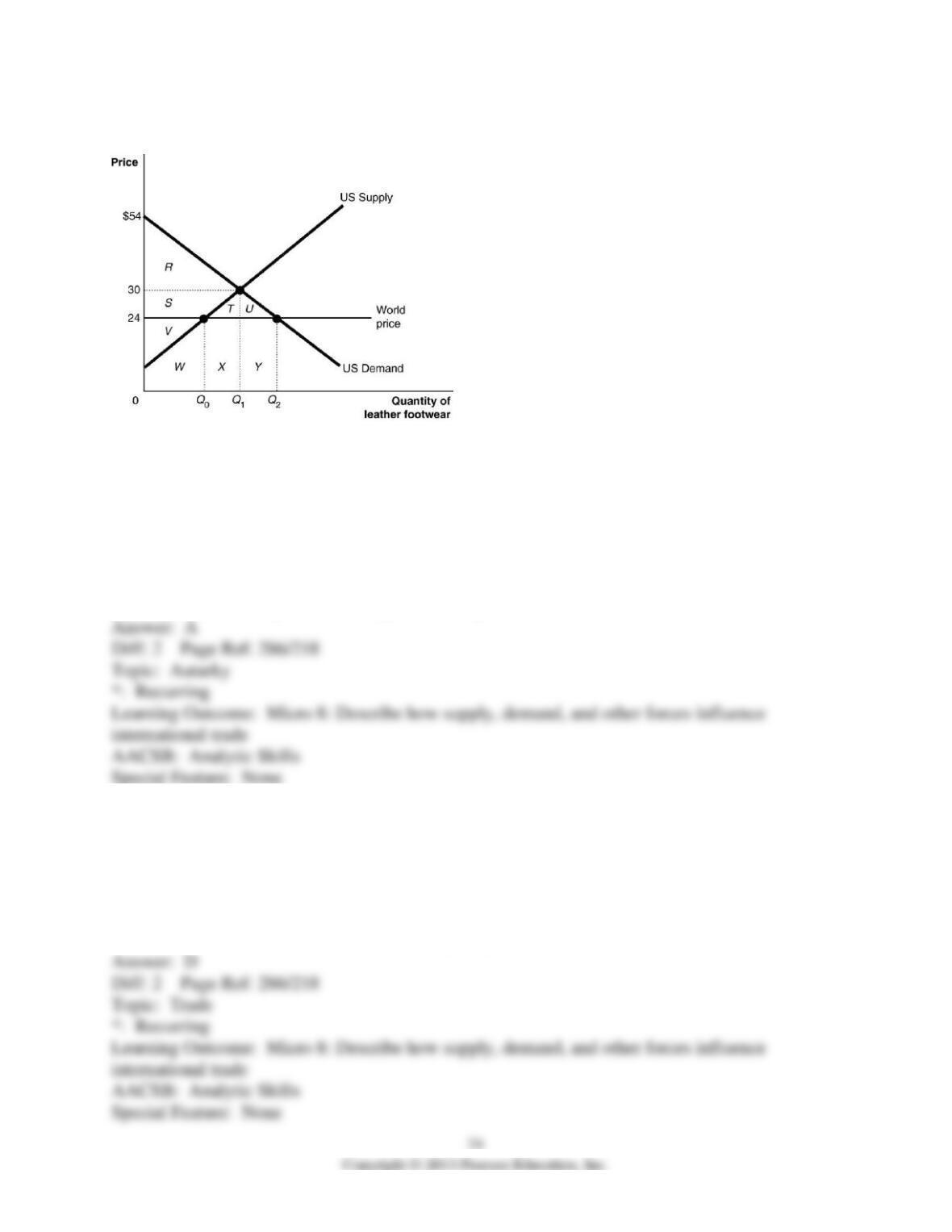
Figure 9-1
Figure 9-1 shows the U.S. demand and supply for leather footwear.
2) Refer to Figure 9-1. Under autarky, the equilibrium price is ________, the consumer surplus
is ________ and the producer surplus is ________.
A) $30; consumer surplus = area R; producer surplus = area S + V
B) $30; consumer surplus = area R + S + V; producer surplus = area T + W+ X
C) $24; consumer surplus = area R + S; producer surplus = area V
D) $30; consumer surplus = area R; producer surplus = area S + T + V + W + X
3) Refer to Figure 9-1. Suppose the government allows imports of leather footwear into the
United States. What happens to the market price and what is the quantity of imports?
A) The price equals $24 and imports equal Q2 units.
B) The price falls to $24 and imports equal Q2 – Q1 units.
C) The price falls to $24 and imports equal Q1 – Q0 units.
D) The price equals $24 and imports equals Q2 – Q0 units.
4) Refer to Figure 9-1. Suppose the government allows imports of leather footwear into the
United States. The market price falls to $24. What areas represent consumer surplus and
domestic producer surplus?
A) Consumer surplus = R + S; producer surplus = V.
B) Consumer surplus = R + S + T + U; producer surplus = V.
C) Consumer surplus = R + S + T + U; producer surplus = V + W + X + Y.
D) Consumer surplus = R + S + T; producer surplus = W + X + Y.
5) Which of the following is an example of a trade restriction?
A) Japan places a tax on all Korean automobiles.
B) Domestic wine is more expensive than wine imported from Chile.
C) The United States, Canada, and Mexico sign the NAFTA agreement.
D) Consumers prefer German beer to domestic beer.
6) International trade
A) harms consumers but helps exporting firms.
B) helps consumers but harms exporting firms and their workers.
C) helps consumers but hurts firms that are less efficient than their foreign competitors.
D) helps consumers and firms that compete with their foreign competitors.
7) A quota is
A) a limit placed on the quantity of goods that can be imported into a country.
B) a tax imposed by a government on goods imported into a country.
C) a subsidy granted to importers of a vital input.
D) a health and safety restriction imposed on an imported product.
8) A tax imposed by a government on imports of a good into a country is called a
A) tariff.
B) quota.
C) value added tax.
D) sales tax.
9) Which of the following is the best example of a quota?
A) a subsidy from the U.S. government to domestic manufacturers of residential air conditioners
to enable them to compete more effectively with foreign producers
B) a limit on the quantity of residential air conditioners that can be imported from a foreign
country
C) a $150 fee imposed on all imported residential air conditioners
D) a tax placed on all residential air conditioners sold in the domestic market to help offset the
impact of emissions on the environment
10) A tariff
A) makes domestic consumers better off.
B) makes both domestic producers and consumers better off.
C) makes everyone worse off.
D) makes domestic producers better off.
Figure 9-2
Suppose the U.S. government imposes a $0.75 per pound tariff on coffee imports. Figure 9-2
shows the impact of this tariff.
11) Refer to Figure 9-2. The tariff revenue collected by the government equals
A) $10 million.
B) $15 million.
C) $19.875 million.
D) $35 million.
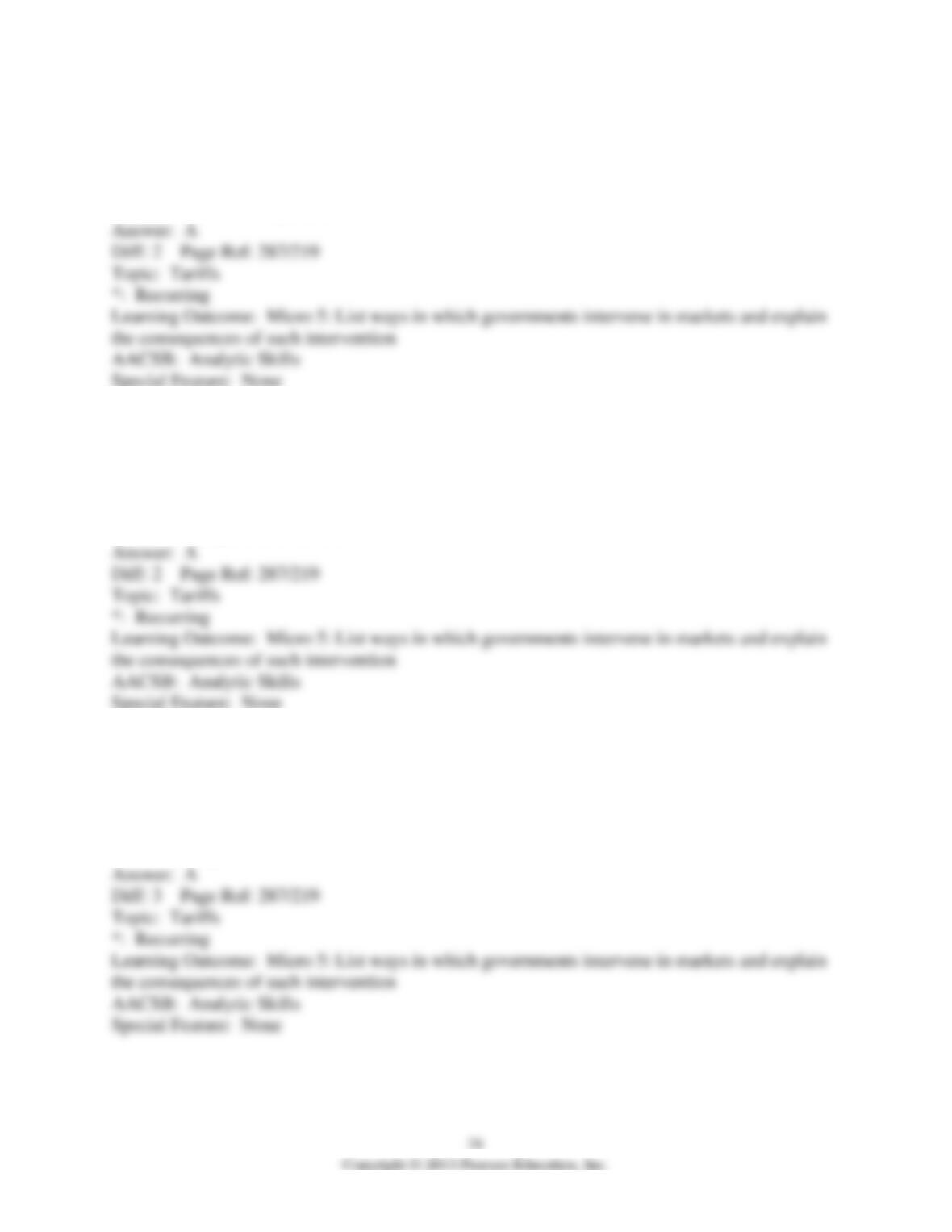
12) Refer to Figure 9-2. With the tariff in place, the United States
A) imports 20 million pounds of coffee.
B) imports 12 million pounds of coffee.
C) imports 18 million pounds of coffee.
D) exports 38 million pounds of coffee.
13) Refer to Figure 9-2. As a result of the tariff, domestic producers increase their quantity
supplied by
A) 6 million pounds of coffee.
B) 18 million pounds of coffee.
C) 26 million pounds or coffee.
D) 38 million pounds of coffee.
14) Refer to Figure 9-2. The increase in domestic producer surplus as a result of the tariff is
equal to
A) $11.25 million.
B) $18 million.
C) $32.5 million.
D) $45 million.
15) Refer to Figure 9-2. The tariff causes domestic consumption of coffee
A) to fall by 27 million pounds.
B) to fall by 7 million pounds.
C) to rise by 6 million pounds.
D) to rise by 20 million pounds.
16) Refer to Figure 9-2. The loss in domestic consumer surplus as a result of the tariff is equal to
A) $5 million.
B) $19.875 million.
C) $24.875 million.
D) $31.125 million.
17) A voluntary export restraint is an agreement negotiated by two countries that places
________ that can be imported by one country from another country.
A) a tax on goods
B) a minimum quantity of a good
C) quality standards on goods
D) a numerical limit on the quantity of a good
18) In the 1980s Japan agreed to limit the quantity of automobiles it would export to the United
States. Why did the Japanese government agree to this trade restriction?
A) Japanese automobile producers lobbied for the restrictions in order to increase the price of
their exports to the United States.
B) The Japanese government wanted to limit sales to the United States in order to make more
automobiles available for Japanese consumers.
C) The Japanese government feared that the alternative would be a tariff or quota on imports of
Japanese automobiles imposed by the U.S. government.
D) The Japanese government wanted more automobiles to be available for export to countries
other than the United States.
19) Which of the following is the best example of a tariff?
A) a limit imposed on the number of sports utility vehicles that the United States can import
from Japan
B) a subsidy granted by the U.S. government to domestic garment manufacturers so they can
compete more effectively with foreign garment manufacturers
C) a tax placed on all sports utility vehicles sold in the domestic market
D) a $5,000 per-car fee imposed on all sports utility vehicles imported into the United States
20) In order to avoid the imposition of other types of trade barriers, foreign producers will
sometimes agree to limit their exports to a country. What are these types of agreements called?
A) involuntary export restraints
B) voluntary export restraints
C) implicit quotas
D) sanctions
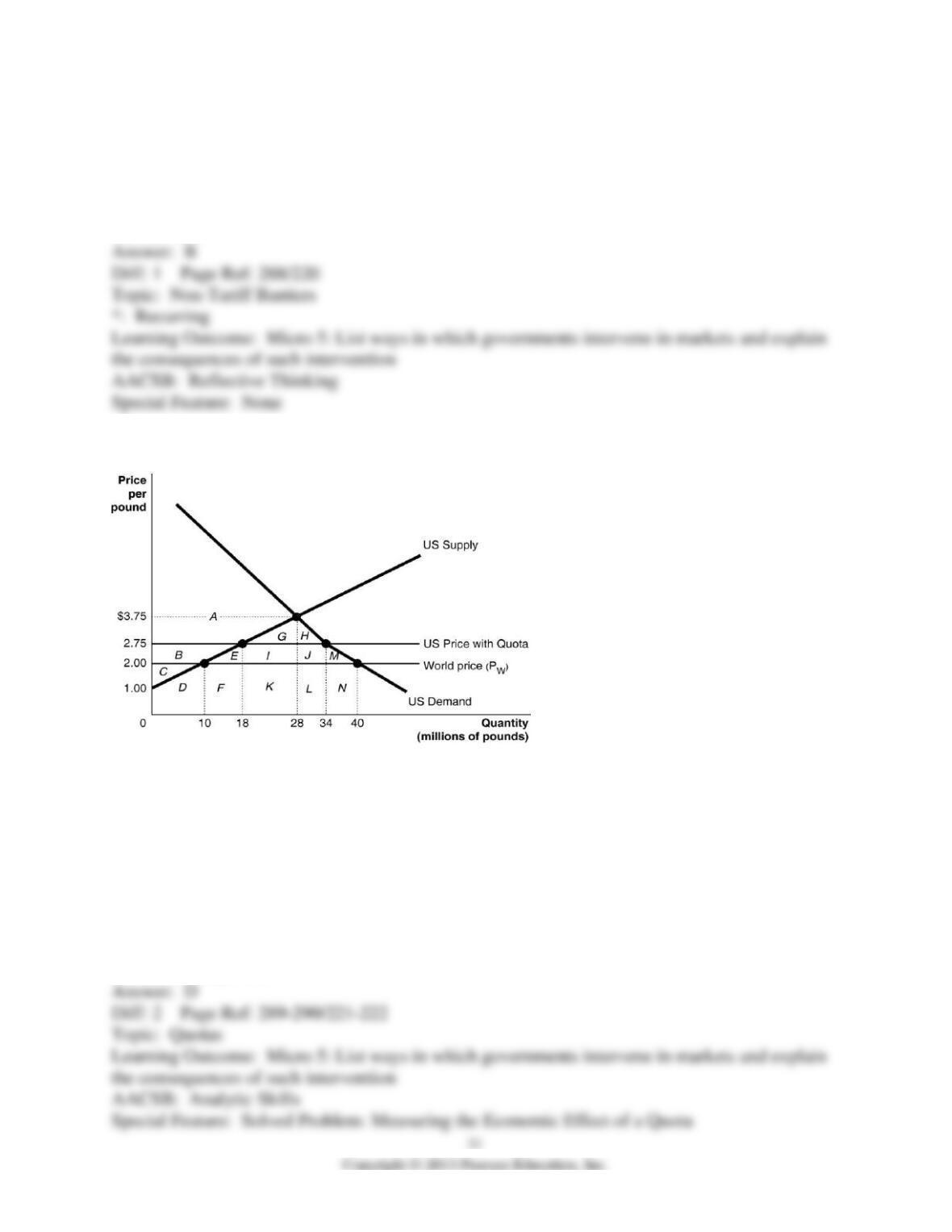
Figure 9-3
Since 1953 the United States has imposed a quota to limit the imports of peanuts. Figure 9-3
illustrates the impact of the quota.
21) Refer to Figure 9-3. Without the quota, the domestic price of peanuts equals the world price
which is $2.00 per pound. What is the quantity of peanuts demanded by domestic consumers in
the absence of a quota?
A) 10 million pounds
B) 28 million pounds
C) 30 million pounds
D) 40 million pounds
22) Refer to Figure 9-3. If there was no quota, how many pounds of peanuts would be imported?
A) 16 million
B) 28 million
C) 30 million
D) 40 million
23) Refer to Figure 9-3. What is the value of domestic producer surplus without a quota?
A) $5 million
B) $15.75 million
C) $38.5 million
D) $53.5 million
24) Refer to Figure 9-3. With a quota in place, what is the quantity consumed in the domestic
market and what portion of this is supplied by imports?
A) Domestic consumption equals 28 million pounds of which 18 million pounds are imports.
B) Domestic consumption equals 40 million pounds of which 22 million pounds are imports.
C) Domestic consumption equals 34 million pounds of which 16 million pounds are imports.
D) Domestic consumption equals 34 million pounds of which 18 million pounds are imports.
25) Refer to Figure 9-3. What is the value of consumer surplus after the imposition of the quota?
A) $8 million
B) $26.25 million
C) $45.5 million
D) $72.25 million
26) Refer to Figure 9-3. What is the value of domestic producer surplus after the imposition of a
quota?
A) $10.75 million
B) $15.75 million
C) $17.25 million
D) $27.75 million
27) Refer to Figure 9-3. What is the value of revenue to foreign producers who are granted
permission to sell in the U.S. market when there is a quota?
A) $12 million
B) $17.25 million
C) $20 million
D) $44 million
28) Refer to Figure 9-3. What is the value of the deadweight loss as a result of the quota?
A) $5.25 million
B) $8 million
C) $17.25 million
D) $20 million
29) Which of the following is common to both tariffs and quotas?
A) Tariffs and quotas are both used as a means to increase government revenue.
B) Tariffs and quotas both increase economic efficiency.
C) Tariffs and quotas are both designed to reduce foreign competition faced by domestic firms.
D) Tariffs and quotas are both examples of voluntary export restraints.
30) Trade restrictions are often motivated by a desire to save domestic jobs threatened by
competition from imports. Which of the following counter-arguments is made by economists
who oppose trade restrictions?
A) Statistics show that trade restrictions actually do not save jobs.
B) Consumers pay a high cost for jobs saved through trade restrictions.
C) Trade restrictions have a limited impact because most Americans prefer domestic goods over
imports.
D) Trade restrictions benefit consumers in the short run but not in the long run.
31) Which of the following statements is true?
A) Economic efficiency would be increased if the United States eliminated all of its trade
restrictions, but only if all other countries eliminated their trade restrictions too.
B) The U. S. economy would gain from the elimination of its tariffs but not from the elimination
of its quotas.
C) Eliminating its tariffs and quotas unilaterally would not benefit the United States because this
would remove the leverage it would have to persuade other countries to eliminate their trade
restrictions.
D) The U.S. economy would gain from the elimination of tariffs and quotas even if other
countries do not reduce their tariffs and quotas.
32) Governments sometimes erect barriers to trade other than tariffs and quotas. Which of the
following is not an example of this type of trade barrier?
A) a requirement that the employees of domestic firms that engage in foreign trade pay income
taxes
B) a requirement that imports meet health and safety requirements
C) restrictions on imports for national security reasons
D) a requirement that the U.S. government buy military uniforms only from U.S. manufacturers