
Chapter 9: Optics
TRUE/FALSE
1. You can see your image in a mirror because of diffuse reflection.
2. You do not see your image when you look at a flat rough aluminum surface because of
specular reflection.
3. Liquid crystal displays make use of interference of light.
4. Light spreads out when it passes through a narrow slit because of interference.
5. When light passes through two or more narrow slits, an alternating dark and bright pattern is
observed on a screen because of interference.
6. Certain types of sunglasses are very effective at diminishing light reflected from surfaces
because of polarization.
7. Optical fibers work because of dispersion of light.
8. You see colors in a rainbow because of diffraction.
9. Blue light travels more slowly through glass than red light does.
10. A light ray bends when it goes from one medium to another because of diffraction.
11. A light ray can pass through a diverging lens without being deflected.

12. The path of a light ray through a refracting surface is reversible.
13. When you look into a pool of water, the depth looks less than it actually is because the light
is dispersed.
14. Dispersion results because the speed of light in a transparent medium varies with frequency.
15. Light is a transverse wave.
16. Light goes slower through glass than through air.
17. The colors you see with a prism result because the light is diffracted.
18. Your eye’s iris changes the size of your pupil to adjust the amount of light that enters your
eye.
19. The lens in your eye and the cornea both contribute to image formation.
20. Astigmatism is due to too flat a cornea.
21. An EM wave with a wavelength of 500 nm will be visible.
22. A one-way mirror works because its surfaces are half-silvered.

23. You look at yourself in a plane mirror. If you move away from the mirror and look at
yourself again, you now see more of yourself.
24. A curved mirror that produces an enlarged image will also have a greater field of view than
a plane mirror.
25. The ideal shape for the primary mirror of a telescope is concave parabolic.
26. Diverging lenses have negative focal lengths.
27. The Hubble Space Telescope has been repaired.
28. A convex mirror will allow you to see large areas normally hidden from your view.
29. A convex mirror will allow you to see large areas normally hidden from your view.
30. A person looking through eyeglasses sees real images.
31. A diverging lens is thicker at the center than the edges.
32. In the atmosphere, the intensity of scattered sunlight of longer wavelength is greater than
that of shorter wavelength.
33. An image seen projected on a screen by a single lens is always inverted.
34. A converging lens always forms an object’s image at the focal point of the lens.
35. Halos are caused by hexagonal ice crystals in the upper atmosphere.
36. A movie projector is equipped with a 0.5 m focal length lens that is positioned 0.505 m in
front of the film. The distance in front of the lens that a screen must be placed for an image
to be in focus is 50.5 m.
37. For the projector in the previous problem, the image is 10 times as large as the object.
38. The magnification of the magnifying glass in the previous problem is –3.
39. A magnifying glass with focal length 15 cm is placed 10 cm above a stamp. The image of
the stamp is located 30 cm above the magnifying glass.
40. LCDs operate on the principle of refraction through glass.
41. The speed of light in any transparent medium is the same as the speed of light in a vacuum.
42. The sky is blue due to air molecules scattering sunlight in all directions.
43. In order to see a rainbow, the sun must be directly in front of you.
MULTIPLE CHOICE
1. You can see your image in a mirror because of
a.
interference
b.
diffraction
c.
specular reflection
d.
diffuse reflection
e.
polarization
2. You do not see your image when you look at a flat rough aluminum surface because of
a.
interference
b.
diffraction
c.
specular reflection
d.
diffuse reflection
e.
polarization
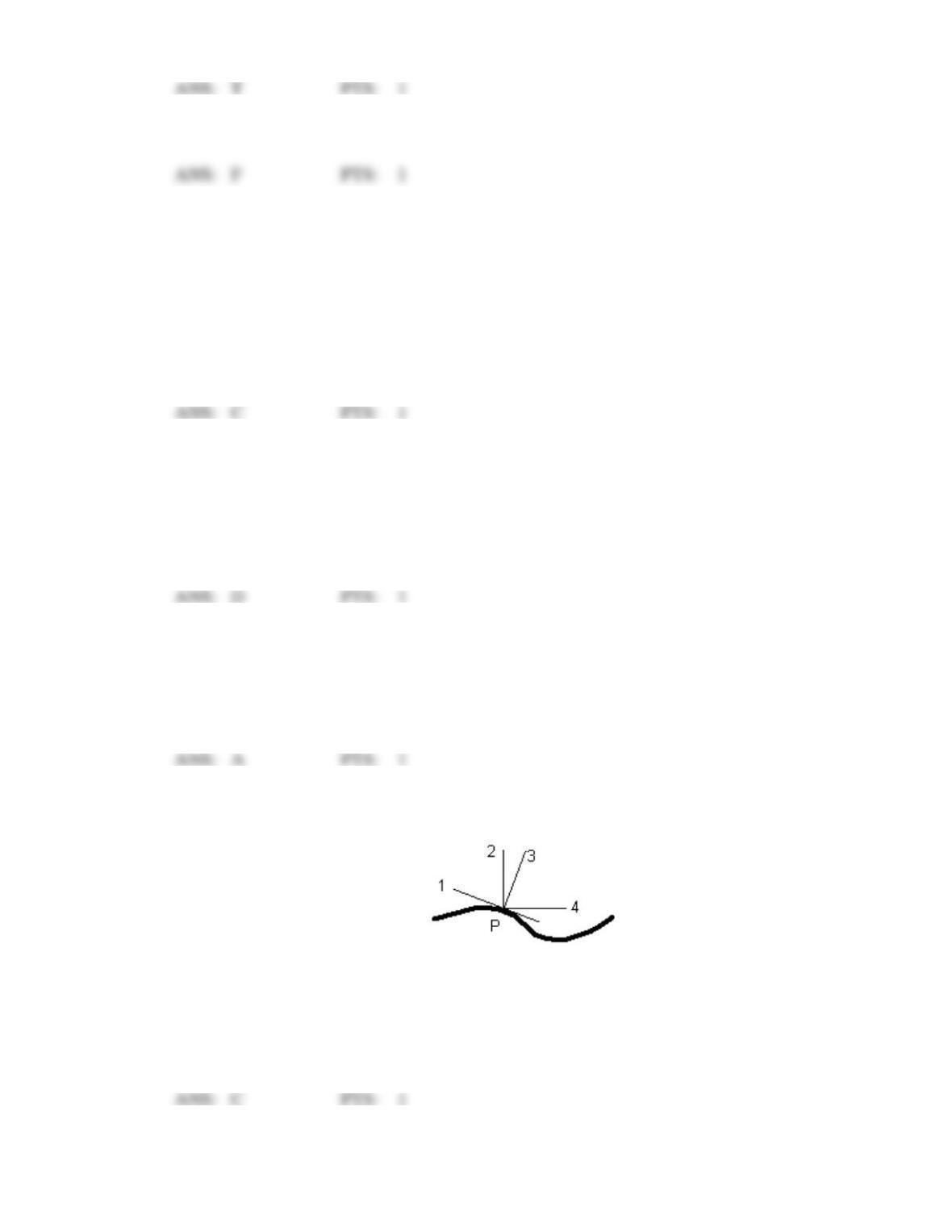
3. What is meant by the “normal” to a surface?
a.
a line perpendicular to the surface at a given point
b.
the angle between the surface and the light ray
c.
a line parallel to the surface at a given point
d.
the direction of a reflected ray
4. Which of the lines in the figure represents the normal to the surface at point P?
a.
1
b.
2
c.
3
d.
4
e.
none of the above
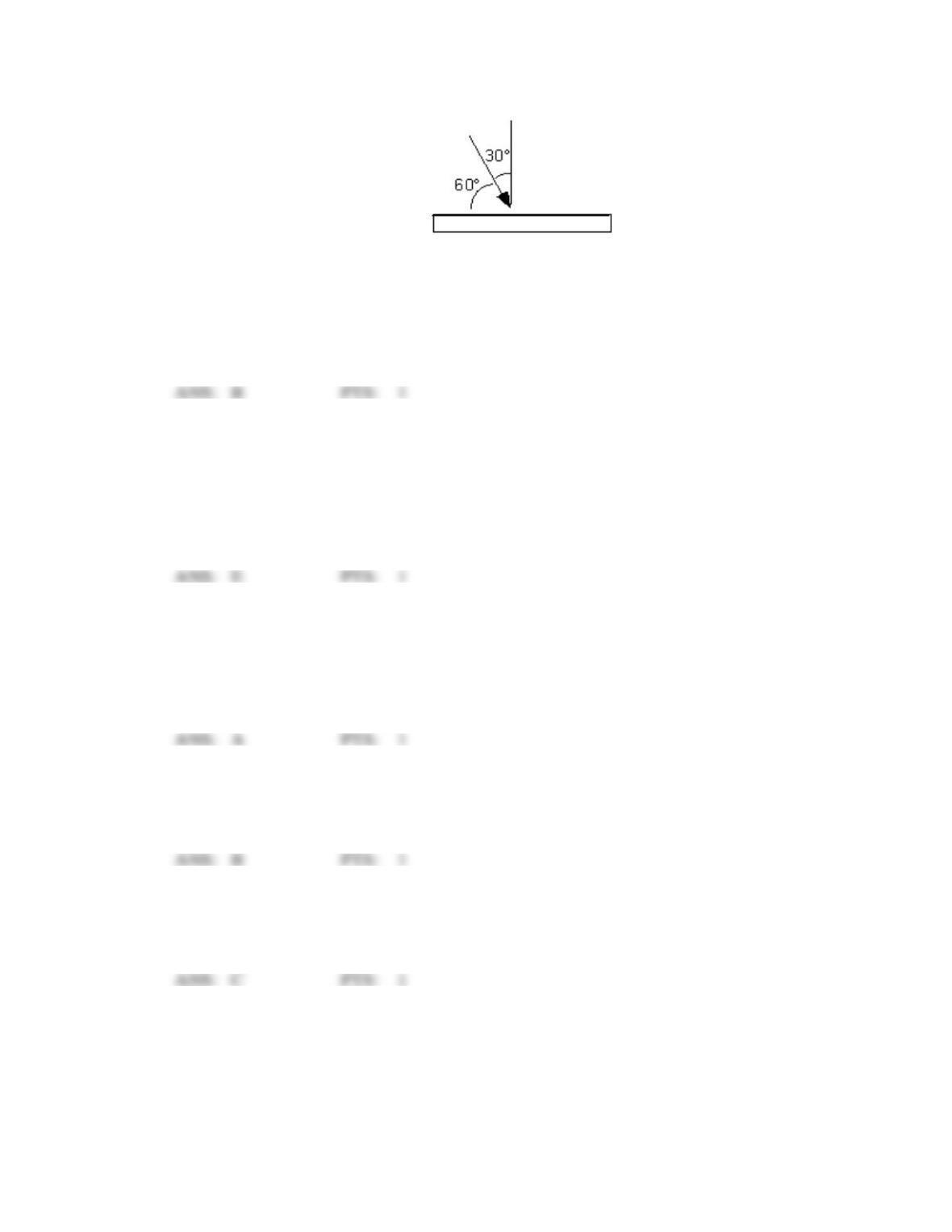
5. Which angle is the angle of incidence for the light ray shown approaching the plane mirror?
a.
60°
b.
30°
c.
neither
d.
either
6. Liquid crystal displays make use of
a.
interference
b.
diffraction
c.
specular reflection
d.
diffuse reflection
e.
polarization
7. Why are optical fibers important for communication?
a.
They can carry thousands of times the information that wires can.
b.
Light goes faster than electricity.
c.
They carry digital information. Wires can’t carry digital information.
d.
all of the above
8. The colors of objects we see by reflected light are due to
a.
interference
c.
specular reflection
b.
selective absorption
d.
diffuse reflection
9. A helium neon laser generates light of 632.8 nm wavelength. What color is that?
a.
blue
c.
red
b.
yellow
d.
green
10. Light spreads out when it passes through a narrow slit because of
a.
interference
b.
diffraction
c.
specular reflection
d.
diffuse reflection

e.
polarization
11. Thin film interference is responsible for the colors of
a.
bird feathers
c.
soap bubbles
b.
gasoline spills
d.
all of the above
12. When light passes through two or more narrow slits, an alternating dark and bright pattern is
observed on a screen because of
a.
interference
b.
diffraction
c.
specular reflection
d.
diffuse reflection
e.
polarization
13. Certain types of sunglasses are very effective at diminishing light reflected from surfaces
because of
a.
interference
b.
diffraction
c.
specular reflection
d.
diffuse reflection
e.
polarization
14. According to the law of reflection, a light ray striking a mirror at an angle of incidence of 30
degrees will leaves the mirror at an angle of
a.
60 degrees
b.
30 degrees
c.
less than 30 degrees
d.
none of the above
15. Optical fibers work because of
a.
interference
b.
diffraction
c.
total internal reflection
d.
diffuse reflection
e.
polarization
16. You see colors in a rainbow because of
a.
interference
b.
diffraction
c.
specular reflection

d.
dispersion
e.
polarization
17. If you see a rainbow near the time of sunset, where in the sky will the rainbow be?
a.
overhead
b.
toward the eastern horizon
c.
toward the western horizon
d.
toward the northern horizon
e.
toward the southern horizon
18. Which of the following is not involved in the formation of a rainbow?
a.
interference
c.
internal reflection
b.
dispersion
d.
refraction
19. An object is 50 cm in front of a plane mirror. Its image will be located
a.
50 cm in front of the mirror
b.
at the mirror’s surface
c.
50 cm behind the mirror
d.
25 cm in front of the mirror
e.
25 cm behind the mirror
20. A light ray bends when it goes from one medium to another because of
a.
interference
b.
diffraction
c.
specular reflection
d.
refraction
e.
polarization
21. In optics, what is meant by an “interface?”
a.
optically connecting one computer to another
b.
using the image created by one lens as the object for another lens
c.
when the crest of one wave lines up with the trough of another wave
d.
none of the above
22. When you look into a pool of water, the depth looks less than it actually is because of
a.
interference
b.
diffraction
c.
specular reflection
d.
refraction
e.
polarization

23. In this figure a light ray travels between air and glass. Which way did the light ray go?
a.
from the air into the glass.
b.
from the glass into the air.
c.
either A or B.
d.
none of the above—this depicts an impossible situation.
24. In air a light source emits a wavelength of 630 nm. Under water the wavelength of this light
will be
a.
630 nm
b.
less than 630 nm
c.
more than 630 nm
d.
unpredictable
25. The variation of the speed of light in a transparent medium with frequency results in
a.
interference
b.
diffraction
c.
dispersion
d.
diffuse reflection
e.
polarization
26. You see colors with a prism because of
a.
interference
b.
diffraction
c.
specular reflection
d.
dispersion
e.
polarization
27. Rank the following media in order according to the speed of light in them, from slowest to
fastest: vacuum, air, water and glass.
a.
air, water, glass, vacuum
b.
glass, air, water, vacuum
c.
water, glass, air, vacuum
d.
glass, water, air, vacuum

e.
none of the above
28. The sky is blue because of
a.
interference
b.
diffraction
c.
scattering
d.
dispersion
e.
polarization
29. The primary mirror in an astronomical telescope must be a
a.
half-silvered mirror
b.
convex mirror
c.
concave mirror
d.
plane mirror.
30. New telescopes are using “adaptive optics.” What is that?
a.
using parabolic instead of spherical mirrors
b.
using computer image processing to enhance images
c.
building mirrors in hexagonal segments
d.
continually adjusting the mirror’s shape during observations
31. What is meant by the term “plane mirror?”
a.
not an unusual mirror
c.
a horizontal mirror
b.
a flat mirror
d.
none of the above
32. Parallel light rays from a distant object strike the surface of a concave mirror. After
reflecting from the mirror’s surface, the rays will converge at
a.
the mirror’s focal point
b.
a point beyond the mirror’s focal point
c.
a point nearer than the mirror’s focal point
d.
none of the above
33. Diverging light rays from a nearby object (a few focal lengths away from the mirror) strike
the surface of a concave mirror. After reflecting from the mirror’s surface, the rays will
converge at
a.
the mirror’s focal point
b.
a point beyond the mirror’s focal point
c.
a point nearer than the mirror’s focal point
d.
none of the above

34. What makes pink ink pink?
a.
refraction
c.
dispersion
b.
selective absorption
d.
none of the above
35. Upon entering a medium in which the speed of light is 1.5 108 m/s from a medium in
which the speed of light is 2 108 m/s, an oblique light ray will be _____________ the
normal to the interface between the two media.
a.
bent away from
c.
travel along
b.
bent toward
d.
remain undeviated with respect to
36. A one-way mirror works because of
a.
interference
b.
diffraction
c.
its surfaces being half-silvered
d.
dispersion
e.
polarization
37. The ideal shape for the primary mirror of a telescope is
a.
concave circular
b.
convex circular
c.
concave parabolic
d.
convex parabolic
e.
plane
38. The type of mirror that will allow you to see large areas normally hidden from your view is
a.
concave
b.
convex
c.
plane
d.
half-silvered
e.
polaroid
39. An image formed using a converging lens
a.
is always real
b.
is always virtual
c.
can have negative magnification
d.
can never be upright