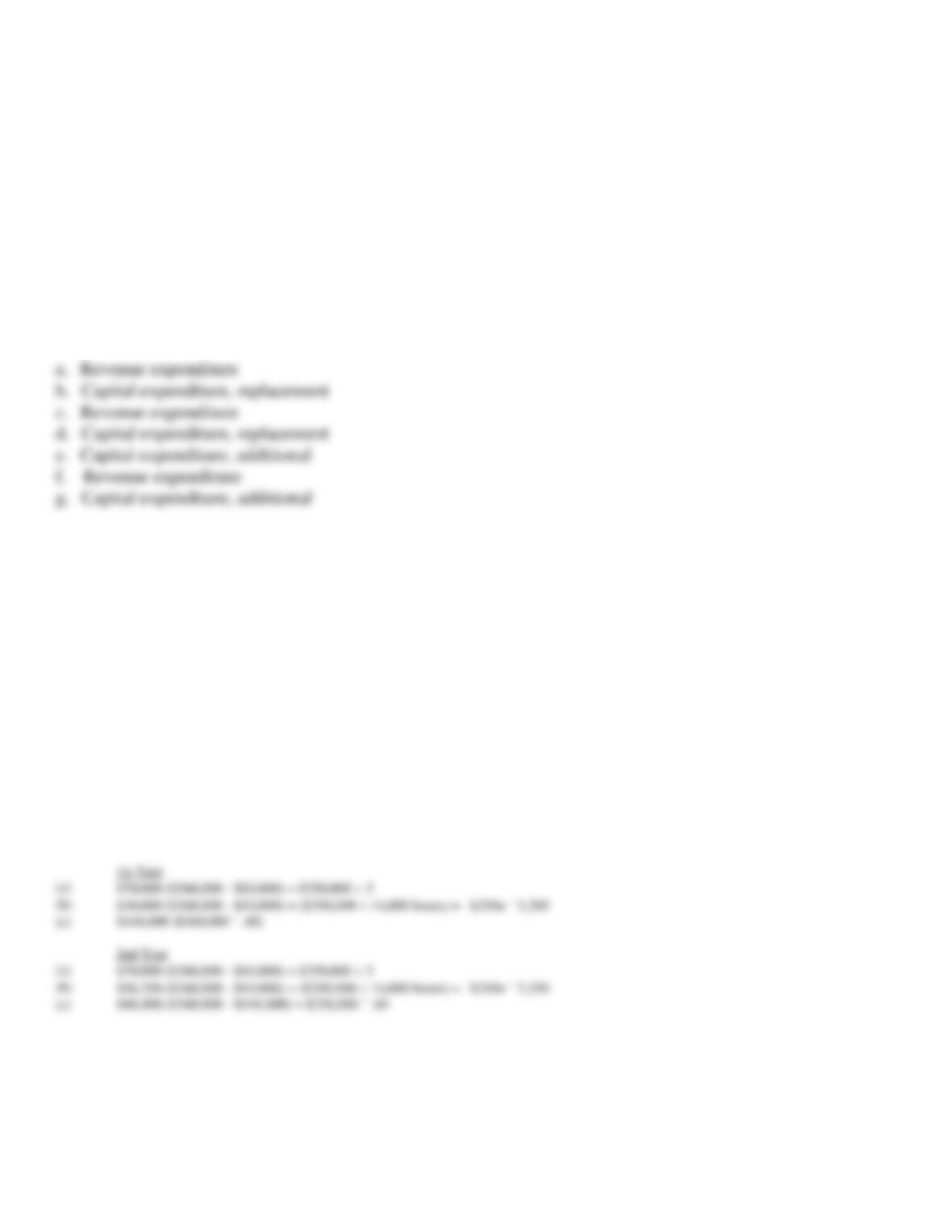
164. XYZ Co. incurred the following costs related to the office building used in operating its sports supply
company:
a.
Replaced a broken window.
b.
Replaced the roof that had been on the building 23 years.
c.
Serviced all the air conditioners before summer started.
d.
Replaced the air conditioners with refrigerated air conditioners in the customer service areas.
e.
Added a warehouse to the back of the building.
f.
Repainted the interior walls.
g.
Installed window shutters on all windows.
Classify each of the costs as a capital expenditure or a revenue expenditure. For those costs identified as capital expenditures, classify each as an
additional or replacement component.
165. Equipment purchased at the beginning of the fiscal year for $360,000 is expected to have a useful life of 5
years, or 14,000 operating hours, and a residual value of $10,000. Compute the depreciation for the first and
second years of use by each of the following methods:
(a)
straight-line
(b)
units-of-production (1,200 hours first year; 2,250 hours second year)
(c)
declining-balance at twice the straight-line rate
(Round the answer to the nearest dollar.)
1st Year
$70,000 ($360,000 – $10,000) = $350,000 5
$30,000 ($360,000 – $10,000) = ($350,000 14,000 hours) = $25/hr ´ 1,200
(c)
$144,000 ($360,000 ´ .40)
2nd Year
$70,000 ($360,000 – $10,000) = $350,000 5
$56,250 ($360,000 – $10,000) = ($350,000 14,000 hours) = $25/hr ´ 2,250
(c)
$86,400 ($360,000 – $144,000) = $216,000 ´ .40
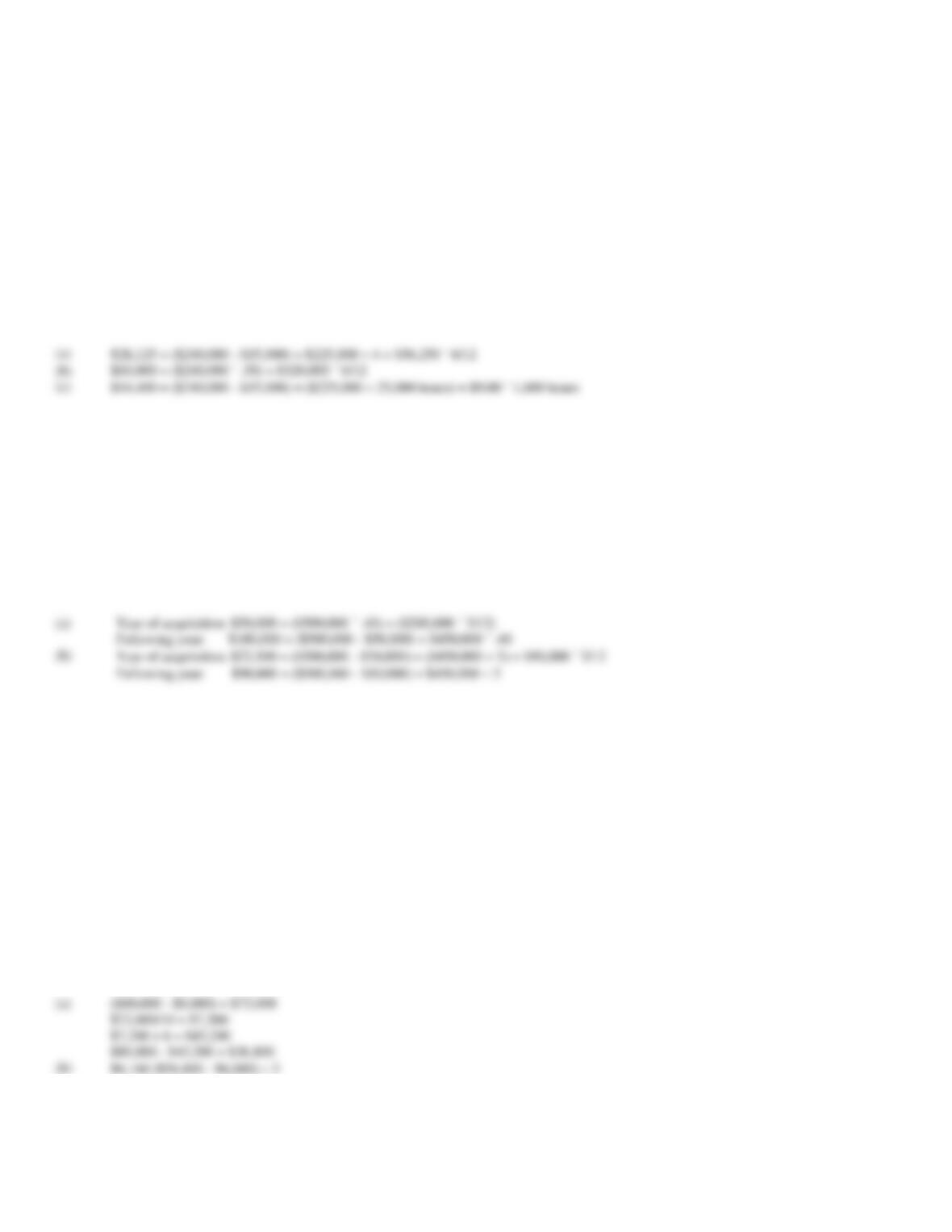
166. Machinery is purchased on July 1 of the current fiscal year for $240,000. It is expected to have a useful
life of 4 years, or 25,000 operating hours, and a residual value of $15,000. Compute the depreciation for the last
six months of the current fiscal year ending December 31 by each of the following methods:
(a)
straight-line
(b)
declining-balance at twice the straight-line rate
(c)
units-of-production (used for 1,600 hours during the current year)
(Round the answer to the nearest dollar.)
167. Determine the depreciation, for the year of acquisition and for the following year, of a fixed asset acquired
on October 1 for $500,000, with an estimated life of 5 years, and residual value of $50,000, using (a) the
declining-balance method at twice the straight-line rate and (b) the straight-line method. Assume a fiscal year
ending December 31.
(a)
Year of acquisition: $50,000 = ($500,000 ´ .40) = ($200,000 ´ 3/12)
Following year: $180,000 = ($500,000 – $50,000) = $450,000 ´ .40
Year of acquisition: $22,500 = ($500,000 – $50,000) = ($450,000 5) = $90,000 ´ 3/12
Following year: $90,000 = ($500,000 – $50,000) = $450,000 5
168. Equipment costing $80,000 with a useful life of 10 years and a residual value of $8,000 has been
depreciated for 6 years by the straight-line method. Assume a fiscal year ending December 31.
(a)
What is the book value at the end of the sixth year of use?
(b)
If early in the seventh year it is estimated that the remaining useful life is 5 years (instead of 4) and the residual value is $6,000,
what is the amount of depreciation for the seventh year?
$80,000 – $43,200 = $36,800
$28,125 = ($240,000 – $15,000) = $225,000 4 = $56,250 ´ 6/12
(b)
$60,000 = ($240,000 ´ .50) = $120,000 ´ 6/12
$14,400 = ($240,000 – $15,000) = ($225,000 25,000 hours) = $9.00 ´ 1,600 hours
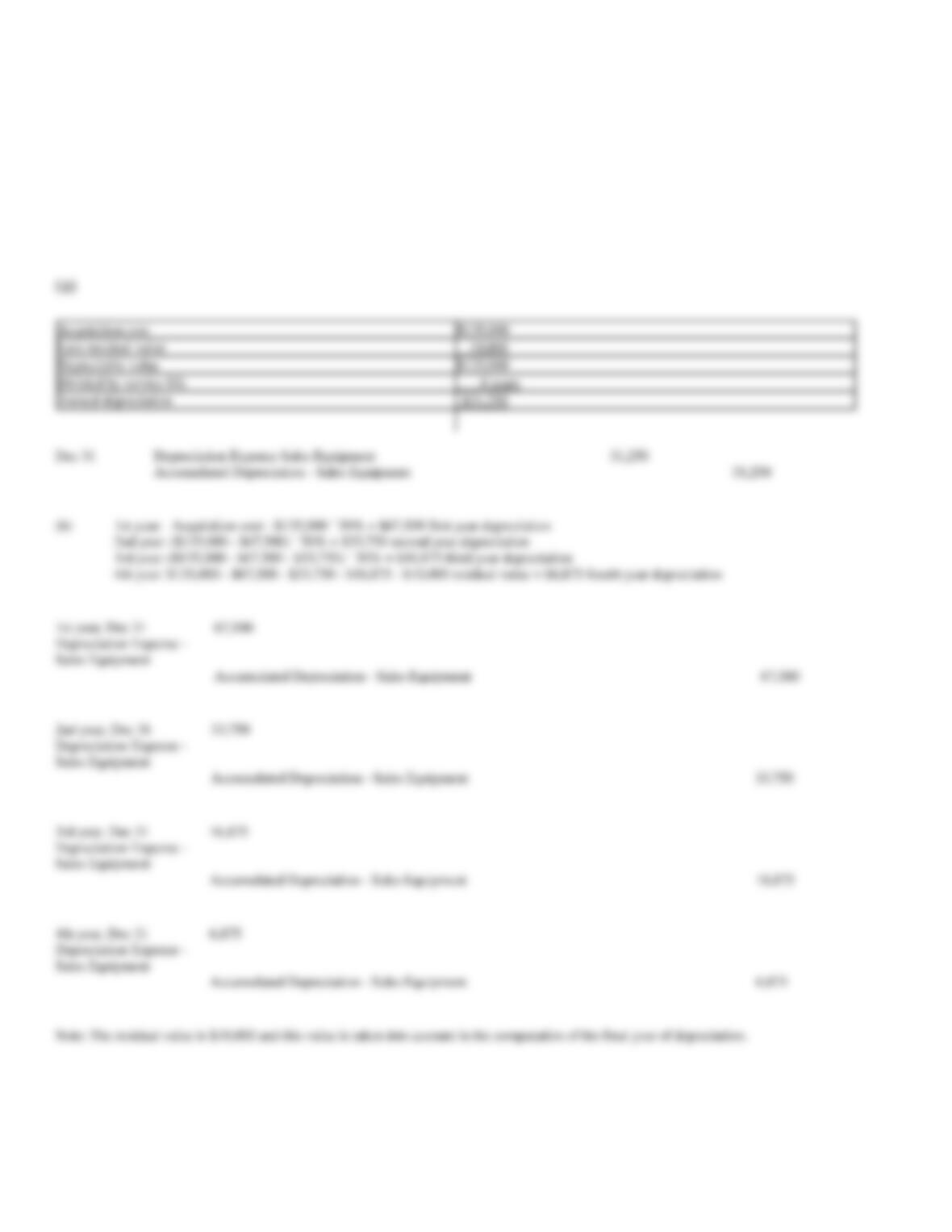
169. Golden Sales has bought $135,000 in fixed assets on January 1st associated with sales equipment. The
residual value of these assets is estimated at $10,000 after they service their 4 year service life. Golden Sales
managers want to evaluate the options of depreciation.
(a) Compute the annual straight-line depreciation and provide the sample depreciation journal entry to be posted
at the end of each of the years.
(b) Write the journal entries for each year of the service life for these assets using the double- declining balance
method.
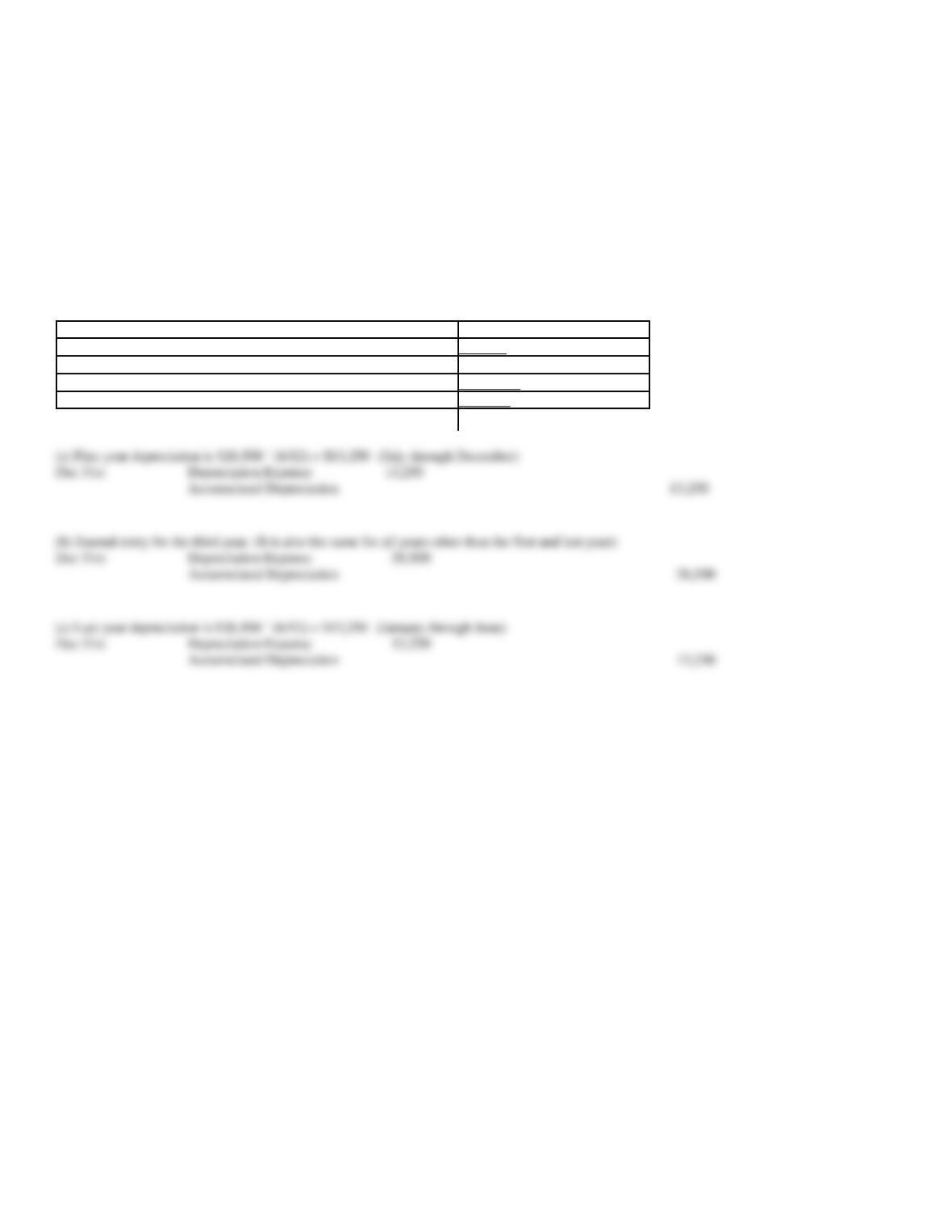
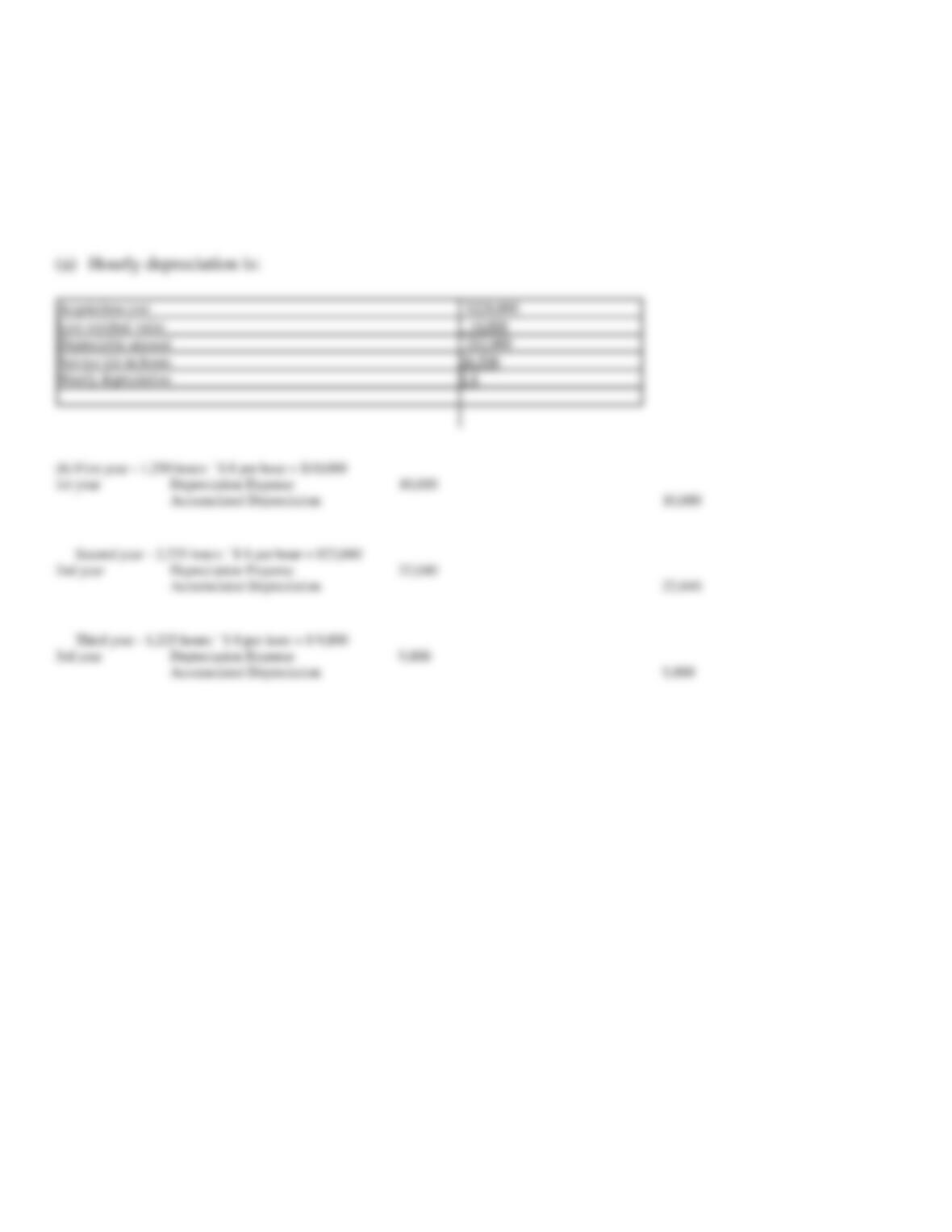
170. On July 1st, Harding Construction purchases a bulldozer for $228,000. The equipment has a 8 year life
with a residual value of $16,000. Harding uses straight-line depreciation.
(a) Calculate the depreciation expense and provide the journal entry for the first year ending December 31st.
(b) Calculate the third year’s depreciation expense and provide the journal entry for the third year ending
December 31st.
(c) Calculate the last year’s depreciation expense and provide the journal entry for the last year.
Annual depreciation is:
Acquisition cost
$228,000
Less residual value
16,000
Depreciable amount
212,000
Divided by service life in years
8
Annual depreciation
$26,500
Dec 31st
Depreciation Expense
13,250
Accumulated Depreciation
13,250
Dec 31st
Depreciation Expense
26,500
Accumulated Depreciation
26,500
Dec 31st
Depreciation Expense
13,250
Accumulated Depreciation
13,250
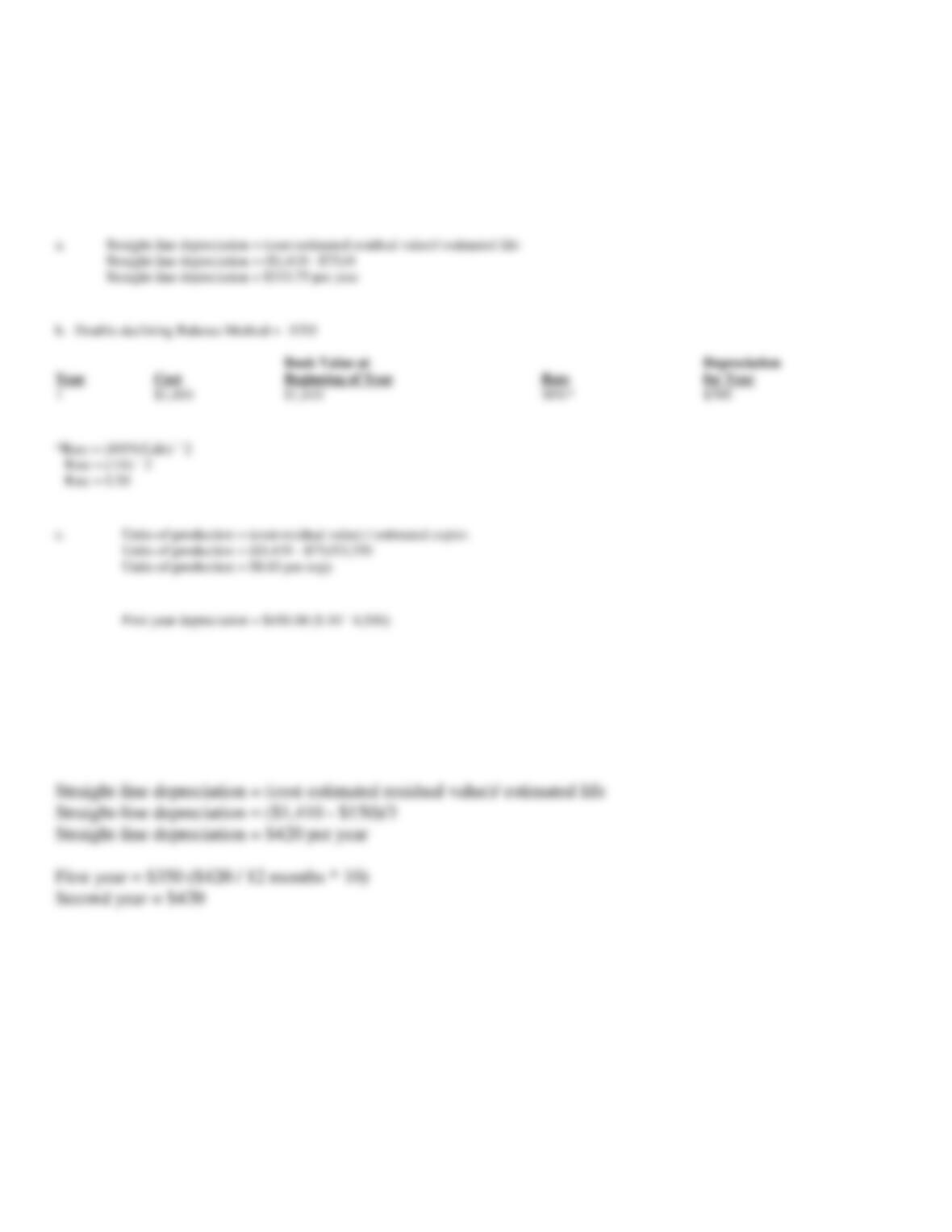
171. On July 1st, Hartford Construction purchases a bulldozer for $228,000. The equipment has a 9 year life
with a residual value of $16,000. Hartford uses units-of-production method depreciation and the bulldozer is
expected to yield 26,500 operating hours.
(a) Calculate the depreciation expense per hour of operation.
(b) The bulldozer is operated 1,250 hours in the first year, 2,755 hours in the second year, and 1,225 hours in
the third year of operations. Journalize the depreciation expense for each year.

172. Eagle Country Club has acquired a lot to construct a clubhouse. Eagle had the following costs related to
the construction:
Architects’ Fees
$45,000
Construction Labor
80,000
Engineers’ Fees
15,000
Fences around building
9,000
Grading and leveling
10,000
Insurance costs incurred during construction
7,000
Interest on money borrowed for construction
5,000
Land
73,000
Building Materials
237,000
Sales Taxes
6,000
Trees and Shrubs
6,000
Determine the cost of the Club House to be reported on the balance sheet.
Architects’ Fees
$45,000
Construction Labor
80,000
Engineers’ Fees
15,000
Insurance costs incurred during construction
7,000
Interest on money borrowed for construction
5,000
Building Materials
237,000
Sales Taxes
6,000
Cost of Club House
$395,000
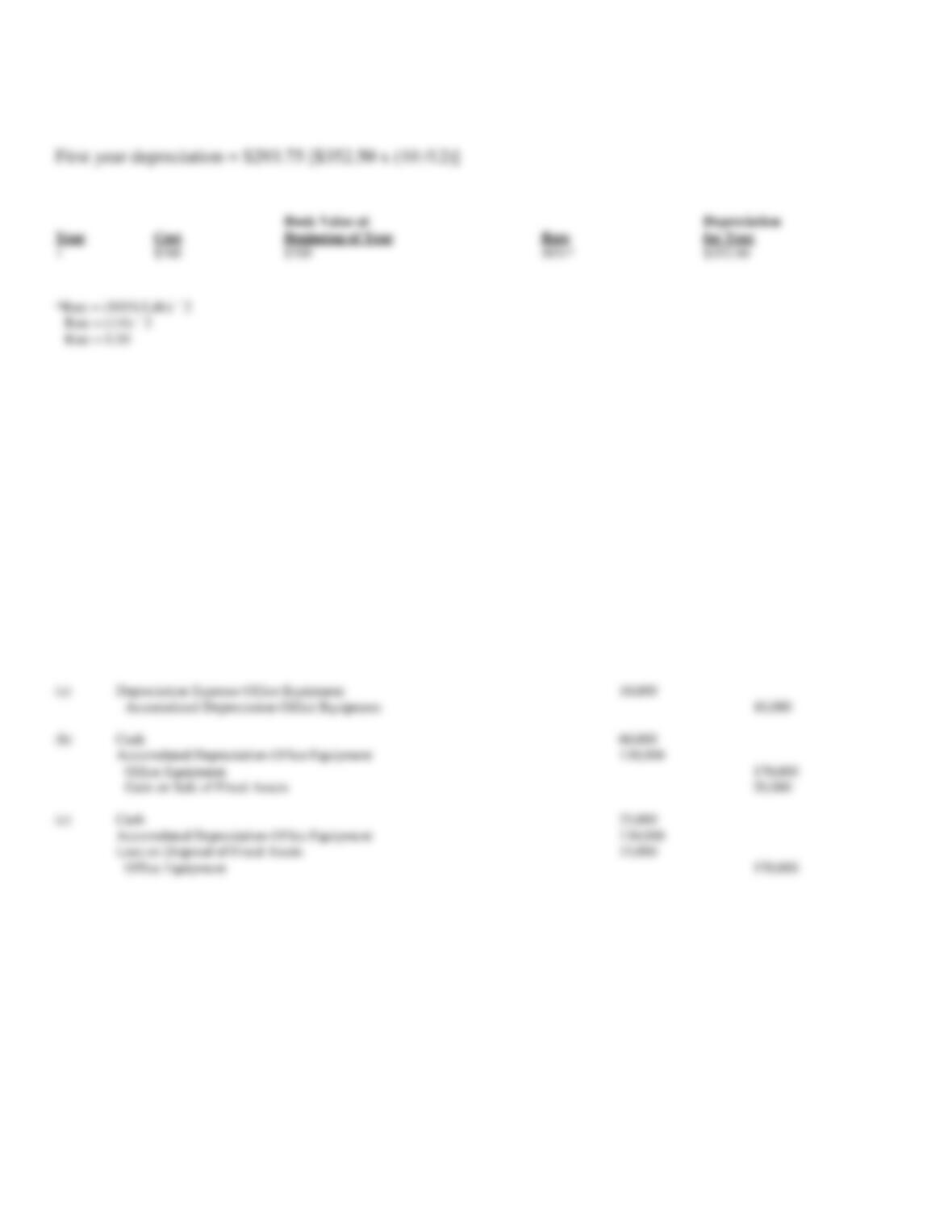
173. A copy machine acquired with a cost of $1,410 has an estimated useful life of 4 years. It is also expected
to have a useful operating life of 13,350 copies. Assuming that it will have a residual value of $75, determine
the depreciation for the first year by the
a.
straight-line method
b.
double declining-balance method
c.
production method (4,500 copies were made the first year)
174. A copy machine acquired on March 1, 2011 with a cost of $1,410 has an estimated useful life of 3
years. Assuming that it will have a residual value of $150, determine the depreciation for the first and second
year by the straight-line method.
a.
Straight-line depreciation = (cost-estimated residual value)/ estimated life
Straight-line depreciation = ($1,410 – $75)/4
Straight-line depreciation = $333.75 per year
1
$1,410
$1,410
50%*
$705
*Rate = (100%/Life) ´ 2
Rate = (1/4) ´ 2
Rate = 0.50
c.
Units-of-production = ($1,410 – $75)/13,350
First year depreciation = $450.00 ($.10 ´ 4,500)
175. A copy machine acquired on March 1, 2011 with a cost of $705 has an estimated useful life of 4
years. Assuming that it will have a residual value of $125, determine the depreciation for the first year by the
double-declining-balance method.
176. Computer equipment (office equipment) purchased 6 1/2 years ago for $170,000, with an estimated life of
8 years and a residual value of $10,000, is now sold for $60,000 cash. (Appropriate entries for depreciation had
been made for the first six years of use.) Journalize the following entries:
(a)
Record the depreciation for the one-half year prior to the sale, using the straight-line method.
(b)
Record the sale of the equipment.
(c)
Assuming that the equipment had been sold for $25,000 cash, prepare the entry for (b) above to record the sale.
(a)
Depreciation Expense-Office Equipment
10,000
Accumulated Depreciation-Office Equipment
10,000
(b)
Cash
60,000
Accumulated Depreciation-Office Equipment
130,000
Office Equipment
170,000
Gain on Sale of Fixed Assets
20,000
(c)
Cash
25,000
Accumulated Depreciation-Office Equipment
130,000
Loss on Disposal of Fixed Assets
15,000
Office Equipment
170,000
1
$705
$705
50%*
$352.50
*Rate = (100%/Life) ´ 2
Rate = (1/4) ´ 2
Rate = 0.50
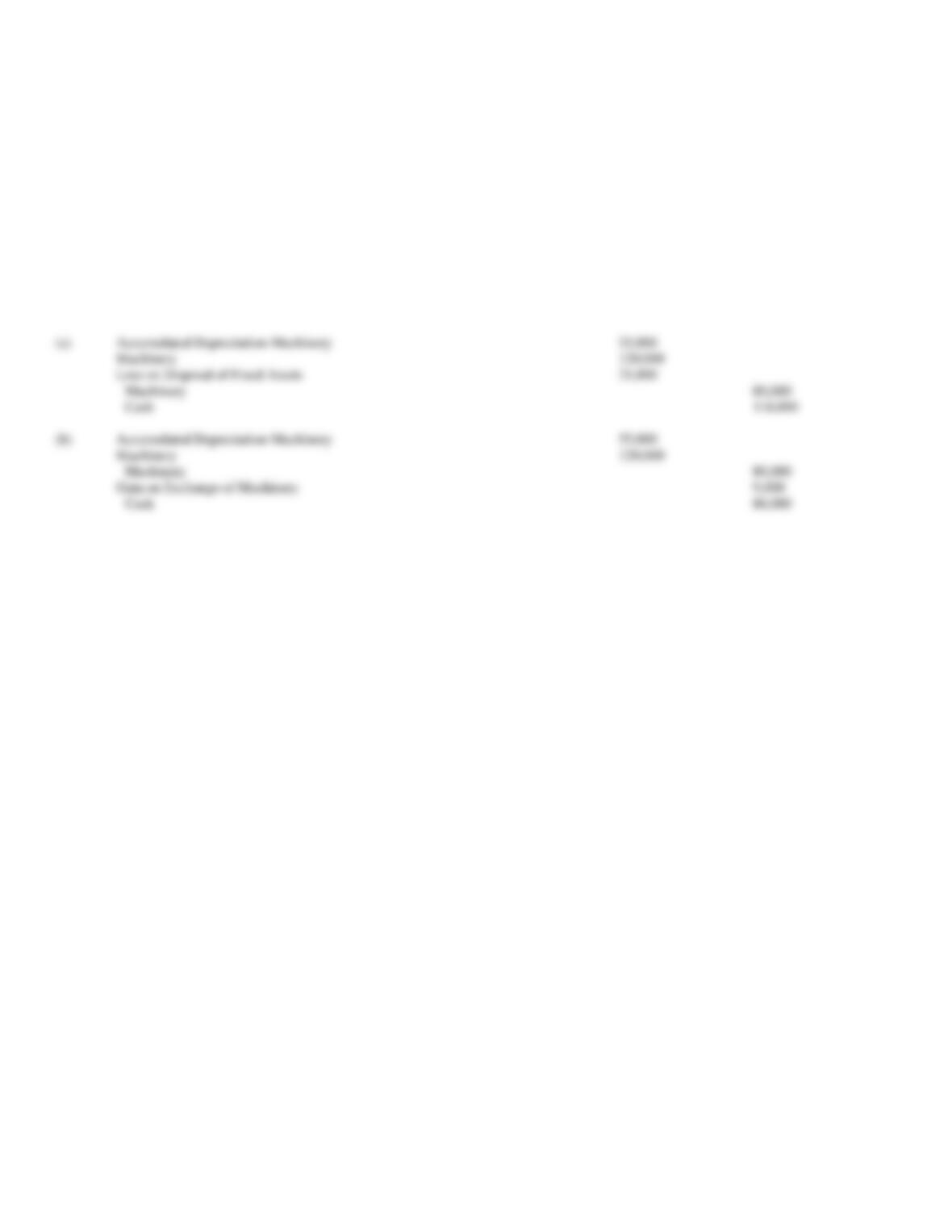
177. Machinery acquired at a cost of $80,000 and on which there is accumulated depreciation of $55,000
(including depreciation for the current year to date) is exchanged for similar machinery. For financial reporting
purposes, present entries to record the disposition of the old machinery and the acquisition of new machinery
under each of the following assumptions:
(a)
Price of new, $120,000; trade-in allowance on old, $4,000; balance paid in cash.
(b)
Price of new, $120,000; trade-in allowance on old, $34,000; balance paid in cash.
(a)
Accumulated Depreciation-Machinery
55,000
Loss on Disposal of Fixed Assets
21,000
Machinery
80,000
Cash
116,000
(b)
Accumulated Depreciation-Machinery
55,000
Machinery
120,000
Machinery
80,000
Cash
86,000
178. Equipment acquired at a cost of $126,000 has a book value of $42,000. Journalize the disposal of the
equipment under the following independent assumptions.
a.
The equipment had no market value and was discarded.
b.
The equipment is sold for $54,000.
c.
The equipment is sold for $24,000.
d.
The equipment is traded-in for a similar asset. The list price of the new equipment is $63,000. The buyer gave no cash in the
exchange. The transaction lacks commercial substance.
Journal
Date
Description
Post Ref
Debit
Credit
179. Prepare the following journal entries and calculations:
(a)
A patent that was acquired for $410,000 at the beginning of the current year expires in 15 years and is expected to have value for 4
years. Present the adjusting entry to amortize the patent for the current year.
(b)
Mineral rights on an ore deposit estimated at 4,000,000 tons of ore were acquired for $2,800,000. Present the adjusting entry to record
depletion for the current year, during which 350,000 tons of ore were removed.
(c)
Legal costs incurred to defend the rights that a patent provided in (a) were $60,000. At the time the patent had been in existence for 5
years. Determine the amount to be amortized for the current fiscal year.
Patents
102,500
($410,000 4)
(b)
Depletion Expense
245,000
Accumulated Depletion
245,000
$4,000 ($60,000 15)
Loss on Disposal of Fixed Asset
42,000
Equipment
126,000
Cash
54,000
Accumulated Depreciation – Equipment
84,000
Equipment
126,000
Gain on Disposal of Fixed Asset
12,000
Cash
24,000
Loss on Disposal of Fixed Asset
18,000
Equipment
126,000
Equipment (new equipment)
42,000
Equipment (old equipment)
126,000
180. Macon Co. acquired drilling rights for $7,500,000. The oil deposit is estimated at 37,500,000 gallons.
During the current year, 3,000,000 gallons were drilled. Journalize the adjusting entry at December 31, 2011 to
recognize the depletion expense.
Journal
Date
Description
Post Ref
Debit
Credit
181. On July 1, 2010, Howard Co. acquired patents rights for $40,000. The patent has a useful life of 8 years
and a legal life of 15 years. Journalize the adjusting entry on December 31, 2010 to recognize the amortization.
Journal
Date
Description
Post Ref
Debit
Credit
Post Ref
Dec 31
Amortization Expense
2,500
2,500
Post Ref
Accumulated Depletion
600,000
182. On December 31 it was estimated that goodwill of $65,000 was impaired. In addition, a patent with an
estimated useful economic life of 10 years was acquired for $60,000 on July 1.
a)
Journalize the adjusting entry on December 31 for the impaired goodwill.
b)
Journalize the adjusting entry on December 31 for the amortization of the patent rights.
Loss from Impaired Goodwill
65,000
Goodwill
65,000
Amortization Expense – Patents
3,000
Patents
3,000
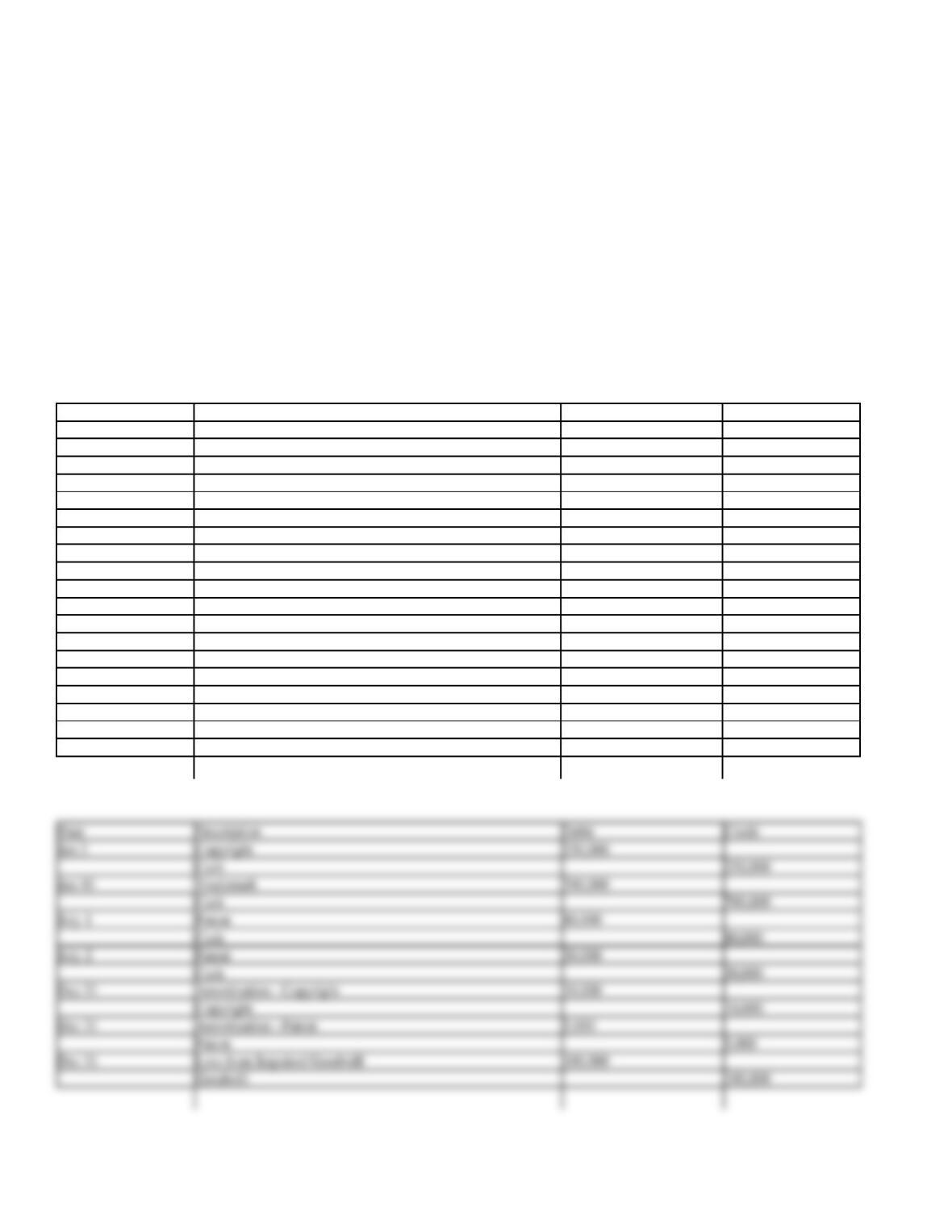
183. Clanton Company engaged in the following transactions during 2011. Record each in the general journal
below:
1) On January 3, 2011, Clanton purchased a copyright from Dalton Company with a cost of $250,000 with a
remaining useful life of 25 years.
2) On January 10, 2011, Clanton purchased a trademark from Felton Company with a cost of $700,000.
3) On July 1, 2011, Clanton purchased a patent from Garrison Company at a cost of $80,000. The remaining
legal life of the patent is 15 years and the expected useful life is 11 years.
4) On July 2, 2011, Clanton paid $30,000 in legal fees to defend the patent protection purchased on July 1,
2011.
5) Recorded the appropriate amortization for the intangible assets for 2011.
6) Clanton Company includes an asset in its ledger recorded when Clanton purchased a computer service
business at a price in excess of the fair value of the assets of the company in the amount of $400,000. At
December 31, 2011, $100,000 of this asset has become impaired.
Date
Description
Debit
Credit
Date
Description
Debit
Credit
Jan 3
Copyright
250,000
Cash
250,000
Jan 10
Trademark
700,000
Cash
700,000
July 1
Patent
80,000
Cash
80,000
July 2
Patent
30,000
Cash
30,000
Dec 31
Amortization – Copyright
10,000
Copyright
10,000
Dec 31
Amortization – Patent
5,000
Patent
5,000
Dec 31
Loss from Impaired Goodwill
100,000
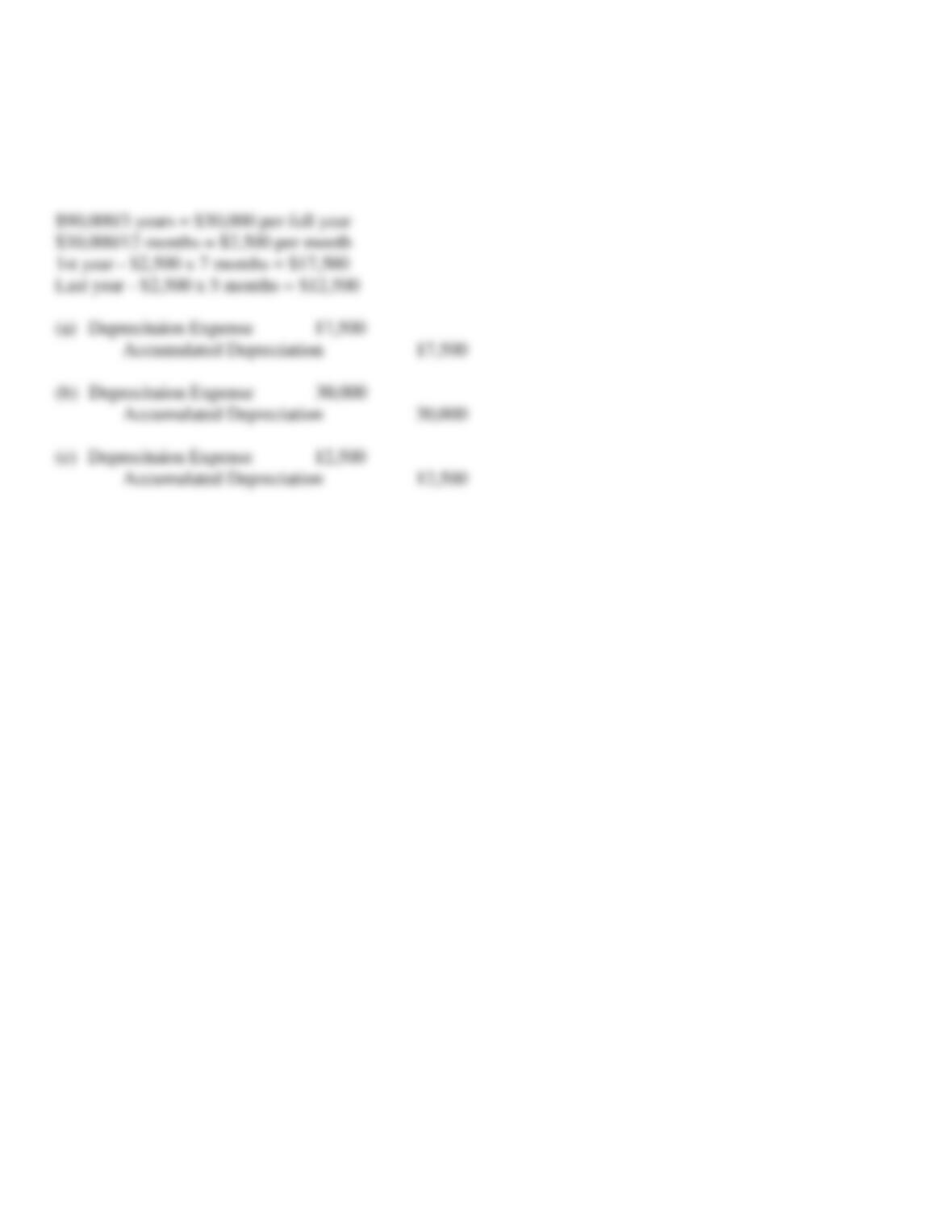
184. On June 1, 2014, Aaron Company purchased equipment at a cost of $120,000 that has a depreciable cost of
$90,000 and an estimated useful life of 3 years and 30,000 hours.
Using straight line depreciation, prepare the journal entry to record depreciation expense for (a) the first year,
(b) the second year and (c) the last year.