Ch 9 Test Bank-4e doc Page 1
Chapter 9
Business-Type Activities
TRUE/FALSE (CHAPTER 9)
1. In both the fund statements and the government-wide statements, business-type activities and
internal service funds are on a full accrual basis, and their measurement focus is on all
economic resources.
2. The operating statement required as one of the three basic financial statements for
proprietary funds is called the statement of revenues, expenditures, and changes in net
position.
3. The amounts reported in proprietary fund statements are generally the same as those reported
in the government-wide statements because both sets of statements are on a full accrual basis
of accounting.
4. Governments are required to prepare a statement of cash flows for proprietary funds, but not
for governmental funds.
5. GASB Statement No. 34 mandates that governments report their cash flows from operations
using the indirect method.
6. The FASB mandates that entities report their cash flows from operations using the direct
method.
7. Governments generally do not have to get formal legislative approval for enterprise fund
budgets or incorporate them into their accounting systems.
8. In accounting for closure and postclosure landfill costs in an enterprise fund, a government
does not necessarily have to “fund” the costs during the landfill’s useful life; it merely has to
report both an expense and a liability for them.
9. The revenues of an internal service fund are the expenditures and expenses of other funds of
that government.
10. The proprietary fund operating statement includes ALL changes in net position including
capital contributions.
11. Governments must account for an activity in an enterprise fund only if local laws specifically
require use of an enterprise fund.
12. Governments are not required to incorporate proprietary fund budgets into the accounting
system.
13. GASB standards require that governments advance fund landfill closure and postclosure
costs on an actuarial basis similar to the advance funding of pension plans.
14. The costs of cleaning up toxic substances seeping out from an abandoned county dump into
the town water supply may be accounted for in either a governmental fund or an enterprise
fund.
15. Internal service funds should be consolidated with other governmental funds in the
government-wide statements.
16. Governments may choose whether to account for internal service fund activities on an
accrual basis or a modified accrual basis.

Ch 9 Test Bank-4e doc Page 2

Ch 9 Test Bank-4e doc Page 3
MULTIPLE CHOICE (CHAPTER 9)
1. The appropriate measurement focus for the business-type activities of the Raymond City is
a) Current financial resources.
b) Economic resources.
c) Both (a) and (b).
d) None of the above.
2. Which of the following is not a proprietary fund?
a) City Water Enterprise Fund.
b) City Motor Pool Internal Service Fund.
c) City Hall Capital Projects Fund.
d) None of the above. They are all proprietary funds.
3. The appropriate basis of accounting for the proprietary funds of a government is
a) Cash basis.
b) Modified accrual.
c) Full accrual.
d) None of the above.
4. Which of the following is a valid reason for governments to engage in business-type
activities?
a) The government does not want control over the activity.
b) The activity competes with general government activities.
c) The government does not want to subsidize the activity.
d) The government can provide the services more cheaply or efficiently than can a private
firm.
5. Which of the following is a valid argument for separate accounting principles for proprietary
activities?
a) Two separate measurement focuses and bases for accounting within the same set of
financial statements are confusing.
b) There are no clear-cut distinctions between business and non-business activities.
c) The measurement focus on all economic resources is more consistent with the GASB’s
objectives that financial reporting should provide information to help determine whether
current-year revenues were sufficient to pay for current-year services.
d) Surveys of statement users indicate that information on depreciation is not of high
priority to government decision makers.
6. Which of the following is a key reason for using business-type accounting to account for
proprietary fund activities?
a) The modified accrual basis of accounting captures all the resources and obligations
associated with an activity.
b) Depreciation is not recognized in business-type accounting in governments and surveys
of statement users indicate that information on depreciation is not of high priority to
government decision makers.
c) The measurement focus on all economic resources is more consistent with the GASB’s
objectives that financial reporting should provide information to help determine whether
current-year revenues were sufficient to pay for current-year services.
d) Business-type accounting facilitates comparisons with governmental activities.
Ch 9 Test Bank-4e doc Page 4
7. Which of the following is NOT a budget typically prepared for an activity accounted for in a
proprietary fund?
a) Appropriation budget.
b) Cash budget.
c) Capital budget.
d) Flexible budget.
8. A government reports the utility services it provides to citizens in a proprietary fund. Which
accounting standards must the proprietary fund apply?
a) All FASB pronouncements, unless a FASB pronouncement conflicts with or contradicts a
GASB pronouncement.
b) All FASB pronouncements issued prior to November 30, 1989, as well as any post-
November 30, 1989 pronouncements specifically adopted by GASB.
c) All GASB pronouncements.
d) All FASB and AICPA standards incorporated into GASB Statement No. 62, as well as
any FASB pronouncements issued after November 30, 1989 that have been specifically
adopted by the GASB.
9. A proprietary fund of a government has some donor-restricted assets. Which of the following
best describes where and how those assets will generally be displayed in the fund’s financial
statements?
a) In a separate restricted asset category on the statement of net position.
b) Intermingled with other assets on the statement of net position.
c) Intermingled with other assets on the statement of net position, but footnoted.
d) In a separate restricted fund.
Use the following information to answer #10 and #11.
Bowdon City voted to establish an internal service fund to account for its printing services. The
city transferred $500,000 cash from the general fund to the newly created internal service fund.
10. The appropriate entry in the general fund to account for this transfer is a credit to cash for
$500,000 and a debit for $500,000 to
a) Due from internal service fund.
b) Nonreciprocal transfer-out.
c) Expenditures.
d) Investment in internal service fund.
11. The appropriate entry in the internal service fund is a debit to cash for $500,000 and a credit
for $500,000 to
a) Due to general fund.
b) Nonreciprocal transfer-in.
c) Capital contribution (Revenues).
d) Investment provided by the general fund.
Ch 9 Test Bank-4e doc Page 5
12. Cougar City issued $2 million in general obligation bonds to acquire a fleet of vehicles for
the Central Motor Pool Internal Service Fund. At the date of issue, the appropriate entry in
the internal service fund is a $ 2 million debit to cash and a $2 million credit to
a) Bonds payable.
b) Capital contribution (revenues).
c) Capital contributed (revenues) AND show $2 million as an addition to the schedule of
changes in long-term obligations.
d) No entry in the internal service fund. Show $2 million as an addition to the schedule of
changes in long-term obligations.
13. Which of the following is the best rationale/justification for reporting the business-type
activities of a government in a separate fund?
a) Laws or regulations require that the activity’s costs of providing services be recovered by
fees and charges rather than by general purpose taxes or similar charges.
b) Separate funds facilitate budgeting, planning, and control.
c) Separate funds facilitate an assessment of the activity’s performance.
d) Separate funds facilitate an assessment of the activity’s fiscal status.
14. Which of the following are required basic statements of a proprietary fund?
a) Balance sheet and income statement.
b) Balance sheet; statement of revenues, expenses, and changes in retained earnings; and
statement of cash flows.
c) Statement of net assets and statement of revenues, expenses, and changes in fund net
assets.
d) Statement of net position; statement of revenues, expenses, and changes in net position;
and statement of cash flows.
15. Flora County issues $6 million of revenue bonds to finance construction of additional
physical plant facilities for the county sewer system that is accounted for in an enterprise
fund. The bond agreement requires that $0.5 million of the proceeds be invested in U.S.
Treasury securities to be used to service the debt if revenues in a particular year are
insufficient to do so. When it sells the bonds, the county debits restricted cash and credits
revenue bonds payable. What additional entry, if any, is needed?
a) No additional entry is needed at this time.
b) Debit restricted net position $0.5 million; Credit unrestricted net position $0.5 million.
c) Debit unrestricted net position $0.5 million; Credit restricted net position $0.5 million.
d) Debit unrestricted retained earnings $0.5 million; Credit restricted retained earnings $0.5
million.
16. Linden County operates a solid waste landfill that is accounted for in an enterprise fund. The
county calculated this year’s portion of the total closure and postclosure costs associated with
the landfill to be $300,000. The entry(ies) to record this cost should be
a) Debit landfill expense $300,000; Credit liability for landfill costs $300,000
b) Debit landfill expense $300,000; Credit liability for landfill costs $300,000 AND
include an addition of $300,000 on the schedule of changes in long-term obligations.
c) Show only an addition of $300,000 on the schedule of changes in long-term obligations.
d) No entry in the fund; No addition on the schedule of changes in long-term obligations.
Ch 9 Test Bank-4e doc Page 6
17. Fennell County operates a solid waste landfill that is accounted for in a governmental fund.
The county calculated this year’s portion of the total closure and postclosure costs associated
with the landfill to be $600,000. The entry to record this cost should be
a) Debit landfill expenditure $600,000; Credit liability for landfill costs $600,000
b) Debit landfill expenditure $600,000; Credit liability for landfill costs $600,000 AND
include $600,000 as an addition on the schedule of changes in long-term obligations.
c) No entry in the fund; include $600,000 on the schedule of changes in long-term
obligations.
d) No entry in the fund; no addition on the schedule of changes in long-term obligations.
18. During the current year, the Adams County Solid Waste Landfill, which is accounted for in
an enterprise fund, installed wells designed to assist in the ground water monitoring process
after closure of the landfill. The landfill has reached 40 percent of its capacity and is
expected to continue to accept waste until 2016. The wells cost $80,000 to acquire and
install. The appropriate entry to record the addition is a credit to Cash for $80,000 and an
$80,000 debit to
a) Landfill assets.
b) Landfill expenses.
c) Liability for landfill costs.
d) Deferred outflow of resourcs.
19. Over the long run, internal service funds are intended to generate sufficient revenues to cover
the
a) Full costs of providing services.
b) Full costs of providing services and earn a profit.
c) Current operating costs of providing services.
d) Current operating costs of providing services and earn an operating profit.
20. Which of the following is NOT true about internal service funds as reported in the fund
financial statements?
a) Costs reported by internal service funds are reported twice within the same set of
financial statements.
b) Billing rates must be set to cover the full cost of providing the goods or services.
c) Depreciation can be charged to governmental funds through the billing rates established
by the internal service fund.
d) Deficits or surpluses in the general fund can be transferred to the internal service fund by
adjusting the billing rates.
21. In a statement of net position, the net position of a proprietary fund should be displayed in
which of the following categories?
a) Unrestricted fund balance; restricted fund balance; invested in capital assets, net of
related debt.
b) Unrestricted net position; restricted net position; invested in capital assets, net of related
debt.
c) Unrestricted net assets; restricted net assetsRestricted net assets; retained earnings;
unrestricted net assets.
Ch 9 Test Bank-4e doc Page 7
22. A statement of revenues, expenses, and changes in net position of a proprietary fund should
include which of the following in addition to operating revenues, operating expenses, and
ending net position?
a) Nonoperating revenues and expenses.
b) Nonoperating revenues and expenses; other changes in net position.
c) Nonoperating revenues and expenses; capital contributions and other changes in net
position; beginning net assets.
d) None of the above.
23. In which of the following circumstances must an enterprise fund be used to account for the
activity?
a) A newly created electric utility fund will finance its operations by a charge to users based
on kilowatt hours used.
b) To finance the acquisition of plant facilities, a newly created electric utility issues general
obligation debt.
c) To finance the acquisition of plant facilities, a newly created electric utility issues
revenue bonds that will be repaid solely from operations of the electric utility.
d) To acquire needed plant facilities, a newly created electric utility enters into long-term
lease agreements.
24. Jay County has designated the General Fund as the single fund to account for its self-
insurance activities. What is the maximum amount that can be charged to expenditure in the
general fund related to the self-insurance activities?
a) The amount of “premium” charged to the other funds.
b) The amount of actual claims expenditures.
c) The actuarially determined amount necessary to cover claims, expenditures, and
catastrophic losses.
d) The amount transferred from other funds and activities to the general fund for self-
insurance purposes.
25. Jona City has designated an internal service fund as the single fund to account for its self-
insurance activities. Most of the insured activities, such as the police department, fire
department, and general government functions, are accounted for in the general fund. What
is the maximum amount that can be charged to expenditure in the general fund related to the
self-insurance activities?
a) The amount of “premium” charged to the general fund by the internal service fund.
b) The amount of actual losses incurred by the insurance activity.
c) The actuarially determined amount necessary to cover claims, expenditures, and
catastrophic losses.
d) The amount transferred from the general fund to the internal service fund for self-
insurance purposes.
26. A government operates a landfill. In the Landfill Enterprise Fund financial statements, which
of the following would be reported as a restricted asset?
a) Cash received from the sale of bonds that must, based on the debt covenant, be spent only
on building a new landfill runoff treatment plant.
b) Cash that management has voted to use only for landfill expansion.
c) Cash received from the general fund that will be used only to expand the landfill.
d) None of the above.
Ch 9 Test Bank-4e doc Page 8
Use the following information to answer questions #27 and #28.
During the year Endor City’s self-insurance internal service fund billed the general
fund $600,000 for “premiums,” of which $60,000 was for catastrophic losses and the balance was
the premium computed on an actuarially determined basis. During the year the city incurred
$500,000 in claims losses. The total amount transferred to the self-insurance fund by the general
fund was $620,000.
27. The amount the city’s self-insurance fund can recognize as revenue is
a) $620,000
b) $600,000.
c) $540,000.
d) $500,000.
28. The amount the city’s general fund can recognize as an expenditure is
a) $620,000.
b) $600,000.
c) $540,000.
d) $500,000.
29. When a government enterprise fund has restricted assets on its statement of net position,
which of the following is a true statement?
a) The total of the restricted assets in the asset section will be equal to the “restricted net
position” amount in the equity section.
b) The total of the restricted assets will be offset by a liability of an equal amount.
c) The total of the restricted assets less related liabilities will be equal to the “restricted net
assets” amount in the equity section.
d) None of the above statements is true.
30. Any internal service fund balances that are not eliminated in the consolidation process should
generally be presented on the government-wide financial statements
a) In the business-type activities column.
b) In the internal service fund column.
c) In the governmental activities column.
d) These balances should not be presented on the government-wide financial statements.
31. On the fund financial statements, internal service activities should be presented
a) In the propriety fund statements, net of interfund eliminations.
b) In the governmental fund statements, net of interfund eliminations.
c) In the proprietary fund statements, without any interfund eliminations.
d) In the governmental fund statements, without any interfund eliminations.
32. “Cash flows from investing activities” include which of the following as cash inflows
a) Cash collection of receivables for sales of services.
b) Grants for operating activities.
c) Interest and dividends received.
d) Purchases of investments.
Ch 9 Test Bank-4e doc Page 9
33. “Cash flows from capital and related financing activities” include which of the following as
cash outflows
a) Grants to other governments for operating activities.
b) Grants to other governments for capital asset acquisitions.
c) Payments for services performed by other funds.
d) Purchases of capital assets.
34. “Cash flows from operating activities” include which of the following as inflows
a) Proceeds from short-term borrowing to finance operations.
b) Receipts from property taxes levied to support operations of the activity.
c) Grants from other governments to finance an operating deficit.
d) Any cash receipt that does not meet the definition of investing, capital and related
financing, or noncapital financing activities.
35. “Cash flows from investing activities” include which of the following as outflows
a) Repayments of short-term borrowing to finance operations.
b) Interest received on investments.
c) Cash transfers to other funds.
d) Purchase of short-term investments.
36. “Cash flows from capital and related financing activities” include which of the following as
inflows
a) Repayment of bonds issued to construct a new city hall building.
b) Interest received on investments.
c) Grant from the state to subsidize the mass transit system.
d) Receipts from the sale of an old backhoe that had been used in general government
activities.
37. “Cash flows from investing activities” do NOT include which of the following as inflows
a) Receipts from the sale of marketable securities.
b) Interest received on bonds held as short-term investments.
c) Interest received on bonds held as long-term investments.
d) Transfers to other funds.
38. “Cash flows from noncapital financing activities” include which of the following as outflows
a) Repayment of bonds issued to finance construction of city hall.
b) Deposits into investment pools.
c) Loans to another fund of the same government .
d) Grants made to other governments to support operating activities.
39. Which of the following entities is required to use the direct method to report its cash flows?
a) City of Gaston Utility Fund.
b) United Way.
c) General Motors.
d) Oak Grove Water Users Association.

Ch 9 Test Bank-4e doc Page 10
40. Which of the following factors do rating agencies take into account when considering
revenue bond debt?
a) Tax base.
b) Assessed valuation of property in jurisdiction.
c) History of rates and rate increases.
d) Demographics.
a) 41. The use of either an enterprise fund or a governmental fund to report a particular
activity is most likely optional ifFees are charged to external users for goods or
services.
b) The entity’s pricing policies set fees and charges to recover costs, including capital
costs.
c) The entity is financed solely with revenue debt, as opposed to general obligation
debt.
d) The entity’s costs are legally required to be recovered from fees and charges rather
than general purpose taxes or similar charges.
42. The financial statements of a proprietary fund are prepared using the
Full Accrual Modified Economic Resources Current Financial
Basis Accrual Basis Measurement Focus Resources Measure-
ment Focus
a) No Yes Yes No
b) Yes No No Yes
c) No Yes No Yes
d) Yes No Yes No
43. The following transactions were among those reported by Morris City’s water utility
enterprise fund for the current year.
Proceeds from sales of revenue bonds $3,900,000
Cash received from customer households $1,600,000
Capital contributed by subdivisions $700,000
In the water utility enterprise fund’s statement of cash flows for the current year, what
amount should be reported as cash flows from capital and related financing activities?
a) $3,900,000
b) $6,200,000
c) $5,500,000
d) $4,600,000
44. Which of the following is a common example of governments’ service concession
arrangements with independent operators?
a) Operation of a toll road
b) Management of a for-profit hospital
c) Terms on which the government receives discounts for prompt payment
d) Either a) or b).
Ch 9 Test Bank-4e doc Page 11
45. As part of a service concession arrangement with a private firm involving operation of a city
car park, a government agrees to incur certain future maintenance costs. If the present value
of the consideration paid and to be paid to the government exceeds the present value of the
maintenance costs to be incurred by the government, how, if at all, should the government
report the “gain”?
a) Immediate recognition of revenue.
b) Deferred inflow of resources, and recognize revenue in a systematic and rational manner
over the term of the arrangement.
c) Current liability.
d) A gain should not be reported; only a loss.
46. Which of the following statements about accounting for pollution remediation costs is NOT
true?
a) They may be accounted for in either an enterprise fund or a governmental fund.
b) In the government-wide statements, estimates of costs to be incurred in the future should
be reported as expenses and offsetting liabilities.
c) Because of the potential effects on public health, liabilities for all estimated remediation
costs should be considered and reported as current liabilities.
d) Remediation costs to be accounted for include postremediation monitoring costs as well
as actual cleanup costs.
Ch 9 Test Bank-4e doc Page 12
PROBLEMS (CHAPTER 9)
1. Bilberry County voted to establish an internal service fund to account for printing and copying
for all its departments and agencies. The county engaged in the following activities related to
the new fund. REQUIRED: Prepare journal entries to record these events in the internal
service fund. If no entry is required, write “No entry required.”
a) The county commission voted to transfer $300,000 from the general fund to the internal
service fund to establish the new fund.
b) Entered into a capital lease for equipment to be used in printing activities. The total
present value of the lease obligation is $600,000.
c) Issued $2 million in general obligation bonds at 101. The bonds were issued to acquire
additional equipment and are to be serviced from the internal service fund.
d) Purchased equipment for $1,950,000. The equipment has an estimated useful life of nine
years and an estimated salvage value of $150,000.
e) Billed the general fund for copying and printing charges, $70,000.
f) Paid salaries to printing employees, $50,000.
2. Carlton City has operated a City Utility (Enterprise) Fund for a number of years. The fund
accounts for the activities of the city-owned electric, water and sewer systems. During the
current year, the city engaged in the following transactions related to the city utility Fund.
REQUIRED: Prepare the appropriate journal entries. If none is required, write “No entry
required.”
a) The city billed its customers $1 million for services provided during the year.
b) The city received $260,000 from a developer to connect new houses to the existing utility
lines.
c) Depreciation on existing physical plant was $700,000.
d) Revenue bonds in the amount of $2 million were issued at par to finance new
construction. The bond agreement requires that the city retain $200,000 of the bond
proceeds for purposes of servicing the debt if revenues are not sufficient to do so.
Ch 9 Test Bank-4e doc Page 13
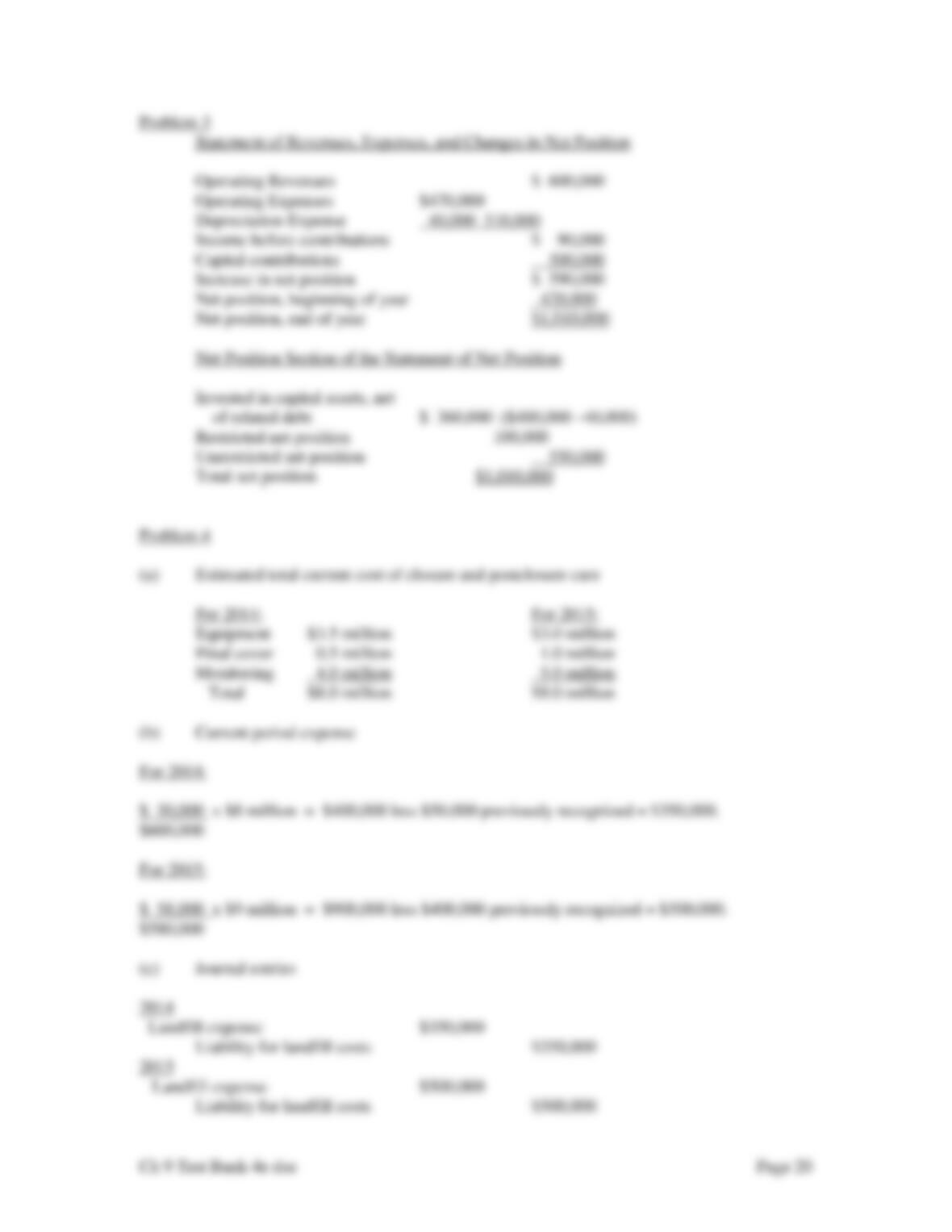
3. The City of Santangelo received a $500,000 federal grant to acquire several buses to be used
in its public transit system. The city paid $400,000 to acquire several buses. At year-end,
$100,000 of the grant had not yet been used. During the year total depreciation on the buses
was $40,000. Revenues for the public system were $600,000; operating expenses (other than
depreciation) were $470,000. REQUIRED: Assuming the Public Transit Enterprise Fund
began the year with unrestricted net assets of $420,000, prepare the following for the Public
Transit Enterprise Fund.
a) Statement of revenues, expenses, and changes in net position.
b) Net position section of the statement of net position.
4. Garfield County operates a solid waste landfill that is accounted for as an enterprise fund. At
the end of 2013, the Landfill Enterprise Fund had a liability for landfill closure and
postclosure care costs of $50,000. The county estimated the total costs associated with
closing and monitoring the landfill as listed below. REQUIRED: (a) Calculate the estimated
total current cost of postclosure care as of year-ends 2014 and 2015. (b) Calculate current
period expenses for year-ends 2014 and 2015. (c) Prepare the required journal entries at
year-ends 2014 and 2015 to recognize the current period expenses. Be sure to show all of
your work.
2014 2015
Costs
Equipment to be installed $3.5 million $3.0 million
Final cover $0.5 million $1.0 million
Monitoring and maintaining $4.0 million $5.0 million
Capacity used 30,000 58,000
Estimated total capacity 600,000 580,000
Ch 9 Test Bank-4e doc Page 14
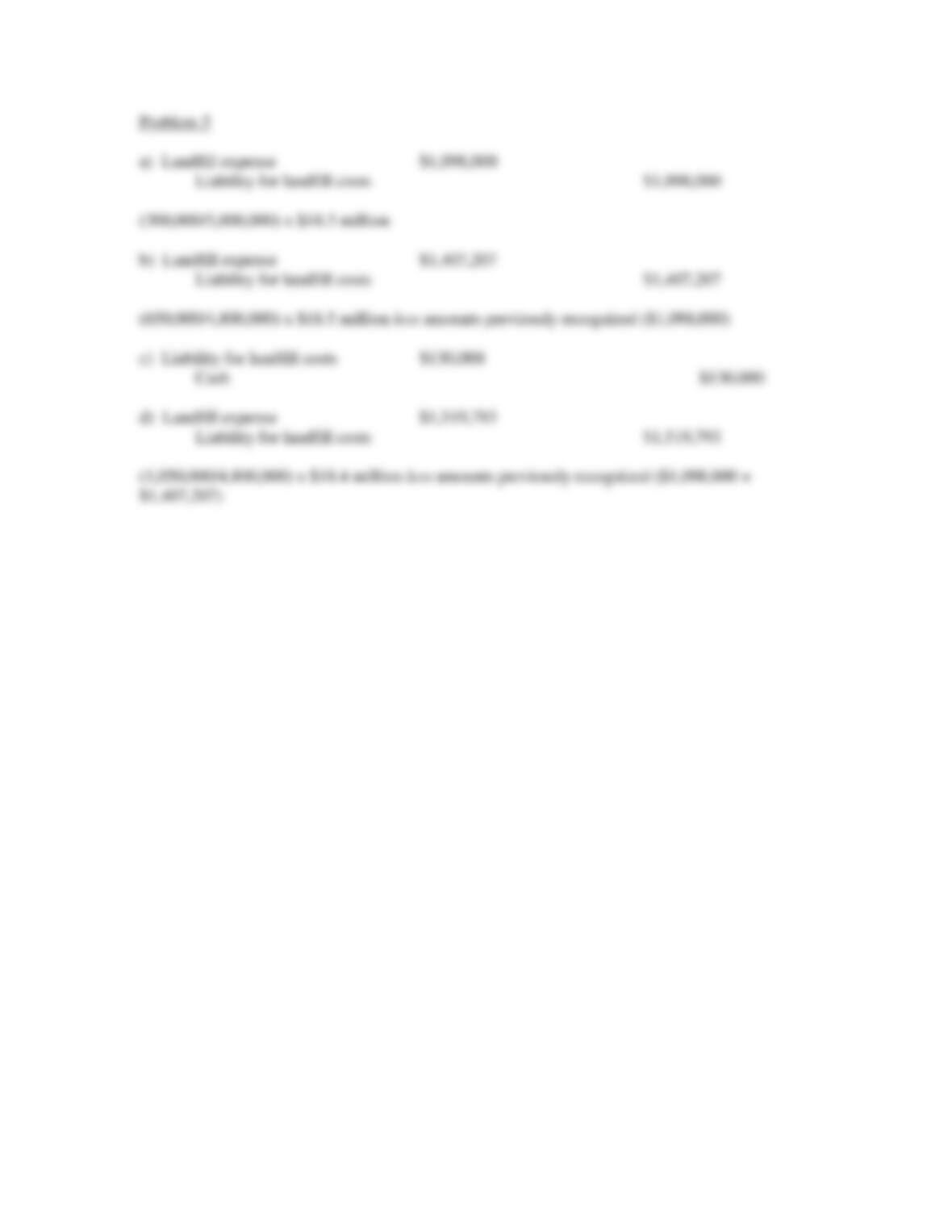
5. Altona City opened a landfill that it elects to account for in an enterprise fund.
• At the time the landfill was opened the government estimated total capacity of the landfill
to be 5 million cubic feet, useful life to be 20 years, and total closure and postclosure
costs to be $18 million.
• At the end of Year 1, the government reestimated total closure costs to be $18.3 million
and estimated capacity to be same as the original estimate.
• At the end of Year 2, the government reestimated total capacity to be 4.8 million cubic
feet and total closure costs to be $18.5 million.
• At the end of Year 3, the government reestimated useful life to be 17 years but capacity
remained unchanged from the preceding year and closure and postclosure costs were
estimated to be $18.4 million.
REQUIRED: Prepare journal entries in the enterprise fund to record the following events.
a) During Year 1, the city estimates that 300,000 cubic feet of capacity were used. Record
the landfill expense.
b) During Year 2, the city estimates that 650,000 cubic feet of capacity were used. Record
the landfill expense.
c) During Year 3 the city installed equipment at a cost of $130,000. The equipment will be
used in monitoring the landfill when it is closed.
d) During Year 3 the city estimates that 1,050,000 cubic feet of capacity were used. Record
the landfill expense.
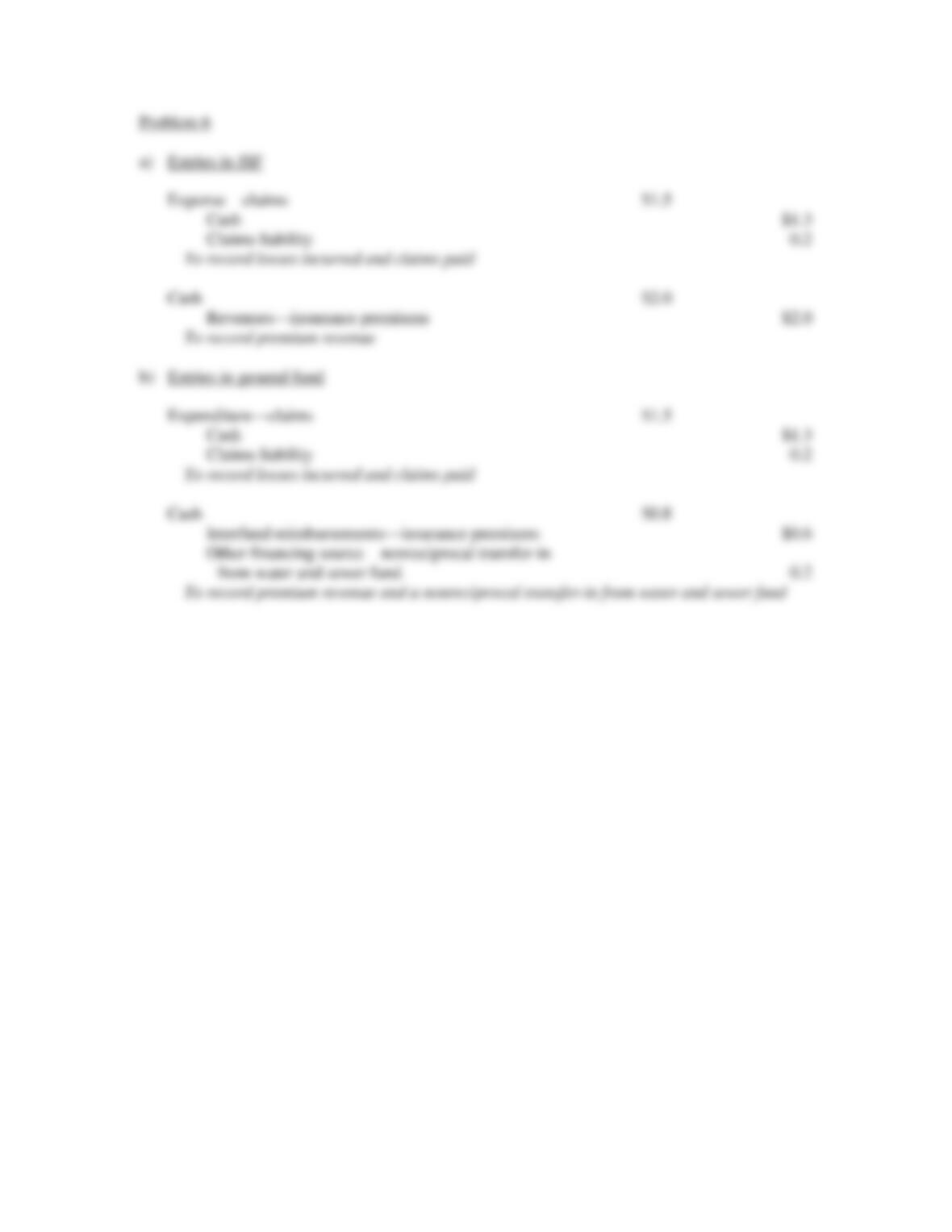
6. When insurance premiums went through the roof, Shorte City decided to “self insure.” It
established an internal service fund (ISF), setting aside resources for potential claims in the
new fund. During the year, the following transactions were recorded in the ISF:
• The ISF recognized $1.5 million in claims expense/liabilities in accordance with GASB
standards and paid $1.3 million of those claims.
• Based on an actuarial calculation, the ISF billed the other funds of the city for $2.0
million. Of this amount, $1.2 million was billed to the city’s general fund and $0.8
million was billed to the city’s water and sewer enterprise fund. The actuarial valuation
included a reasonable provision for future catastrophe losses of $0.3 million.
REQUIRED:
a) Prepare journal entries to record these transactions in the city’s self-insurance ISF.
b) Suppose, instead, that the city reported its self-insurance activities in the general fund.
Prepare journal entries to record these transactions in the City’s general fund. Assume
that any excess was allocated ratably (proportionately) between the general fund and the
water and sewer fund.

Ch 9 Test Bank-4e doc Page 15
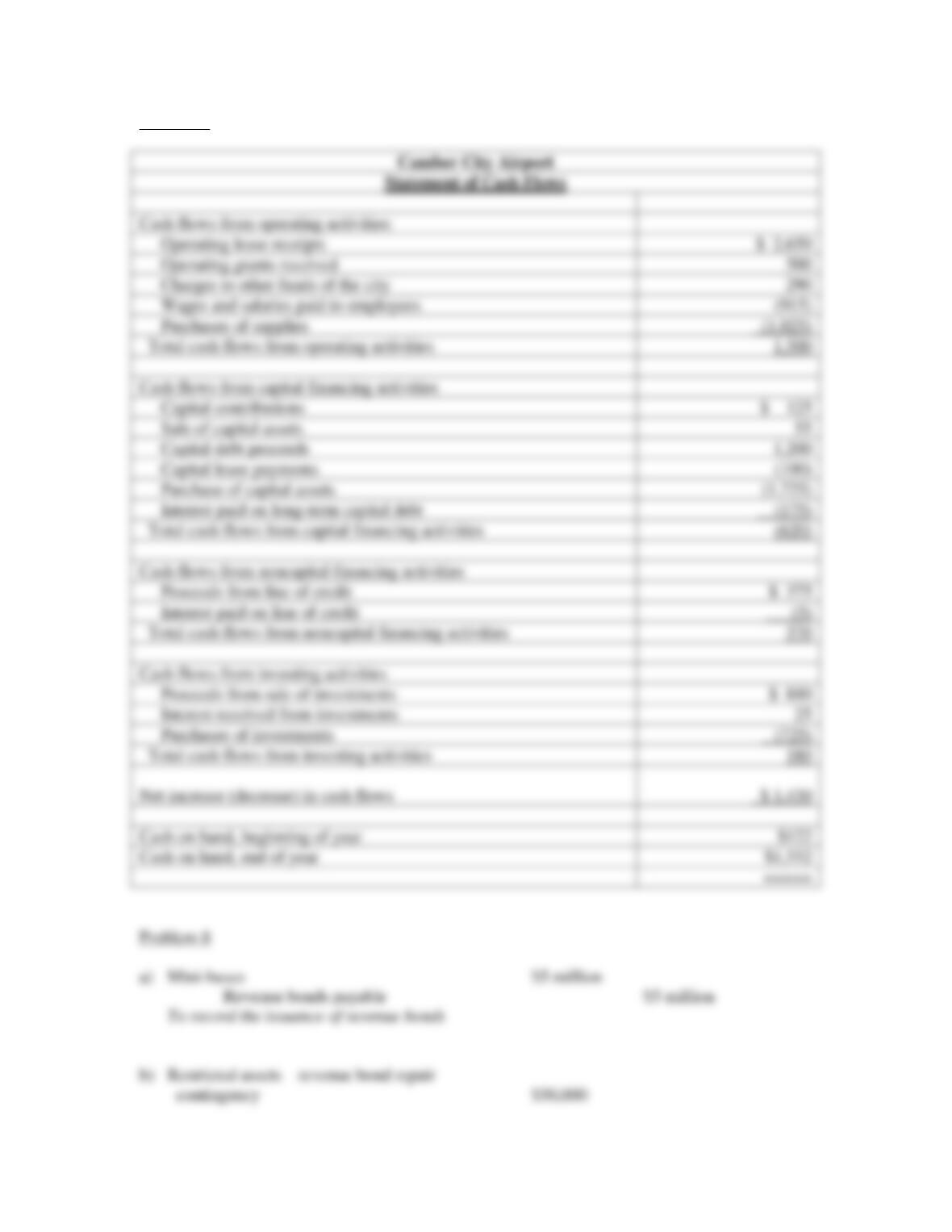
7. The following list of cash flows was taken from the Camber City airport fund’s statement of
cash flows. All amounts are in thousands.
Cash on hand, beginning of year
$ 122
Operating lease receipts
2,650
Interest received from investments
25
Wages and salaries paid
915
Purchases of supplies
1,025
Collections (for services) from other funds of the city
290
Interest paid on long-term capital debt
175
Purchases of capital assets
1,725
Proceeds of revenue bonds to acquire capital assets
1,200
Purchases of investments
725
Proceeds from sale of capital assets
55
Proceeds from sales of investments
880
Capital lease payments
100
Operating grants received
500
Proceeds from line of credit (used for operations)
375
Capital contribution from airline
125
Interest paid on line of credit
5
REQUIRED: Put these cash flow amounts in the form of a cash flows statement for the
airport. Calculate and include a line for cash on hand at the end of the period.
8. Falmouth City owns and operates a mini-bus system which it accounts for in an enterprise
fund. Prepare journal entries to record the following transactions, which occurred in a recent
year.
a) The mini-bus system issued $5 million of 8 percent revenue bonds at par and used the
proceeds to acquire new mini-buses.
b) As required by the bond covenant, the system set aside 1 percent of the gross bond
proceeds for repair contingencies.
c) The system accrued 6 months interest on the revenue bonds at year-end.
d) The system incurred $30,000 of repair costs and paid for them with cash set aside for
repair contingencies.
Ch 9 Test Bank-4e doc Page 16
ESSAYS (CHAPTER 9)
1. Many governments use internal service funds to account for activities that provide services to
the government itself. What are the ramifications of such an accounting arrangement? What
are the effects on the government’s financial statements?
2. Governments may elect to account for their landfill activities in either a governmental or an
enterprise fund. Explain the differences that would result if one government elected to
account for its landfill activities in its general fund and another government elected to
account for its landfill activities in an enterprise fund.
3. Because of the rising cost of commercial insurance, many governments have elected to be
“self–insured.” Explain what being “self–insured” means. Explain the difference in the
accounting for self-insurance activities between a governmental fund and a proprietary fund.
4. An electric utility reports both restricted assets and restricted net position, but the amounts are
different from each other. What could account for this difference?
5. What are the differences between a cash flows statement prepared for a governmental electric
utility versus one prepared for an investor-owned utility?
6. How should a government usually report the activities of an internal service fund in the
government-wide financial statements?
7. A city’s comptroller is distraught because depreciation cannot be recorded in a general fund.
Moreover, for political reasons the city council never permits the general fund to have a
substantial surplus balance. As a consequence the city is unable to “save” resources to
replace aging capital assets. The comptroller has heard that it is possible indirectly to charge
depreciation in a general fund by transferring capital assets to an internal service fund and
correspondingly to build up a cash reserve to replace the capital assets. Is the comptroller
correct? If so, explain how an internal service fund can be used to charge depreciation in the
general fund and thereby create a cash reserve of what would otherwise be general fund
assets.
Ch 9 Test Bank-4e doc Page 17
ANSWERS TO TRUE/FALSE (CHAPTER 9)
Ch 9 Test Bank-4e doc Page 18
ANSWERS TO MULTIPLE CHOICE (CHAPTER 9)
Ch 9 Test Bank-4e doc Page 19
ANSWERS TO PROBLEMS (CHAPTER 9)
Ch 9 Test Bank-4e doc Page 21
Ch 9 Test Bank-4e doc Page 22
Ch 9 Test Bank-4e doc Page 23
Problem 7
Ch 9 Test Bank-4e doc Page 24
Ch 9 Test Bank-4e doc Page 25
ANSWERS TO ESSAYS (CHAPTER 9)
Ch 9 Test Bank-4e doc Page 26
Ch 9 Test Bank-4e doc Page 27