
24)
Which of the following places the steps in the PCR procedure in the correct order?
1) Incubate at 94°C to denature DNA strands;
2) Incubate at 72°C for DNA synthesis;
3) Incubate at 60°C for primer hybridization.
24)
A)
1, 3, 2
B)
1, 2, 3
C)
3, 2, 1
D)
3; 1; 2
E)
2; 1; 3
25)
Which of the following is NOT a desired characteristic of DNA vectors used in gene cloning
procedures?
25)
A)
has a selectable marker
B)
self–replication
C)
may replicate in several species
D)
circular form of DNA or integrates into the host chromosome
E)
large size
26)
Pieces of DNA stored in yeast cells are called a
26)
A)
PCR.
B)
Southern blot.
C)
library.
D)
clone.
E)
vector.
27)
In the Southern blot technique, which of the following is NOT required?
27)
A)
restriction enzyme digestion of DNA
B)
electrophoresis to separate fragments
C)
addition of heat–stable DNA polymerase to amplify DNA
D)
addition of a labeled probe to identify the gene of interest
E)
transfer of DNA to nitrocellulose
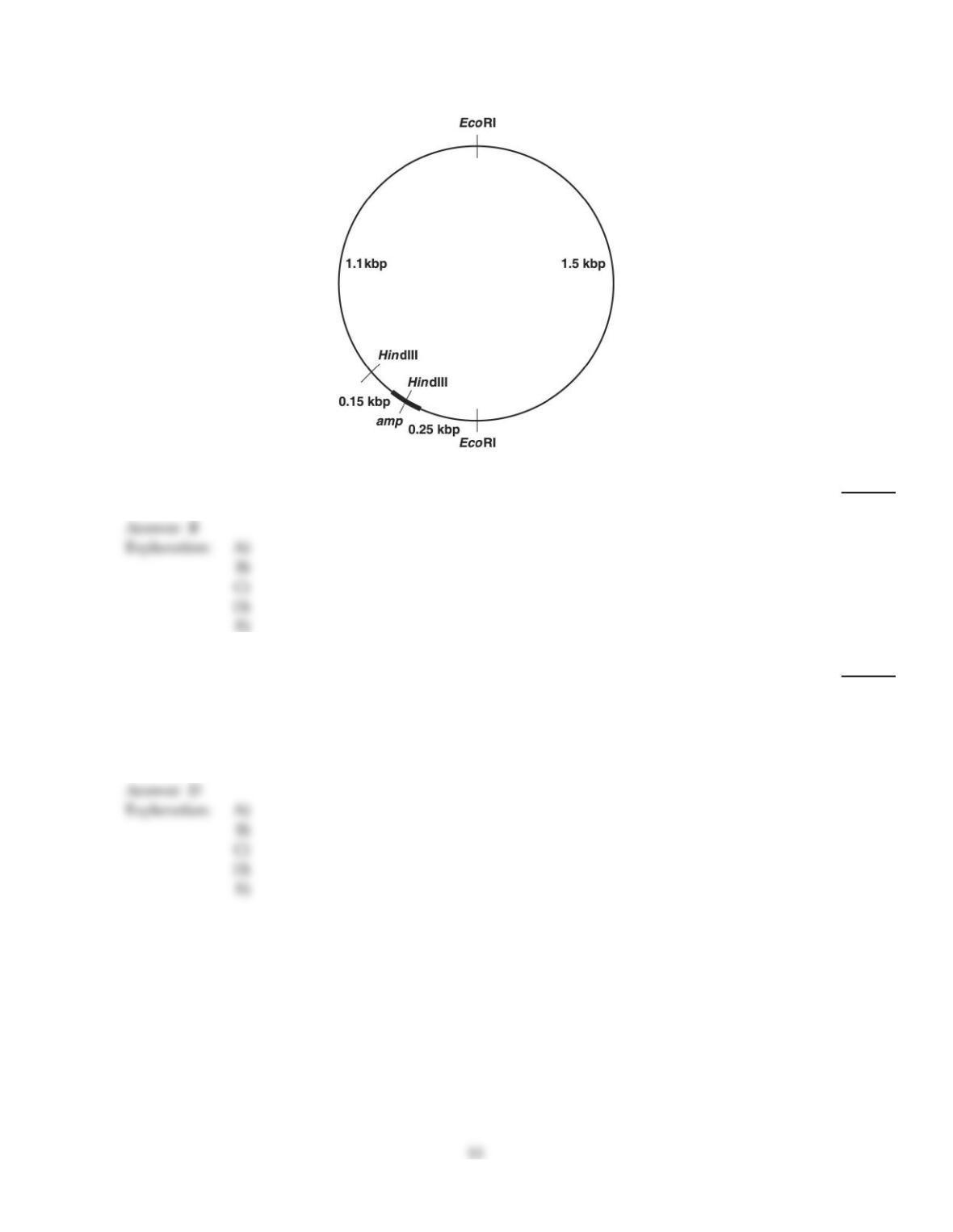
Figure 9.1
28)
How many pieces will EcoRI produce from the plasmid shown in Figure 9.1?
28)
A)
1
B)
2
C)
3
D)
4
E)
5
29)
A source of heat–stable DNA polymerase is
29)
A)
Saccharomyces cerevisiae.
B)
Pseudomonas.
C)
Bacillus thuringiensis.
D)
Thermus aquaticus.
E)
Agrobacterium tumefaciens.

30)
Self–replicating DNA used to transmit a gene from one organism to another is a
30)
A)
library.
B)
vector.
C)
clone.
D)
Southern blot.
E)
PCR.
31)
The random shotgun method is used in
31)
A)
genome sequencing.
B)
transforming plant cells with recombinant DNA.
C)
RFLP analysis.
D)
amplification of unknown DNA.
E)
forensic microbiology.
32)
You want to determine whether a person has a certain mutant gene. The process involves using a
primer and a heat–stable DNA polymerase. This process is
32)
A)
restriction mapping.
B)
site–directed mutagenesis.
C)
translation.
D)
PCR.
E)
transformation.
33)
Which of the following processes is NOT involved in making cDNA?
33)
A)
RNA processing to remove introns
B)
transcription
C)
translation
D)
reverse transcription
34)
Which of the following is NOT an agricultural product made by DNA techniques?
34)
A)
pectinase
B)
glyphosate–resistant crops
C)
nitrogenase (nitrogen fixation)
D)
Bacillus thuringiensis insecticide
E)
frost retardant
35)
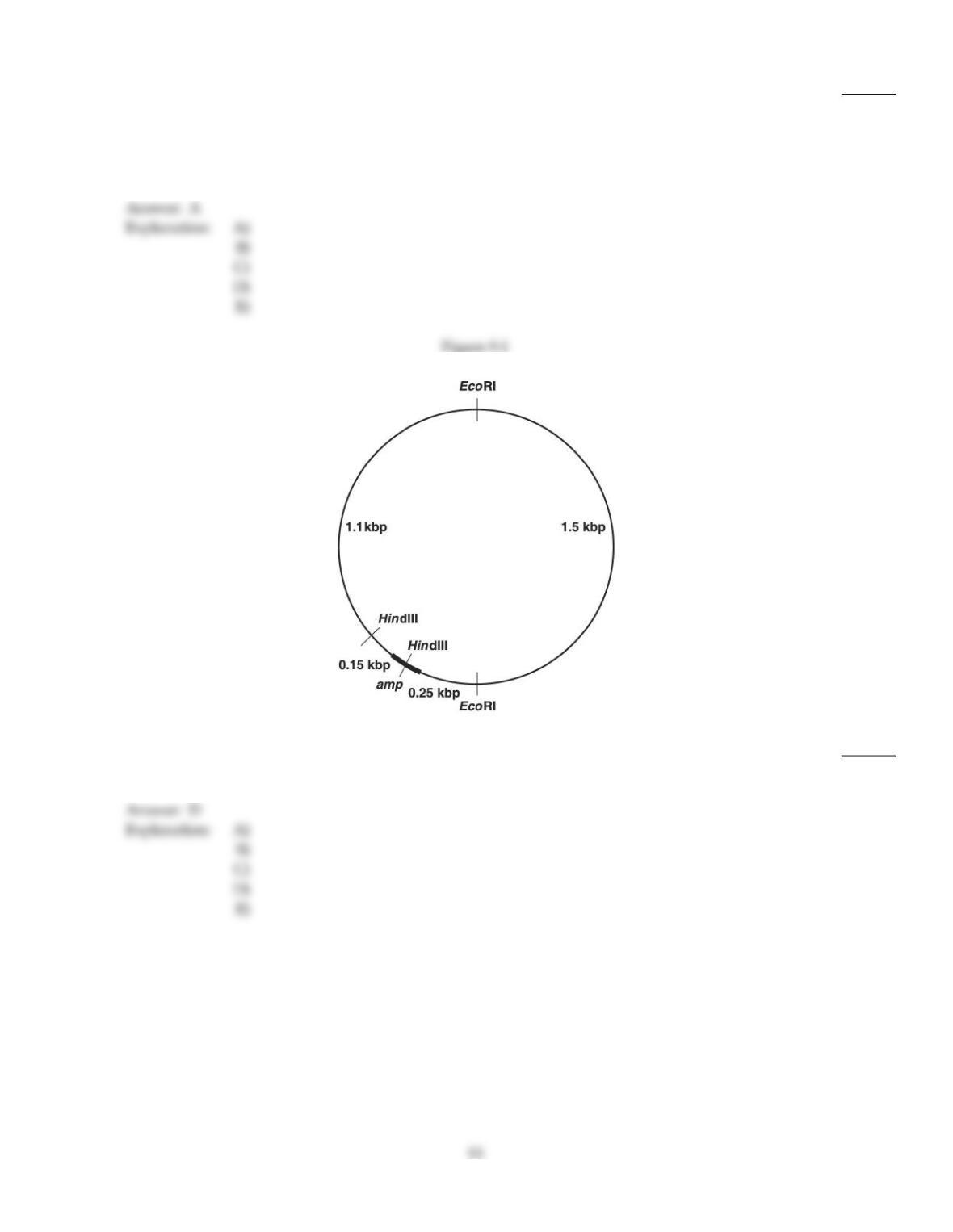
In Figure 9.1, after digestion with the appropriate restriction enzyme, what is the smallest piece
containing the ampicillin–resistance (amp) gene?
35)
A)
0.17 kbp
B)
0.25 kbp
C)
1.08 kbp
D)
1.50 kbp
E)
3.00 kbp

36)
A colleague has used computer modeling to design an improved enzyme. To produce this enzyme,
the next step is to
36)
A)
use siRNA to produce the enzyme.
B)
synthesize the gene for the improved enzyme.
C)
determine the nucleotide sequence for the improved enzyme.
D)
mutate bacteria until one makes the improved enzyme.
E)
look for a bacterium that makes the improved enzyme.
37)
A population of cells carrying a desired plasmid is called a
37)
A)
clone.
B)
vector.
C)
library.
D)
PCR.
E)
Southern blot.
38)
The following steps must be performed to make a bacterium produce human protein X.
1–Translation
2–Restriction enzyme
3–Prokaryotic transcription
4–DNA ligase
5–Transformation
6–Eukaryotic transcription
7–Reverse transcription
Which of the following places the steps in the correct order?
38)
A)
6, 7, 2, 4, 5, 3, 1
B)
1, 2, 3, 5, 4, 7, 6
C)
5, 2, 3, 4, 7, 6, 1
D)
6, 7, 2, 3, 4, 5, 1
E)
6, 2, 1, 3, 4, 5, 7
39)
The Human Genome Project, which was completed in 2003, was focused on
39)
A)
determining all of the proteins encoded by the human genome.
B)
determining the nucleotide sequence of the entire human genome.
C)
cloning all of the genes of the human genome.
D)
finding a cure for all human genetic disorders.
E)
identifying all of the genes in the human genome.
40)
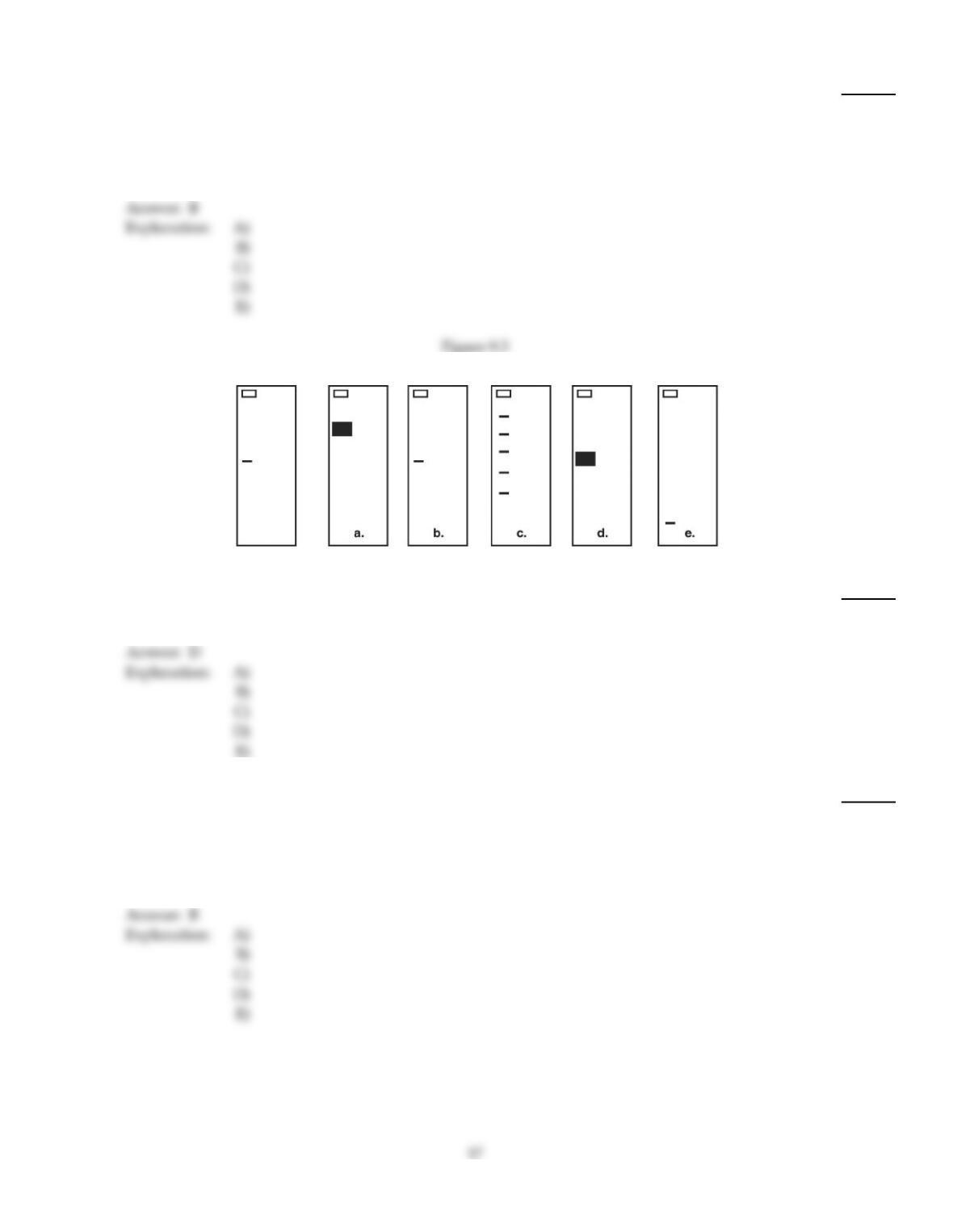
The figure at the left in Figure 9.3 shows a gene identified by Southern blotting. What will a
Southern blot of the same gene look like after PCR?
40)
A)
a
B)
b
C)
c
D)
d
E)
e
41)
An advantage of synthetic DNA over genomic or cDNA is the ability to
41)
A)
obtain genes that lack introns.
B)
insert desired restriction sites into the DNA sequence.
C)
make DNA from cellular RNA and the enzyme reverse transcriptase.
D)
isolate unknown genes.
E)
obtain genes that lack exons.

42)
The restriction enzyme EcoRI recognizes the sequence GAATTC. Which of the following is TRUE
of DNA after it is treated with EcoRI?
42)
A)
All of the DNA fragments will have single–stranded regions ending in AA.
B)
All of the DNA will have blunt ends.
C)
All of the DNA fragments will have single–stranded regions ending in G.
D)
All of the DNA will be circular.
E)
Some of the DNA will have single–stranded regions ending in AA and others will end in G.
43)
Assume you have discovered a cell that produces a lipase that works in cold water for a laundry
additive. You can increase the efficiency of this enzyme by changing one amino acid. This is done
by
43)
A)
irradiating the cells.
B)
site–directed mutagenesis.
C)
selection.
D)
selective breeding.
E)
enrichment.
Explanation:
44)
Biotechnology involves the
44)
A)
use of microorganisms to make desired products.
B)
use of animal cells to make vaccines.
C)
development of disease–resistant crop plants.
D)
use of microorganisms to make desired products and the use of animal cells to make vaccines.
E)
use of microorganisms to make desired products, the use of animal cells to make vaccines,
and the development of disease–resistanct crop plants.
Explanation:
Explanation:
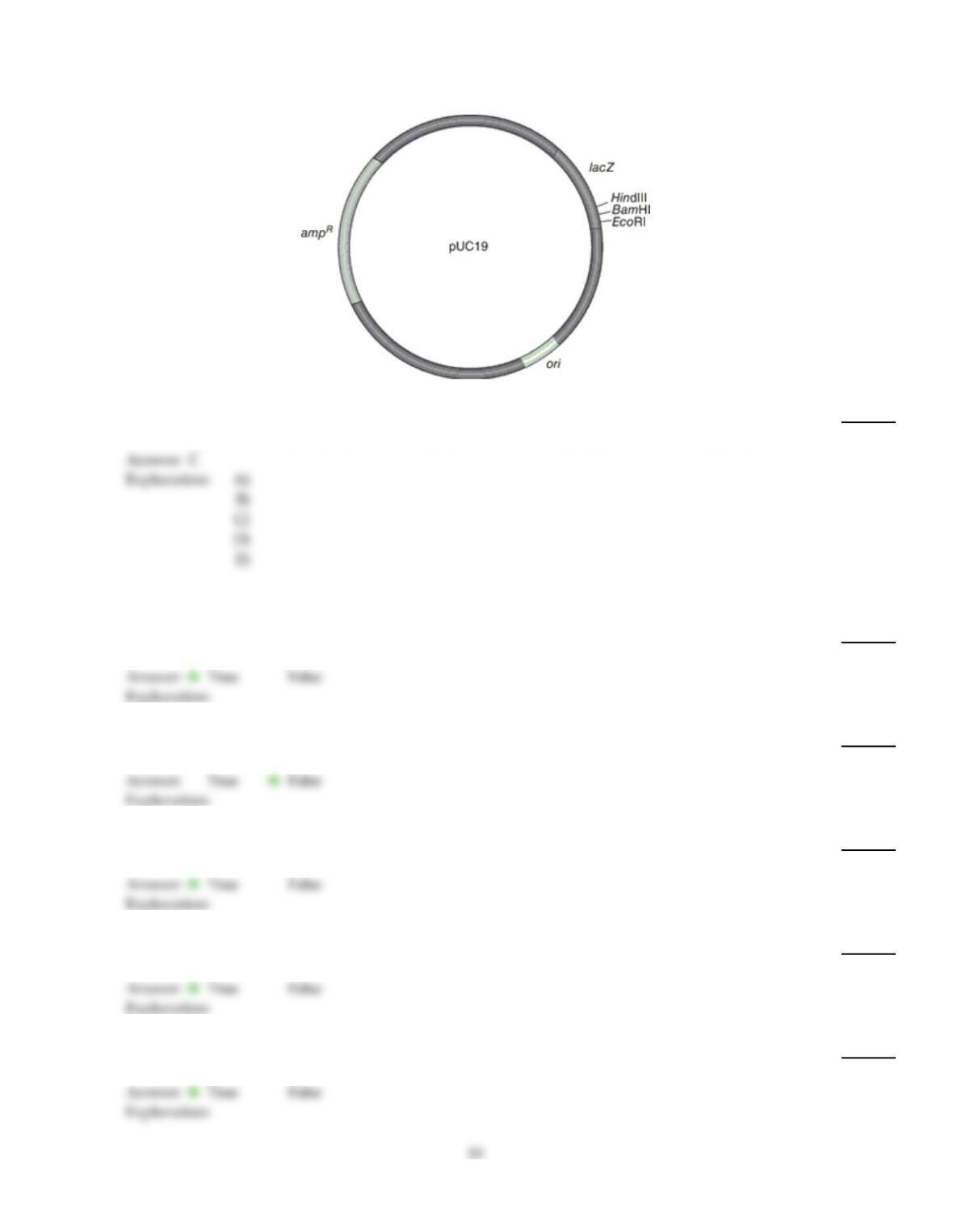
Figure 9.5
45)
In Figure 9.5, the gene that allows the plasmid to be self–replicating is
45)
A)
ampR.
B)
HindIII.
C)
ori.
D)
lacZ.
E)
EcoRI.
TRUE/FALSE. Write ‘T’ if the statement is true and ‘F’ if the statement is false.
46)
A shuttle vector is a plasmid that is used to move pieces of DNA among organisms, such as
bacterial, fungal, and plant cells.
46)
47)
Nearly all cells, including E. coli and yeast, naturally take up DNA from their surroundings without
chemical treatment.
47)
48)
One of the first commercial successes of recombinant DNA technology was the production of
human insulin using genetically engineered E. coli.
48)
49)
The disadvantage of genomic libraries over cDNA libraries is that genomic libraries contain gene
introns.
49)
50)
In recombinant DNA technology, a vector is a self–replicating segment of DNA, such as a plasmid
or viral genome.
50)

51)
The Ti plasmid isolated from Agrobacterium can be used to insert DNA into any type of plant.
51)
52)
The Bt toxin derived from Bacillus thuringiensis has been introduced into some crop plants to make
them resistant to insect destruction.
52)
53)
Bioinformatics is the use of computer technology to compare and analyze genome sequence.
53)
54)
The term biotechnology refers exclusively to the use of genetically engineered organisms for the
production of desired products.
54)
55)
The practice of breeding plants and animals for desirable traits, such as high crop yield, is called
natural selection.
55)
ESSAY. Write your answer in the space provided or on a separate sheet of paper.
56)
Your research group is investigating the possible use of genetically–engineered cells to produce a vaccine for
malaria. List the pros and cons of using E. coli, Saccharomyces, and animal cells to produce the vaccine.
57)
Pseudomonas syringae is found naturally in the soil. Sold as Snomax, it is used to make snow at ski resorts. The
same bacterium with a gene deletion (Ice–minus) is used to prevent ice formation on plants. Should Snomax
and Ice–minus be considered modified organisms and subject to precautions of releasing genetically modified
organisms? Explain why or why not.
58)
The local public health agency has received reports of an outbreak of Salmonella gastroenteritis among attendees
at a city–sponsored chili cook–off. What techniques from recombinant DNA technology would the agency
likely use to investigate this outbreak? Describe the expected results from these techniques.

Answer Key
Testname: C9
21

Answer Key
Testname: C9