The Cultural Landscape, 11e (Rubenstein)
Chapter 9 Development
1) Which is the least developed region among the following?
A) North America
B) Eastern Europe
C) Southwest Asia
D) Western and Central Europe
E) East Asia
2) The total value of the output of goods and services in a year in a country is its
A) gross national income.
B) primary economic sector.
C) productivity index.
D) value added.
E) gross domestic product.
3) Gross domestic product (GDP) is the
A) total value of the outputs minus inputs of goods and services produced in a country during a
year.
B) total value of exports of goods and services produced in a country during a year.
C) total value of outputs of goods and services produced in a country during a year.
D) total value of human capital development in a country during a year.
E) total value of investments made in domestic and foreign sources of revenue during a year.
4) An example of a primary sector activity is
A) education.
B) manufacturing.
C) banking.
D) retailing.
E) mining.
5) Processing of computer information is an example of which sector of the economy?
A) sixth percentile
B) primary and secondary
C) primary
D) tertiary
E) the data sector
6) The secondary sector of the economy includes which of the following?
A) data processing
B) mining
C) government
D) construction
E) banking
7) In MDCs, employment is increasing more rapidly in which of the following sectors?
A) farming
B) primary
C) secondary
D) tertiary
E) fishing
8) The primary sector of the economy includes which of the following?
A) data processing
B) beverage bottling
C) government
D) sheep herding
E) banking
9) The value of a product minus the costs of raw materials and energy is
A) gross domestic product.
B) productivity.
C) tertiary sector analysis.
D) market value.
E) value added.
10) ________ is an example of a secondary sector activity.
A) Banking
B) Farming
C) Manufacturing
D) Secondary education
E) Professional football
11) In less developed countries, consumer goods such as telephones, televisions, and motor
vehicles are
A) available for sharing by a large number of people.
B) unknown and unfamiliar to most people.
C) essential to rural life.
D) familiar to many but owned by relatively few.
E) available only through local manufacture.
12) Examples of material conditions include
A) drinking water and sewage systems.
B) systems of thought.
C) religious institutions.
D) division of jobs into different sectors.
E) political institutions.
13) A country that has a higher level of development exhibits a(n)
A) improvement in material conditions.
B) growth of the output of goods and services.
C) improvement of a product compared to the needed labor.
D) division of jobs into different sectors.
E) growth of political institutions.
14) Per capita GDP is a poor indicator of which of the following?
A) the approximate level of material well being in a country
B) the number of countries below the poverty level
C) the distribution of wealth within a country
D) the spatial distribution of global wealth
E) potential for providing all citizens with a comfortable life
15) Per capita GDP is a good indicator of which of the following?
A) the approximate level of spiritual well being in a country
B) the number of countries below sea level
C) the distribution of wealth within a country
D) the political dimensions of a population
E) potential for providing all citizens with a comfortable life
16) Which of the following is an indicator of a country’s level of development?
A) the number of millionaires
B) the number of newspapers
C) crude death rate
D) natural death rate
E) natural increase rate
17) The inequality-adjusted human development index of the United States is
A) inferior to that of Canada and most Western European countries.
B) greater than any other country in the world.
C) inferior to that of Canada but superior to most Western European countries.
D) greater than Canada because a higher percentage of people in the United States have quality
health care.
E) inferior to Western European countries but far superior to Canada.
18) The IHDI of Latin American countries is
A) inferior to that of Canada and most Western European countries.
B) greater than the United States but less than Canada.
C) inferior to that of Canada but superior to most Western European countries.
D) greater than that of Canada and twice as great as that of the United States.
E) inferior to Western European countries and far superior to Canada.
19) Compared to less developed countries, more developed countries have higher rates of
A) literacy.
B) childhood mortality.
C) infectious disease.
D) illiteracy.
E) environmental pollution.
20) People are more productive in more developed countries because they
A) work harder.
B) have access to more technology.
C) have a low amount of value added per person.
D) are consistently better educated.
E) understand their jobs better than workers in less developed countries.
21) Even though a higher percentage of GDP is spent on education in less developed countries,
A) more women than men have access to education in LDCs.
B) LDCs spend less per pupil than MDCs.
C) LDCs have smaller average class sizes than MDCs.
D) literacy rates are higher in urban areas of LDCs than in many MDCs.
E) levels of educational attainment are higher in LDCs.
22) If a country has a large number of publishers and globally esteemed universities, you might
surmise that the country is most likely
A) neither an LDC nor an MDC.
B) an MDC.
C) an LDC.
D) an LDC that has some of the world’s top universities.
E) an MDC that has some of the world’s lowest literacy rates.
23) Compared to less developed countries, more developed countries have lower
A) percentages of GDP spent on education.
B) literacy rates.
C) numbers of teachers available per pupil.
D) numbers of years attending school.
E) amounts of spending per student.
24) The difference in per capita GDP between the more developed and less developed regions is
A) widening.
B) remaining constant.
C) decreasing.
D) zero.
E) cycling up and down.
25) The North American region has high rates of material development but troubling levels of
A) wealth.
B) inequality.
C) financial and management services.
D) spiritual development.
E) educational attainment.
26) The Gender Inequality Index (GII)
A) compares the level of development of women in a country to the average development level
of women in the world.
B) compares the levels of indicators for females to those of males within a country.
C) is composed of the same measures as the HDI but is applied only to women instead of the
entire population.
D) combines economic and political indicators of empowerment.
E) cannot be used as an indicator of development in the United States.
27) Severe gender inequality is a challenge to development because
A) it leads to smaller family sizes, and families with fewer child laborers cannot earn enough
money to pay for their rent and utilities.
B) it is associated with higher literacy rates, higher economic vitality, and lower infant mortality
rates.
C) it excludes men from the informal economy, wasting a major economic asset.
D) it severely limits the economic and social mobility of women, as well as families that are
headed by women.
E) it does not allow men and boys the freedom to attend the schools and seek the jobs that are
best suited to them.
28) In terms of the GII, most African countries have
A) rates far below the United States and Western Europe.
B) rates that exceed the United States and Western Europe owing to African investment in
centers of higher learning.
C) rates that are greater than the United States but less than Europe.
D) core-periphery models.
E) weak national economies.
29) Since 1990, most countries have seen a decline in previous patterns of
A) gender inequality.
B) gender equality.
C) economic inequality.
D) gender dynamics.
E) innovative agricultural methods.
30) Since 1990, most countries have seen an increase in
A) gender equality.
B) gender inequality.
C) gender indices.
D) economic indices.
E) market forces.
31) Which of the following is not an indicator of global gender inequality?
A) Women on average have only two-thirds of the income of men in MDCs.
B) Women have much lower incomes than men in LDCs.
C) Female life expectancy is less than males in every country of the world.
D) Female literacy is much lower than males in Sub-Saharan Africa.
E) Women hold less than one-fourth of managerial jobs in LDCs where data are available.
32) Gender inequality is a challenge to development because
A) it leads to larger family sizes.
B) it is associated with higher literacy rates and lower infant mortality rates.
C) it excludes all women from both the formal and informal economy.
D) it greatly enhances the economic and social mobility of women.
E) men are responsible for all economic development in impoverished areas.
33) Although there are fewer developed countries in the world, altogether they consume about
________ energy as LDCs.
A) twice as much total
B) the same amount of total
C) five times as much total
D) half as much nonrenewable energy but five times as much renewable
E) one-tenth as much
34) Petroleum reserves in Southwest Asia and North Africa are
A) clustered primarily in the Persian (Arabian) Gulf states.
B) dispersed throughout the region.
C) concentrated primarily along the Mediterranean Sea.
D) primarily in Syria and Iraq.
E) clustered in fields along the western shore of the Red Sea.
35) Saudi Arabia has successfully employed the international trade alternative primarily because
of
A) consumer spending.
B) petroleum reserves.
C) regional cooperation.
D) traditional social customs.
E) its strategic distribution location.
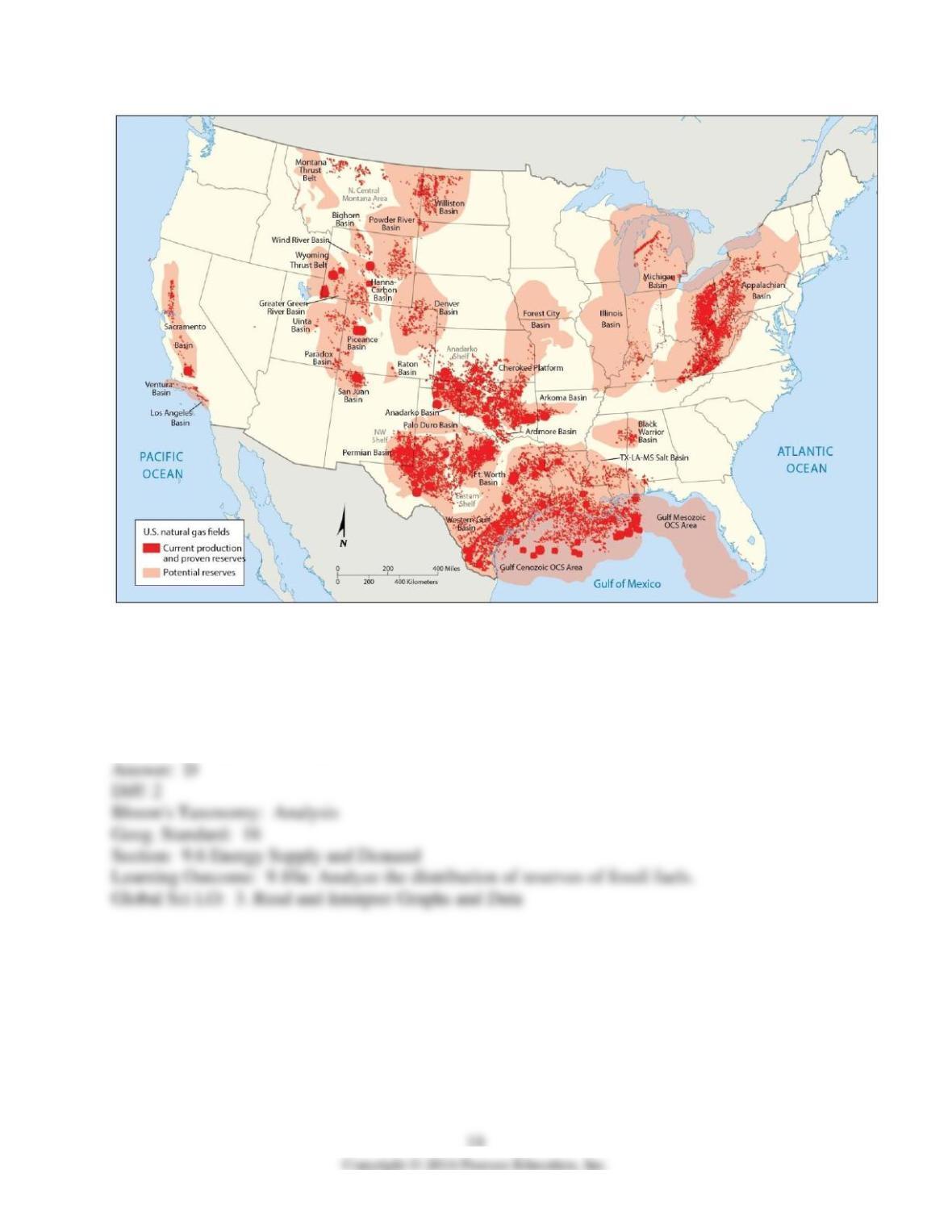
36) Analysis of the maps in this chapter shows that the United States has natural gas fields in
A) Texas but not Oklahoma.
B) the Gulf of Mexico but not the Midwest.
C) the East but not the West.
D) many different areas.
E) the North but not the South.
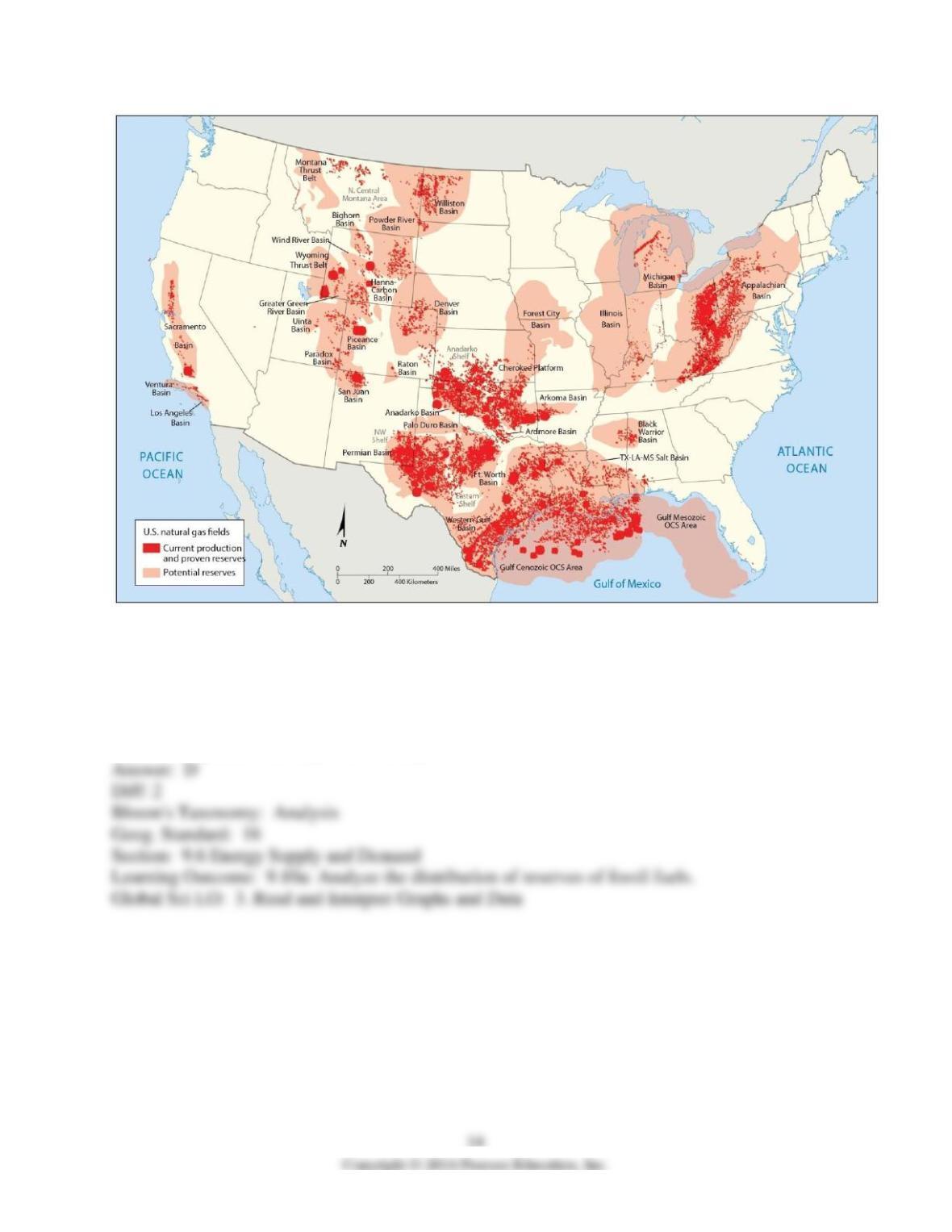
37) Analysis of the maps in this chapter shows that the United States has petroleum production
A) sufficient to meet its needs without further imports.
B) that is now completely shut down due to taxation.
C) inferior to nearly every other country.
D) at significant levels but must still import oil from other countries.
E) at levels greater than any other country.
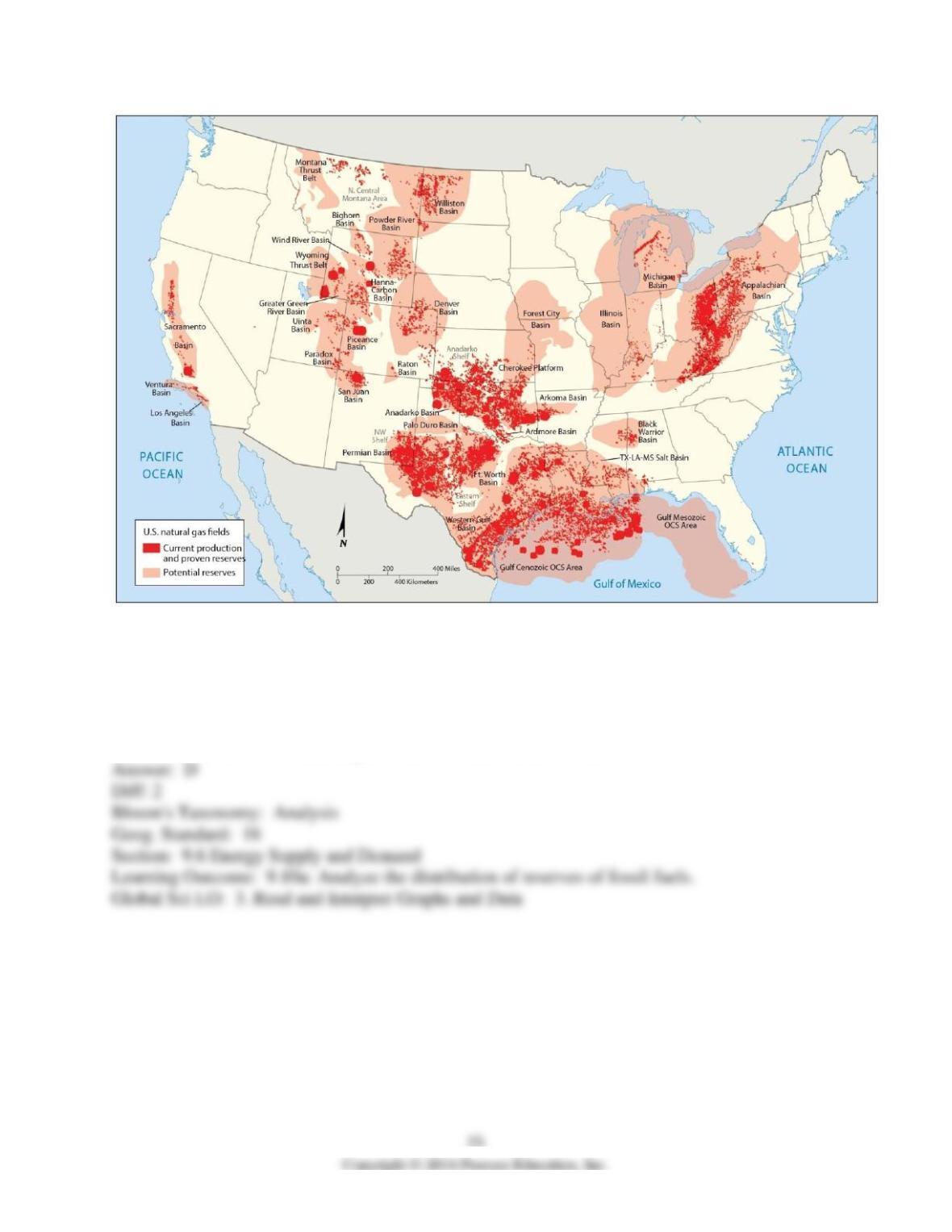
38) The maps of U.S. natural gas fields in this chapter show that the United States has
A) few natural gas fields in Texas and Ohio.
B) the greatest concentration of gas fields in Illinois and Wisconsin.
C) a greater concentration of natural gas fields in the north.
D) a high concentration of natural gas fields in the Gulf of Mexico.
E) the lowest number of natural gas fields in Oklahoma and Texas.
39) The United States has
A) lesser coal and natural gas reserves than China.
B) greater natural gas reserves than Russian and lesser coal reserves than China.
C) a greater concentration of coal reserves in the Gulf of Mexico.
D) more coal reserves than China or Russia.
E) less coal than any other large country.
40) The Chernobyl incident in 1986 involved
A) a nuclear explosion high in the atmosphere.
B) a nuclear missile that misfired and exploded.
C) a nuclear power accident.
D) a massive leak and fire at an oil exploration platform.
E) an explosion and fire at a natural gas field.
41) The Chernobyl incident occurred
A) in the United States.
B) in Cuba.
C) in the Soviet Union.
D) in India.
E) in China.