Cost Accounting: A Managerial Emphasis, 6e
Chapter 9 – Income Effects of Denominator Level on Inventory Valuation
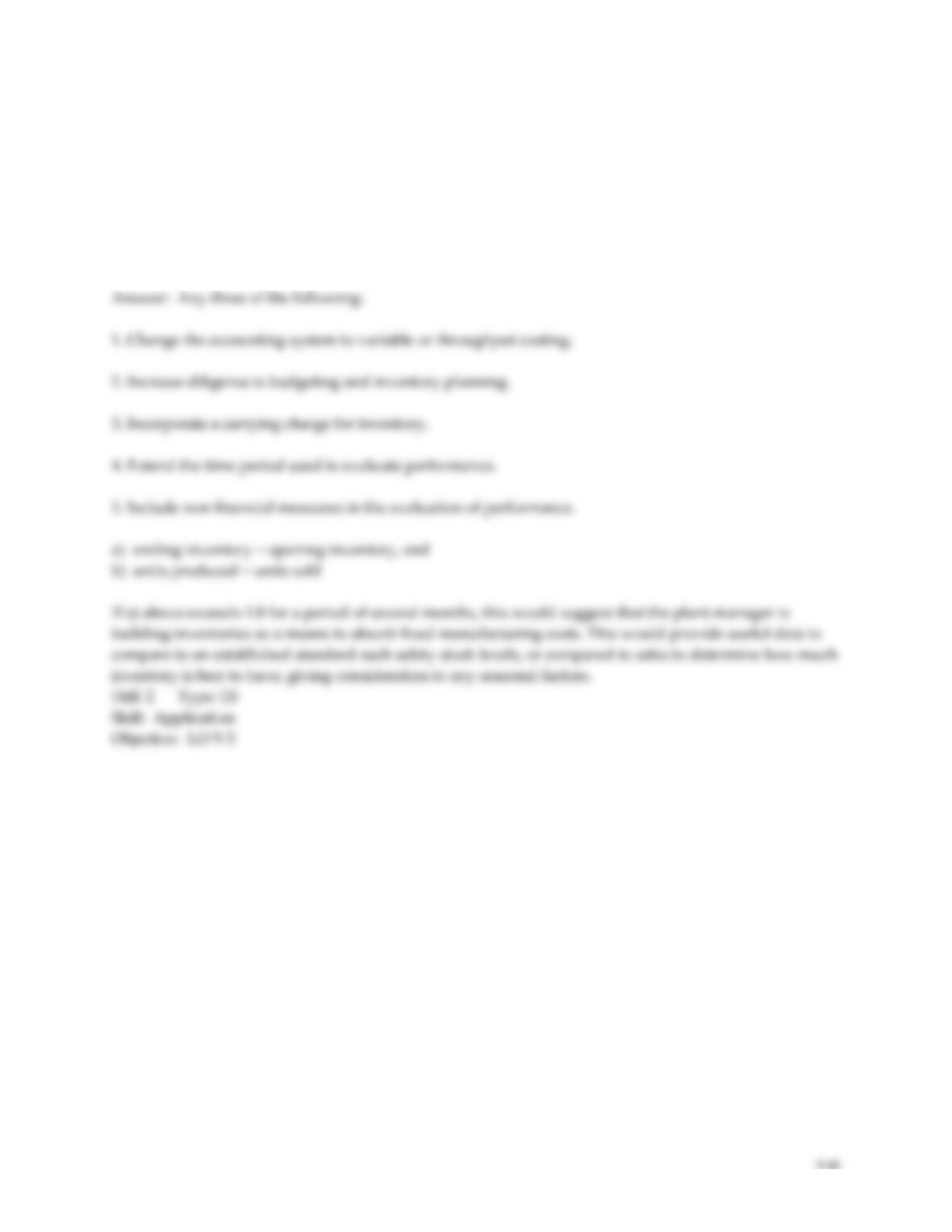
78) You are the management accountant for the West coast division of a musical instrument
manufacturing company. There are three manufacturing plants in your division. Each plant manager was
given decision making authority in terms of production, as long as income for their plant kept on pace.
The manager at Plant A has consistently been the leader in profit for the division, but the other two
managers are complaining that Plant A doesn’t seem to be selling any more product than they are. The
division manager has noticed higher inventory levels at Plant A, which the plant manager justifies by
saying the higher levels are needed to ensure adequate sales. The division manager suspects that there
could be other reasons, and she has asked you to provide three proposals for revising performance
evaluation.
Cost Accounting: A Managerial Emphasis, 6e
Chapter 9 – Income Effects of Denominator Level on Inventory Valuation
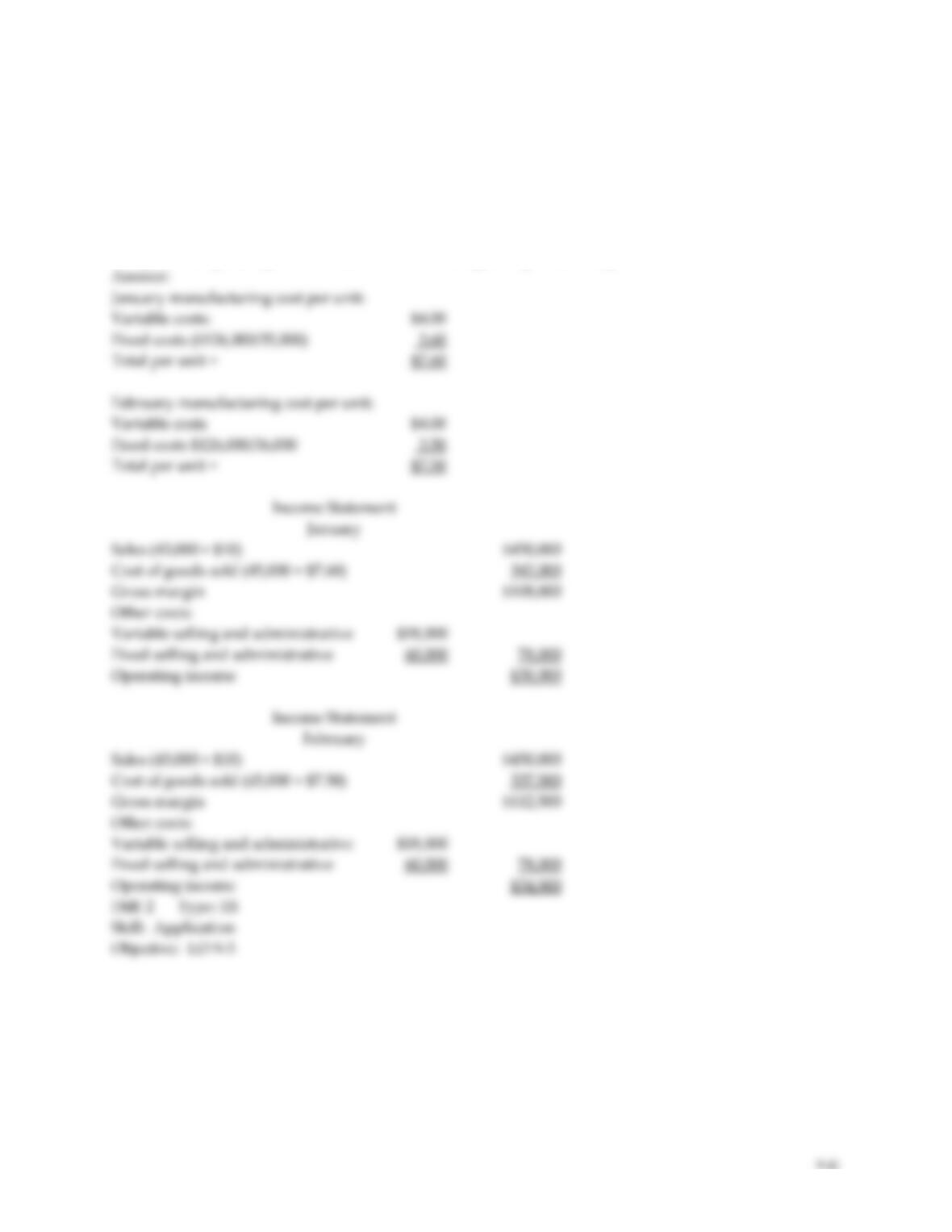
79) Stoll Bottling Works manufactures glass bottles. January and February operations were identical in
every way except for the planned production. January had a production denominator of 35,000 units.
February had a production denominator of 36,000 units. Fixed manufacturing costs totalled $126,000.
Sales for both months totalled 45,000 units with variable manufacturing costs of $4 per unit. Selling and
administrative costs were $0.40 per unit variable and $60,000 fixed. The selling price was $10 per unit.
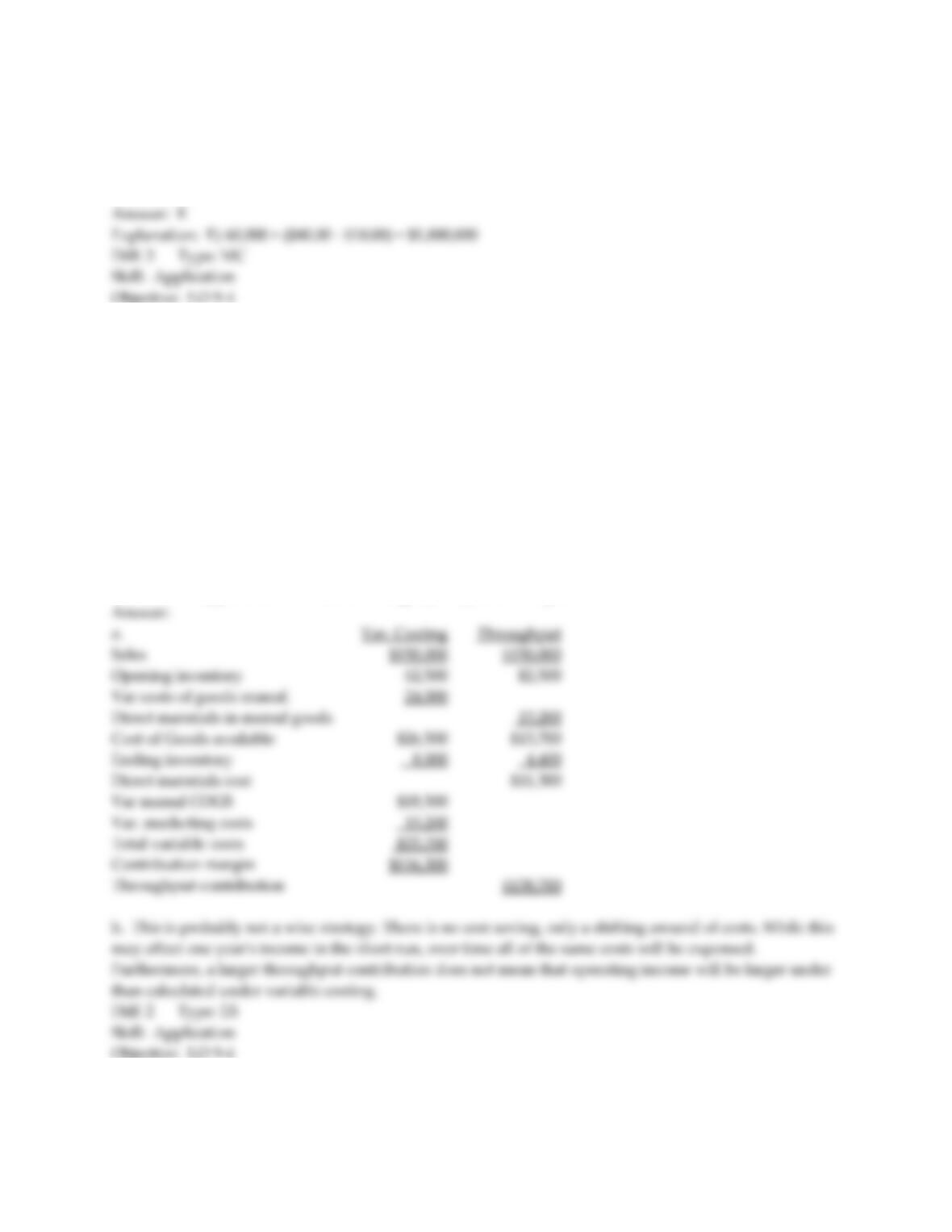
Required:
Compute the operating income for both months using absorption costing.
Cost Accounting: A Managerial Emphasis, 6e
Chapter 9 – Income Effects of Denominator Level on Inventory Valuation
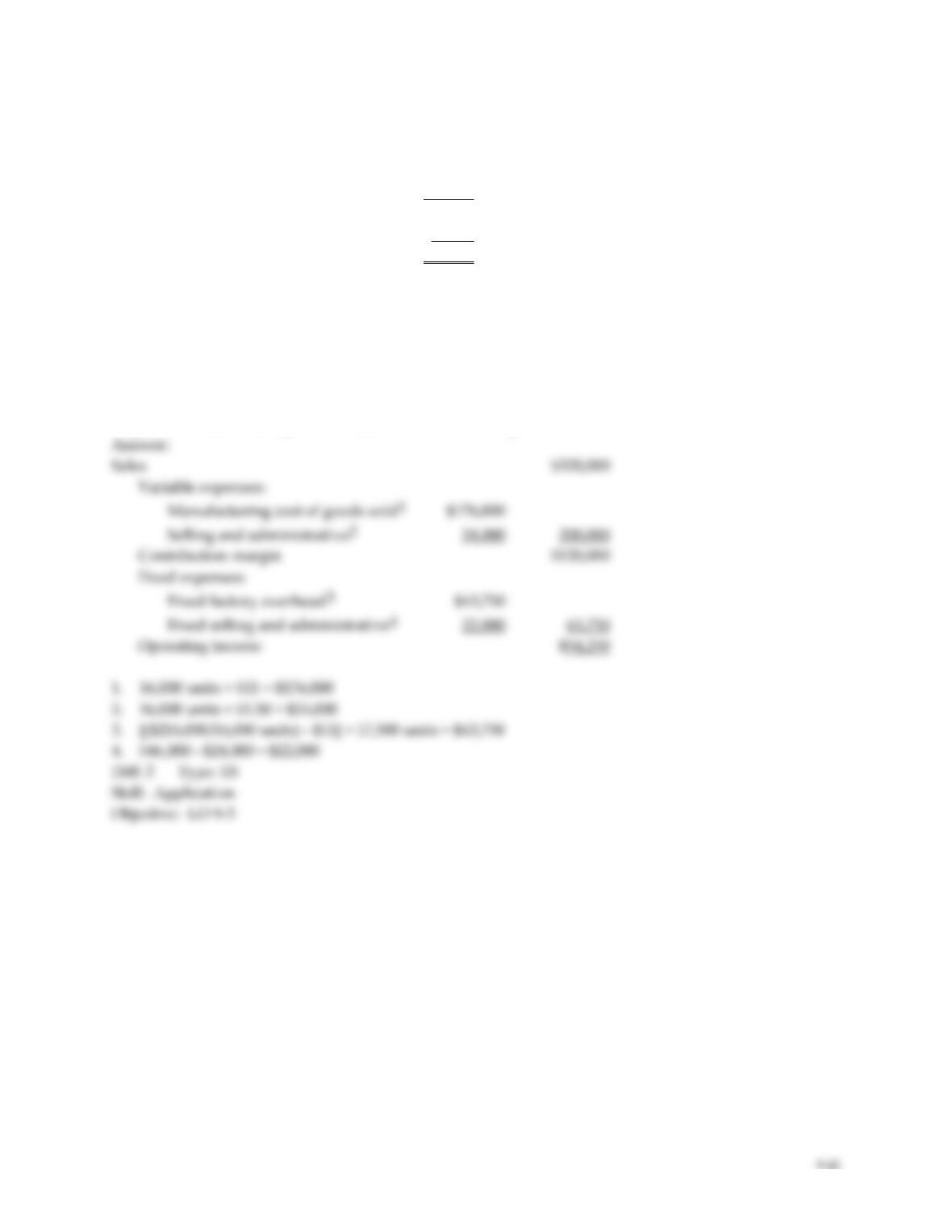
80) Megredy Company prepared the following absorption costing income statement for the year ended
May 31, 2012.
Sales (16,000 units) $320,000
Cost of goods sold 216,000
Gross margin $104,000
Selling and administrative expenses 46,000
Operating income $58,000
Additional information follows:
Selling and administrative expenses include $1.50 of variable cost per unit sold. There was no beginning
inventory, and 17,500 units were produced. Variable manufacturing costs were $11 per unit. Actual fixed
costs were equal to budgeted fixed costs.
Required:
Prepare a variable-costing income statement for the same period.
Cost Accounting: A Managerial Emphasis, 6e
Chapter 9 – Income Effects of Denominator Level on Inventory Valuation
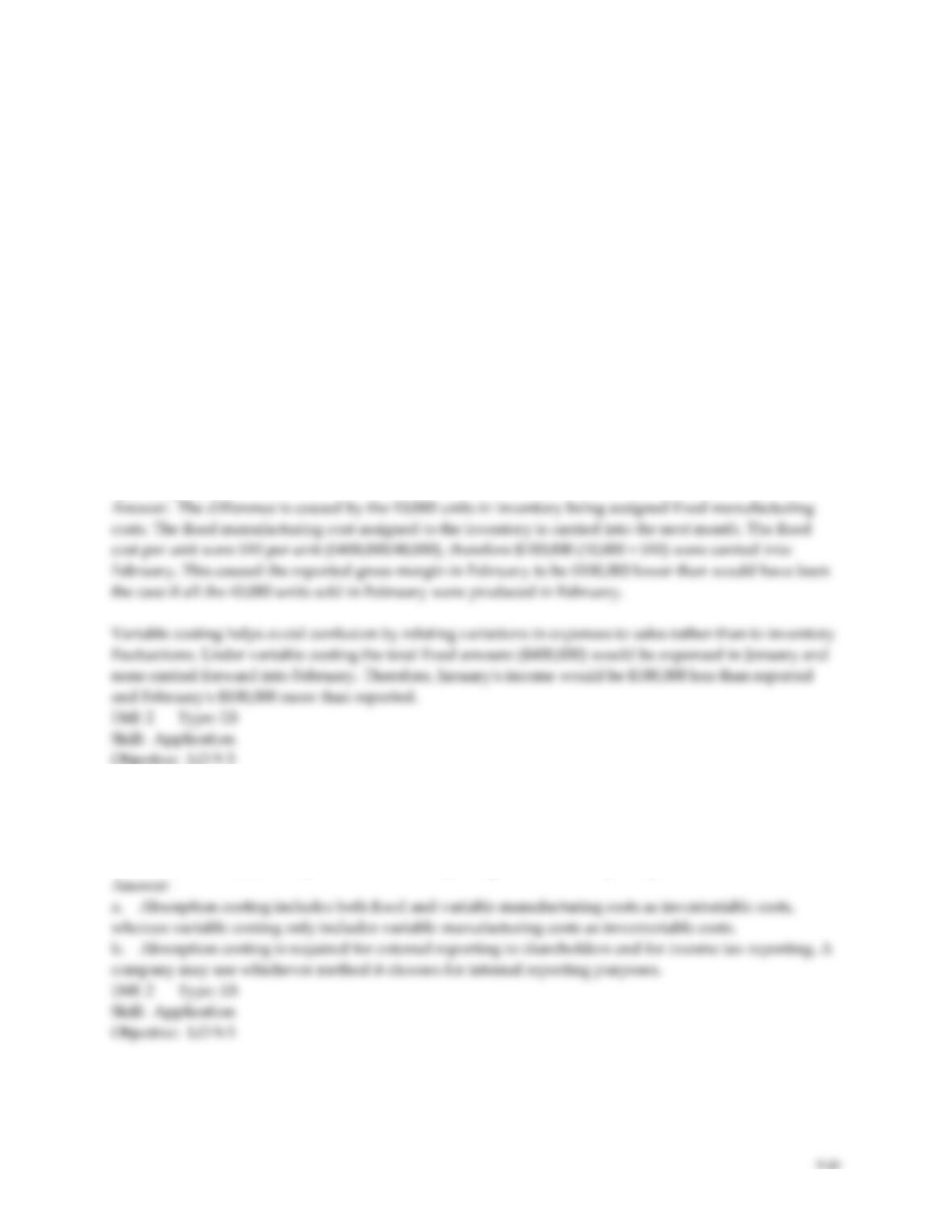
81) The manager of the manufacturing division of Winnipeg Windows does not understand why gross
margin went down in February when sales went up. Some of the information she has selected for
evaluation include:
January February
Units produced 40,000 30,000
Units sold 30,000 40,000
Sales $600,000 $800,000
Beginning inventory 0 $150,000
Cost of production $600,000 $550,000
Ending inventory $150,000 0
Gross margin $150,000 $100,000
The division operated at normal capacity during January. Variable manufacturing cost per unit was $5,
and the fixed manufacturing costs were $400,000. Selling and administrative expenses were all fixed.
Required:
Explain why the gross margin in February was lower than January even though February sales were
higher. How would variable costing income statements help the manager understand the division’s
operating income?
82)
a. Explain the difference between the variable and absorption costing methods.
b. Which method(s) are required for external reporting? For internal reporting?
Cost Accounting: A Managerial Emphasis, 6e
Chapter 9 – Income Effects of Denominator Level on Inventory Valuation
83) SamTech Company has two identical divisions, East and West. Their sales, production volume, and
fixed manufacturing costs have been the same for the last five years. The amounts for each division were
as follows:
Year 1 Year 2 Year 3 Year 4 Year 5
Units produced 50,000 55,000 55,000 44,000 44,000
Units sold 45,000 45,000 50,000 50,000 50,000
Fixed mfg. costs $55,000 $55,000 $55,000 $55,00 $55,000
East Division uses absorption costing and West Division uses variable costing. Both use FIFO inventory
methods. Variable manufacturing costs are $5 per unit. Selling and administrative expenses were
identical for each division. There were no inventories at the beginning of Year 1.
Required:
Which division reports the highest income each year? Explain.
84) Plate Company just hired its fourth production manager in three years. All three previous managers
had quit because they could not get the company above the break-even point, even though sales had
increased somewhat each year. The company was operating at about 60 percent of plant capacity. The
flatware industry was growing, so increased sales were not out of the question.
I. R. Dumm took the job as manager of the production division with a very attractive salary package.
After interviewing for the position, he proposed a salary and bonus package that would give him a very
small salary but a large bonus if he took the operating income (using absorption costing) above the break–
even point during his very first year.
Required:
What do you think Mr. Dumm had in mind for increasing the company’s operating income?
Cost Accounting: A Managerial Emphasis, 6e
Chapter 9 – Income Effects of Denominator Level on Inventory Valuation
85) Briefly discuss two methods of reducing the undesirable incentives associated with the use of
absorption
costing to evaluate the performance of a plant manager.
86) Normandeau Corporation manufactures and sells laptop computers and uses standard costing. For
the month of September there was no beginning inventory, there were 1,500 units produced and 1,250
units sold. The manufacturing variable cost per unit is $770 and the operating cost per unit was $625. The
fixed manufacturing cost is $450,000 and the fixed operating cost is $75,000. The selling price per unit is
$1,850.
Required:
Prepare the income statement for Normandeau Corporation for September under variable costing.
Cost Accounting: A Managerial Emphasis, 6e
Chapter 9 – Income Effects of Denominator Level on Inventory Valuation
87) Explain the difference between the gross margin format and the contribution margin format for the
income statement. What information is highlighted with each?
88) Explain three methods under absorption costing that managers can use to improve operating income.
9.4 Distinguish throughput costing from variable costing and absorption costing, and
explain differences in operating income under each costing policy.
1) Throughput costing treats all costs as period costs.
2) Throughput costing provides more incentive to produce for inventory than does absorption costing.
3) Throughput costing is also referred to as super-variable costing.
Cost Accounting: A Managerial Emphasis, 6e
Chapter 9 – Income Effects of Denominator Level on Inventory Valuation
4) Throughput costing considers only direct materials and direct manufacturing labour to be truly
variable costs.
5) Throughput costing results in a higher amount of manufacturing costs being placed in inventory than
either variable or absorption costing.
Answer the following question(s) using the information below.
Reusser Company produces wood statues. Management has provided the following information:
Actual sales
80,000 statues
Budgeted production
100,000 statues
Selling price
$20.00 per statue
Direct material costs
$5.00 per statue
Variable manufacturing costs
$1.50 per statue
Variable administrative costs
$2.50 per statue
Fixed manufacturing overhead
$2.00 per statue
6) What is the cost per statue if throughput costing is used?
A) $11.00
B) $9.50
C) $7.50
D) $5.00
E) $6.50
Cost Accounting: A Managerial Emphasis, 6e
Chapter 9 – Income Effects of Denominator Level on Inventory Valuation
7) What is the total throughput contribution?
A) $720,000
B) $840,000
C) $1,000,000
D) $1,080,000
E) $1,200,000
8) If 400 units are produced and 600 units are sold, ________ results in the greatest amount of operating
income.
A) throughput costing
B) variable costing
C) absorption costing
D) period costing
E) direct costing
9) Which of the following is true concerning throughput costing?
A) Throughput contribution is the sum of revenues and direct costs.
B) Throughput contribution is the difference between revenues and direct costs.
C) Throughput contribution is the difference between revenues and variable direct labour.
D) Throughput contribution is the difference between revenues and (variable direct labour + variable
direct materials).
E) Throughput contribution is the difference between revenues and variable direct materials costs.
10) Which of the following is true concerning throughput costing?
A) It is also called super-absorption costing.
B) It treats all costs except those related to direct labour as period costs.
C) It provides more incentive to build-up inventories than does absorption costing.
D) It provides more incentive to build-up inventories than does variable costing.
E) Other things being equal, is more conservative than absorption costing.
Cost Accounting: A Managerial Emphasis, 6e
Chapter 9 – Income Effects of Denominator Level on Inventory Valuation
11) Generally Accepted Accounting Principles require that ________ costing is/are the inventory
method(s) to be used in Canada for financial reporting.
A) variable
B) direct
C) throughput
D) super-variable
E) absorption
12) “Super-variable costing” assumes that
A) all costs are variable in the long run.
B) all costs are variable in the short run.
C) only direct materials are variable in the short run.
D) fixed costs are period costs in the long run.
E) all cost are fixed in the long run.
13) One of the biggest reasons variable costing is controversial involves
A) external reporting.
B) corporate goals and mission statements.
C) internal management control reports.
D) internal management reports.
E) foreign subsidiaries.
14) Which of the following combination of costing systems assigns the same direct labour cost to
inventory?
A) variable-throughput
B) variable-absorption
C) throughput-absorption
D) normal-standard
E) actual-standard
Cost Accounting: A Managerial Emphasis, 6e
Chapter 9 – Income Effects of Denominator Level on Inventory Valuation
9-50
Use the information below to answer the following question(s).
Balloon Arrangements produces balloon bouquets. The following information has been provided by
management:
Budgeted production
100,000 bouquets
Direct manufacturing costs
$2.50/bouquet
Fixed manufacturing overhead
$1.00/bouquet
Variable manufacturing overhead
$0.75/bouquet
Variable administrative costs
$1.25/bouquet
15) What is the cost per bouquet if throughput costing is used?
A) $5.50
B) $4.75
C) $3.75
D) $2.50
E) $1.98
Answer the following question(s) using the information below.
Stober Company produces a specialty item. Management has provided the following information:
Actual sales
60,000 units
Budgeted production
50,000 units
Selling price
$40.00 per unit
Direct material costs
$10.00 per unit
Variable manufacturing overhead
$3.00 per unit
Variable administrative costs
$5.00 per unit
Fixed manufacturing overhead
$4.00 per unit
16) What is the cost per statue if throughput costing is used?
A) $22.00
B) $19.00
C) $15.00
D) $10.00
E) $13.00
17) What is the total throughput contribution?
Cost Accounting: A Managerial Emphasis, 6e
Chapter 9 – Income Effects of Denominator Level on Inventory Valuation
9-51
A) $1,080,000
B) $1,260,000
C) $1,500,000
D) $1,620,000
E) $1,800,000
18) The new plant manager has lots of ideas for change. His bonus is tied directly to plant profit, and last
month he had the accounting department change from absorption costing to variable costing, as he heard
at a meeting that contribution margin was usually higher than gross margin. This month, he wants to
change to throughput costing, in hopes that throughput contribution will be greater than contribution
margin. The relevant data are: Sales $150,000; opening inventory $2,500; variable cost of goods
manufactured $24,000; ending inventory using variable costing $8,000; variable marketing cost $15,200;
and, there are no variable cost variances. The above numbers are the same for throughput costing except
as follows: direct materials in goods manufactured $13,200; and, ending inventory $4,400.
Required:
a. Calculate the contribution margin and throughput margin.
b. Does this appear to be a sensible strategy by the plant manager?
19) Calvin Enterprises produces a specialty statue item. The following information has been provided by
management:
Cost Accounting: A Managerial Emphasis, 6e
Chapter 9 – Income Effects of Denominator Level on Inventory Valuation
Actual sales 150,000 units
Budgeted production 160,000 units
Selling price $34 per unit
Direct manufacturing costs $9 per unit
Fixed manufacturing costs $5 per unit
Variable manufacturing costs $4 per unit
Variable administrative costs $2 per unit
Required:
a. What is the cost per statue if absorption costing is used?
b. What is the cost per statue if throughput costing is used?
c. What is the total throughput contribution?
20) What is throughput costing? What advantages is it purported to have over variable and absorption
costing?
9.5 Explain productivity measurement under each of the three costing policies.
1) The break-even points are the same under both variable costing and absorption costing.
Cost Accounting: A Managerial Emphasis, 6e
Chapter 9 – Income Effects of Denominator Level on Inventory Valuation
2) The break-even point under absorption costing depends on the: fixed costs, contribution margin per
unit, unit level sales, unit level of production, and overhead cost rate.
3) Holding fixed cost and unit contribution margin constant, operating income rises as the level of sales
rises.
Answer the following question(s) using the information below.
Ms. Andrea Chadwick, the company president, has heard that there are multiple break-even points for
every product. She does not believe this and has asked you to provide the evidence of such a possibility.
Some information about the company for 2012 is as follows:
Total fixed manufacturing overhead
$180,000
Total other fixed expenses
$200,000
Total variable manufacturing expenses
$120,000
Total other variable expenses
$120,000
Units produced
30,000 units
Budgeted production
30,000 units
Units sold
25,000 units
Selling price
$40
4) What are break-even sales in units using variable costing?
A) 5,625 units
B) 6,250 units
C) 11,875 units
D) 12,180 units
E) 10,556 units
Cost Accounting: A Managerial Emphasis, 6e
Chapter 9 – Income Effects of Denominator Level on Inventory Valuation
5) What are break-even sales in units using absorption costing?
A) 5,625 units
B) 6,667 units
C) 769 units
D) 8,000 units
E) 7,693 units
6) What are break-even sales in units using absorption costing if the production units are actually 25,000?
A) 5,625 units
B) 6,667 units
C) 7,667 units
D) 8,847 units
E) 1,154 units
Cost Accounting: A Managerial Emphasis, 6e
Chapter 9 – Income Effects of Denominator Level on Inventory Valuation
Answer the following question(s) using the information below.
The following information pertains to the Bean Company:
Selling price per unit
$123
Standard fixed manufacturing costs per unit
$60
Variable selling and administrative costs per unit
$12
Standard variable manufacturing costs per unit
$3
Fixed selling and administrative costs
$48,000
Units produce
10,000 units
Units sold
9,600 units
7) What is the variable costing break-even point in units?
A) 1,000 units
B) 5,556 units
C) 4,445 units
D) 6,000 units
E) 445 units
8) What is the absorption costing break-even point in units?
A) 917 units
B) 1,000 units
C) 5,838 units
D) 6,000 units
E) 4,445 units
Cost Accounting: A Managerial Emphasis, 6e
Chapter 9 – Income Effects of Denominator Level on Inventory Valuation
Answer the following question(s) using the information below.
Greene Manufacturing incurred the following expenses during 2012:
Fixed manufacturing costs
$45,000
Fixed nonmanufacturing costs
$35,000
Unit selling price
$100
Total unit cost
$40
Variable manufacturing cost rate
$20
Units produced
1,340 units
9) What will be the break-even point if variable costing is used?
A) 1,334 units
B) 1,000 units
C) 1,125 units
D) 563 units
E) 438 units
10) What will be the break-even point in units if absorption costing is used?
A) 1,330 units
B) 1,000 units
C) 887 units
D) 563 units
E) 2,660 units
Cost Accounting: A Managerial Emphasis, 6e
Chapter 9 – Income Effects of Denominator Level on Inventory Valuation
11) What is the break-even point in units using absorption costing if the units produced are actually
2,250?
A) 1,330 units
B) 1,000 units
C) 887 units
D) 584 units
E) 875 units
12) Sutton Hot Dog Stand sells hot dogs for $1.35. Variable costs are $1.05 per unit with fixed production
costs of $90,000 per month at a level of 400,000 units. Fixed administrative costs total $30,000. Sales
average 400,000 units per month, with planned production of 400,000 hot dogs.
Required:
a. What are break-even unit sales under variable costing?
b. What are break-even unit sales under absorption costing if she sells everything she prepares?
c. What are break-even unit sales under absorption costing if average sales are 498,000 and planned
production is changed to 500,000?