Chapter 9 – Decision Making under Uncertainty
1. All problems related to decision making under uncertainty have three common elements:
a.
the mean, median, and mode
b.
the set of decisions, the cost of each decision and the profit that can be made from each decision
c.
the set of possible outcomes, the set of decision variables and the constraints
d.
the set of decisions, the set of possible outcomes, and a value model that prescribes results
d
1
2. Expected monetary value (EMV) is:
a.
the average or expected value of the decision if you knew what would happen ahead of time
b.
the weighted average of possible monetary values, weighted by their probabilities
c.
the average or expected value of the information if it was completely accurate
d.
the amount that you would lose by not picking the best alternative
b
1
3. Probabilities on the branches of a chance node may be ____ events that have occurred earlier in the decision tree.
a.
marginal due to
b.
conditional on
c.
averaged with
d.
increased by
b
1
4. Which of the following statements is true concerning decision tree conventions?
a.
Time proceeds from right to left.
b.
The trees are composed of circles, triangles and ovals.
c.
The nodes represent points in time.
d.
Probabilities of outcomes are shown to the right of the end nodes.
1
5. The solution procedure for solving decision trees is called:
a.
sensitivity analysis
b.
policy iteration
c.
risk profiling
d.
folding back
d
1
6. The strategy region graph is a type of sensitivity analysis chart that:
a.
is useful in determining whether the optimal decision changes over the range of the input variable.
b.
ranks the sensitivity of the EMV to the input variables.
c.
reflects how the value of information changes over a range of probabilities.
d.
None of these

Chapter 9 – Decision Making under Uncertainty
a
1
7. Bayes’ rule is used to:
a.
update the prior probabilities once new information is observed.
b.
turn the given conditional probabilities (i.e. likelihoods) around.
c.
update the posterior probabilities once new information is observed.
d.
All of the above are uses for Bayes’ rule.
d
1
8. The denominator of Bayes’ rule:
a.
is the same as the simple probability of an outcome O.
b.
decomposes the probability of the new information I into all possibilities.
c.
is sometimes called the law of complementary probabilities.
d.
is unique for each possible outcome.
b
1
9. Which of the following are probabilities that are conditioned on information that is obtained?
a.
Prior probabilities
b.
Posterior probabilities
c.
Marginal probabilities
d.
Objective probabilities
b
1
10. A utility function for risk averse individuals is ____ and/or ____.
a.
decreasing, linear
b.
decreasing, convex
c.
increasing, linear
d.
increasing, concave
d
1
11. In general, the expected monetary value (EMV) of a decision will be equal to one of the possible payoffs.
a.
True
b.
False
False
1
12. For each possible decision and each possible outcome, the payoff table lists the associated monetary value.
a.
True
b.
False
True

13. The expected monetary value (EMV) criterion represents the long-run average of uncertain outcomes, so it should
only be used for recurring decisions.
a.
True
b.
False
False
1
14. The risk profile shows the probability distribution of monetary outcomes in both graphical and tabular form.
a.
True
b.
False
True
1
15. The expected value of information (EVI) is the difference between the EMV obtained with free sample information
and the EMV obtained without any information.
a.
True
b.
False
True
1
16. The expected value of perfect information (EVPI) is a largely irrelevant concept since perfect information is almost
never available at any price.
a.
True
b.
False
False
1
17. Bayes’ rule is used for updating the probability of an uncertain outcome after observing the results of a test or study.
a.
True
b.
False
True
1
18. Prior probabilities are sometimes called likelihoods, the probabilities that are influenced by information about the
outcome of an earlier uncertainty.
a.
True
b.
False
False
1
19. The certainty equivalent is the certain dollar amount a risk-averse decision maker would accept in order to avoid a
gamble altogether.
a.
True
b.
False
1
Chapter 9 – Decision Making under Uncertainty
True
1
20. For a risk averse decision maker, the certainty equivalent is less than the expected monetary value (EMV).
a.
True
b.
False
True
1
Exhibit 9-1
A farmer must decide whether to take protective action to limit damage to his grapefruit crop in the event that the
overnight temperature falls to a level well below freezing. If the temperature drops too low he runs the risk of losing his
entire crop, valued at $75,000. Based on the National Weather Service, the probability of such a temperature drop is 60%.
He can insulate his crop by spraying water on all the trees, which will cost $20,000. This action might succeed in
protecting the crop, with the following possible outcomes:
Probability
Damage
0.30
$0
0.15
$5,000
0.10
$10,000
0.15
$15,000
0.30
$20,000
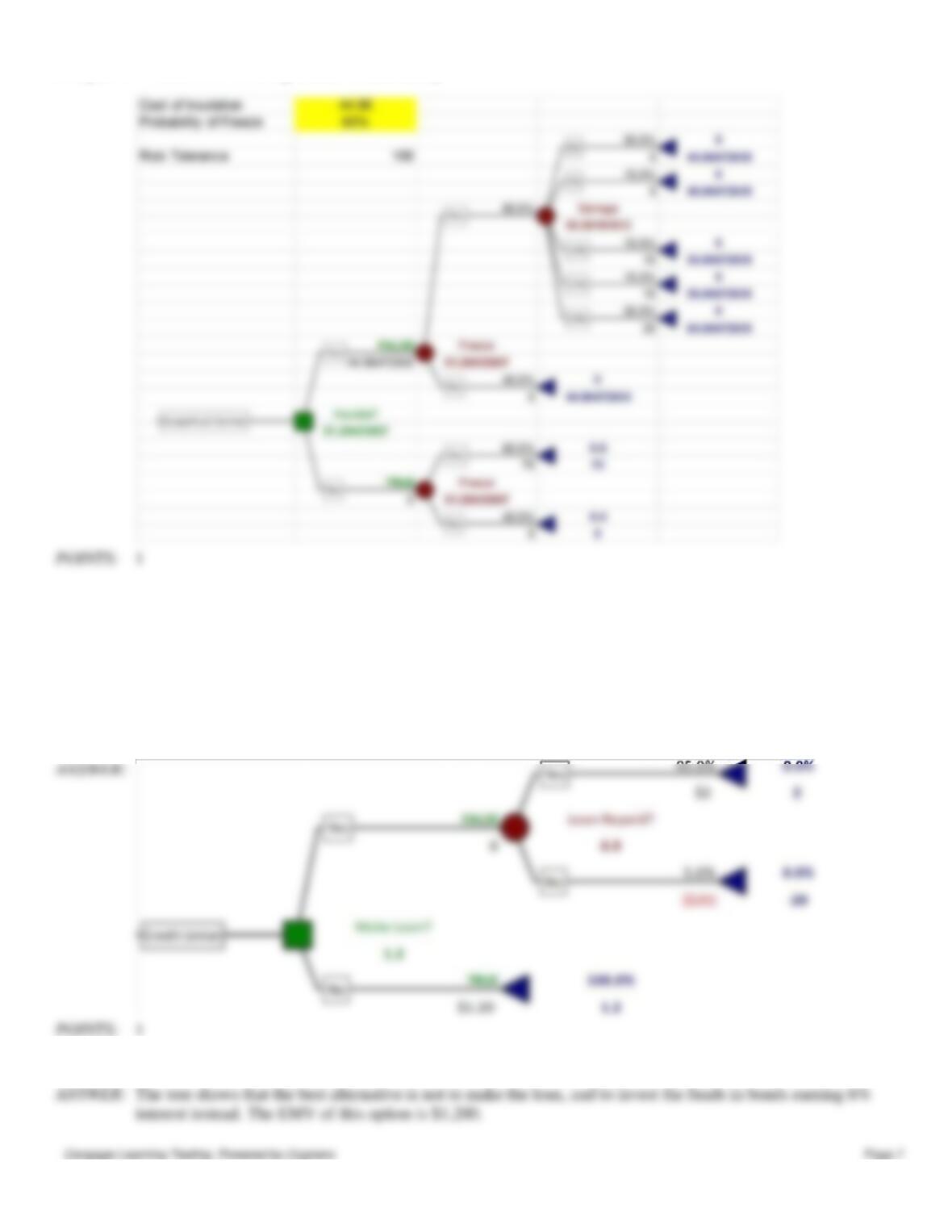
21. Refer to Exhibit 9-1. Construct a decision tree to help the farmer make his decision. What should he do? Explain your
answer.
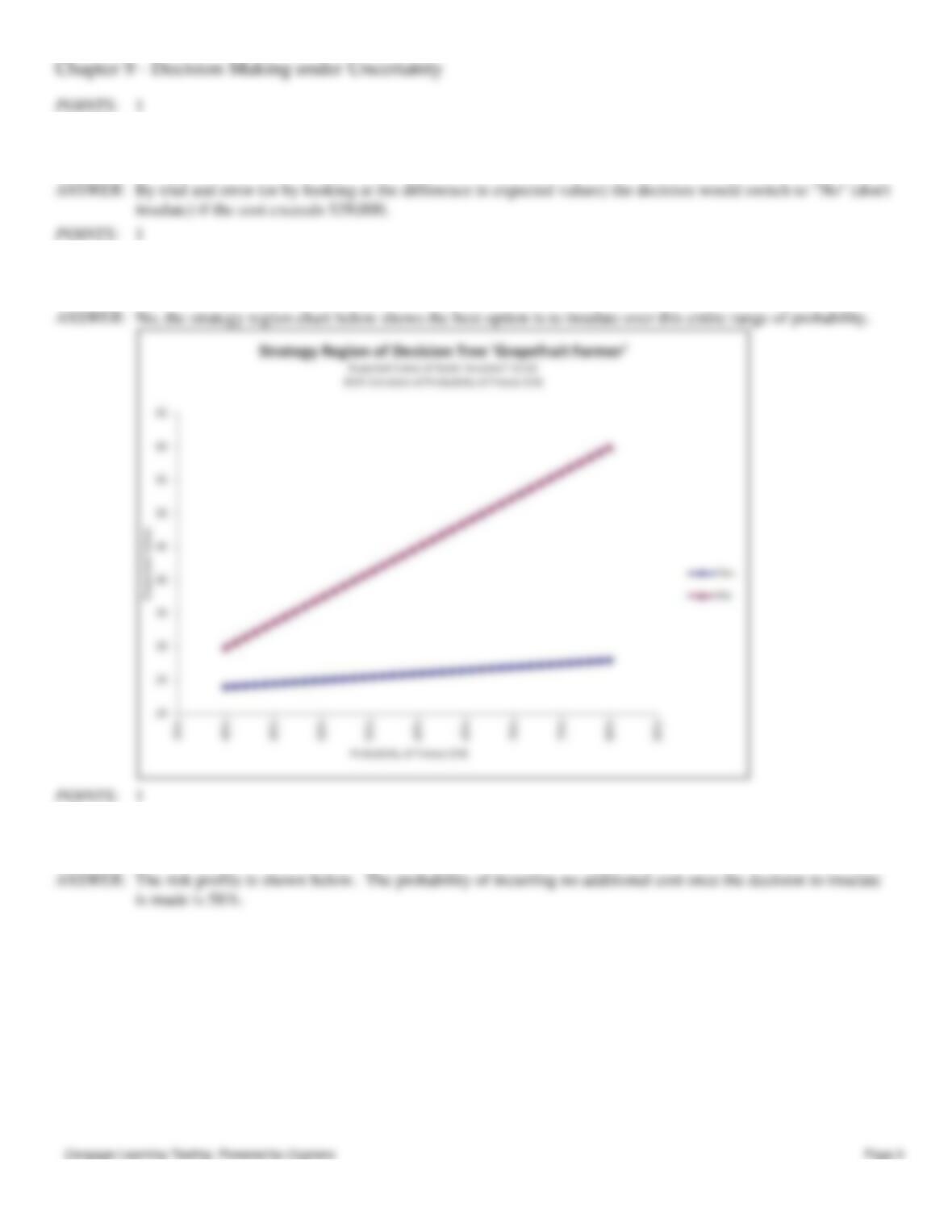
22. Refer to Exhibit 9-1. Find the highest cost of insulating the grapefruits for which the farmer prefers to insulate his
crop.
23. Refer to Exhibit 9-1. Suppose the farmer is uncertain about the reliability of the National Weather Service forecast. If
he thinks the probability of a freeze occurring could be anywhere between 40% and 80%, would that change his decision?
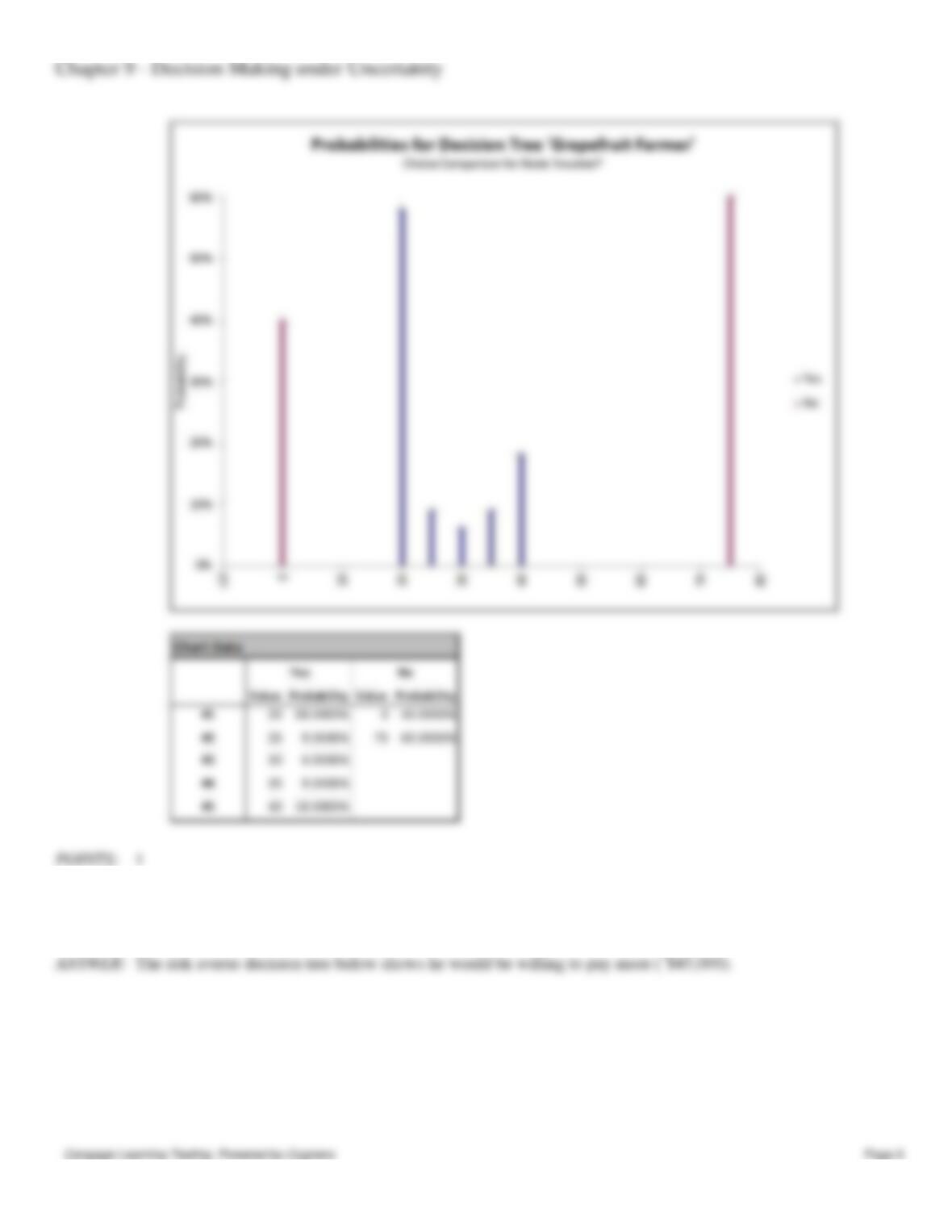
24. Refer to Exhibit 9-1. Construct a risk profile and from that determine the probability that no additional cost is incurred
if the decision to insulate at a cost of $20,000 is made.
25. Refer to Exhibit 9-1. Suppose the farmer is not risk-neutral, but instead his behavior can be modeled using an
exponential utility function with a risk tolerance parameter of 100,000. What is the most he would be willing to pay for
insulation in that case?
Chapter 9 – Decision Making under Uncertainty
Exhibit 9-2
A customer has approached a local credit union for a $20,000 1-year loan at a 10% interest rate. If the credit union does
not approve the loan application, the $20,000 will be invested in bonds that earn a 6% annual return. Without additional
information, the credit union believes that there is a 5% chance that this customer will default on the loan, assuming that
the loan is approved. If the customer defaults on the loan, the credit union will lose the $20,000.
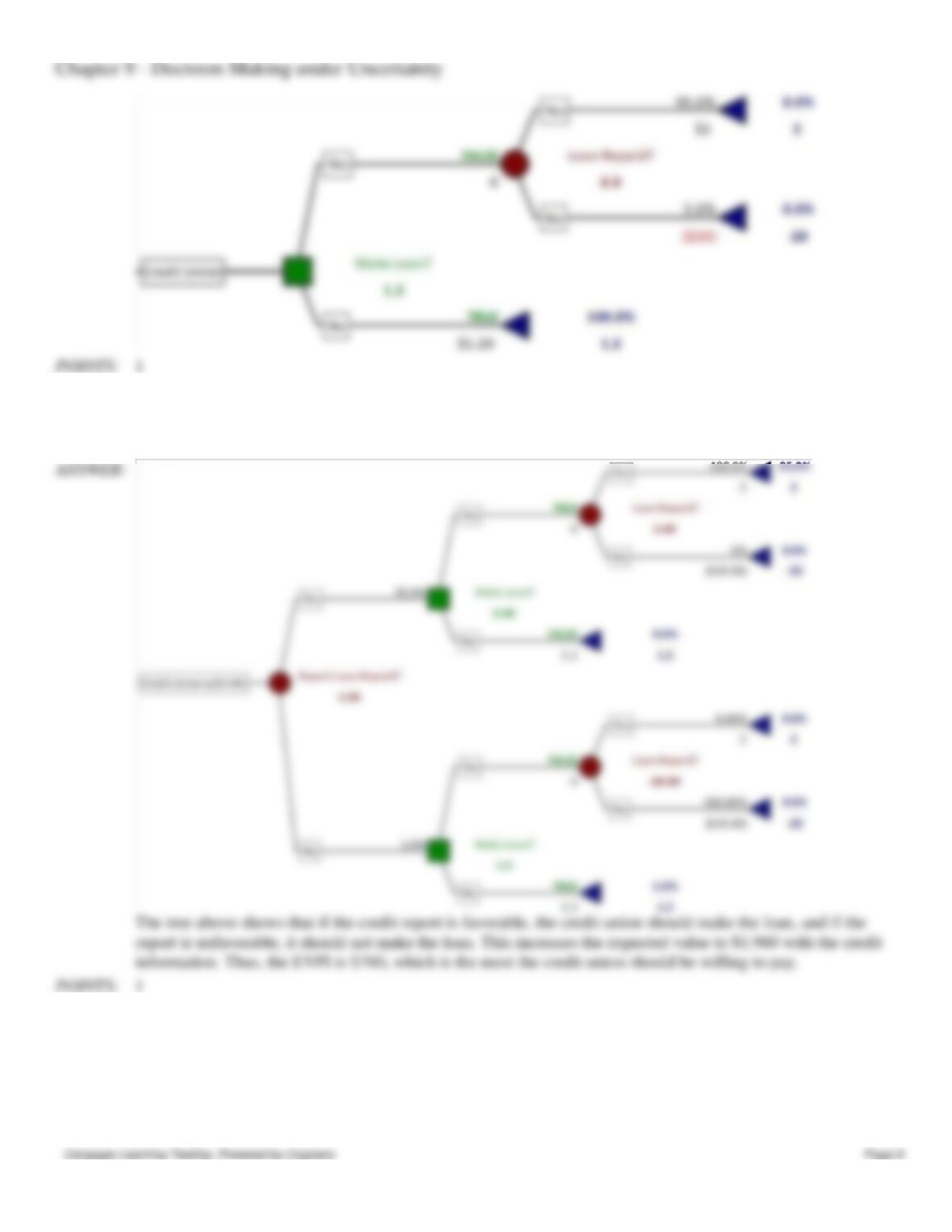
26. Refer to Exhibit 9-2. Construct a decision tree to help the credit union decide whether or not to make the loan. Make
sure to label all decision and chance nodes and include appropriate costs, payoffs and probabilities.
27. Refer to Exhibit 9-2. What should the credit union do? What is their expected profit?
interest instead. The EMV of this option is $1,200.
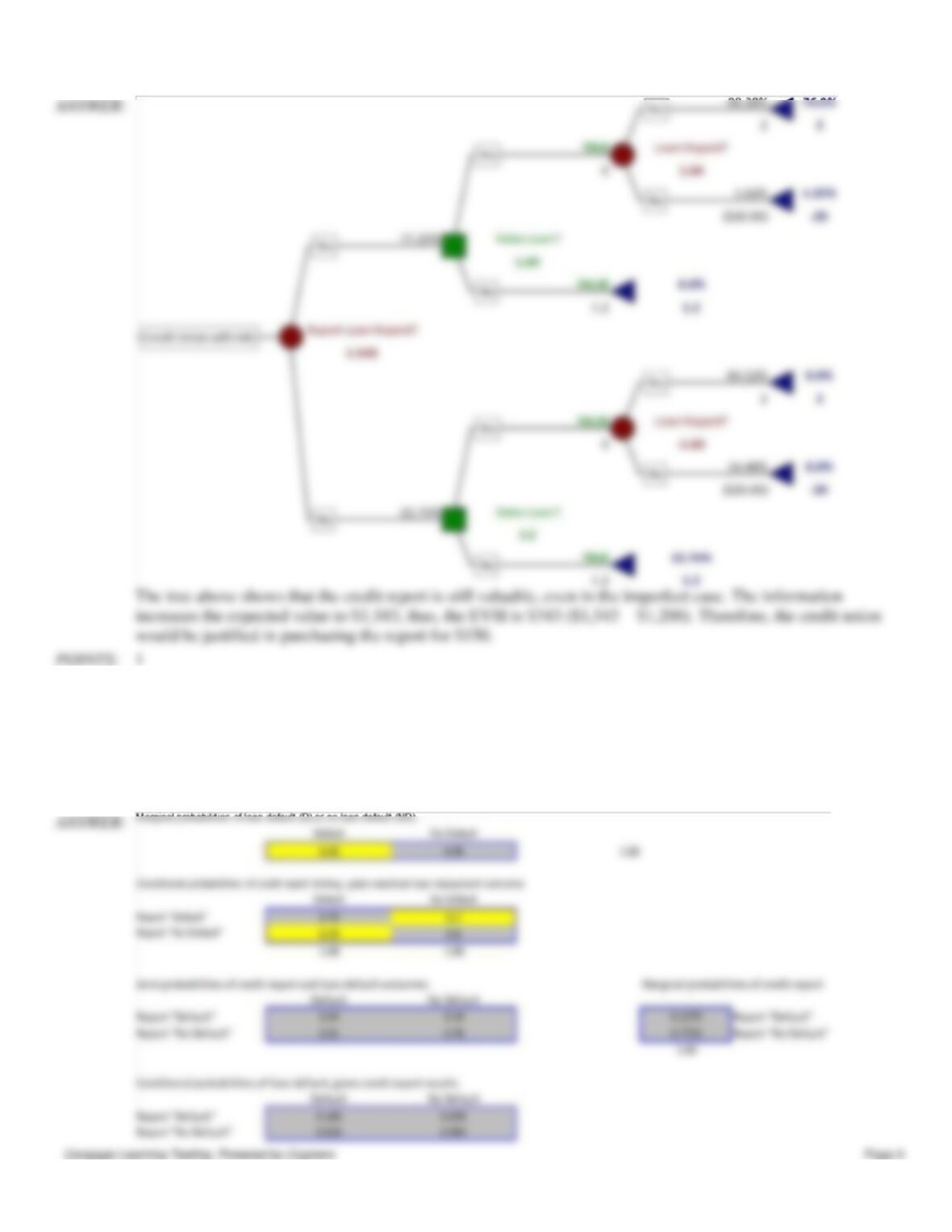
28. Refer to Exhibit 9-2. The bank can thoroughly investigate the customer’s credit record and obtain a favorable or
unfavorable recommendation. If the credit report is perfectly reliable, what is the most the credit union should be willing
to pay for the report?
1
29. Refer to Exhibit 9-2. Should the credit union purchase the report if it costs $150?
1
Chapter 9 – Decision Making under Uncertainty
30. Refer to Exhibit 9-2. Suppose that an actual (not perfectly reliable) credit report has the following characteristics
based on historical data; in cases where the customer did not default on the approved loan, the probability of receiving a
favorable recommendation on the basis of the credit investigation was 80%, while in cases where the customer defaulted
on the approved loan, the probability of receiving a favorable recommendation on the basis of the credit investigation was
25%. Given this information, what are the posterior probabilities that default will and will not occur, given the credit
report?