55) Agricultural subsidies
A) are no longer used by the U.S. government.
B) are often achieved without spending money.
C) distort the true market value of the agricultural products being subsidized.
D) provide family farmers the opportunity earn living wages from their farms.
56) In Tunisia, the rising cost of food, especially ________, was a contributing factor in the
human rights-based demonstrations and protests that launched the Arab Spring.
A) coffee
B) bread
C) meat
D) cheese
57) In core economies, which of the following dominate the food production process?
A) consumers
B) transnational corporations
C) government officials
D) agricultural workers
58) Which of the following is NOT one of the five central and connected sectors of the food
supply chain but, rather, a mediating influence?
A) the physical environment
B) food distribution
C) agricultural inputs
D) food consumption
E) agricultural product processing
59) Rachel Carson’s Silent Spring
A) focused on the negative effects of chemical fertilizers.
B) led to the banning of DDT and other harmful chemicals in the United States.
C) led to international rules prohibiting the use of harmful pesticides in developing countries.
D) did major damage to the environmental movement in the United States.
60) In a dry climate with cold winters, this grain would least likely be cultivated.
A) rice
B) wheat
C) barley
D) oats
E) jatropha
61) Transhumance is least common in
A) Thailand.
B) Central Asia.
C) parts of North Africa.
D) Southern Africa.
E) the Middle East.
62) Fertilizer use is least common in
A) Africa.
B) the United States.
C) Europe.
D) Asia.
63) In the core’s current food regime, ________ are dominant.
A) wheat and livestock
B) fresh fruits and vegetables
C) fast foods
D) free-range chicken and hormone-free beef
64) This grain was NOT a major focus of the Green Revolution.
A) maize
B) wheat
C) rice
D) millet
65) Plantation agriculture and the Green Revolution both promote
A) monoculture.
B) local foods.
C) intensive subsistence.
D) food security.
E) food self-sufficiency.
66) The population of the world’s economically developed areas (the core) consume noticeably
more ________ on a per person basis than do the people of the world’s periphery.
A) cereals and grains
B) meat and milk
C) roots and tubers
D) fruits and vegetables
67) The more one eats from the local food shed, the more one is likely to be a(n)
A) locavore.
B) omnivore.
C) vegetarian.
D) herbivore.
E) carnivore.
68) Richard and Maurice McDonald
A) invented the assembly-line style of industrial food preparation.
B) invented a new way to eat cheaply — the french fry.
C) popularized the hamburger with cheese.
D) mastered the concept of franchising.
E) wrote the book Fast Food Nation.
69) An alternative food movement that directly connects farmers with consumers, originated in
Japan and is spreading throughout the core is
A) CSA.
B) GMO.
C) WTO.
D) NTAE.
E) BMI.
70) Though they are on the margins of the global agro-food system, organic farming practices
are on the rise in the core. In growing crops and raising livestock organically, which of the
following is (are) permitted?
A) composted cow manure
B) commercial fertilizers
C) growth hormones
D) synthetic pesticides
71) In contrast to conventional agro-food systems, alternative food networks
A) operate under the logic of sustainable development.
B) have cheap food as the primary goal.
C) attempt to remove the uncertainties and risks of nature from food production.
D) emphasize monoculture.
E) encourage the use of the latest a chemical fertilizers and genetically modified seeds.
72) International organizations and non-governmental organizations argue that the key to food
security and reduced risk from famines and chronic hunger can be attained only through attention
to
A) food sovereignty.
B) free trade.
C) increased production.
D) GMOs and improved technologies.
E) alternative food movements.
73) In the United States,
A) all foods with genetically engineered ingredients are required to be clearly labeled.
B) only genetically engineered food stuffs from Europe and Japan are allowed to be imported.
C) GMOs are required to undergo rigorous and systematic testing.
D) GMOs are widely permitted because they have not been proven to be unsafe.
E) genetically engineered ingredients are banned.
74) According to our text, rainforest destruction, biodiversity, topsoil conservation, water
quality, water quantity, and global climate are associated with
A) industrial beef production.
B) community supported agriculture.
C) pastoral nomadism.
D) urban agriculture.
E) biopharming.
75) Around the world, runoff from heavy use of synthetic fertilizers has created
A) coastal dead zones.
B) new deltas of arable lands.
C) super fisheries.
D) biochemical farming zones.
E) harvestable deposits of reusable fertilizers.
76) Which of the following has had an impact on commercialized agriculture?
A) recessions
B) inflation
C) fluctuations in the value of international currency
D) changes in the price of oil
E) recessions, inflation, fluctuations in the value of international currency and changes in the
price of oil
1) Hunting and gathering is typically associated with non-commercial, primitive subsistence
agricultural systems.
2) The Green Revolution is so named because it is environmentally sustainable.
3) Seed agriculture began to replace hunting and gathering with the advent of the first
agricultural revolution.
4) The last subsistence agriculturalists disappeared with the third agricultural revolution.
5) Intertillage involves growing many different agricultural crops together in the same plot.
6) Pastoral nomads know their environments intimately.
7) Among the important benefits of the Green Revolution is reduced reliance on oil and other
non-renewable resources.
8) Agribusiness in the core economies has helped the small, family farmer remain competitive in
the food chain.
9) Negative social and environmental impacts from the globalization of agriculture are confined
to the world’s core.
10) The Community Supported Agriculture movement began in Japan.
11) The Green Revolution was directed toward the needs of the world’s core countries.
12) The great thing about biotechnology and GMOs is that both positive and negative impacts
are spread evenly across core and peripheral regions.
13) In the biorevolution, control over food production is moving from the farmer to the
biotechnological firm.
14) Despite the fact that impacts from GMO foods on human health and the environment are not
well-understood, they are permitted in foods in the United States.
15) Famines can occur when overall levels of food availability are adequate.
16) Farmers are the dominant players in the global food system.
17) Consistent with its pro- and free-trade positions, the United States no longer subsidizes
agriculture.
18) Agriculture in the core is characterized by its integration into the manufacturing, service,
finance and trade sectors.
19) The WTO has determined that prohibiting GMO food from entering a country is an illegal
barrier to trade.
20) Many of the pesticides currently sprayed on crops in peripheral countries have been banned
in core countries.
21) Subsistence agriculture replaced hunting and gathering.
22) Crop rotation is most commonly practiced in tropical forests.
23) Practitioners of swidden typically plant only one crop per field.
24) Intensive subsistence agriculture is capable of supporting large rural populations.
25) The practice of transhumance involves changing pastoral locations as the seasons change.
26) The history of world agriculture is characterized by long periods of no change interrupted
with short periods of major change.
27) The Industrial Revolution spurred the first agricultural revolution.
28) The third agricultural revolution had its roots in North America.
29) Some have criticized the Green Revolution for increasing social inequalities in targeted
countries.
30) Commercial pastoralism can be found in the Western United States.
31) The use of high yield varieties has enhanced global genetic diversity.
32) Despite the development of modern techniques in agriculture, the environment still has a
significant effect on food production.
33) Over 10% of the world’s population is actively engaged in urban agriculture.
34) Desertification contributes to the loss of agricultural land.
35) Because of other lifestyle factors, the rise in obesity associated with fast and processed foods
that is seen in the USA is not noticeable elsewhere in the world.
36) Subsistence agriculture has been growing in importance in the last few decades.
37) Shifting cultivation is more commonly practiced by small groups than by larger groups.
38) Transhumance is practiced across the Middle East and North Africa.
39) Farming in communal lands declined after the Industrial Revolution.
40) The Green Revolution began as a League of Nations program in the early 1920s.
41) High yield seed varieties were a major product of the Green Revolution.
42) Most forms of modern agriculture have led to a net increase in topsoil on farmlands.
43) Sophisticated food safety programs have eliminated food contamination and scares from the
core.
44) The most heavily subsidized animal agricultural product is beef/veal.
45) Eating from the local food shed is an attempt to eat foods produced locally is a way of
supporting the local economy, improving personal health, and sustaining the environment.
46) To ensure the safety of the food supply, the United States government strictly regulates
genetically engineered food through product testing and labeling.
47) Though acute hunger may occur in the United States, chronic hunger is limited to the
periphery.
48) Food deserts are not found in rural and farming communities.
49) Among the world’s primary food security concerns is that the world’s growing urban areas
continue to be entirely dependent on the world’s shrinking rural areas for food.
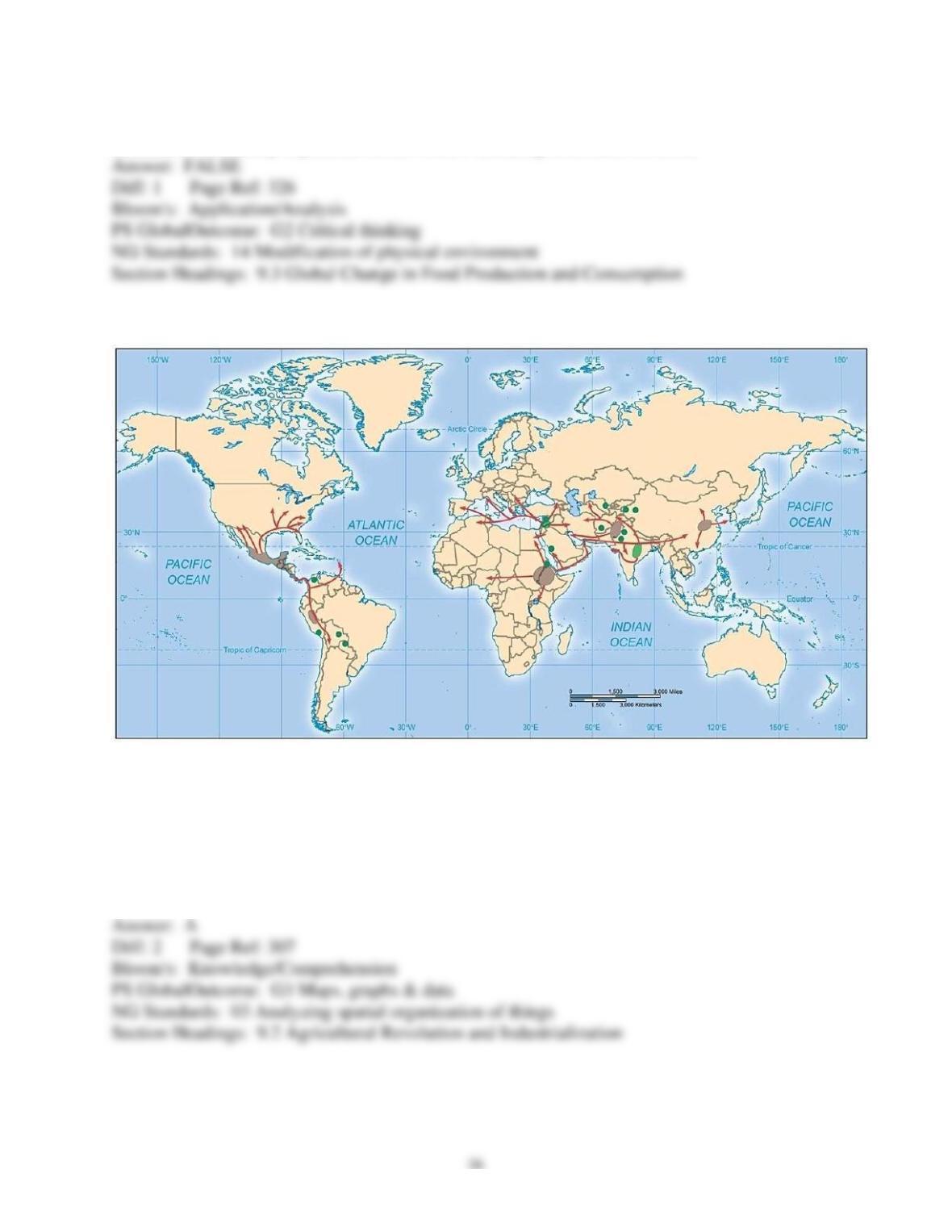
9.3 Questions with Images
1) The shaded areas and diffusion arrows on the above world map indicate the most prominent
regions of the
A) first agricultural revolution.
B) second agricultural revolution.
C) third agricultural revolution.
D) Green Revolution.
E) Industrial Revolution.