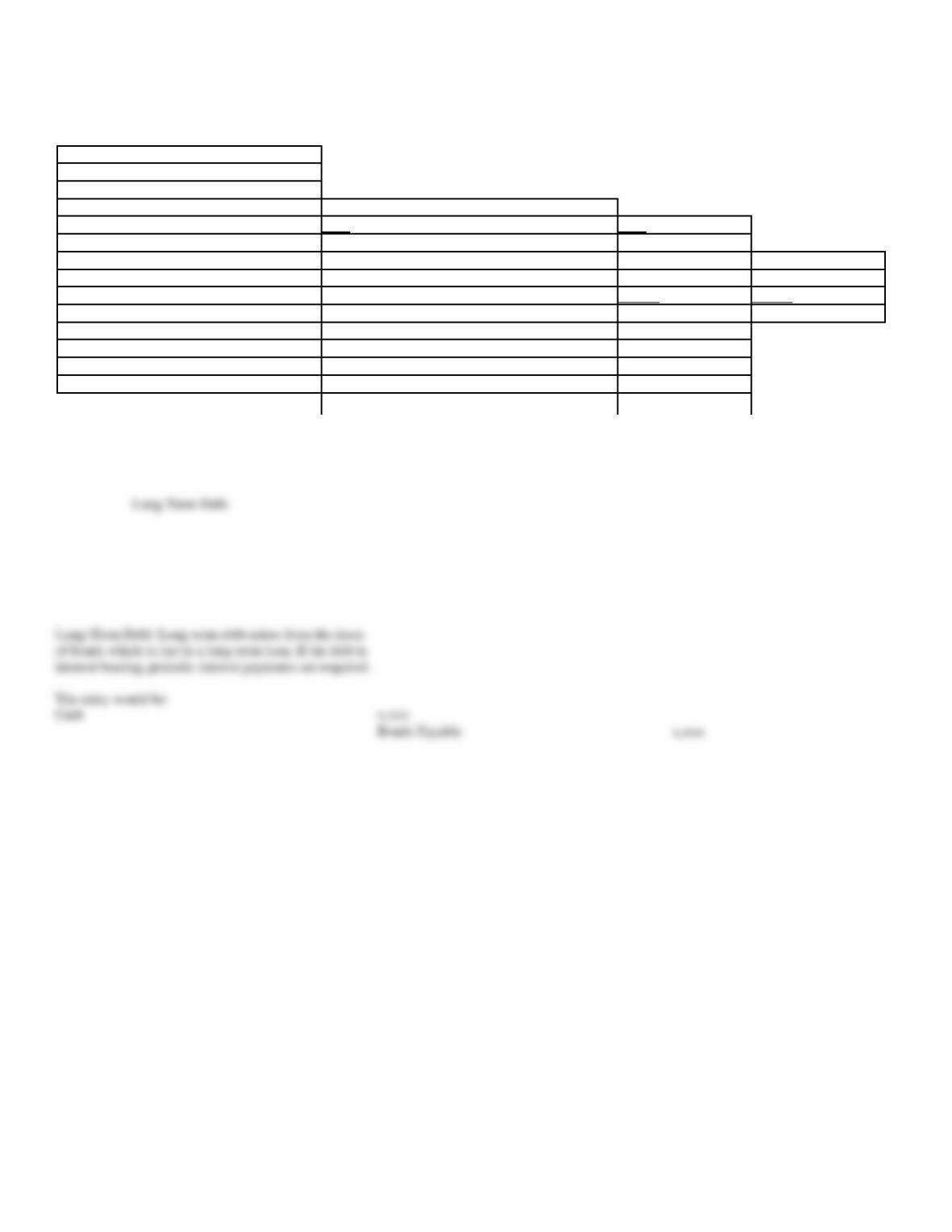
122. King Cotton Company
The liabilities section of the company’s most recent consolidated balance sheets is provided below:
King Cotton Company
Consolidated Balance Sheets
(in millions)
December 31,
2013
2012
Current liabilities
Short-term borrowings
$ 250
$ 200
Accounts payable and other current liabilities
4,500
4,450
Income taxes payable
200
50
Total current liabilities
$4,950
$4,700
Long-term debt
2,700
3,000
Other long-term liabilities
3,800
3,950
Deferred income taxes
1,500
1,400
Refer to King Cotton Company. Describe briefly how each of the following long-term liabilities arises; i.e., what kind of transaction produces the
resulting long-term liability? You may want to include the appropriate journal entry (ignore amounts) in your description.
Long-Term Debt
The entry would be:
Cash
x,xxx
Bonds Payable
x,xxx
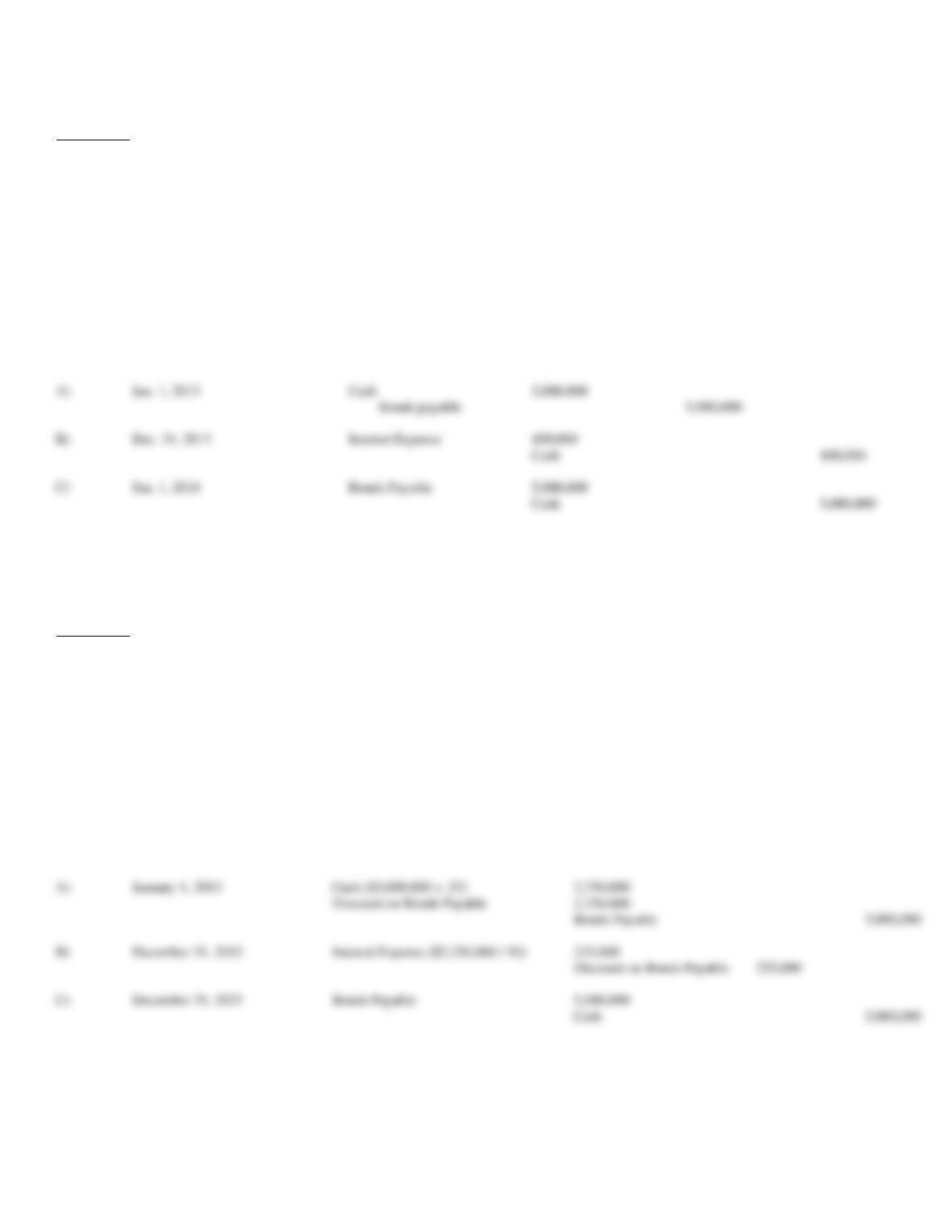
123. On January 1, 2013, a company issued $5,000,000 of 8 percent bonds at par. These bonds are due in five
years with interest payable annually on December 31.
Required:
A)
Record the issuance of the bonds.
B)
Record the journal entry needed on December 31, 2013.
C)
Record the journal entry needed on January 1, 2018.
124. On January 1, 2013, a company issued $5,000,000 of a 10-year, zero-coupon bonds at 55.
Required:
A)
Record the issuance of the bonds on January 1, 2013.
B)
Record interest expense for 2013 assuming the use of the straight line amortization method.
C)
Record the retirement of the bonds on January 1, 2023.
A)
January 1, 2013
Cash ($5,000,000 x .55)
2,750,000
Discount on Bonds Payable
2,250,000
Bonds Payable
B)
December 31, 2013
Interest Expense ($2,250,000 / 10)
225,000
Discount on Bonds Payable
225,000
C)
December 31, 2023
Bonds Payable
5,000,000
Cash
5,000,000
A)
Jan. 1, 2013
Cash
5,000,000
Bonds payable
5,000,000
B)
Dec. 31, 2013
Interest Expense
400,000
Cash
C)
Jan. 1, 2018
Bonds Payable
5,000,000
Cash
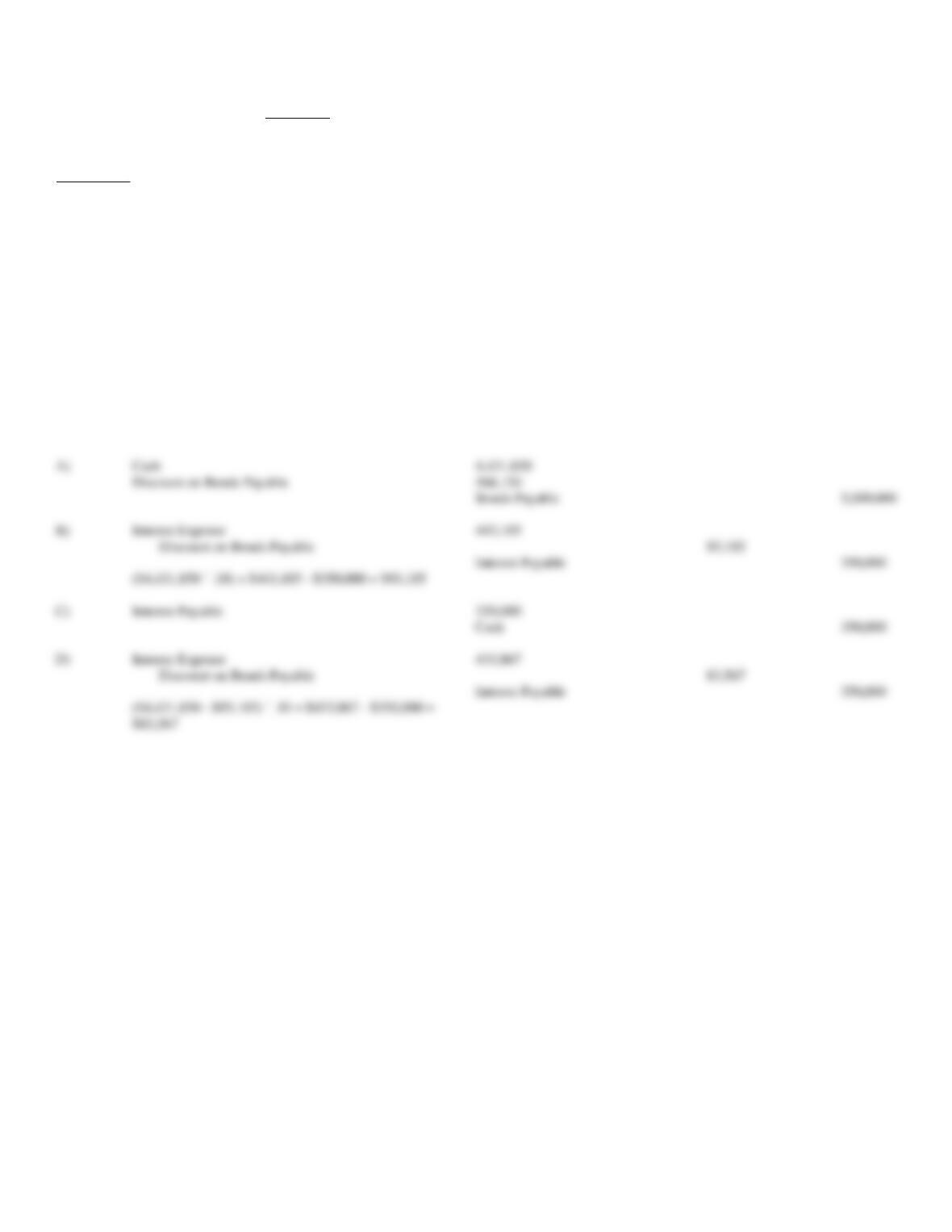
125. A company issued 5-year bonds with a par value of $5,000,000 and a 7% annual stated rate of interest on
January 2, 2013. The issue price of the bond issue was $4,431,850 which reflected a 10% effective interest rate.
Interest payments are made annually. Any premiums or discounts should be amortized using the effective
interest rate method.
Required:
A)
Record the issuance of the bonds.
B)
Record interest expense at December 31, 2013.
C)
Record the interest paid to the bondholders on January 2, 2014.
D)
Record interest expense at December 31, 2014.
A)
Cash
4,431,850
Discount on Bonds Payable
568,150
Bonds Payable
B)
Interest Expense
443,185
Discount on Bonds Payable
93,185
Interest Payable
($4,431,850 ´ .10) = $443,185 – $350,000 = $93,185
C)
Interest Payable
350,000
Cash
D)
Interest Expense
433,867
Discount on Bonds Payable
83,567
Interest Payable
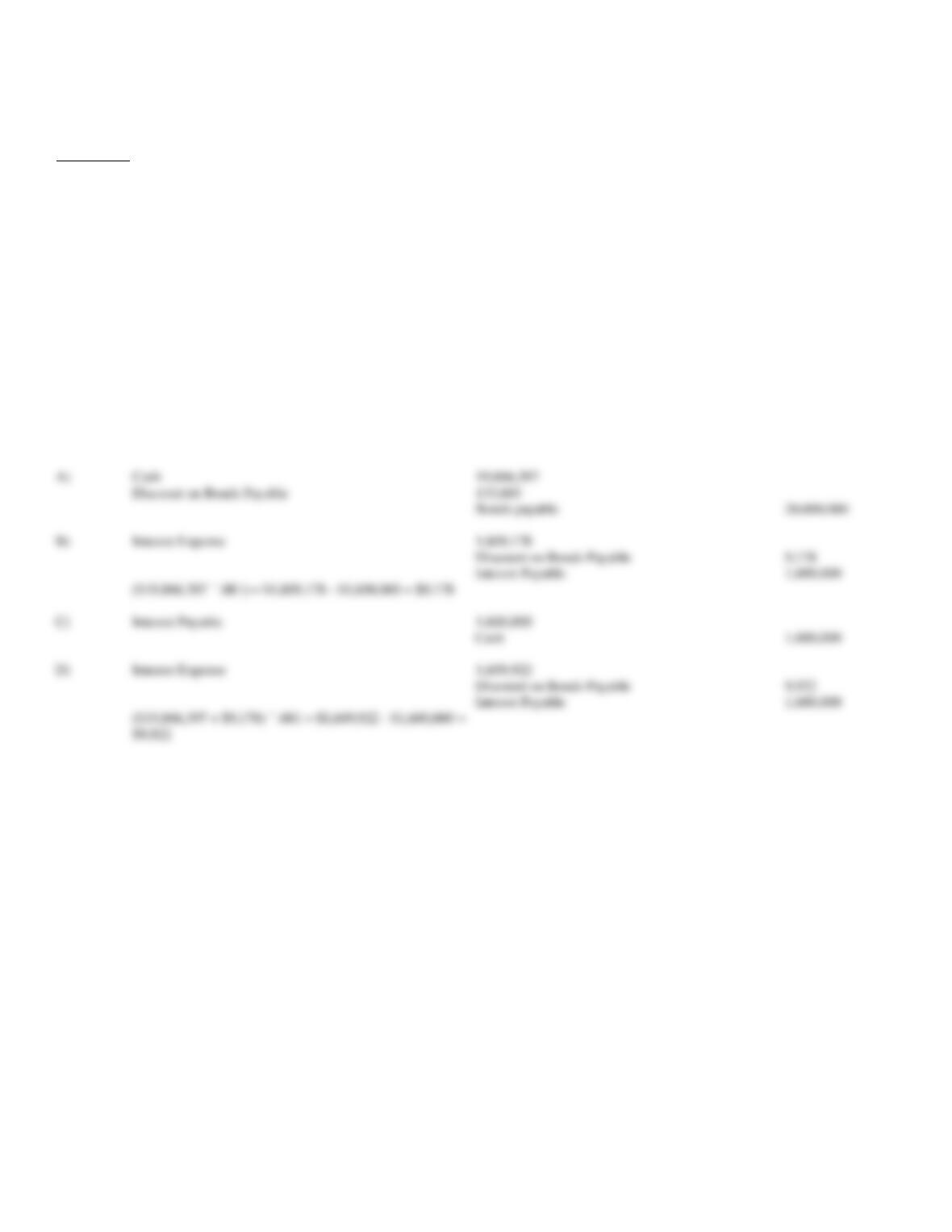
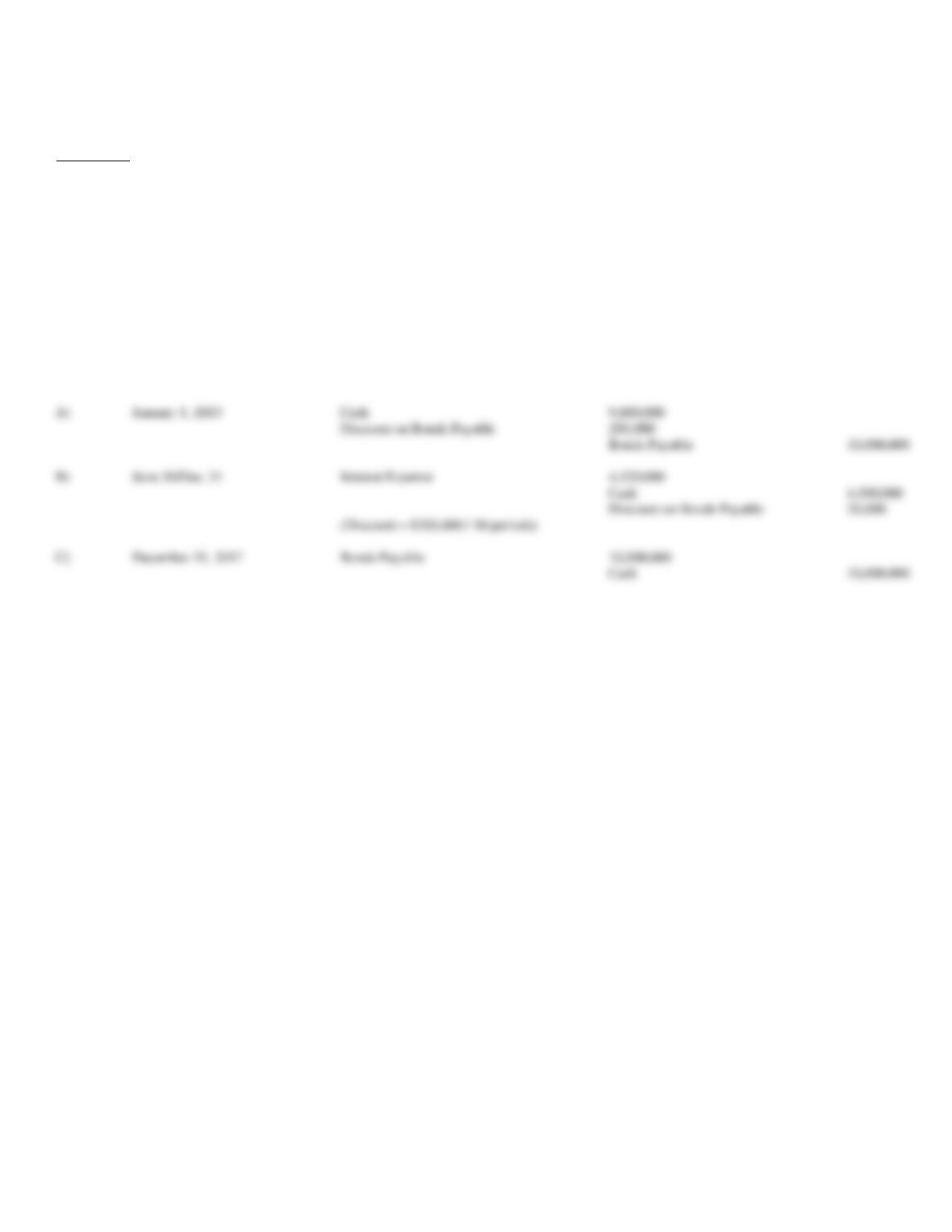
126. A company issued 10-year bonds with a par value of $20,000,000 and an 8% annual face rate of interest on
January 2, 2013. The issue price of the bond issue was $19,866,397 which reflected an 8.1% effective interest
rate. Interest payments are made annually.
Required:
A)
Give the journal entry to record the issuance of the bonds.
B)
Give the journal entry to record the recognition of interest expense at December 31, 2013. Any premium or discount should be
amortized using the effective interest rate method.
C)
Give the journal entry to record the interest paid to the bondholders on January 2, 2014.
D)
Give the journal entry to record the recognition of interest expense at December 31, 2014. Any premium or discount should be
amortized using the effective interest rate method.
A)
Cash
19,866,397
Discount on Bonds Payable
133,603
Bonds payable
20,000,000
B)
Interest Expense
1,609,178
Discount on Bonds Payable
9,178
Interest Payable
1,600,000
($19,866,397 ´ .081) = $1,609,178 – $1,600,000 = $9,178
C)
Interest Payable
1,600,000
Cash
1,600,000
D)
Interest Expense
1,609,922
Discount on Bonds Payable
9,922
Interest Payable
1,600,000
($19,866,397 + $9,178) ´ .081 = $1,609,922 – $1,600,000 =
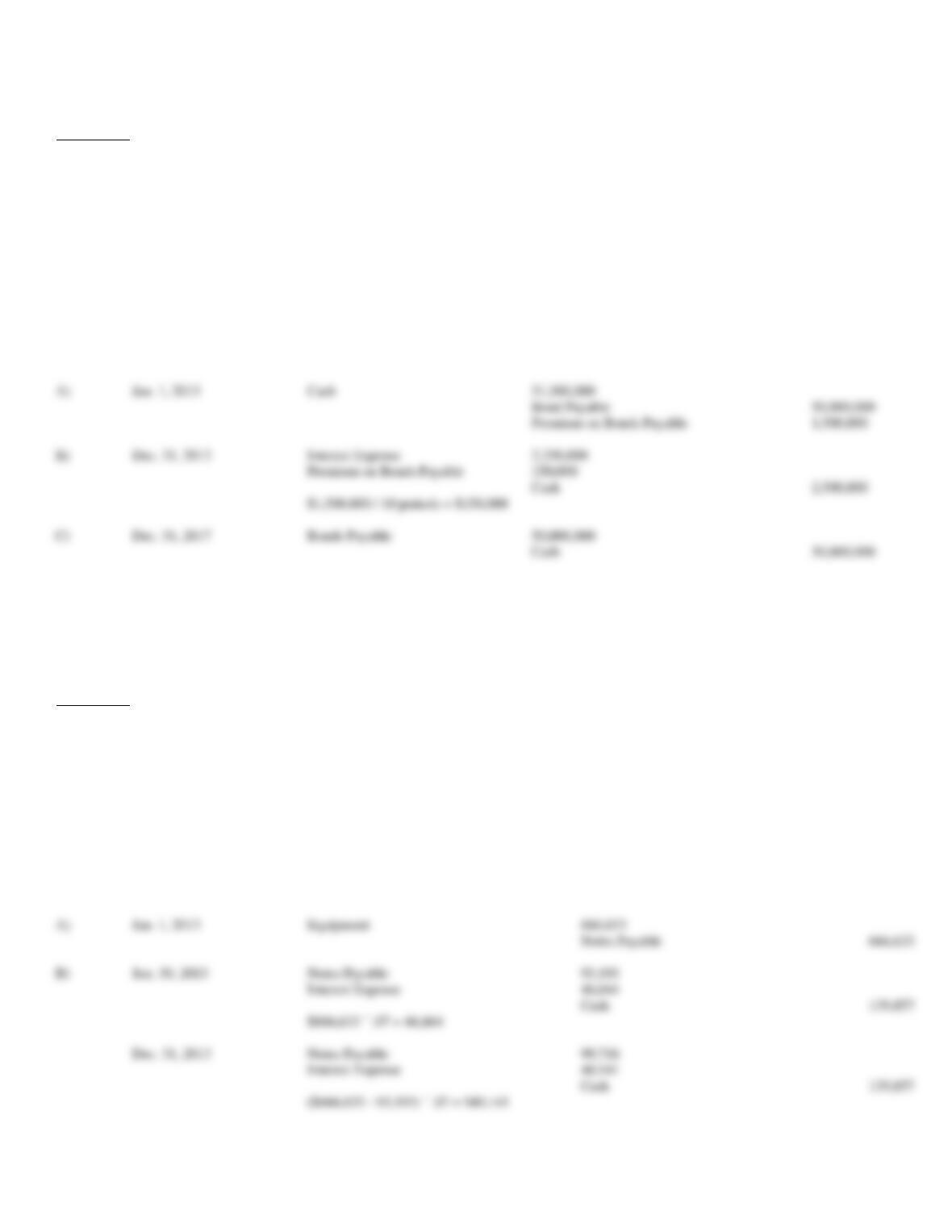
127. On January 1, 2013, Kitchen Concepts, Inc. issued five-year, $10,000,000, 9 percent notes at 98
($9,800,000). The discount at the time of issuance was $200,000. Interest is paid semiannually on June 30, and
December 31.
Required:
A)
Provide the journal entry to record the issuance of the bonds on January 1, 2013.
B)
What journal entry would have to be recorded each June 30 and December 31 assuming the use of straight line amortization?
C)
Give the journal entry to record the repayment of the loan principal on December 31, 2017.
A)
January 1, 2013
Cash
9,800,000
Discount on Bonds Payable
200,000
Bonds Payable
B)
June 30/Dec. 31
Interest Expense
4,520,000
Cash
Discount on Bonds Payable
(Discount = $200,000 / 10 periods)
C)
December 31, 2017
Bonds Payable
10,000,000
Cash
128. On January 1, 2013, Krammer Company issued five-year, $50,000,000, 10% percent notes at 103. The
premium was $1,500,000. Interest is paid semiannually on June 30 and December 31.
Required:
A)
Record the issuance of the bonds on January 1, 2013.
B)
Record the journal entry required on December 31, 2013, assuming the use of straight line amortization.
C)
Record the repayment of the loan principal on December 31, 2017.
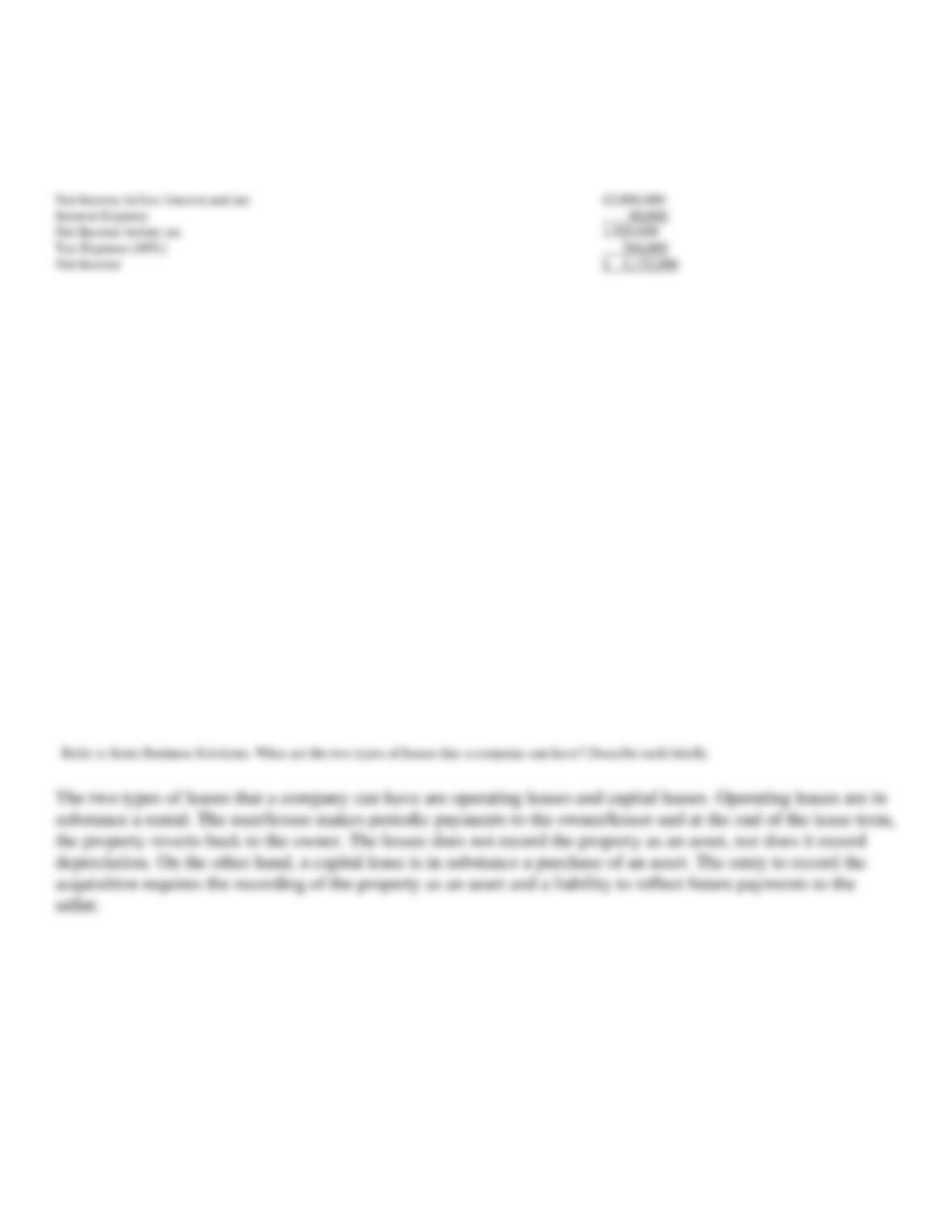
129. On January 1, 2013, a company buys equipment for $666,633 with a 14% installment note to pay off the
debt with 6 semiannual payments over three years. The payments are $139,857.
Required:
A)
Provide the journal entry to record the purchase of the equipment.
B)
Give the journal entries for June 30 and December 31.
A)
Jan. 1, 2013
Equipment
666,633
Notes Payable
B)
Jun. 30, 2013
Notes Payable
93,193
Interest Expense
46,664
Cash
$666,633 ´ .07 = 46,664
Dec. 31, 2013
Notes Payable
99,716
A)
Jan. 1, 2013
Cash
51,500,000
Bond Payable
50,000,000
Premium on Bonds Payable
1,500,000
B)
Dec. 31, 2013
Interest Expense
2,350,000
Premium on Bonds Payable
150,000
Cash
2,500,000
$1,500,000 / 10 periods = $150,000
C)
Dec. 31, 2017
Bonds Payable
50,000,000
Cash
50,000,000
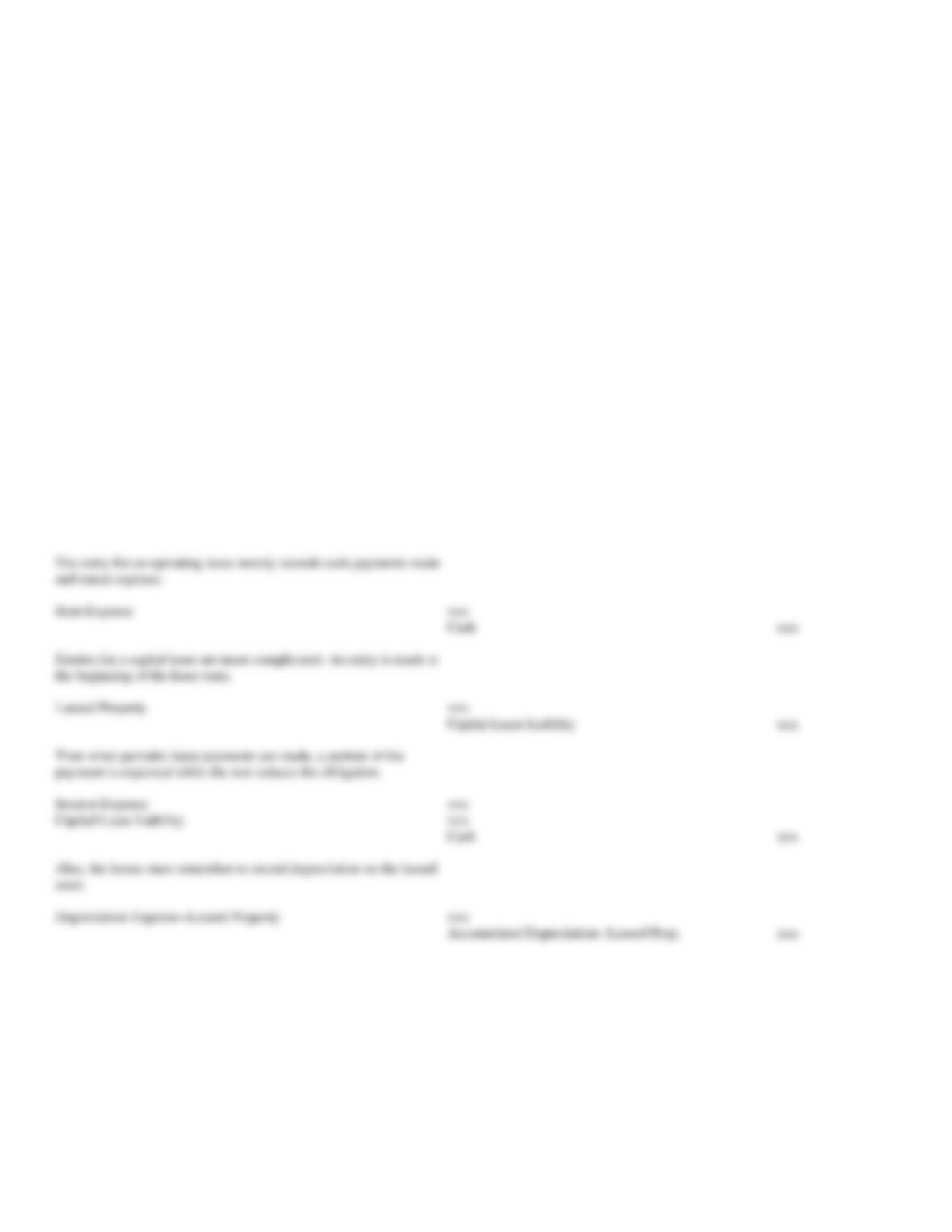
130. Knox Jewelers issued $1,000,000 of 8% interest bearing debt at the beginning of the year. The company
reported net income before interest and taxes of $2,000,000 for the current year. Assuming a 40% tax rate,
what is the company’s net income for the year?
131. Korn Business Solutions
The following footnote accompanied the company’s 2013 financial statements:
The Corporation leases office, warehouse and showroom space, retail stores, and office equipment under
operating leases, which expire no later than 2025. The Corporation normalizes fixed escalations in rental
expense under its operating leases. Minimum annual rentals under non-cancelable operating leases, excluding
operating cost escalations and contingent rental amounts based upon retail sales, are payable as follows:
Fiscal year ending March 31,
2014
$10,051,000
2015
11,121,000
2016
10,161,000
2017
9,063,000
2018
8,814,000
Thereafter
46,681,000
Rent expense was $12,551,000; $8,911,000; and $5,768,000 for the years ended March 31, 2013, 2012, and 2011, respectively.
Net Income before Interest and tax
$2,000,000
Interest Expense
80,000
Net Income before tax
1,920,000
Tax Expense (40%)
768,000
Net Income
$ 1,152,000
132. Korn Business Solutions
The following footnote accompanied the company’s 2013 financial statements:
The Corporation leases office, warehouse and showroom space, retail stores, and office equipment under
operating leases, which expire no later than 2025. The Corporation normalizes fixed escalations in rental
expense under its operating leases. Minimum annual rentals under non-cancelable operating leases, excluding
operating cost escalations and contingent rental amounts based upon retail sales, are payable as follows:
Fiscal year ending March 31,
2014
$10,051,000
2015
11,121,000
2016
10,161,000
2017
9,063,000
2018
8,814,000
Thereafter
46,681,000
Rent expense was $12,551,000; $8,911,000; and $5,768,000 for the years ended March 31, 2013, 2012, and 2011, respectively.
Refer to Korn Business Solutions. Write the journal entries that would be used to record each type of lease described in the previous question.
Rent Expense
Cash
Leased Property
Capital Lease Liability
Interest Expense
Capital Lease Liability
Cash
Depreciation Expense—Leased Property
Accumulated Depreciation—Leased Prop.
133. Korn Business Solutions
The following footnote accompanied the company’s 2013 financial statements:
The Corporation leases office, warehouse and showroom space, retail stores, and office equipment under
operating leases, which expire no later than 2025. The Corporation normalizes fixed escalations in rental
expense under its operating leases. Minimum annual rentals under non-cancelable operating leases, excluding
operating cost escalations and contingent rental amounts based upon retail sales, are payable as follows:
Fiscal year ending March 31,
2014
$10,051,000
2015
11,121,000
2016
10,161,000
2017
9,063,000
2018
8,814,000
Thereafter
46,681,000
Rent expense was $12,551,000; $8,911,000; and $5,768,000 for the years ended March 31, 2013, 2012, and 2011, respectively.
Refer to Korn Business Solutions. Does the note disclosure show evidence of the two types of leases?
134. On January 1, 2013, Kroger Corporation issued $10,000,000 of 8% bonds, due in five years with interest
payable annually on December 31. The market yield rate is 9 percent. Calculate the present value (market
value) of the bonds.
Interest = $10,000,000 ´ .08 = $800,000 ´ 3.88965 pres. value of annuity =
$3,111,720
Principal = $10,000,000 ´ .64993 present value of single sum =
6,499,300
Present (market) value of the bonds =
$9,611,020
135. Match these terms with their definitions.
2. Agreement whereby the legal owner of the asset retains
3. Debt that is so risky that it must pay a high rate of interest
5. A non-cancelable agreement that is in substance a purchase
6. General term that refers to debt that provides collateral
7. This debt, evidenced by a formal agreement or contract to
repay, is frequently issued in exchange for a noncash asset
8. Give the borrower the option to pay off the debt prior to
9. Give the lender the option to convert the debt into other
136. Match these terms with their definitions.
Market rate,
2. A contract that gives one party the right to use an asset that belongs to
Straight-line
Contract,
Effective interest
5. Under this method, interest expense for the period is always the yield (i.e.,
effective interest rate) times the carrying value of the bonds at the beginning of
6. The use of borrowed capital to produce more income than needed to pay the
7. Under this method, equal amounts of premium or discount are amortized to
8. The process used to determine the amount of interest to be recorded in each
Face value, par
9. The rate found in the debt contract that determines the amount of the interest
10. A type of liability which requires the issuing entity to pay the face value to
the holder on the maturity date and to pay interest periodically at a specified
Interest
15. The rate that reflects the provisions of the debt instrument, the credit
standing of the borrowing business, and the current conditions in the credit
137. “You Decide” Essay
You own a thriving book store in a major college town. You have been talking with your CPA about borrowing
$5,000,000 to finance a larger and more modern building. One option is to issue 20-year bonds with a fixed
rate of 8% while another option is to issue 20-year bonds with a variable rate of one-year LIBOR (London
Interbank Offered Rate) plus 5%. For the first year, this will result in a 6.2% rate, but the rate will be adjusted
annually. The current market interest rate is 8%.
What things should you consider in making the decision about which borrowing option is better for your
company?
138. “You Decide” Essay
You are the Chief Financial Officer of Kyoto Mining Company. Your company issued $10,000,000 in bonds
payable at the beginning of the year at a sizable discount. You are getting ready to make your December 31
adjusting entries. The owners, who are worried about their tax bill for the year, have asked you to select
whichever method of amortizing bond discounts that maximizes interest expense.
Respond to the owners.