Larson_Calculus_10e ch09sec05
MULTIPLE CHOICE
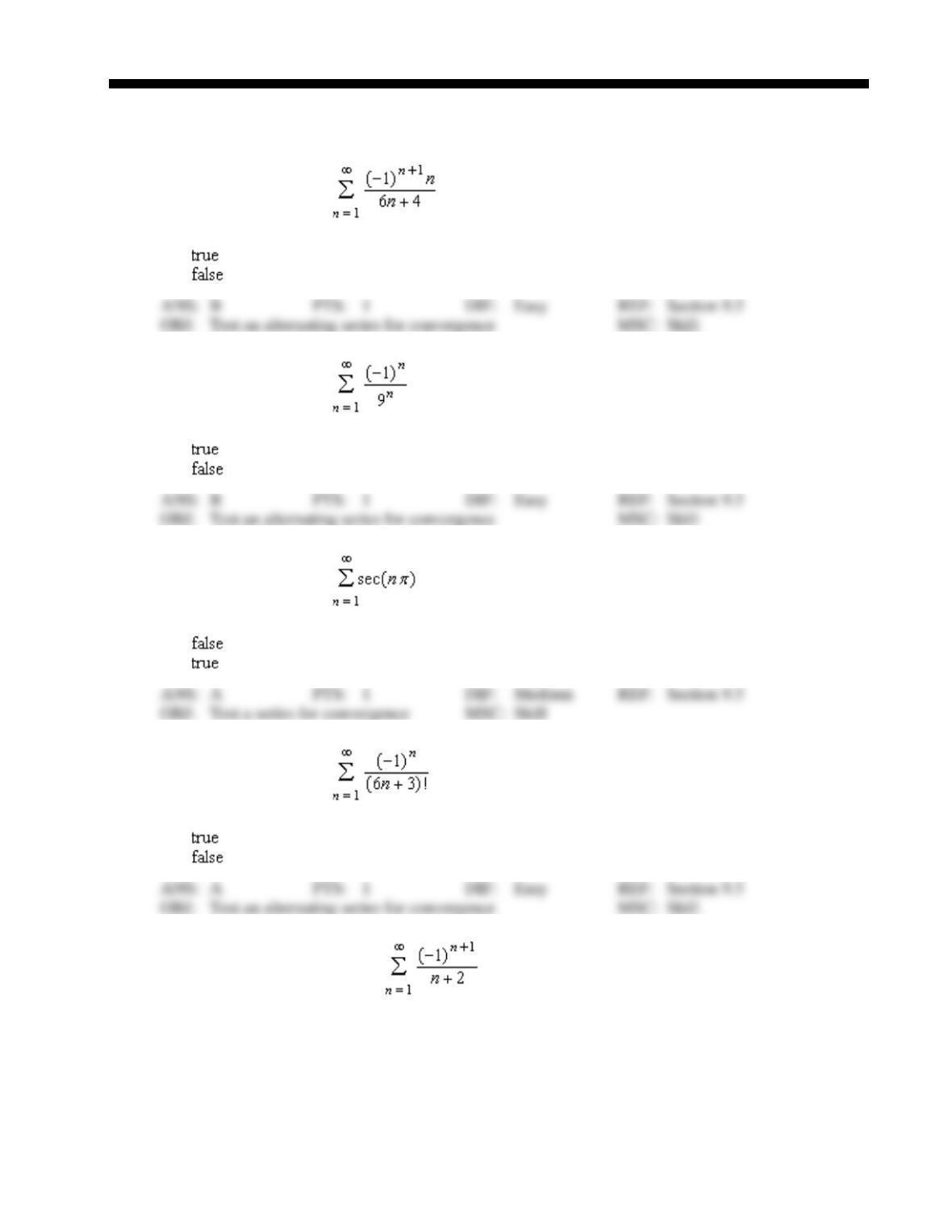
1. True or false: The series converges.
a.
b.
2. True or false: The series diverges.
a.
b.
3. True or false: The series converges.
a.
b.
4. True or false: The series converges .
a.
b.
5. Determine whether the series converges conditionally or absolutely, or diverges.
a.
The series converges conditionally but does not converge absolutely.
b.
The series converges absolutely but does not converge conditionally.
c.
The series diverges.
d.
The series converges absolutely.
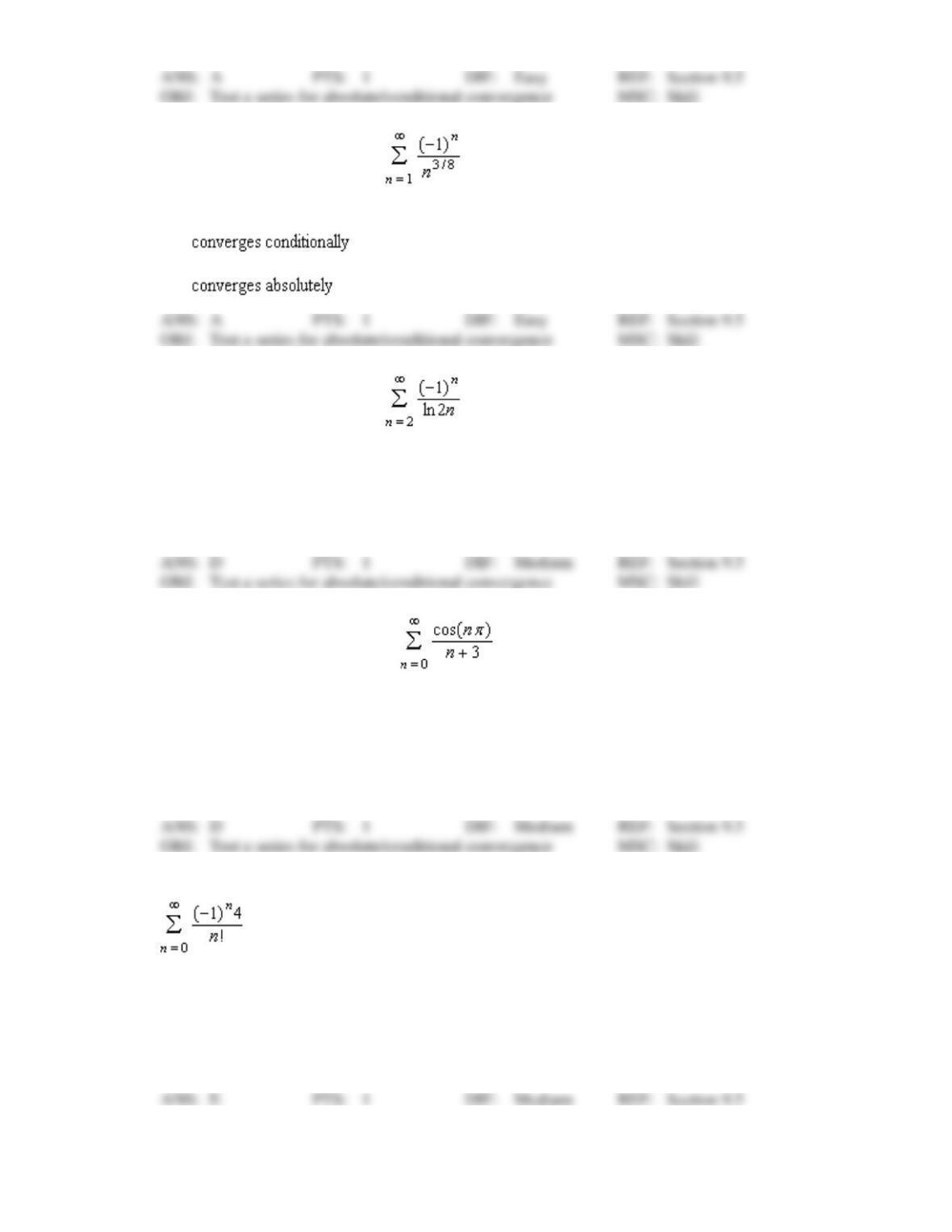
6. Determine whether the series converges absolutely, converges conditionally, or
diverges.
a.
b.
diverges
c.
7. Determine whether the series converges conditionally or absolutely, or diverges.
a.
The series converges absolutely.
b.
The series diverges.
c.
The series converges absolutely but does not converge conditionally.
d.
The series converges conditionally but does not converge absolutely.
8. Determine whether the series converges conditionally or absolutely, or
diverges.
a.
The series converges absolutely.
b.
The series diverges.
c.
The series converges absolutely but does not converge conditionally.
d.
The series converges conditionally but does not converge absolutely.
9. Approximate the sum of the series by using the first six terms.
a.
1.457 < S < 1.477
b.
1.417 < S < 1.497
c.
1.467 < S < 1.472
d.
1.427 < S < 1.467
e.
1.461 < S < 1.473
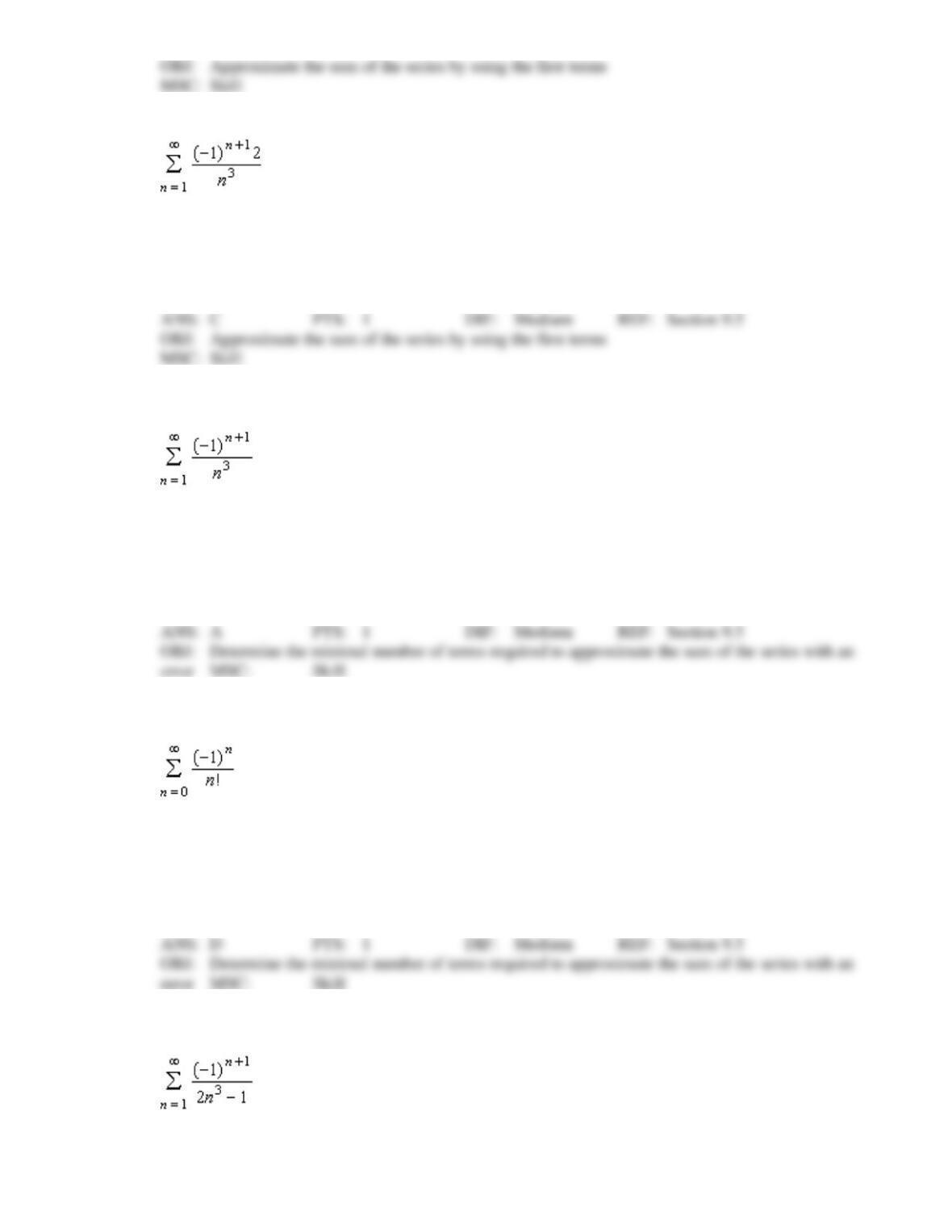
10. Approximate the sum of the series by using the first six terms.
a.
1.799 < S < 1.805
b.
1.794 < S < 1.806
c.
1.794 < S < 1.805
d.
1.792 < S < 1.792
e.
1.698 < S < 1.902
11. Determine the minimal number of terms required to approximate the sum of the series with an error of
less than 0.007.
a.
5
b.
4
c.
2
d.
6
e.
3
12. Determine the minimal number of terms required to approximate the sum of the series with an error of
less than 0.004.
a.
10
b.
5
c.
8
d.
6
e.
4
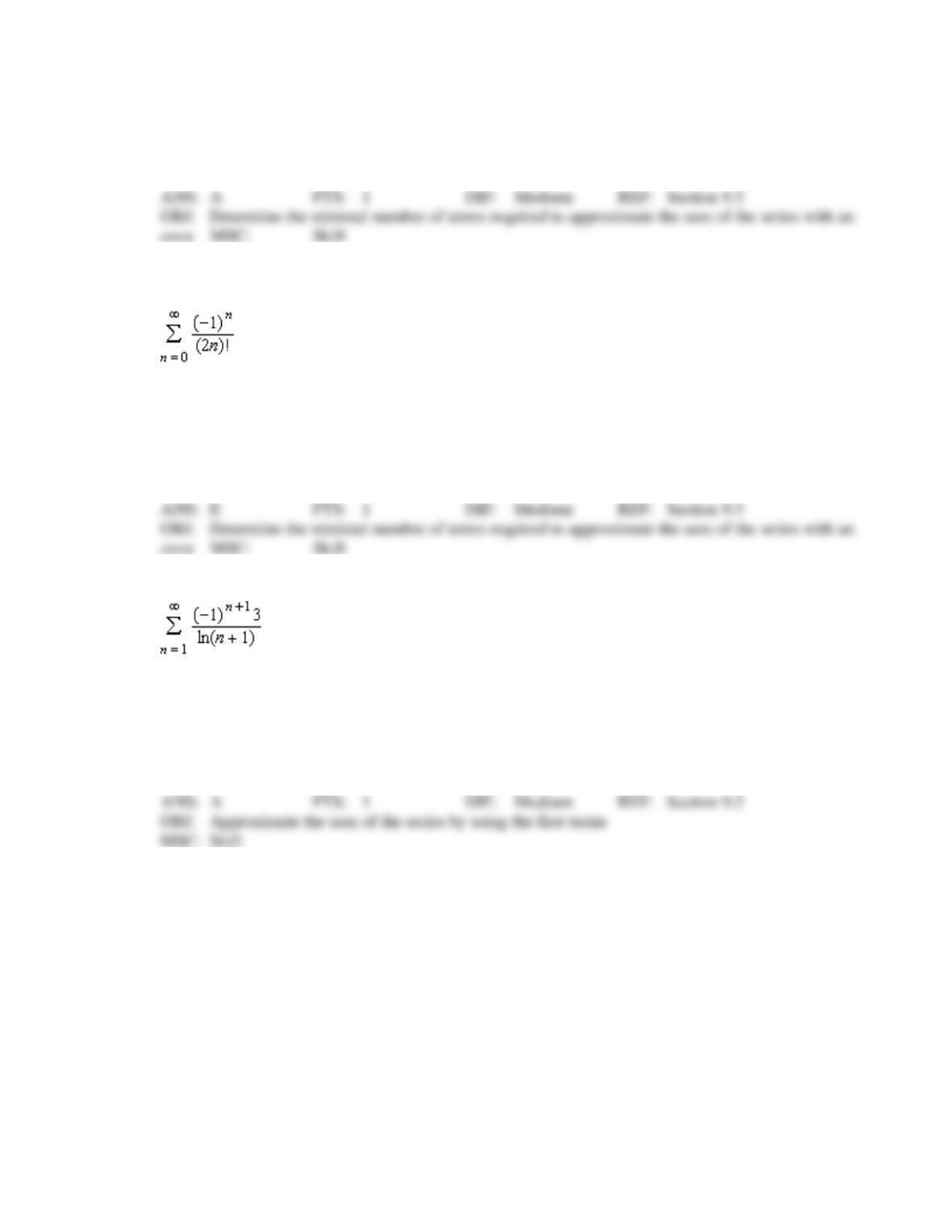
13. Determine the minimal number of terms required to approximate the sum of the series with an error of
less than 0.008.
a.
3
b.
1
c.
4
d.
6
e.
2
14. Determine the minimal number of terms required to approximate the sum of the series with an error of
less than 0.005.
a.
6
b.
4
c.
5
d.
8
e.
3
15. Approximate the sum of the series by using the first six terms.
a.
0.587 < S < 3.473
b.
1.549 < S < 2.511
c.
1.309 < S < 2.751
d.
0.427 < S < 3.633
e.
0.227 < S < 3.833