Chapter 09 – Cell Communication
Chapter 09
Cell Communication
Multiple Choice Questions
1. The protein Sonic Hedgehog (SHH) plays a role in specifying the identity of digits (such
as fingers and toes) in mammals. Several digits arise directly from cells that both express and
respond to secreted SHH. What type of signaling would this be considered?
2. One cell sends second messengers to another cell through gap junctions. What type of
signaling would this be considered?
Chapter 09 – Cell Communication
3. In synaptic signaling, neurotransmitters are released into a space that is referred to as a:
4. In response to injury, cell fragments called platelets get activated to induce clotting.
Activated platelets release factors that can in turn bind to specific membrane receptors on
nearby cells. What type of signaling would this be considered?
Chapter 09 – Cell Communication
5. A researcher is working to generate a new cancer drug. Thus far, he has identified a
compound that can reduce the size of tumors in the lung. However, in order for the drug to
work, the lung tumor has to be small. In addition, the tumor cannot have metastasized (spread
to other areas of the body). Furthermore, he knows that the drug acts to prohibit the signaling
from one tumor cell to another tumor cell. Given the above information, this new drug
prohibits:
Clarify Question
•
What is the key concept addressed by the question?
•
What type of thinking is required?
Gather Content
•
What do you know about signaling involved in cancer growth? What other information is
related to the question?
Choose Answer
•
Given what you now know, what information is most likely to produce the correct
answer?
Reflect on Process
•
Did your problem-solving process lead you to the correct answer? If not, where did the
process break down or lead you astray? How can you revise your approach to produce a
more desirable result?
Chapter 09 – Cell Communication
6. Using a specific chemical, a cell biologist has blocked one type of channel-linked
receptor in a lab rat’s liver tissue. What was the likely mechanism of the chemical she used?
Chapter 09 – Cell Communication
Clarify Question
•
What is the key concept addressed by the question?
•
What type of thinking is required?
Gather Content
•
What do you know about specifically inhibiting one class of receptors? What other
information is related to the question?
Choose Answer
•
Given what you now know, what information is most likely to produce the correct
answer?
Reflect on Process
•
Did your problem-solving process lead you to the correct answer? If not, where did the
process break down or lead you astray? How can you revise your approach to produce a
more desirable result?
Chapter 09 – Cell Communication
7. Leptin is a circulating hormone that is produced by fat cells and plays a role in body
metabolism and obesity. It normally binds to receptors in the brain and inhibits
appetite. Studies have demonstrated that when obese mice that are leptin deficient are injected
with leptin they quickly lose their excess weight. Interestingly, however, many overweight
people have high levels of leptin in their bloodstream. Why do you think that the high levels
of leptin in obese individuals are insufficient to curb their appetite?
Chapter 09 – Cell Communication
Clarify Question
•
What is the key concept addressed by the question?
•
What type of thinking is required?
Gather Content
•
What do you know about resistance to leptin? What other information is related to the
question?
Choose Answer
•
Given what you now know, what information is most likely to produce the correct
answer?
Reflect on Process
•
Did your problem-solving process lead you to the correct answer? If not, where did the
process break down or lead you astray? How can you revise your approach to produce a
more desirable result?
Chapter 09 – Cell Communication
8. Vasopressin is a hormone that is primarily released when the body is low on water.
Release of vasopressin causes the kidneys to conserve water by concentrating urine and
decreasing urine output. However, vasopressin also has additional functions in other tissues
such as the brain and blood vessels, which are not directly involved in urine production. How
could it be possible for vasopressin to trigger different responses in different tissues?
9. Addison’s disease is a disorder that results from a reduction in production of
glucocorticoids and mineralocorticoids. Individuals with Addison’s disease suffer from a
variety of systemic symptoms including: muscle weakness, fever, issues with the
gastrointestinal tract, and increased tanning. Considering this information, what type of
signaling do you think that glucocorticoids and mineralocorticoids stimulate?
Chapter 09 – Cell Communication
Clarify Question
•
What is the key concept addressed by the question?
•
What type of thinking is required?
Gather Content
•
What do you know about different types of signaling? What other information is related
to the question?
Choose Answer
•
Given what you now know, what information is most likely to produce the correct
Reflect on Process
•
Did your problem-solving process lead you to the correct answer? If not, where did the
process break down or lead you astray? How can you revise your approach to produce a
more desirable result?
Chapter 09 – Cell Communication
10. What is the function of a protein kinase?
11. You have identified a novel cytoplasmic protein. Through sequence analysis you are able
to identify the presence of a number of serine/threonine phosphorylation motifs. Based on
these data, you hypothesize that this protein may be a substrate for what kind of enzyme?
Chapter 09 – Cell Communication
Clarify Question
•
What is the key concept addressed by the question?
•
What type of thinking is required?
Gather Content
•
What do you know about phosphorylation of a protein? What other information is
related to the question?
Choose Answer
•
Given what you now know, what information is most likely to produce the correct
answer?
Reflect on Process
•
Did your problem-solving process lead you to the correct answer? If not, where did the
process break down or lead you astray? How can you revise your approach to produce a
more desirable result?
Chapter 09 – Cell Communication
12. You have identified a molecule, molecule X, that can bind to the ATP binding site of a
specific protein kinase, and prevent ATP binding. You are conducting a kinase assay using
this protein kinase and a known substrate of this kinase, and have set up the reaction using the
proper conditions and co-factors to allow for optimal protein kinase activity. If you add
molecule X to the reaction, what do you predict will be the outcome?
Chapter 09 – Cell Communication
Clarify Question
•
What is the key concept addressed by the question?
•
What type of thinking is required?
Gather Content
•
What do you know about kinase inhibitors? What other information is related to the
question?
Choose Answer
•
Given what you now know, what information is most likely to produce the correct
answer?
Reflect on Process
•
Did your problem-solving process lead you to the correct answer? If not, where did the
process break down or lead you astray? How can you revise your approach to produce a
more desirable result?
Chapter 09 – Cell Communication
13. Why are phosphorylation and dephosphorylation reactions commonly used to regulate
signal transduction pathways?
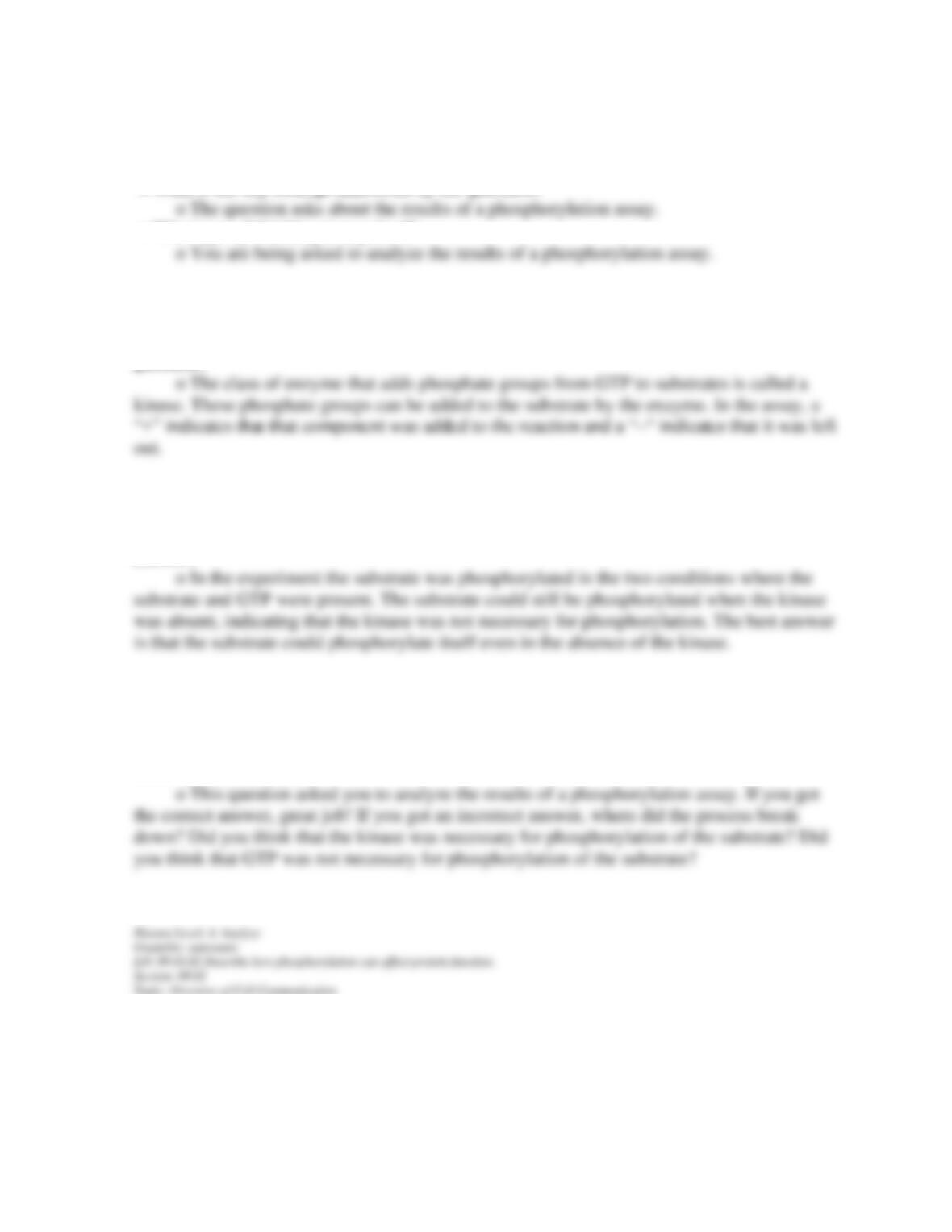
14. You are performing an experiment to assay phosphorylation of a substrate by a protein
kinase. Based on the data in the table below, what do these experimental results suggest?
Chapter 09 – Cell Communication
Clarify Question
•
What is the key concept addressed by the question?
•
What type of thinking is required?
Gather Content
•
What do you know about phosphorylation? What other information is related to the
question?
Choose Answer
•
Given what you now know, what information is most likely to produce the correct
answer?
Reflect on Process
•
Did your problem-solving process lead you to the correct answer? If not, where did the
process break down or lead you astray? How can you revise your approach to produce a
more desirable result?
Chapter 09 – Cell Communication
15. These molecules can directly convert extracellular signals into intracellular signals.
16. When bound to ligand, this type of receptor changes conformation to allow ions to move
down their concentration gradient across the membrane:
17. Growth of new blood vessels is stimulated by vascular endothelial growth factor (VEGF).
This ligand binds to the VEGF receptor, which leads to the dimerization and
autophosphorylation of this receptor on cytoplasmic tyrosines. What type of receptor is the
VEGF receptor?
Chapter 09 – Cell Communication
18. What type of receptor is not an enzyme, but is directly associated with an enzyme that
can hydrolyze GTP?
19. You are planning to perform some protein-protein interaction studies to identify a
receptor for a steroid hormone you have been working on. You start by fractionating the cell.
What cell fraction would you want to work with to identify the steroid hormone receptor of
interest?
Chapter 09 – Cell Communication
20. What property defines most ligands for intracellular receptors?
21. You are interested in developing an inhibitor for the estrogen receptor. You have
identified a molecule that is small and hydrophilic. In a test tube, this inhibitor binds tightly to
the estrogen receptor, and inhibits the interaction of the receptor with estrogen. Do you think
that this molecule will be an effective inhibitor of the estrogen receptor in cells?