Exam
Name___________________________________
MULTIPLE CHOICE. Choose the one alternative that best completes the statement or answers the question.
1)
________ is the maximum possible damage designation on the Mercalli scale.
1)
A)
XII
B)
12
C)
10
D)
X
2)
The asthenosphere is located ________.
2)
A)
within the crust
B)
between the mantle and outer core
C)
in the upper mantle
D)
within the outer core
3)
The distance between a seismological recording station and the earthquake source is determined
from the ________.
3)
A)
length of the seismic record
B)
intensity of the earthquake
C)
earthquake magnitude
D)
arrival times of P and S waves
4)
Major earthquakes are often followed by somewhat smaller events known as ________.
4)
A)
hyposhocks
B)
aftershocks
C)
tremors
D)
foreshocks
5)
When an earthquake occurs, energy radiates in all directions from its source. The source is also
referred to as the ________.
5)
A)
inertial point
B)
epicenter
C)
seismic zone
D)
focus
6)
The Mercalli Scale is a scale from ________.
6)
A)
I to X that rates the total energy released during the main quake and all aftershocks
B)
I to XII that rates the structural damage due to an earthquake
C)
1 to 10 that rates the energy released by an earthquake
D)
1 to 12 that rates the energy required for faulting to occur
7)
The instrument that records earthquake events is termed a ________.
7)
A)
seismograph
B)
polygraph
C)
thermograph
D)
barograph
8)
The lithosphere is defined as ________.
8)
A)
a rocky layer having a relatively uniform chemical composition
B)
a rigid layer of crustal and mantle material
C)
a plastic layer composed mainly of mantle material
D)
a rocky layer composed mainly of crustal rocks
9)
P waves ________.
9)
A)
have higher amplitudes than do S waves
B)
propagate only in solids
C)
are faster than S waves and surface waves
D)
produce the strongest ground shaking
10)
The record of an earthquake obtained from a seismic instrument is a(n) ________.
10)
A)
time–travel graph
B)
seismograph
C)
seismogram
D)
epigraph
11)
Which one of the following statements is correct?
11)
A)
P waves travel through solids; S waves do not.
B)
P and S waves travel through liquids, but S waves do not travel through solids.
C)
S waves travel through solids and P waves travel through liquids.
D)
P and S waves travel through liquids, but P waves do not travel through solids.
12)
Which one of the following statements about the crust is NOT true?
12)
A)
It is thickest where prominent mountains exist.
B)
It is the thinnest of the major subdivisions.
C)
Continental rocks are compositionally different than oceanic rocks.
D)
Oceanic crust is enriched in potassium, sodium, and silicon.
D
13)
The average composition of the oceanic crust is thought to approximate that of ________.
13)
A)
granite
B)
peridotite
C)
basalt
D)
iron
C
14)
On a typical seismogram, ________ will show the highest amplitudes.
14)
A)
body waves
B)
surface waves
C)
P waves
D)
S waves
B
15)
The average composition of the continental crust most closely approximates that of ________.
15)
A)
peridotite
B)
granite
C)
iron
D)
basalt
B
C
16)
Approximately how much more energy is released in a 6.5 Moment Magnitude earthquake than in
one with Mw of 5.5?
16)
A)
30 times
B)
300 times
C)
3000 times
D)
3 times
17)
Which one of the following is TRUE regarding tsunamis?
17)
A)
They travel as deep–water waves at speeds greater than surface seismic waves but slower
than S waves.
B)
They occur in the open ocean, wavelengths are many miles or kilometers and wave heights
are only a few feet.
C)
They are started by fault–induced, horizontal shifts in the seafloor that suddenly propel great
masses of water in opposite directions.
D)
Their wave heights decrease and wavelengths increase as they move into shallower water.
18)
The position on Earth’s surface directly above the earthquake source is called the ________.
18)
A)
epicenter
B)
focus
C)
seismic zone
D)
inertial point
19)
The ________ earthquake was accompanied by extensive fire damage.
19)
A)
San Francisco, 1906
B)
Anchorage, 1964
C)
Mexico City, 1985
D)
Yerevan, Armenia, 1988
20)
The Richter magnitude of an earthquake is determined from the ________.
20)
A)
intensity of the earthquake
B)
arrival time of P and S waves
C)
amplitude of the surface waves
D)
duration of the earthquake
21)
________ have the highest velocities.
21)
A)
Secondary waves
B)
Refracted S waves
C)
Surface waves
D)
Primary waves
22)
Overall, this type of seismic wave is the most destructive.
22)
A)
P wave
B)
surface wave
C)
tsunami
D)
S wave
23)
________ refers to the tendency for a foundation material to lose its internal cohesion and fail
mechanically during earthquake shaking.
23)
A)
Seismoflowage
B)
Slurrying
C)
Motion slip
D)
Liquefaction
24)
The elastic rebound theory for the origin of earthquakes was first proposed by ________ following
the ________ earthquake.
24)
A)
Richter; 1989 Loma Prieta
B)
Mohorovicic; 1964 Anchorage
C)
Giuseppe; 1925 Pizza Lake
D)
Reid; 1906 San Francisco
25)
Which one of the following best characterizes tsunamis?
25)
A)
They are faster than seismic surface waves.
B)
They cause the land to ripple and oscillate.
C)
They have relatively small amplitudes compared to their very long wavelengths.
D)
They are easily seen at sea but are lost in the swell and breaking waves along a coast.
26)
The dense core of Earth is thought to consist predominantly of ________.
26)
A)
lead
B)
iron
C)
copper
D)
nickel
27)
Most of our knowledge about Earth’s interior comes from ________.
27)
A)
examination of deep mine shafts
B)
volcanic eruptions
C)
seismic waves
D)
drill holes
28)
The ________ Magnitude is a measure of the total energy released. It does not directly measure the
extent of building damage.
28)
A)
Moment
B)
Reid
C)
Mercalli
D)
Gutenberg
29)
The mechanism by which rocks store and eventually release energy in the form of an earthquake is
termed ________.
29)
A)
fault displacement
B)
stress fracture
C)
elastic rebound
D)
seismic rebound
30)
The amount of destruction caused by earthquake vibrations is affected by ________.
30)
A)
intensity and duration of the vibrations
B)
nature of the surface material
C)
design of structures
D)
all of these

SHORT ANSWER. Write the word or phrase that best completes each statement or answers the question.
Word Analysis. Examine the words and/or phrases for each question below and determine the relationship among the
majority of words/phrases. Choose the option that does not fit the pattern.
31)
a. Modified Mercalli b. energy c. Moment Magnitude d. large
earthquakes
31)
32)
The upper mantle is very close in chemical and mineralogical composition to ________.
32)
33)
The ________ core is probably solidified.
33)
34)
________ is the cool, brittle, outer layer of Earth that includes the crust and uppermost
mantle.
34)
Word Analysis. Examine the words and/or phrases for each question below and determine the relationship among the
majority of words/phrases. Choose the option that does not fit the pattern.
35)
a. focus b. seismograph c. epicenter d. fault
35)
36)
________ is the layer of warm rock below the crust and uppermost mantle that readily
deforms and flows plastically.
36)
Word Analysis. Examine the words and/or phrases for each question below and determine the relationship among the
majority of words/phrases. Choose the option that does not fit the pattern.
37)
a. core b. asthenosphere c. mesosphere d. lithosphere
37)
38)
What instrument is used to record earthquake vibrations?
38)
39)
________ is another name commonly used by scientists to denote seismic sea waves
induced by earthquakes.
39)
40)
An earthquake of magnitude 7.5 releases about how much more energy than one of
magnitude 5.5?
40)
Word Analysis. Examine the words and/or phrases for each question below and determine the relationship among the
majority of words/phrases. Choose the option that does not fit the pattern.
41)
a. P wave b. S wave c. surface wave d. body wave
41)
42)
The ________ is the site of initial rupturing associated with an earthquake.
42)
Word Analysis. Examine the words and/or phrases for each question below and determine the relationship among the
majority of words/phrases. Choose the option that does not fit the pattern.
43)
a. crust b. lithosphere c. core d. mantle
43)
44)
________ is the name of the earthquake–magnitude scale based on the amount of total
energy released during a large earthquake.
44)
45)
What is thought to be the material state (liquid, solid, gas) and elemental composition of
Earth’s outer core?
45)
TRUE/FALSE. Write ‘T’ if the statement is true and ‘F’ if the statement is false.
46)
Oceanic crust is mainly basaltic in composition; the mantle is more like the igneous rock peridotite
in chemical composition.
46)
47)
The time between the first P–wave and S–wave arrivals is a measure of the distance from a
receiving station to the epicenter of the earthquake.
47)
48)
The Mercalli earthquake magnitude scale is based on the total amount of energy released by the
earthquake.
48)
49)
The epicenter of an earthquake is on the surface of the Earth directly above the focus.
49)
50)
The crust, mantle, and outer core are solid.
50)
51)
S waves can travel through solid and liquid media.
51)
52)
Earthquakes result from the sudden release of elastic strain energy previously stored in rocks
surrounding a zone of fault movement.
52)
53)
The mantle is composed mainly of metallic iron with small amounts of magnesium silicate
minerals.
53)
54)
Tsunamis are caused by sudden displacement of large volumes of seawater.
54)
55)
Continental crust is generally thicker than oceanic crust.
55)
56)
Unconsolidated, water–saturated soils or sediments provide good foundation materials for
buildings and other structures.
56)
ESSAY. Write your answer in the space provided or on a separate sheet of paper.
Critical thinking and discussion questions. Use complete sentences, correct spelling, and the information presented in
chapter 9 to answer the questions below.
57)
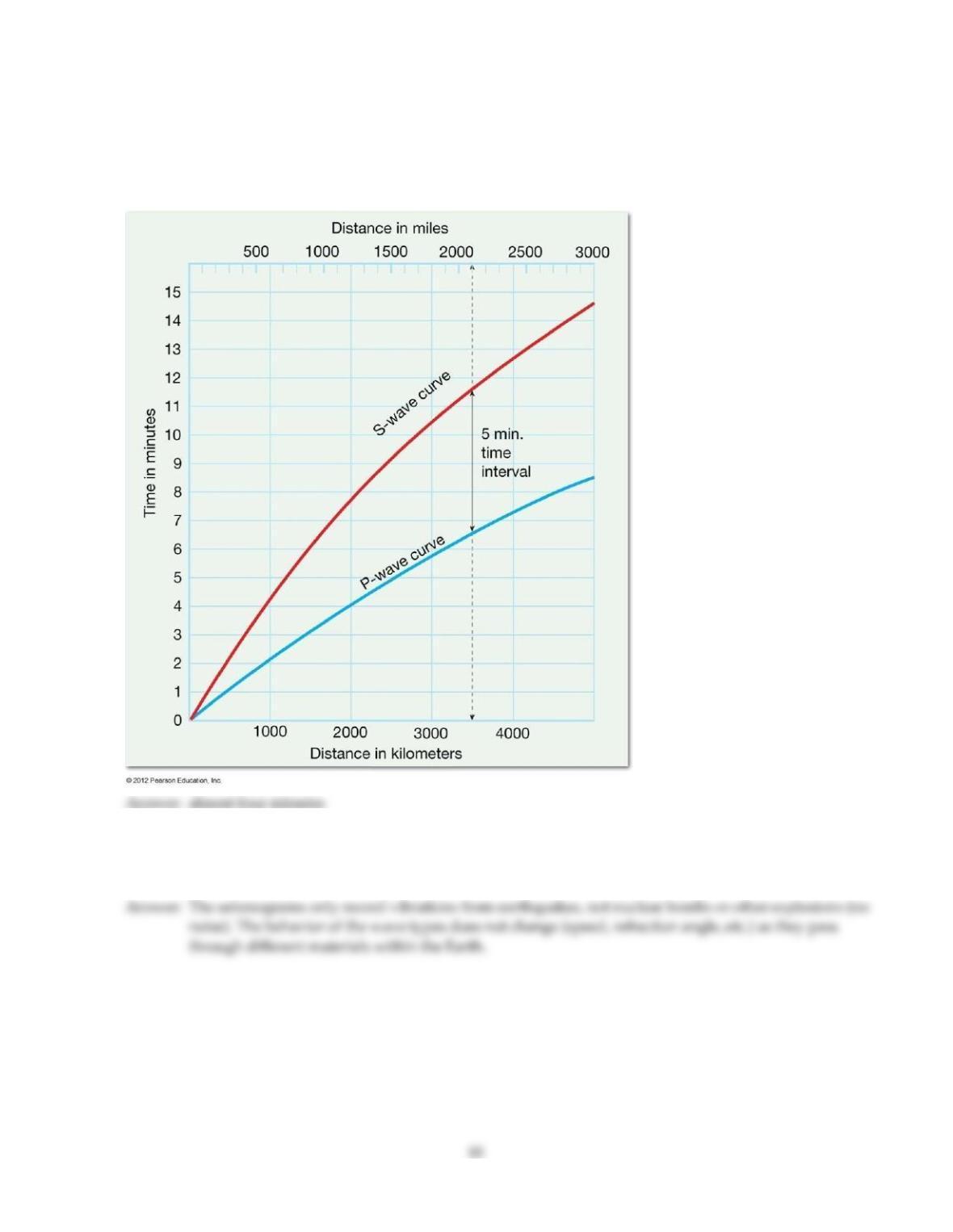
Using the time–travel graph below, how long does it take a P wave to travel 2000 km?
58)
Since much of our knowledge of Earth’s interior is inferred from the behavior of seismic waves and not actual
samples, what are some of the assumptions that are made in order for our models to be correct? (Hint: Think of
earth materials, physical and chemical parameters, etc.)
59)
Would earthquakes of similar magnitudes in different regions of the Earth cause approximately the same levels
of damage necessarily? In your explanation, consider both geologic and human–induced factors.
60)
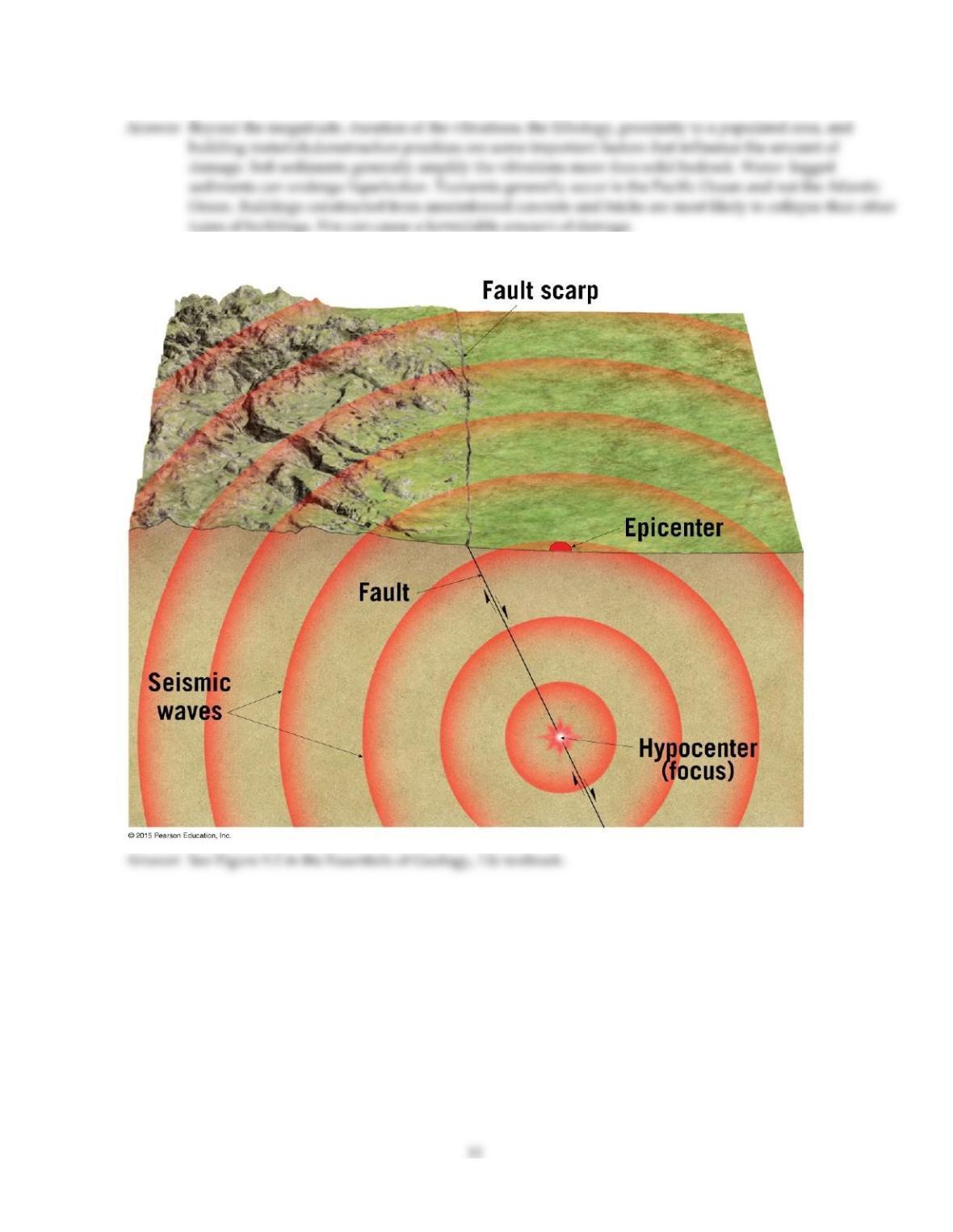
Label the focus and epicenter on the diagram below.
Answer Key
Testname: C9
Answer Key
Testname: C9