Exam
Name___________________________________
MULTIPLE CHOICE. Choose the one alternative that best completes the statement or answers the question.
1)
The ________ drives the exogenic processes of the rock cycle.
1)
A)
tectonic cycle
B)
atmospheric circulation
C)
rock cycle
D)
hydrologic cycle
2)
Areas of upwelling material from the mantle to form new seafloor occur along
2)
A)
areas of seafloor spreading.
B)
transform boundaries.
C)
convergent boundaries.
D)
divergent boundaries.
D
3)
Glaciers that once covered the Hudson Bay area melted 8,000 years ago. As a result of this, the bay
is gradually rising. In another 10,000 years or so, it will have risen above sea level and become dry.
This process can best be considered an example of
3)
A)
orogenesis.
B)
catastrophism.
C)
accretion.
D)
isostasy.
D
4)
The majority of Earth’s volume is within the
4)
A)
inner core.
B)
outer core.
C)
crust.
D)
mantle.
D
5)
Approximately 95% of Earth’s crust is made up of
5)
A)
silicates.
B)
oxides.
C)
phosphates.
D)
carbonates.
A
D
6)
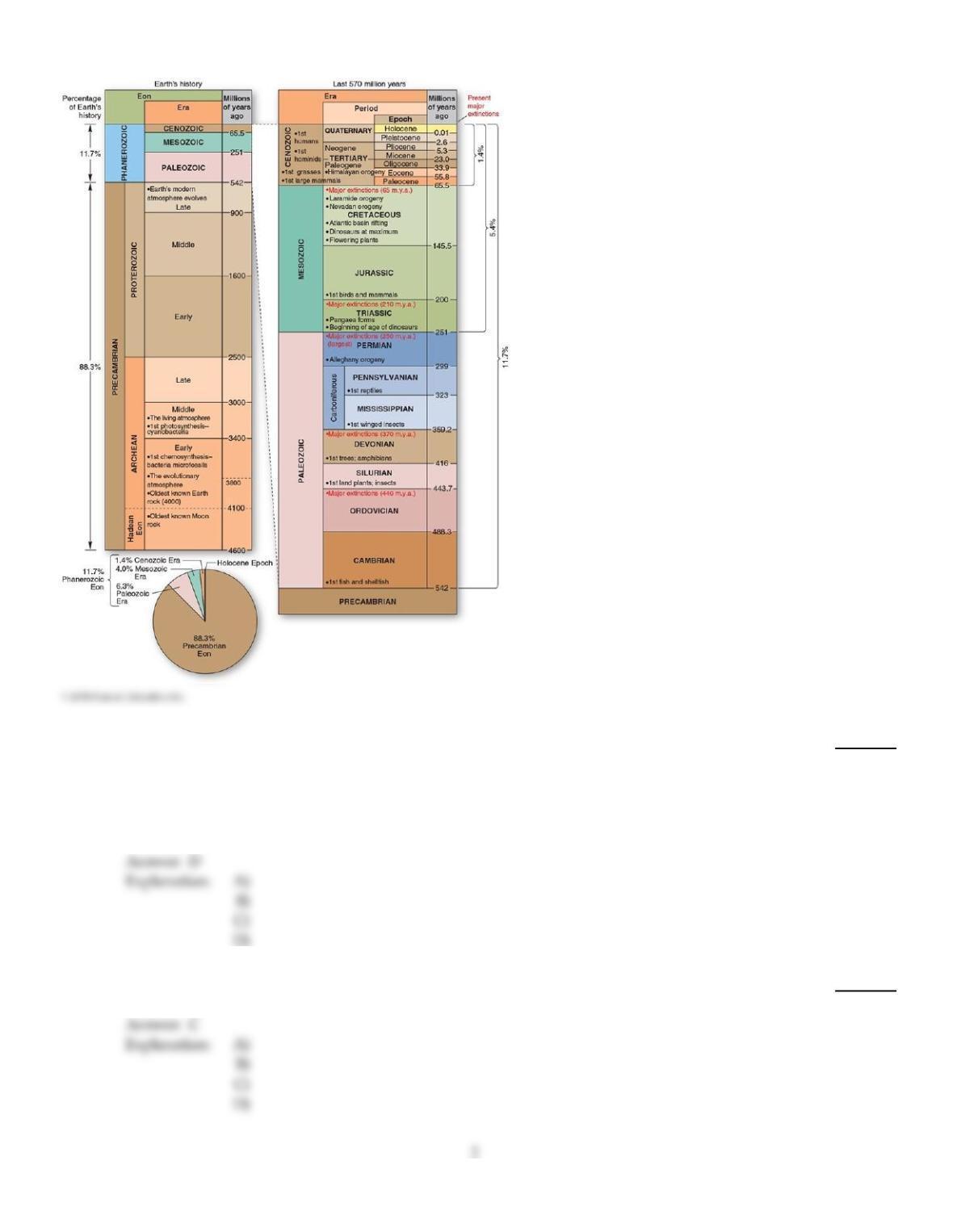
Which of the following is CORRECT regarding the geologic time scale?
6)
A)
The Jurassic period occurred during the Paleozoic era.
B)
Over 87 percent of Earth’s history has elapsed during the more recent Cenozoic, Mesozoic,
and Paleozoic eras.
C)
We live in the Tertiary period.
D)
The bulk of Earth’s history has occurred during the Precambrian eon.
7)
The average length of a period during which a given magnetic field polarity exists is about
7)
A)
10,000 years.
B)
100,000 years.
C)
500,000 years.
D)
1,000,000 years.

8)
Which of the following are located along the mid–ocean ridges?
8)
A)
Outcrops of granite
B)
Evaporite deposits
C)
Old oceanic sediments
D)
Volcanoes
9)
Which of the following is INCORRECTLY matched?
9)
A)
Exogenic external processes
B)
Weathering exogenic breaking and dissolving the crust
C)
Endogenic internal processes
D)
Radioactive decay heat exogenic energy source
10)
Metamorphism that occurs when rocks are exposed to the pressure and extreme temperature
associated with intruding magma is known as
10)
A)
regional metamorphism.
B)
contact metamorphism.
C)
extrusive metamorphism.
D)
intrusive metamorphism.
11)
If you were driving down the highway and saw mountains composed of layered strata, you could
be confident that you were looking at
11)
A)
sedimentary rocks.
B)
batholiths or laccoliths.
C)
a shield volcano.
D)
extrusive igneous rock.
12)
Knowledge of Earth’s interior is mostly derived from
12)
A)
direct sampling of the interior using deep–test wells.
B)
indirect evidence involving the analysis of seismic waves.
C)
historic and prehistoric records.
D)
work in Earth’s deepest caverns and caves.
13)
The fact that Earth’s interior is sorted into layers indicates that
13)
A)
the rotation of the early Earth acted like a centrifuge which separated materials based on
weight.
B)
the process of formation from a nebula (by the slamming together of material and
planetesimals that stuck together on impact) produces nice, neat layers.
C)
Earth was once in a molten state, during which materials became sorted based on density.
D)
nothing can be inferred about such a perplexing level of organization.
14)
Which of the following is CORRECT regarding Alfred Wegener’s theory of continental drift?
14)
A)
It was immediately adopted because of his geological background.
B)
He believed that 225 million years ago all the continents were joined together to form
Pangaea.
C)
Although he provided a mechanism for continental drift, he could not find evidence of it.
D)
He was the first to propose that the continents moved.
15)
The lowest features on Earth’s surface coincide with
15)
A)
divergent plate boundaries.
B)
transform plate boundaries.
C)
mid–oceanic ridges.
D)
subduction zones.
16)
What type of rock forms from the solidification of molten material?
16)
A)
igneous
B)
metamorphic
C)
sedimentary
17)
Which of the following plays a role in the shaping of Earth’s surface?
17)
A)
The radioactive decay of atoms
B)
The action of wind, water, and ice
C)
Gravity
D)
Gravity, wind, water, and ice, and radioactive decay
E)
Gravity and wind, water, and ice only
18)
Earth’s magnetic poles
18)
A)
are migrating approximately 55 to 60 km (34 to 37 mi) per year.
B)
are fixed.
C)
are misaligned from Earth’s axis by 23.5 degrees.
D)
are perfectly aligned with Earth’s axis.
19)
Which of the following is NOT supporting evidence of plate tectonics?
19)
A)
Lack of oceanic ridges that would indicate sea floor spreading.
B)
The fossil and climatic record.
C)
The “jigsaw puzzle” shape of the continents.
D)
Similar rock assemblages on the east coast of South America and West Coast of Africa.
20)
Which of the following is NOT correct?
20)
A)
The Hawai’ian island chain will subduct in approximately 40 my.
B)
Measured from the sea floor to its summit, Mauna Kea is the tallest mountain on Earth.
C)
The formation of the big island of Hawai’i took less than 1 my.
D)
The newest Hawai’ian island, Lo’ihi, should reach the surface in around 10,000 years.
21)
Obsidian is an igneous rock with a glassy appearance and minimal crystal growth. What accounts
for this?
21)
A)
Obsidian is an extrusive igneous rock that cooled rapidly on Earth surface, resulting in little
crystal growth.
B)
Obsidian is an intrusive igneous rock that cooled rapidly beneath Earth’s surface, resulting in
little crystal growth.
C)
Obsidian is an extrusive igneous rock that cooled very slowly on Earth surface, resulting in
little crystal growth.
D)
Obsidian is an intrusive igneous rock that cooled slowly beneath Earth’s surface, resulting in
little crystal growth.
22)
The dominant element in continental crust are
22)
A)
silica and aluminum.
B)
potassium and iron.
C)
magnesium and aluminum.
D)
silica and magnesium.
23)
Which of the following is CORRECT regarding continental drift?
23)
A)
It is an old theory that has been essentially disproven.
B)
The term “continental drift” is now called plate tectonics.
C)
It does not occur because the crust is brittle.
D)
It occurred about two billion years ago, but no longer occurs today.
24)
Which of the following is an exogenic process?
24)
A)
Weathering
B)
Earthquakes
C)
Flows of heat and materials in the mantle
D)
Volcanism
25)
In terms of human–environment interaction, which of the following is an example of an
anthropogenic endogenic process contributing to the geologic cycle?
25)
A)
Rock removal for building contributing to land slides.
B)
Injection wells contributing to earthquake activity.
C)
Harnessing geothermal energy for electricity development.
D)
Strip mining.
26)
The transition zone from the upper mantle to the crust is known as the ________ discontinuity.
26)
A)
Asthensosphere
B)
Lithosphere
C)
Gutenberg
D)
Mohorovi
27)
A rock transformed from any other rock through extreme heat and or pressure is referred to as
27)
A)
igneous.
B)
metamorphic.
C)
ancient.
D)
sedimentary.
28)
Areas of crustal collision and subduction occur along
28)
A)
areas of seafloor spreading.
B)
transform boundaries.
C)
divergent boundaries.
D)
convergent boundaries.
29)
Areas where plates slide past one another, usually ar right angles to a seafloor spreading are
29)
A)
convergent boundaries.
B)
divergent boundaries.
C)
transform boundaries.
D)
areas of seafloor spreading.
30)
At which of the following locations is new ocean crust being formed?
30)
A)
Along collision zones between two continents
B)
Along collision zones between two oceanic plates
C)
In oceanic trenches
D)
Mid–ocean ridges
31)
What type of rock is derived from the bits and pieces of former rocks?
31)
A)
Igneous
B)
Hydrothermal
C)
Sedimentary
D)
Metamorphic
32)
Which of the following is the fuel for continental drift and plate tectonics?
32)
A)
Chemical reactions in Earth’s core
B)
Solar energy
C)
Nuclear fusion
D)
Radioactive decay
33)
In terms of dating of specific rocks, structures, or landscapes, numerical age refers to
33)
A)
the age of geological features based on isotopic dating techniques.
B)
a range of numeric values in which a features was likely formed and based on several lines of
evidence, such as paleoclimatic and paleobotanical reconstructions.
C)
the age of one feature with respect to another within a sequence of events and deduced from
the positions of rock strata above and below one another.
D)
the approximate age of geological features based on the period or epoch in which they
occurred. For instance, noting a feature is from the Cretaceous.
34)
Which of the following can occur when seismic waves encounter a layer in Earth’s interior?
34)
A)
Change in speed
B)
Reflection and/or refraction
C)
Absorption
D)
Reflection, refraction, absorption, and change in speed
E)
Seismic waves cannot penetrate below the crust of Earth.
35)
Uniformitarianism assumes that
35)
A)
catastrophic episodes have regularly occurred.
B)
Earth is quite young and is shaped by dramatic events.
C)
mountains, plains, and canyons formed by catastrophic events.
D)
the same physical processes we see today are a key to understanding the processes that have
been operating throughout geologic time.
36)
The uneven transition zone from the outer core to the mantle is known as the ________
discontinuity.
36)
A)
Lithosphere
B)
Asthensosphere
C)
Mohorovi
D)
Gutenberg
37)
The boundary between the crust and the rest of the lithospheric upper mantle is a discontinuity
known as the
37)
A)
Moho.
B)
mantle.
C)
lithospheric layer.
D)
Gutenberg.
38)
Along ________ new ocean floor is formed by upwelling flows of magma, whereas along ________
old oceanic crust is destroyed.
38)
A)
mid–ocean ridges; subduction zones
B)
subduction zones; mid–ocean ridges
C)
archipelagos; oceanic trenches
D)
oceanic trenches; archipelagos
39)
During the past ice age, landmasses were generally
39)
A)
unaffected by the climatic conditions of the time.
B)
pressed down into the asthenosphere by the load of ice.
C)
elevated, because ice is lighter than rock.
D)
more exposed to the atmosphere.
40)
The thickness of Earth’s crust ranges from
40)
A)
5 km to 60 km (3 mi. to 37 mi.).
B)
70 km to 250 km (43 mi. to 155 mi.).
C)
the surface down to 2900 km (1800 mi.).
D)
the surface to an unknown depth.
41)
Limestone formed from the shells of marine organisms is an example of ________ sedimentary
rock.
41)
A)
biochemical
B)
clastic
C)
organic
D)
chemical
42)
Sedimentary rock formed from the combined processes of weathering, erosion, transportation,
deposition, lithication, and compaction of rock fragments of other rocks are
42)
A)
biochemical.
B)
chemical.
C)
clastic.
D)
organic.
43)
Molten rock beneath Earth’s surface is known as ________, whereas molten rock on Earth’s surface
is called ________.
43)
A)
extrusive; intrusive
B)
lava; magma
C)
magma; lava
D)
intrusive; extrusive
44)
The process whereby one portion of the lithosphere beneath another and dives downward into the
mantel is called
44)
A)
compression.
B)
subduction.
C)
isostatic uplift.
D)
rifting.
45)
Which of the following is NOT a criteria to be classified as a mineral?
45)
A)
Inorganic
B)
Specific chemical composition
C)
Anthropogenic
D)
Crystalline structure
E)
Solid
46)
The principle that the same physical processes currently active in the environment were operating
throughout Earth’s history is known as
46)
A)
parallelism.
B)
catastrophism.
C)
uniformitarianism.
D)
statism.
47)
A batholith forms from
47)
A)
sediment accumulation in a depression.
B)
extrusive igneous rock.
C)
metamorphic rock.
D)
intrusive igneous rock.
48)
An assemblage of minerals bound together is called a
48)
A)
rock.
B)
mineral.
C)
granitic compound.
D)
molecule.
49)
Which rock type makes up approximately 90% of Earth’s crust?
49)
A)
Igneous
B)
Sedimentary
C)
Metamorphic
50)
The dominant element in oceanic crust are
50)
A)
silica and magnesium.
B)
magnesium and aluminum.
C)
potassium and iron.
D)
silica and aluminum.
51)
The scientific study of rock strata (layers) is known as ________ and based on the principle of
________.
51)
A)
Paleontology; catastrophism.
B)
stratigraphy; superposition.
C)
geomorphology; uniformitarianism.
D)
Paleogeography; plate tectonics.
52)
The geologic cycle is fueled by
52)
A)
solar energy.
B)
Earth’s internal heat.
C)
both solar energy and Earth’s internal heat.
D)
neither solar energy and Earth’s internal heat.

53)
On average, the thickness of oceanic crust is ________ that of continental crust
53)
A)
the same as
B)
greater than
C)
less than
54)
The major rocks of Earth’s crust are classified into principal types based on
54)
A)
mineral composition.
B)
three specific rock–forming processes; i.e., the manner in which they formed.
C)
element composition.
D)
relative and absolute locations.
55)
In terms of dating of specific rocks, structures, or landscapes, relative age refers to
55)
A)
the inability to ascertain exact age through isotopic methods and the necessity to provide a
date range for such features.
B)
the age of one feature with respect to another within a sequence of events and deduced from
the positions of rock strata above and below one another.
C)
the age of geological features based on isotopic dating techniques.
D)
the approximate age of geological features based on the period or epoch in which they
occurred. For instance, noting a feature is from the Cretaceous.
56)
Which of the following is NOT an example of an age–relationship based on absolute dating?
56)
A)
The Vishnu schist at the bottom of the Grand Canyon is 2 billion years old.
B)
The dinosaurs became extinct 65 million years ago.
C)
The Coconino formation in the Grand Canyon is older than the Kaibab formation.
D)
The oldest known rocks on Earth are 3.96 billion years old.
57)
The three basic rock types are
57)
A)
sedimentary, metamorphic, and igneous.
B)
intrusive, extrusive, and plutonic.
C)
laterite, schist, and basalt.
D)
conglomerates, clastics, and evaporative.
58)
Which of the following lists, in proper sequential order, the steps leading to the formation of clastic
sedimentary rock?
58)
A)
Erosion, transportation, deposition, metamorphism
B)
Erosion, deposition, transportation, cementation
C)
Precipitation, settling, compaction, cementation
D)
Erosion, transportation, deposition, cementation
59)
Sedimentary rocks are more a product of the ________ system whereas metamorphic and igneous
rocks are more a product of the ________ system.
59)
A)
endogenic; exogenic
B)
exogenic; endogenic
C)
intrusive; extrusive
D)
tectonic; rock
60)
Which of the following is an endogenic process?
60)
A)
Weathering
B)
Stream deposition
C)
Glacial erosion
D)
Volcanism
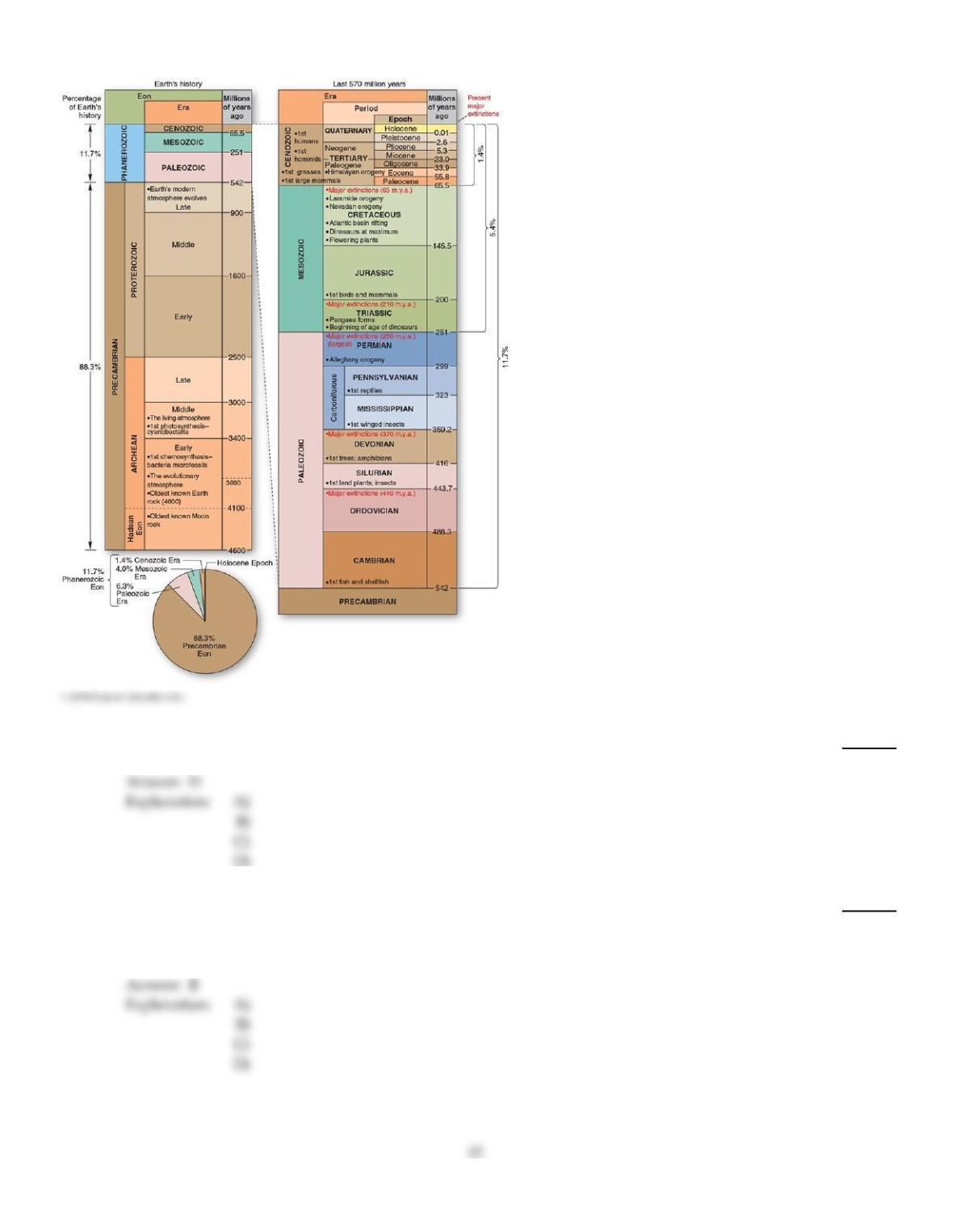
61)
The Precambrian Eon encompasses what percentage of Earth’s total history?
61)
A)
0.04 %
B)
11.7%
C)
5%
D)
88.3%
62)
Metamorphism that occurs over broad areas when the pressure and associated heat of of
overlaying rocks or other tectonic forces cause the rocks to undergo deformation is known as
62)
A)
intrusive metamorphism.
B)
regional metamorphism.
C)
contact metamorphism.
D)
extrusive metamorphism.
63)
Which of the following is NOT correct regarding geothermal energy?
63)
A)
It can be used to produce both heat and electricity.
B)
It is the product of exogenic processes.
C)
Used geothermal water can be returned to aquifers via injection wells.
D)
It’s in use in Iceland, Japan, and California.
64)
At which of the following locations does subduction occur?
64)
A)
Along collision zones between two continents
B)
At sea floor spreading zones
C)
Along collision zones between continental and oceanic plates
D)
Above mantle hot spots
65)
Tectonic forces are an example of
65)
A)
endogenic processes.
B)
exogenic processes.
C)
both exogenic and endogenic processes.
D)
neither exogenic nor endogenic processes.
66)
Which of the following is CORRECT in regards to the geologic time scale?
66)
A)
An era is the smallest unit of geologic time.
B)
An epoch is composed of one or more periods.
C)
The largest defined unit is an eon or, according to some, a supereon.
D)
Every period is composed of 2 epochs.

67)
Which of the following is NOT correct regarding the metamorphism process?
67)
A)
It can be accomplished by heat.
B)
It can be accomplished by pressure.
C)
It can be accomplished by chemical processes.
D)
It involves melting of the original rock.
68)
The ________ drives the endogenic processes of the rock cycle.
68)
A)
hydrologic cycle
B)
atmospheric circulation
C)
rock cycle
D)
tectonic cycle
D
69)
________ is the theory that describes the motion of Earth’s lithosphere.
69)
A)
Pangaea
B)
Plate tectonics
C)
Sea floor spreading
D)
Metamorphism
B
70)
Which of the following is INCORRECT regarding Earth’s inner core?
70)
A)
It has a density of 13.5 grams/cm3.
B)
It is about 1230 km (760 mi.) thick.
C)
It is the source of Earth’s magnetic field.
D)
It is solid iron in composition.
C
71)
Sedimentary rock formed from dissolved minerals that precipitate out of water solution and build
up to form rock are
71)
A)
inorganic.
B)
clastic.
C)
chemical.
D)
organic.
C
D
72)
Extrusive igneous cooled and hardened ________ Earth‘s surface, resulting in ________ grained
rocks.
72)
A)
beneath; finer
B)
at; finer
C)
beneath; coarser
D)
at; coarser
73)
The rigid crust and uppermost mantle are known collectively as the
73)
A)
Gutenberg discontinuity.
B)
Moho.
C)
asthenosphere.
D)
lithosphere.
74)
Earth’s magnetic field
74)
A)
remains a mystery as to its cause.
B)
is variable, and it has faded to zero and returned to full strength with the polarity reversed.
C)
is principally generated in the inner core.
D)
is constant in its intensity.
75)
Boundaries between intervals of the geological time scale are determined by
75)
A)
Climatic periods based on paleoclimatological reconstructions.
B)
using a quantile method whereby the number of years in each subdivision is determined by
dividing the number of years by the desired number of classes.
C)
dividing the time range of the interval by the number desired subdivisions, thereby creating
equal intervals between the divisions.
D)
Major events in Earth’s history, such as major extinctions.
76)
The plastic layer in the mantle from about 70 to 250 km (43 to 155 mi) in depth is known as the
76)
A)
asthenosphere.
B)
Gutenberg discontinuity.
C)
Moho.
D)
lithosphere.
77)
Which of the following gives the CORRECT sequence of layers in Earth, from the surface to the
center?
77)
A)
Crust, inner core, mantle, outer core
B)
Mantle, crust, inner core, outer core
C)
Crust, mantle, outer core, inner core
D)
Inner core, outer core, mantle, crust
78)
The principles of buoyancy and balance, when applied to Earth’s crust, helps us to explain
fluctuations in Earth’s outer crust, a property known as
78)
A)
Moho effect.
B)
magnetism.
C)
isostasy.
D)
orogenesis.
79)
Scientists have direct evidence of Earth‘s structure to
79)
A)
the upper mantle (~250 km (155 mi)).
B)
about 2 km (1.2 mi) from the surface.
C)
10 km (6 mi) from the surface, based on the deepest well shaft.
D)
the inner core.
80)
Earth’s interior is layered because
80)
A)
materials became sorted based on density as Earth solidified.
B)
materials became sorted based on electromagnetic fields as Earth solidified.
C)
centrifugal force separated out the materials based on weight as Earth solidified.
81)
An element or combination of elements that forms an inorganic, natural compound is called a
81)
A)
molecule.
B)
granitic compound.
C)
tectonic rock.
D)
mineral.
82)
Of the elements in Earth’s crusts, ________ makes up the most of Earth’s crust by weight.
82)
A)
silicon (Si)
B)
Iron (Fe)
C)
Aluminum (Al)
D)
oxygen (O)
83)
Which of the following is an example of the principle of uniformitarianism?
83)
A)
The processes by which streams carve valleys at present are the same as those that carved
valleys 500 millions years ago.
B)
Catastrophic events, such as major landslides, earthquakes, and volcanic episodes, are the
primary drivers of geomorphological change.
C)
Earth‘s geological history is mostly uniform and homogeneous, existing now as it mostly
always has with the exception of minor recent changes.
D)
It is not possible to know how Earth processes have changed overtime, therefore it is not
possible to deduce how Earth’s ancient landforms evolved.
84)
The majority of Earth‘s crust is composed of ________ rock.
84)
A)
metamorphic
B)
igneous
C)
sedimentary
D)
carbonate
85)
Which of the following is CORRECT?
85)
A)
Continental crust is denser than oceanic crust and composed primarily of granite.
B)
Oceanic crust is less dense than continental crust and is composed primarily of granite.
C)
Oceanic crust is denser than continental crust and is composed primarily of basalt.
D)
Continental crust is less dense than oceanic crust and composed primarily of basalt.
86)
The asthenosphere can best be described as
86)
A)
a plasma.
B)
a liquid.
C)
a plastic.
D)
a rigid solid.
87)
The process of isostatic adjustment is most closely associated with which of the following?
87)
A)
Buoyancy
B)
Volcanic activity
C)
Sea–floor spreading
D)
Lithospheric plate collisions
88)
The density of material below the Moho is ________ that above it.
88)
A)
less than
B)
the same as
C)
greater than
89)
Which of the following is NOT a process than can cause metamorphism?
89)
A)
Pressure
B)
Solidification of magma
C)
Compression and shear
D)
Heating
90)
The occurrence of contact metamorphism would be direct evidence for
90)
A)
lithification of clastics.
B)
regional plate collision.
C)
the local intrusion of magma.
D)
cementation of sedimentary rock.
91)
The three most abundant elements in Earth’s crust are
91)
A)
magnesium, potassium, and oxygen.
B)
iron, aluminum, and granite.
C)
rock, water, and tectonics.
D)
oxygen, silicon, and aluminum.
92)
Which of the following statements about Earth’s core is NOT correct?
92)
A)
A third of Earth’s entire mass, but only 1/6th of its volume lies in its core.
B)
Scientists think the inner core formed before the outer core.
C)
The inner core is believed to be liquid and the outer core solid.
D)
It is composed primarily of iron.
93)
Which of the following is an example of an intrusive, igneous rock formation?
93)
A)
Pluton
B)
Dome
C)
Lava flow
D)
Volcano
A
94)
Travertine, formed from the CaCO3 that has been precipitated from groundwater, is an example of
________ sedimentary rock.
94)
A)
chemical
B)
biochemical
C)
clastic
D)
organic
A
95)
The percentage of oxygen is the crusts is ________ than that in the atmosphere.
95)
A)
greater than
B)
the same as
C)
less than
A
96)
The oldest seafloor is a no more than 280 million years in old because
96)
A)
hot spots continuously destroy the ocean floor.
B)
the ocean floor is pushed up onto continental material during plate collisions.
C)
Earth is only 280 million years old.
D)
the ocean floor subducts during plate collisions.
D
C
97)
Which of the following is an example of an age–relationship based on relative dating?
97)
A)
Australopithecines were alive 3.2 million years ago.
B)
The Neanderthals became extinct 35,000 years ago.
C)
Clovis points have been dated at 11,000 years old in North America.
D)
Australopithecines evolved before Homo erectus.
98)
Convergent plate boundaries are characteristic of
98)
A)
collision zones between plates.
B)
sea–floor spreading centers.
C)
lateral motions of plates.
D)
all plate boundaries.
99)
Which of the following is CORRECT?
99)
A)
The age of the sea floor does not follow a discernable pattern.
B)
The age of the sea floor increases with increasing distance from a mid–ocean ridge.
C)
The oldest sea floor material is several billion years in age.
D)
The age of the sea floor increases with increasing distance from a trench.
E)
The age of the sea floor is the same in most areas of the ocean.
100)
How does the ocean floor preserve evidence of past magnetic reversals.
100)
A)
Isotopic analysis of ocean core sediments help determine sea floor age and this can be used to
infer past magnetism.
B)
Magnetic particles in basalt orient with the magnetic field in force at the time the oceanic lava
cooled and hardened.
C)
The ocean floor is uniformly old, preserving Earth’s 4.6 billion history.
D)
Mantle hot spots are always oriented to the magnetic field.
101)
The continuous alteration of Earth materials from one rock type to another is known as the
101)
A)
hydrologic cycle.
B)
geologic cycle.
C)
tectonic cycle.
D)
rock cycle.
102)
Ocean floor subducts under continents because
102)
A)
the weight of the continents is so great that they push the ocean floor material downward.
B)
the ocean floor has a lower density and therefore sinks more easily.
C)
the ocean floor is made of silica and aluminum s and is heavier than continental material.
D)
the ocean floor is made up of silica and magnesium and is more dense than continental
material.
D
103)
Continental crust is basically ________, whereas oceanic crust is basically ________.
103)
A)
sima; sial
B)
basalt; granite
C)
thin; thick
D)
granite; basalt
D
104)
The Hawaiian Islands were formed as a result of
104)
A)
activity along a mid–ocean ridge.
B)
a rising plume of magma from the mantle.
C)
a continental–oceanic plate collision.
D)
an oceanic–oceanic plate collision.
B
105)
Mid–ocean ridges occur where
105)
A)
plates are converging.
B)
plates are moving apart (diverging).
C)
plates are sliding past one another (transform boundaries).
D)
the geographic middle of an ocean basic occurs.
B
D
106)
Earth’s crust is roughly made up of
106)
A)
mantle and core material.
B)
strong, unbroken material.
C)
at least 14 plates capable of movement.
D)
a brittle material that does not move.
107)
Pangaea is currently dated at
107)
A)
the beginning of the Holocene.
B)
4.6 billion years ago.
C)
65 million years ago.
D)
about half the timespan of Earth’s existence.
E)
225 to 200 million years ago.
108)
When geologists conclude that the Grand Canyon sequence of rocks was formed through hundreds
of millions of years of deposition, mountain building, and erosion, they are basing this conclusion
on the principle of ________ which states that ________.
108)
A)
catastrophism; a single, large flood was responsible for the creation of the rock sequence
B)
catastrophism; most rock formations were created as a result of supernatural processes
C)
uniformitarianism; the geologic processes that operated in the past are the same as those that
operate today, and they occurred in accordance with the same laws of nature that are
operating today
D)
uniformitarianism; all geologic processes take immense amounts of time to occur and always
occur at the same rate
109)
________ are sites of upwelling of magma from the mantle independent of plate boundaries.
109)
A)
Transform faults
B)
Hot spots
C)
Mid–ocean ridges
D)
Subduction zones
110)
Which layer of the planet forms 80 percent of Earth’s total volume, and has an average density of
4.5 grams /cm3?
110)
A)
Core
B)
Continental crust
C)
Oceanic crust
D)
Mantle
111)
Intrusive igneous cooled and hardened ________ Earth’s surface, resulting in ________ grained
rocks.
111)
A)
at; coarser
B)
beneath; coarser
C)
at; finer
D)
beneath; finer
B
112)
In terms of the geologic cycle, which of the following is NOT an exogenic process?
112)
A)
Subduction
B)
Deposition
C)
Weathering
D)
Erosion
A
113)
Transform faults along plate boundaries are typically associated with
113)
A)
subduction zones.
B)
earthquake activity.
C)
sea–floor spreading centers.
D)
volcanism.
B
114)
The subfield of geography and geology concerned with the study of the origins, evolutions, form,
and spatial distribution of Earth’s landforms is
114)
A)
geomorphology.
B)
pedology.
C)
lithology.
D)
geophysics.
A
D
115)
Divergent plate boundaries are characteristic of
115)
A)
transform plate boundaries.
B)
sea–floor spreading centers.
C)
all plate boundaries.
D)
collision zones between plates.
116)
Small plutons that form parallel to layers of sedimentary rock are known as
116)
A)
dikes.
B)
batholiths.
C)
sills.
D)
laccoliths.
C
117)
Limestone is a type of ________ rock that forms when ________.
117)
A)
igneous; lava cools
B)
sedimentary; broken fragments of rock are deposited in a water environment and are then
cemented together.
C)
igneous; magma cools
D)
sedimentary; calcium carbonate precipitates, or organic material containing calcium
carbonate accumulates in a water environment
D
118)
The three principal cycles composing the geologic cycle include all the following EXCEPT
118)
A)
rock cycle.
B)
tectonic cycle.
C)
biogeochemical cycle.
D)
hydrologic cycle.
C
119)
Which of the following layers of Earth is liquid and is responsible for producing Earth’s magnetic
field?
119)
A)
Asthenosphere
B)
Outer core
C)
Inner core
D)
Lower mantle
B
B
TRUE/FALSE. Write ‘T’ if the statement is true and ‘F’ if the statement is false.
120)
According to currently accepted scientific theories, Earth is never affected by catastrophes.
120)
121)
Earth‘s magnetic field is generated from within the uppermost mantle and crust.
121)
122)
The relative age of geologic features is ascertained through the use of radiometric dating.
122)
123)
The inner core is liquid iron, surrounded by a solid iron outer core.
123)
124)
The geologic cycle is powered both by exogenic and endogenic energy systems.
124)
125)
The rock cycle is fueled both by the hydrologic cycle and the tectonic cycle.
125)
126)
The lithosphere lies above the asthenosphere.
126)
127)
Ocean floor is destroyed along transform faults.
127)
128)
Oceanic crust is denser than continental crust.
128)
129)
The half–life of a radioactive isotope does not vary.
129)
130)
Uniformitarianism holds that all geologic change affecting Earth’s surface requires immense
amounts of time to occur.
130)
131)
Convergent plate boundaries occur in areas of seafloor spreading.
131)
132)
Though Earth is 4.6 billion years old, the oldest seafloor is no more than 280 million years old.
132)
133)
Earth’s interior composition has been inferred by the use of seismic waves.
133)
134)
Earth‘s magnetic field has reversed nine times in the last four million years.
134)
135)
The core comprises 1/3rd of Earth’s mass, but only 1/6th of its volume.
135)
136)
The North Magnetic Pole is moving northwest at approximately 55 to 60 km (34–37 mi) per year.
136)
137)
The crust is thickest under mountains and thinnest under the oceans.
137)
138)
Earthquake and volcanic occurrences do not correlate well with crustal plate boundaries.
138)
139)
Uniformitarianism assumes the physical processes now active have been operating throughout
Earth’s history.
139)
140)
The upper mantle is rigid, whereas the asthenosphere is plastic–like.
140)
141)
The geological time scale uses equal intervals for dividing Earth’s long history in a series of eons,
eras, periods, and epochs.
141)
142)
Humans can contribute to both the endogenic and exogenic processes shape Earth.
142)
143)
Sedimentary rock may be formed from the shells of organisms containing calcium carbonate.
143)
144)
New oceanic crust is formed at mid–ocean ridges.
144)
145)
True north is a fixed geographic point?
145)
146)
The arrangement of continents is permanent with only minor changes wrought by crustal
movement (e.g., earthquakes).
146)
147)
The oldest surface rocks on Earth are between 3.8 and 4.4 billion years old.
147)
148)
Exogenic processes cause warping, folding, faulting, and uplift of Earth’s surface.
148)
149)
Evidence of reversals in Earth’s magnetic field is found along areas of seafloor spreading.
149)
150)
An intrusive igneous rock has finer crystal grains than an extrusive igneous rock.
150)
151)
Roughly 95% of Earth’s crust is made up of silicates.
151)
152)
Any rock, either igneous or sedimentary, may be transformed into a metamorphic rock, by going
through profound physical and/or chemical changes under increased pressure and temperature.
152)
153)
A mineral can be either organic or inorganic.
153)
154)
Most sedimentary rocks are derived from preexisting rocks, or from organic materials (such as
bone and shell).
154)
155)
Rock assemblages from the east coast in South America and west coast of Africa provide
supporting evidence to the theory of plate tectonics.
155)
156)
Just eight natural elements make up over 98% of Earth’s crust by weight.
156)
157)
The principle of isostasy refers to the vertical movement of Earth‘s crust in response to loading and
unloading of weight, such as ice or sediment.
157)
158)
Contact metamorphism involves changes in the texture and mineralogy of a rock caused by the
extreme heat and pressure of intruding magma.
158)
159)
The Moho separates the uppermost mantle from the crust.
159)
160)
Scientists have direct evidence of Earth’s internal structure down to upper mantle.
160)
161)
The mantle represents 80% of Earth‘s volume.
161)
162)
The deepest places in the ocean are those in which rifting occurs.
162)
163)
Transform plate boundaries are associated with earthquake activity.
163)
164)
The Moho separates the outer core from mantle.
164)
165)
Major events in Earth’s history, such as major extinctions, determine the boundaries between the
intervals in the geologic time scale.
165)
166)
The continents of the words were once connected, forming a supercontinent called Pangaea.
166)
167)
The formation of clastic sedimentary rock may involve weathering, erosion, transportation, and
deposition.
167)
168)
Alfred Wegener’s theory of continental drift was immediately accepted by the scientific community
when it was proposed.
168)
169)
Endogenic processes cause warping, folding, faulting, and uplift of Earth’s surface.
169)
ESSAY. Write your answer in the space provided or on a separate sheet of paper.
170)
Present the main assumptions of uniformitarianism.
171)
What are some examples of anthropogenic endogenic and exogenic processes in the geologic cycle.
172)
Describe the three basic rock types, how each are formed, and subcategories of each.
173)
Which part of Earth is primarily responsible for Earth’s magnetic field? Why? What are the characteristics of
magnetic reversals? How often do they occur? When will the next one occur, and what will happen when it
does?

174)
Diagram and label the three types of plate boundaries.

175)
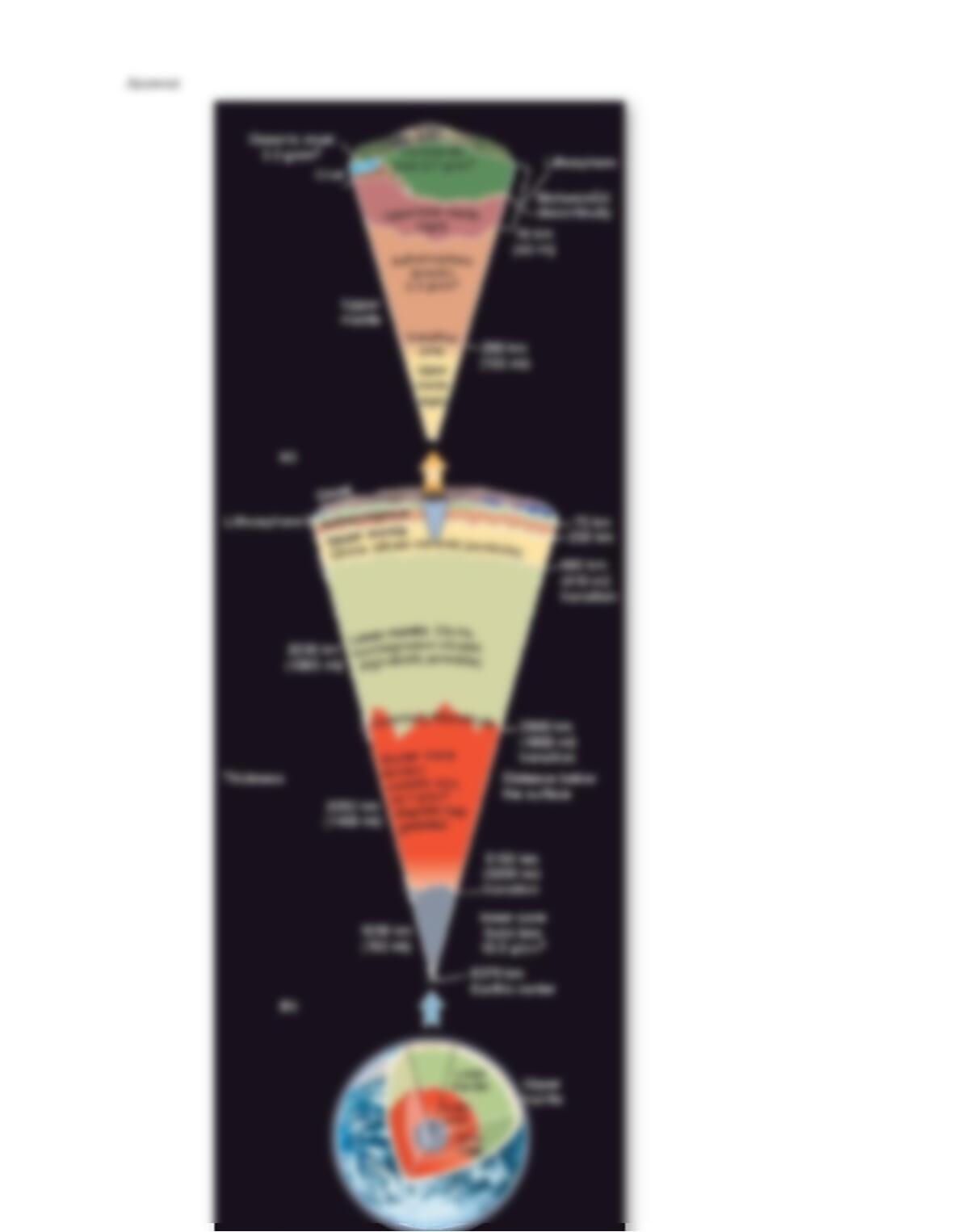
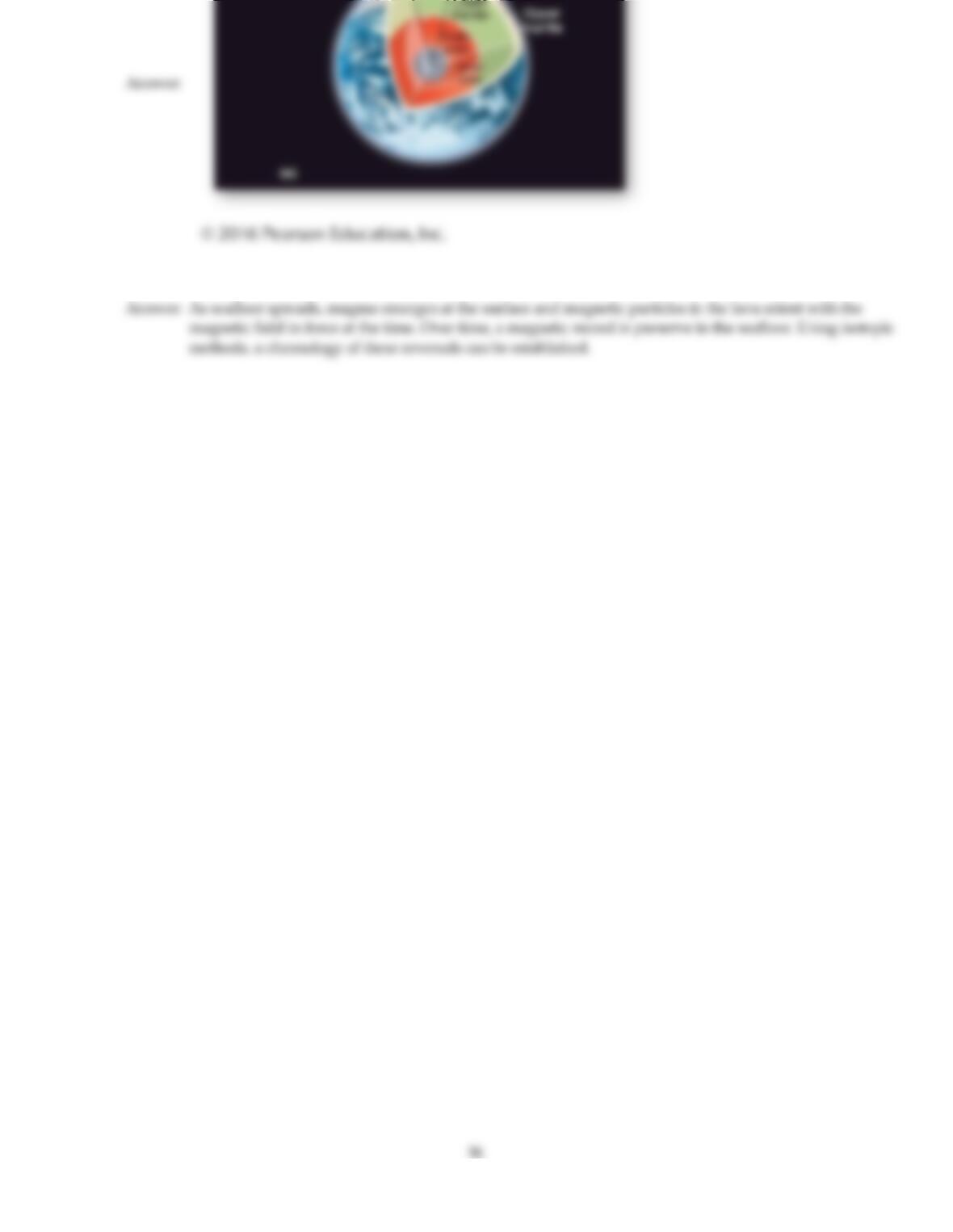
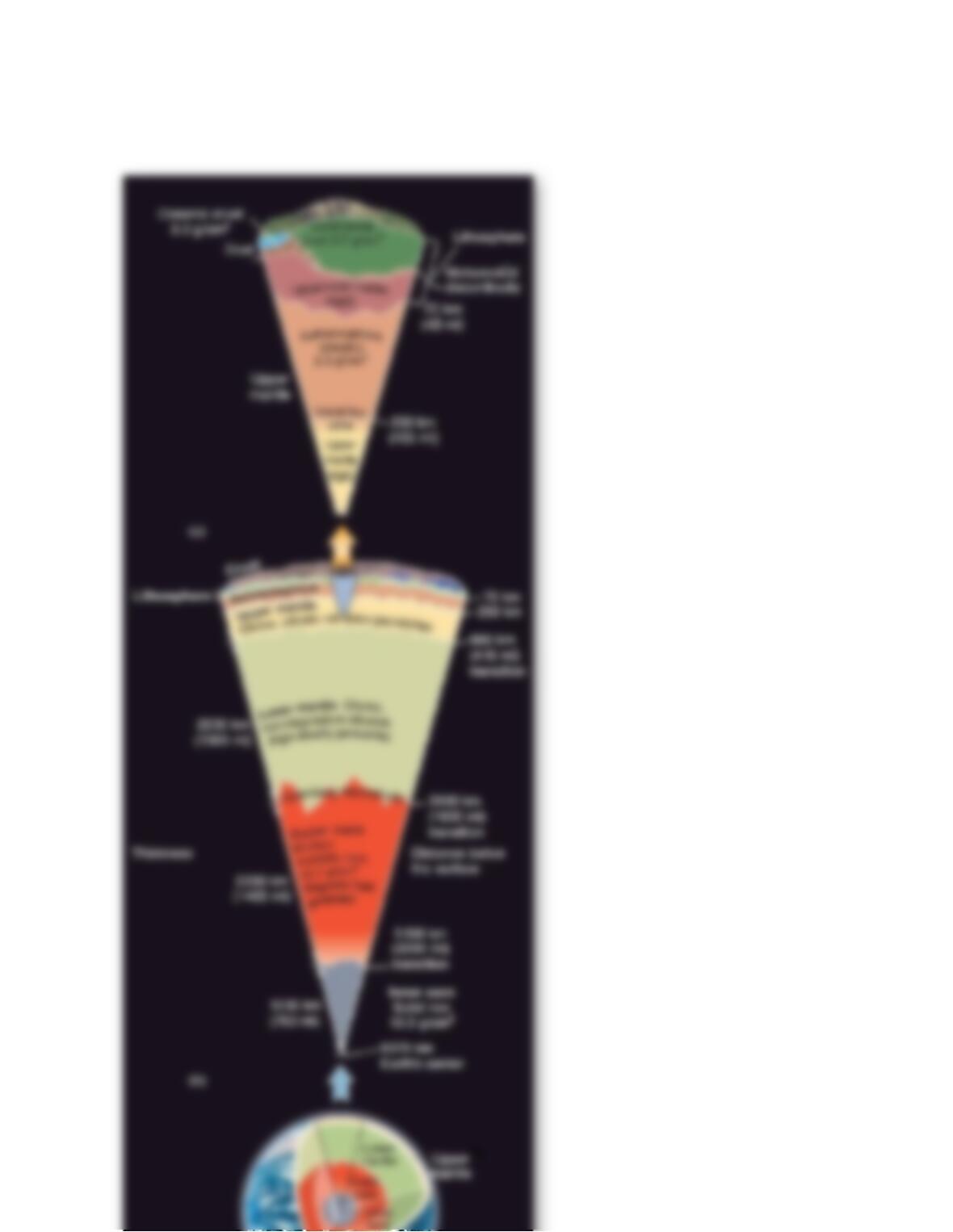
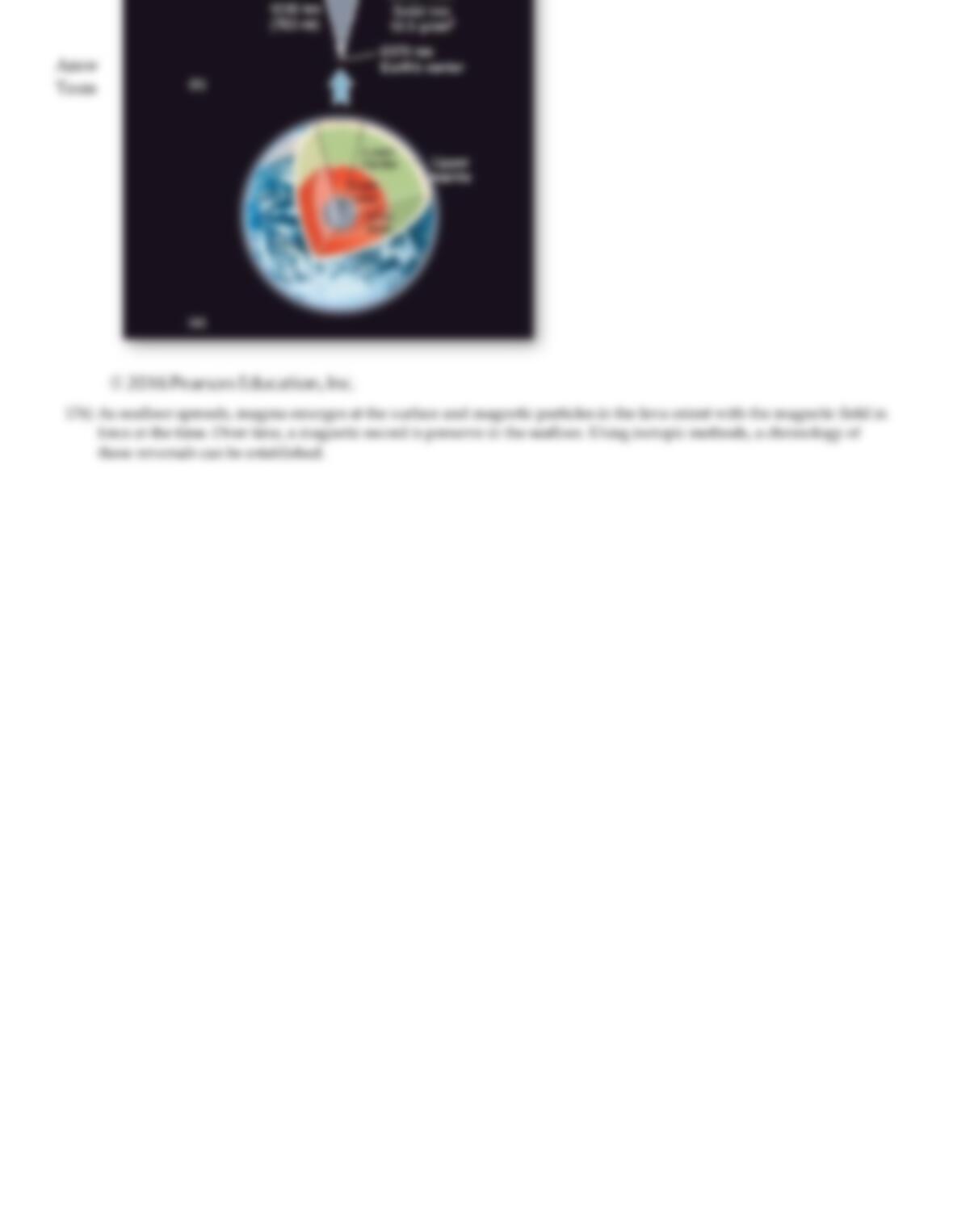
Draw or verbally depict a cross–section of Earth from the center to the surface including all of its major
components. Include important physical characteristics, such as the thickness of the layer, the nature of the rock,
approximate temperature, density, and mineral types.
176)
What is the relationship between seafloor spreading and reversals in Earth’s magnetic field.
177)
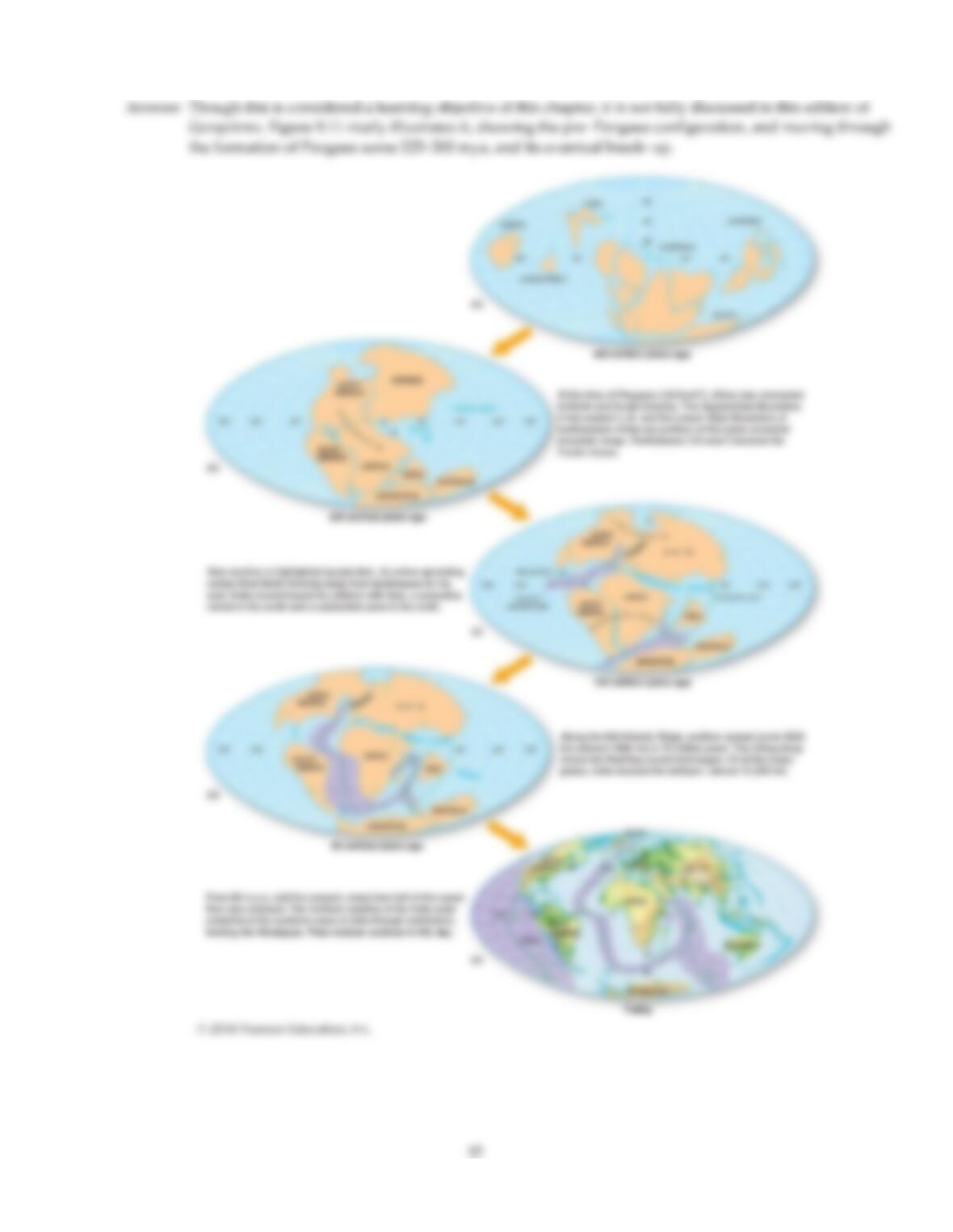
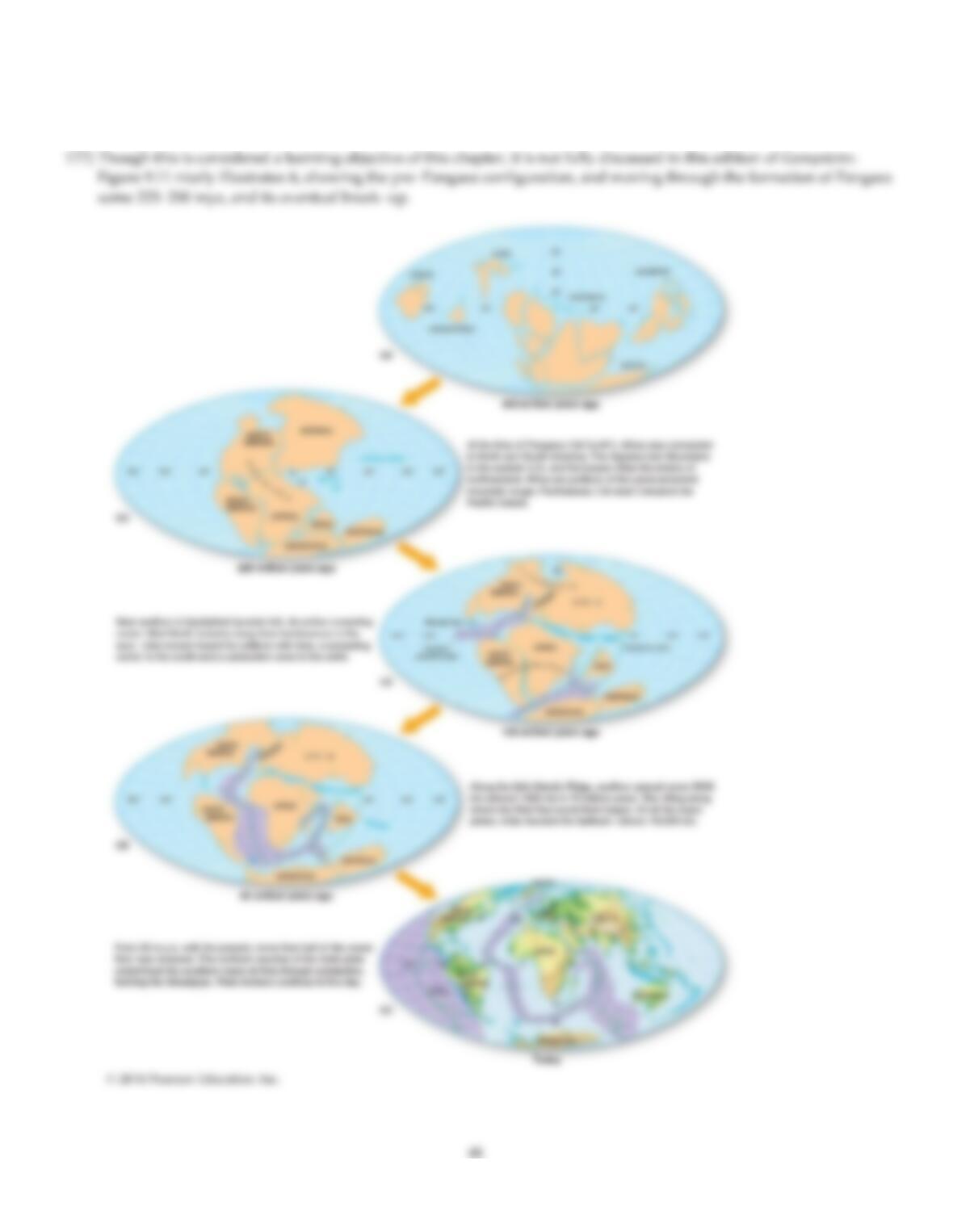
Describe the important aspects of the formation and breakup of Pangaea.
178)
Briefly review the history of the theory of plate tectonics. What was Alfred Wegener’s role? What evidence did
he present? Why was his theory NOT widely accepted initially? What new evidence led to its later acceptance?
179)
Describe the endogenic and exogenic processes involved in the geologic cycle.

Answer Key
Testname: C9
Answer Key
Testname: C9
Answer Key
Testname: C9
Answer Key
Testname: C9
42

Answer Key
Testname: C9
43
Answer Key
Testname: C9
45
Answer Key
Testname: C9
Answer Key
Testname: C9