CHAPTER 9—SUSTAINING BIODIVERSITY: THE ECOSYSTEM APPROACH
MULTIPLE CHOICE
1. The Green Belt Movement, founded by Wangari Maathai, combines tree planting and preservation
with
a.
a drug rehabilitation program
b.
a women’s self help group that addresses poverty
c.
a family planning organization
d.
a sustainable agriculture program
e.
a cooperative farming college course
2. All of the following statements about Wangari Maathai’s tree planting program in Kenya are true
except
a.
It was initially very successful, but has since failed due to government support.
b.
It has sparked the creation of similar programs in 30 other African countries.
c.
Since its inception in 1977, it has had 50,000 members.
d.
It has established 6,000 village nurseries.
e.
It started with a small nursery in her backyard.
3. Which type of forest is considered a reservoir of biodiversity?
a.
old-growth
b.
second-growth
c.
Commercial
d.
tree plantation
e.
All forests are reservoirs of biodiversity.
4. Fairly diverse second- and third-growth forests now exist in all parts of the United States except the
a.
East
b.
West
c.
North
d.
South
e.
Northeast

5. Strip cutting of timber is a method of harvesting that
a.
harvests trees singly or in small groups
b.
involves clearing trees along a contour of the land within a narrow corridor
c.
removes all trees from a very large area, with no attention to land contours
d.
is particularly damaging to the forest
e.
is promoted by logging companies because of the high profit margin
6. Which of the following is a secondary cause of forest degradation rather than a basic cause?
a.
crop and timber exports
b.
government policies
c.
population growth
d.
Fires
e.
Poverty
7. When roads are built into previously inaccessible forest areas to harvest timber, all of the following
things happen except:
a.
the forest becomes fragmented
b.
topsoil erodes
c.
biodiversity is lost
d.
sediment runoff occurs in waterways
e.
the forest ecosystem remains intact with no disturbance or damage
8. All of the following are examples of economic services that forests provide except:
a.
Fuelwood
b.
reduce soil erosion
c.
Recreation
d.
Jobs
e.
livestock grazing
9. A tree harvesting method that involves cutting intermediate-aged or mature trees singly or in small
groups is called
a.
clear-cutting
b.
strip cutting
c.
selective cutting
d.
patch cutting
e.
landscape cutting
10. Sustainable management and harvesting of forests is certified by the
a.
U.S. Forest Service
b.
California Conservation Core
c.
Forest Stewardship Council
d.
Convention on International Trade of Endangered Species
e.
Endangered Species Act
11. Countries with the largest areas of Forest Stewardship Council (FSC) certified trees, in order from
largest to smallest certified areas, are:
a.
United States, Poland, Brazil, Canada, Russia, and Sweden
b.
Sweden, United States, Canada, Russia, Brazil, and Poland
c.
Russia, Canada, United States, Sweden, Poland, and Brazil
d.
Canada, Russia, Sweden, United States, Poland, and Brazil
12. Political steps that can help reduce the destruction and degradation of tropical forests include all of the
following except
a.
certifying sustainably grown timber
b.
establishing programs to teach settlers sustainable agriculture and forestry strategies
c.
subsidizing only sustainable-use forestry
d.
encouraging migration to undisturbed tropical forests
e.
reducing poverty
13. A program undertaken by the U.S. Forest Service and the National Advertising Council that has helped
humans and saved forests is
a.
the prescribed burn program
b.
the Smokey Bear campaign
c.
the program to restore watersheds below clear cuts
d.
the program to remove dams
e.
the program to thin trees in old growth forests
14. All of the following are important aspects of sustainable forestry except
a.
no logging of old-growth forests
b.
no clear-cutting on steep slopes
c.
reduce road-building into uncut forest areas
d.
rely more on clear-cutting
e.
certify timber grown by sustainable methods
15. A plant called kenaf would help to reduce the pressure to cut trees because its fiber is very useful for
a.
making paper
b.
home construction material
c.
furniture making
d.
fencing and decking material
e.
fabric for outdoor carpeting
16. According to environmental writer Bill McKibbin, “the great environmental story of the United States,
and in some ways, the whole world” is the
a.
restoration of grasslands
b.
regrowth of forests
c.
production of biofuels on forest land
d.
restoration of aquatic ecosystems
e.
restoration of saguaro cactus stands
17. A process in which grazing cattle are confined with portable fencing to specific small areas for a short
time and then moved is called
a.
erosion control
b.
rotational grazing
c.
nutrient cycling
d.
organic grazing
e.
organizing grazing and erosion control
18. The most compelling issue that is causing loss of grasslands in the Western United States is
a.
destructive range fires
b.
harvesting grasses for hay for domestic animals
c.
conversion to cropland
d.
Overgrazing
e.
intrusion of forests into grassland areas
19. Natural ecological restoration of riparian areas can happen if
a.
enough chemical fertilizer is applied
b.
there is aggressive planting of native trees and shrubs
c.
the native fish in the adjacent stream or river are restocked
d.
protecting overgrazed land by moving cattle around
e.
cloud seeding is performed
20. As a consequence of the reintroduction of the gray wolf into Yellowstone National Park and northern
Idaho, the following other wild species have made a comeback:
a.
Beavers
b.
round squirrels, mice, and gophers
c.
willow, aspen, and cottonwood trees
d.
beavers, ground squirrels, mice, gophers, willow, aspen and cottonwood trees.
e.
wolf reintroduction caused other species to decline, not reemerge or increase.
21. Reintroduction of the wolf eventually reduced attacks on domestic cattle by what other species?
a.
golden eagle
b.
Coyote
c.
Fox
d.
grizzly bear
e.
local wild dogs
22. The wolf reintroduction was based partly on its importance as a(n)
a.
indicator species
b.
generalist species
c.
fur-bearing species
d.
keystone species
e.
predator on grizzly bear cubs

23. According to your textbook, the biggest problem for U.S. national and state parks today is
a.
popularity
b.
nearby human activities
c.
non-native species
d.
poaching
e.
soil erosion
24. Of Earth’s remaining wilderness areas, about ____ are strictly or partially protected by law from
human activities.
a.
5%
b.
20%
c.
45%
d.
50%
e.
55%
25. Which common problem of U.S. cities is now a problem in United States national parks?
a.
homeless people
b.
lack of funding for schools
c.
air pollution
d.
high crime rates
e.
alcoholism
26. Conservation biologists want the protection of at least ____ of the Earth’s land.
a.
10%
b.
15%
c.
20%
d.
25%
e.
30%
27. The zone of a biosphere reserve where there would be little, if any, disturbance from human activities
would be the
a.
buffer zone
b.
transition zone
c.
core
d.
mantle
e.
biozone
28. Which country pays landowners to restore tree cover?
a.
Panama
b.
Brazil
c.
Costa Rica
d.
China
e.
Norway
29. “Leave it as it is. You cannot improve on it.” This statement was made by ____ about ____.
a.
Bill Clinton, wilderness
b.
Richard Nixon, environmental laws
c.
George W. Bush, national park maintenance
d.
Barack Obama, Yellowstone National Park
e.
Theodore Roosevelt, wilderness
30. According to Stephen Saunders, former deputy assistant Secretary of the Interior, the greatest threat
the national parks have ever had is
a.
large scale deforestation
b.
the projected climate change
c.
overuse by tourists
d.
air pollution
e.
pollution of both air and fresh water bodies such as streams and rivers
31. The Wilderness Act passed in 1964 allows the government to
a.
take legal action against environmental degradation in wildlife preserves
b.
protect native species
c.
protect undeveloped tracts of public land
d.
protect national parks and reserves
e.
rotate usage of wildlife areas

32. In the United States, about 4.7% of our land is set aside as protected wilderness. The vast majority of
that land is in Alaska, which accounts for ____________of the total.
a.
80%
b.
75%
c.
50%
d.
45%
e.
Actually of the protected wilderness land in the U.S. is in Alaska
33. All of the following are approaches to helping ecosystems recover except
a.
Rehabilitation
b.
secondary succession
c.
Replacement
d.
creating artificial ecosystems
e.
Restoration
34. Biocultural restoration refers to
a.
restoration of the cultural aspect of cities damaged by natural disasters
b.
embedding cultural awareness as part of biology courses
c.
projects that have biological themes for school art projects
d.
projects that involve local people in restoration of degraded areas
e.
both restoration of the cultural aspect of cities damaged by natural disasters and projects
that involve local people in restoration of degraded areas
35. A former taxi driver from San Francisco led a successful community project to restore native wild
salmon to the Mattole River on the north coast of California. He eventually convinced California Fish
and Game to use his program to restore all coastal California river systems and reintroduce
biodiversity to native salmon stocks. This is best described as an example of
a.
pure fantasy
b.
reconciliation ecology
c.
deep ecology
d.
biocultural restoration
e.
biocultural ecology
36. The hotspots strategy is thought to be a very _____ way to protect much of the earth’s remaining
biodiversity.
a.
expensive
b.
cost effective
c.
questionable
d.
unscientific
e.
politically correct
37. A certain lake in the arid west contains an endangered species of fish. The legal status of this fish
required water diversions out of the river feeding the lake to be decreased substantially. About 10
years following this decree, the declining cottonwood forest and canopy along the riverbanks was
noted to be recovering. This situation illustrates the potential effectiveness of
a.
the species approach to sustaining biodiversity
b.
the ecosystem approach to sustaining biodiversity
c.
cottonwood trees as part of all stream recovery programs
d.
water as a solution to species decline
e.
fish as indicator species
38. Referring to the scenario in the previous question, respond to this question: Resurgence of the
cottonwood forest along the riverbank led to cooler water in certain areas of the river. Cool water
contains more oxygen than warm water. How would this cooler water affect the native fish
populations in the river?
a.
they would decrease
b.
they would stay the same
c.
they would initially increase and then decrease
d.
they would increase
e.
they would be choked out by the algal bloom that resulted from the increased oxygen
39. It can be said that coastal habitats are actually
a.
increasing in area
b.
disappearing up to 10 times faster than tropical forests
c.
maintaining a solid level of biodiversity
d.
disappearing at the same rate as tropical forests
e.
declining in many areas but rebounding in others
40. The area of ocean needed to sustain the consumption of fish for an average person, nation, or the world
is called the
a.
footprint
b.
ecological footprint
c.
biodiversity print
d.
fishprint
e.
foodprint
41. Which of the following is a fish harvesting method used for harvesting schools of fish in shallow or
surface waters, which has caused the death of large numbers of dolphins?
a.
longlining
b.
purse-seine fishing
c.
trawler fishing
d.
drift-net fishing
e.
sport fishing
42. Although there are currently more than 4,000 marine protected areas (MPA’s) worldwide, nearly all of
these sites still allow
a.
Dredging
b.
trawler fishing
c.
other harmful human resource extraction activities
d.
skin diving for viewing coral
e.
dredging, trawling and other harmful human resource extraction activities
43. Sylvia Earle
a.
seeks to ignite public support for “hope spots”
b.
seeks to ignite public support for “hot spots”
c.
is an oceanographer
d.
is an explorer and seeks to ignite public support for “hot spots”
e.
is an oceanographer, explorer and seeks to ignite public support for “hope spots”
TRUE/FALSE
1. Introduction of the gray wolf to Yellowstone National Park caused the squirrel population to increase.
2. Forest fires cause the germination of seeds of certain tree species.
3. The difference between a nature reserve and a wilderness area is that people are allowed to visit nature
reserves.
4. The United States is the only country that has set aside about 25% of its total land area for nature
reserves and national parks.
5. Removing dams and allowing rivers to flow freely can help restore biodiversity.
6. Recycling paper and buying recycled paper products is one way you can help to sustain terrestrial
biodiversity.
7. E.O. Wilson said we might as well go ahead and log the world’s remaining old growth forests.
8. In the United States, more wood is grown than is cut in a year.
9. Commercial forests have the same biodiversity as old-growth forests.
10. The overall loss of forest biodiversity on the planet violates all three principles of sustainability.

11. The United States is the clear leader in total area of forests approved by the Forest Stewardship
Council.
12. A program called a debt-for-nature swap makes it financially attractive for countries to protect their
tropical forests.
13. Millions of trees are cut down in North, Central and South America to make ultra-soft toilet paper.
14. A helpful, but somewhat more expensive way of controlling unwanted vegetation such as invasive
plants is short-term trampling by large numbers of livestock.
15. Costa Rica is a global conservation leader.
COMPLETION
1. ____________________ contributes to the greenhouse effect by destroying plants that store carbon
dioxide.
2. Uncut forests or regenerated forests that have not been significantly impacted by humans or natural
disasters for several hundred years or more are known as ____________________.
3. The majority of deforestation on the planet that has been caused by human activities has occurred
since ____________________.

4. In a forest ecosystem, occasional ____________________ fires have a number of ecological benefits.
5. Wangari Maathai’s Green Belt Movement in Kenya planted a total of ____________________ trees
between 1977 and 2005.
6. Costa Rica’s largest source of income is its $1 billion-a-year tourism industry, two-thirds of which is
____________________.
7. Wilderness serves as a(n) ____________________ bank.
8. One suggestion for sustainably managing fisheries is to use wide-meshed nets for harvesting fish
caught with nets. This would allow escape of ____________________.
9. Definite priorities for protecting the world’s remaining ecosystems and species have been proposed by
____________________.

10. Recreation and jobs are two ____________________ services that forests provide.
11. If a stream is located at the bottom of a slope of forest that has been strip cut or selectively cut, the
stream would likely be ____________________.
12. Today, forests in the United States cover ____________________ area than they did in 1920.
13. Scientists estimate that _________ __________ _______account for at least 17% of all human-created
greenhouse gas emissions.
14. It has been estimated that up to 60% of the wood consumed in the United States is ________________
_____________.
15. ____________________ is a non-tree plant fiber from a rapidly growing woody plant that yields more
paper pulp per area of land than tree farms do.
197
MATCHING
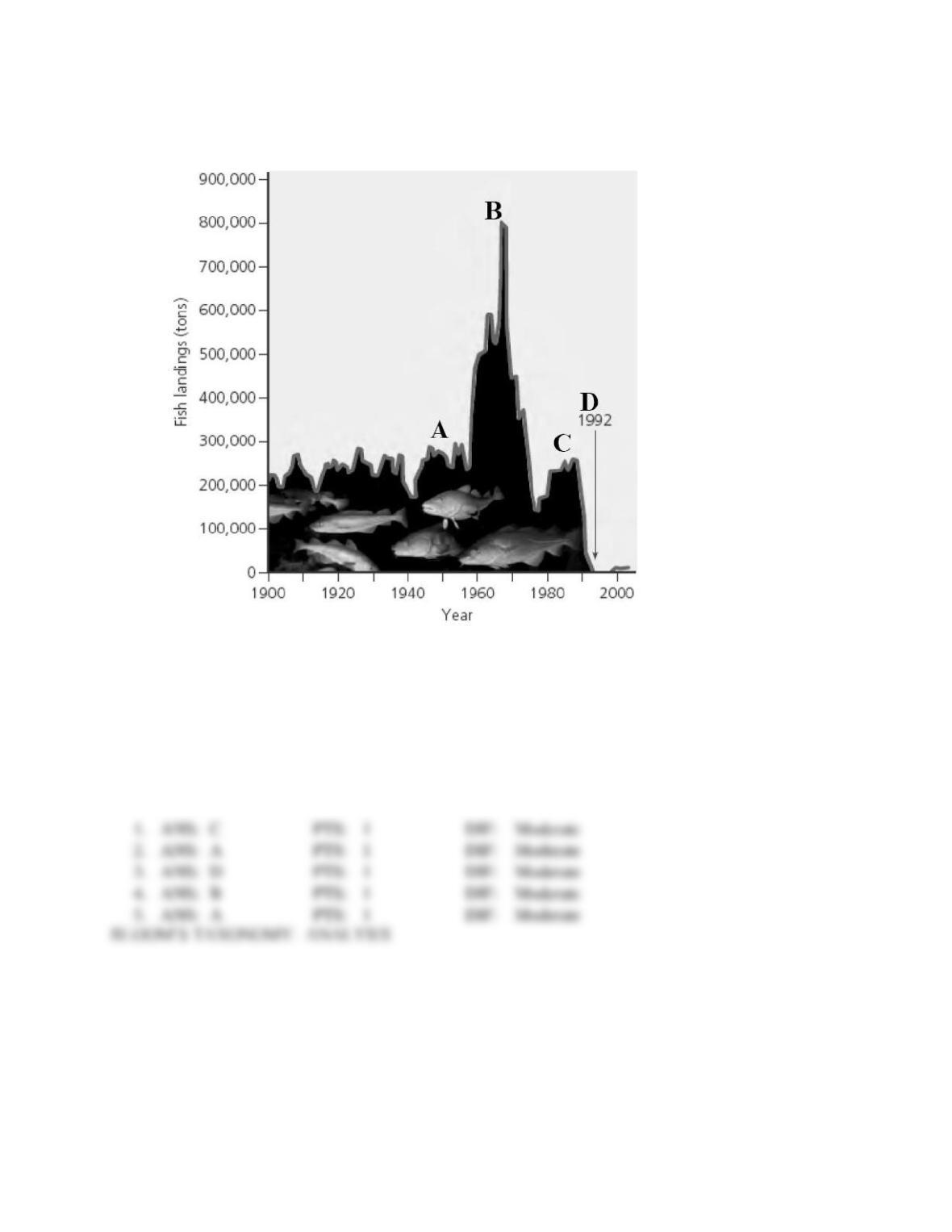
Using the graph pictured below that shows the tons of cod catch in the North Atlantic from 1900 on,
match the appropriate letter with the description given.
1. What area on the graph represents a slight recovery in the collapsed fishery?
2. What area on the graph represents the point when fishermen began to use bottom trawlers to catch
fish?
3. What point on the graph represents the year when 20,000 fishermen and fish processors lost their jobs?
4. What point on the graph represents the fish catch after the use of bottom trawlers was established?
5. At what point on the graph would it have been most beneficial to implement sustainable fishing
practices to preserve the cod fishery?
SHORT ANSWER
1. The Body Shop is the name of a very popular and successful cosmetics and personal care chain of
stores located in the United States and abroad. The founder of this store sought out natural remedies
known by native peoples in developing countries, and does not use animal testing. She not only paid
the natives for the recipes to the remedies, she employed them in production of the items for sale. How
is this enterprise helpful to the preservation of wild species?
2. Explain both the positive and negative aspect of the Smokey the Bear educational campaign.
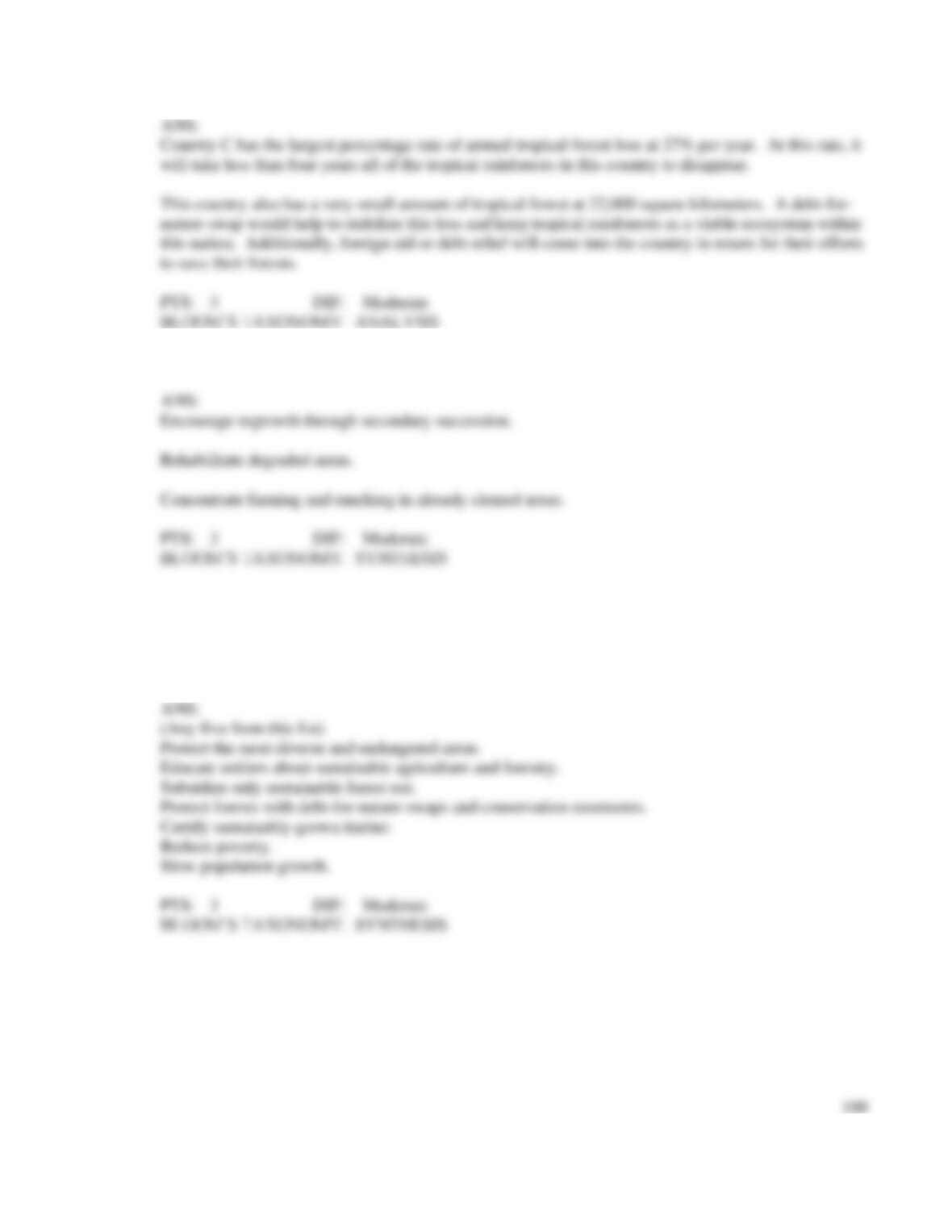
3. Using the above pictured chart, explain which country would gain the most from adopting a debt-for-
nature swap?
4. List three things that can be done to restore tropical forests so they can be used more sustainably.
ESSAY
1. List or describe at least five ways that we can protect tropical forests and begin to slow their
destruction and loss.
200
2. You are the forest manager in a large tract of forest surrounding a lake resort town of 15,000 residents
in the Adirondacks. Each year, over 200,000 vacationers visit and stay in this town for short periods of
time. The forest around this resort and lake has become infested with a bark beetle that has caused the
death of about 20–35% of the trees. Dead trees can be seen on the hills above the resort.
The residents of this town are concerned about destructive crown fires that may threaten their lives or
property. They have petitioned you as the forest manager to have the dead trees removed. They prefer
to have this done by the quickest means possible.
What information can you provide to the residents about sustainable forestry? How can tree removal
be accomplished in a manner that is in line with sustainable forestry?
3. Summarize the challenges we face in protecting marine biodiversity. For each item, present a brief
explanation.
Further, briefly explain which challenge you personally think is the worse threat and why.