Exam
Name___________________________________
MULTIPLE CHOICE. Choose the one alternative that best completes the statement or answers the question.
Provide an appropriate response.
1)
If the trinomial ax2 + bx + c is a perfect square, what can we conclude about the equation
ax2 + bx + c = 0?
1)
A)
The equation has one rational solution.
B)
The equation has two rational solutions.
C)
The equation has no real solutions.
D)
The equation has one irrational solution.
2)
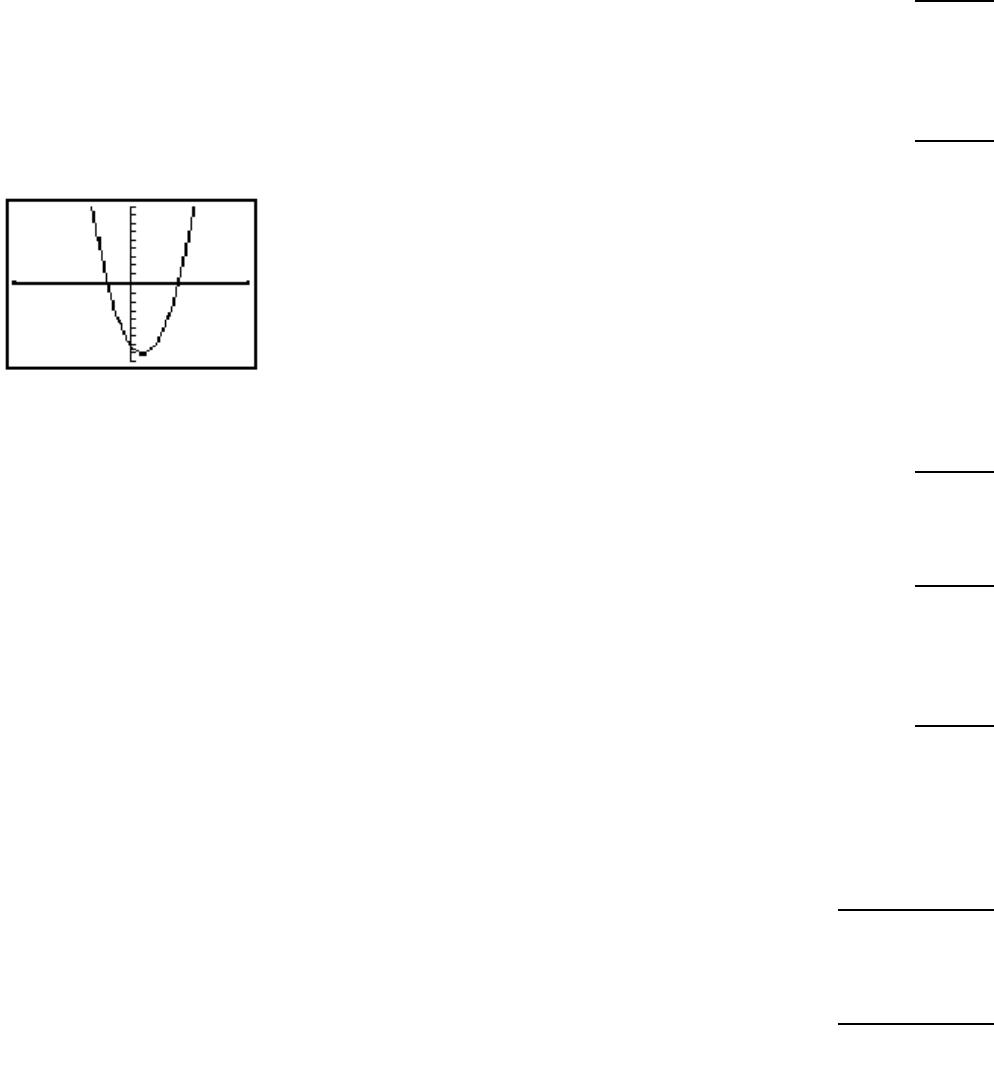
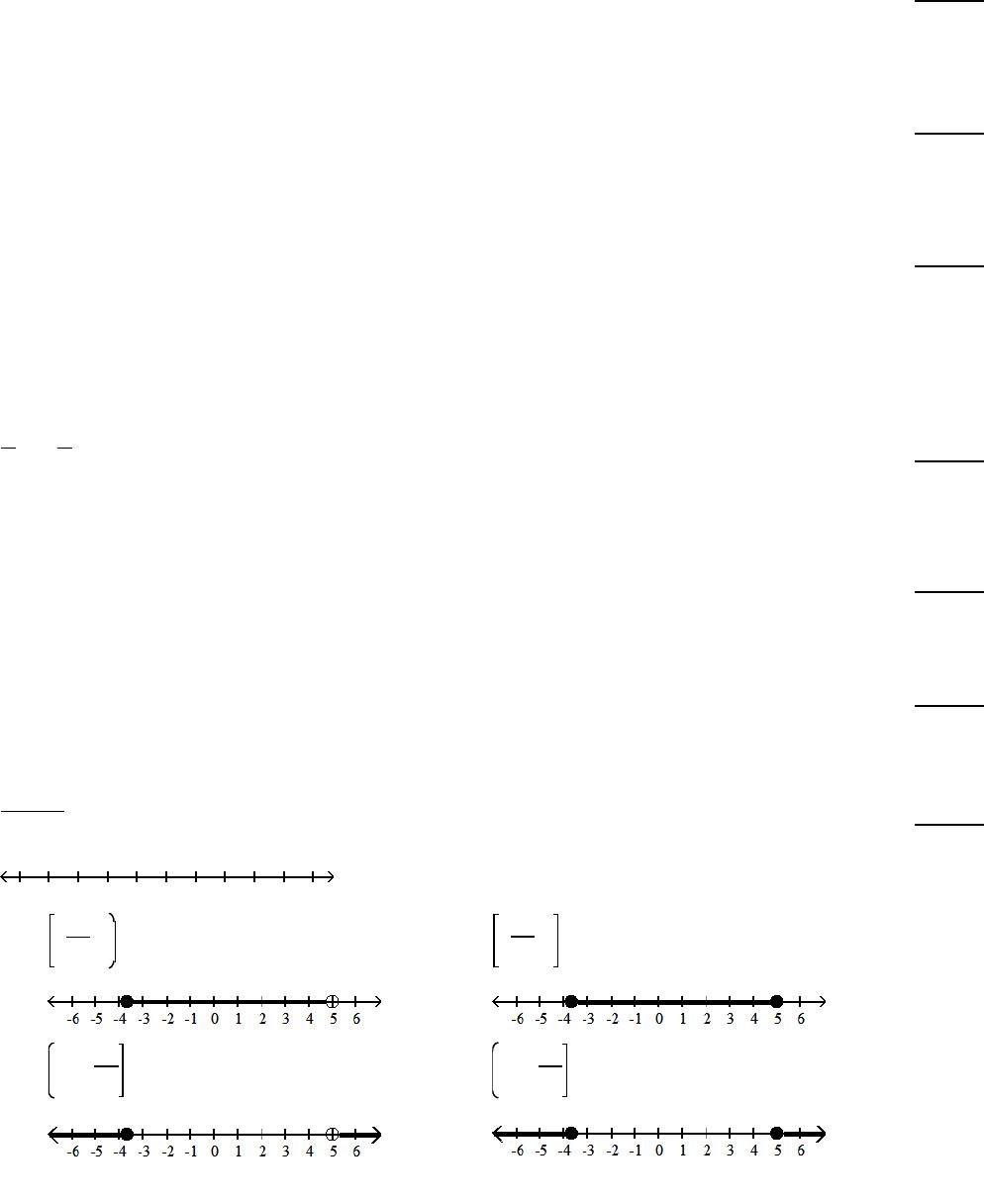
The graph of a quadratic function y = f(x) is shown in the standard viewing window, without
x–axis tick marks. Which one of the following sets could possibly be the solution set for f(x) = 0?
2)
A)
{2, 4}
B)
{–2, –4}
C)
{–2, 4}
D)
{–4, 2}
3)
Which one of the following methods cannot be used to solve the equation x2 – 4x – 1 = 0?
3)
A)
Quadratic formula
B)
Completing the square
C)
Factoring
D)
All of the methods can be used.
4)
If we apply the quadratic formula and find that the value of b2 – 4ac is positive, what can we
conclude?
4)
A)
The equation has no real solutions.
B)
The equation has two irrational solutions.
C)
The equation has two real solutions.
D)
The equation has one rational solution.
5)
If we apply the quadratic formula and find that the value of b2 – 4ac equals zero, what can we
conclude?
5)
A)
The equation has one rational solution.
B)
The equation has one irrational solution.
C)
The equation has two rational solutions.
D)
The equation has no real solutions.
SHORT ANSWER. Write the word or phrase that best completes each statement or answers the question.
6)
Why is it not possible to choose h and k, neither zero, so the parabola f(x) = a(x – h)2 + k has
its vertex at the origin?
6)
Answer the question.
7)
Use the equation 2x2+ 5x = c to explain how to solve a quadratic equation by completing
the square.
7)
1
Provide an appropriate response.
8)
Which of the other three methods for solving quadratic equations is used to derive the
quadratic formula?
8)
Answer the question.
9)
To complete the square of 2x2+ 4x = 8, is it ever a good idea to divide by the coefficient of
x2?
9)
Provide an appropriate response.
10)
Give a definition or an example of the word or phrase. Quadratic function
10)
Find the mistake, then find the correct answer.
11)
Solve for x: 5x2–7x + 1 = 0
line 1 x =–7 ± (-7)2 – (4)(5)(1)
2(5)
line 2 x =–7 ± 49 – 20
10
line 3 x =–7 ± 29
10
11)
Provide an appropriate response.
12)
Describe how the graph of y = 5x2 differs from the graph of y = x2.
12)
13)
Describe how the graph of y =x2+ 4 differs from the graph of y = x2.
13)
Find the mistake, then find the correct answer.
14)
Solve for x: x2–10x +29 = 0
line 1 x =-(-10) ±(-10)2 – (4)(1)(29)
2(1)
line 2 x =10 ±100 – 116
2
line 3 x =10 ± –16
2
line 4 x =10 ± 4
2
line 5 x =3, 7
14)
2
15)
line 1 x2– 6x =16
line 2 x2– 6x + 9 =16 + 9
line 3 (x – 3)2=25
line 4 x – 3 =25
line 5 x – 3 =5
line 6 x – 3 + 3 =5+ 3
line 7 x =8
15)
Provide an appropriate response.
16)
Describe how the graph of y =x2– 4 differs from the graph of y = x2.
16)
Find the mistake, then find the correct answer.
17)
Solve for x: x2–4x +10 = 0
line 1 x =-(-4) ± (4)2 – (4)(1)(10)
2(1)
line 2 x =4 ± 16 – 40
2
line 3 x =4 ± -24
2
17)
18)
Solve for x: (x – 2)2= –10
line 1 x –2=10
line 2 x =2±10
18)
Answer the question.
19)
What is the first step in order to solve the equation 3x2– 2x =3 by completing the square?
19)
Provide an appropriate response.
20)
Write the equation so that it is quadratic in form.
8 = -5 x– 5x
20)
21)
What are the advantages and disadvantages of the quadratic formula as a method of
solving quadratic equations?
21)
3
22)
Which of the four methods of solving quadratic equations work for any quadratic
equation?
22)
Find the mistake, then find the correct answer.
23)
Solve for x: (x – 8)2= –5
line 1 x –8=–5
line 2 x =8+ i 5
23)
Provide an appropriate response.
24)
Explain why the vertex of a parabola must lie on its axis.
24)
Find the mistake, then find the correct answer.
25)
Solve for x: 3x2–7x + 1 = 0
line 1 x =-(-7) ±(-7)2 – (4)(3)(1)
2(3)
line 2 x =7 ± –49 – 12
6
line 3 x =7 ± –61
6
line 4 x = Not a real number because –61 is not a real number.
25)
26)
Solve for x: x2=54
line 1 x2=54
line 2 x = ±6 3
26)
27)
Solve for x: x2=40
line 1 x2=40
line 2 x =210
27)
Provide an appropriate response.
28)
What are the advantages and disadvantages of factoring as a method of solving quadratic
equations?
28)
4
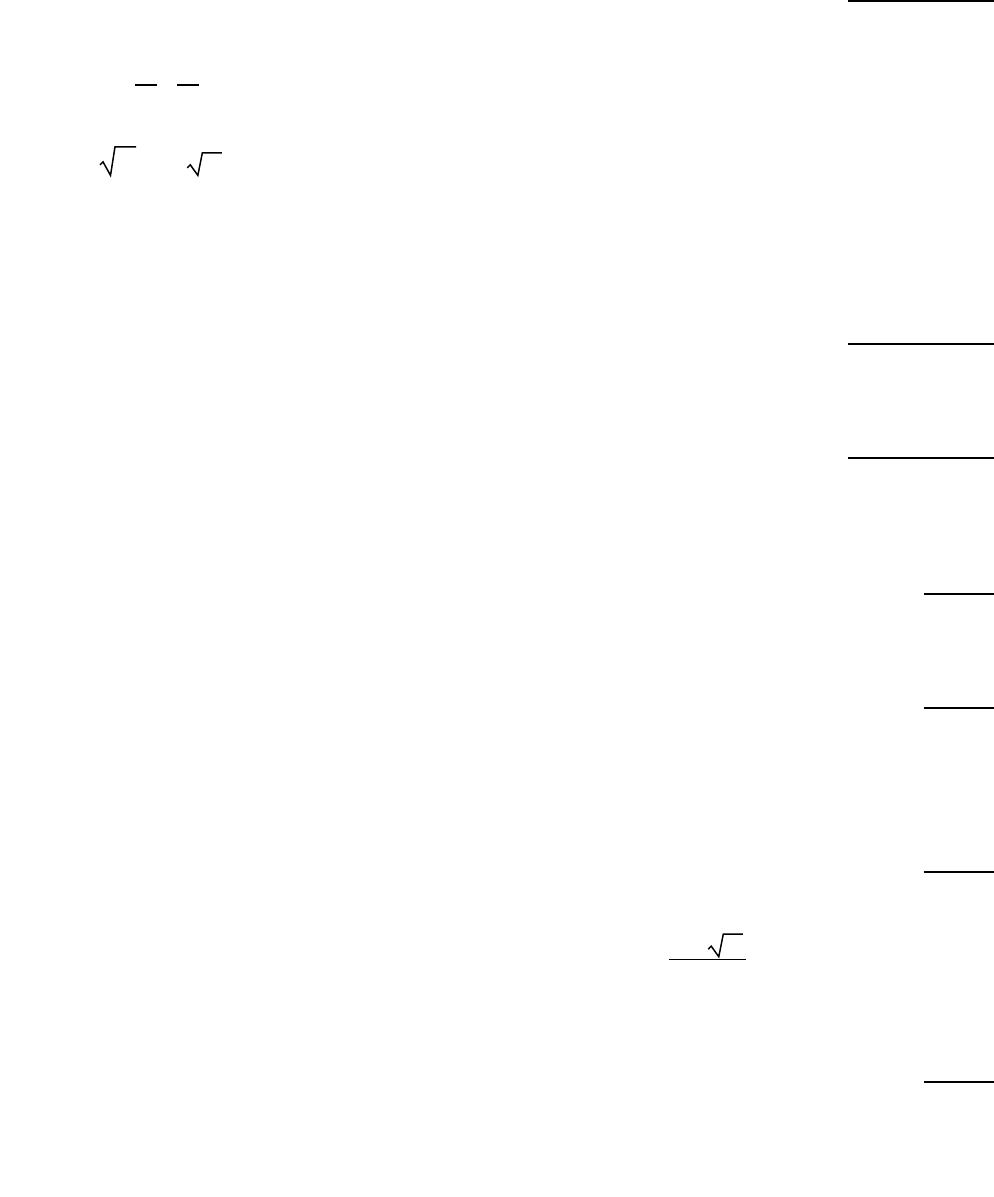
Find the mistake, then find the correct answer.
29)
Solve for x: x2+9=73
line 1 x2+9=73
line 2 – 9– 9
line 3 x2=64
line 4 x2=64
line 5 x =8
29)
Answer the question.
30)
To complete the square from an equation in the form x2– ax = b, is it ever appropriate to
subtract a positive number from each side?
30)
Provide an appropriate response.
31)
Describe how the graph of y = –5x2 differs from the graph of y = x2.
31)
MULTIPLE CHOICE. Choose the one alternative that best completes the statement or answers the question.
Find the ordered pair for the vertex.
32)
f(x) =-2x2– 12x – 17
32)
A)
(-1, 3)
B)
(3, -1)
C)
(-3, 1)
D)
(1, -3)
Provide an appropriate response.
33)
True or false? The equation (5x – 6)2=-9 has two real solutions. If false, give the correct number of
real solutions.
33)
A)
False; three
B)
False; zero
C)
False; one
D)
True
Determine which of the following methods is the best choice for solving the given equation: factoring, using the
principle of square roots or using the quadratic formula. Then, solve the equation.
34)
7x2+ 10x + 2 = 0
34)
A)
Factoring; -5, 14
B)
Square root principle or factoring; –7
C)
Square root principle; -10, 0
D)
Quadratic formula; -5 ±11
7
Solve the problem.
35)
The solution set of the inequality x2 + 5x + 6 0 is (-, –3] [-2, ). Without doing any work, give
the solution to x2 + 5x + 6 < 0.
35)
A)
(–
, –3) (–2,
)
B)
(–3,
)
C)
[-3, –2]
D)
(-3, –2)
5
Solve.
36)
A partial map of a state in a road atlas covers a square area of 16,900 square miles. What is the
length of each side of the square area?
36)
A)
13 mi
B)
130 mi
C)
169 mi
D)
4225 mi
Use the graph of a quadratic function to find the solution set of the equation or inequality. For a solution set that involves
an interval, use interval notation.
37)
x2+6x +8 0
37)
A)
x = –4, –2
B)
(–
, –4) (–2,
)
C)
(–
, –4] [–2,
)
D)
x = –4, 2
Solve the problem.
38)
Mary lives on a corner lot. The neighborhood children have been cutting diagonally across her
lawn instead of walking around the yard. If the diagonal distance across the lawn is 30 feet and the
longer part of the sidewalk is twice the shorter length, how many feet are the children saving by
cutting across the lawn? Round to the nearest foot if necessary.
38)
A)
17 ft
B)
13 ft
C)
10 ft
D)
40 ft
Find the x– and y–intercepts. If no x–intercepts exist, state so.
39)
y =2x2+ 10x + 2
39)
A)
-5 ±21
4, 0 , (0, -2)
B)
-5 ±21
2, 0 , (0, 2)
C)
-10 ±21
2, 0 , (0, 2)
D)
-5 ±29
2, 0 , (0, -2)
Solve the equation.
40)
15
x – 2 +15
x + 2 =4
40)
A)
1
2, -8
B)
– 1
2, 8
C)
– 2, -8
D)
2, 8
Solve.
41)
A square sheet of posterboard has an area of 256 square centimeters. What is the length of each
side?
41)
A)
128 cm
B)
16 cm
C)
8 cm
D)
32 cm
6
Solve the problem. Round your answer to the nearest tenth, if necessary.
42)
Two pipes together can fill a large tank in 10 hr. One of the pipes, used alone, takes 15 hr longer
than the other to fill the tank. How long would each pipe take to fill the tank alone?
42)
A)
12.5 hr; 27.5 hr
B)
15 hr; 30 hr
C)
25 hr; 40 hr
D)
10 hr; 25 hr
Solve the problem.
43)
A lot is in the shape of a right triangle. The shorter leg measures 120 m. The hypotenuse is 40 m
longer than the length of the longer leg. How long is the longer leg?
43)
A)
200 m
B)
120 m
C)
240 m
D)
160 m
Solve the problem. Round your answer to the nearest tenth, if necessary.
44)
A man rode a bicycle for 12 mi and then hiked an additional 8 mi. The total time for the trip was 5
hr. If his rate when he was riding a bicycle was 10 mph faster than his rate walking, what was each
rate?
44)
A)
Bike: 14.5 mph; hike: 4.5 mph
B)
Bike: 12 mph; hike: 2 mph
C)
Bike: 11.5 mph; hike: 1.5 mph
D)
Bike: 13 mph; hike: 3 mph
Solve using the quadratic formula. Use a calculator to approximate the solution to three decimal places.
45)
4
9x2–4
3x = –1
45)
A)
± 0.667
B)
–1.5
C)
1.5
D)
0.086, 2.914
Find the ordered pair for the vertex.
46)
f(x) = x2– 1
46)
A)
(0, 1)
B)
(0, -1)
C)
(-1, 0)
D)
(1, 0)
State whether the parabola opens upwards or downwards.
47)
y =x2+ 19
47)
A)
Upwards
B)
Downwards
Solve the rational inequality. Write the solution set using interval notation; then graph the solution set on a number line.
48)
3y + 11
y – 5 0
48)
A)
– 11
3, 5
B)
– 11
3, 5
C)
–,– 11
3 (5,
)
D)
–,– 11
3 [5,
)
7
Find the term that should be added to the expression to form a perfect square trinomial. Write the resulting perfect square
trinomial in factored form.
49)
x2+ 9x
49)
A)
81
4; x – 9
2
2
B)
0; x + 9 2
C)
0; x + 9
2
2
D)
81
4; x + 9
2
2
Solve using the quadratic formula. Use a calculator to approximate the solution to three decimal places.
50)
3.9x2–0.1x = –1.8
50)
A)
0.013 ±0.679
B)
0.013 ±3.599i
C)
0.013 ±0.679i
D)
0.026 ±2.683i
51)
1
3x2= – 1
6x +1
2
51)
A)
–1
B)
–1.5, 1
C)
1.5, –1
D)
–1.5
Rewrite the quadratic equation in the form ax2+ bx + c = 0, then identify a, b, and c.
52)
x =-0.8x2+13.9
52)
A)
a =-0.8, b = –1, c =13.9
B)
a =-0.8, b =13.9, c = –1
C)
a =-0.8, b = –1, c = –13.9
D)
a = –-0.8, b = –1, c = –13.9
Solve the problem. Round your answer to the nearest tenth, if necessary.
53)
Bill can row 3 mph in still water. It takes him 3 hr 36 min to go 3 mi upstream and then return. Find
the speed of the current.
53)
A)
2 mph
B)
1.5 mph
C)
2.5 mph
D)
3 mph
Graph the equation.
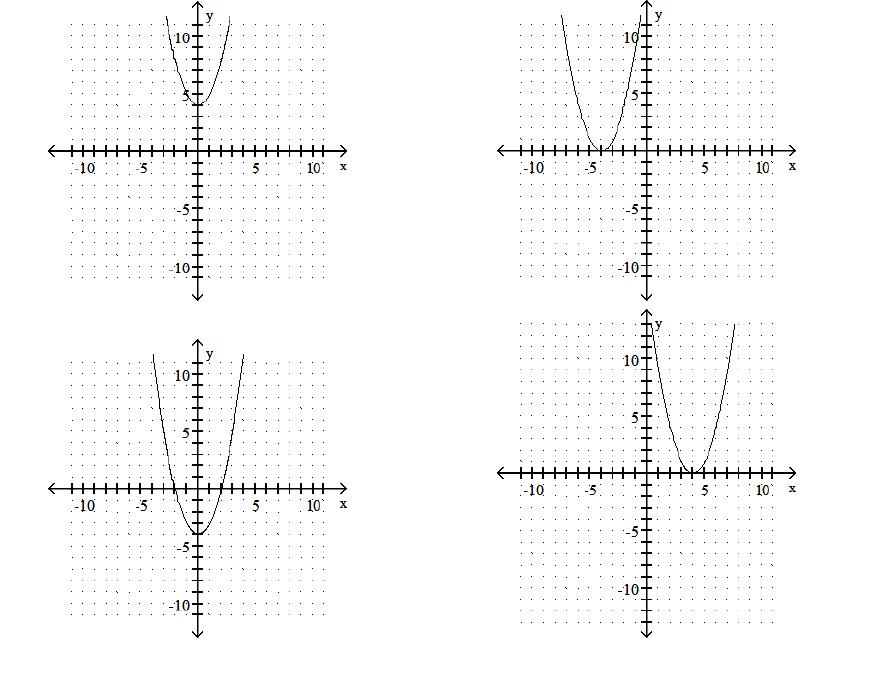
54)
f(x) =x2+ 8x + 16
54)
8
A)
B)
C)
D)
9
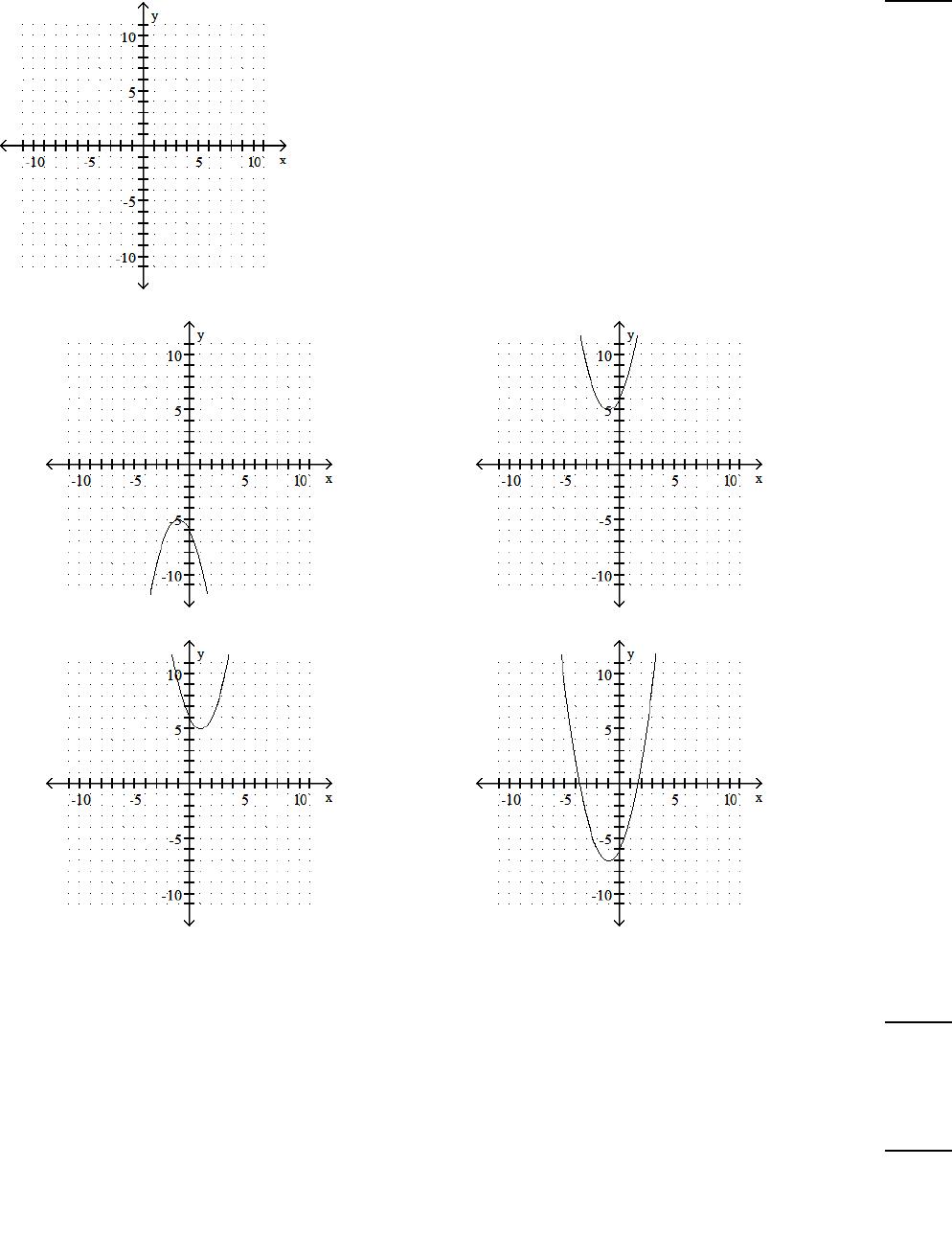
55)
g(x) = –x2– 2x – 6
55)
A)
B)
C)
D)
Rewrite the quadratic equation in the form ax2+ bx + c = 0, then identify a, b, and c.
56)
2x2+ 11 = 0
56)
A)
a = 0, b =2, c =11
B)
a = 2, b = 0, c =-11
C)
a =2, b =11, c = 0
D)
a =2, b = 0, c =11
Solve.
57)
A gardener is fencing off a rectangular area with a fixed perimeter of 44 ft. What is the maximum
area?
57)
A)
11 ft2
B)
2.75 ft2
C)
121 ft2
D)
484 ft2
10
Solve the problem.
58)
The height h of a ball thrown is given by h(x) = 2x – .08x2, where x is the horizontal distance
traveled and both measurements are in feet. At what horizontal distances will the height of the ball
be more than 9 ft? (Round distances to the nearest tenth of a foot, if necessary.)
58)
A)
5.9 ft < x < 19.1 ft
B)
5.9 ft < x < 25 ft
C)
0 ft < x < 5.9 ft or 19.1 ft < x < 25 ft
D)
0 ft < x < 19.1 ft
Solve the equation.
59)
2x + 15 – x = 6
59)
A)
–7
B)
–3
C)
–7, –3
D)
No solution
Write the equation of the axis of symmetry.
60)
f(x) =2x2– 20x + 49
60)
A)
x =-5
B)
x =1
C)
x =-1
D)
x =5
Solve using the quadratic formula. Use a calculator to approximate the solution to three decimal places.
61)
2x –3
5=3
5x2
61)
A)
0.333, 3
B)
3
C)
–3.100, –0.233
D)
–0.333
Find the ordered pair for the vertex.
62)
f(x) = x2– 14x + 54
62)
A)
(5, 0)
B)
(5, 7)
C)
(0, 7)
D)
(7, 5)
Solve the equation.
63)
16
x + 2 = 1 +2
x – 4
63)
A)
6, 10
B)
–2, 4
C)
–12
D)
Solve the problem.
64)
Find two consecutive positive integers such that the square of the larger integer added to seven
times the smaller integer is equal to 253.
64)
A)
No such integers exist.
B)
–21, –20
C)
21, 22
D)
12, 13
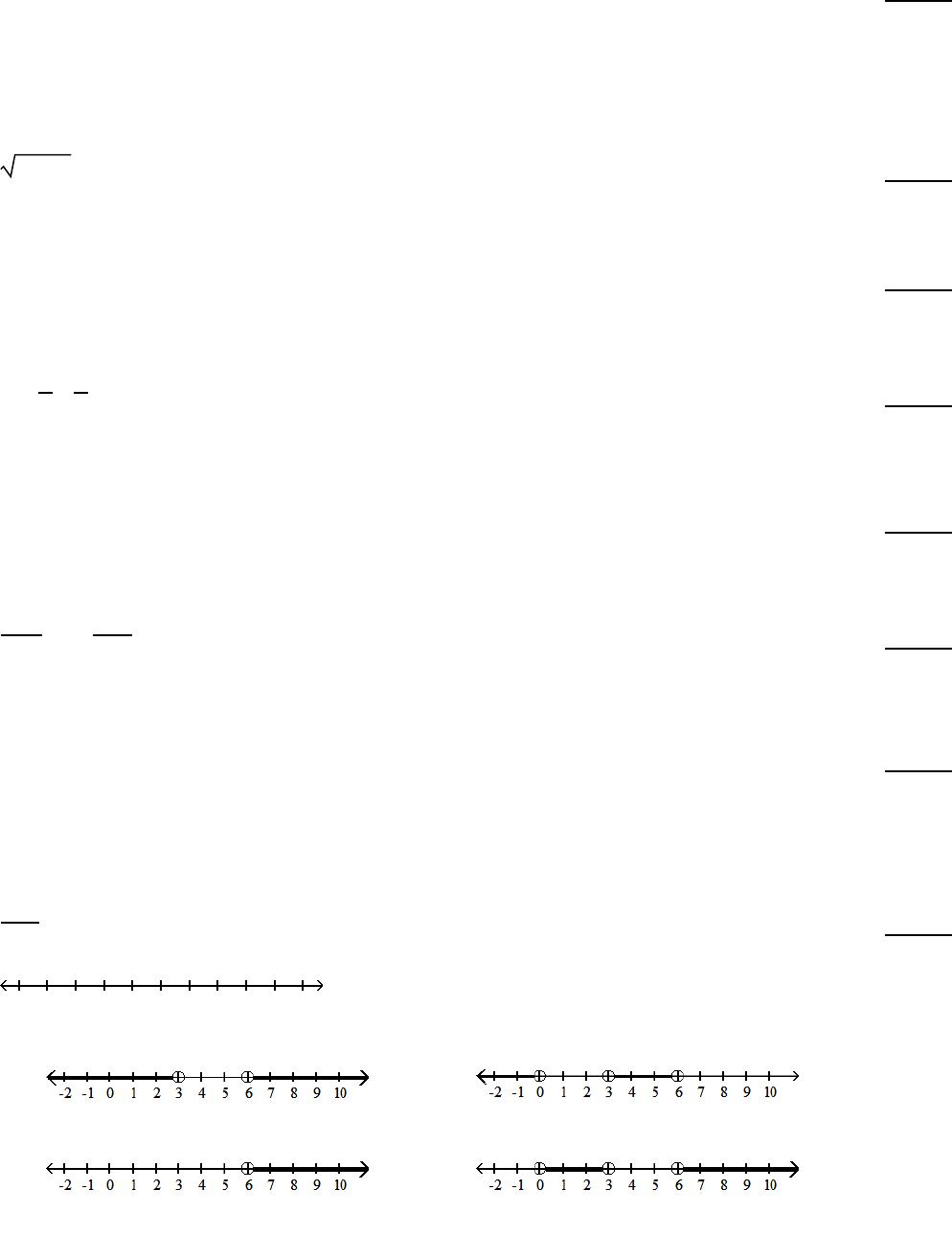
Solve the rational inequality. Write the solution set using interval notation; then graph the solution set on a number line.
65)
3x
6 – x > x
65)
A)
(–
, 3) (6,
)
B)
(–
, 0) (3, 6)
C)
(6,
)
D)
(0, 3) (6,
)
11
Solve. Use a calculator to approximate the irrational solutions to three places.
66)
x2+1=13
66)
A)
±3.742
B)
2.606, -4.606
C)
2.606
D)
±3.464
Solve the equation.
67)
x + 7 + 5 = x
67)
A)
2, 9
B)
9, 18
C)
9
D)
2
Solve and check. Use the square root principle to eliminate the square.
68)
(2m – 3)2=49
68)
A)
10, -4
B)
2, -5
C)
no real solution
D)
5, -2
Provide an appropriate response.
69)
True or false? If k = 0, then x2= k will have exactly one real solution. If false, give the correct
number of real solutions.
69)
A)
True
B)
False; two
C)
False; zero
D)
False; three
Use the discriminant to determine the number and type of solutions for the equation. If the solution(s) are real, state
whether they are rational or irrational.
70)
4x2– 12x + 9 = 0
70)
A)
Two irrational solutions
B)
One rational solution
C)
Two rational solutions
D)
Two nonreal complex solutions
Use the graph of a quadratic function to find the solution set of the equation or inequality. For a solution set that involves
an interval, use interval notation.
71)
–x2+6x –9< 0
71)
A)
x =3
B)
(–
, 3) (3,
)
C)
(–
,
)
D)
Solve.
72)
3(x – 3)2+ 14(x – 3) –5= 0
72)
A)
– 10
3, 2
B)
1
3, -5
C)
– 1
3, 5
D)
10
3, -2
12
Provide an appropriate response.
73)
If it takes pdays to build a house, what is the worker’s rate (in jobs per day)?
73)
A)
p– 1 jobs per day
B)
1
p – 1 jobs per day
C)
1
p jobs per day
D)
p jobs per day
Solve the inequality and write the solution set using interval notation; then graph the solution set on a number line.
74)
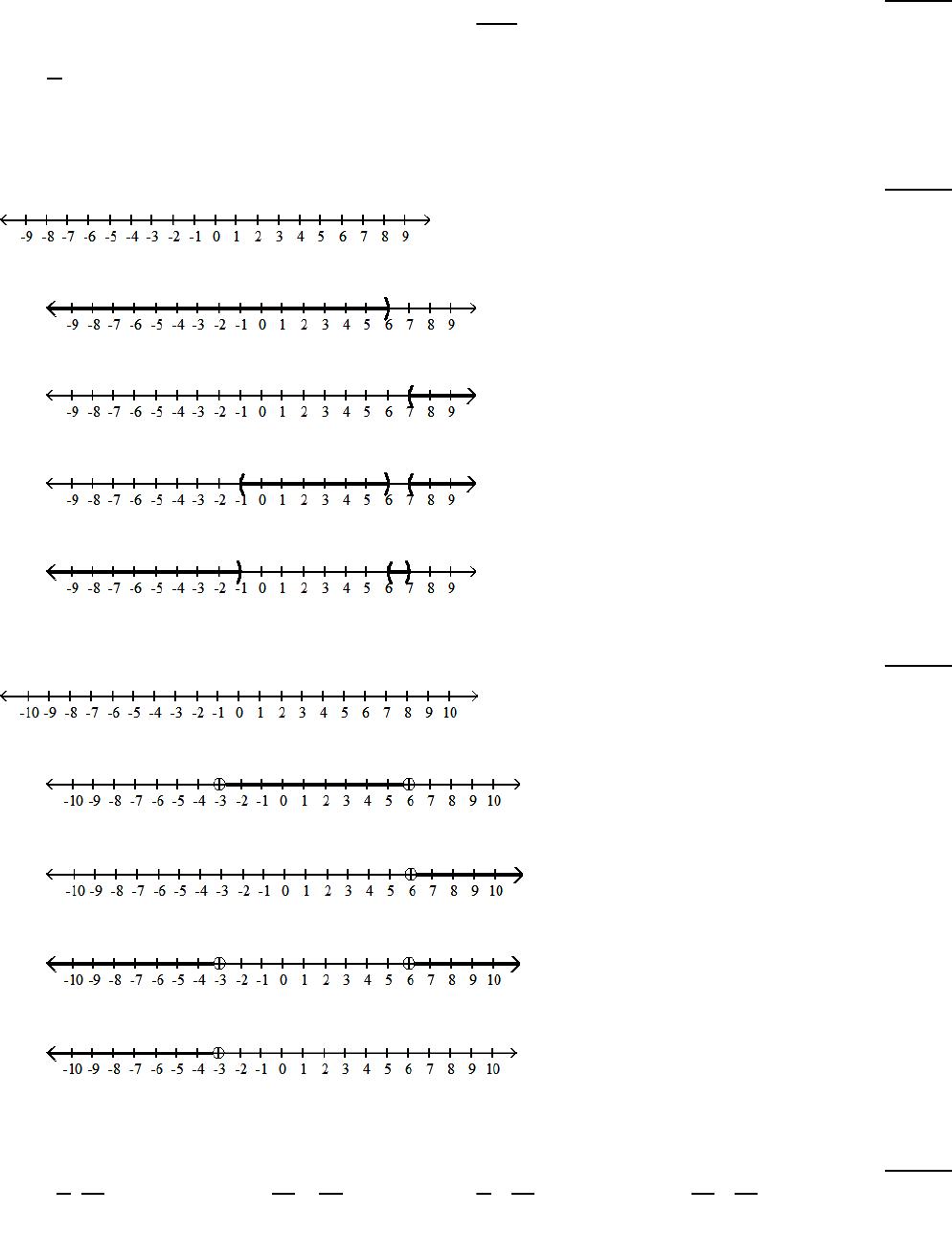
(a + 1)(a – 6)(a – 7) > 0
74)
A)
(–
, 6)
B)
(7,
)
C)
(-1, 6) (7,
)
D)
(–
, -1) (6, 7)
75)
s2– 3s – 18 < 0
75)
A)
(-3, 6)
B)
(6,
)
C)
(–
, -3) (6,
)
D)
(–
, -3)
Solve the equation by completing the square.
76)
49g2+ 42g – 40 = 0
76)
A)
– 4
7, 10
7
B)
– 10
49 , –30
49
C)
4
7, – 10
7
D)
4
49 , – 10
49
13
Solve using the quadratic formula. Write the solution set using interval notation.
77)
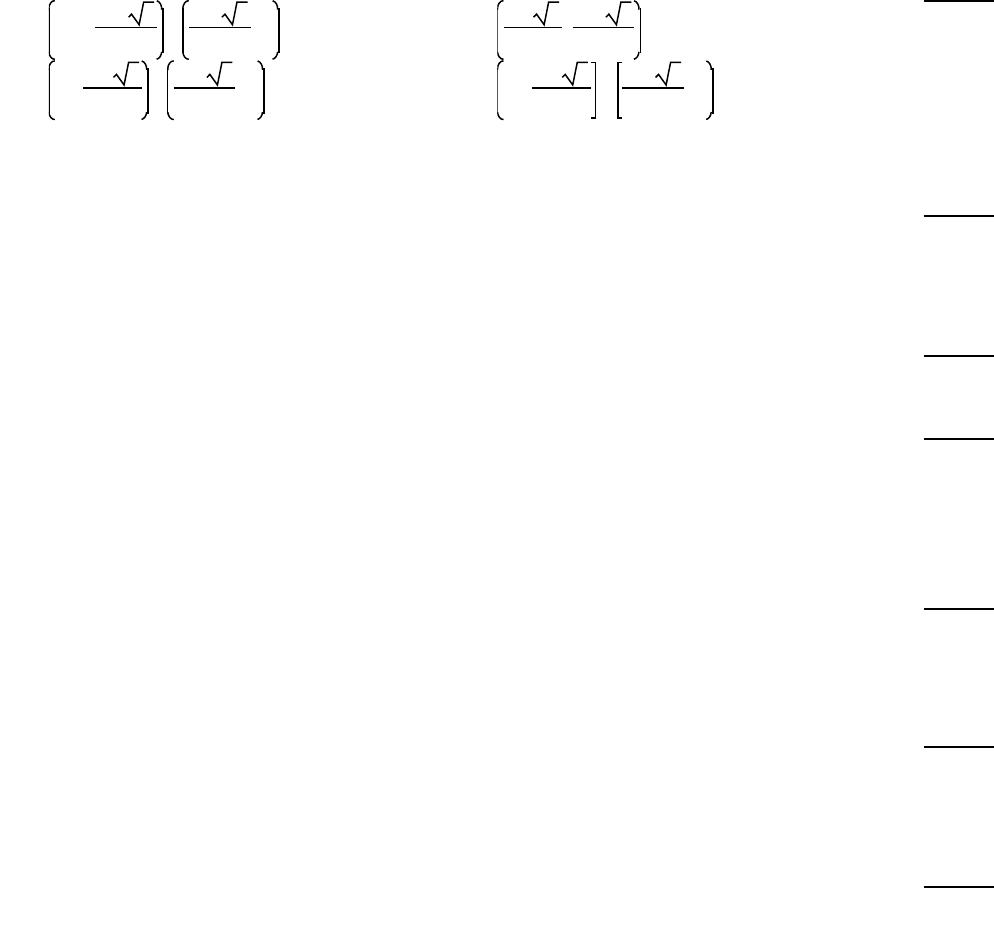
0.9x2–4.2x +4.6 > 0
77)
A)
–, – 7 + 3
37 + 3
3,
B)
7 – 3
3, 7 + 3
3
C)
–, 7 – 3
37 + 3
3,
D)
–, 7 – 3
37 + 3
3,
Rewrite the quadratic equation in the form ax2+ bx + c = 0, then identify a, b, and c.
78)
3x2=12x –12
78)
A)
a =3, b =12, c = –12
B)
a =3, b = –12, c = –12
C)
a =3, b =12, c =12
D)
a =3, b = –12, c =12
Solve.
79)
x4+ 5x2– 36 = 0
79)
A)
±2i, ±3i
B)
±3, ±2i
C)
±2, ±3
D)
±2, ±3i
80)
John owns a hotdog stand. He has found that his profit is represented by the equation
P = -x2+ 60x + 79, with P being the profit in dollars, and x the number of hotdogs sold. How many
hotdogs must he sell to earn the most profit?
80)
A)
31 hotdogs
B)
30 hotdogs
C)
49 hotdogs
D)
24 hotdogs
Solve the equation by completing the square.
81)
x2–14x +53 = 0
81)
A)
5, 9
B)
7±2i
C)
14 ±4i
D)
–7±2i
Use the discriminant to determine the number and type of solutions for the equation. If the solution(s) are real, state
whether they are rational or irrational.
82)
2+ 4z2=2z
82)
A)
Two nonreal complex solutions
B)
Two rational solutions
C)
One rational solution
D)
Two irrational solutions
Write the equation of the axis of symmetry.
83)
f(x) =x2+ 5
83)
A)
x =5
B)
x = 0
C)
x = –5
D)
x = 6
14
Solve the inequality and write the solution set using interval notation; then graph the solution set on a number line.
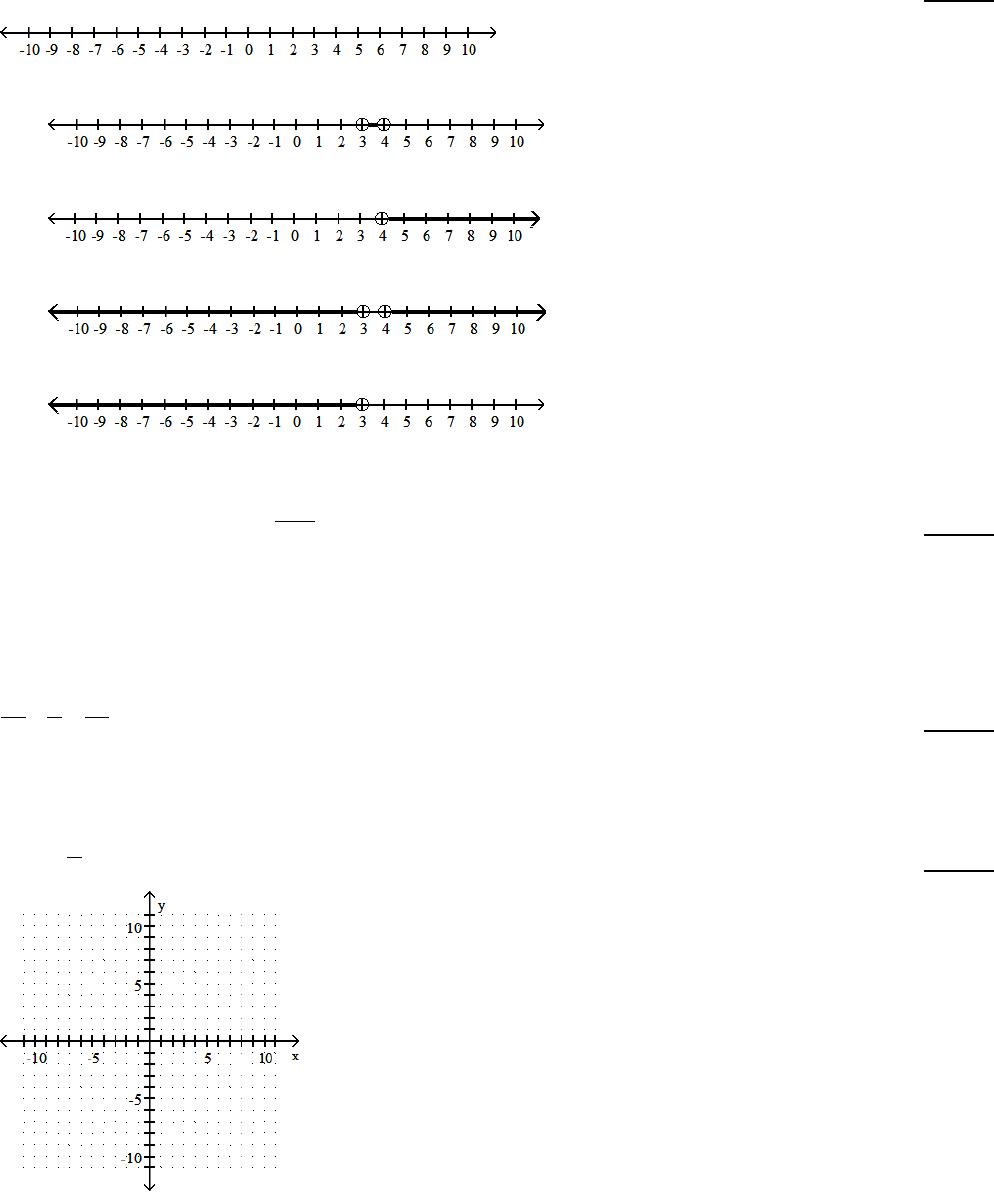
84)
p2– 7p + 12 > 0
84)
A)
(3, 4)
B)
(4,
)
C)
(–
, 3) (4,
)
D)
(–
, 3)
Solve the problem.
85)
To solve the rational inequality -2
x – 3
2, you can first write the inequality with 0 on one side and
the other side expressed as a single fraction. What value or values of x make the numerator of that
fraction equal to 0?
85)
A)
{2, 3}
B)
{-2}
C)
{2}
D)
{3}
Solve using the quadratic formula. Use a calculator to approximate the solution to three decimal places.
86)
x2
5–x
6=1
30
86)
A)
1
B)
0.333, 0.5
C)
0.5
D)
–0.167, 1
Graph.
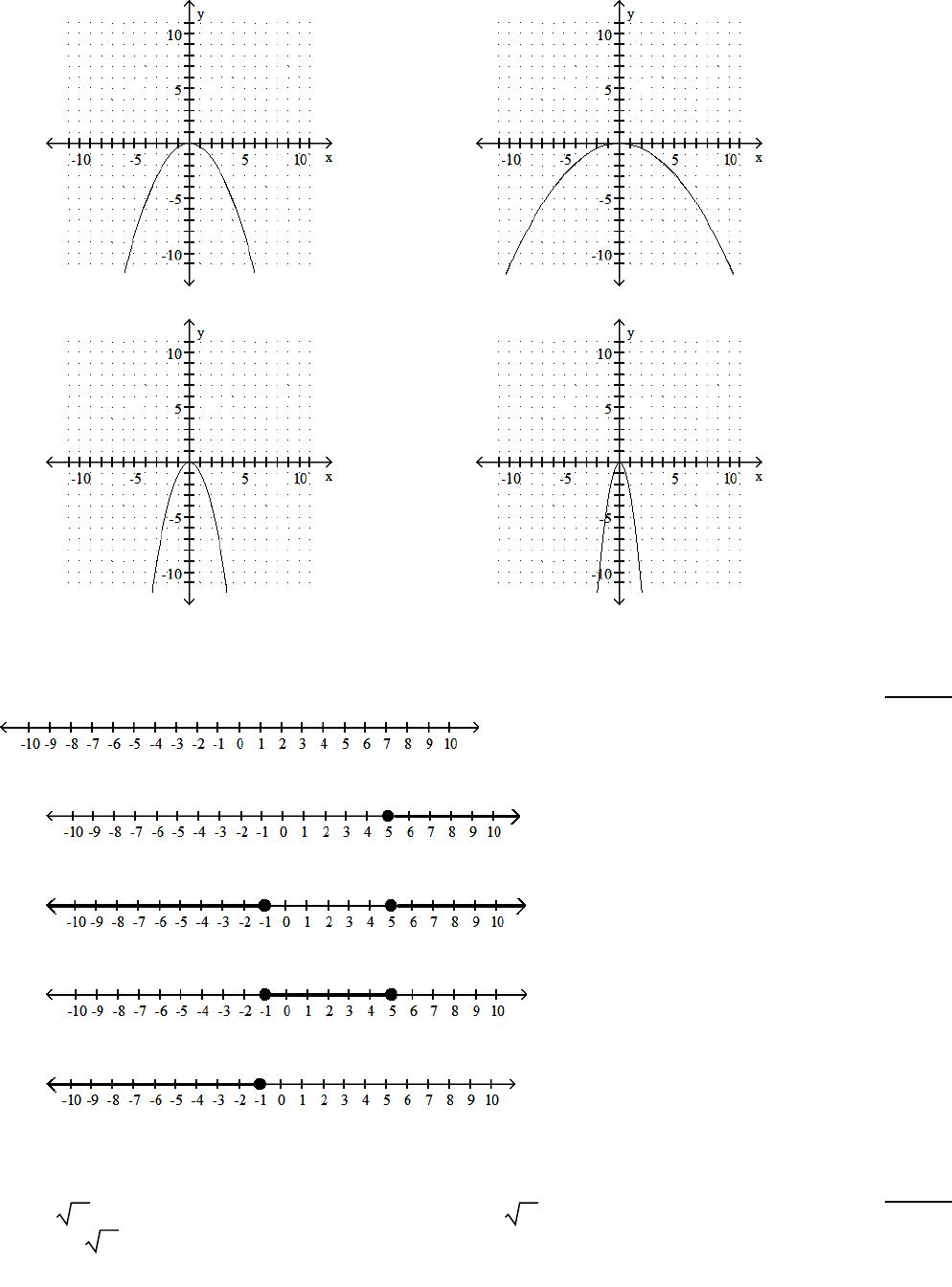
87)
f(x) = – 1
3x2
87)
15
A)
B)
C)
D)
Solve the inequality and write the solution set using interval notation; then graph the solution set on a number line.
88)
t2– 4t – 5
0
88)
A)
[5,
)
B)
(–
, -1] [5,
)
C)
[-1, 5]
D)
(–
, -1]
Solve and check. Use the square root principle to eliminate the square.
89)
(r + 4)2=10
89)
A)
±10
B)
4±10
C)
–4±10
D)
6
16
Provide an appropriate response.
90)
Describe how the graph of y = (x + 9)2 is shifted compared to the graph of y = x2.
90)
A)
The parabola is shifted 9 units up.
B)
The parabola is shifted 9 units to the right.
C)
The parabola is shifted 9 units down.
D)
The parabola is shifted 9 units to the left.
91)
Use the substitution u = y+ 3 to solve the equation 2(y + 3)2– 5(y + 3) + 3 = 0.
91)
A)
3
2, 2
B)
3
2, 1
C)
– 3
2, -2
D)
9
2, 4
Find the ordered pair for the vertex.
92)
f(x) =2x2– 8x + 11
92)
A)
(–3, -2)
B)
(2, 3)
C)
(3, 2)
D)
(-2, –3)
Solve the rational inequality. Write the solution set using interval notation; then graph the solution set on a number line.
93)
-6x + 7
5x2+ 3 > 0
93)
A)
– 7
6,
B)
–, – 6
7
C)
(–
, 0)
D)
–, 7
6
17
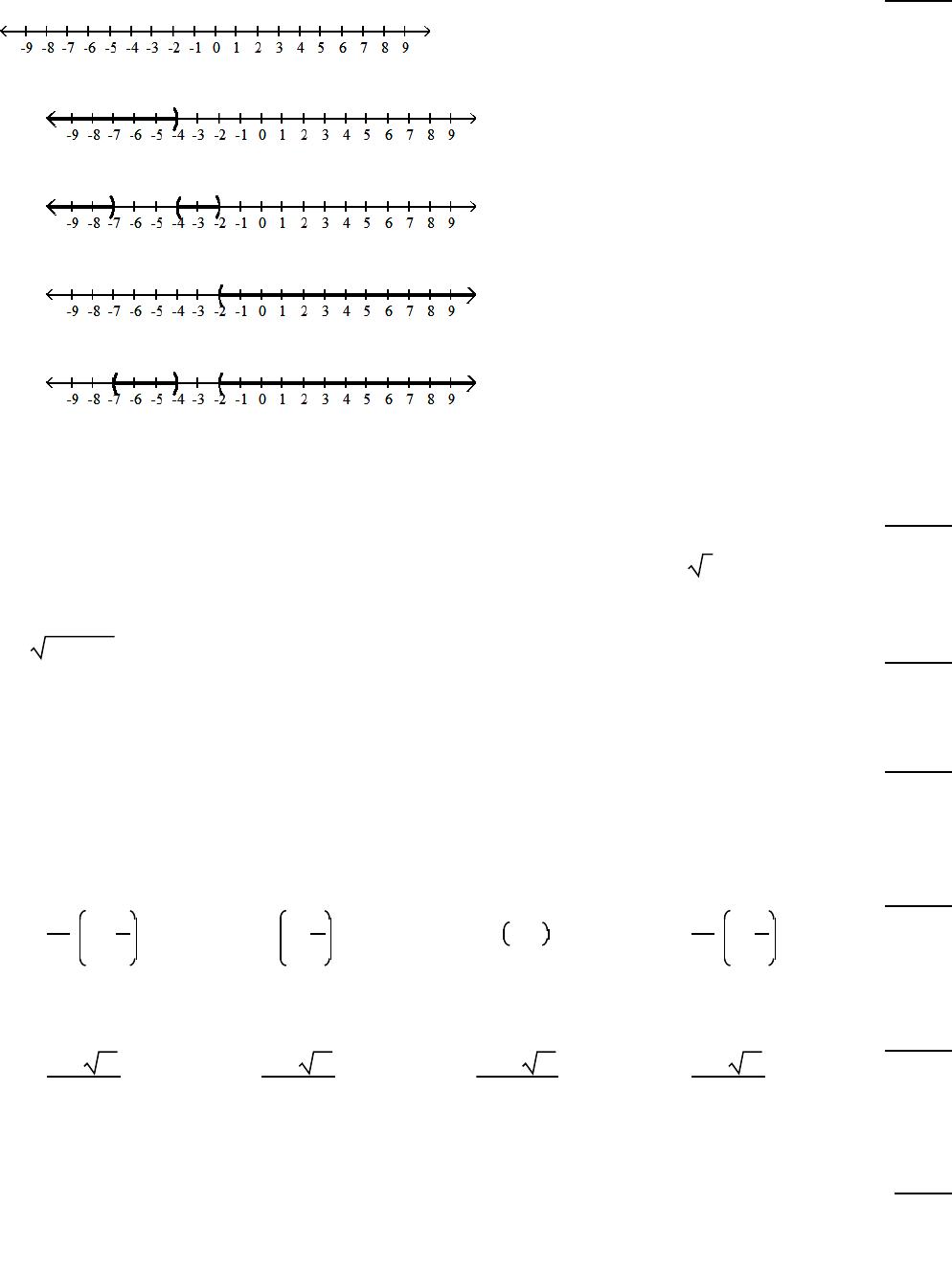
Solve the inequality and write the solution set using interval notation; then graph the solution set on a number line.
94)
(b + 7)(b + 4)(b + 2) < 0
94)
A)
(–
, -4)
B)
(–
, -7) (-4, -2)
C)
(-2,
)
D)
(-7, -4) (-2,
)
Determine which of the following methods is the best choice for solving the given equation: factoring, using the
principle of square roots or using the quadratic formula. Then, solve the equation.
95)
x2+ 16x = 0
95)
A)
Square root principle; 16, 0
B)
Square root principle or factoring; –1, -16
C)
Factoring; -16, 0
D)
Quadratic formula; -16 ±7
Solve the equation.
96)
x =2x + 15
96)
A)
5, –3
B)
2
C)
5
D)
No solution
Solve.
97)
x2/3 – 7x1/3 + 10 = 0
97)
A)
-5, -2
B)
-125, -8
C)
8, 125
D)
2, 5
Find the term that should be added to the expression to form a perfect square trinomial. Write the resulting perfect square
trinomial in factored form.
98)
x2– 7x
98)
A)
49
4; x + 7
2
2
B)
0; x – 7
2
2
C)
49; x – 7 2
D)
49
4; x – 7
2
2
Solve using the quadratic formula.
99)
6x2+ 10x =– 2
99)
A)
-5 ±37
6
B)
-5 ±13
12
C)
-10 ±13
6
D)
-5 ±13
6
Provide an appropriate response.
100)
True or false? The equation (x + 13)2= 0 has exactly one real solution. If false, give the correct
number of real solutions.
100)
A)
False; three
B)
False; two
C)
False; zero
D)
True
18
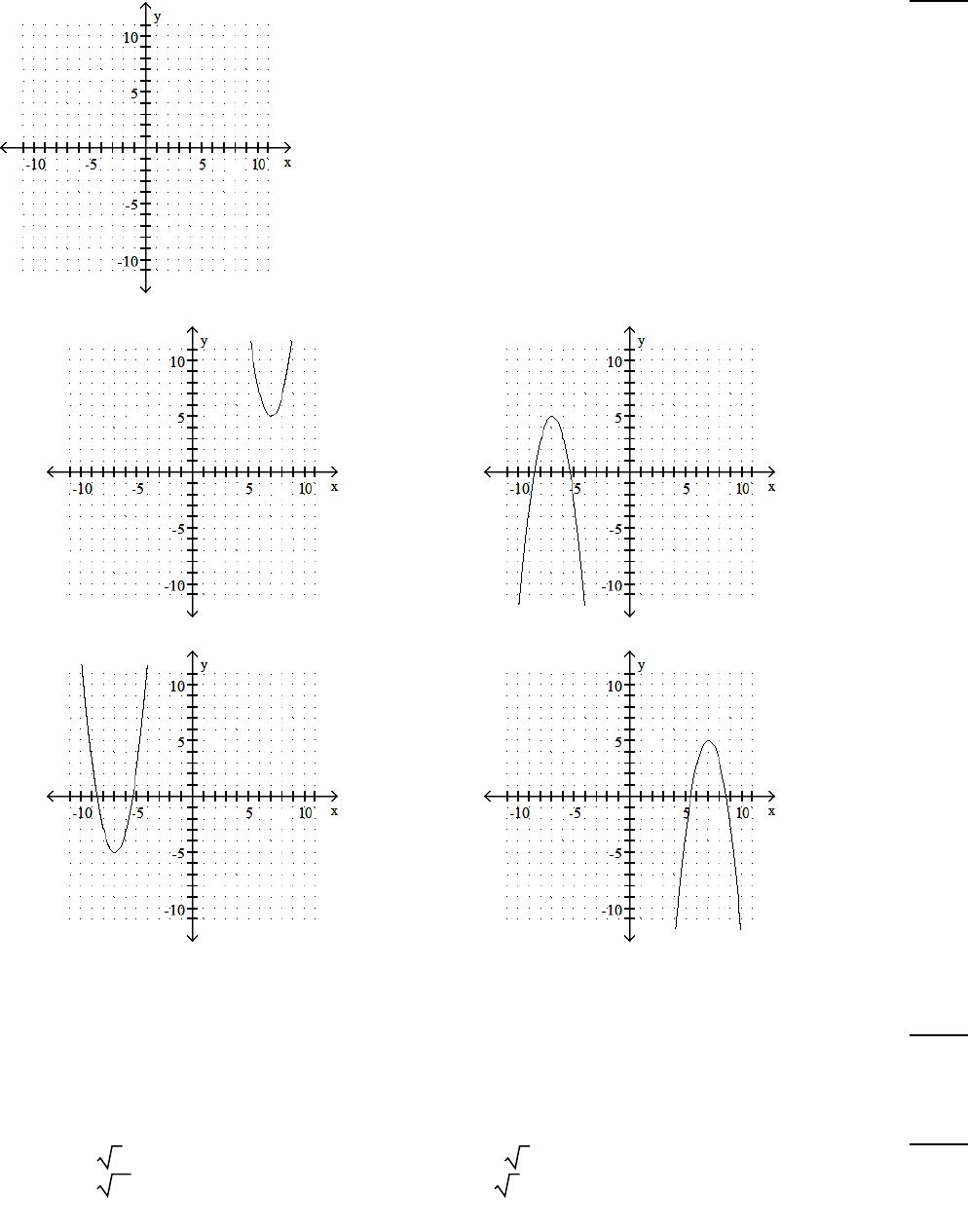
Graph.
101)
f(x) =-2(x – 7)2+ 5
101)
A)
B)
C)
D)
Write the equation of the axis of symmetry.
102)
f(x) =-5x2– 10x – 9
102)
A)
x =-1
B)
x =-4
C)
x =4
D)
x =1
Solve and check. Use the square root principle to eliminate the square.
103)
(x + 5)2=28
103)
A)
–5± 2 7
B)
±2 7
C)
–5± 2 14
D)
2 7 ±5
19
Solve using the quadratic formula.
104)
4x2+ 12x + 4 = 0
104)
A)
-12 ± 5
2
B)
-3 ± 5
8
C)
-3 ± 5
2
D)
-3 ±13
2
Find the x– and y–intercepts. If no x–intercepts exist, state so.
105)
y = x2+ 4x
105)
A)
(0, -4), (-4, 0), (0, 0)
B)
(0, 0), (-4, 0), (0, 0)
C)
(0, 0), (4, 0), (0, 0)
D)
No x–intercepts, (0, 0)
Find the term that should be added to the expression to form a perfect square trinomial. Write the resulting perfect square
trinomial in factored form.
106)
x2– 5
3x
106)
A)
25
36; x – 5
6
2
B)
25
9; x – 5
6
2
C)
25
36; x + 5
6
2
D)
0; x – 5
6
2
Solve the equation.
107)
6
x + 5 = 1 –1
x – 5
107)
A)
0, –5
B)
1, 5
C)
0, 7
D)
Find the ordered pair for the vertex.
108)
f(x) =17
6(x + 17)2+ 6
108)
A)
(0, 6)
B)
(-17, 6)
C)
(-17, 17)
D)
(6, 0)
Use the discriminant to determine the number and type of solutions for the equation. If the solution(s) are real, state
whether they are rational or irrational.
109)
w2+ 2w + 4 = 0
109)
A)
Two nonreal complex solutions
B)
Two rational solutions
C)
One rational solution
D)
Two irrational solutions
Solve the equation.
110)
2x + 5 –x – 2 = 3
110)
A)
2
B)
2, 38
C)
3, 8
D)
–2
Solve.
111)
x2=9
111)
A)
±4
B)
±3
C)
3
D)
4.5
20
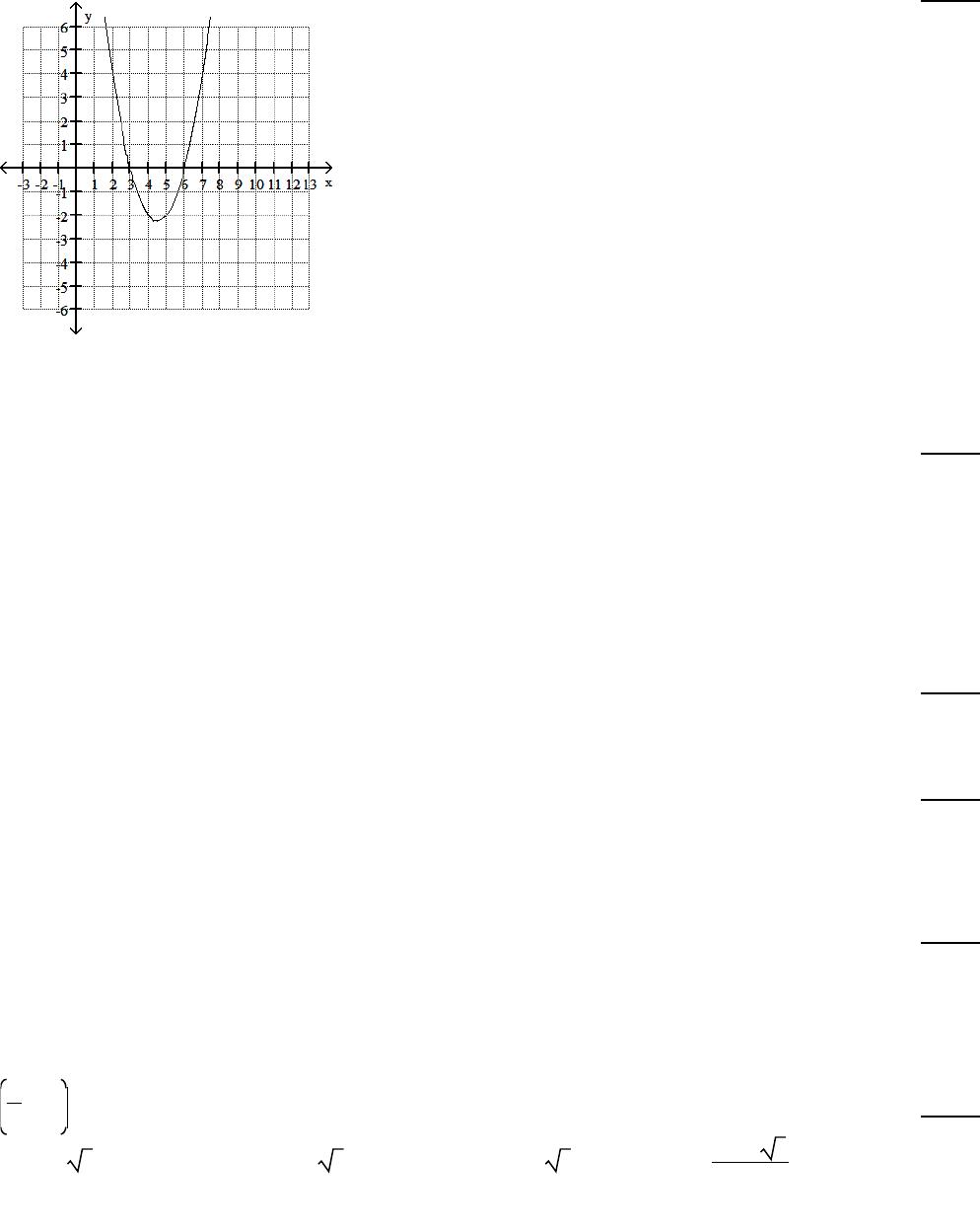
Use the graph of a quadratic function to find the solution set of the equation or inequality. For a solution set that involves
an interval, use interval notation.
112)
x2–9x +18 > 0
112)
A)
(–
, 3) (6,
)
B)
(–
, 3] [6,
)
C)
[3, 6]
D)
x =3, 6
Solve the problem.
113)
The height h in feet of a frisbee thrown is given by h(x) = x – .099x2 + 3, where x is the time traveled
in seconds. The frisbee is released at a height of 3 feet. At what time will the height of the frisbee be
3 feet again? (Round your answer to the nearest tenth of a second, if necessary.)
113)
A)
5.1 sec
B)
10.1 sec
C)
12.5 sec
D)
The height of the frisbee will never be 3 feet again.
Write the equation of the axis of symmetry.
114)
f(x) =x2– 16x + 70
114)
A)
x =8
B)
x = 0
C)
x =6
D)
x =-8
Solve.
115)
A projectile is thrown upward so that its distance above the ground after t seconds is
h = -15t2+ 390t. After how many seconds does it reach its maximum height?
115)
A)
26 sec
B)
19.5 sec
C)
13 sec
D)
6 sec
Solve the problem.
116)
Assume that the profit P made when t units are sold, t > 0, is given by P(t) = t2– 26t + 168. For what
values of t will there be a loss (that is, P < 0)?
116)
A)
t =12 or t =14
B)
12 < t <14
C)
t > 0
D)
0 < t <12 or t >14
Solve and check. Use the square root principle to eliminate the square.
117)
1
2x + 1 2=320
117)
A)
16 5± 2
B)
2± 16 5
C)
-2 ± 16 5
D)
-1 ± 8 5
2
21
Solve the equation by completing the square.
118)
x2+ 4x +68 = 0
118)
A)
–2 ±8i
B)
2 ±8i
C)
–2 ±217i
D)
6, -10
Solve.
119)
9x4–13x2+4= 0
119)
A)
±1, ±2
3
B)
±1, ±4
9
C)
±4
9
D)
±2
3
Solve the equation by completing the square.
120)
x2–6x +7= 0
120)
A)
-3 ±2
B)
3±2
C)
5
D)
2±3
Solve the problem.
121)
The cost C of producing t units is given by C(t) =2t2+ 7t, and the revenue R generated from selling
t units is given by R(t) = 3t2 + t. For what values of t will there be a profit?
121)
A)
t > 0
B)
t >7
C)
t >8
D)
t >6
Find the x– and y–intercepts. If no x–intercepts exist, state so.
122)
y = x2– 5
122)
A)
(0, 5), (0, –5), (0, -5)
B)
(0, 5), (0, –5), (0, 5)
C)
( 5, 0), (–5, 0), (0, 5)
D)
( 5, 0), (–5, 0), (0, -5)
Solve.
123)
x4–9x2+20 = 0
123)
A)
±2, ±5
B)
±2, ±5
C)
2, 5
D)
±2, ±2 5
124)
2x1/2 – 15x1/4 – 50 = 0
124)
A)
10, – 5
2
B)
10,000
C)
-10, -5
D)
10,000, 625
16
125)
Which of the pairs of numbers whose sum is 72 has the largest product?
125)
A)
26 and 46
B)
30 and 42
C)
35 and 37
D)
36 and 36
Solve the equation.
126)
32x =1 – 48x
126)
A)
1
32
B)
1
64
C)
1
16
D)
–1
16
22
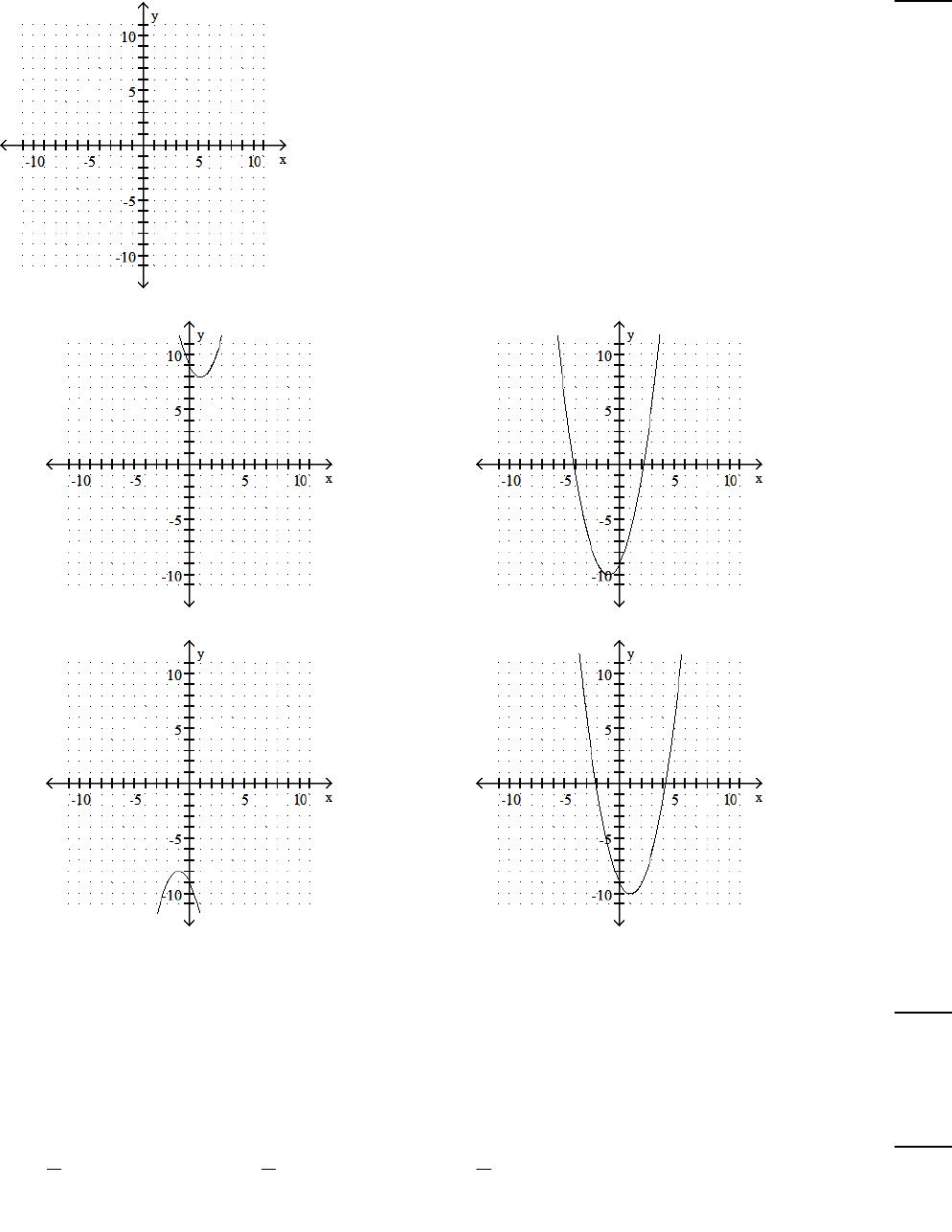
Graph the equation.
127)
k(x) = x2– 2x – 9
127)
A)
B)
C)
D)
Solve the problem.
128)
The length of a table is 17 inches more than its width. If the area of the table is 2090 square inches,
what is its length?
128)
A)
76 in.
B)
21 in.
C)
38 in.
D)
55 in.
Solve the equation by completing the square.
129)
2x2– 6 =4x
129)
A)
1
3, 0
B)
1
3, –1
C)
1
3, 1
D)
3, –1
23
Determine which of the following methods is the best choice for solving the given equation: factoring, using the
principle of square roots or using the quadratic formula. Then, solve the equation.
130)
x2–10x +34 = 0
130)
A)
Square root principle or factoring; 8, 2
B)
Factoring; –5, 3
C)
Quadratic formula; 5±3i
D)
Square root principle; 10 ±6i
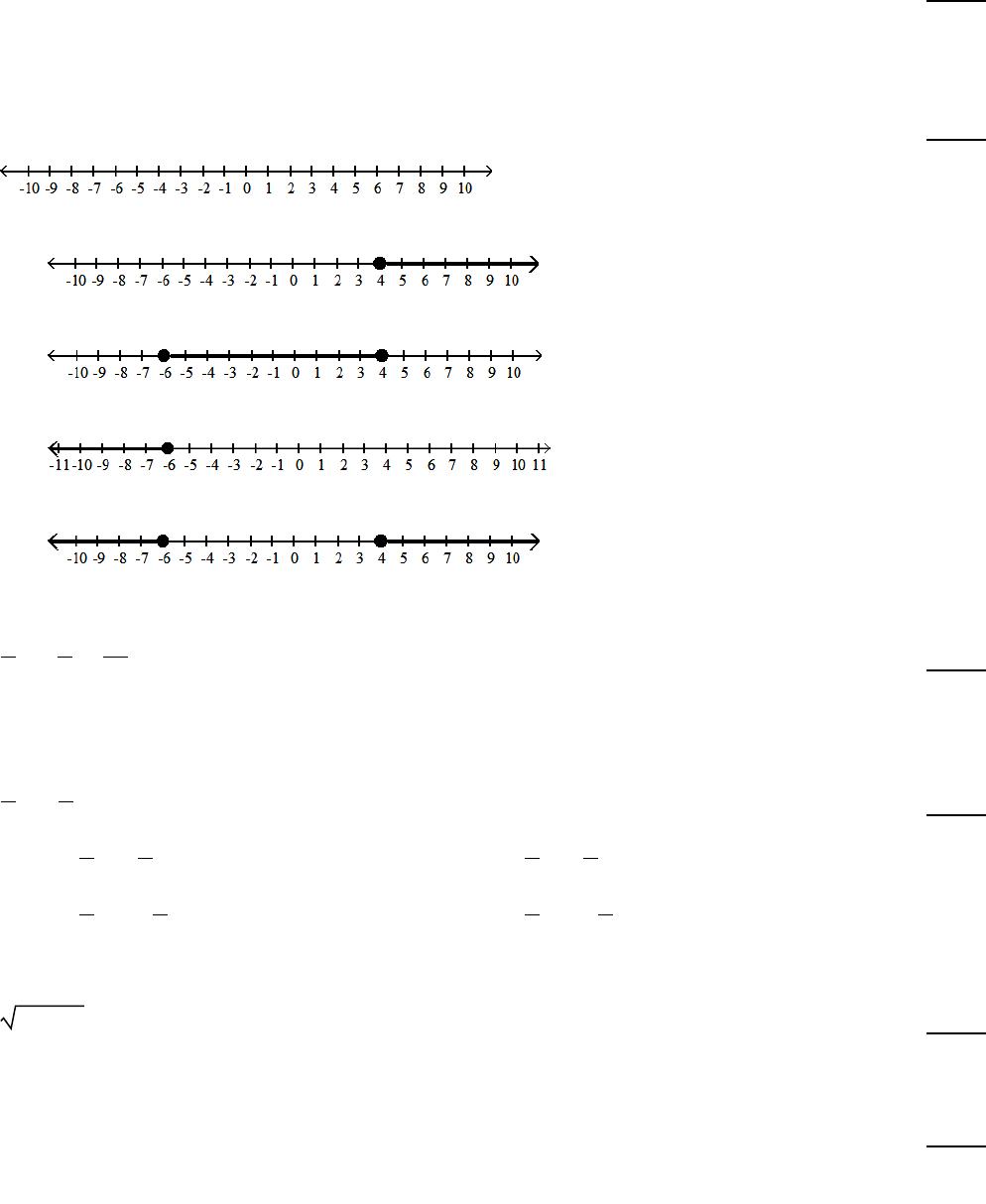
Solve the inequality and write the solution set using interval notation; then graph the solution set on a number line.
131)
v2+ 2v – 24
0
131)
A)
[4,
)
B)
[-6, 4]
C)
(–
, -6]
D)
(–
, -6] [4,
)
Solve using the quadratic formula. Use a calculator to approximate the solution to three decimal places.
132)
3
4x2+1
2x +1
12 = 0
132)
A)
±3
B)
0.333
C)
±0.333
D)
–0.333
Rewrite the quadratic equation in the form ax2+ bx + c = 0, then identify a, b, and c.
133)
3
2x2=9
2x +10
133)
A)
a =9
2, b =3
2, c = –10
B)
a =3
2, b =9
2, c =10
C)
a =3
2, b = – 9
2, c = –10
D)
a =3
2, b = – 9
2, c =10
Solve the equation.
134)
10x + 21 – x –5= 0
134)
A)
2i
B)
±4i
C)
±2
D)
±2i
Solve and check. Begin by using the addition or multiplication principles of equality to isolate the squared term.
135)
0.6x2– 0.3 =0.186
135)
A)
±0.81
B)
±0.19
C)
no real solution
D)
±0.9
24
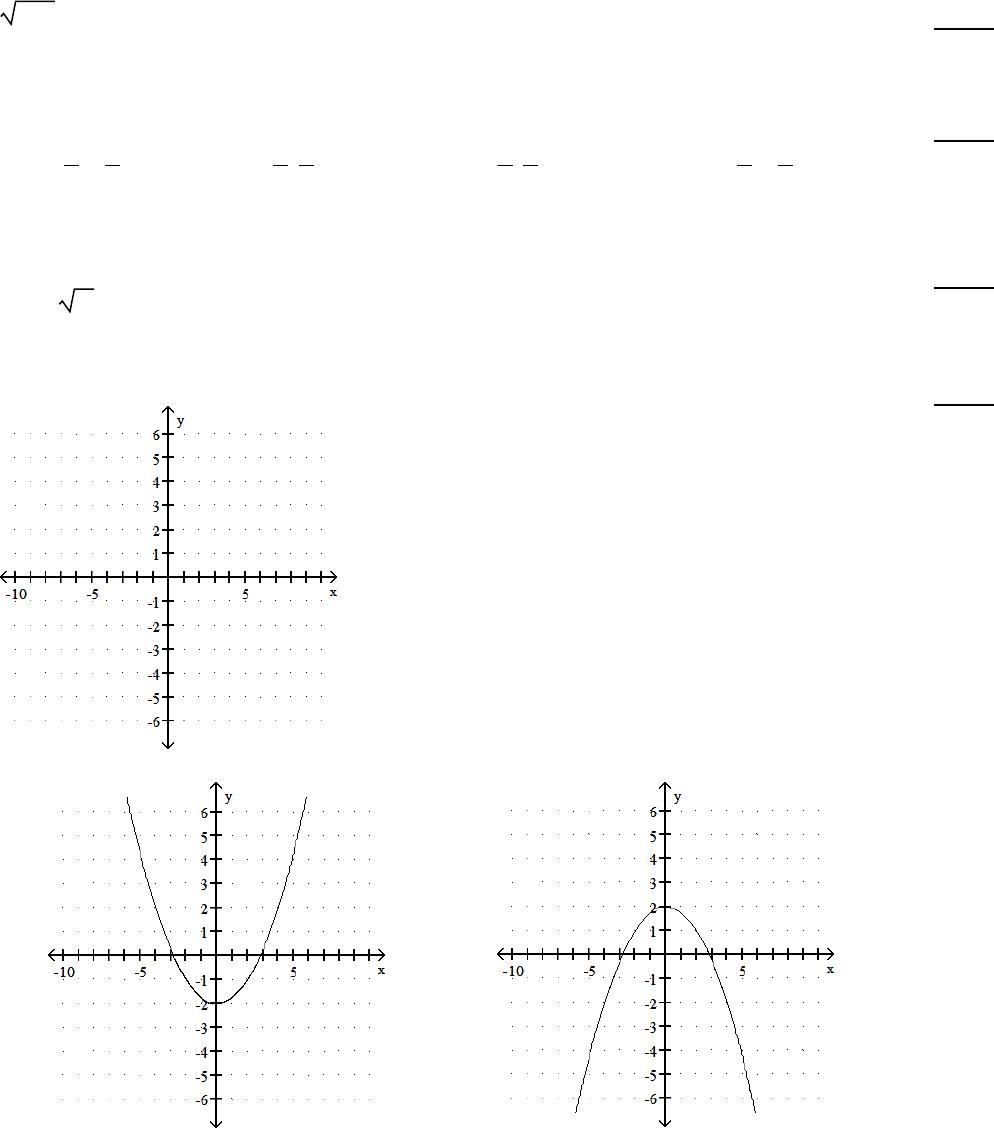
Solve the equation.
136)
x + 3 = x – 3
136)
A)
1, 13
B)
1, 6
C)
6
D)
6, 13
Solve the equation by completing the square.
137)
16n2+ 24n + 9 = 0
137)
A)
–3
4, –3
4
B)
4
3, 4
3
C)
3
4, 3
4
D)
–4
3, –3
4
Solve and check. Begin by using the addition or multiplication principles of equality to isolate the squared term.
138)
–3x2= –33
138)
A)
±11
B)
12
C)
16.5
D)
±11
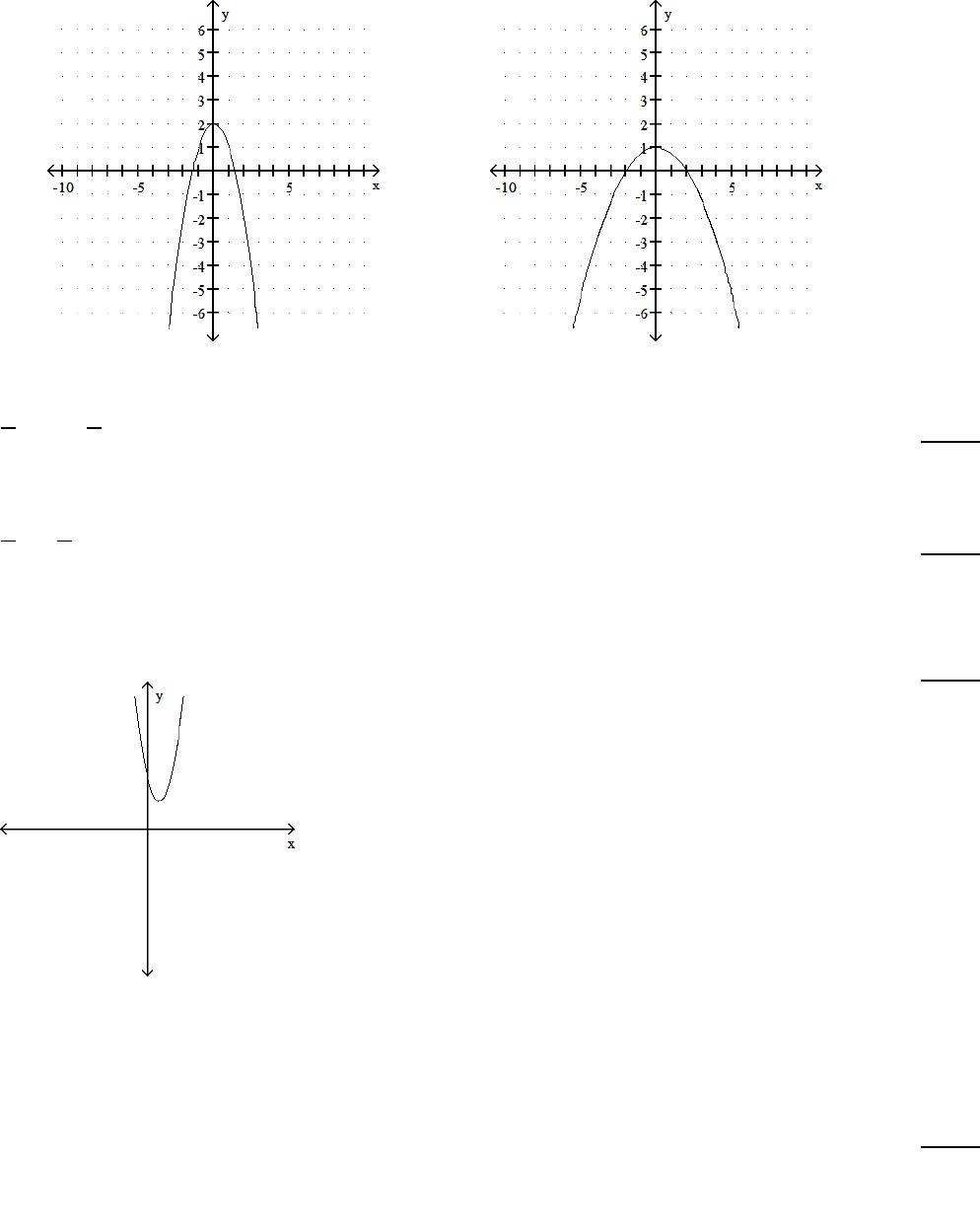
Graph.
139)
h(x) = –0.25x2+2
139)
A)
B)
25
C)
D)
Solve using the quadratic formula. Use a calculator to approximate the solution to three decimal places.
140)
1
3x2– x +1
3= 0
140)
A)
0.5, 2.5
B)
–0.303, 3.303
C)
2.5
D)
0.382, 2.618
141)
1
6x2+5
2= x
141)
A)
3±2.449
B)
3±2.449i
C)
3+2.449i
D)
-0.3 ±2.449i
Provide an appropriate response.
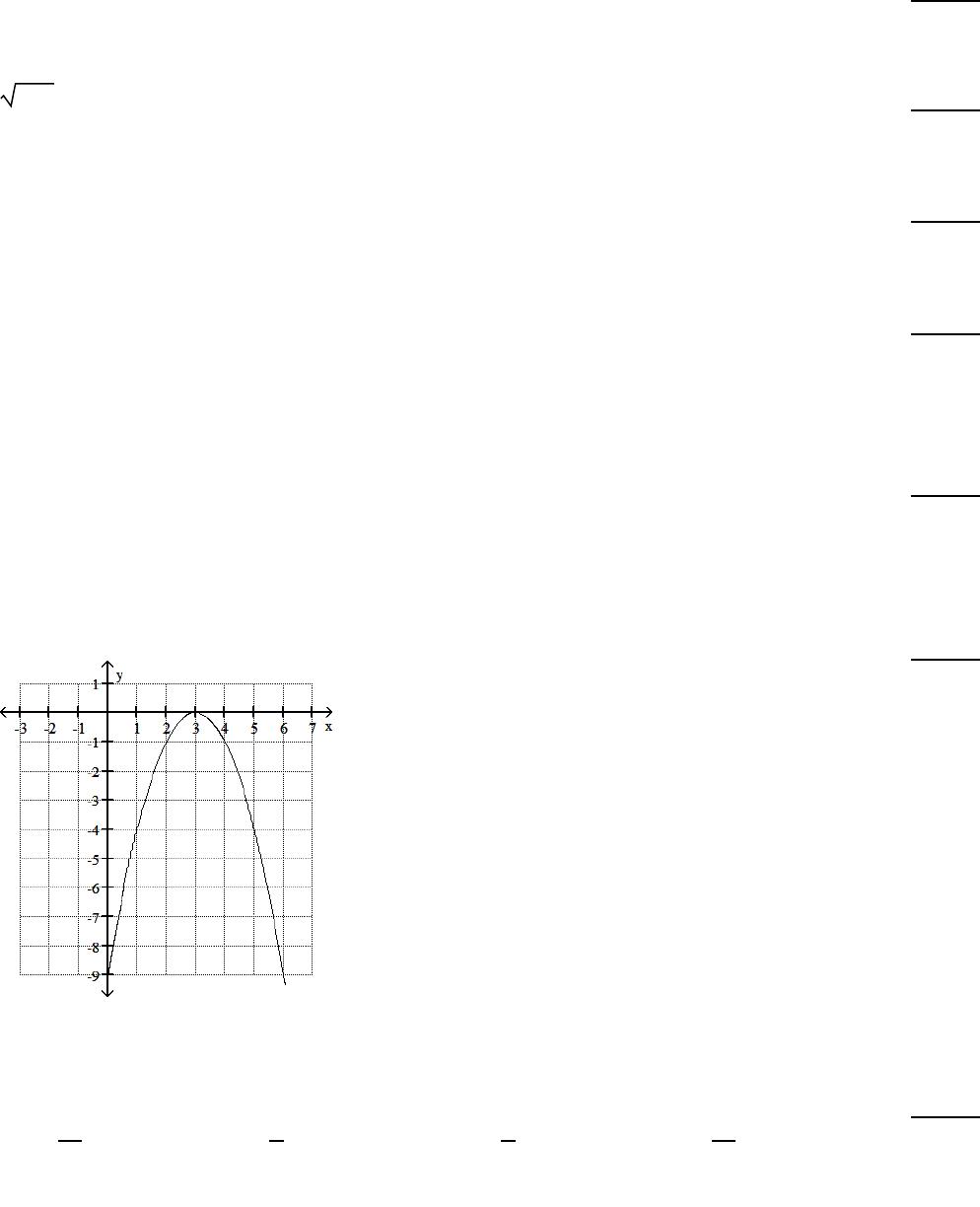
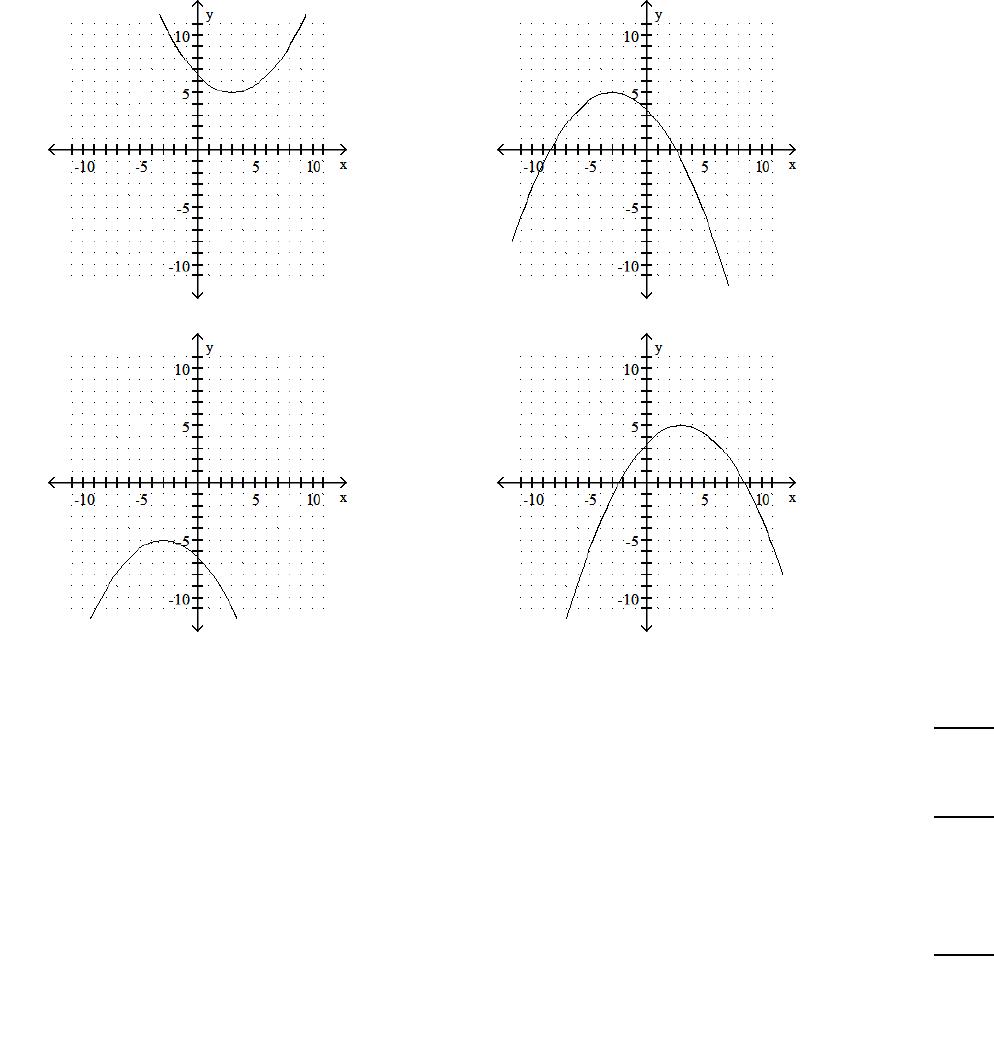
142)
Using only this graph of f(x) = a(x – h)2+ k, what are the signs of h and k?
142)
A)
h is negative and k is positive.
B)
Both are positive.
C)
Both are negative.
D)
h is positive and k is negative.
Solve the problem.
143)
A ladder is resting against a wall. The top of the ladder touches the wall at a height of 15 ft. Find
the length of the ladder if the length is 5 ft more than its distance from the wall.
143)
A)
30 ft
B)
25 ft
C)
20 ft
D)
15 ft
26

Write the equation of the axis of symmetry.
144)
f(x) =2x2– 4x – 3
144)
A)
x =5
B)
x = –5
C)
x =1
D)
x = –1
Solve. Use a calculator to approximate the irrational solutions to three places.
145)
x2=6
145)
A)
2.449
B)
±2.449
C)
36
D)
12
Solve the problem.
146)
A flare fired from the bottom of a gorge is visible only when the flare is above the rim. If it is fired
with an initial velocity of 128 ft/sec and the gorge is 192 ft deep, during what interval can the flare
be seen? (h(t) = -16t2 + vot + ho.)
146)
A)
6 sec < t <10 sec
B)
4 sec < t <8 sec
C)
2 sec < t <6 sec
D)
0 sec < t <2 sec
27
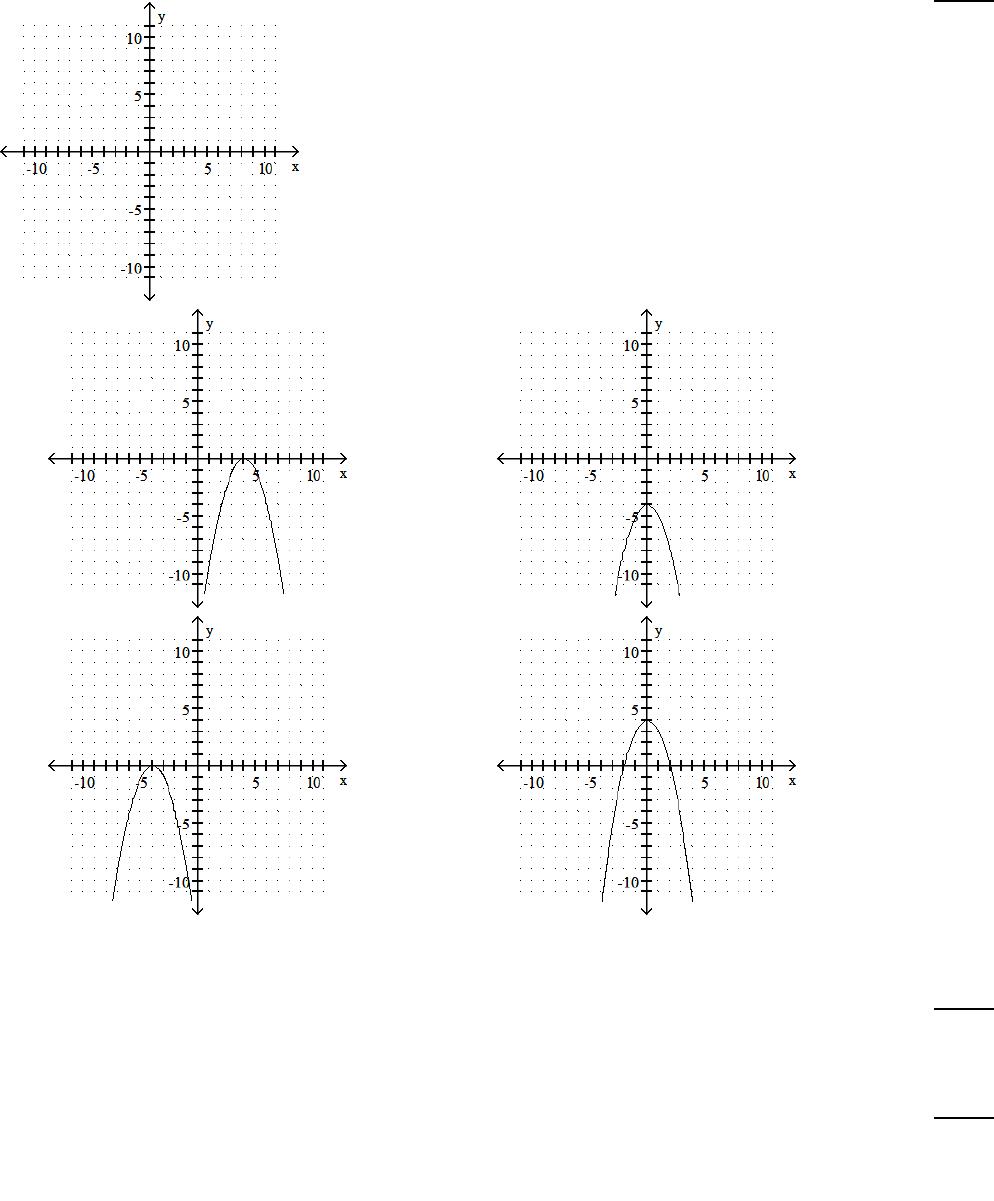
Graph the equation.
147)
h(x) = –x2+ 8x – 16
147)
A)
B)
C)
D)
Find the x– and y–intercepts. If no x–intercepts exist, state so.
148)
y = x2+ 12x +36
148)
A)
(36, 0), (0, -6)
B)
(-6, 0), (0, 36)
C)
(6, 0), (0, 36)
D)
(36, 0), (0, 6)
Solve the problem. Round your answer to the nearest tenth, if necessary.
149)
Working together, Rick and Juanita can complete a job in 6 hr. It would take Rick 9 hr longer than
Juanita to do the job alone. How long would it take Juanita alone?
149)
A)
6 hr
B)
9 hr
C)
15 hr
D)
3 hr
28
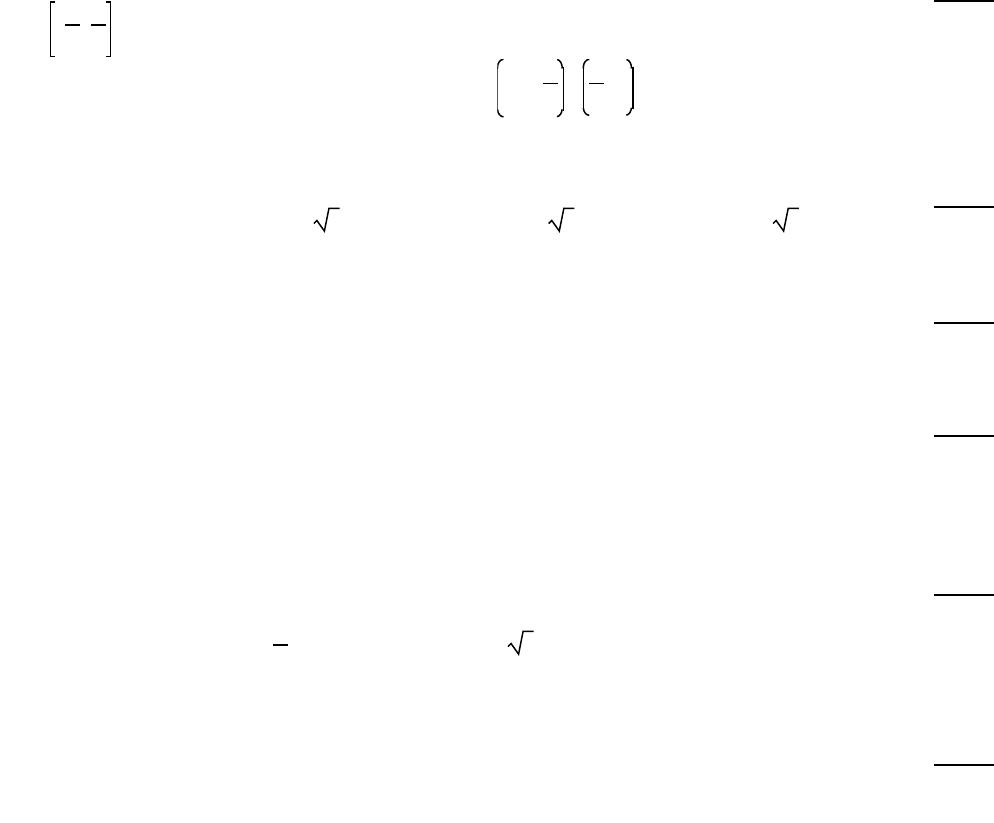
Solve the inequality and write the solution set using interval notation.
150)
(4 + 4x)2-25
150)
A)
– 9
4, 1
4
B)
(–
,
)
C)
No solution, or
D)
–, – 9
41
4,
Solve.
151)
x4–49x2+180= 0
151)
A)
±3, ±3
B)
±2, ±5
C)
±2, ±3 6
D)
±2, ±3 5
Solve the equation by completing the square.
152)
a2– 8a – 33 = 0
152)
A)
–30,-3
B)
±7
C)
11, -3
D)
–11, 3
Solve the problem. Round your answer to the nearest tenth, if necessary.
153)
A jet plane traveling at a constant speed goes 1200 mi with the wind, then turns around and travels
for 1000 mi against the wind. If the speed of the wind is a constant 50 mph, and the total flight took
4 hours, find the speed of the plane.
153)
A)
605 mph
B)
525 mph
C)
550 mph
D)
435 mph
Solve the problem.
154)
A cylinder is to be made so that its volume is equal to that of a sphere with a radius of 3 inches. If a
cylinder is to have a height of 9 inches, find its radius.
154)
A)
1.5 in.
B)
4
9 in.
C)
2 3 in.
D)
2 in.
Solve and check. Use the square root principle to eliminate the square.
155)
(2x + 2)2=16
155)
A)
±9
B)
1, -3
C)
0, 1
D)
1, 3
29
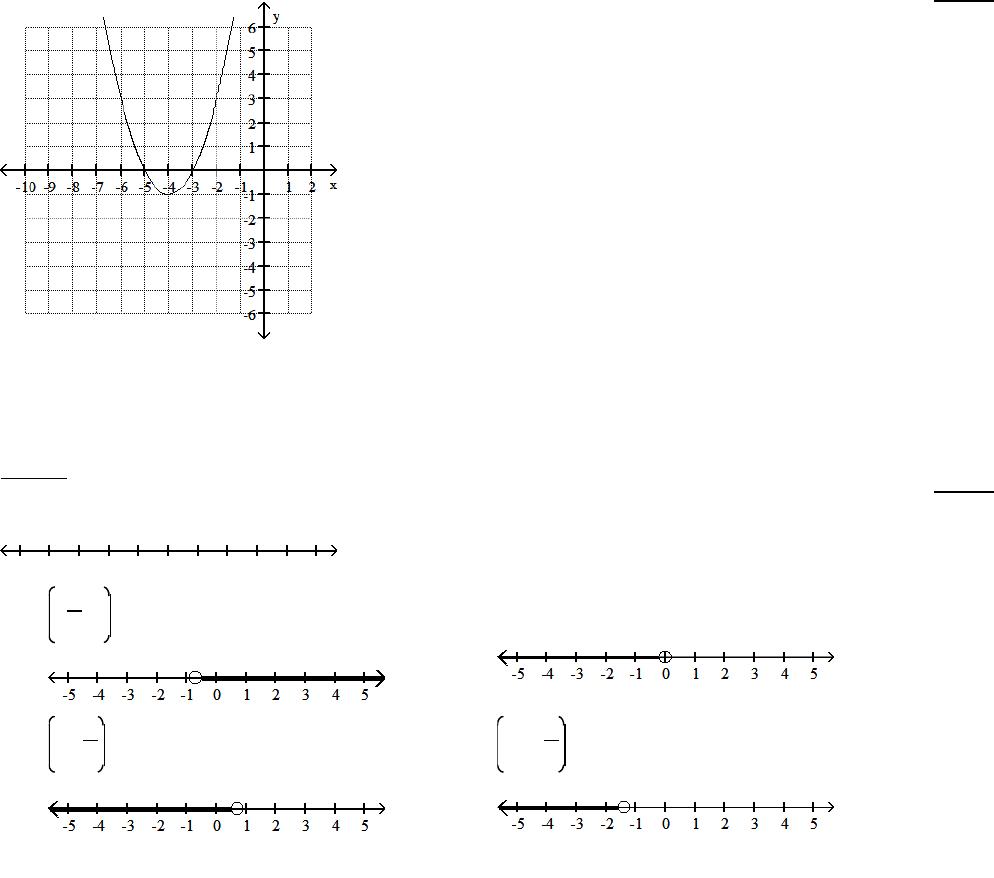
Use the graph of a quadratic function to find the solution set of the equation or inequality. For a solution set that involves
an interval, use interval notation.
156)
x2+8x +15 = 0
156)
A)
x = –5, –3
B)
(–
, –5) (–3,
)
C)
x =-1, –3
D)
x =3, 5
Solve the rational inequality. Write the solution set using interval notation; then graph the solution set on a number line.
157)
-7x + 5
3x2+ 5 > 0
157)
A)
– 5
7,
B)
(–
, 0)
C)
–, 5
7
D)
–, – 7
5
30
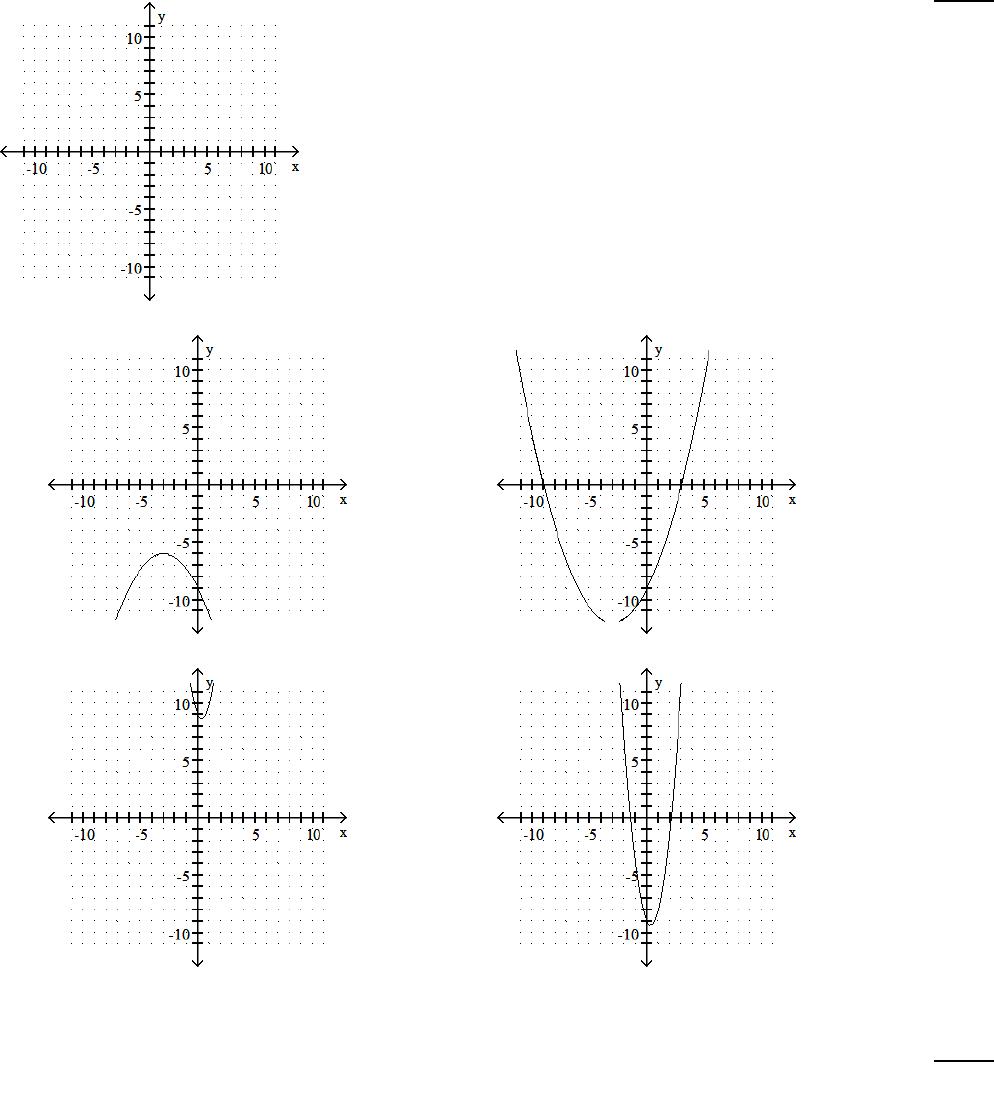
Graph the equation.
158)
f(x) =3x2– 2x – 9
158)
A)
B)
C)
D)
Find the ordered pair for the vertex.
159)
f(x) =4x2– 24x + 31
159)
A)
(5, -3)
B)
(-5, 3)
C)
(3, -5)
D)
(-3, 5)
31
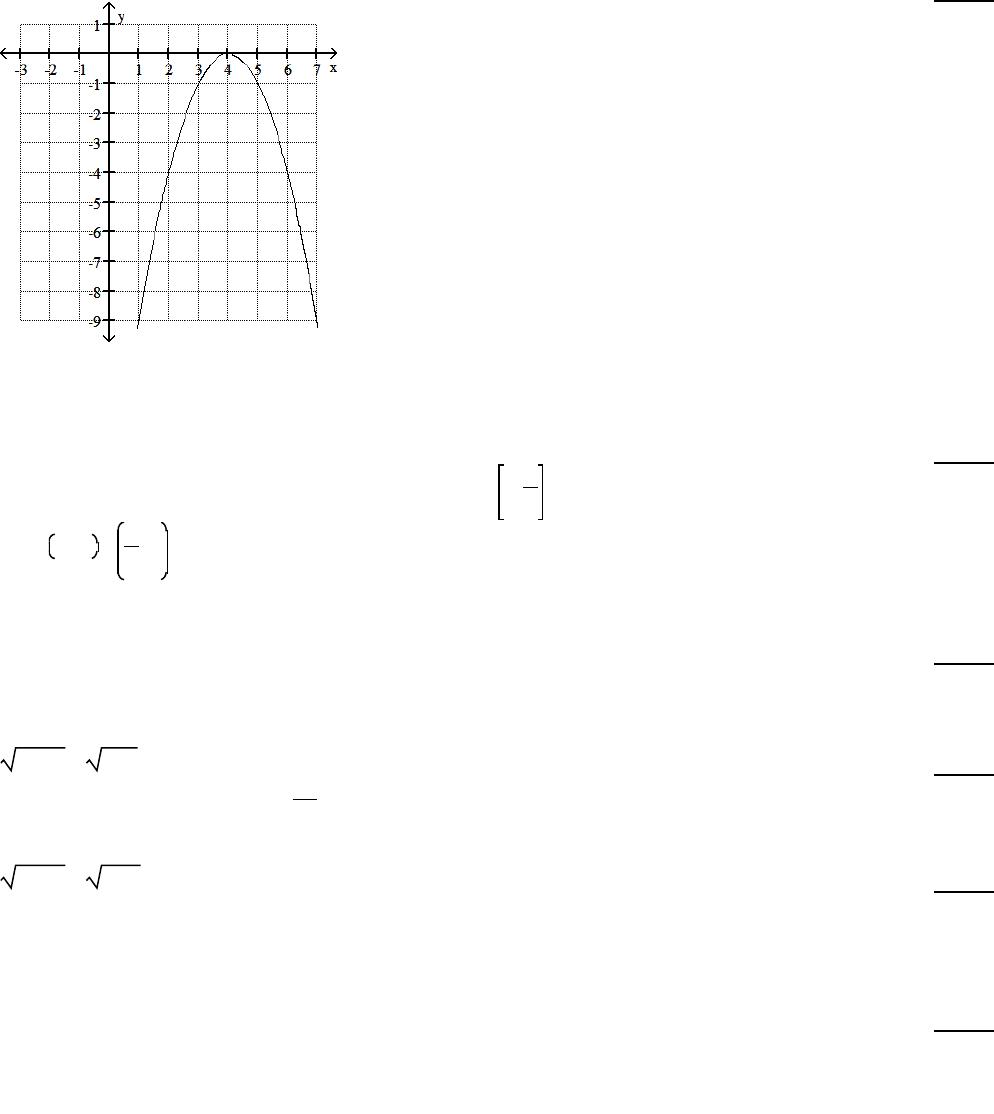
Use the graph of a quadratic function to find the solution set of the equation or inequality. For a solution set that involves
an interval, use interval notation.
160)
–x2+8x –16 > 0
160)
A)
(–
,
)
B)
x =4
C)
(–
, 4) (4,
)
D)
Solve the inequality and write the solution set using interval notation.
161)
(8 – 3x)2-16
161)
A)
(–
,
)
B)
4, 4
3
C)
–, 44
3,
D)
No solution, or
Solve.
162)
What is the minimum product of two numbers whose difference is 40?
162)
A)
-400
B)
-800
C)
-20
D)
-10
Solve the equation.
163)
2x + 3 +4 – x = 4
163)
A)
3
B)
3, 11
9
C)
–3
D)
No solution
164)
2x + 3 –x + 1 = 1
164)
A)
–3, –1
B)
3
C)
3, –1
D)
No solution
Use the discriminant to determine the number and type of solutions for the equation. If the solution(s) are real, state
whether they are rational or irrational.
165)
6y2=5y – 2
165)
A)
One rational solution
B)
Two nonreal complex solutions
C)
Two irrational solutions
D)
Two rational solutions
32
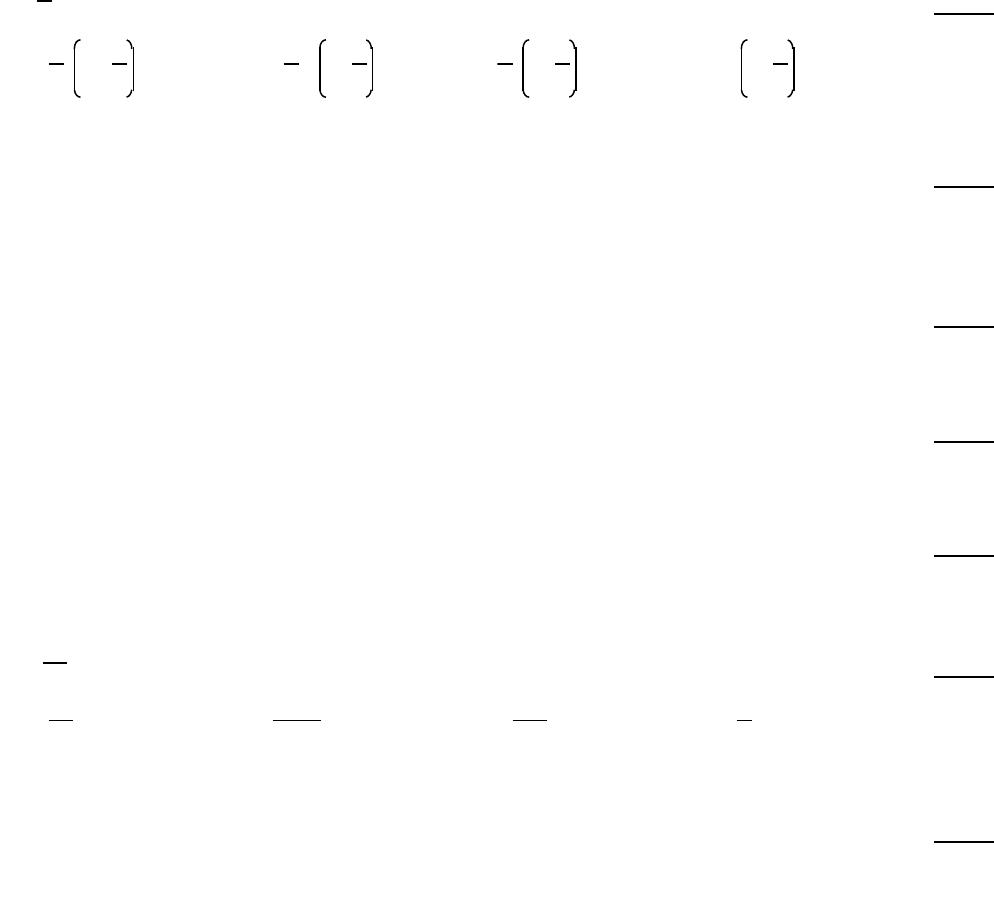
Find the term that should be added to the expression to form a perfect square trinomial. Write the resulting perfect square
trinomial in factored form.
166)
x2– 2
3x
166)
A)
1
9; x + 1
3
2
B)
– 2
3x; x – 1
3
2
C)
1
9; x – 1
3
2
D)
9; x – 1
3
2
Solve the inequality and write the solution set using interval notation.
167)
a2–3a +6< 0
167)
A)
(–6, 6)
B)
No solution, or
C)
(–
,
)
D)
(–
, 3) (9,
)
Solve.
168)
x2= –36
168)
A)
±6i
B)
±36i
C)
± i
D)
±6
Solve and check. Begin by using the addition or multiplication principles of equality to isolate the squared term.
169)
x2–100= 0
169)
A)
10
B)
±9
C)
±10
D)
52.5
Find the ordered pair for the vertex.
170)
f(x) =3(x – 7)2–2
170)
A)
(3, 7)
B)
(7, –2)
C)
(–7, –2)
D)
(–2, 7)
Solve.
171)
x2=9
64
171)
A)
9
32
B)
81
4,096
C)
±9
128
D)
±3
8
Solve and check. Begin by using the addition or multiplication principles of equality to isolate the squared term.
172)
4z2–16 = 0
172)
A)
10
B)
±2
C)
2
D)
±3
33
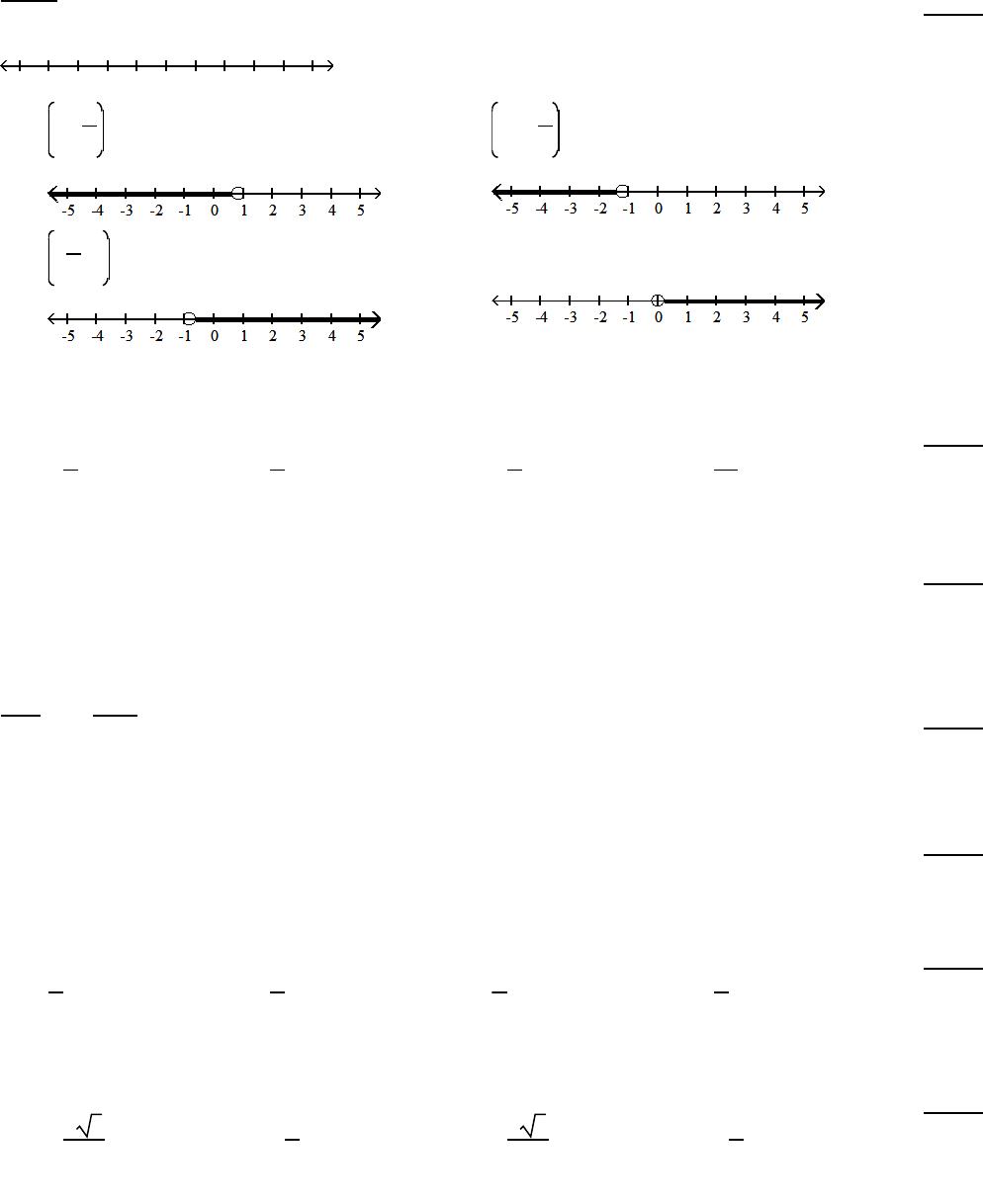
Solve the rational inequality. Write the solution set using interval notation; then graph the solution set on a number line.
173)
–3
-6x – 5 > 0
173)
A)
–, 5
6
B)
–, – 6
5
C)
– 5
6,
D)
(0,
)
Solve and check. Begin by using the addition or multiplication principles of equality to isolate the squared term.
174)
36x2= 9
174)
A)
±1
8
B)
1
2
C)
±1
2
D)
1
16
Solve the problem. Round your answer to the nearest tenth, if necessary.
175)
Sue rowed her boat across and back Lake Bend in 3 hr. If her rate rowing back was 2 mph less than
the rate rowing across, and if the distance each way was 7 mi, find her rate rowing across.
175)
A)
1.5 mph
B)
5.9 mph
C)
3.7 mph
D)
5.5 mph
Solve the equation.
176)
7
x – 4 = 1 + 9
x + 4
176)
A)
-8, 10
B)
-9, 10
C)
8, -10
D)
Solve.
177)
What is the maximum product of two positive numbers whose sum is 30?
177)
A)
225
B)
450
C)
15
D)
7.5
Solve the equation by completing the square.
178)
6x2– 3x =9
178)
A)
2
3, 1
B)
2
3, 0
C)
2
3, –1
D)
3
2, –1
Solve and check. Begin by using the addition or multiplication principles of equality to isolate the squared term.
179)
2x2=49
179)
A)
±2 7
7
B)
±2
7
C)
±7 2
2
D)
±7
2
34
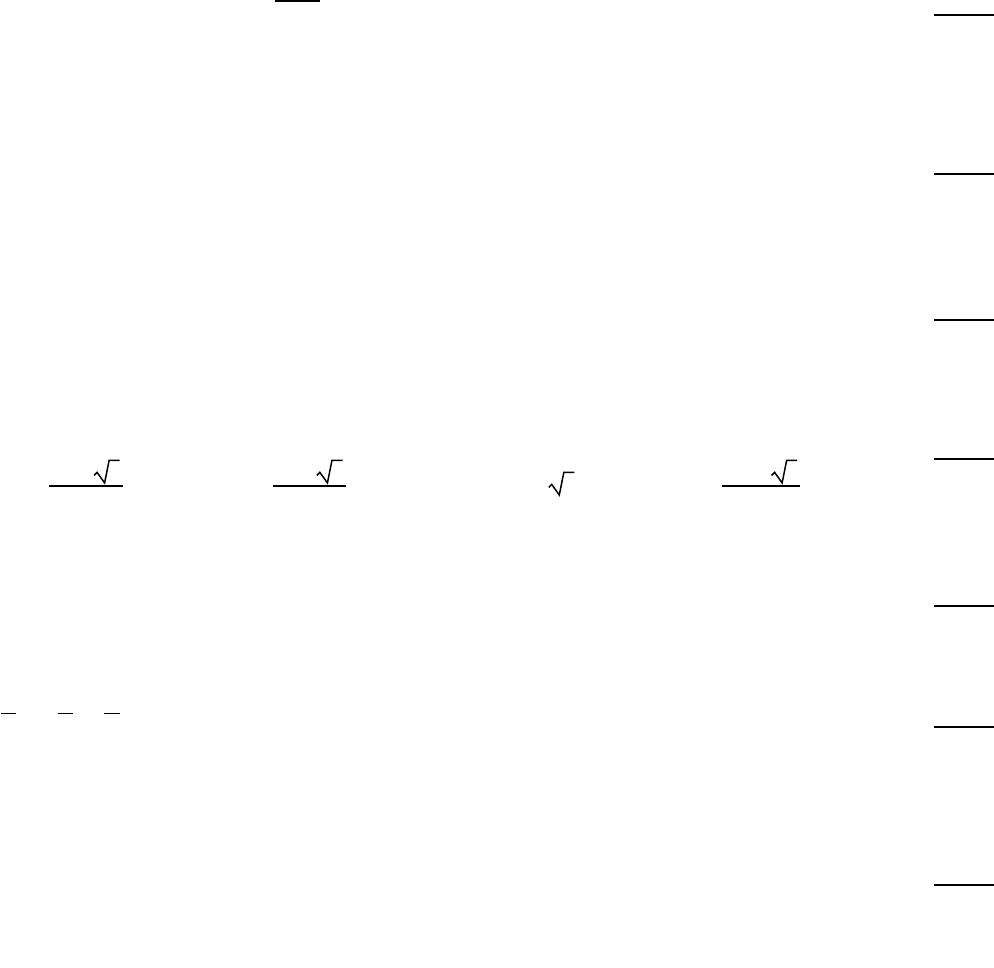
Solve the problem.
180)
To solve the rational inequality -2
x + 2
2, you can first write the inequality with 0 on one side and
the other side expressed as a single fraction. What value or values of x make the denominator of
that fraction equal to 0?
180)
A)
{-3, –2}
B)
{-3}
C)
{2}
D)
{–2}
181)
The solution set of the inequality x2– 5x –14 < 0 is (–2, 7). Without doing any work, give the
solution to x2 – 5x – 14 > 0.
181)
A)
[-2, 7]
B)
(–7, 2)
C)
(–
, -2] [7,
)
D)
(–
, -2) (7,
)
Solve the inequality and write the solution set using interval notation.
182)
y2+3y +10 0
182)
A)
No solution, or
B)
(–
, 0) (0,
)
C)
[–10, 10]
D)
(–
,
)
Solve the equation by completing the square.
183)
p2+ 3p – 9 = 0
183)
A)
-3 – 3 5
2
B)
3+ 3 5
2
C)
–3±3 5
D)
-3 ± 3 5
2
Solve using the quadratic formula.
184)
x2+ 4x – 77 = 0
184)
A)
–11, 7
B)
–11, 1
C)
11, -7
D)
11, 7
Solve using the quadratic formula. Use a calculator to approximate the solution to three decimal places.
185)
1
2x2+1
4x –1
2= 0
185)
A)
–1
B)
0.75
C)
–1.25, 0.75
D)
–0.781, 1.281
Use the discriminant to determine the number and type of solutions for the equation. If the solution(s) are real, state
whether they are rational or irrational.
186)
10 – 8a2= –3a + 9
186)
A)
One rational solution
B)
Two nonreal complex solutions
C)
Two irrational solutions
D)
Two rational solutions
35
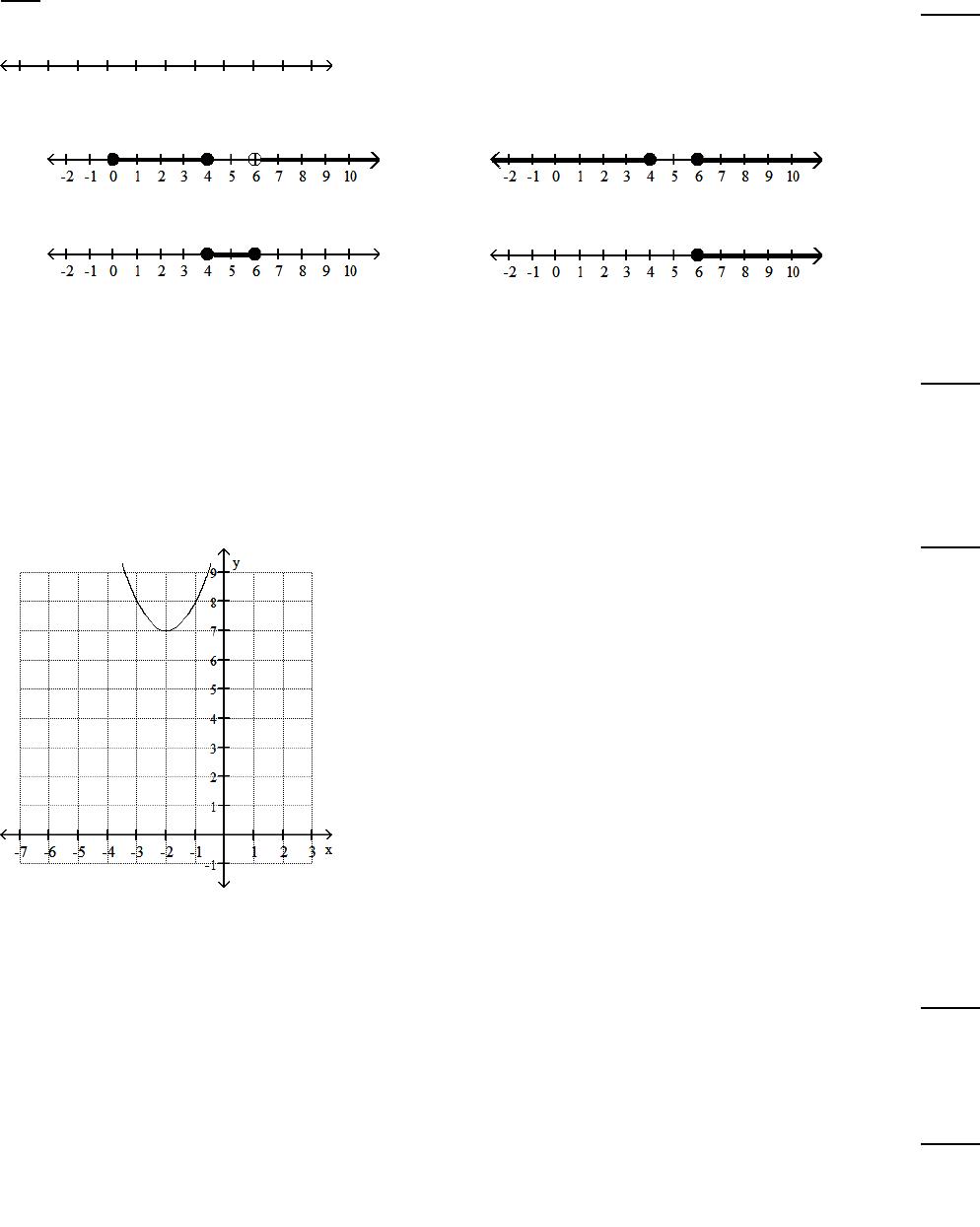
Solve the rational inequality. Write the solution set using interval notation; then graph the solution set on a number line.
187)
6x
6 – x 3x
187)
A)
[0, 4] (6,
)
B)
(–
, 4] [6,
)
C)
[4, 6]
D)
[6,
)
Rewrite the quadratic equation in the form ax2+ bx + c = 0, then identify a, b, and c.
188)
2x2=3x
188)
A)
a =2, b = 0, c =3
B)
a =2, b =-3, c = 0
C)
a = 3, b =3, c = 0
D)
a =2, b =-3
Use the graph of a quadratic function to find the solution set of the equation or inequality. For a solution set that involves
an interval, use interval notation.
189)
x2+4x +11 0
189)
A)
(–
,
)
B)
(–
, 11) (11,
)
C)
x =11
D)
State whether the parabola opens upwards or downwards.
190)
y =-7x2
190)
A)
Upwards
B)
Downwards
Use the discriminant to determine the number and type of solutions for the equation. If the solution(s) are real, state
whether they are rational or irrational.
191)
t2+ 8t + 16 = 0
191)
A)
Two irrational solutions
B)
Two rational solutions
C)
One rational solution
D)
Two nonreal complex solutions
36
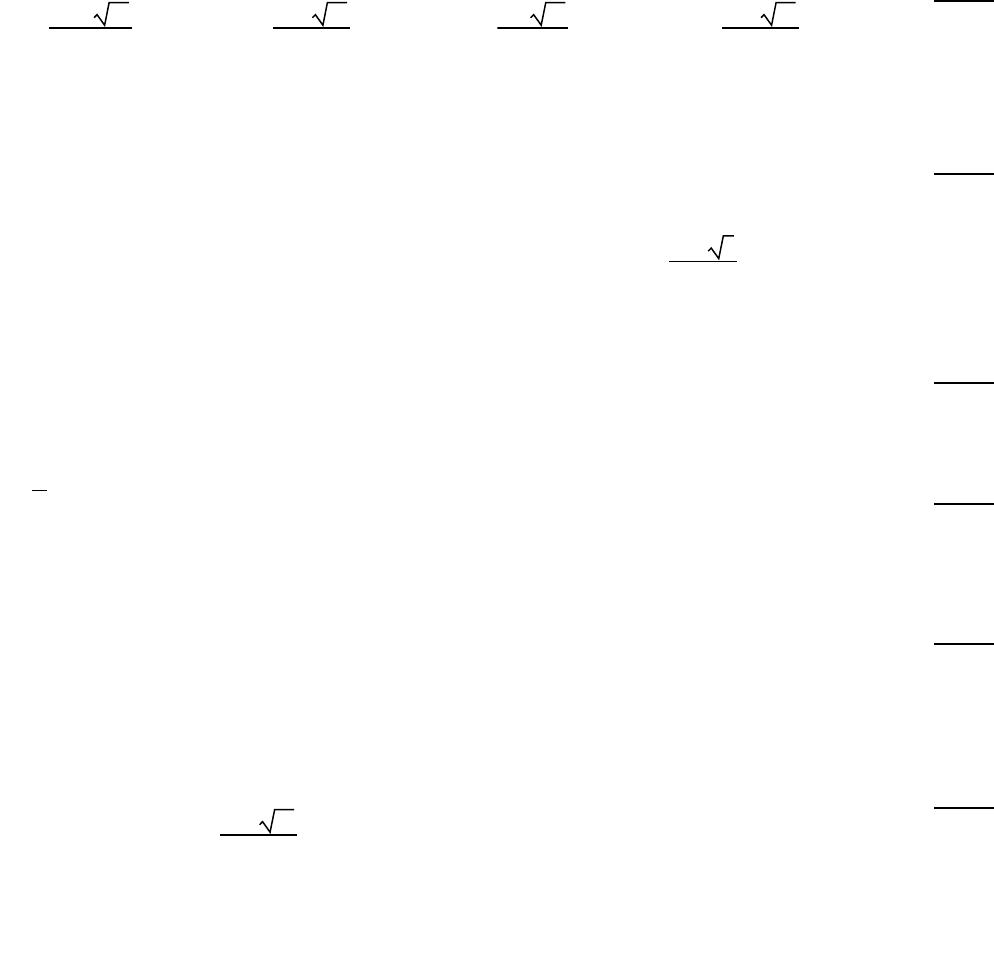
Solve using the quadratic formula.
192)
x2+ x + 9 = 0
192)
A)
-1 ± i 35
2
B)
-1 ±35
2
C)
1 ±35
2
D)
1 ± i 35
2
Determine which of the following methods is the best choice for solving the given equation: factoring, using the
principle of square roots or using the quadratic formula. Then, solve the equation.
193)
(x – 2)2=9
193)
A)
Square root principle or factoring; 11
B)
Factoring; ±3
C)
Square root principle; 5, -1
D)
Quadratic formula; -5 ± 2
3
Find the ordered pair for the vertex.
194)
g(x) =0.1x2–1
194)
A)
(0, –1)
B)
(–1.6, 0)
C)
(–1, 0)
D)
(0, 1.6)
State whether the parabola opens upwards or downwards.
195)
y =1
6x2– 2
195)
A)
Upwards
B)
Downwards
Rewrite the quadratic equation in the form ax2+ bx + c = 0, then identify a, b, and c.
196)
3x2+13x –15 = 0
196)
A)
a =3, b = –13, c =15
B)
a =3, b =13, c = –15
C)
a =3, b =13, c =15
D)
a =3, b = –13, c = –15
Determine which of the following methods is the best choice for solving the given equation: factoring, using the
principle of square roots or using the quadratic formula. Then, solve the equation.
197)
5x2+ 8x =– 1
197)
A)
Quadratic formula; -4 ±11
5
B)
Factoring; -8
C)
Square root principle; 5, 10
D)
Square root principle or factoring; -4, 0
37
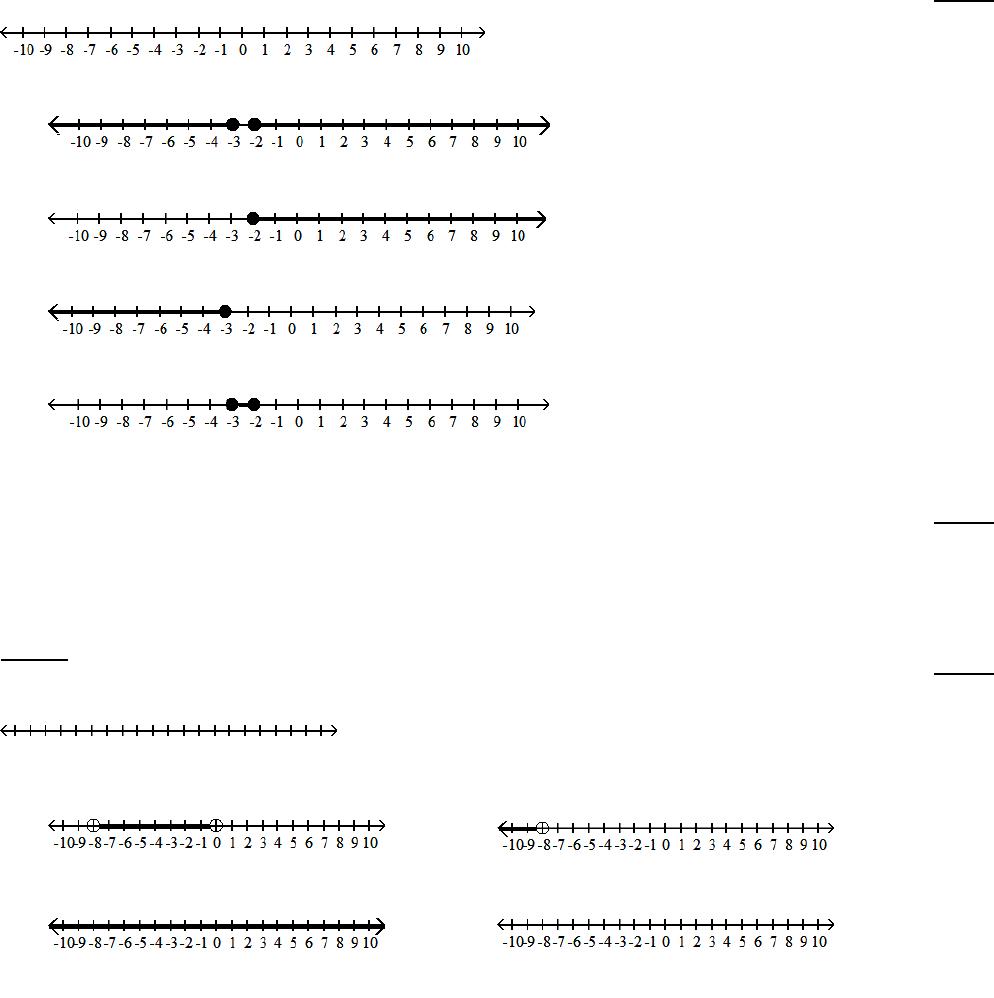
Solve the inequality and write the solution set using interval notation; then graph the solution set on a number line.
198)
x2+ 5x –6
198)
A)
(–
, -3] [–2,
)
B)
[–2,
)
C)
(–
, -3]
D)
[-3, –2]
Solve.
199)
A projectile is thrown upward so that its distance, in feet, above the ground after t seconds is
h = -11t2+ 440t. What is its maximum height?
199)
A)
16,800 ft
B)
189,640 ft
C)
4719 ft
D)
4400 ft
Solve the rational inequality. Write the solution set using interval notation; then graph the solution set on a number line.
200)
4
(x + 8)2< 0
200)
A)
(–8, 0)
B)
(–
, –8)
C)
(–
,
)
D)
38
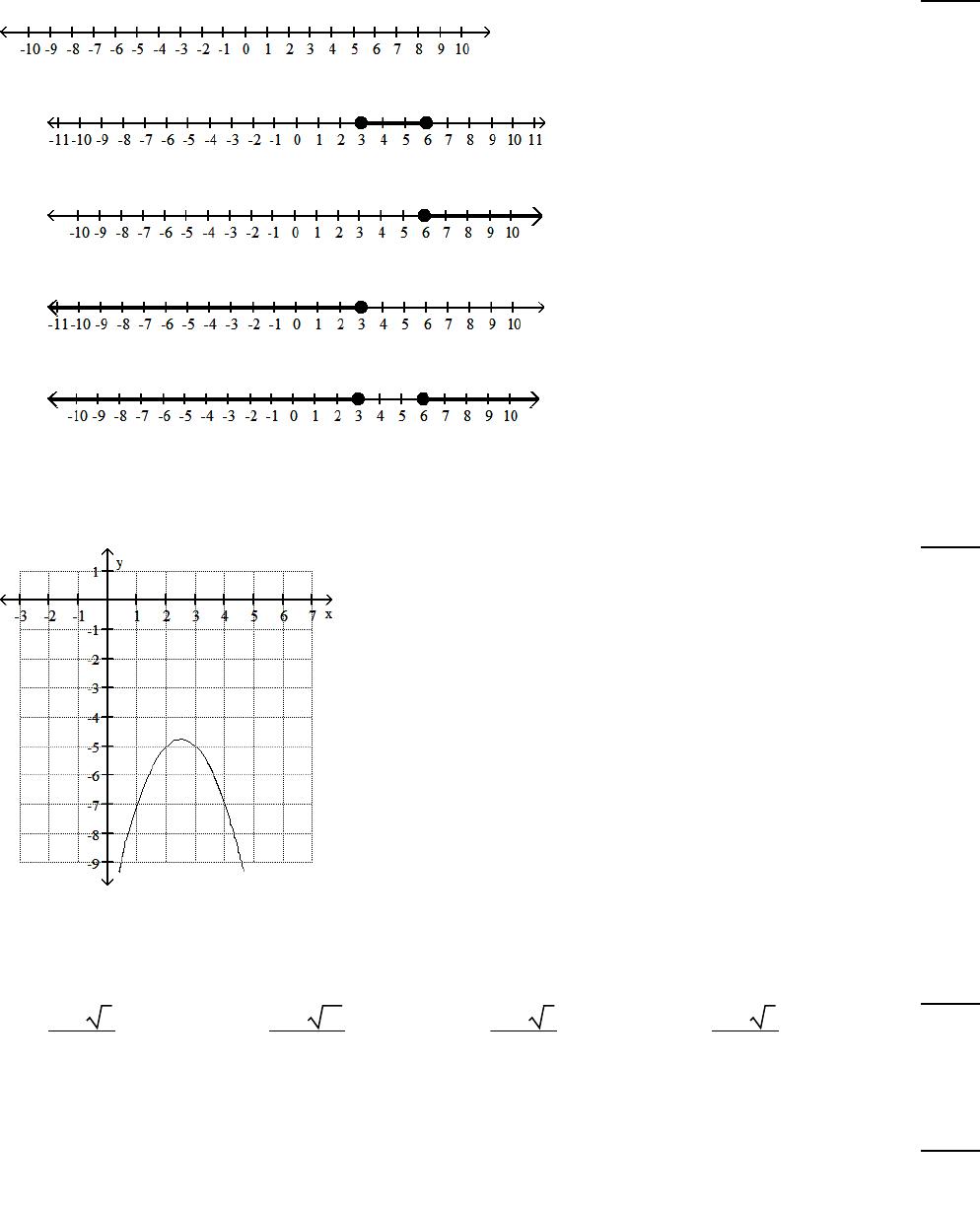
Solve the inequality and write the solution set using interval notation; then graph the solution set on a number line.
201)
v2– 9v + 18 0
201)
A)
[3, 6]
B)
[6,
)
C)
(–
, 3]
D)
(–
, 3] [6,
)
Use the graph of a quadratic function to find the solution set of the equation or inequality. For a solution set that involves
an interval, use interval notation.
202)
–x2–5x –11 = 0
202)
A)
(–
, 11) (11,
)
B)
C)
(–
,
)
D)
x =11
Solve using the quadratic formula.
203)
6x2=-6x – 1
203)
A)
-3 ± 3
6
B)
-3 ±15
6
C)
-6 ± 3
6
D)
-3 ± 3
12
Write the equation of the axis of symmetry.
204)
f(x) =-2x2+ 16x – 37
204)
A)
x = –4
B)
x =-5
C)
x =5
D)
x =4
39
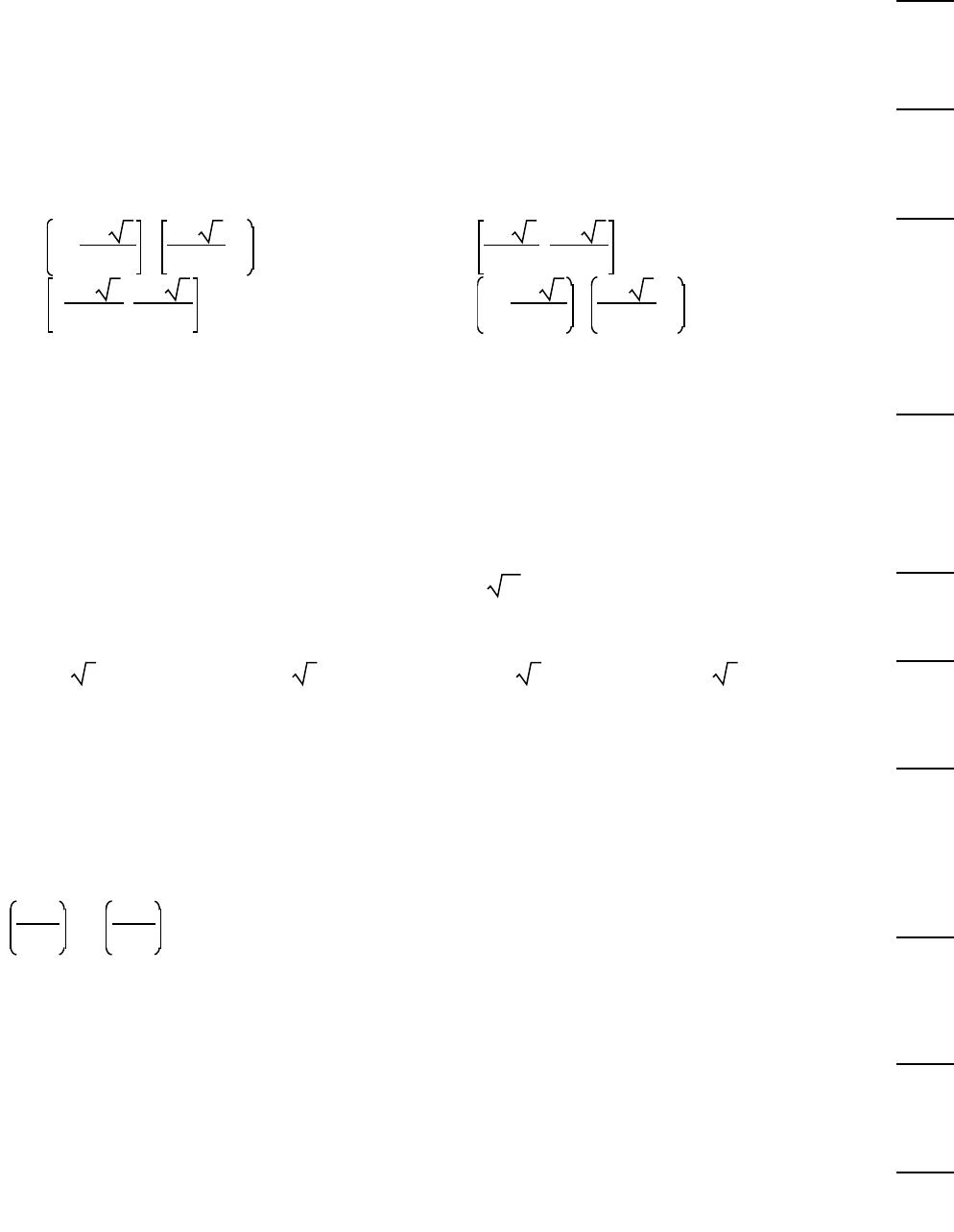
Solve using the quadratic formula.
205)
4x2– 28x + 40 = 0
205)
A)
–2, -5
B)
–2, 5
C)
2, 5
D)
2, -5
Solve.
206)
x2= 0.49
206)
A)
±0.7
B)
±8
C)
0.7
D)
24.5
Solve using the quadratic formula. Write the solution set using interval notation.
207)
4x2–12x +2
0
207)
A)
–, 3 – 7
23 + 7
2,
B)
3 – 7
2, 3 + 7
2
C)
– 3 + 7
2, 3 + 7
2
D)
–, 3 – 7
23 + 7
2,
Solve the problem. Round your answer to the nearest tenth, if necessary.
208)
Ron takes two hr more time than Paul to mow the lawn. Working together they can mow the lawn
in 5 hr. How long does it take each of them working alone?
208)
A)
Paul: 9.1 hr; Ron: 11.1 hr
B)
Paul: 10 hr; Ron: 12 hr
C)
Paul: 8 hr; Ron: 10 hr
D)
Paul: 8.3 hr; Ron: 10.3 hr
Solve and check. Begin by using the addition or multiplication principles of equality to isolate the squared term.
209)
3x2=39
209)
A)
±13
B)
19.5
C)
±13
D)
14
210)
x2+125= 0
210)
A)
±5 5
B)
±5i 5
C)
±10i 5
D)
± i 5
Solve the problem.
211)
Two cars leave an intersection. One car travels north; the other east. When the car traveling north
had gone 18 mi, the distance between the cars was 6 mi more than the distance traveled by the car
heading east. How far had the eastbound car traveled?
211)
A)
24 mi
B)
36 mi
C)
30 mi
D)
18 mi
Solve.
212)
2x + 2
22+ 8 x + 2
2– 10 = 0
212)
A)
1, -5
B)
– 1, 5
C)
-12, 0
D)
12, 0
Find the ordered pair for the vertex.
213)
f(x) =4x2– 24x + 31
213)
A)
(3, -5)
B)
(5, -3)
C)
(-3, 5)
D)
(-5, 3)
Solve the equation by completing the square.
214)
k2=– 8k – 12
214)
A)
±2
B)
–2, -6
C)
18,-6
D)
2, 6
40
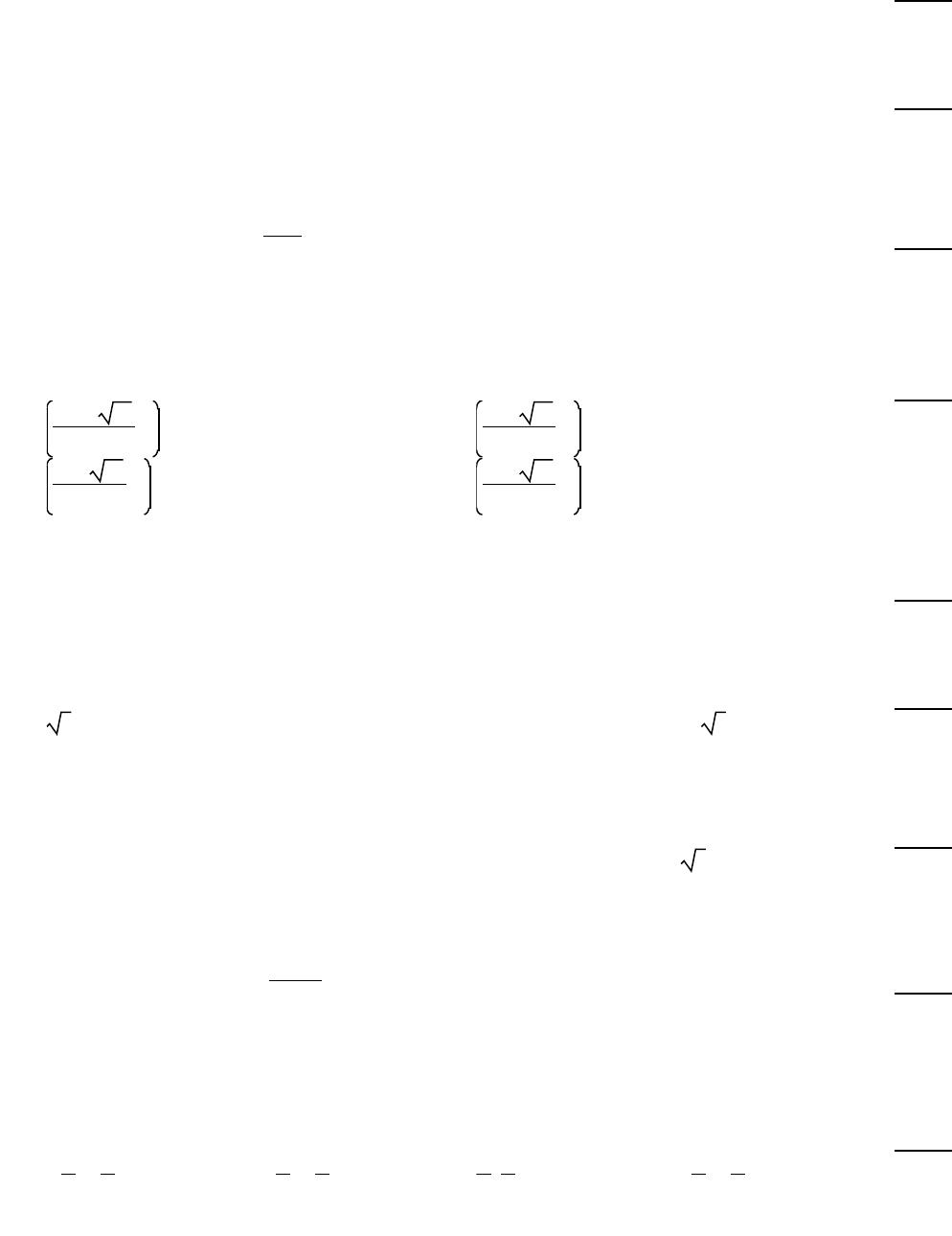
Find the ordered pair for the vertex.
215)
f(x) = –(x + 5)2+ 8
215)
A)
(8, -5)
B)
(8, -25)
C)
(-5, 8)
D)
(-8, 5)
Find the x– and y–intercepts. If no x–intercepts exist, state so.
216)
f(x) = 2x2– 14x – 16
216)
A)
(8, 0), (1, 0), (0, 16)
B)
(-8, 0), (-1, 0), (0, 16)
C)
(8, 0), (-1, 0), (0, –16)
D)
(-8, 0), (1, 0), (0, –16)
Solve the problem.
217)
To solve the rational inequality -2
x – 1
2, you can first write the inequality with 0 on one side and
the other side expressed as a single fraction. Give the solution.
217)
A)
[0, 1)
B)
(0, 1]
C)
[-2, 1)
D)
{1}
Find the x– and y–intercepts. If no x–intercepts exist, state so.
218)
y =5x2+ 10x + 2
218)
A)
-10 ±15
5, 0 , (0, 2)
B)
-5 ±35
5, 0 , (0, -2)
C)
-5 ±15
10 , 0 , (0, -2)
D)
-5 ±15
5, 0 , (0, 2)
State whether the parabola opens upwards or downwards.
219)
y = –x2– 6
219)
A)
Upwards
B)
Downwards
Solve.
220)
y2=7
220)
A)
7
B)
49
C)
3.5
D)
±7
Determine which of the following methods is the best choice for solving the given equation: factoring, using the
principle of square roots or using the quadratic formula. Then, solve the equation.
221)
x2–9= 0
221)
A)
Factoring; 0, 3
B)
Quadratic formula; -3 + i 2
C)
Square root principle or factoring; 3
D)
Square root principle or factoring; ±3
Solve the problem.
222)
Consider the rational inequality 6
x2 + 5< 0. Without doing any work, give the solution set. (Hint:
determine the sign of the numerator and denominator.)
222)
A)
B)
(–
,
)
C)
(5, 6)
D)
(5,
)
Solve using the quadratic formula.
223)
6x2+ 17x + 12 = 0
223)
A)
–2
3, –1
4
B)
–4
3, –3
2
C)
4
3, 3
2
D)
4
3, –3
2
41
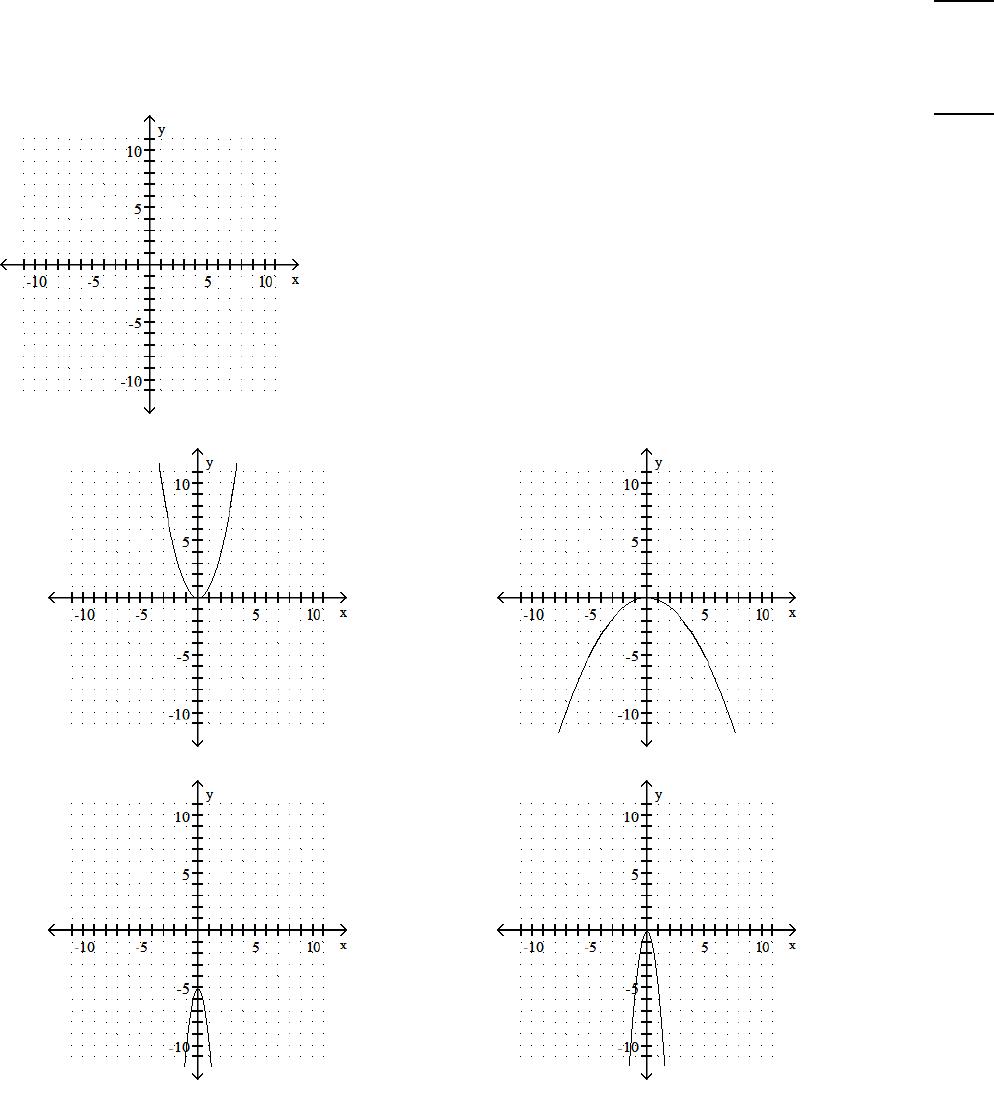
Solve and check. Begin by using the addition or multiplication principles of equality to isolate the squared term.
224)
x2+ 2 =66
224)
A)
±8
B)
33
C)
8
D)
±7
Graph.
225)
f(x) =-5x2
225)
A)
B)
C)
D)
42
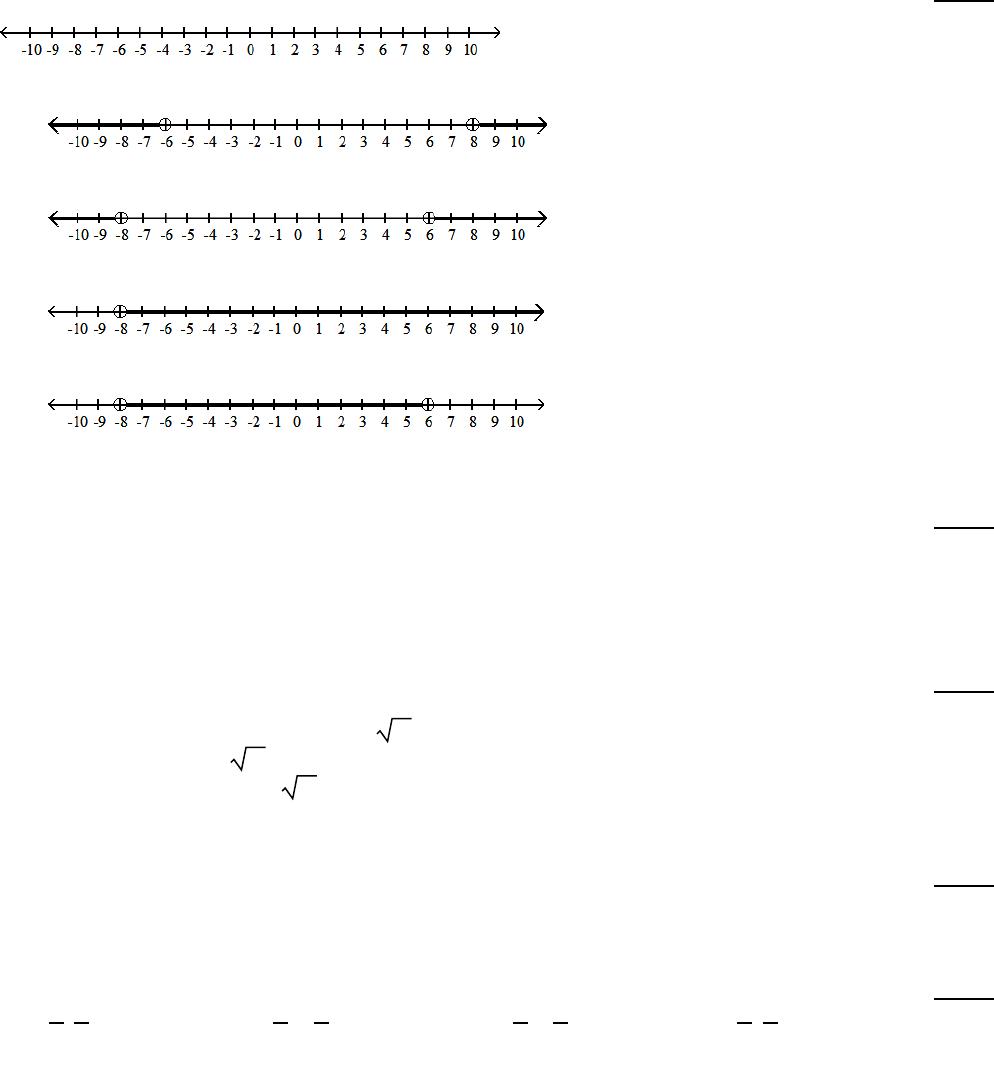
Solve the inequality and write the solution set using interval notation; then graph the solution set on a number line.
226)
(x – 6)(x + 8) > 0
226)
A)
(–
, -6) (8,
)
B)
(–
, -8) (6,
)
C)
(-8,
)
D)
(-8, 6)
Find the x– and y–intercepts. If no x–intercepts exist, state so.
227)
y = –x2+ 19x – 90
227)
A)
(-9, 0), (-10, 0), (0, -90)
B)
No x–intercepts, (0, 9)
C)
(9, 0), (10, 0), (0, -90)
D)
(9, 0), (10, 0), (0, 9)
Determine which of the following methods is the best choice for solving the given equation: factoring, using the
principle of square roots or using the quadratic formula. Then, solve the equation.
228)
(x + 5)2=15
228)
A)
Factoring; 10
B)
Square root principle or factoring; 5±15
C)
Quadratic formula; ±15
D)
Square root principle; –5±15
Solve.
229)
The length and width of a rectangle have a sum of 86. What dimensions give the maximum area?
229)
A)
Length 34 and width 52
B)
Length 42 and width 44
C)
Length 33 and width 53
D)
Length 43 and width 43
230)
(4m – 4)2– 2(4m – 4) – 15 = 0
230)
A)
9
4, 1
4
B)
1
4, –7
4
C)
–9
4, –1
4
D)
–1
4, 7
4
Graph.
43
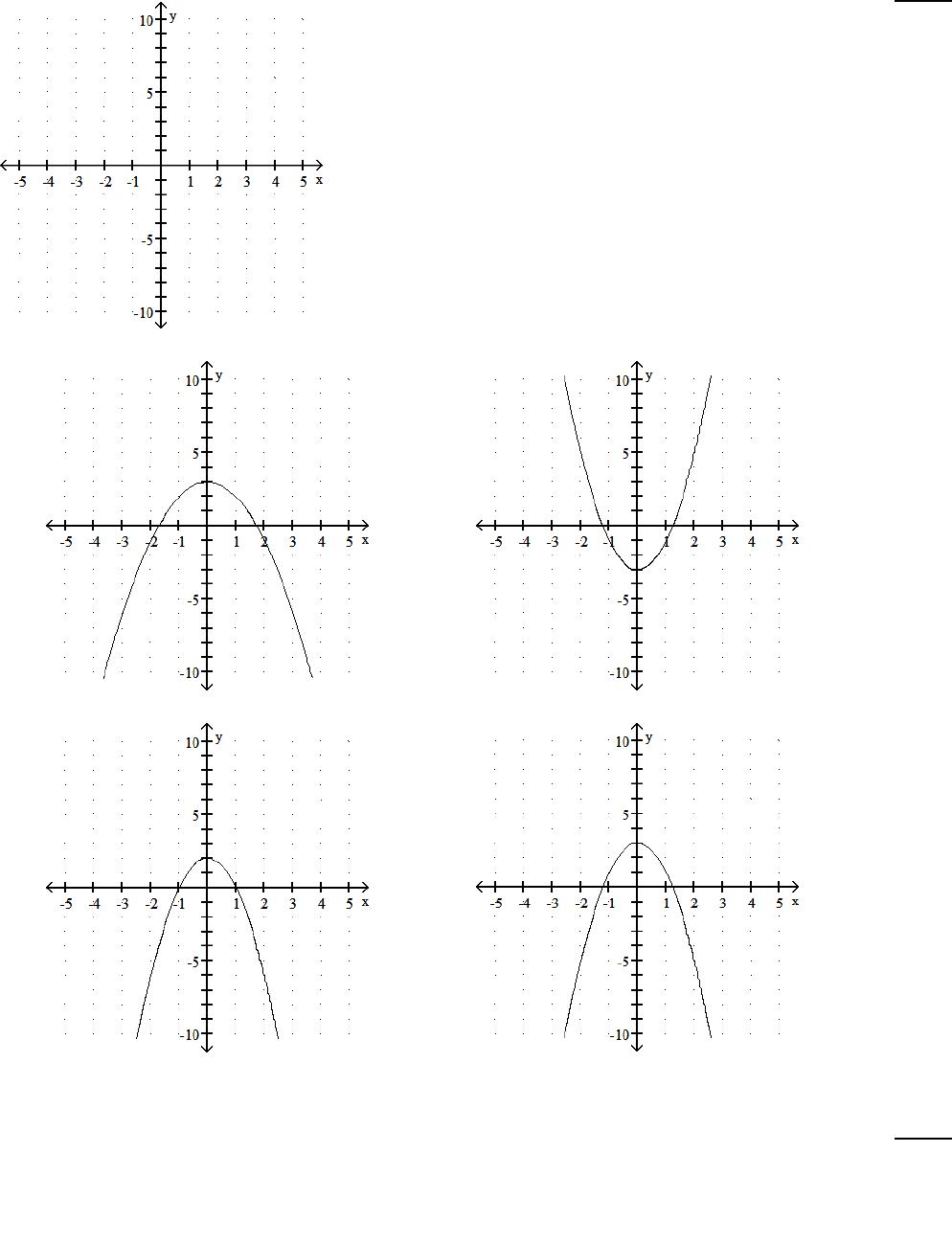
231)
g(x) = –2x2+3
231)
A)
B)
C)
D)
Solve the problem.
232)
A retailer knows that n games can be sold in a month at a price of 30 – 0.1n dollars per game.
Assume that he buys each game for $22, and sells everyone that he buys. If he wishes to make a
profit of at least $150 per month on sales of this game, how many games must he sell each month?
232)
A)
25
n 40
B)
0 n 30
C)
30
n 50
D)
30
n 80
44
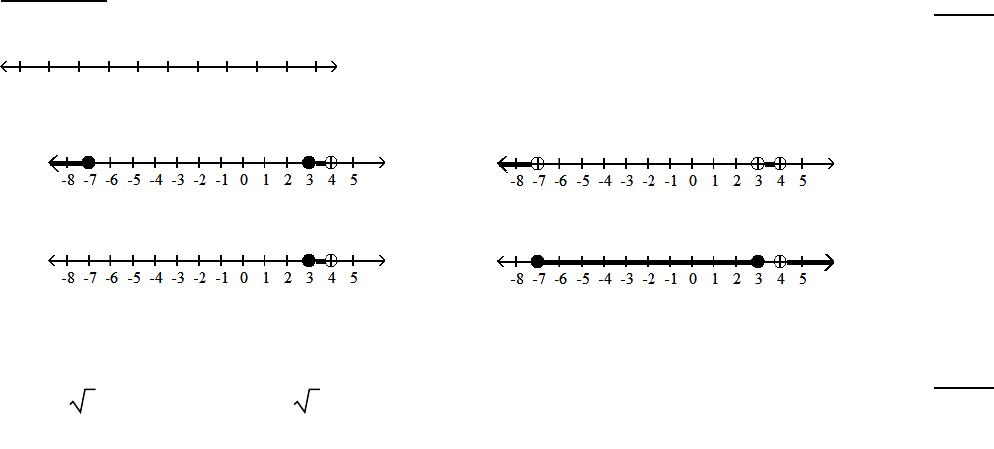
Solve the rational inequality. Write the solution set using interval notation; then graph the solution set on a number line.
233)
(x – 3)(x + 7)
x – 4 0
233)
A)
(–
, –7] [3, 4)
B)
(–
, –7) (3, 4)
C)
[3, 4)
D)
[–7, 3] (4,
)
Solve.
234)
x2=24
234)
A)
±6 2
B)
±2 6
C)
±12
D)
576
45
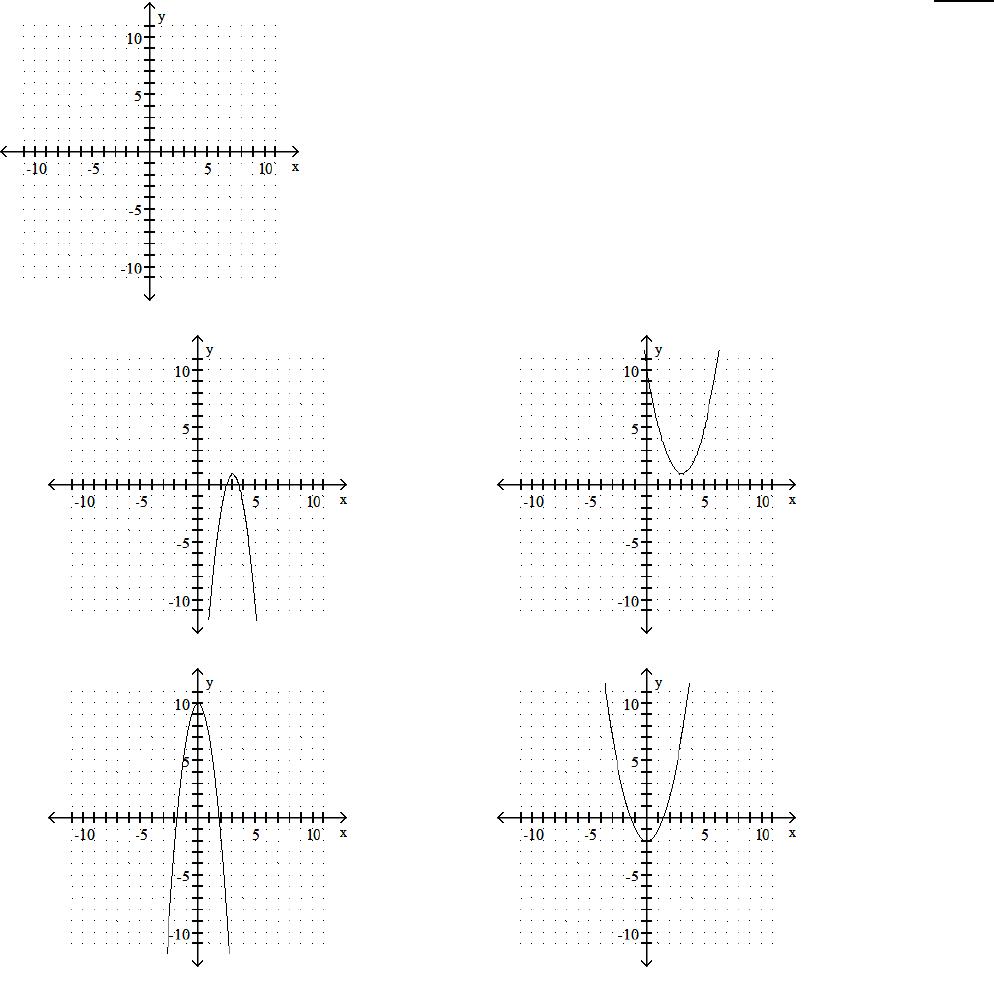
Graph.
235)
f(x) =-3(x – 3)2+ 1
235)
A)
B)
C)
D)
46
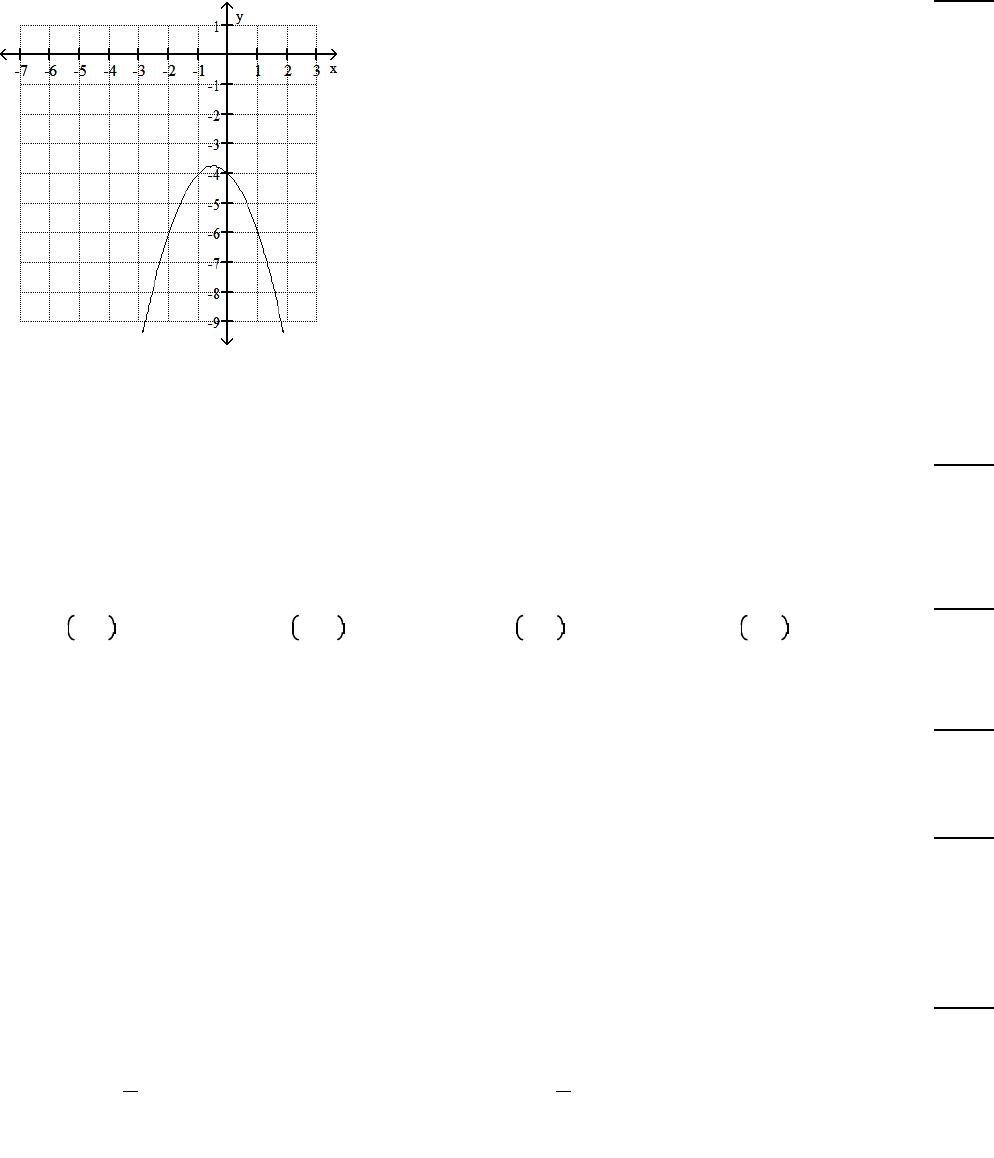
Use the graph of a quadratic function to find the solution set of the equation or inequality. For a solution set that involves
an interval, use interval notation.
236)
–x2–1x –4 0
236)
A)
(–
, 4) (4,
)
B)
C)
x =4
D)
(–
,
)
Solve the equation by completing the square.
237)
w2+ 12w =– 27
237)
A)
3, 9
B)
±3
C)
-3, -9
D)
36,-9
Find the term that should be added to the expression to form a perfect square trinomial. Write the resulting perfect square
trinomial in factored form.
238)
x2– 6x
238)
A)
0; x – 3 2
B)
9; x + 3 2
C)
9; x – 3 2
D)
9; x – 6 2
Solve. Use a calculator to approximate the irrational solutions to three places.
239)
(x + 3)2=14
239)
A)
±4.123
B)
±3.317
C)
0.742
D)
0.742, -6.742
Solve the problem.
240)
If a rocket is propelled upward from ground level, its height h in meters after t sec is given by
h(t) = -9.8t2+ 98t. During what interval of time will the rocket be higher than 235.2 m?
240)
A)
0 sec < t <6 sec
B)
4 sec < t <6 sec
C)
0 sec < t <4 sec
D)
8 sec < t <10 sec
Find the x– and y–intercepts. If no x–intercepts exist, state so.
241)
f(x) = 2x2– 19x + 42
241)
A)
(7, 0), (3, 0), (0,-42)
B)
(7, 0), (3, 0), (0,42)
C)
(6, 0), (–7
2, 0), (0,-42)
D)
(6, 0), (7
2, 0), (0,42)
47
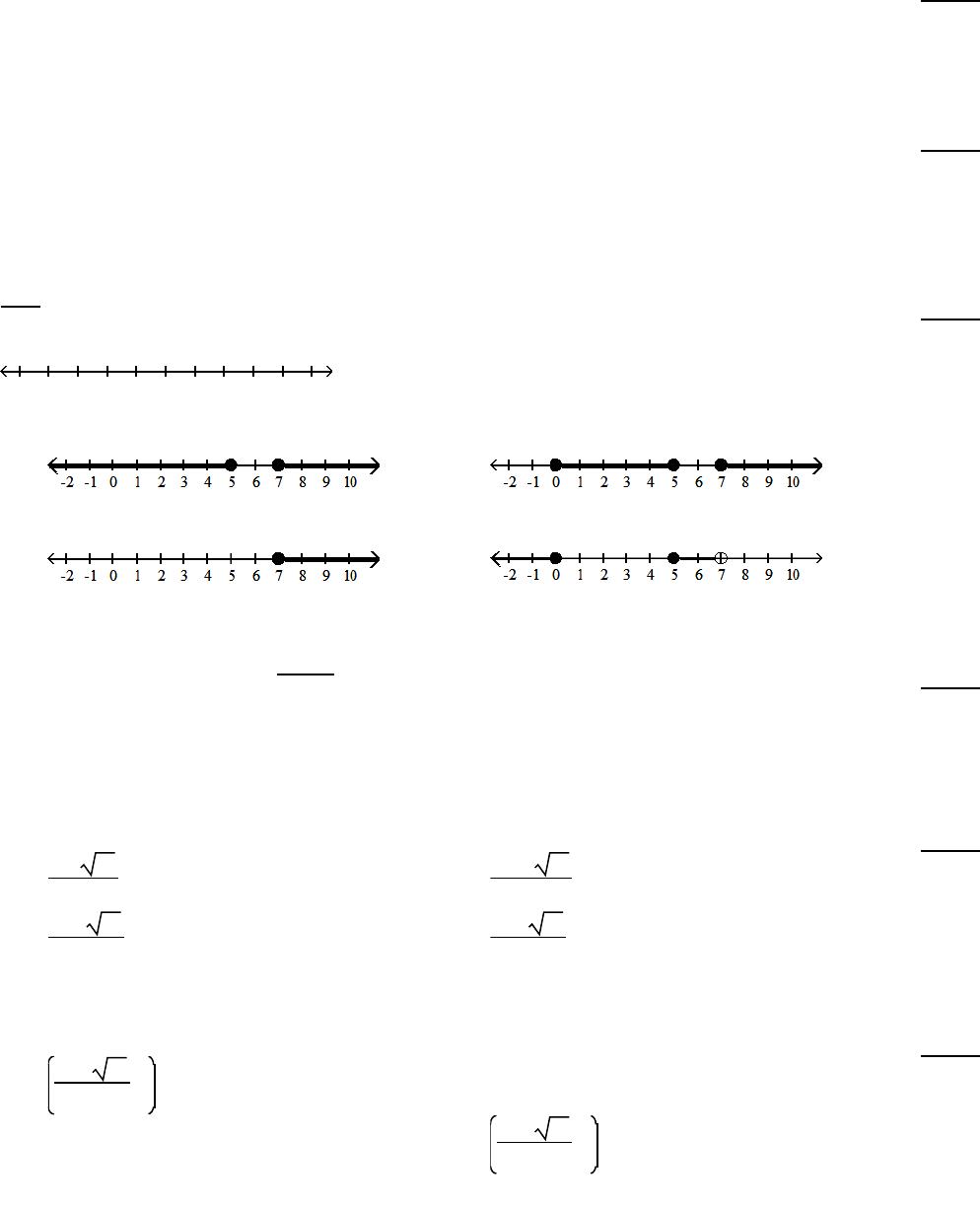
Solve the problem.
242)
A coin is tossed upward from a balcony 242 ft high (ho) with an initial velocity (vo) of 16 ft/sec,
according to the formula h(t) = –16t2+vot +ho, where t is time in seconds. During what interval of
time will the coin be at a height of at least 50 ft?
242)
A)
4 sec t 8 sec
B)
3 sec t 4 sec
C)
0 sec t 1 sec
D)
0 sec t 4 sec
243)
Find two consecutive positive integers such that the square of the smaller integer added to seven
times the larger integer is equal to 85.
243)
A)
13, 14
B)
6, 7
C)
–13, –12
D)
No such integers exist.
Solve the rational inequality. Write the solution set using interval notation; then graph the solution set on a number line.
244)
8x
7 – x 4x
244)
A)
(–
, 5] [7,
)
B)
[0, 5] [7,
)
C)
[7,
)
D)
(–
, 0] [5, 7)
Solve the problem.
245)
Consider the rational inequality -8
-x2 – 9> 0. Without doing any work, give the solution set. (Hint:
determine the sign of the numerator and denominator.)
245)
A)
(–9,
)
B)
C)
(–
,–8)
D)
(–
,
)
Solve using the quadratic formula.
246)
8x2+ 7x = –2
246)
A)
7 ±15
16
B)
–7 ± i 15
16
C)
–7 ±15
16
D)
7 ± i 15
16
Find the x– and y–intercepts. If no x–intercepts exist, state so.
247)
y = –x2+ 4x – 16
247)
A)
-4 ±80
2, 0 , (0, -16)
B)
No x–intercepts, (0, -16)
C)
No x–intercepts, (0, 16)
D)
-4 ±80
2, 0 , (0, 16)
48
Determine which of the following methods is the best choice for solving the given equation: factoring, using the
principle of square roots or using the quadratic formula. Then, solve the equation.
248)
x2+ 10x – 24 = 0
248)
A)
Square root principle or factoring; 12, 2
B)
Square root principle; –12 ±2 3
C)
Quadratic formula; -2 ± i 3
D)
Factoring; –12, 2
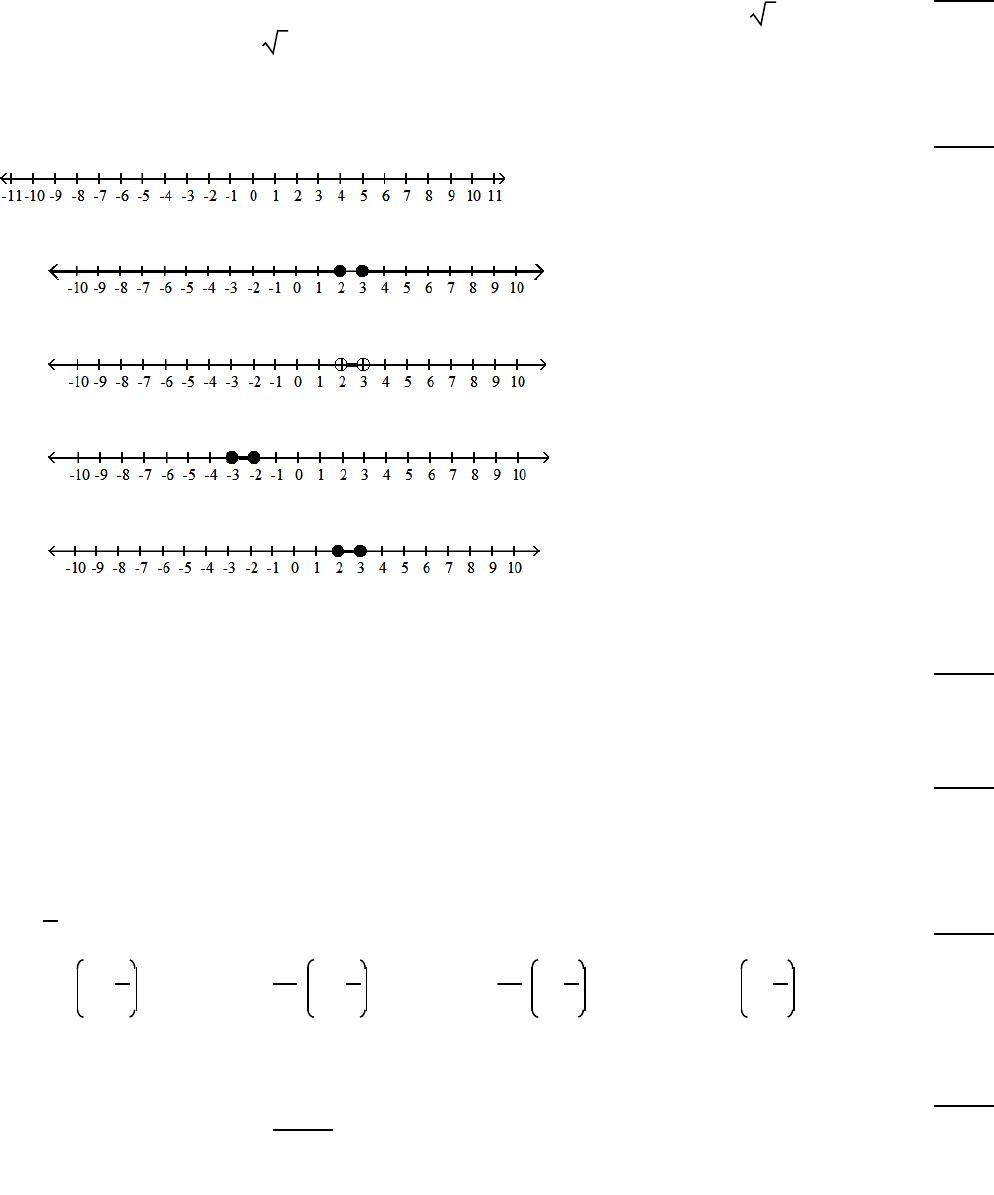
Solve the inequality and write the solution set using interval notation; then graph the solution set on a number line.
249)
x2+ 5x -6
249)
A)
(–
, 2] [3,
)
B)
(2, 3)
C)
[-3, -2]
D)
[2, 3]
Solve.
250)
x2= –100
250)
A)
–10
B)
100i
C)
±10i
D)
±10
Write the equation of the axis of symmetry.
251)
f(x) =0.4x2–4
251)
A)
y =0.2
B)
x =0.2
C)
x = 0
D)
y = 0
Find the term that should be added to the expression to form a perfect square trinomial. Write the resulting perfect square
trinomial in factored form.
252)
x2+ 2
9x
252)
A)
81; x + 1
9
2
B)
1
81; x + 1
9
2
C)
1
81; x – 1
9
2
D)
0; x – 1
9
2
Solve and check. Use the square root principle to eliminate the square.
253)
(2m – 3)2= –121
253)
A)
14, -8
B)
3 ± 11i
2
C)
4, -7
D)
8, -14
49
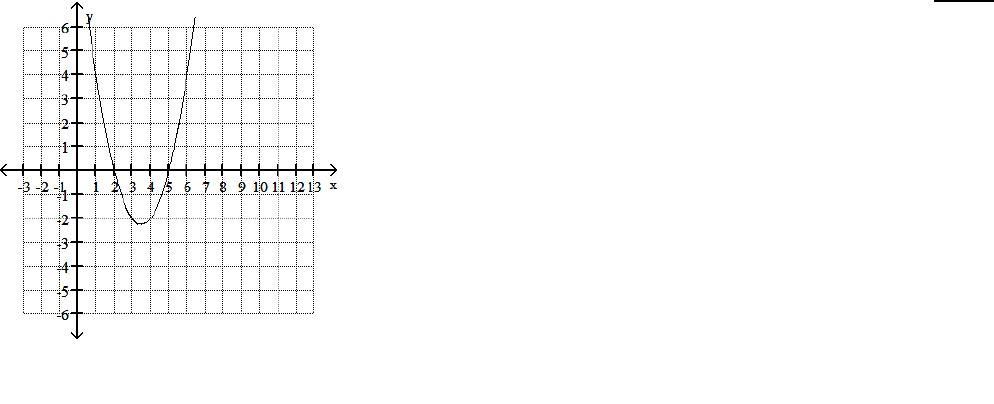
Use the graph of a quadratic function to find the solution set of the equation or inequality. For a solution set that involves
an interval, use interval notation.
254)
x2–7x +10 0
254)
A)
(2, 5)
B)
(–
, 2) (5,
)
C)
[2, 5]
D)
x =2, 5
50
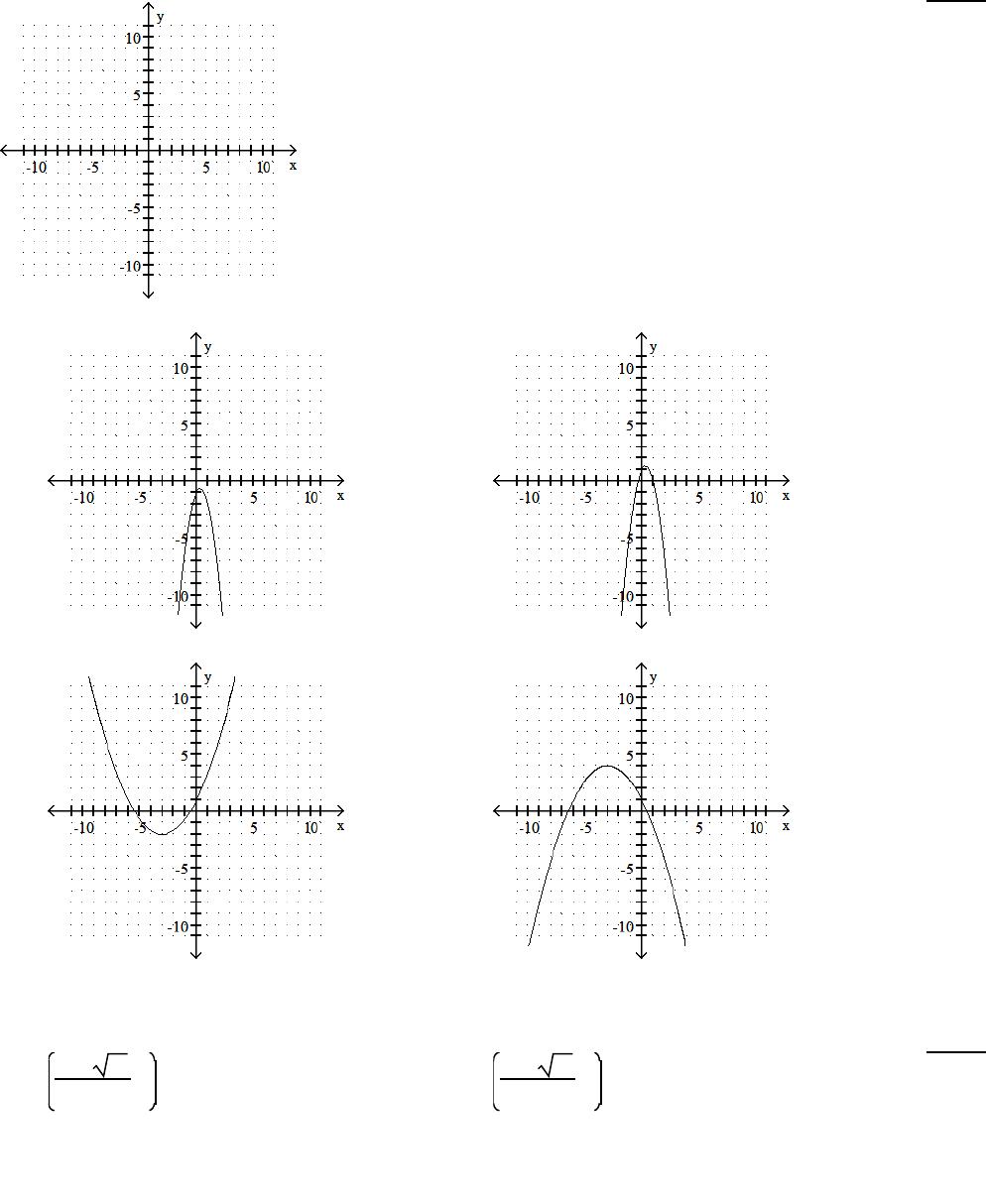
Graph the equation.
255)
h(x) =-3x2+ 2x + 1
255)
A)
B)
C)
D)
Find the x– and y–intercepts. If no x–intercepts exist, state so.
256)
y = x2+ 2x + 3
256)
A)
-2 ±16
2, 0 , (0, 3)
B)
-2 ±16
2, 0 , (0, -3)
C)
No x–intercepts, (0, 3)
D)
No x–intercepts, (0, -3)
51
Solve.
257)
Bob owns a watch repair shop. He has found that the cost of operating his shop is given by
c = 3x2– 192x + 68, where c is the cost in dollars, and x is the number of watches repaired. How
many watches must he repair to have the lowest cost?
257)
A)
68 watches
B)
32 watches
C)
34 watches
D)
30 watches
258)
6x2/5 + 15x1/5 + 9 = 0
258)
A)
–1, –243
32
B)
3, 2
C)
1, 243
32
D)
–1, –3
2
259)
x2=1
16
259)
A)
±1
8
B)
±1
4
C)
1
256
D)
1
32
Solve and check. Use the square root principle to eliminate the square.
260)
(x + 16)2– 6 = 0
260)
A)
16 ±6
B)
-10, 22
C)
–4±6
D)
–16 ±6
Determine which of the following methods is the best choice for solving the given equation: factoring, using the
principle of square roots or using the quadratic formula. Then, solve the equation.
261)
x2+ x + 2 = 0
261)
A)
Factoring; –1, 0
B)
Square root principle; 1 ± 7
2
C)
Quadratic formula; -1 ± i 7
2
D)
Square root principle or factoring; 1, 0
Graph.
262)
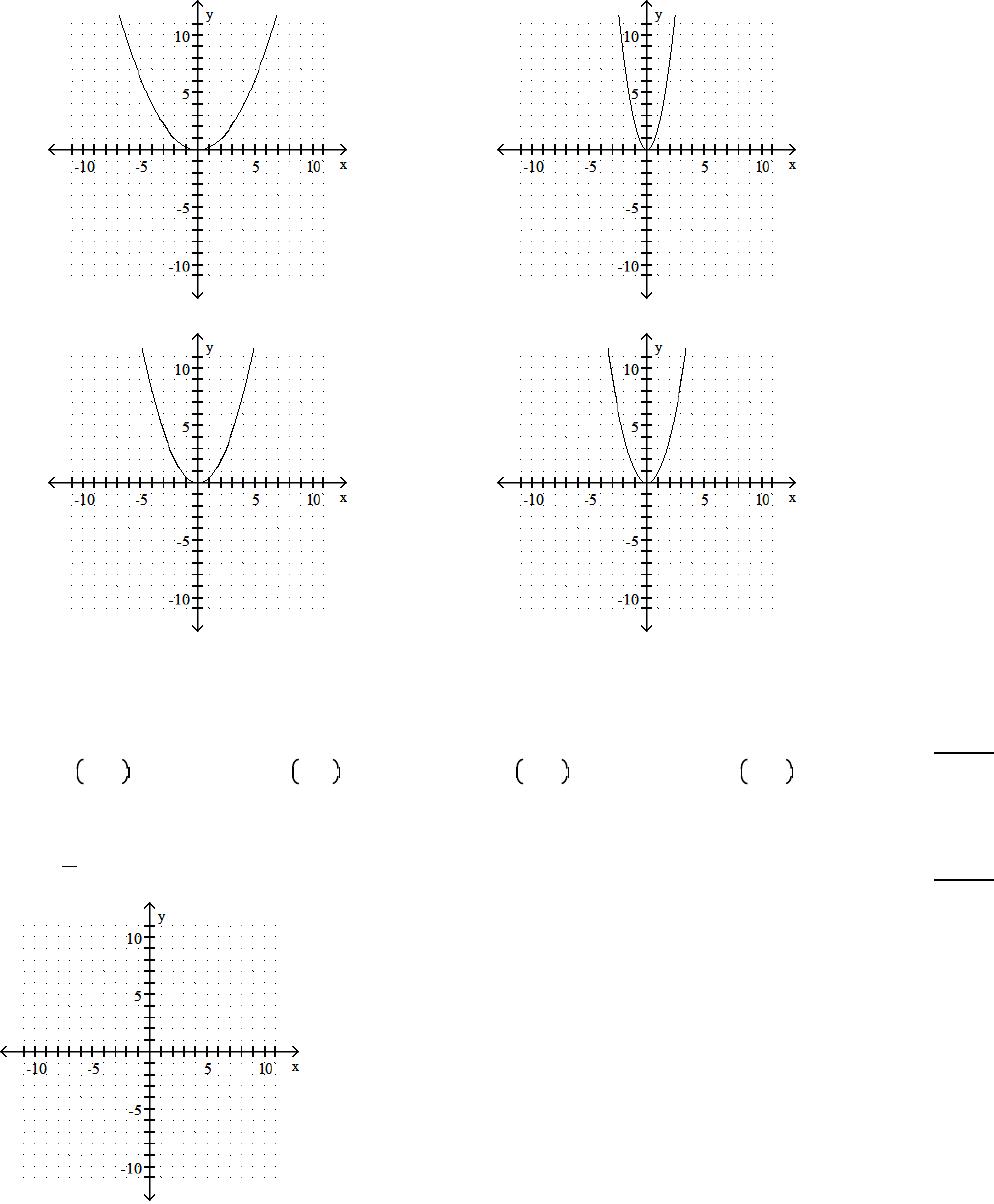
f(x) =1
2x2
262)
52
A)
B)
C)
D)
Find the term that should be added to the expression to form a perfect square trinomial. Write the resulting perfect square
trinomial in factored form.
263)
x2+ 6x
263)
A)
36; x + 6 2
B)
9; x – 3 2
C)
0; x + 3 2
D)
9; x + 3 2
Graph.
264)
f(x) =– 1
6 (x – 3)2+ 5
264)
53
A)
B)
C)
D)
Write the equation of the axis of symmetry.
265)
f(x) =2x2– 16x + 27
265)
A)
x =5
B)
x = –5
C)
x =-4
D)
x =4
266)
f(x) =6x2– 120x + 608
266)
A)
x =-8
B)
x =10
C)
x =8
D)
x = 0
Use the discriminant to determine the number and type of solutions for the equation. If the solution(s) are real, state
whether they are rational or irrational.
267)
s2– 7s + 6 = 0
267)
A)
Two rational solutions
B)
One rational solution
C)
Two irrational solutions
D)
Two nonreal complex solutions
54
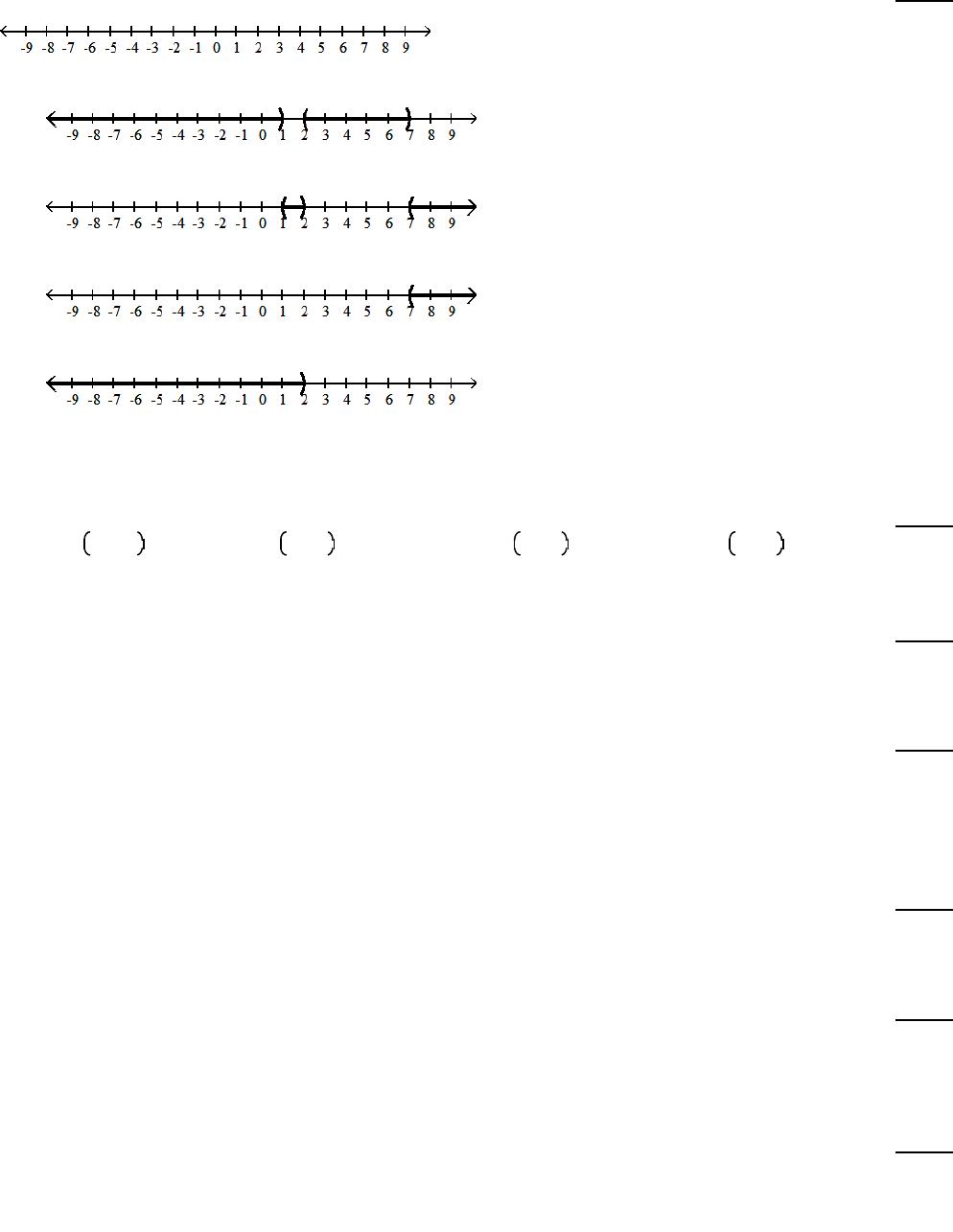
Solve the inequality and write the solution set using interval notation; then graph the solution set on a number line.
268)
(c – 1)(c – 2)(c – 7) > 0
268)
A)
(–
, 1) (2, 7)
B)
(1, 2) (7,
)
C)
(7,
)
D)
(–
, 2)
Find the term that should be added to the expression to form a perfect square trinomial. Write the resulting perfect square
trinomial in factored form.
269)
x2– 20x
269)
A)
100; x + 10 2
B)
0; x – 10 2
C)
100; x – 20 2
D)
100; x – 10 2
Solve using the quadratic formula.
270)
x2–4x +13 = 0
270)
A)
2±3i
B)
–2±3i
C)
4±6i
D)
5, -1
Solve the problem.
271)
A rectangular enclosure must have an area of at least 3600 yd2. If 260 yd of fencing is to be used,
and the width cannot exceed the length, within what limits must the width of the enclosure lie?
271)
A)
0 yd
width 40 yd
B)
40 yd width 90 yd
C)
65 yd width 90 yd
D)
40 yd width 65 yd
Solve and check. Begin by using the addition or multiplication principles of equality to isolate the squared term.
272)
8z2+ 2 =650
272)
A)
±9
B)
±10
C)
325
D)
9
Provide an appropriate response.
273)
True or false? The equation –x2=– 121 has no real solutions. If false, give the solution or solutions.
273)
A)
True
B)
False; 11 and -11
C)
False; 11
D)
False; -11
Solve and check. Use the square root principle to eliminate the square.
274)
(x – 3)2=49
274)
A)
-4, -10
B)
10, -4
C)
±7
D)
52
55
Find the term that should be added to the expression to form a perfect square trinomial. Write the resulting perfect square
trinomial in factored form.
275)
x2+ 20x
275)
A)
100; x – 10 2
B)
0; x + 10 2
C)
100; x + 10 2
D)
400; x + 20 2
Write the equation of the axis of symmetry.
276)
f(x) = –(x + 5)2+ 7
276)
A)
x =6
B)
x =-5
C)
x =7
D)
x =25
Solve the problem.
277)
Assume that the profit P made when t units are sold, t > 0, is given by P(t) = t2– 22t + 112. For what
values of t will there be a profit (that is, P > 0)?
277)
A)
t =22
B)
0 < t <8 or t >14
C)
8< t <14
D)
t =8 or t =14
Use the discriminant to determine the number and type of solutions for the equation. If the solution(s) are real, state
whether they are rational or irrational.
278)
v2+ 7v + 3 = 0
278)
A)
Two rational solutions
B)
Two nonreal complex solutions
C)
Two irrational solutions
D)
One rational solution
Solve the equation.
279)
3x + 10 = 5 – 2x
279)
A)
5
4, 9
B)
3
4, 5
C)
5
D)
3
4
56
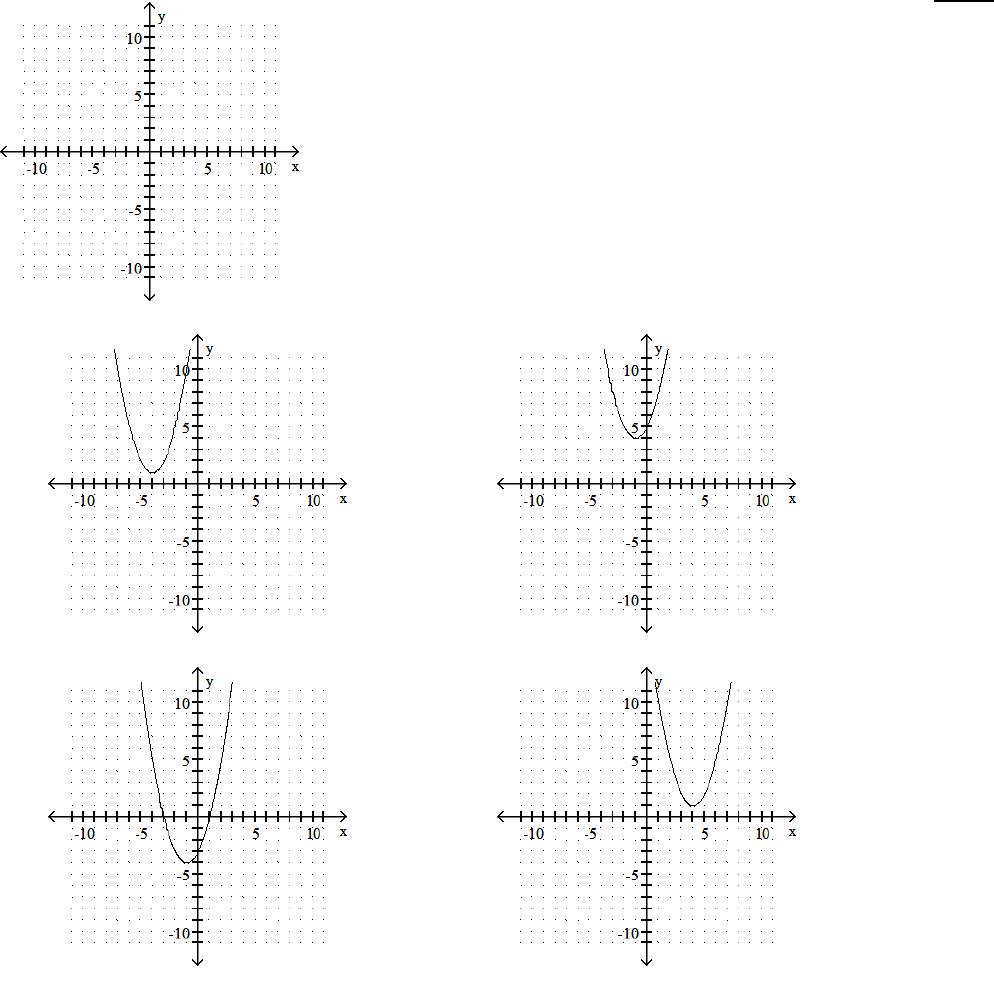
Graph.
280)
f(x) =(x – 4)2+1
280)
A)
B)
C)
D)
57
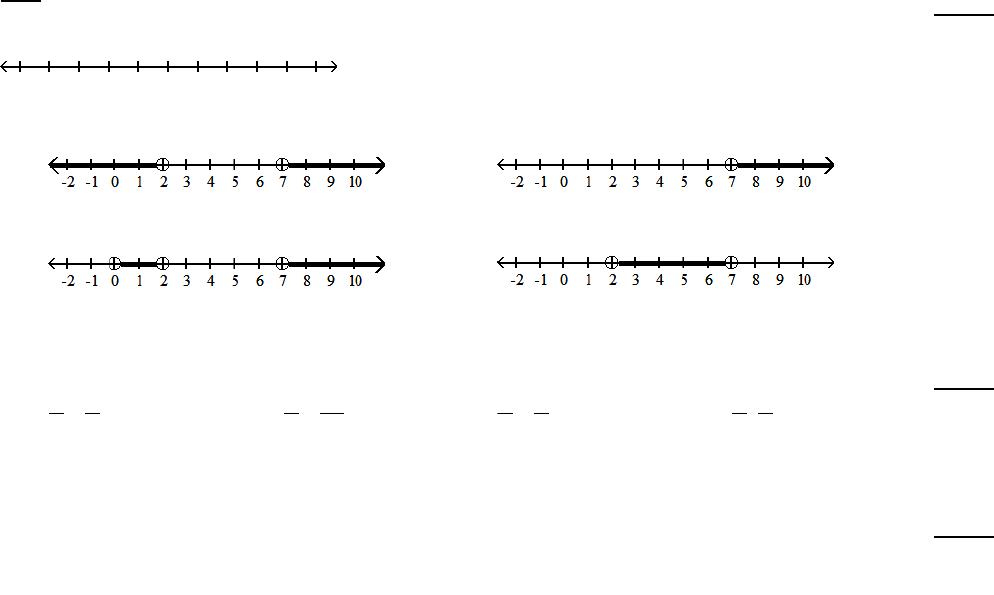
Solve the rational inequality. Write the solution set using interval notation; then graph the solution set on a number line.
281)
5x
7 – x < x
281)
A)
(–
, 2) (7,
)
B)
(7,
)
C)
(0, 2) (7,
)
D)
(2, 7)
Solve the equation by completing the square.
282)
4w2– 35 =4w
282)
A)
7
4, – 5
4
B)
– 5
2, – 15
2
C)
7
2, – 5
2
D)
– 7
2, 5
2
Solve using the quadratic formula. Use a calculator to approximate the solution to three decimal places.
283)
0.1x2– 0.2x – 0.2= 0
283)
A)
-0.732, 2.732
B)
0.268
C)
0.268, 3.732
D)
2.732
58
Answer Key
Testname: C9
59
Answer Key
Testname: C9
Answer Key
Testname: C9
61
Answer Key
Testname: C9
62
Answer Key
Testname: C9
63
Answer Key
Testname: C9
64
Answer Key
Testname: C9
65