Larson_Calculus_10e ch09sec02
MULTIPLE CHOICE
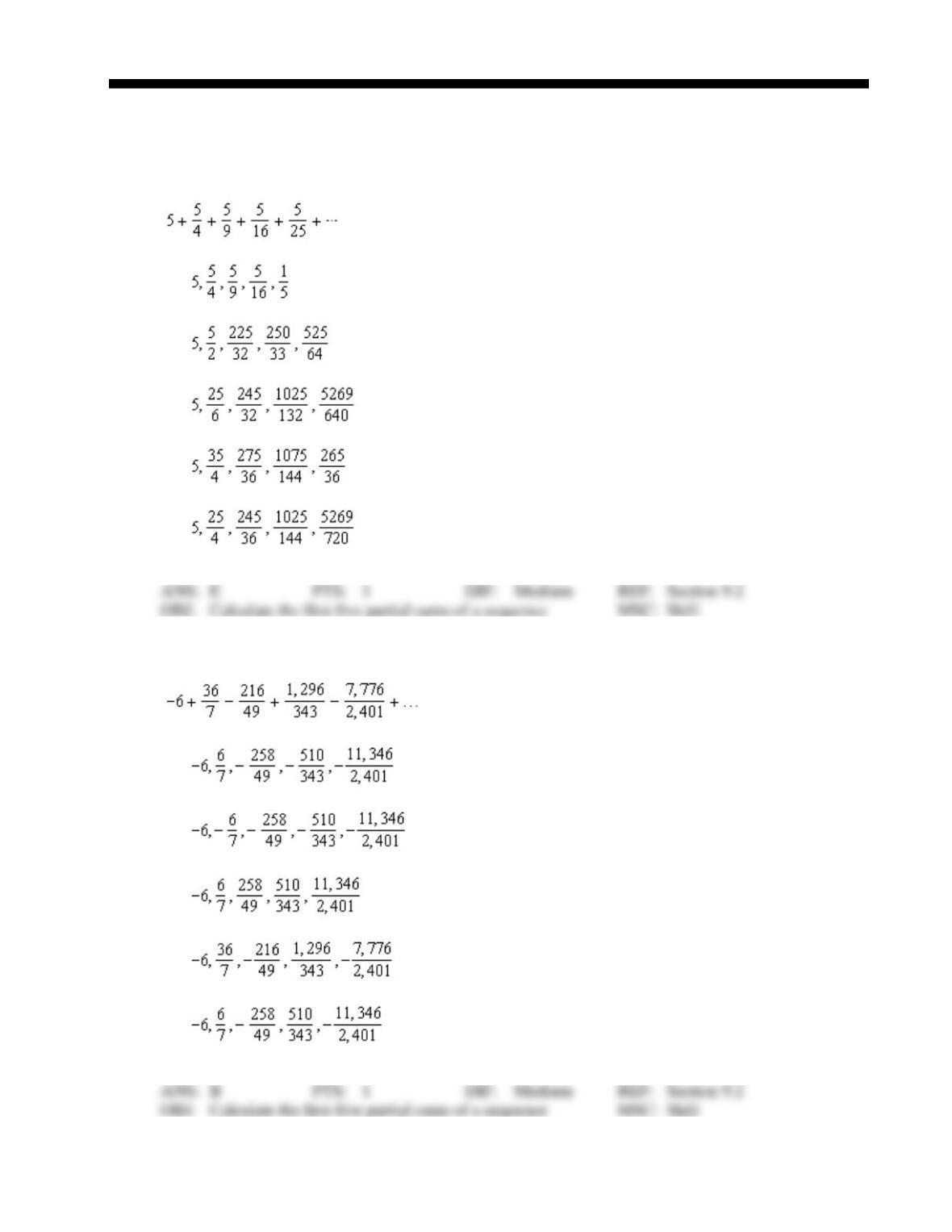
1. Write the first five terms of the sequence of partial sums.
a.
b.
c.
d.
e.
2. Write the first five terms of the sequence of partial sums.
a.
b.
c.
d.
e.
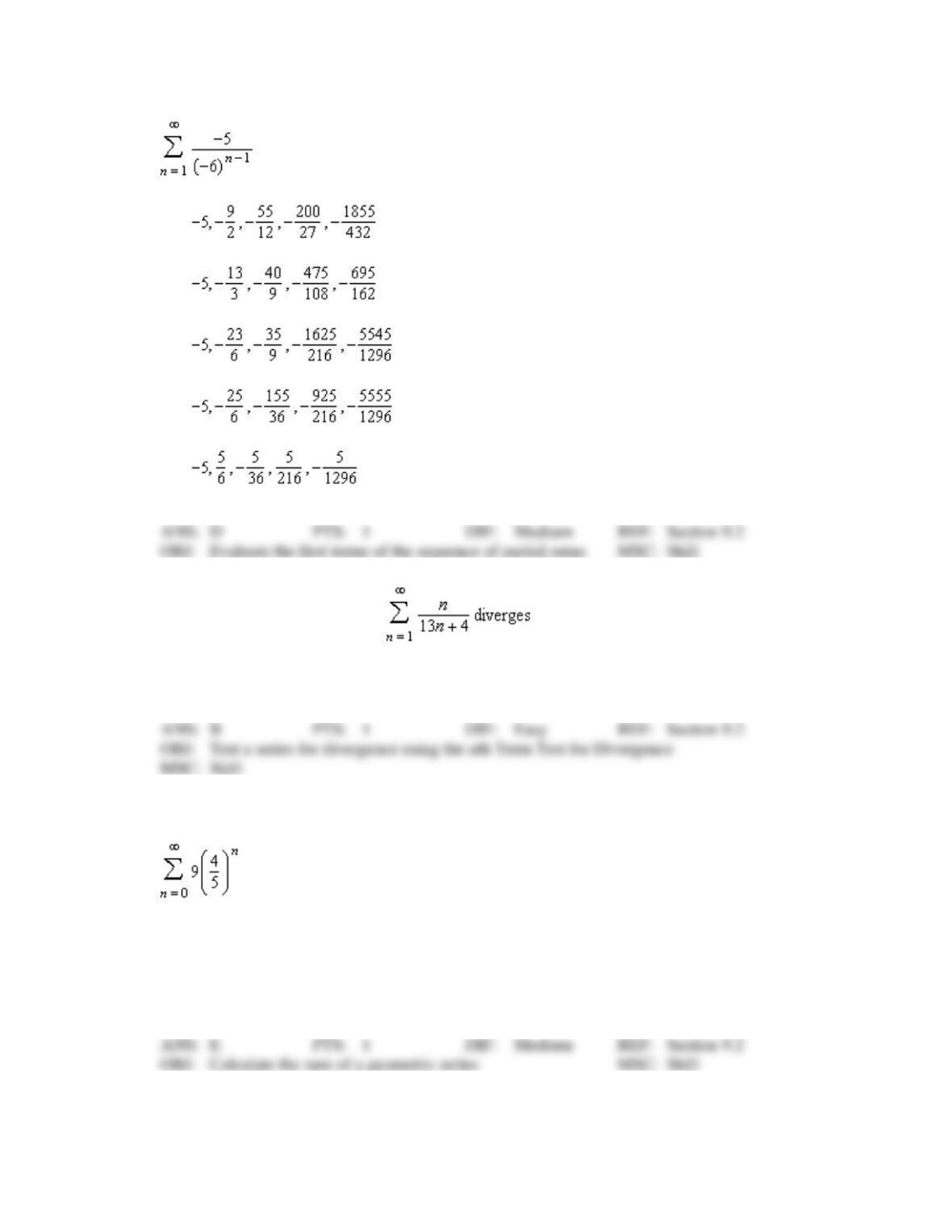
3. Write the first five terms of the sequence of partial sums.
a.
b.
c.
d.
e.
4. True or false. The infinite series .
a.
false
b.
true
5. Find the sum of the convergent series.
a.
4
b.
36
c.
9
d.
27
e.
45
6. Find the sum of the convergent series.
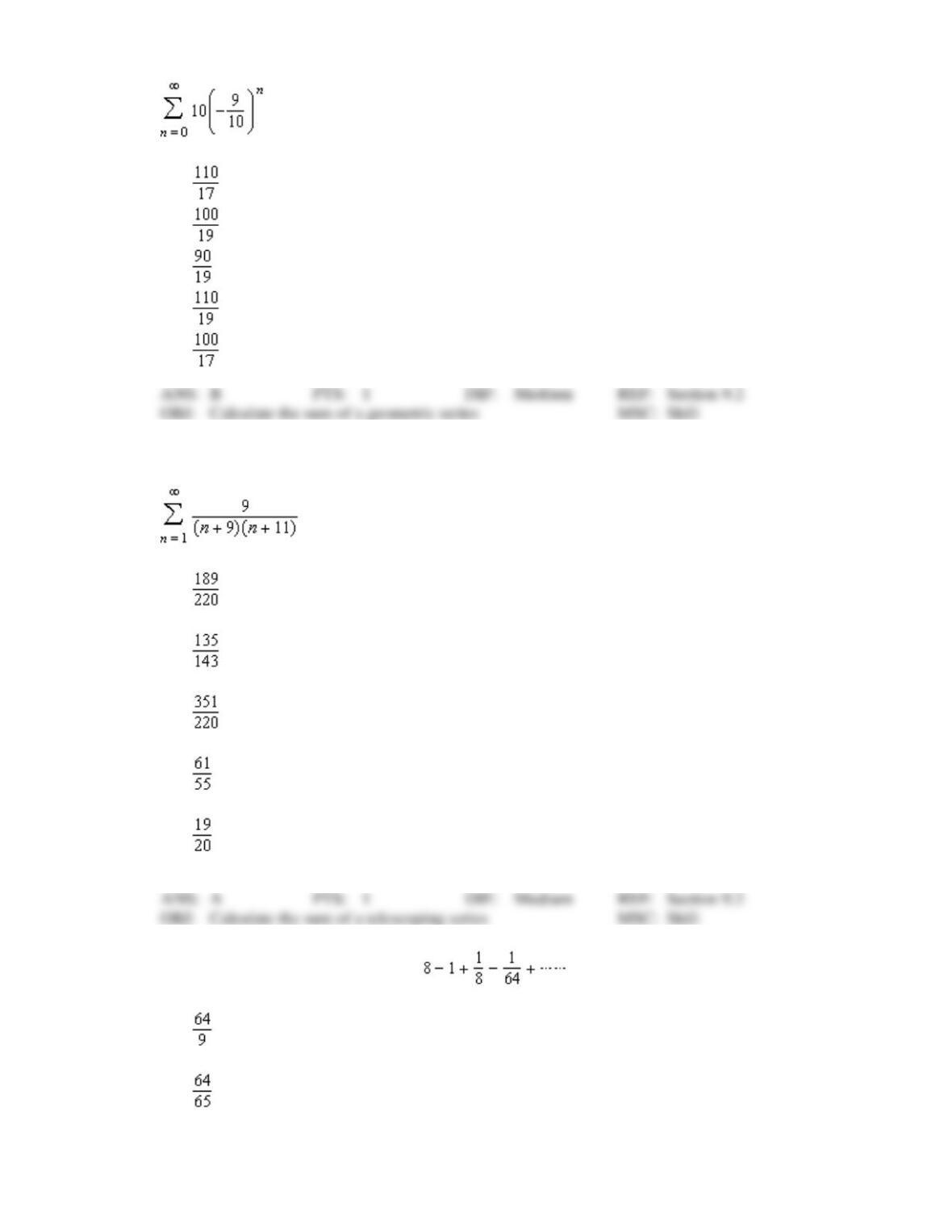
a.
b.
c.
d.
e.
7. Find the sum of the convergent series.
a.
b.
c.
d.
e.
8. Find the sum of the convergent series
a.
b.
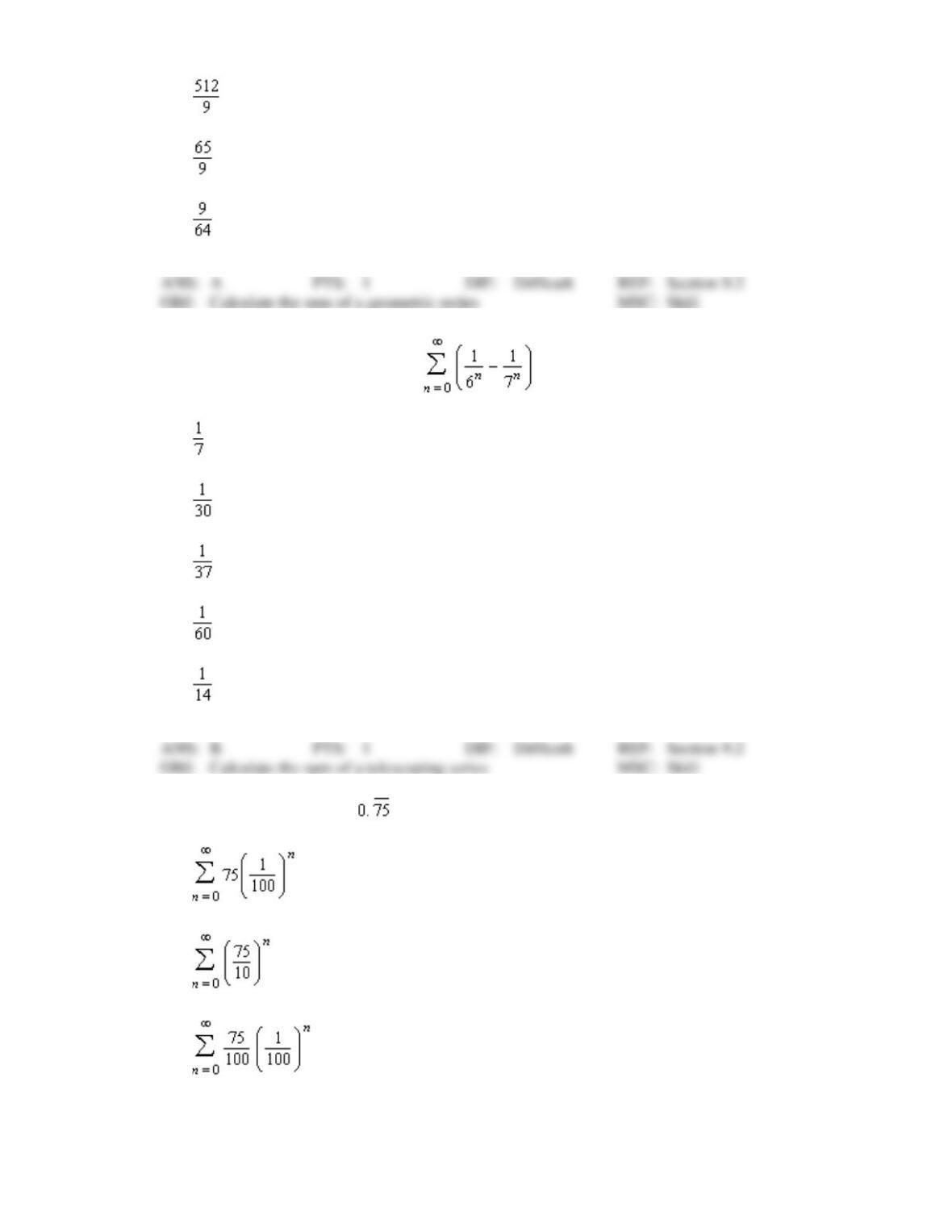
c.
d.
e.
9. Find the sum of the convergent series .
a.
b.
c.
d.
e.
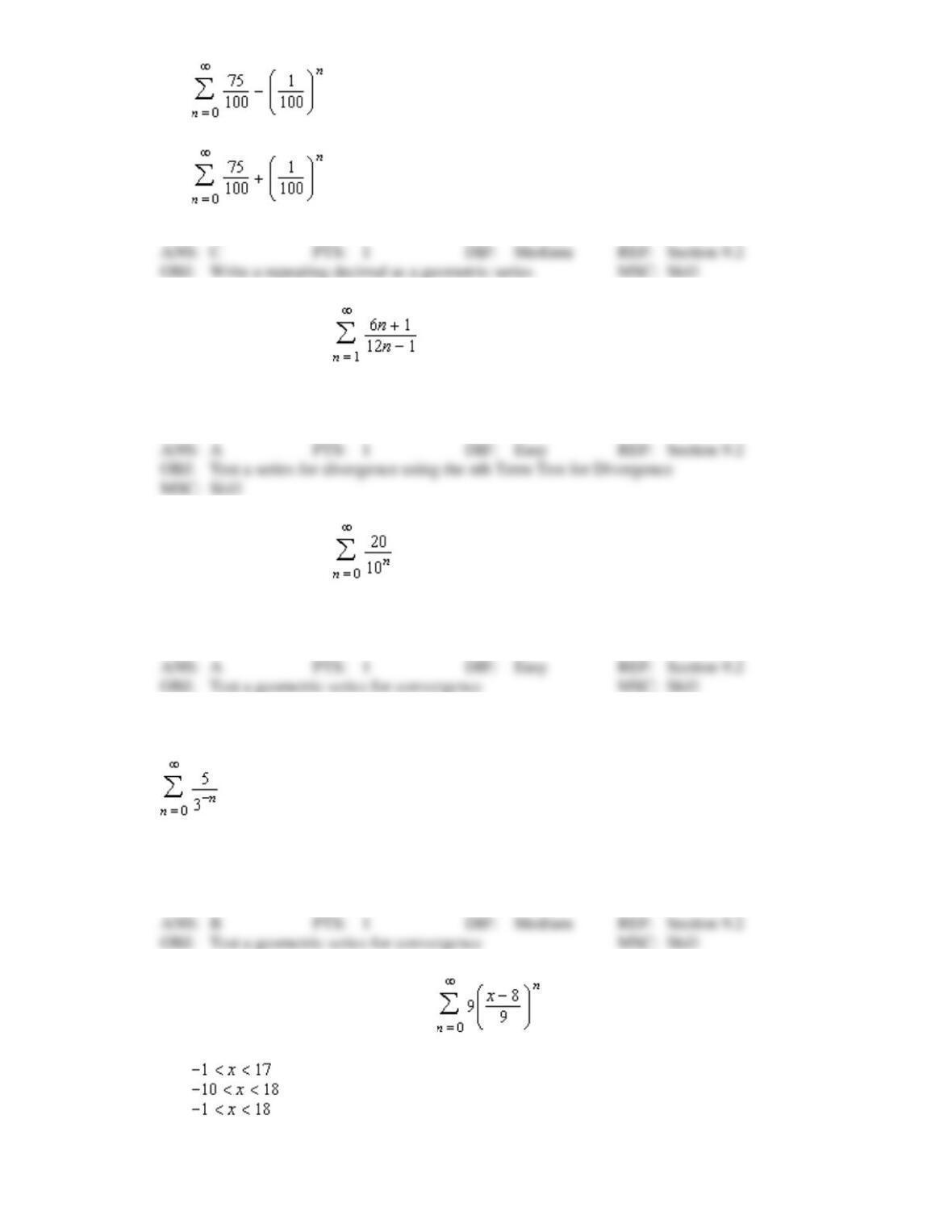
10. Write the repeating decimal as a geometric series.
a.
b.
c.
d.
e.
11. True or false. The series is convergent.
a.
false
b.
true
12. True or false. The series is divergent.
a.
false
b.
true
13. Determine the convergence or divergence of the series.
a.
cannot be determined from the methods in the chapter
b.
Diverges
c.
Converges
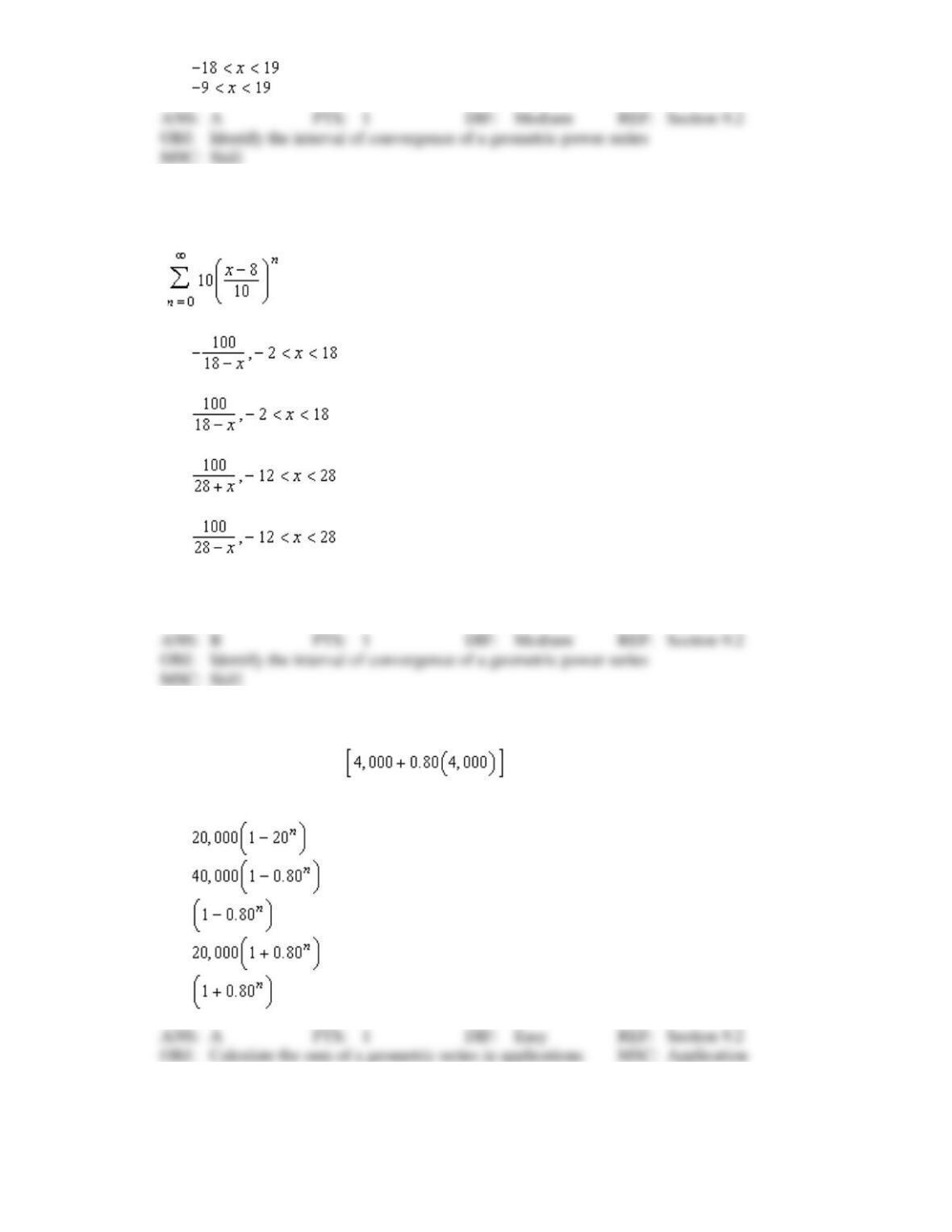
14. Find all values of x for which the series converges.
a.
b.
c.
d.
e.
15. Find all values of x for which the series converges. For these values of x, write the sum of the series as
a function of x.
a.
b.
c.
d.
e.
The series diverges for all x.
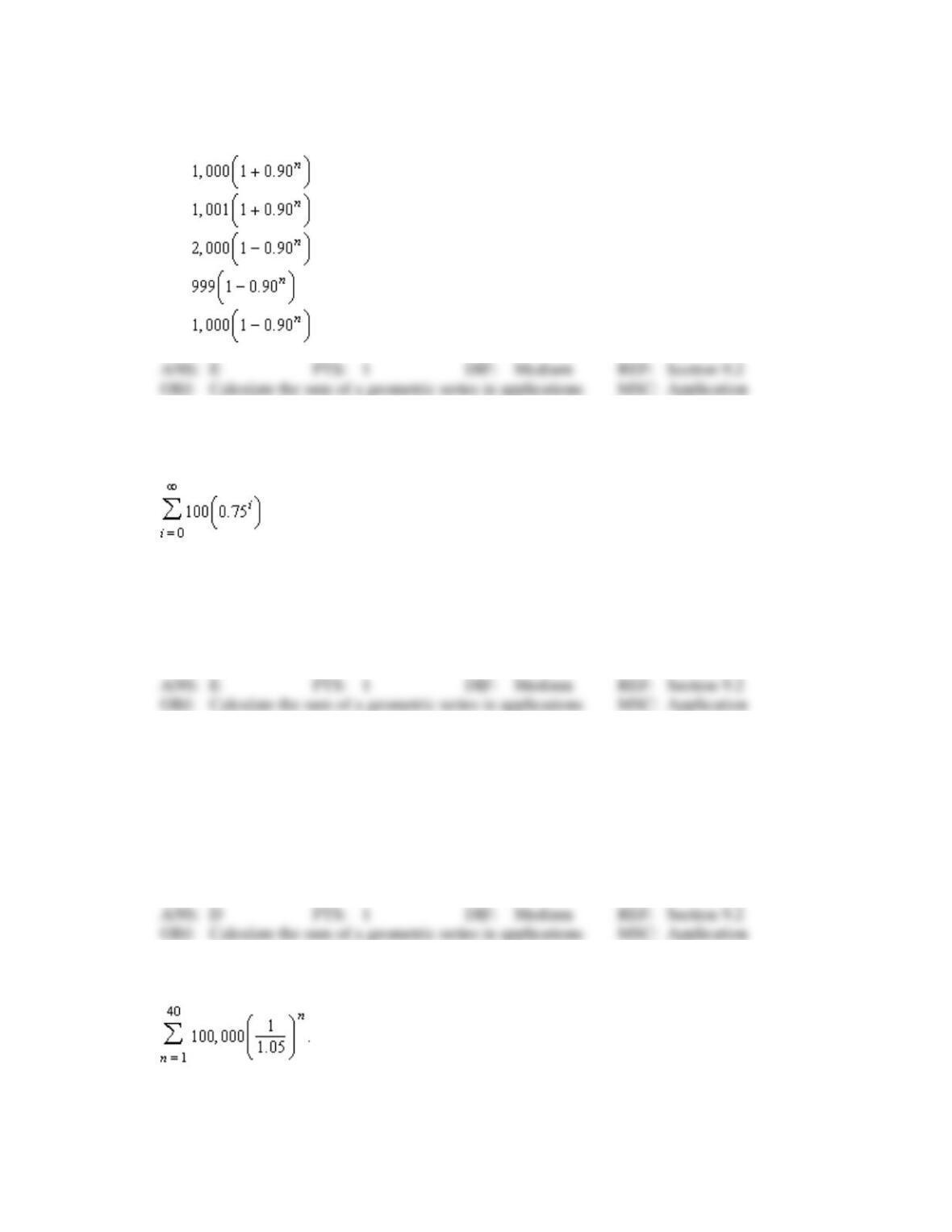
16. Suppose an electronic games manufacturer producing a new product estimates the annual sales to be
4,000 units. Each year 20% of the units that have been sold will become inoperative. So, 4,000 units
will be in use after 1 year, units will be in use after 2 years, and so on. How
many units will be in use after n years?
a.
units
b.
units
c.
units
d.
units
e.
units
17. Suppose the annual spending by tourists in a resort city is $100 million. Approximately 90% of that
revenue is again spent in the resort city, and of that amount approximately 90% is again spent in the
same city, and so on. Write the expression that gives the total amount of spending generated by the
$100 million after n years.
a.
million dollars
b.
million dollars
c.
million dollars
d.
million dollars
e.
million dollars
18. Suppose the annual spending by tourists in a resort city is $100 million. Approximately 75% of that
revenue is again spent in the resort city, and of that amount approximately 75% is again spent in the
same city, and so on. Summing all of this spending indefinitely, leads to the geometric series
. Find the sum of this series.
a.
$800 million
b.
$401 million
c.
$200 million
d.
$801 million
e.
$400 million
19. Suppose a ball is dropped from a height of 16 feet. Each time it drops h feet, it rebounds 0.85h feet.
Find the total distance traveled by the ball. Round your answer to two decimal places.
a.
229.33 feet
b.
410.67 feet
c.
181.33 feet
d.
197.33 feet
e.
213.33 feet
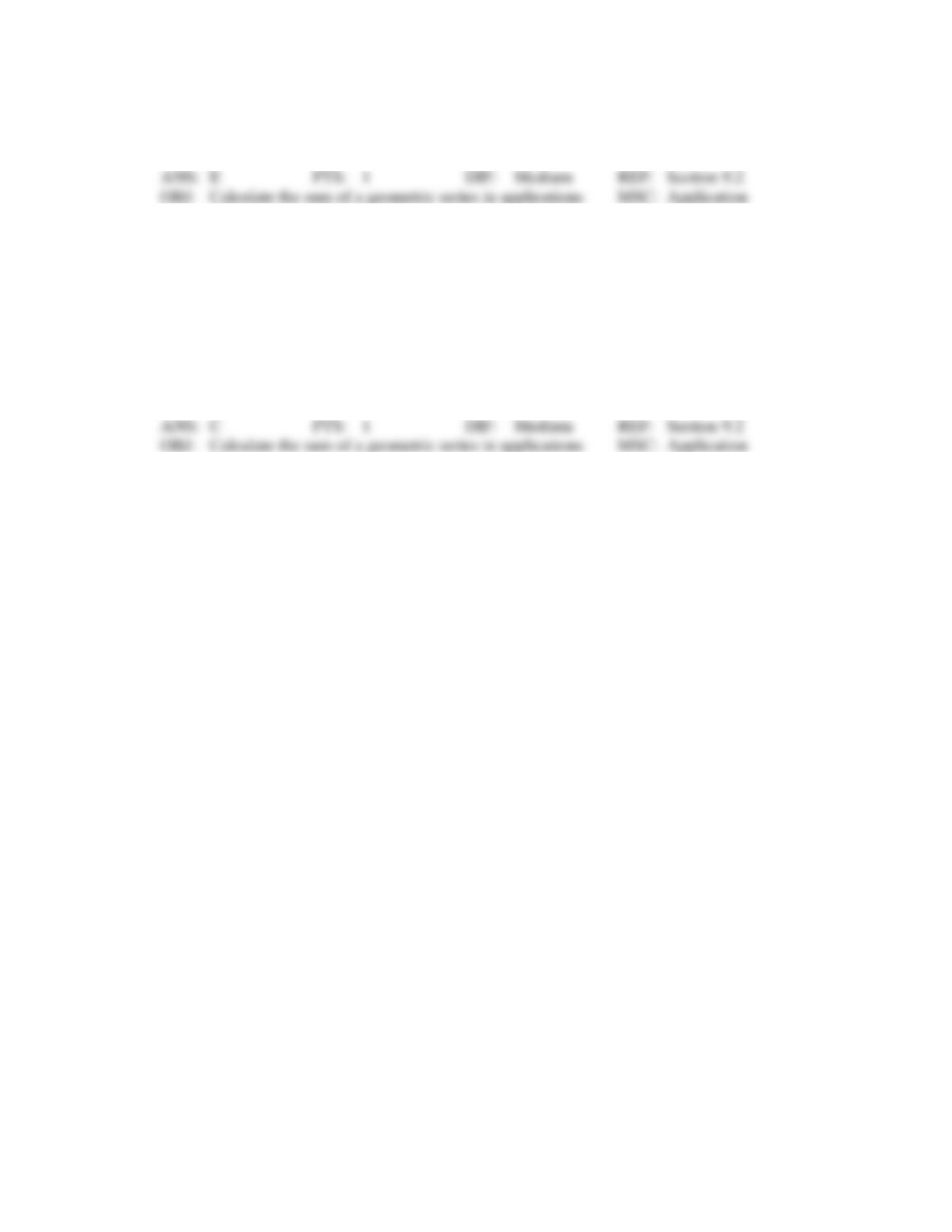
20. Suppose the winner of a $4,000,000 sweepstakes will be paid $100,000 per year for 40 years, starting a
year from now. The money earns 5% interest per year. The present value of the winnings is
Compute the present value using the formula for the nth partial sum of a
geometric series. Round your answer to two decimal places.
a.
$6,852,274.09
b.
$1,959,646.05
c.
$4,568,182.73
d.
$1,246,221.03
e.
$1,715,908.64
21. Suppose you go to work at a company that pays $0.08 for the first day, $0.16 for the second day, $0.32
for the third day, and so on. If the daily wage keeps doubling, what would your total income be for
working 29 days? Round your answer to two decimal places.
a.
$21,474,836.48
b.
$10,737,418.24
c.
$42,949,672.88
d.
$171,798,691.52
e.
$85,899,345.76