Page 1
1.
Find
( )
(–2)fg
where
( ) –4 +8f x x=
and
2
( ) 10 – 2g x x=
.
2.
Find
( )
(3)fg
where
( ) –9 + 2f x x=
and
2
( ) 3 – 6g x x=
.
3.
Find
( )
(3)gf
where
( ) –4 – 2f x x=
and
2
( ) –8 –1g x x=
4.
Find
( )
(3)gf
where
( ) 2 – 4f x x=
and
2
( ) 9 +5g x x=
5.
Evaluate
( )
(2)fg
where
6
() 5 – 3
fx x
=
and
( ) –1+ 2g x x=
.
Give an exact answer in the form of a reduced fraction.
6.
Evaluate
( )
(–8)fg
where
1
() –6
fx x
=
and
( ) –7 +3g x x=
.
Give a decimal answer. Round your answer to 2 decimal places, if necessary.
7.
Evaluate
( )
(1)fg
where
7
() 2 – 3
fx x
=
and
( ) –6 + 5g x x=
.
Give an exact answer in the form of a reduced fraction.
8.
Evaluate
( )
(6)fg
where
5
() 3 – 4
fx x
=
and
( ) 5 – 2g x x=
.
Give a decimal answer. Round your answer to 2 decimal places, if necessary.
9.
Find
( )
()f g x
where
( ) –6 + 6f x x=
and
2
( ) –10 + 5g x x=
10.
Find
( )
()f g x
where
( ) 4 – 2f x x=
and
2
( ) –6 – 9g x x=
11.
Find
( )
()g f x
where
( ) 3 – 3f x x=
and
2
( ) –8 – 9g x x=
Page 2
12.
Find
( )
()g f x
where
( ) 4 – 2f x x=
and
2
( ) – + 7g x x=
13.
Evaluate
( )
(–4)gf
where
7
() 5 – 6
fx x
=
and
( ) 5 – 2g x x=
.
Give an exact answer in the form of a reduced fraction.
14.
Evaluate
( )
(–7)gf
where
7
() +5
fx x
=
and
( ) 4 – 5g x x=
.
Give a decimal answer. Round your answer to 2 decimal places, if necessary.
15.
Evaluate
( )
(6)gf
where
4
() 2 +1
fx x
=
and
( ) –8+ 4g x x=
.
Give an exact answer in the form of a reduced fraction.
16.
Evaluate
( )
(8)gf
where
9
() 5 + 4
fx x
=
and
( ) 6 –g x x=
.
Give a decimal answer. Round your answer to 2 decimal places, if necessary.
17.
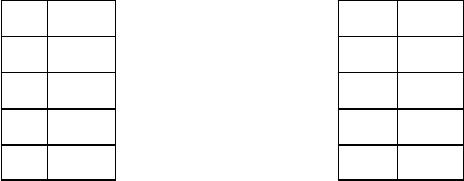
Use the tables to evaluate
( )
(–5)gf
.
()
–10 10
–6 –4
–5 3
0 –5
x f x
()
–5 7
15
–3 2
3 –8
x g x
Page 3
18.
Use the tables to evaluate
( )
(8)fg
.
()
8 –2
0 –5
–3 3
31
x f x
()
–10 10
10 8
–4 –2
83
x g x
19.
Use the table to determine whether or not the function is one-to-one.
x
f(x)
–9
1
–10
5
–1
–10
–3
–4
5
–8
A)
()fx
is one-to-one.
B)
()fx
is not one-to-one.
20.
Use the table to determine whether or not the function has an inverse.
x
f(x)
1
–3
3
3
–1
9
–8
–9
–4
–5
A)
()fx
does not have an inverse.
B)
()fx
has an inverse.
21.
Use the table to determine evaluate
1(–7)f−
.
x
f(x)
–1
–3
2
3
–10
0
–3
–9
7
6
Page 4
22.
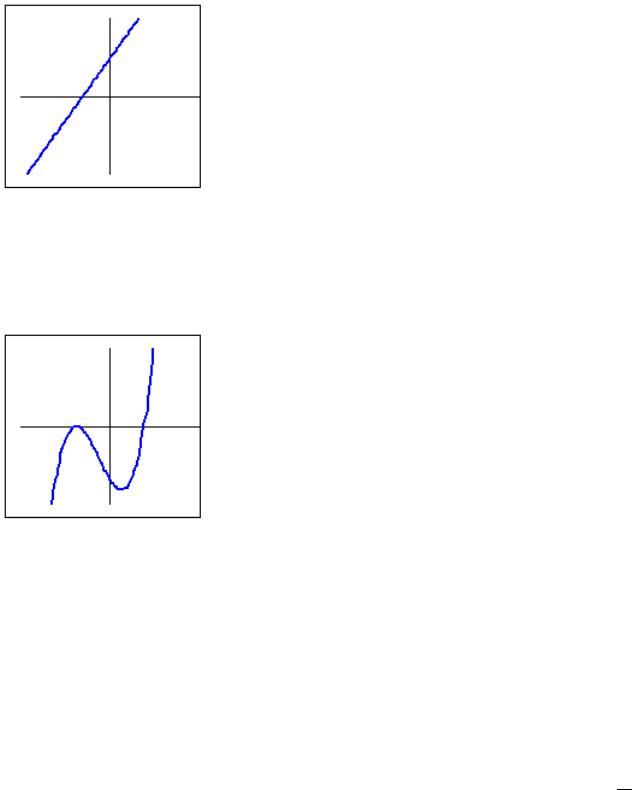
Determine whether or not the function whose graph is pictured is one-to-one.
A)
The function is not one-to–one.
B)
The function is one-to-one.
23.
Determine whether or not the function whose graph is pictured has an inverse.
A)
The function has an inverse.
B)
The function does not have an inverse.
24.
Find the formula for
1()fx
−
,the inverse of the function
( ) 6+9f x x=
.
Express any values exactly using reduced fractions.
25.
Find the formula for
1()fx
−
,the inverse of the function
2
( ) +5fx x
=
.
Express any values exactly using reduced fractions.
26.
The amount of material, M, used to fabricate a 2-inch diameter aluminum can is given
by
2Mh
=+
where h is the height of the can. Find a formula for
()hM
the
height as a function of the amount of material to be used.
27.
Find the inverse of the function
( ) 3 4f x x=−
Page 5
28.
The cost of building a square house is $11,500 for a utilities plus $85 per square foot of
area. The area of a square house is equal to the length of one side of the house squared.
Create a function to describe the cost of building a square house with each side having a
length of s feet.
Page 6
Answer Key