Chapter 9 – Budgeting Projects
TRUE/FALSE
1. The component of the project management plan that describes how costs will be planned, structured
and controlled is called the project financial plan.
2. Plan cost management is the process that establishes the policies, procedures and documentation for
planning, managing, expending, and controlling project costs.
3. On small projects, the cost management plan may simply address the accuracy of estimating, the
source of funding and cost reporting procedures.
4. Estimate cost is the process of developing an approximation of the monetary resources needed to
complete project activities.
5. Cost estimating is linked very closely with scope, schedule and resource planning.
6. Project managers should not lie to themselves or others regarding project costs.
7. Fixed costs remain the same regardless of the size or volume of work, while variable costs vary
directly with volume of use.
8. Decisions related to fixed and variable costs are very sensitive to changes in volume related factors
and project scope.
9. Direct costs typically include the cost of direct labor as well as other direct costs for items such as
material, travel, subcontracts and computer time.

10. Recurring costs tend to occur during project planning and closing while nonrecurring costs tend to
occur during project execution.
11. Typically, expedited costs are preferred over regular costs.
12. Regardless of what method is used to estimate project costs, supporting detail should be provided.
13. A contingency reserve is an amount of the project budget withheld for management control purposes,
for unforeseen work that is within the scope.
14. Early in a project when very little detail is known about a project, it is impractical to render even a
rough estimate of the final project cost.
15. Analogous estimating is the most detailed, time consuming and accurate way to estimate.
16. Most projects will employ bottom-up estimating at some point to serve as a basis for estimating cash
flow needs and for controlling the project.
17. Generally, parametric estimating requires less information and time than analogous estimating.
18. Special cause variation arises when something out of the ordinary occurs.
19. Inflating the value of future revenue and cost streams to account for the time value of money enables
better project decisions.
20. Both normal and special cause variation add to project cost and need to be considered by project
managers.
21. Vendor bid analysis is used to determine whether the price being asked by the vendors appears to be
reasonable.
22. In addition to optimizing project life cycle costs, value engineering can also be used to improve quality
or expand market share.
23. A project manager needs to ensure that the cumulative amount of cash coming into the project either
from internal budgeting or from customer payments meets or exceeds the demands for paying cash
out.
MULTIPLE CHOICE
1. All of the following are among the benefits realized as a consequence of developing a cost
management plan EXCEPT:
a.
It shows how to develop and share relevant, accurate and timely information that
stakeholders can use to make intelligent and ethical decisions.
b.
It documents how the business case should be created
c.
It helps stakeholders to focus on schedule and performance as well as cost.
d.
It provides feedback that shows how the project’s success is related to business objectives.
2. The process of developing an approximation of the cost of the monetary resources needed to complete
project activities is known as:
a.
capital budgeting.
b.
estimate resources.
c.
estimate cost.
d.
activity resourcing.

3. Projects often include indirect costs that are not associated directly with one specific project. Which
of the following items are most typically considered to be indirect costs?
a.
costs associated with material and purchased parts
b.
the cost of labor provided by project team members, consultants and subcontractors
c.
executive salaries, utilities and insurance
d.
travel cost for the project team
4. Costs that repeat as project work continues such as writing code are appropriately classified as:
a.
fixed costs.
b.
indirect costs.
c.
nonrecurring costs.
d.
recurring costs
5. What type of cost is incurred when a project must be conducted faster than normal, and overtime for
workers and / or extra charges for rapid delivery from suppliers are necessary?
a.
marginal costs
b.
expedited costs
c.
nonrecurring costs
d.
variable costs.
6. Which of the following terms best describes a provision in the project management plan to mitigate
cost and / or schedule risk?
a.
reserve
b.
insurance
c.
padding
d.
discretionary fund
7. Complex projects such as research and development for new products often employ rolling wave
planning to estimate costs. Which of the following best describes “rolling wave” planning?
a.
Project managers render a definitive estimate for the first stage and an order of magnitude
estimate for the remainder of the project.
b.
Project managers render an order of magnitude estimate for the first stage and a definitive
estimate for the remainder of the project.
c.
Project managers render definitive estimates for all stages of the project during initiation.
d.
Project managers render an order of magnitude estimate for all stages of the project.

8. Which estimating technique uses historical data from a similar project as a starting point for creating a
time or cost estimate?
a.
analogous estimating
b.
parametric estimating
c.
bottom-up estimating
d.
Monte Carlo estimating
9. All of the following factors must be in place in order to develop an analogous estimate effectively
EXCEPT:
a.
An organization must know details behind the time value of money.
b.
An organization must know how the proposed project differs from the previous project.
c.
An organization must have experience in performing similar projects.
d.
An organization must know how much previous projects actually cost.
10. Which estimating technique uses an algorithm to calculate cost or duration based on historical data and
other project parameters?
a.
empirical estimating
b.
parametric estimating
c.
grass roots estimating
d.
analogous estimating
11. Which estimating technique decomposes the work into detailed pieces for which estimates are
prepared and then aggregated into a total quantity for the project?
a.
piece meal pricing
b.
decomposition estimating
c.
bottom-up estimating
d.
grass roots estimating
12. The documentation of a project cost estimate generally requires substantial supporting detail to include
all of these EXCEPT:
a.
a description of scope.
b.
management reserve needs
c.
the estimating methods and a range of possible outcomes.
d.
assumptions and constraints.
13. There are many causes of variation in project costs. Which of the following accurately describes the
nature of this variation?
a.
Variation is generally greater on projects that use well-known technology and an
experienced project team.
b.
Variation occurs in all work processes and the novelty associated with most projects
creates many opportunities for variation.
c.
Special cause variation comes from many small causes that are inherent in a work process.
d.
Special cause variation is when something ordinary occurs
14. All of the following items describe an aspect of life cycle costing EXCEPT:
a.
Life cycle cost includes the cost of creating the project and using the result.
b.
Many project selection decisions are made based upon life cycle cost.
c.
Life cycle cost only includes the project cost from initiating through closing
d.
Project managers may need to consider product disposition costs to calculate total life
cycle cost.
15. Activity based costing allocates indirect costs to fixed costs based on different types of cost drivers.
Which of the following is one of the cost drivers that serve as a basis of cost allocation?
a.
number of units produced
b.
number of labor hours
c.
quantity of materials used
d.
direct equipment costs
16. The approved time-phased project budget, excluding any management reserves, which can be
changed only through formal change control procedures and is used as a basis of comparing actual
results, is called a ____:
a.
measurement baseline.
b.
cost baseline.
c.
cost benchmark
d.
control account
Work Package
Budget
Time-phased Budget
FEB
MAR
APR
1.2.1
10,000
10,000
1.2.2
20,000
8,000
12,000
1.2.3
16,000
8,000
8,000
Monthly Budget
18,000
20,000
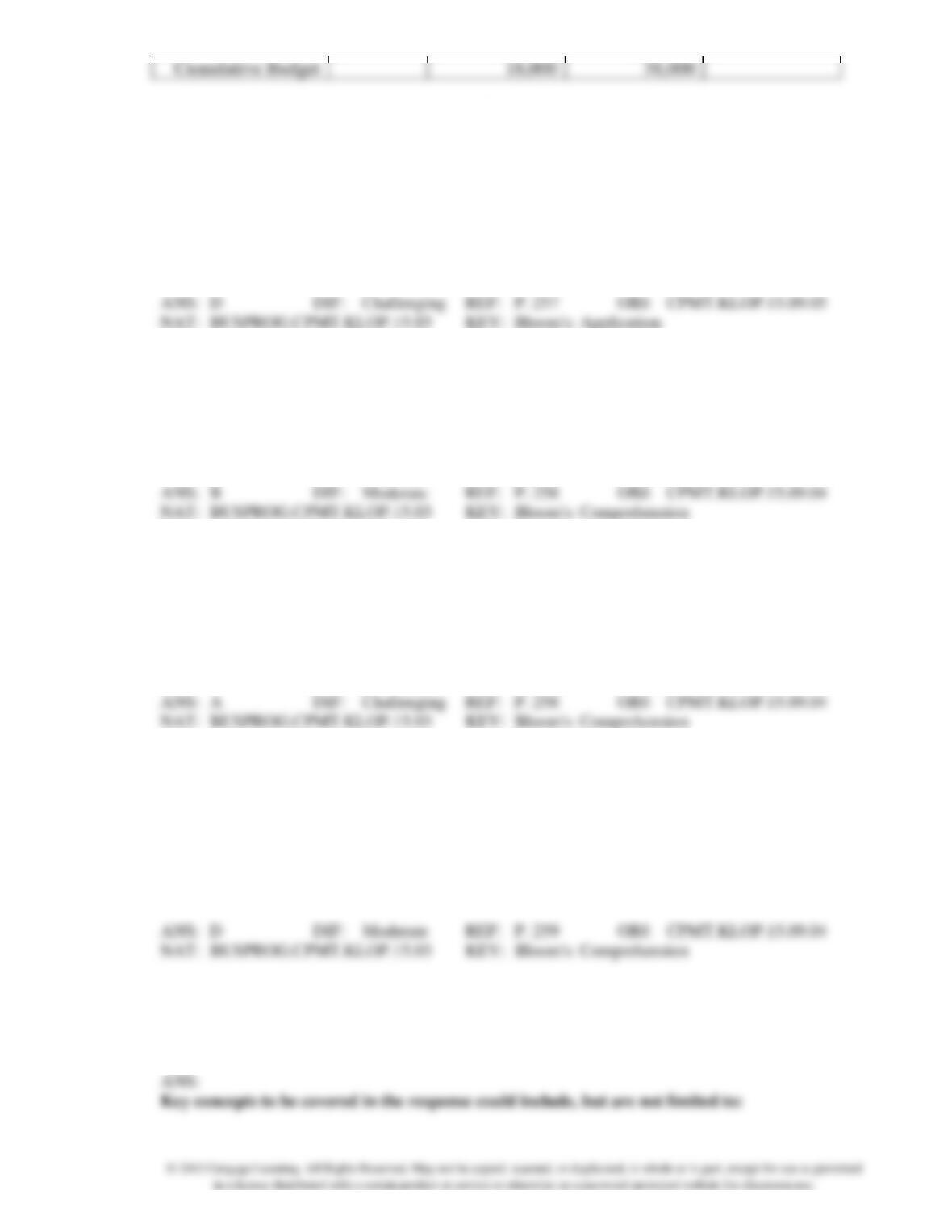
17. Consider the time-phased budget presented in Figure 9-1. What is the cumulative project budget
through the end of April?
a.
$ 8.000
b.
$20,000
c.
$38,000
d.
$46,000
18. Events discovered during Identify Risks that may or may not occur are often categorized as:
a.
known knowns
b.
known unknowns
c.
unknown unknowns
d.
known certainties
19. “Unknown unknowns” are unexpected events which can occur when the project is underway. All of
the following accurately describe an implication associated with unknown unknowns EXCEPT:
a.
They are usually discovered during risk identification
b.
They need to be covered in the project budget.
c.
They usually require the use of management reserve.
d.
They usually cause an increase in cost and / or schedule.
20. A milestone is a typical measuring point used when establishing cost control. Which of the following
DOES NOT accurately describes the use of cost control milestones?
a.
Project managers can use their cash flow projections to determine the funding needed to
reach each milestone.
b.
Project managers and sponsors often decide the number of milestones jointly.
c.
Milestones are often identified in the project charter.
d.
Milestones are developed during risk planning.
ESSAY
1. Discuss how the accuracy of cost estimates becomes more precise during a project.
2. Describe analogous, parametric and bottom-up estimating, and briefly discuss the advantages and
disadvantages of each method.
3. Describe several sources of uncertainty in estimating the cost of a project as well as strategies you can
employ to address uncertainty.
ANS: