Chapter 9: Current Liabilities, Contingencies, and the Time Value of Money
Chapter 9: Current Liabilities, Contingencies, and the Time Value of Money
Chapter 9: Current Liabilities, Contingencies, and the Time Value of Money
Chapter 9: Current Liabilities, Contingencies, and the Time Value of Money
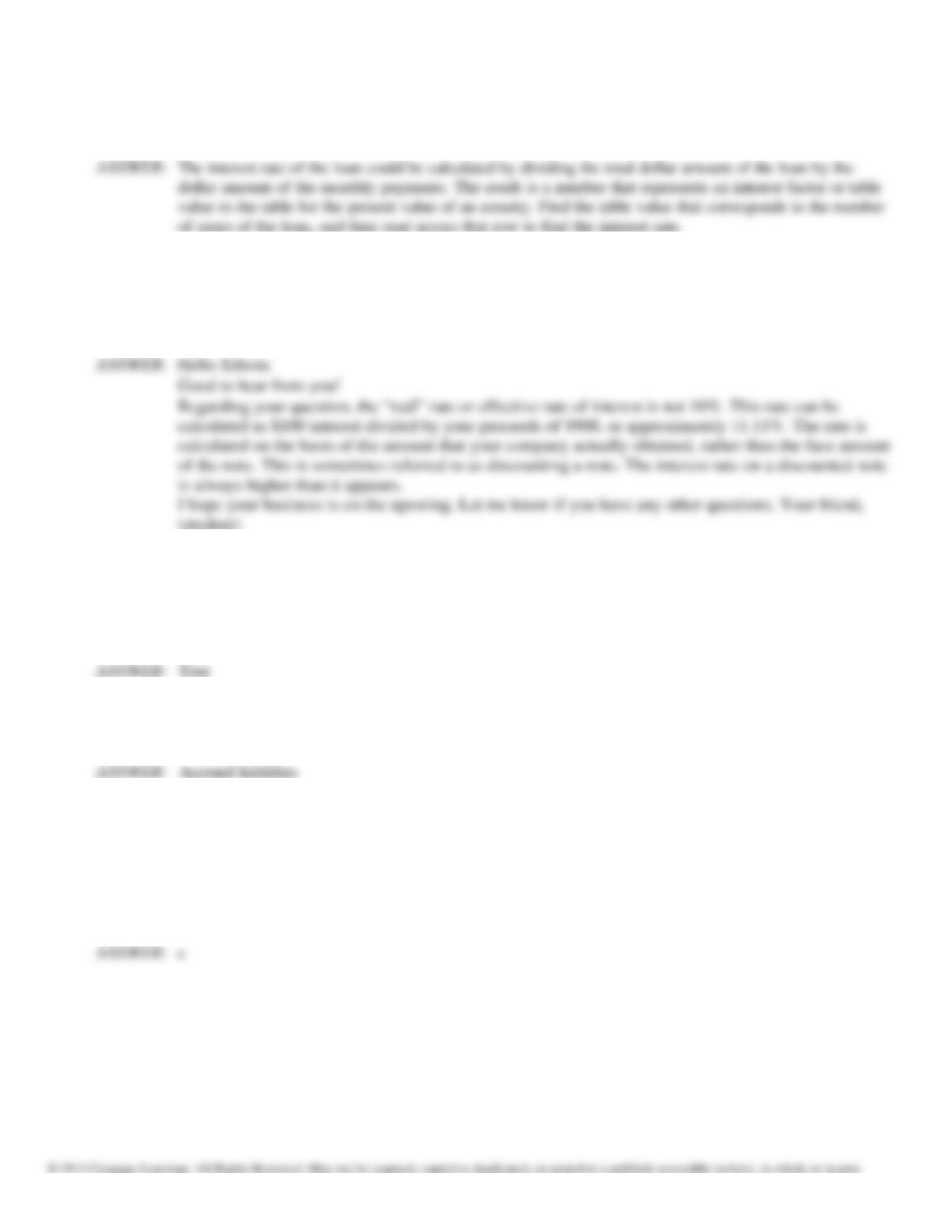
70. Assume that you know the total dollar amount of a loan and the amount of the monthly payments. How can you
determine the interest rate as a percentage of the loan?
71. You friend, Edwin Slotkin, has started a new business, but has recently encountered a slight cash flow problem. He
obtains a $1,000 loan at 10% per year from a local bank, but would like to ask you about the terms. The bank has
deducted the interest in advance and he wants to know if 10% is his effective interest rate. How would you respond
in an email?
72. Generally, an increase in a current liability results in an increase in the operating activities category of the cash flow
statement.
a. True
b. False
73. include any amount that has been incurred due to the passage of time, but not
paid as of the balance sheet date.
74. Which of the following statements regarding contingencies is true?
a. Contingencies that are not estimable should not be disclosed even if probable.
b. Contingent assets, if probable and estimable, are treated in much the same way as contingent liabilities.
c. Contingencies that are probable and estimable must be recorded before the outcome of future events.
d. The accounting principle that determines whether a contingent asset is recorded is that of materiality.
Chapter 9: Current Liabilities, Contingencies, and the Time Value of Money
75. An invoice received from a supplier for $8,000 on January 1 with terms 1/15, n/30 means that the company should
pay
a. $6,800 before January 16.
b. either $7,920 before January 16 or $8,000 before the end of the month.
c. $8,000 between January 2 and January 16.
d. $7,920 before the end of January.
76. International accounting standards use the term provision for those contingent items that must be recorded on the
balance sheet.
a. True
b. False
77. Using the future value table, a student found that the future value amount of $1 for 5 years at an annual interest
rate of 10% is 1.611. The student also observed that the future value of $1 for 5 years at 10% compounded
semiannually is 1.629. This means that
a. the student was looking in the wrong column; the second amount should be 1.611/2.
b. the more often the compounding, the higher the future value.
c. there was an error in the table.
d. when interest is compounded semiannually, more money must be deposited to have a desired ending balance.
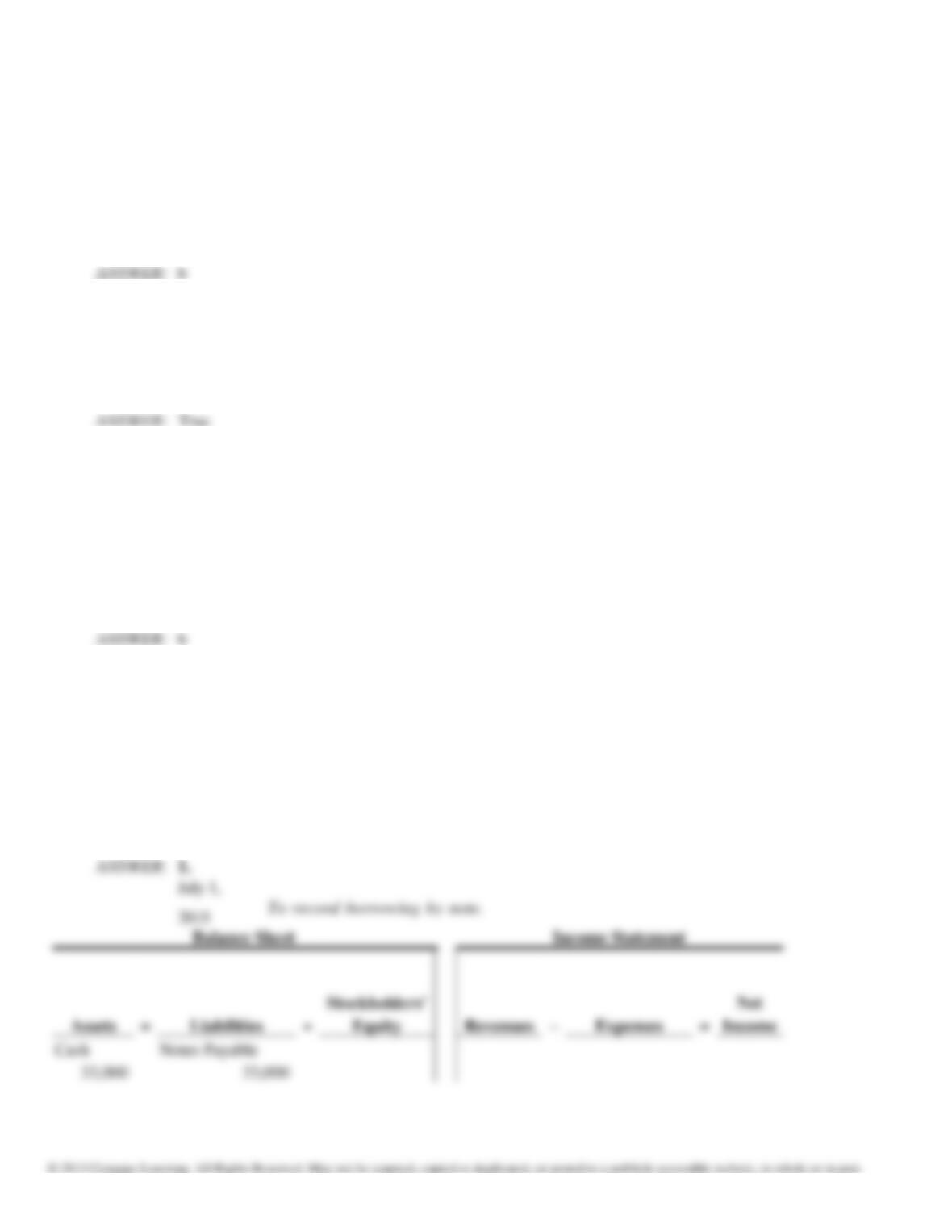
78. On July 1, 2015, Clayton Shop borrowed $33,000 from the bank. Clayton signed a ten-month, 6% promissory note
for the entire amount. Clayton uses a calendar year-end.
REQUIRED:
1. Identify the accounting equation effects for the July 1, 2015 transaction of issuing the promissory note.
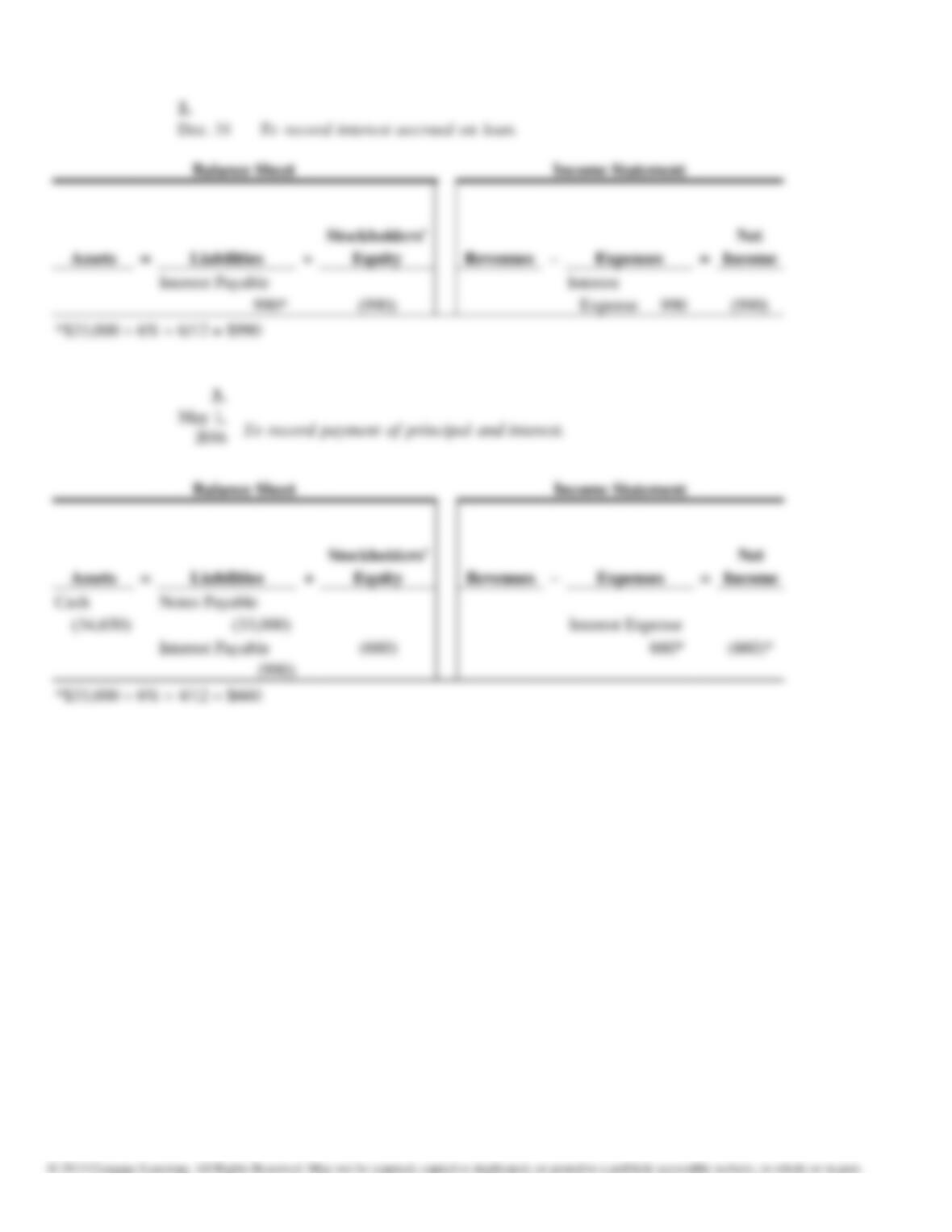
2. Identify any adjustments needed at year-end.
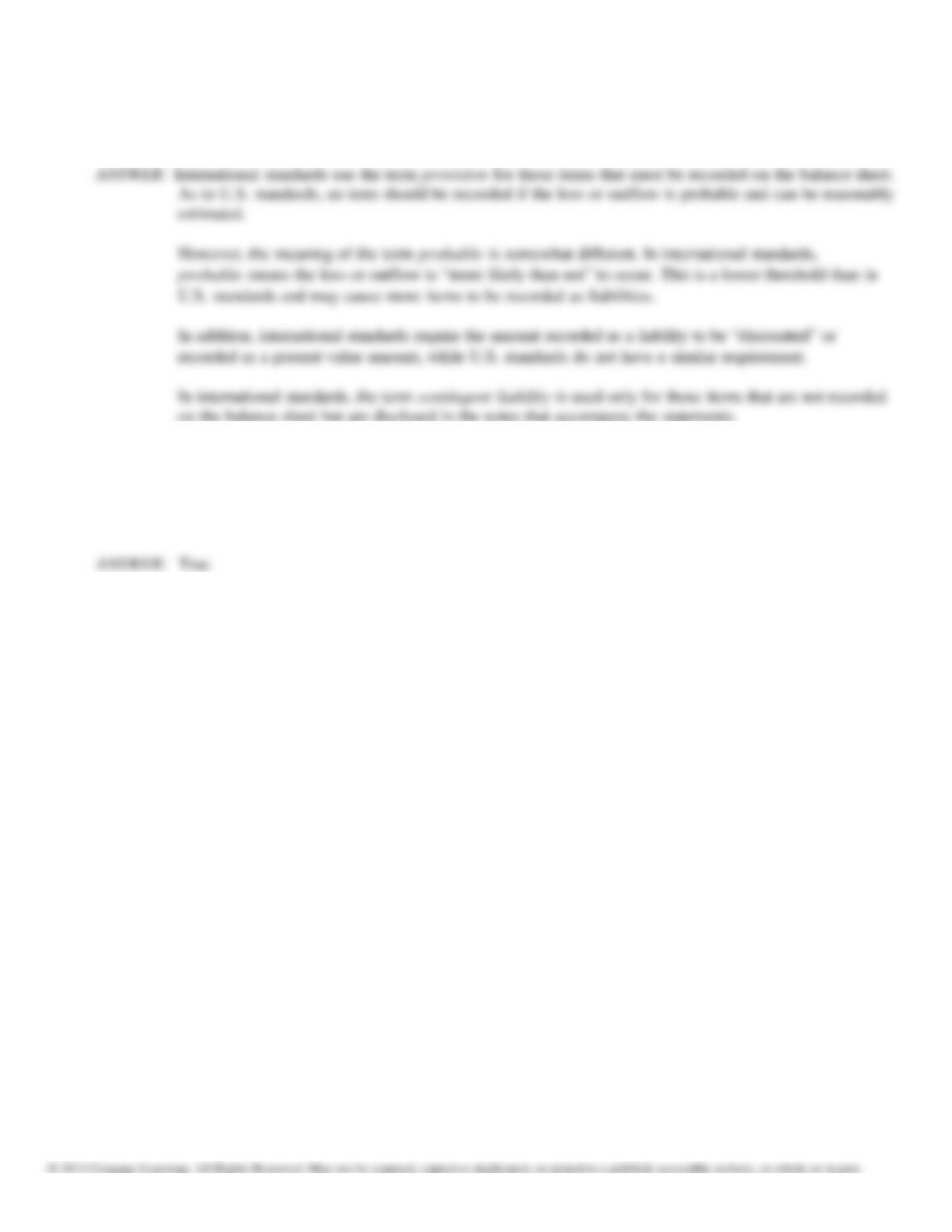
3. Identify the accounting equation effects for the May 1, 2016 transaction to record the payment of principal and
interest.
Chapter 9: Current Liabilities, Contingencies, and the Time Value of Money
Chapter 9: Current Liabilities, Contingencies, and the Time Value of Money
79. There are very important differences between U.S. and international standards regarding contingencies. Even the
terms used to refer to situations with unknown outcomes differ. Explain these differences.
80. U.S. standards do not require a classified balance sheet, but International accounting standards require companies to
present classified balance sheets with liabilities classified as either current or long term.
a. True
b. False
Note Disclosure of Legal Matters
Use the Note Disclosure Of Legal Matters below to answer the questions that follow.
Note 13 – Legal Matters
On December 14, 2015, the Company was served with a class action complaint filed in federal court in Burlington,
Vermont. The complaint, captioned John Doe vs. The Company was filed by a Company’s shareholder on behalf of
himself and purportedly on behalf of all other Company’s shareholders who purchased the common stock of the
Company during the period from March 25, 2014 through December 19, 2014. Plaintiff alleges that the Company
violated the federal securities laws by making, in 2014, untrue statements of material facts and omitting to state
material facts primarily concerning the Company’s construction and start-up of its new manufacturing facility. Also
named as defendants in the Complaint are certain present and former officers and directors of the Company. Plaintiff
is seeking an unspecified amount of monetary damages.
While this action is in its preliminary stages, management believes, based on an initial review, the allegations made in
the lawsuit are without merit and the Company intends to defend the lawsuit vigorously.
Chapter 9: Current Liabilities, Contingencies, and the Time Value of Money
81. Review the Note Disclosure of Legal Matters.
REQUIRED:
(1) If you were to make an entry for the lawsuit against Company, what monetary amount should be recorded? On
what did you base your decision with regard to the amount?
(2) Does the disclosure imply that the Company is involved in only this litigation at this time?
(3) Why did this lawsuit arise? Do you believe it to be a reasonable one or do you think that the plaintiff, has little
grounds for this lawsuit?
82. Review the Note Disclosure of Legal Matters.
REQUIRED:
(1) What type of liability does this lawsuit typify?
(2) In your opinion, should the Company prepare a journal entry in 2015 to record a liability for this lawsuit? Why or
why not?
Chapter 9: Current Liabilities, Contingencies, and the Time Value of Money
83. What is the difference between simple interest and compound interest? Is the amount of interest higher or lower
when the interest is simple rather than compound?
84. Which of the following statements regarding the inclusion of liabilities on the statement of cash flows is true?
a. Long-term liabilities generally affect the investing activities section.
b. A decrease in a current liability from the beginning to the end of the year is accompanied by an inflow of cash.
c. All current liabilities affect the operating activities section.
d. A decrease in a current liability from the beginning to the end of the year is accompanied by a decrease of cash.
85. Apply the time value of money in the following independent situations:
1. Jason Marx deposited $29,500 in the bank on January 1, 1998, at an interest rate of 12% compounded annually.
How much has accumulated in the account by January1, 2015?
2. June Cunningham deposited $54,200 in the bank on January 1, 2005. On January 2, 2015, this deposit has
accumulated to $106,611. Interest is compounded annually on the account. What rate of interest did June earn on the
deposit?
86. The solution to this problem requires time value of money calculations. Reference to Tables 9-1 through 9-4
in the text is necessary to complete the calculations.
Winston wins the lottery. He wins $20,000 per year to be paid to him for 10 years. The state offers him the choice of
a cash settlement now instead of the annual payments for 10 years. If the interest rate is 6%, what is the amount the
state will offer for a settlement today?
a. $147,200
b. $200,000
c. $154,440
d. $175,000
87. If a bank discounts a note, then the borrower needs to only pay the cash received and not the face value of the note.
a. True
b. False
88. When a company uses coupon or premium offers in conjunction with the sale of its products, there is no need to
record any contingent liability.
a. True
b. False
Chapter 9: Current Liabilities, Contingencies, and the Time Value of Money
Match each of the following terms pertaining to liabilities to their definitions.
a. Current liability
b. Accounts payable
c. Notes payable
d. Discount on notes payable
e. Current maturities of long-term liabilities
f. Accrued liabilities
g. Contingent liability
h. Estimated liability
89. Amounts owed that are represented by a formal contractual agreement. These amounts usually require the payment
of interest.
90. The portion of a long-term liability that will be paid within one year of the balance sheet date.
91. Amounts owed for the purchase of inventory, goods, or services acquired in the normal course of business.
92. A contra-liability account that represents interest deducted from a loan or note in advance.
93. A liability that has been incurred but has not been paid as of the balance sheet date.
94. Accounts that will be satisfied within one year or the next operating cycle.
95. A liability that involves an existing condition for which the outcome is not known with certainty and depends on some
future event.
Chapter 9: Current Liabilities, Contingencies, and the Time Value of Money
96. In 2015, Morton Co.sold 150 hot air balloons at $4,000 each. The balloons carry a 5-year warranty for defects.
Morton estimates that repair costs will average 4% of the total selling price. The estimated warranty liability at the
beginning of the year was $14,000. $20,000 in claims was actually incurred during the year to honor their warranty.
What was the warranty expense for 2015?
a. $20,000
b. $10,000
c. $24,000
d. $18,000
97. The solution to this problem requires time value of money calculations. Reference to Tables 9-1 through 9-4
in the text is necessary to complete the calculations.
Josh and Sara want to buy a house in 4 years. If the house will cost $180,000, how much must they deposit at the end
of every year for the next 4 years at 5% compounded annually in order to buy the house?
a. $41,763
b. $32,040
c. $36,990
d. $45,000
98. A note payable that is due in six months is a current liability.
a. True
b. False
99. Compound interest is a repeated calculation of the interest on the principal over certain periods of time.
a. True
b. False
100. In 2015, Boone, Inc. sold 1,000 carpets for $50 each. The carpets carry a 2-year warranty for repairs. Boone
estimates that repair costs will average 2% of the total selling price. What is the amount that would be recorded in the
warranty liability account as a result of selling the carpets during 2015?
a. No liability should be recorded until the carpets are returned for repairs.
b. $ 20
c $1,000
d $500
Chapter 9: Current Liabilities, Contingencies, and the Time Value of Money
101. What type of interest is calculated on the balance of the principal only?
a. Equivalent interest
b. Simple interest
c. Future interest
d. Compounded interest
102. In 2015, Baloga Heating Company sold 400 water heaters for $350 each. The water heaters carry a 2-year warranty
for repairs. Baloga estimates that repair costs will average 2% of the total selling price. How much is recorded in the
warranty liability account as a result of selling the water heaters during 2015?
a. $4,200
b. $1,400
c. $2,800
d. no liability should be recorded until the water heaters are brought back for repairs.
103. Accountants need not worry about calculations based upon the concept of the time value of money.
a. True
b. False
104. Boston Trombley Company is a defendant in a lawsuit alleging damages of $3 billion. It is probable that Boston
Trombley will lose the suit. The litigation is anticipated to continue for several years, but no reasonable estimate can
be made at this time regarding ultimate financial responsibility. This situation is an example of:
a. an estimated liability that must appear in Boston Trombley Company’s balance sheet.
b. a loss contingency that should be disclosed in the notes to Boston’s financial statements.
c. an $3 billion expense to be recorded in the income statement during the year of the suit.
d. none of these. No accrual or disclosure is required in Boston’s financial statements.
105. All of the following statements are true except:
a. under IFRS, an unclassified balance sheet based on the order of liquidity is acceptable only when it provides more
reliable information than a classified one.
b. U.S. standards require a classified balance sheet with liabilities in order by size or by order of liquidity.
c. IFRS require companies to present classified balance sheets.
d. U.S. standards do not require a classified balance sheet.
Chapter 9: Current Liabilities, Contingencies, and the Time Value of Money
Identify the classifications of the following accounts as either current or long-term liabilities for the
December 31, 2014 balance sheet.
a. Current liability
b. Long-term liability
106. An amount of money owed for years 2016 to 2020 to a creditor as annual installment payments on a ten-year note,
due June 30, 2020.
107. An amount of money owed to the federal government based on the company’s annual income.
108. An amount of money owed to a supplier based on the terms 2/20, n/40, for which no note was executed.
109. Estimated warranty payable by June 30, 2015.
110. An amount of money owed in 2015 to a creditor as an annual installment payment on a ten-year note, due June 30,
2020.
111. An amount of money owed to a creditor on a note due August 15, 2022.
112. Contingent assets may be disclosed in the notes if probable and reasonably estimable.
a. True
b. False
113. When borrowing money to be repaid in regular future payments, the payment is based on the present value of the
loan, the interest rate and the length of the loan.
a. True
b. False
Chapter 9: Current Liabilities, Contingencies, and the Time Value of Money
From the following list, identify whether the change in the account balance during the year would
be reported as an operating (O), an investing (I), or a financing (F) activity or not separately
reported on the statement of cash flows (N). Assume that the indirect method is used to determine
the cash flows from operating activities.
a. O – Operating
b. I – Investing
c. F – Financing
d. N – Not separately reported on the Statement of Cash Flows
114. Current maturities of long–term debt
115. Notes payable
116. Other accrued liabilities
117. Accounts payable
118. Taxes payable
119. Salaries and wages payable
120. You just won the lottery. You can take your $2 million in a lump sum today, or you can receive $220,000
per year over the next 12 years. Assuming a 6% interest rate, which would you prefer, ignoring tax
considerations?
121. A possible loss from lawsuit is not reported on the balance sheet as a current liability.
a. True
b. False

Chapter 9: Current Liabilities, Contingencies, and the Time Value of Money
122. Simple interest on a loan can be calculated by multiplying the principal by the annual interest rate
expressed as a percentage of the time in years or a fraction of the time in years.
a. True
b. False
123. The solution to this problem requires time value of money calculations. Reference to Tables 9-1
through 9-4 in the text is necessary to complete the calculations.
How much would have to be deposited in a savings account earning 6%, so that equal annual withdrawals
of $200 can be made at the end of each of 10 years? The balance at the end of the last year would be
zero.
a. $528
b. $2,000
c. $1,472
d. $2,636
124. If a company borrows money from its bank and the bank deducts the interest in advance, the company
would record the amount of the interest deduction as
a. prepaid interest.
b. a discount.
c. an expense.
d. a loss.
125. A firm is required to estimate a liability for repairs for products sold with a warranty. If the firm’s
accountants later find that the estimated amount for repairs has been overstated, the correct accounting
procedure is to
a. show the amount of overstatement on the income statement as a loss.
b. do nothing for the year in question and modify the next year‘s estimate.
c. make a correcting entry because the overstatement is an error.
d. make an adjusting entry to reduce the amount of estimate.
126. All of the following statements about current liabilities are true except:
a. current liabilities are normally recorded at face value.
b. current liabilities are obligations which will be satisfied within one year.
c. current liabilities finance the working capital of the company.
d. the current liability section never contains any portion of long-term liabilities.

Chapter 9: Current Liabilities, Contingencies, and the Time Value of Money
127. A current ratio of or better is usually considered a comfortable margin.
128. When a liability is accrued, the account decreased in the transaction is a stockholders’ equity account.
a. True
b. False
129. Assume the current ratio is 3 to 1. Estimating the warranties expense on the period’s sales would cause
the current
ratio to
a. be unchanged since it has no effect on any current accounts.
b. be unchanged since the effects offset one another.
c. decrease.
d. increase.
130. The solution to this problem requires time value of money calculations. Reference to Tables 9-1
through 9-4 in the text is necessary to complete the calculations.
Approximately how many years will it take for a sum invested at 8% with annual compounding to
quadruple?
a. 81 years
b. 9 years
c. 18 years
d. 17 years
131. The solution to this problem requires time value of money calculations. Reference to Tables 9-1
through 9-4 in the text is necessary to complete the calculations.
If a company wishes to accumulate $500,000 in 20 years at 5% by making equal yearly deposits into an
account, calculation of the deposits is an application of the
a. future value of a single amount.
b. future value of an annuity.
c. present value of a single amount.
d. present value of an annuity.

Chapter 9: Current Liabilities, Contingencies, and the Time Value of Money
132. The solution to this problem requires time value of money calculations. Reference to Tables 9-1
through 9-4 in the text is necessary to complete the calculations.
Kingston inherited $140,000 from an aunt. If Kingston decides not to spend his inheritance but to leave
the money in his savings account until he retires in 15 years, how much money will he have assuming an
annual interest rate of 8%, compounded semiannually (to the closest answer given)?
a. $ 308,000
b. $ 509,880
c. $ 454,076
d. $7,851,900
133. Advance ticket sales for a concert next month are a current liability.
a. True
b. False
134. A note payable due in two years is a current liability.
a. True
b. False
135. For users of financial statements, the current liability classification in the balance sheet is important
because it is most closely tied to the concept of profitability.
a. True
b. False
136. The solution to this problem requires time value of money calculations. Reference to Tables 9-1
through 9-4 in the text is necessary to complete the calculations.
If interest is compounded annually, the total amount of interest on an $18,000 note payable for 4 years at
10% is
a. $8,500
b. $7,200
c. $5,706
d. $8,352
137. The classification of current liabilities is closely tied to the concept of .
Chapter 9: Current Liabilities, Contingencies, and the Time Value of Money
138. The issue price of a bond is based on the of the cash flows that the bond will
produce.
139. Assume that you want to accumulate $20,000 as a down payment on a home. You believe that you can
save $2,000 per semiannual period, and your bank will pay interest of 6% per year, or 3% per semiannual
period. How long will it take you to accumulate the desired amount?
140. The difference between notes payable and accounts payable is .
141. In a compound interest problem, if you know the future value, the present value, and the number of
periods, then you can solve for the interest rate.
a. True
b. False
142. The present value and future value concepts are applied to measure the amount of several accounts
common in accounting. What are some accounts that are valued in this manner?
143. Which of the following statements regarding contingencies is true?
a. Contingencies that are probable and not estimable appear on the balance sheet.
b. Contingent assets are recorded on the balance sheet, but not in the notes to the financial statements.
c. Contingencies that are probable and not estimable are disclosed in the notes to the financial statements.
d. Contingencies that are remote but estimable are disclosed in the notes to the financial statements
Chapter 9: Current Liabilities, Contingencies, and the Time Value of Money
144. An example of a current liability that must be accrued is
a. current maturity of long-term debt.
b. accounts payable.
c. income taxes payable.
d. revenue received in advance.
145. Executive, Inc. has a weekly payroll of $10,000 for a 5-day workweek, Monday through Friday. If
December 31, the last day of the accounting year, falls on Thursday, Executive would make an adjustment
that would
a. decrease Wages Payable $2,000.
b. increase Wages Payable $2,000.
c. increase Wages Expense $8,000.
d. decrease Cash $8,000.
146. If the market value that you paid for a car is known and the annual payment and number of payments is
known, the table factor to help find the interest rate can be calculated by dividing .