Chapter 09 – Gene Expression and Gene Regulation
True / False
1. mRNA is made up of introns that have been spliced together.
a.
True
b.
False
False
2. Prion diseases are always fatal and there is no treatment.
a.
True
b.
False
True
3. Twenty different types of amino acids are used to make proteins.
a.
True
b.
False
True
4. The codon encoding the amino acid methionine functions as a start codon when it occurs at the beginning of a gene.
a.
True
b.
False
True
can lead to the production of billions of different proteins.
5. Translation begins when the DNA in a chromosome unwinds and one strand is used as a template to make a pre-mRNA
molecule.
a.
True
b.
False
False
6. An mRNA molecule has a cap attached to its 5’ end and a poly-A tail attached to its 3’ end.
a.
True
b.
False
True
7. During translation, the rRNA in the large ribosomal subunit acts as an enzyme, linking amino acids together to form a
polypeptide.
a.
True
b.
False
True
8. Each amino acid is encoded by only one mRNA codon.
a.
True
b.
False
False
can lead to the production of billions of different proteins.
9. The set of proteins in a particular cell type is always equal to the number of genes in the genome.
a.
True
b.
False
False
10. The most common mutation in cystic fibrosis is the deletion of a single amino acid which results in a misfolded
protein.
a.
True
b.
False
True
11. Amino acids are characterized by ____.
a.
an amino group and a hydrogen bond
b.
a carboxyl group and a hydrogen bond
c.
two R groups
d.
an amino group, a carboxyl group, and an R group
e.
an amino group and a hydrochloric group
d
Bloom’s: Understand
9-6 Translation Requires the Interaction of Several Components
terms polypeptide, C-terminus, and N-terminus.
12. Peptide bonds form between ____.
a.
two amino groups
b.
two carboxyl groups
c.
a carboxyl group and an R group
d.
an amino group and a carboxyl group
e.
an amino group and an R group
d
Bloom’s: Understand
9-6 Translation Requires the Interaction of Several Components
terms polypeptide, C-terminus, and N-terminus.
13. The three-dimensional shape of a protein is determined by the ____ and the results of chemical modifications and
other processing events.
a.
interaction of R groups
b.
interaction with other polypeptide chains
c.
amino acid sequence
d.
bonds formed with other proteins
e.
initiation complex
Bloom’s: Understand
9-7 Polypeptides Are Processed and Folded to Form Proteins
become functional proteins.
14. Codons are ____ that encode the information for a specific amino acid in a protein.
a.
made of two polynucleotide strands
b.
ribosomal subunits
c.
mRNA templates that are transcribed into tRNA
d.
post-translational templates of tRNA
Chapter 09 – Gene Expression and Gene Regulation
e.
triplets of nucleotides in mRNA
Bloom’s: Understand
9-3 The Genetic Code: The Key to Life
can lead to the production of billions of different proteins.
15. The secondary structure of a protein forms ____.
a.
pleated sheets or coils
b.
when pleated sheet regions fold back on themselves
c.
from interactions between polypeptide chains
d.
from covalent bonding between amino acids
e.
a functional chromatin unit
Bloom’s: Understand
9-8 Protein Structure and Function
improper protein folding can affect protein function.
16. One gene is able to encode information for different forms of a protein via ____.
a.
alternative splicing
b.
primary splicing
c.
secondary splicing
d.
mRNA mutations
e.
tRNA mutations
Bloom’s: Understand
9-5 Transcription Produces Genetic Messages
enzymes involved in the process.
17. At one end of a tRNA molecule is a sequence of 3 nucleotides called an anticodon that ____.
a.
signals the production of a ribosome
b.
signals the unwinding of the DNA coils
c.
initiates the movement of mRNA out of the cell nucleus and into the cytoplasm
d.
binds to its anti-complementary tRNA codon
e.
binds to its complementary mRNA codon
Bloom’s: Understand
9-6 Translation Requires the Interaction of Several Components
anticodon, and ribosome and describe their interactions during translation.
18. Prions are created when normal proteins in the body ____.
a.
combine with large ribosomal subunit and become infectious
Chapter 09 – Gene Expression and Gene Regulation
b.
exchange several long sections of amino acids with other infected proteins
c.
refold into a different and infectious three-dimensional shape that kills cells in the brain and nervous system
d.
undergo mutation and create hundreds of copies of themselves
e.
invade the immune system, causing it to mistakenly destroy the body’s healthy tissue
c
Bloom’s: Understand
9-1 Cows as a Cause of Death
HUHE.CUMM.16.9-1-2 – List the normal functions of proteins and define the term prion.
19. During the elongation step of translation, ____.
a.
the small ribosomal subunit pairs with an anticodon
b.
amino acids are added to a growing polypeptide chain
c.
methionine is inserted at the beginning of all proteins
d.
mRNA is transformed into tRNA
e.
release factors bind to stop codons
b
Bloom’s: Understand
9-5 Transcription Produces Genetic Messages
enzymes involved in the process.
20. Messenger RNA is a(n) ____ of the amino acid-coding nucleotide sequence of a gene.
a.
exact copy of the DNA template
b.
exact copy of the tRNA template
c.
double-stranded complementary copy
d.
single-stranded complementary copy
e.
single-stranded anti-complementary copy
d
Bloom’s: Understand
9-4 Tracing the Flow of Genetic Information from Nucleus to Cytoplasm
a protein.
21. ____ nucleotides form the code for one amino acid.
a.
Two
b.
Three
c.
Six
d.
Nine
e.
Twelve
b
Bloom’s: Understand
9-3 The Genetic Code: The Key to Life
can lead to the production of billions of different proteins.
22. Activated genes can be inactivated by reversing histone modification during a process called ____.
a.
chromatin remodeling
b.
histone remodeling
c.
chromatin interference
d.
interference remodeling
e.
histone interference
Bloom’s: Understand
9-9 Several Mechanisms Regulate the Expression of Genes
control gene expression.
23. In pre-mRNA processing, ____.
a.
exons are spliced out and used to produce ribosomal subunits
b.
introns are spliced out and combined to form complete proteins
c.
introns are spliced out and combined in the tRNA
d.
exons are spliced out and the introns are combined in the mature mRNA
e.
introns are spliced out and the exons are combined in the mature mRNA
Bloom’s: Understand
9-5 Transcription Produces Genetic Messages
HUHE.CUMM.16.9-5-2 – Describe how pre-mRNA is processed into mRNA in eukaryotes.
24. Most protein synthesis ____.
a.
takes place on the surface of the rough endoplasmic reticulum
b.
takes place inside the smooth endoplasmic reticulum
c.
takes place inside the nucleus of the cell
d.
relies on mitochondria to supply the amino acids necessary
e.
is carried out by ribosomes on the Golgi complex
Bloom’s: Understand
9-7 Polypeptides Are Processed and Folded to Form Proteins
that can be produced from the 20,000 genes in the human genome.
25. Tetracyclines interfere with ____.
a.
DNA replication
b.
initiation of transcription
c.
initiation of translation
d.
the process of protein folding
e.
transport of proteins to the Golgi complex
Bloom’s: Understand
9-6 Translation Requires the Interaction of Several Components
26. Each amino acid has a different side chain, called a(n) ____.
a.
amino strand
b.
carboxyl group
c.
R group
d.
glucose pentose configuration
e.
ribosomal attachment
c
Bloom’s: Understand
9-6 Translation Requires the Interaction of Several Components
terms polypeptide, C-terminus, and N-terminus.
27. Variant Creutzfeldt-Jakob disease is caused by errors in ____.
a.
DNA replication
b.
translation
c.
transcription
d.
protein folding
e.
RNA template replication
d
Bloom’s: Understand
9-1 Cows as a Cause of Death
genetic disease.
28. The process of post-transcriptional gene silencing triggered by micro-RNA molecules that stop translation is called
____.
a.
RNA interference
b.
micro-interference
c.
translational interference
d.
transcriptional disruption
e.
disruptive genetic silencing
a
Bloom’s: Understand
9-9 Several Mechanisms Regulate the Expression of Genes
control gene expression.
29. Proteins are composed of subunits called ____ linked together by chemical bonds.
a.
nucleotides
b.
polynucleotides
c.
mRNAs
d.
amino acids
during translation.
Chapter 09 – Gene Expression and Gene Regulation
e.
proteasomes
d
Bloom’s: Understand
9-2 The Link Between Genes and Proteins
establishing the connection among genes, proteins, and phenotypes.
30. The tertiary structure of a protein is ____.
a.
the amino acid sequence in a polypeptide chain
b.
generated by the formation of bonds between amino acids
c.
formed by a protein region folding on itself
d.
formed by the interaction of two or more polypeptide chain
e.
generated by bonding and folding of ribosomes attached to the endoplasmic reticulum
c
Bloom’s: Understand
9-8 Protein Structure and Function Are Related
improper protein folding can affect protein function.
Completion
31. Transcribed DNA sequences that are removed during mRNA processing are called _____________________.
introns
Bloom’s: Understand
9-5 Transcription Produces Genetic Messages
HUHE.CUMM.16.9-5-2 – Describe how pre-mRNA is processed into mRNA in eukaryotes.
32. A protein folded into an infectious conformation that is the cause of several disorders is called a(n)
____________________.
prion
Bloom’s: Remember
9-8 Protein Structure and Function Are Related
improper protein folding can affect protein function.
33. Amino acids that cannot be manufactured by the human body are called ____________________.
essential
Bloom’s: Understand
9-6 Translation Requires the Interaction of Several Components
terms polypeptide, C-terminus, and N-terminus.
34. Of the 64 triplet combinations in the genetic code, ____________________ code(s) for amino acids and
____________________ code(s) for the signal that ends protein synthesis.
61; 3
35. The primary structure of a protein is the ____________________ in a polypeptide chain.
36. Cytoplasmic organelles composed of two subunits, one large and one small, which are the sites of polypeptide
synthesis are called ____________________.
ribosomes
37. In the process of initiation, RNA polymerase and several regulatory proteins bind to a(n) ____________________ that
marks the beginning of a gene.
promoter
38. Archibald Garrod was the first to advance the idea that there is a direct link between ____________________ and
____________________.
alkaptonuria.
39. The process of turning genes on and off is called ____________________.
regulation
40. A proteome is the set of ____________________ present in a particular cell at a specific time under a particular set of
conditions.
Chapter 09 – Gene Expression and Gene Regulation
41. The RNA molecule involved in both transcription and translation is ____________________.
42. An N-terminus is the end of a(n) ____________________ that has a free amino group.
43. Another name for bovine spongiform encephalopathy (BSE) is ____________________.
44. Proteins are the intermediary between a(n) ____________________ and a(n) ____________________.
45. During processing in the nucleus, a(n) ____________________ is added to the 3’ end of mRNA molecules.
46. Proteins are made in the ____________________, but are present in all parts of the cell.
47. A protein that guides the folding of a polypeptide into a functional, three-dimensional shape, converting the
polypeptide into a protein is called a(n) ____________________.
48. If the nucleotide sequence in a DNA template strand is GGCTTAACCATT; the complementary mRNA strand will
have the sequence ____________________.
49. George Beadle and Edward Tatum discovered the key step in showing that genes produce ____________________
through the action of proteins.
50. A mechanism of gene regulation that controls the amount of mRNA available for translation is called
____________________.
51. Elaborate on the idea that proteins are the workhorse molecules of the cell.
52. Discuss the concept and consequences of built-in redundancy as it applies to amino acid sequences, and include an
example.
53. Explain how the composition and distribution of codons among living organisms provide evidence for evolution from
a common ancestor.
54. Describe the three steps of translation.
55. Outline the series of steps that transfers genetic information from the linear sequence of nucleotides in a DNA
molecule into the linear sequence of amino acids in a protein.
56. Explain why vegetarians and vegans might be deficient in some amino acids.
57. Explain how chromatin remodeling can involve changes to DNA instead of histones.
58. Outline the four levels of protein structure that give the protein its three-dimensional shape and determine its function.
Chapter 09 – Gene Expression and Gene Regulation
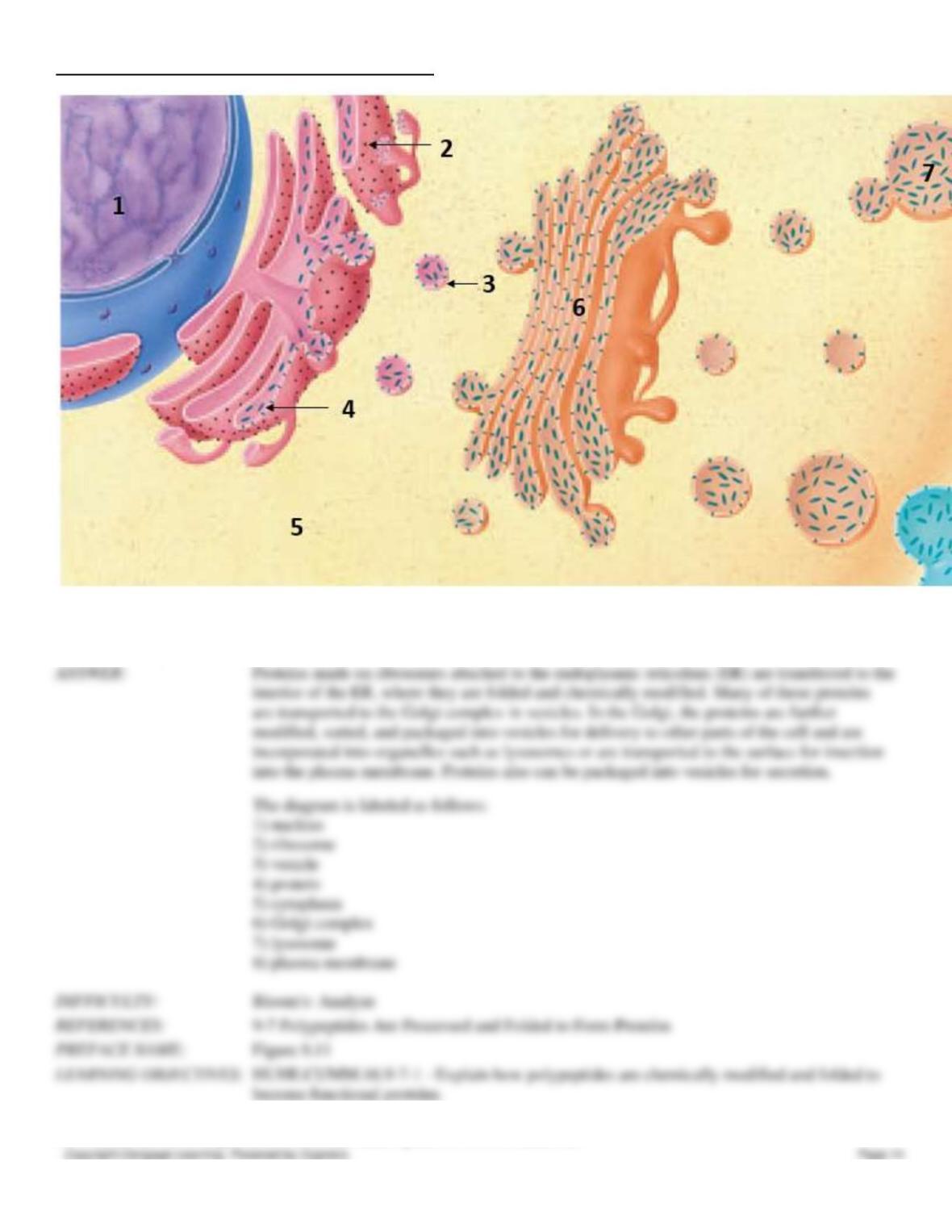
Figure 9.11
59. Summarize the sequence of processing, sorting, and transport of proteins synthesized in a human cell. Then indicate
which cell component corresponds with each number above.
60. Outline the three stages involved in the transcription of a DNA molecule.
Chapter 09 – Gene Expression and Gene Regulation