a.
Runaway jobs
b.
Technology transfers abroad
c.
Tax evasion
d.
All of the above
47. Joint ventures may lead to
a.
Welfare increases
b.
Welfare decreases
c.
No changes in welfare
d.
All of the above
United States – BPROG: Reflective Thinking – BPROG: Analysis
48. Foreign direct investment typically occurs when
a.
The earnings of the parent company are invested in plant expansion overseas
b.
The parent company transfers jobs overseas
c.
The parent company closes its foreign production plants
d.
The parent company purchases bonds of foreign governments
United States – BPROG: Reflective Thinking – BPROG: Analysis
United States – PA – DESC: International Trade and Fi – DESC: International Trade and
The Multinational Enterprise
United States – BPROG: Reflective Thinking – BPROG: Analysis
Multinat. Ent. as a Source of Conflict
49. Consider Figure 9.3, at labor market equilibrium with supply S0, _____ workers are hired at a wage rate of $____ per
hour, while total wages equal ____.
a.
6, 7 pesos, 24 pesos
b.
6, 6 pesos, 36 pesos
c.
7, 7 pesos, 49 pesos
d.
7, 6 pesos, 42 pesos
50. Consider Figure 9.3. At labor market equilibrium, the payment to Mexican capital owners equals:
a.
3 pesos
b.
6 pesos
c.
9 pesos
d.
12 pesos
United States – BPROG: Analytic
United States – BPROG: Analytic
International Labor Mobility: Migration
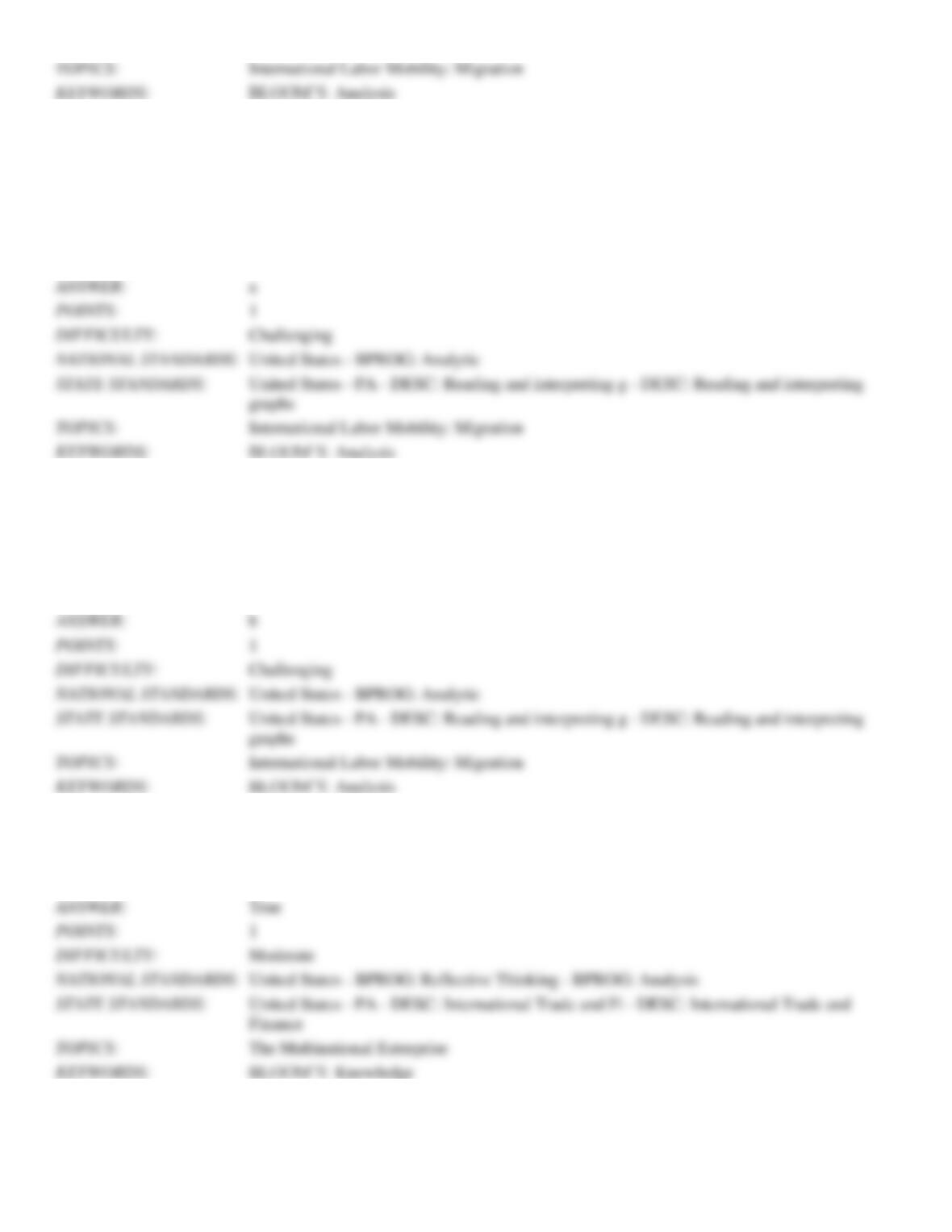
51. Consider Figure 9.3. If Honduran migration to Mexico results in the labor force increasing to 12 workers, denoted by
schedule S1, the:
a.
Wage rate for native Mexican workers decreases and the payments to Mexican capital owners increases
b.
Wage rate for native Mexican workers decreases and the payments to Mexican capital owners decreases
c.
Wage rate for native Mexican workers increases and the payments to Mexican capital owners increases
d.
Wage rate for native Mexican workers increases and the payments to Mexican capital owners decreases
a
Challenging
United States – BPROG: Analytic
graphs
International Labor Mobility: Migration
52. Consider Figure 9.3. Policies that permit Honduran workers to freely migrate to Mexico would likely be resisted by:
a.
Mexican capital owners
b.
Native Mexican workers
c.
Mexican capital owners and native Mexican workers
d.
Neither Mexican capital owners nor native Mexican workers
Challenging
United States – BPROG: Analytic
graphs
International Labor Mobility: Migration
53. International trade in goods and services and flows of productive factors are substitutes for each other.
a.
True
b.
False
True
Moderate
United States – BPROG: Reflective Thinking – BPROG: Analysis
The Multinational Enterprise
54. Most multinational corporations have a low ratio of foreign sales to total sales, usually 5 percent or less.
a.
True
International Labor Mobility: Migration

b.
False
55. Vertical integration occurs if a parent multinational corporation establishes foreign subsidiaries to produce
intermediate goods or inputs that go into the production of a finished good.
a.
True
b.
False
True
Moderate
56. Exxon Oil Co. would undertake forward vertical integration if its retailing division acquired oil wells in the Middle
East.
a.
True
b.
False
False
Moderate
57. Forward vertical integration would occur if a U.S. automobile manufacturer acquired a German subsidiary.
a.
True
b.
False
False
Moderate
Finance
False
Moderate

58. Most vertical foreign investment, as implemented by multinational corporations, is “forward” in nature rather than
“backward.”
a.
True
b.
False
59. Horizontal integration would occur if General Motors sets up a subsidiary in Mexico to produce automobiles identical
to those that it produces in the United States.
a.
True
b.
False
True
Moderate
60. Multinational corporations sometimes locate manufacturing subsidiaries abroad to avoid tariff barriers which would
place their products at a competitive disadvantage in a foreign country.
a.
True
b.
False
True
Moderate
61. Foreign direct investment would occur if Mobile Inc. of the United States acquired sufficient common stock in a
foreign oil company to assume voting control.
a.
True
b.
False
True
Moderate
False
Moderate

62. Foreign direct investment would occur if Microsoft Inc. of the United States purchased securities of the French
government.
a.
True
b.
False
False
Moderate
United States – BPROG: Reflective Thinking – BPROG: Analysis
Motives for Foreign Direct Investment
63. Conglomerate integration would occur if General Motors Inc. of the United States acquired a controlling interest in a
British chemical company.
a.
True
b.
False
True
Moderate
United States – BPROG: Reflective Thinking – BPROG: Analysis
The Multinational Enterprise
64. Both economic theory and empirical studies support the notion that foreign direct investment is conducted in
anticipation of future profits.
a.
True
b.
False
True
Moderate
United States – BPROG: Reflective Thinking – BPROG: Analysis
Motives for Foreign Direct Investment
65. Multinational corporations often locate manufacturing operations abroad in order to take advantage of foreign
resource endowments or wage scales.
United States – BPROG: Reflective Thinking – BPROG: Analysis
Finance
Motives for Foreign Direct Investment
a.
True
b.
False
66. If the size of the Canadian market is large enough to permit efficient production in Canada, a U.S. firm would profit
by establishing a Canadian manufacturing subsidiary or licensing rights to a Canadian firm to manufacture and sell its
product in Canada.
a.
True
b.
False
True
Moderate
67. There is virtually universal agreement among economists that foreign direct investment in the United States has
reduced the economic welfare of the average U.S. citizen.
a.
True
b.
False
False
Moderate
68. Foreign-owned companies in the United States operate under more strict antitrust, environmental, and other
regulations than U.S.-owned companies.
a.
True
b.
False
False
Moderate
True
Moderate

69. During the 1980s and 1990s, Japanese auto firms established manufacturing facilities in the United States known as
“transplants.”
a.
True
b.
False
True
Moderate
70. By establishing transplant factories in the United States, Japanese automakers were able to avoid export restrictions
imposed by the Japanese government, but not import restrictions imposed by the U.S. government.
a.
True
b.
False
False
Moderate
Finance
71. Mergers differ from joint ventures in that they involve the creation of a new business firm, rather than the union of
two existing companies.
a.
True
b.
False
False
Moderate
72. Developing countries, such as Mexico and India, often close their borders to foreign companies unless they are willing
to take on partner companies in developing countries.
a.
True
b.
False
Finance

73. In natural-resource oriented industries, such as oil and copper, joint ventures have often been formed by several
companies since the cost of resource-extraction may be prohibitively large for a particular company.
a.
True
b.
False
True
Moderate
International Joint Ventures
74. International joint ventures tend to yield a welfare increasing market-power effect and a welfare decreasing cost-
reduction effect.
a.
True
b.
False
False
Moderate
Finance
75. A joint venture leads to increases in national welfare if the cost-reduction effect is due to wage concessions and if it
more than offsets the market-power effect.
a.
True
b.
False
False
Moderate
Finance
True
Moderate

76. A joint venture leads to increases in national welfare if its cost-reduction effect is due to productivity gains and if it
more than offsets the market-power effect.
a.
True
b.
False
77. Joint ventures lead to losses in national welfare when the newly established business adds to pre-existing production
capacity and fosters additional competition.
a.
True
b.
False
False
Moderate
78. Joint ventures lead to national welfare gains if the newly established business yields productivity increases that would
have been unavailable if each parent performed the same function separately.
a.
True
b.
False
True
Moderate
79. A joint venture along two large competing companies tends to yield a market-power effect, which results in a
reduction in consumer surplus, that is not offset by a corresponding gain to producers.
a.
True
b.
False
True
Moderate
True
Moderate

80. If a joint venture among competing firms is able to cut costs by extracting wage concessions from domestic workers,
national welfare increases.
a.
True
b.
False
False
Moderate
81. Critics of multinational corporations maintain that they often abandon domestic workers in order to take advantage of
lower wage scales abroad.
a.
True
b.
False
True
Moderate
82. The theory of multinational enterprise is totally inconsistent with the principle of comparative advantage.
a.
True
b.
False
False
Moderate
Finance
83. Due to transfer-pricing problems, multinational corporations must shift profits away from countries with low corporate
tax rates to high tax-rate countries, thus absorbing a larger tax bite.
a.
True
Finance

b.
False
84. The operations of an MNE have little effect on employment in either the host country or the home country.
a.
True
b.
False
False
Moderate
85. In the short run, the home country of an MNE will likely experience an employment decline when production is
shifted overseas.
a.
True
b.
False
True
Moderate
Finance
86. As workers migrate from low-wage Mexico to high-wage United States, wages tend to rise in Mexico and fall in the
United States.
a.
True
b.
False
True
Moderate
Finance
False
Moderate
87. The migration of workers from Mexico to the United States tends to exert downward pressure on the wages of native
U.S. workers that compete against Mexican workers for jobs.
a.
True
b.
False
88. The effect of workers migrating from low-wage Mexico to high-wage United States is to redistribute income from
capital to labor in the United States and from labor to capital in Mexico.
a.
True
b.
False
False
Moderate
89. Developing countries have sometimes feared open immigration policies of developed countries on the grounds that
highly educated and skilled people may emigrate to the developed countries, thus limiting the growth potential of the
developing countries.
a.
True
b.
False
True
Moderate
90. In the United States, labor unions have generally resisted efforts to implement restrictions on the number of foreigners
allowed into the country.
a.
True
b.
False
False
True
Moderate
91. The United States has discouraged the “brain drain” problem by permitting the immigration of unskilled workers while
restricting the immigration of skilled persons.
a.
True
b.
False
False
Moderate
92. Labor migration tends to increase output and decrease wages in the country of immigration while decreasing output
and increasing wages in the country of emigration.
a.
True
b.
False
True
Moderate
93. What are the typical ways in which multinational enterprises have diversified their operations?
Moderate
Finance
94. What are guest workers?
Moderate
95. Are there any differences between the theory of multinational enterprises and conventional trade theory?
96. What are the disadvantages of forming joint ventures?