Chapter 9
52.
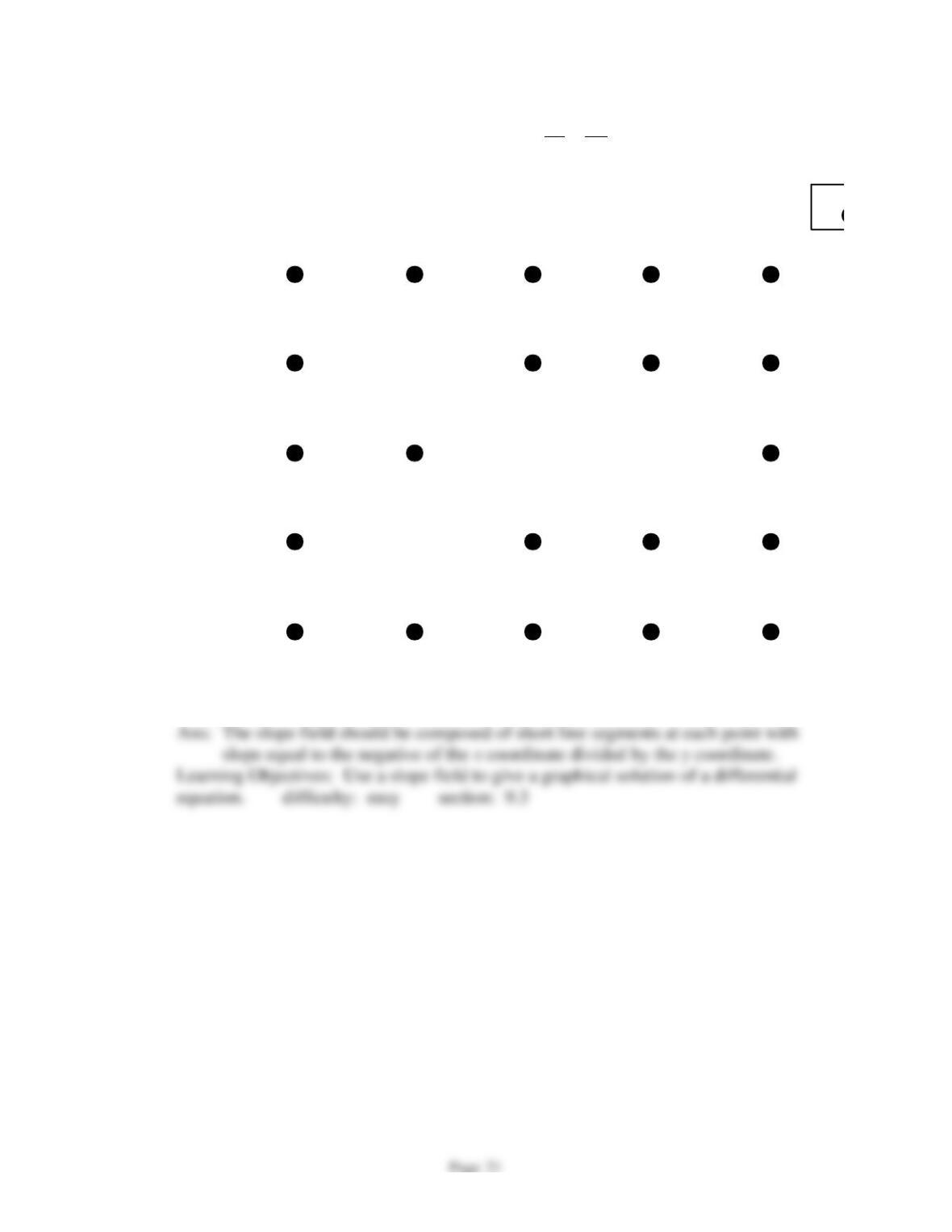
Sketch a slope field for the differential equation
dy x
dx y
−
=
using the points indicated on
the axes.
Seri
Chapter 9
53.
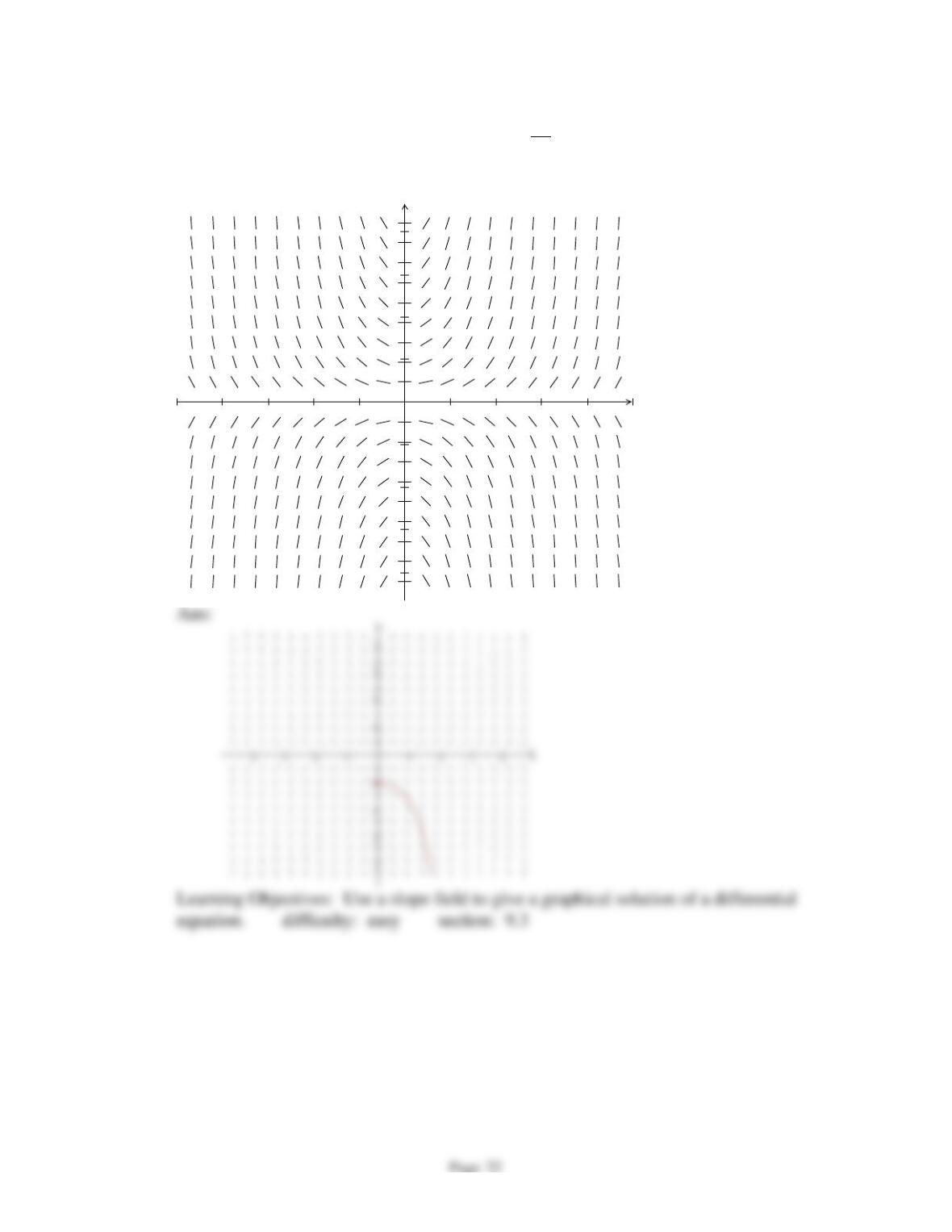
On the slope field for the differential equation
dy xy
dx
=
, sketch the solution curve in the
fourth quadrant that goes through the point (0, -1).
− − − −
−
−
−
−
x
y
Chapter 9
54.
The solution to the differential equation
0
4
dy y
dx
−=
subject to the initial condition
(1) 27y=
is
kx
y Ce=
, where k = _____ and C = _____. Round answers to 2 decimal
places.
Part A:
0.25
Part B:
21.03
Learning Objectives: Solve the differential equation dy/dt = ky difficulty: easy
section: 9.4
55.
The solution to the differential equation
8
dy y
dx
=−
subject to the initial condition that y
= 80 when x = 0 is
kx
y Ce=
, where k = _____ and C = _____.
Part A:
-8
Part B:
80
Learning Objectives: Solve the differential equation dy/dt = ky difficulty: easy
section: 9.4
56.
What is the solution to the differential equation
0.15
dP P
dt
=
, given that P = 5 when t =
0?
Learning Objectives: Solve the differential equation dy/dt = ky difficulty: easy
section: 9.4
57.
A radioactive isotope decays at a continuous rate of approximately 15% per day. If A is
the amount of the isotope and t is time in days, what is the differential equation for this
situation and its general solution?
A)
0.15
dA A
dt
=−
;
0.15t
A Ce−
=
B)
0.85
dA A
dt
=−
;
0.85t
A Ce−
=
C)
0.15
dA A
dt
=
;
0.15t
A Ce=
D)
0.85
dA A
dt
=
;
0.85t
A Ce=
Ans: A Learning Objectives: Use the differential equation dy/dt = ky to model
exponential growth and decay. difficulty: easy section: 9.4
Chapter 9
58.
Money in a bank account grows continuously at an annual rate of 4%. Suppose
$10,000 is put into an account at time t = 0. If B is the balance in the account after t
years, what is the differential equation for B and its solution?
A)
1.04
dB B
dt
=
;
1.04
10,000 t
Be=
B)
0.04
dB B
dt
=
;
0.04
10,000 t
Be=
C)
0.04
dB B
dt
=−
;
0.04
10,000 t
Be
−
=
D)
4
dB B
dt
=
;
4
10,000 t
Be=
59.
An anti-inflammatory drug has a half-life in the human body of about 8 hours.
A. Use the half-life to find the value of k in the differential equation
dQ kQ
dt
=−
,
where Q is the quantity of the drug in the body t hours after the drug is administered.
Round to 4 decimal places.
B. After how many hours will 45% of the original dose remain in the body? Round to
2 decimal places.
Part A:
A. 0.0866
Part B:
B. 9.22
growth and decay. difficulty: medium section: 9.4
60.
The amount of medicine present in the blood of a patient decreases due to metabolism
according to the exponential decay model. One hour after a dose was given, there were
3.7 nanograms/cm3 present, and a hour later there were 2.5 ng/cm3. After how many
hours will there be less than 0.8 ng/cm3 present, assuming no more medication is taken?
Round to 1 decimal place.
Ans:
4.9
growth and decay. difficulty: medium section: 9.4
Chapter 9
61.
For the first week, the spread of a rumor is proportional to the number of people who
have heard the rumor. Find the particular solution to the differential equation for N, the
number of people who have heard the rumor as a function of time in days, t, if 15
people have heard it at time t = 0, and 210 people have heard it at time t = 5.
A)
0.792
15 t
Ne=
B)
0.792
5t
Ne=
C)
0.528
15 t
Ne=
D)
0.528
5t
Ne=
Ans: C Learning Objectives: Use the differential equation dy/dt = ky to model
exponential growth and decay. difficulty: hard section: 9.4
62.
A country experiences a continuous inflation rate of about 5.7% per year. If a t-shirt
had a value of $12 in 1995, write a differential equation and use it to find what the t–
shirt’s value was in 2005. Round to the nearest cent.
Ans:
$21.22
Learning Objectives: Use the differential equation dy/dt = ky to model exponential
growth and decay. difficulty: easy section: 9.4
63.
If no more pollutants are dumped into a lake, the amount of pollution in the lake will
decrease at a rate proportional to the amount of pollution present. If there are 400 units
of pollution present initially and 184 units left after 8 years, use differential equations to
find the number of units left after 13 years. Round to 1 decimal place.
Ans:
113.3
Learning Objectives: Use the differential equation dy/dt = ky to model exponential
growth and decay. difficulty: medium section: 9.4
64.
On January 1, 1879, records show that 500 of a fish called Atlantic striped bass were
introduced into the San Francisco Bay. In 1899, the first year fishing for bass was
allowed, 100,000 of these bass were caught, representing 10% of the population at the
start of 1899. Owing to reproduction, at any moment in time the bass population is
growing at a rate proportional to the population at that moment. Write a differential
equation satisfied by B(t), the number of Atlantic striped bass a time t, where t is in
years since January 1, 1879 and 0 t < 20 and solve it for B(t).
A)
7.6
( ) 500 t
B t e=
B)
0.38
( ) 500 t
B t e=
C)
0.38
( ) 500(1 )
t
B t e=−
D)
7.6
( ) 500(20 )
t
B t e=−
Ans: B Learning Objectives: Use the differential equation dy/dt = ky to model
exponential growth and decay. difficulty: medium section: 9.4
Chapter 9
65.
What is the general solution to the differential equation
dy ky
dt
=
?
A)
kt
y Ce=
B)
/kt
y Ce=
C)
Ct
y ke=
D)
/Ct
y ke=
E)
none of the above
Ans: A Learning Objectives: Solve the differential equation dy/dt = ky
66.
You invest $2,500 in your nephew’s catering business. He guarantees you a minimum
return at a continuous interest rate of 4%. Of course, if the business continues to thrive,
you will earn at a higher rate.
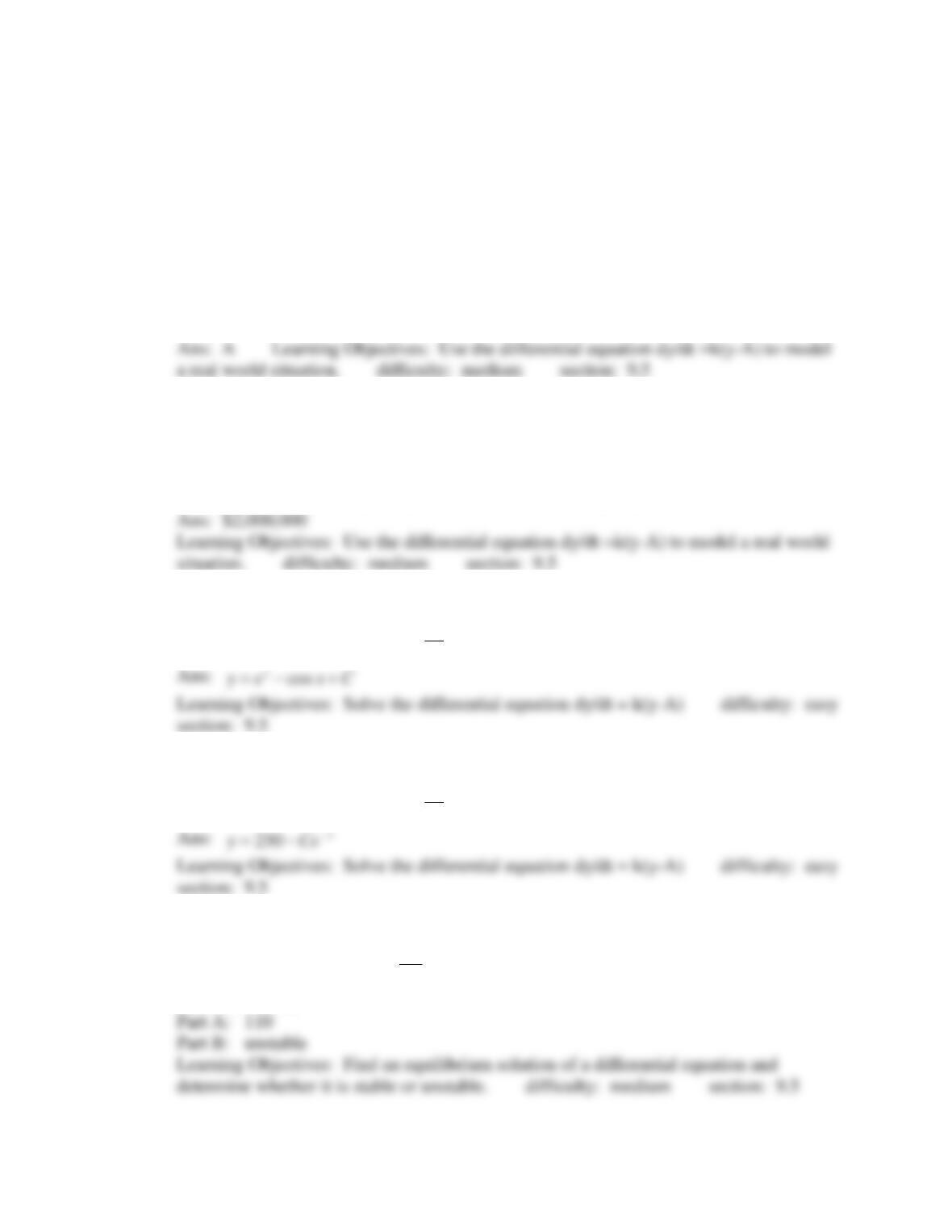
a) Write a differential equation for the minimum amount, B, of your return on
investment at time t.
b) Solve the differential equation.
c) Graph the solution.
dt
b)
0.04
2,500 t
Be=
c)
Initial investment
t years
B dollars
Learning Objectives: Use the differential equation dy/dt = ky to model exponential
growth and decay. difficulty: hard section: 9.4
Chapter 9
Page 27
67.
A certain bank account earns interest at the rate of 5% compounded continuously.
Money is being withdrawn from the account in a continuous stream at a constant rate of
$100,000 per year. Write a differential equation modeling how the balance B changes
over time. Which of the following is the general solution, given an initial balance of
B0?
A)
0.05
0
( 2,000,000) 2,000,000
t
B B e= − +
B)
0.05
0
( 100,000) 100,000
t
B B e= − +
C)
0.05
02,000, 000
t
B B e=+
D)
0.05
0100,000
t
B B e
=+
68.
A certain bank account earns interest at the rate of 5% compounded continuously.
Money is being withdrawn from the account in a continuous stream at a constant rate of
$100,000 per year. Use differential equations to determine what the minimum initial
balance should be in order for the account never to be depleted.
Ans:
$2,000,000
Learning Objectives: Use the differential equation dy/dt =k(y-A) to model a real world
situation. difficulty: medium section: 9.5
69.
What is the general solution of
sin x
dy xe
dx
=+
?
Learning Objectives: Solve the differential equation dy/dt = k(y-A) difficulty: easy
section: 9.5
70.
What is the general solution of
250
dy y
dx
=−
?
Learning Objectives: Solve the differential equation dy/dt = k(y-A) difficulty: easy
section: 9.5
71.
The equilibrium solution for
0.5 55
dP P
dt
=−
is P = _____. This solution is ________
(stable/unstable).
Part A:
110
Part B:
unstable
determine whether it is stable or unstable. difficulty: medium section: 9.5
Ans: A Learning Objectives: Use the differential equation dy/dt =k(y-A) to model
a real world situation. difficulty: medium section: 9.5
Chapter 9
72.
The equilibrium solution for
0.8 174
dP P
dt
= − +
is P = _____. This solution is
________ (stable/unstable).
Part A:
217.5
Part B:
stable
Learning Objectives: Find an equilibrium solution of a differential equation and
determine whether it is stable or unstable. difficulty: medium section: 9.5
73.
A person receives a drug intravenously at the rate of 3 mg per hour. The drug is
eliminated from the body at a rate proportional to the amount present with a constant of
proportionality of k = -0.4. What is the long term amount of the drug in the body, once
the system has stabilized?
Ans:
7.5
Learning Objectives: Use the differential equation dy/dt =k(y-A) to model a real world
situation. difficulty: easy section: 9.5
74.
A company earns a continuous annual rate of 11% of its net worth. At the same time, it
has expenses of 6.4 million dollars per year. Write a differential equation for the
company’s worth, W, in millions of dollars as a function of time t, in years. What is the
general solution to your differential equation?
A)
0.11
6.4 t
W Ce=+
B)
0.11
58.2 t
W Ce=+
C)
0.11
64 t
W Ce=+
D)
0.11
70.4 t
W Ce=+
Ans: B Learning Objectives: Use the differential equation dy/dt =k(y-A) to model
a real world situation. difficulty: medium section: 9.5
75.
A company earns a continuous annual rate of 11% of its net worth. At the same time, it
has expenses of 6.2 million dollars per year. If the company’s net worth at time t = 0 is
50 million, how many years will it take to go bankrupt? Round to the nearest year.
Ans:
20
situation. difficulty: medium section: 9.5
Chapter 9
76.
According to Newton, the rate at which the temperature of water in a swimming pool
changes is directly proportional to the difference between the temperature L outside and
the temperature T of the water in the pool. Suppose the temperature outside stays at a
constant 28 C for two hours, and that during that time the temperature of the water
increases from 20 C to 24 C. Which of the following shows the differential
equation for this situation and its solution?
A)
/ ( )dT dt k T L=−
;
0.55
( ) 28 8
t
T t e
−
=−
B)
/ ( )dT dt k L T=−
;
0.35
( ) 28 8
t
T t e
−
=−
C)
/ ( )dT dt k T L=−
;
0.35
( ) 28 4 t
T t e−
=−
D)
/ ( )dT dt k L T=−
;
0.55
( ) 28 4 t
T t e−
=−
77.
According to Newton, the rate at which the temperature of water in a swimming pool
changes is directly proportional to the difference between the temperature L outside and
the temperature T of the water in the pool. Suppose the temperature outside stays at a
constant 28 C for two hours, and that during that time the temperature of the water
increases from 20 C to 24 C. What is the equilibrium solution to the equation
modeling this situation?
Ans:
The equilibrium temperature is T = 28.
78.
A lake with constant volume V, in km3, contains a quantity of Q km3 pollutant. Clean
water enters the lake and causes a total outflow of r km3 per year. The rate at which the
pollutant decreases at any time t equals the product of the pollutant Q per volume V and
the rate at which the water flows out of the lake. If
3
12 10V=
km3 and
75r=
km3
per year, how many years will it take for the pollutant to decrease to half of its original
quantity? Round to the nearest whole year.
Ans:
111
situation. difficulty: medium section: 9.5
Chapter 9
79.
What is the solution of the differential equation
24
d
dt
=−
if
7
=
when
2t=
?
A)
2
( ) 7 2
t
te
=+
B)
2
( ) 7 4
t
te
=+
C)
2
4
5
( ) 2
t
te
e
=+
D)
2
4
7
( ) 4
t
te
e
=+
80.
The logistic model for a population’s growth is
2
12 6
dP PP
dt
=−
, where P is the size of
the population in millions at any time t, measured in years. What is the size of the
population when the rate of increase starts to decrease?
81.
Newton’s Law of Cooling states that the rate of change of temperature of an object is
proportional to the difference between the temperature of the object and the temperature
of the surrounding air. A detective discovers a corpse in an abandoned building, and
finds its temperature to be 24°C. An hour later its temperature is 16°C. Assume that the
air temperature is 8°C, that normal body temperature is 37°C, and that Newton’s Law of
Cooling applies to the corpse. How many hours has the corpse been dead at the
moment it is discovered? Round to 2 decimal places.
Chapter 9
82.
On January 1, 1879, records show that 500 of a fish called Atlantic striped bass were
introduced into the San Francisco Bay. In 1899, the first year fishing for bass was
allowed, 100,000 of these bass were caught, representing 10% of the population at the
start of 1899. Owing to reproduction, at any moment in time the bass population is
growing at a rate proportional to the population at that moment. Assume that when
fishing starts in 1899, the rate at which bass are caught is proportional to the square of
the population with constant of proportionality
9
10
−
. Write a differential equation
satisfied by B(t), for t > 20.
A)
92
7.6 10
dB BB
dt
−
=−
B)
9
2
10
7.6
dB B
dt B
−
=−
C)
92
0.38 10
dB BB
dt
−
=−
D)
9
2
10
0.38
dB B
dt B
−
=−
a real world situation. difficulty: medium section: 9.5
83.
On January 1, 1879, records show that 500 of a fish called Atlantic striped bass were
introduced into the San Francisco Bay. In 1899, the first year fishing for bass was
allowed, 100,000 of these bass were caught, representing 10% of the population at the
start of 1899. Owing to reproduction, at any time the bass population is growing at a rate
proportional to the population at that moment. Assume that when fishing starts in
1899, the rate at which bass are caught is proportional to the square of the population
with constant of proportionality
9
10
−
. What happens to the bass population in the long
run?
A)
It approaches 0.
B)
It grows without bound.
C)
It approaches
8
7.6 10
.
D)
It approaches
8
3.8 10
.
a real world situation. difficulty: medium section: 9.5
Chapter 9
84.
A manufacturer of a chocolate beverage mixes liquid chocolate with milk in a large vat
containing 450 liters of the mixture that is 20% chocolate initially. The differential
equation for A, the amount of chocolate in the vat at time t, follows a “rate in – rate out”
model. When chocolate flows in at a rate of 2 liters/min and the mixed beverage flows
out at the same rate, you can model the situation with the differential equation
2225
dA A
dt
=−
liters/min which can be rewritten as
1( 450)
225
dA A
dt
−
=−
.
a) What is the particular solution to this differential equation?
b) In the long run, how many liters of chocolate will be in the mixture contained in the
vat?
b) 450 liters
85.
In a study of the milk drinking habits of a certain population of children, it was found
that children drank more and more slowly as they finished a 16 ounce container of milk.
Suppose that the rate at which a child drinks is equal to the percentage left to drink, i.e.
100
dA A
dt
=−
. Find the particular solution given the initial condition A(0) = 0.
A)
100 100 t
Ae
−
=−
B)
100 t
A Ce=−
C)
100 100
t
Ae
−
=−
D)
100
t
A Ce=−
Chapter 9
86.
Two species of insects coexist with each other. Both would do fine on their own.
Species x does not do well in the presence of species y. Species y does not do well in
the presence of species x. Which of the following systems of equations would best
model this scenario?
A)
–
dx y xy
dt
=
–
dy x xy
dt
=
B)
+
dx y xy
dt
=
+
dy x xy
dt
=
C)
–
dx x xy
dt
=
–
dy y xy
dt
=
D)
+
dx x xy
dt
=
+
dy y xy
dt
=
Ans: C Learning Objectives: Interpret or write differential equations that model
various types of species interactions. difficulty: easy section: 9.6
87.
Two movie theaters are across the street from each other. Each is doing well, but each
would do better if the other were not there. Call the net worth of one theater x and the
net worth of the other theater y. Which system of differential equations best models
this scenario?
A)
dx y xy
dt
=+
dy x xy
dt
=+
B)
dx y xy
dt
=−
dy x xy
dt
=−
C)
dx x xy
dt
=+
dy y xy
dt
=+
D)
dx x xy
dt
=−
dy y xy
dt
=−
Ans: D Learning Objectives: Interpret or write differential equations that model
various types of species interactions. difficulty: medium section: 9.6
Chapter 9
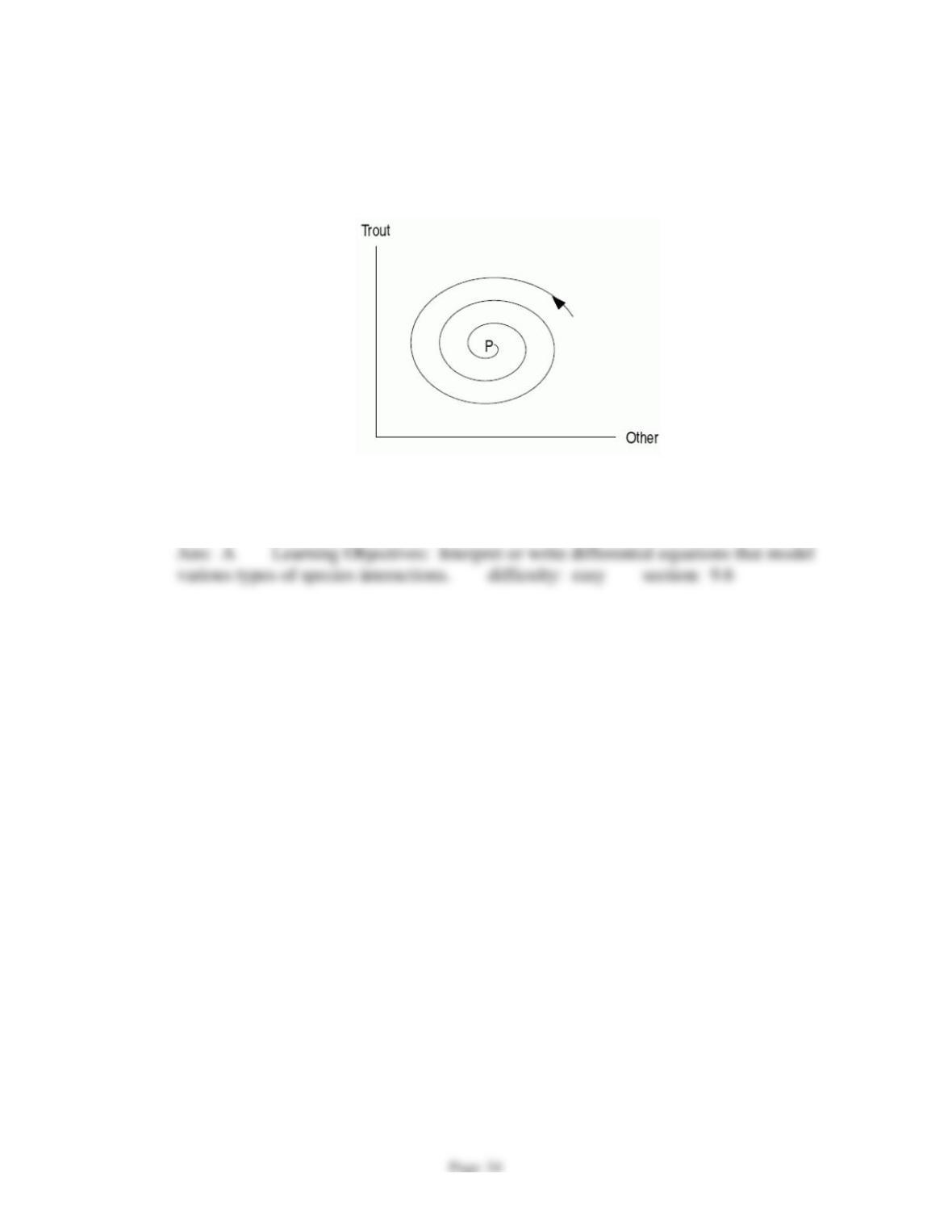
88.
Trout are introduced into a stream. Trout is a predator species and therefore has an
influence on the population size of other fish. The following figure shows how the
trout and other fish populations vary over time. The progress of time is shown by the
direction of the arrow. What happens to the size of the trout population at point P?
A)
It will be stable.
B)
It will be at a maximum.
C)
It will be at a minimum.
D)
Nothing can be determined.
various types of species interactions. difficulty: easy section: 9.6